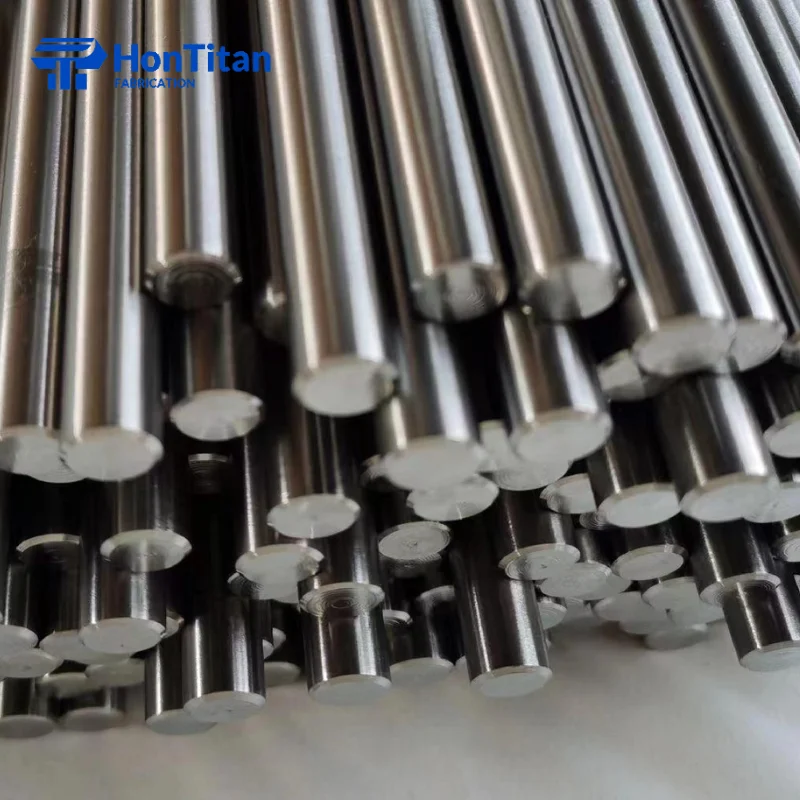
Le titane est utilisé dans l'architecture emblématique depuis les années 1990, avec comme exemple le plus célèbre le musée Guggenheim de Bilbao, où 33 000 panneaux d'une épaisseur de seulement 0,38 mm recouvrent 25 221 m² de surfaces incurvées. Après près de 30 ans, le revêtement en titane de Bilbao ne présente aucun signe de corrosion — le test en conditions réelles le plus probant qu'un matériau de façade puisse revendiquer. Cet article traite des spécifications vérifiées, du choix des nuances, des options de finition de surface, des systèmes d'installation, de la réalité des coûts, ainsi que de l'idée reçue persistante concernant un célèbre bâtiment de Frank Gehry qui n'est, en réalité, pas revêtu de titane.
Pourquoi les architectes continuent de prescrire le titane
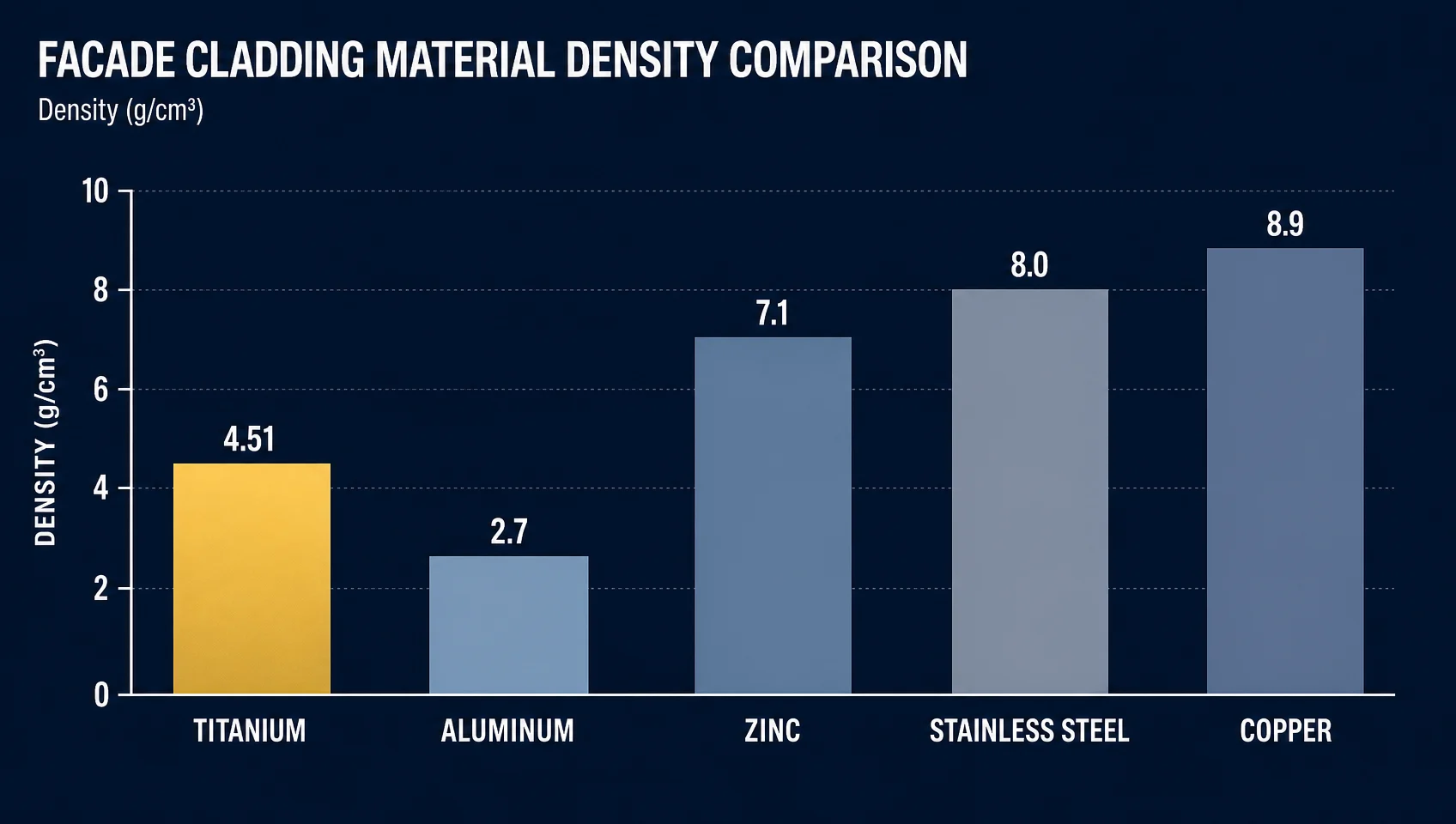
La densité du titane est de 4,51 g/cm³, soit environ 60 % de celle de l'acier et 50 % de celle du cuivre, mais 1,7 fois plus dense que l'aluminium. Avec les faibles épaisseurs utilisées pour les façades (0,4 à 1,0 mm), cela correspond à un poids de panneau d'environ 1,8 à 4,5 kg/m², ce qui s'inscrit parfaitement dans les limites de charge des systèmes d'ossature de murs-rideaux standards.
L'argument le plus convaincant est la corrosion. Le titane forme un film d'oxyde de dioxyde de titane (TiO₂) stable et auto-régénérant lorsqu'il est exposé à l'air ou à l'humidité. Ce film se reforme spontanément en cas de rayure. Il est performant dans les environnements marins, les zones industrielles contenant des composés soufrés et face à la pollution urbaine — le tout sans aucun revêtement appliqué. Contrairement à l'acier inoxydable, qui nécessite une sélection rigoureuse de l'alliage pour éviter les piqûres de corrosion dans les environnements côtiers riches en chlorures, le titane commercialement pur (Grade 1 ou Grade 2) est pratiquement immunisé contre toutes les classes d'exposition extérieure typiques.
Son coefficient de dilatation thermique est de 8,6 µm/m·°C — soit la moitié de celui de l'acier inoxydable (17,3) et le tiers de celui de l'aluminium (23,6). Concrètement, cela signifie moins de joints de dilatation dans un grand réseau de panneaux de murs-rideaux, et moins de points où le mastic, les clips ou les fixations de la sous-structure peuvent subir de la fatigue au cours d'une durée de vie de plusieurs décennies.
Le Guggenheim Bilbao : Spécifications vérifiées, pas de simples promesses marketing
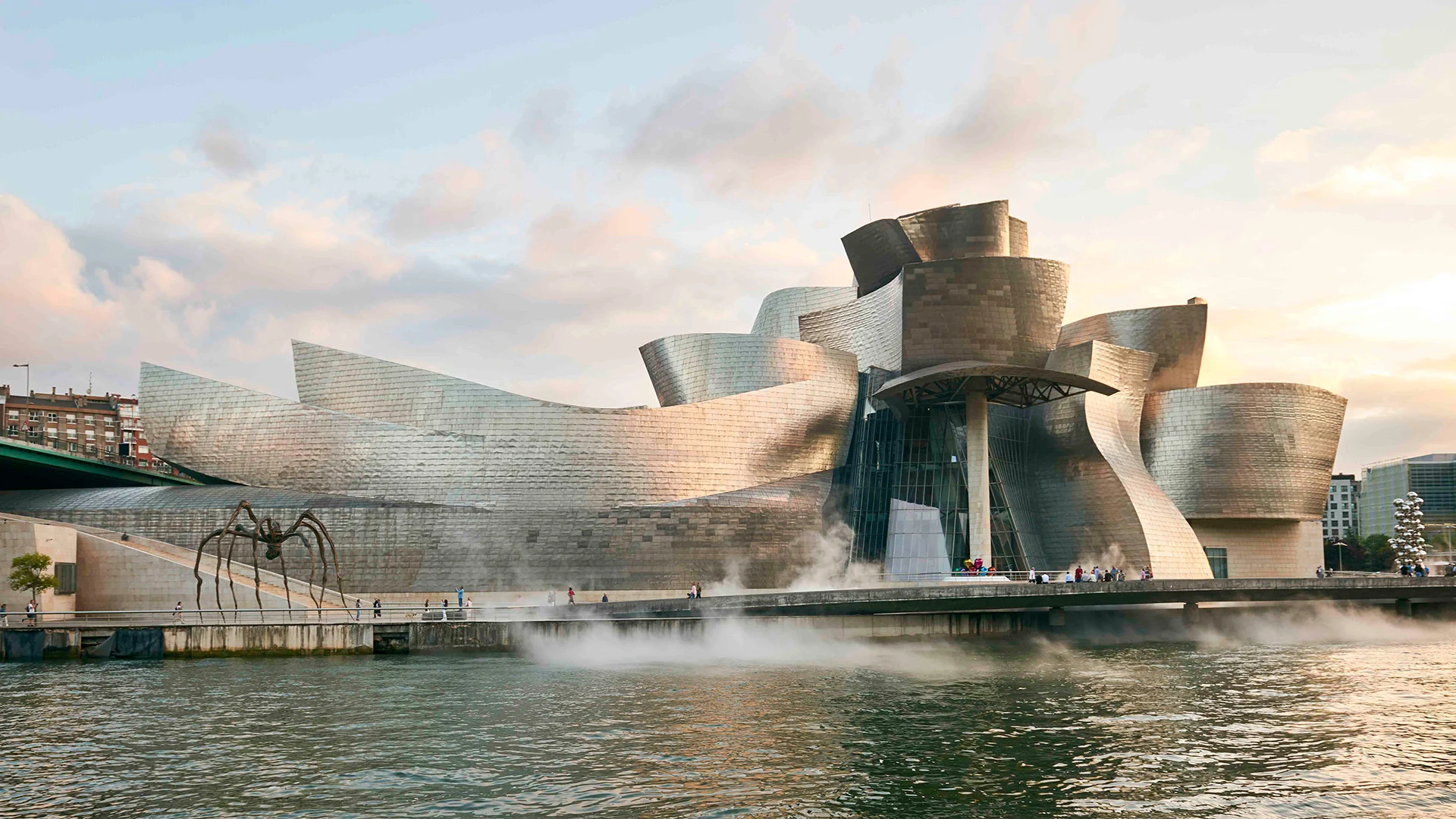
Le Musée Guggenheim Bilbao — conçu par Frank Gehry et achevé en octobre 1997 — demeure la référence absolue pour l'utilisation du titane en architecture. Voici les données techniques confirmées :
| Spécifications | Valeur |
|---|---|
| Nombre de panneaux | ~33 000 panneaux |
| Épaisseur des panneaux | 0,38 mm |
| Dimensions des panneaux | ~60 × 30 cm |
| Surface du revêtement en titane | 25 221 m² |
| Également utilisés | Pierre (34 343 m²) et verre (6 136 m²) |
| Grade du titane | Grade 1 (pureté commerciale, formabilité maximale) |
| Fixation | Système traditionnel à joints debout |
Sources : évaluation du bardage sur academia.edu ; documentation officielle de construction du Musée Guggenheim de Bilbao.
Le cahier des charges initial prévoyait de l'acier inoxydable. Gehry a changé de matériau après avoir observé comment un échantillon de titane changeait de couleur selon la lumière — un miroitement iridescent chaleureux que l'acier inoxydable ne pouvait égaler. Cette décision était esthétique avant d'être technique, ce qu'il convient de garder à l'esprit lors de l'évaluation de l'usage architectural du titane : il a d'abord été choisi pour son aspect visuel, sa réputation de durabilité venant au second plan.
La preuve par les 30 ans : En 2026, la façade en titane de Bilbao sera en service depuis près de 30 ans. La documentation technique de Nippon Steel sur le projet n'indique aucun signe de corrosion — aucune piqûre, aucune corrosion caverneuse, aucune dégradation de surface dans cet environnement côtier atlantique. Pour les prescripteurs, il s'agit d'une preuve bien plus fiable que n'importe quelle garantie constructeur.
Un bâtiment sur lequel tout le monde se trompe
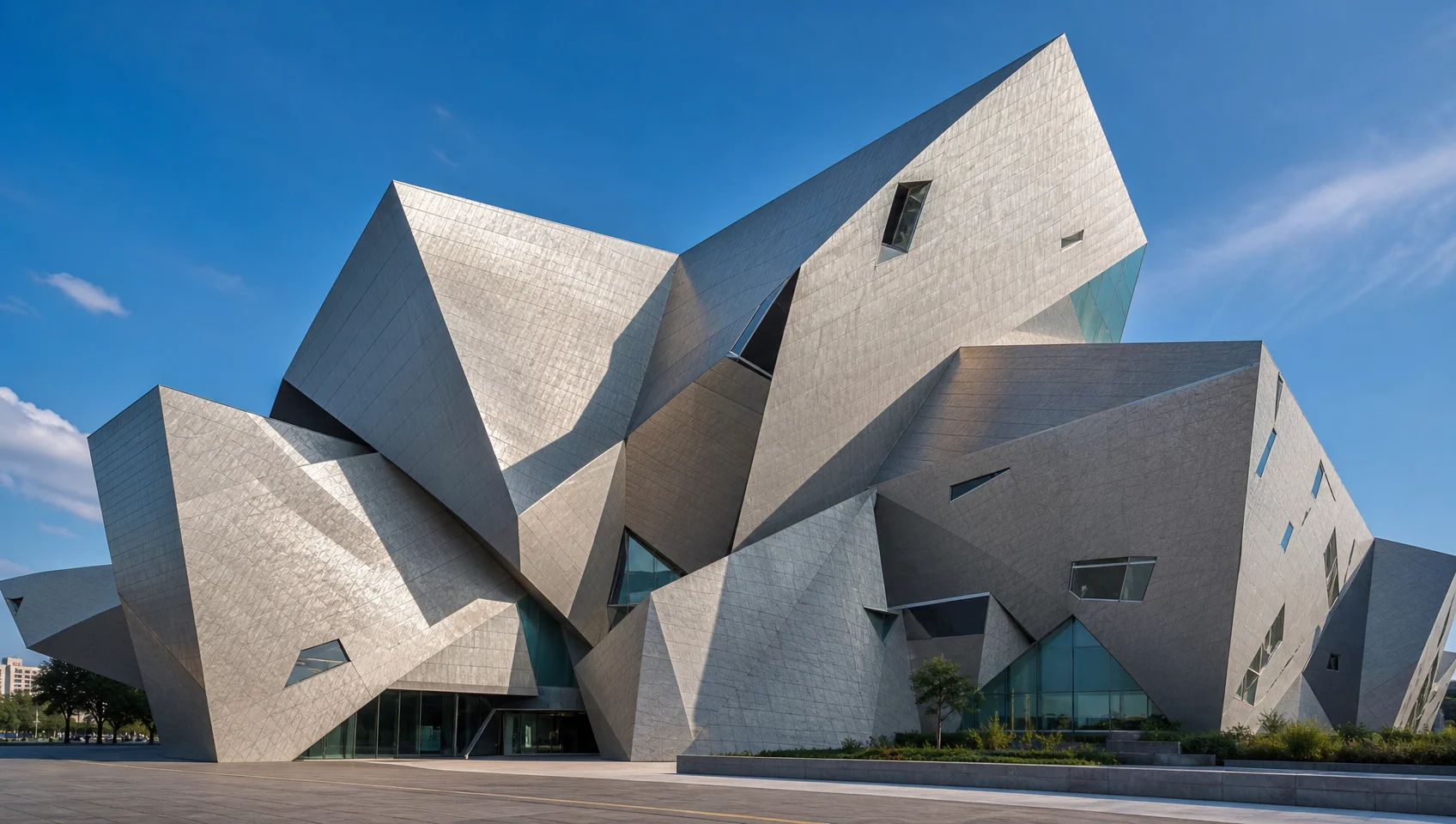
Le Walt Disney Concert Hall de Los Angeles, également conçu par Frank Gehry (ouvert en 2003), est souvent cité comme étant revêtu de titane. Ce n'est pas le cas. Le Walt Disney Concert Hall est revêtu d'acier inoxydable. Le reportage de NPR de 2003 sur l'inauguration du bâtiment marquait explicitement la distinction : “ Le musée de Bilbao est revêtu de titane — le Disney Hall est revêtu d'acier inoxydable. ”
La confusion est compréhensible — même architecte, mêmes courbes sculpturales, même éclat métallique. Mais le choix des matériaux et leur comportement diffèrent.
Bâtiments dont l'utilisation du titane est confirmée :
- Musée Guggenheim de Bilbao (1997, Gehry) — 33 000 panneaux, 25 221 m²
- Denver Art Museum — Frederic C. Hamilton Building (2006, Libeskind) — 9 000 panneaux de titane recouvrant l'intégralité de la surface du bâtiment
- Centre national des arts du spectacle, Pékin (2007, Andreu) — dôme ellipsoïde en titane et verre
- Japon : première toiture architecturale en titane installée en 1973 ; travaux de restauration de temples utilisant le titane à partir des années 1980
Grade 1 vs Grade 2 : ce que les prescripteurs commandent réellement
Le Grade 1 (UNS R50250) et le Grade 2 (UNS R50400) sont tous deux des titanes commercialement purs couverts par la norme ASTM B265 (bandes, feuilles et plaques). La différence est d'ordre pratique plutôt que spectaculaire :
Première année — ductilité maximale, plus facile à façonner pour des courbes complexes. Résistance minimale à la traction (UTS) d'environ 240 MPa. Il s'agit du grade spécifié pour le musée Guggenheim de Bilbao et c'est le grade le plus couramment utilisé pour les panneaux architecturaux, en particulier lorsque la géométrie exige une courbure composée ou un formage profond.
Niveau 2 — slightly higher strength (minimum UTS 345 MPa / 50 ksi per ASTM B265), marginally less formable. Used for simpler panel geometries where the additional strength allows the same panel to carry higher wind loads at reduced thickness, or where the project calls for structural integration beyond pure cladding.
Corrosion performance between the two grades is equivalent in all standard architectural exposure environments. The choice comes down to panel geometry and the forming operations required to achieve it.
Panel Thickness, Surface Finishes, and How Titanium Attaches to a Building
Épaisseur : Architectural facade panels typically run from 0.4 mm to 1.0 mm. The Guggenheim used 0.38 mm — at the thin end of what is practical, enabled by the locked seam system that provides mechanical stiffness. For flat or lightly curved panels, 0.5–0.8 mm is more common. Sheet widths reach up to 1,219 mm (48 inches) in standard supply condition.
Finitions de surface : Titanium’s natural supply condition after mill annealing and acid pickling is a matte silver-grey. From there:
- Anodized finishes grow a transparent TiO₂ interference film via voltage-controlled electrolytic oxidation. Gold appears at approximately 10 V; violet, blue, orange, red, and green emerge at progressively higher voltages. The color results from light interference, not pigment — meaning it will shift slightly with viewing angle and lighting conditions. This is the characteristic that attracted Gehry.
- Textured finishes — etching, abrasive blasting, embossing — are available but deep embossing is limited by the material’s stiffness.
- Titanium-coated stainless steel is a lower-cost alternative: a thin titanium film deposited via physical vapor deposition onto stainless substrate. Available in black, bronze, gold, rose gold, and grey. The corrosion and thermal performance reverts to that of the stainless substrate.
Installation systems: Three systems dominate for titanium facades:
- Rainscreen cavity system — titanium panels attached to a ventilated sub-frame with a cavity behind. The cavity manages condensation and moisture drainage. Most common for complex building geometries. Works with hidden or exposed fixings.
- Standing seam — interlocking panels with raised seam joints, the system used at Guggenheim Bilbao. Good for curved roofline transitions. Water-shedding by geometry rather than sealant.
- Concealed fix / cassette panel — flat or lightly profiled panels clipped into a frame from behind with no visible fasteners. Suits regular grid facades with a clean visual finish.
Mixing systems on a single project is common when the envelope transitions between roof, wall, and curved transition zones.
The Cost Conversation No One Is Having
Raw titanium sheet costs approximately $9–$13 per pound in the US market. That makes the material roughly 3–5× more expensive per pound than aluminum sheet, and significantly more than zinc or corten steel at comparable thicknesses.
No publicly verified installed cost per m² for titanium facade systems exists in the architectural cost benchmarking data I could find. Project-specific quotes are standard, and the fabrication complexity (particularly for curved panels) dominates the total cost more than the raw material alone. Anyone quoting a flat installed $/m² without knowing the panel geometry and forming requirements is estimating.
The conversation that actually matters for titanium’s cost position is lifecycle framing. Standard aluminum composite panel cladding systems typically carry 20–30 year performance warranties. Titanium’s real-world track record runs toward 100 years — Bilbao’s 30 years with zero degradation supports this, and the self-healing oxide film means there is no coating or treatment cycle to budget for. For clients with a long asset hold or listed building ambitions, the total cost of ownership calculation looks meaningfully different than a day-one comparison.
Sustainability Claims With and Without Numbers
Titanium is 100% recyclable, and because titanium scrap retains high value, in-process manufacturing recovery rates approach 100%. The circularity case is real.
The more nuanced number comes from a 2023 life cycle assessment by IperionX (admittedly a manufacturer-commissioned LCA, so treat with appropriate weight): titanium produced from 100% recycled feedstock carries a carbon footprint more than 90% lower than conventional plasma-atomized titanium and approximately 80% lower than Kroll-process primary titanium. The production energy cost of virgin titanium is significant — the Kroll process is energy-intensive. Recycled titanium closes that gap substantially.
The EU Joint Research Centre classifies titanium as a critical raw material with high circularity potential, noting that current end-of-life recycling rates from building streams remain low. For a project seeking verified sustainability credentials, specifying recycled-content titanium sheet from a documented supply chain is the approach that converts the recyclability claim into a measurable outcome.
Questions fréquemment posées
Pourquoi Frank Gehry a-t-il choisi le titane pour le Guggenheim Bilbao ?
The original specification was stainless steel. Gehry changed the material after observing how a titanium sample shifted in color under changing light — a warm, iridescent response that stainless steel could not replicate. The decision was aesthetic; the durability and corrosion performance were technical benefits that followed.
La salle de concert Walt Disney est-elle faite de titane ?
No. The Walt Disney Concert Hall in Los Angeles, though also designed by Gehry, is clad in stainless steel. The two buildings are frequently confused due to their similar visual language. The Guggenheim Bilbao is the Gehry titanium project.
How thick are titanium facade panels?
Standard architectural panels run 0.4–1.0 mm. The Guggenheim Bilbao used 0.38 mm panels in a locked seam system that provides stiffness through geometry rather than sheet thickness. For flat or simply curved panels, 0.5–0.8 mm is more typical.
What grade of titanium is used in architecture?
Grade 1 (commercially pure, ASTM B265) is most commonly specified for architectural facades because of its superior formability — necessary for complex curved panel geometries. Grade 2 is used where higher yield strength is required and the panel geometry is simpler. Both perform equivalently in terms of corrosion resistance.
How long does a titanium facade last?
Standard Titanium Co. and similar manufacturers cite 100 years. The best real-world evidence is the Guggenheim Bilbao, which has been in service for nearly 30 years in an Atlantic coastal environment with zero reported corrosion incidents. An independent verified standard equivalent to, say, an ISO-rated warranty does not exist — but 30 years with no degradation in a marine environment is a meaningful data point.
Thirty Years of No Corrosion Is the Real Spec Sheet
Titanium’s architectural case rests on one building more than any other. The Guggenheim Bilbao has been rained on, salted by Atlantic air, and exposed to a full cycle of European seasons for nearly three decades. Its 33,000 panels, each a third of a millimeter thick, show no corrosion. That is not a manufacturer’s claim — it is a confirmed outcome in an architect’s peer-reviewed evaluation.
For specifiers evaluating high-performance facade materials for landmark, coastal, or long-hold assets, the technical profile is strong: low weight, self-repairing corrosion protection, low thermal expansion, and a surface finish range that includes both the natural matte grey of an industrial building and the iridescent anodized colors of a cultural institution. The upfront cost is real. The lifecycle case is equally real, and in 2026, it is increasingly the one that drives the decision.