
Introduction: Engineering Properties and Manufacturing Challenges
Titanium is widely recognised in engineering for its superior material properties. It possesses the strength of steel while being approximately 45% lighter. Additionally, it offers exceptional corrosion resistance and biocompatibility.
However, titanium presents significant challenges in traditional manufacturing. It is difficult to machine due to its hardness and low thermal conductivity.
Traditional CNC machining of titanium can be slow and cause rapid tool wear. Furthermore, subtractive manufacturing results in material waste. In the aerospace industry, a high “buy-to-fly” ratio (the ratio of raw material weight to the finished part weight) means that a significant portion of the raw material is removed and becomes scrap.
Titanium 3D printing, specifically metal additive manufacturing, offers an alternative solution.
This technology has evolved from prototyping to a viable industrial production method. This guide provides a technical overview of DMLS/SLM (Direct Metal Laser Sintering/Selective Laser Melting) processes, the cost structure, and applications in aerospace and medical sectors.
The Manufacturing Process (DMLS/SLM)
The industry standard for printing titanium is Direct Metal Laser Sintering (DMLS) or Selective Laser Melting (SLM). Unlike traditional “subtractive” manufacturing, which removes material from a block, this is an “additive” process that builds parts layer by layer using high-powered lasers and metal powder.
1. Raw Material: Titanium Powder
The process utilises specific titanium alloys, typically Ti-6Al-4V (Grade 5) or Grade 23 (Ti-6Al-4V ELI) for medical applications. The material consists of gas-atomised, spherical powder, with a particle size typically between 15 and 45 microns. This particle consistency is essential for achieving high density (99.5%+) and surface resolution.
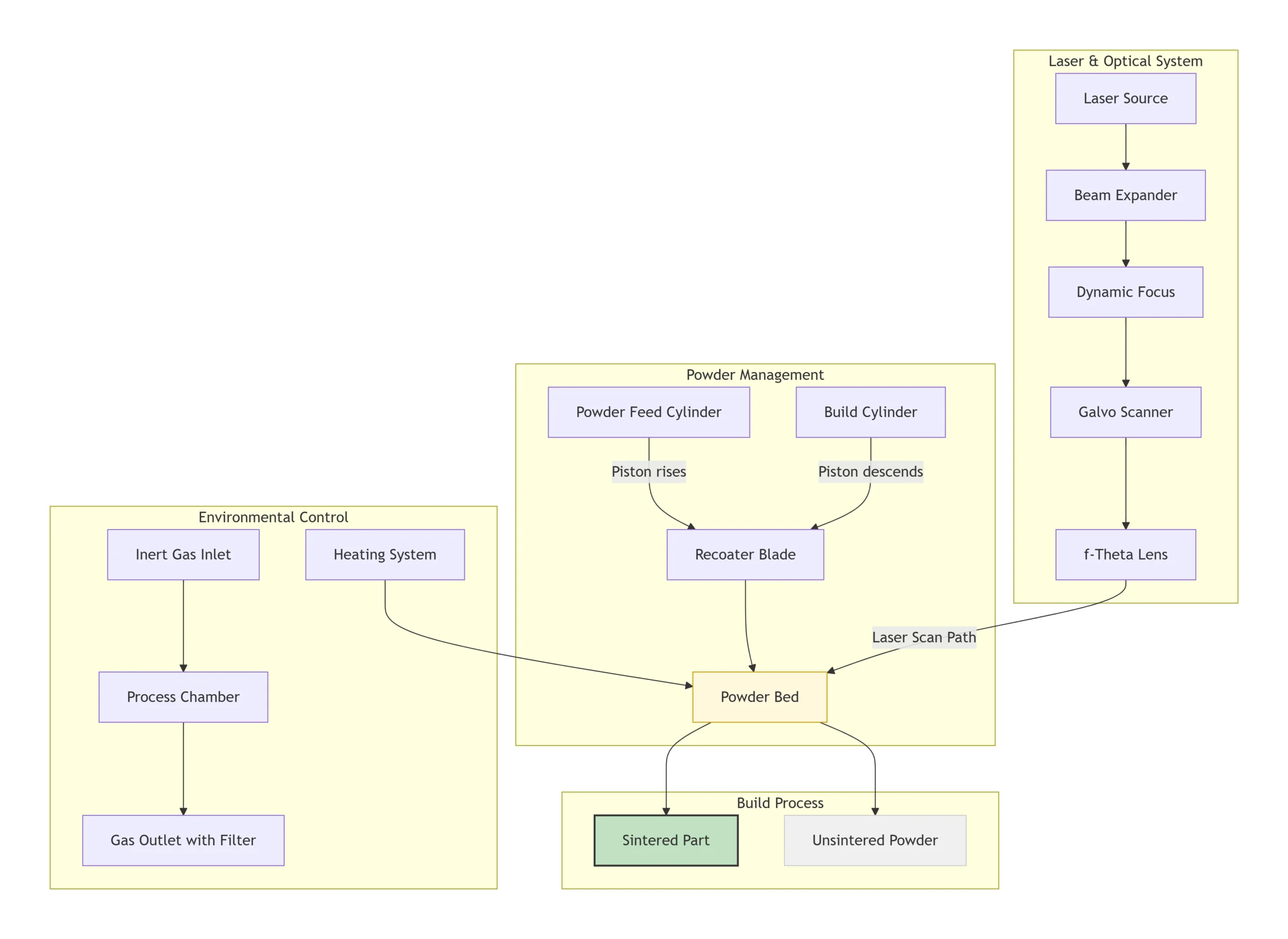
2. Process Environment: Argon Atmosphere
Safety and Quality Control: Titanium powder is reactive. To ensure safety and part quality, the printing process occurs inside a sealed chamber filled with argon gas.
The oxygen level is maintained strictly below 0.1% (1000 ppm) (often below 500 ppm for critical parts). This inert atmosphere serves two purposes:
- Safety: It prevents the reactive titanium powder from igniting.
- Quality: It safeguards the material properties of the final part by preventing oxidation during the melting process.
3. The Printing Cycle
Once the environment is prepared, the machine operates in a continuous cycle:
- Recoating: A blade spreads a thin layer of titanium powder (usually 30-60 microns) across the build plate.
- Melting: High-power fibre lasers scan the cross-section of the design, heating the powder to over 1,600°C and fusing it into solid metal.
- Lowering: The build platform lowers by one layer’s thickness.
- Repeat: This process repeats until the part is fully formed within the powder bed.
Mechanical Properties Data Sheet
One of the most common misconceptions is that printed titanium is weaker than forged titanium. The data proves otherwise. When properly processed (especially after Heat Treatment/HIP), DMLS titanium meets or exceeds the standards for wrought material.
Comparative Mechanical Properties (Ti-6Al-4V)
| Property | Unit | DMLS (As Printed) | DMLS (HIP + Heat Treated) | Forged Standard (ASTM F1472) |
|---|---|---|---|---|
| Tensile Strength (UTS) | MPa | 1150 ± 50 | 1050 ± 50 | Min. 930 |
| Yield Strength (0.2%) | MPa | 1050 ± 50 | 920 ± 50 | Min. 860 |
| Elongation at Break | % | 8 – 10% | 12 – 15% | Min. 10% |
| Hardness | HRC | 32 – 35 | 30 – 33 | 30 – 34 |
| Density | g/cm³ | >99.5% | >99.9% | 100% |
Data Source Reference: EOS Material Data Sheets & ASTM F2924/F3001 Standards.
Key Engineering Insight:
- As-Printed: Extremely strong but less ductile due to rapid cooling rates (martensitic microstructure).
- HIP (Hot Isostatic Pressing): Essential for critical applications. It reduces yield strength slightly but significantly restores ductility (elongation) and fatigue life, making it comparable to forged material.
Advantages: Design Flexibility
3D printing offers distinct geometric advantages over traditional CNC machining. It removes many constraints associated with tool access, thereby enabling complex geometries.
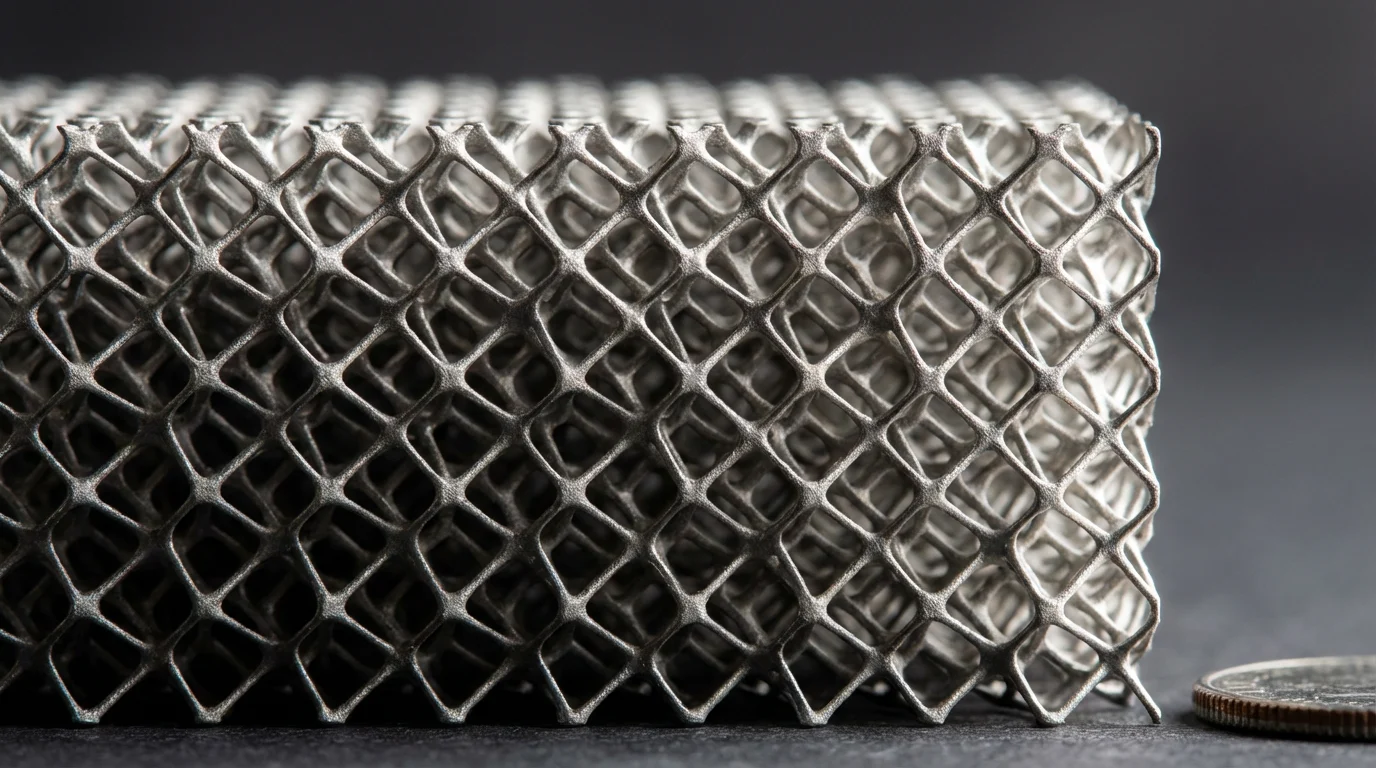
1. Lattice Structures (Lightweighting)
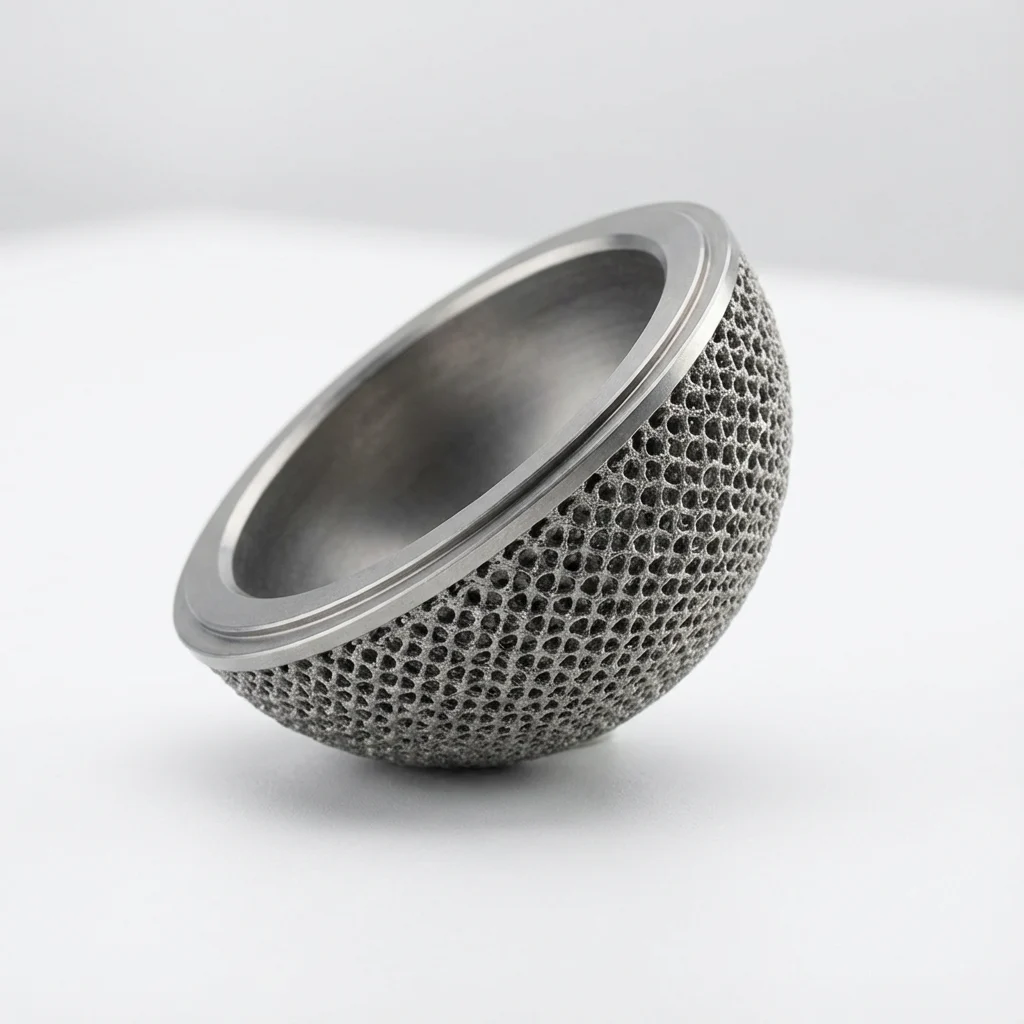
Titanium 3D printing allows for the creation of internal lattice structures. These are complex, porous structures that fill the interior of a part. The result is a component that retains structural integrity while being significantly lighter than a solid machined part. This type of structure is a key application in aerospace brackets and medical implants.
2. Complex Internal Geometries
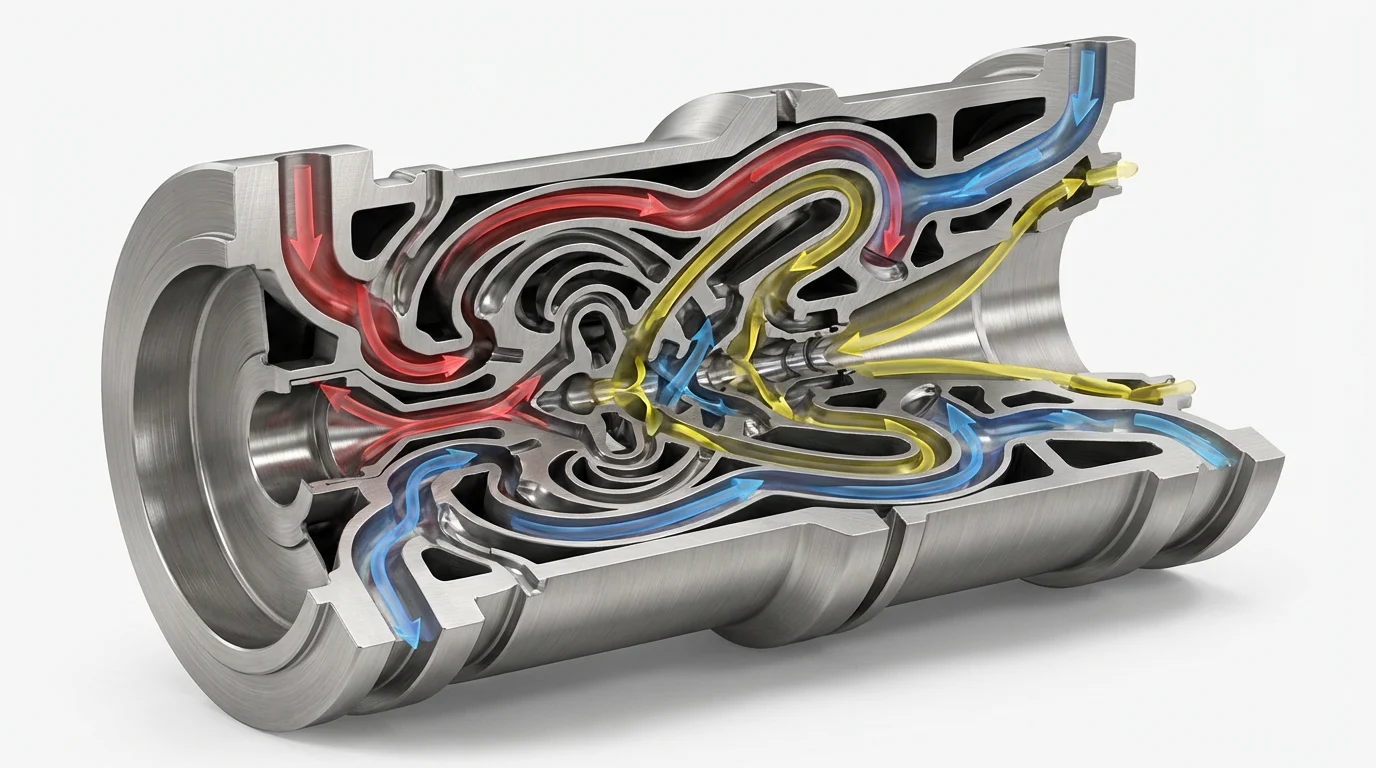
The technology is particularly effective when combined with generative design and algorithmic engineering.
For example, in rocket engine injector heads, algorithms can design internal cooling channels with variable diameters to optimise fluid dynamics. These internal features are often impossible to manufacture with traditional cutting tools, which cannot access the interior of a solid block to create curved, variable paths.
Post-Processing Requirements
Post-processing is a critical stage in the additive manufacturing workflow. A printed part requires several steps before it is ready for use, which can account for a significant portion of the production cost.

1. Stress Relief
During the printing process, rapid heating and cooling cycles generate internal thermal stresses. Before the part is removed from the build plate, it typically undergoes a stress-relief heat treatment in a vacuum furnace to prevent warping or cracking.
2. Component Removal (Wire EDM)
The first layer of the print is fused directly to the build plate. Industrial manufacturers often use Wire EDM (Electrical Discharge Machining) to precisely cut the part from the plate. This method ensures the bottom surface remains flat and prevents damage to the plate.
3. HIP (Hot Isostatic Pressing)
For critical applications, such as turbine blades or medical implants, parts undergo Hot Isostatic Pressing (HIP). The part is subjected to high heat and uniformly high pressure. This process eliminates microscopic internal voids, increasing density to near 100% and improving fatigue resistance.
4. Surface Finishing
As-printed titanium parts have a rough surface texture (Ra 10-15 microns). Depending on the requirements, additional finishing is performed:
- CNC Machining: Used for precise tolerances on mating surfaces or threads.
- Polishing: Used to achieve smooth surfaces for medical or aesthetic purposes.
Industrial Applications
Titanium 3D printing is established in industries requiring high-performance materials.
Medical Sector
Titanium is naturally biocompatible. 3D printing enhances its utility in medical applications:
- Osseointegration: Implants can be printed with porous surface structures that mimic bone trabeculae, encouraging bone ingrowth and improving implant stability.
- Patient-Specific customisation: Implants, such as cranial plates, can be manufactured based on patient CT data for an exact anatomical fit.
Aerospace Sector
In the aerospace industry, weight reduction is a primary objective.
- Part Consolidation: Multiple components can be redesigned and printed as a single unit, reducing assembly time and eliminating potential failure points like welds or fasteners.
- Weight Reduction: Optimised designs reduce the overall weight of aircraft components, thereby contributing to fuel efficiency.
Economic Considerations – CNC vs. 3D Printing
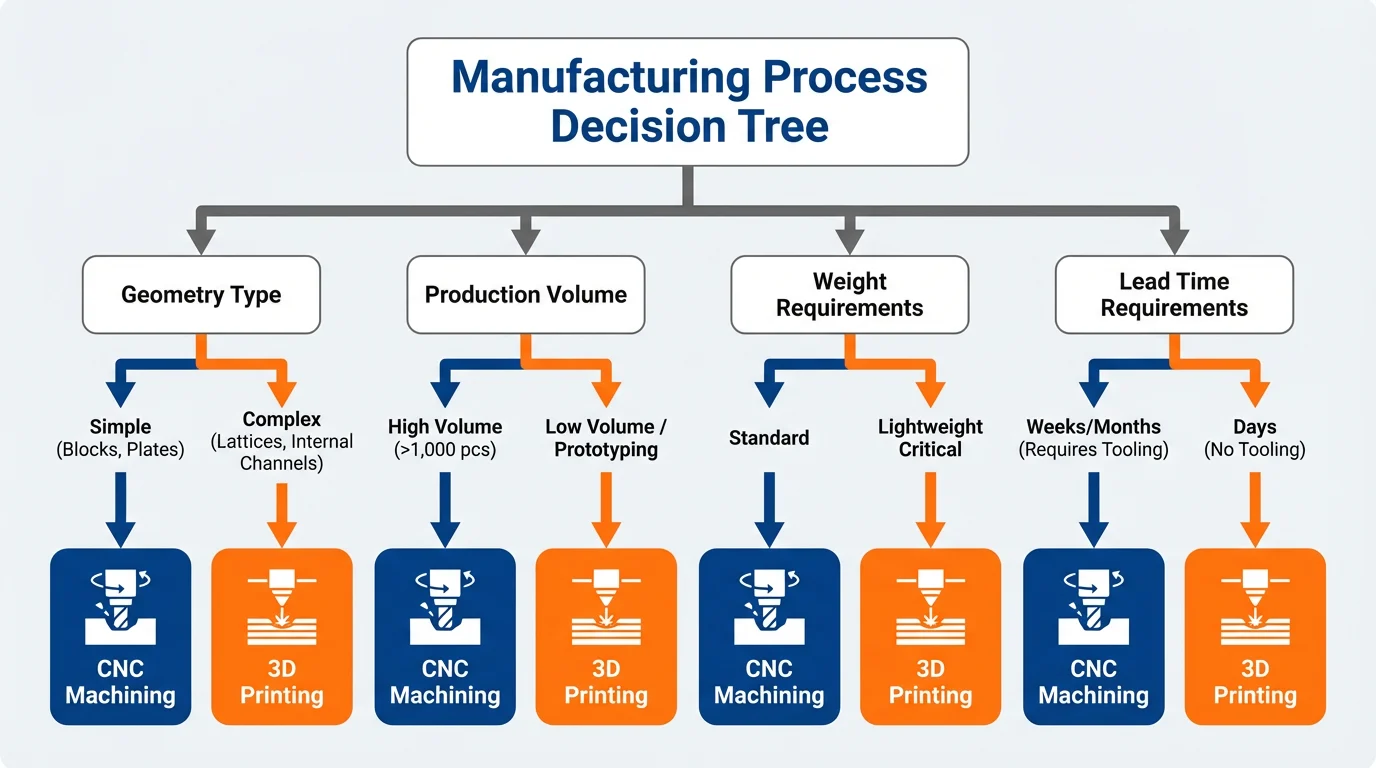
The choice between 3D printing and CNC machining depends largely on part geometry and production volume.
The equipment cost for industrial titanium printing is high. Therefore, economic feasibility is determined by specific use cases.
Selection Criteria: When to Print vs. When to Machine
| Feature | CNC Machining | 3D Printing (DMLS) |
|---|---|---|
| Geometry | Simple blocks, cylinders, and flat plates. | Organic shapes, internal channels, lattices. |
| Volume | High-volume production. | Low volume, prototypes, or complex batches. |
| Weight | Standard weight requirements. | Lightweighting is a priority. |
| Lead Time | Requires tooling setup. | No tooling required (faster for the first part). |
General Guideline: If a part can be easily machined on a 3-axis CNC mill, traditional machining is usually more cost-effective. However, for parts requiring 5-axis machining, internal features, or significant weight reduction, 3D printing often provides a better value proposition.
Frequently Asked Questions (FAQ)
Q: Is 3D printed titanium as strong as forged titanium?
A: Yes, in most industrial applications. When printed correctly with high density (99.5%+) and properly heat-treated (specifically using HIP), the mechanical properties of DMLS titanium (Ti-6Al-4V) meet or exceed ASTM standards for forged material.
Q: Will 3D printed titanium rust?
A: No. Titanium is naturally immune to corrosion due to a stable, protective oxide layer that forms instantly on its surface. This property makes it ideal for harsh environments, such as marine applications or the human body.
Q: Can 3D printed titanium be polished to a mirror finish?
A: Yes. While parts emerge from the printer with a matte grey, rough texture (Ra 10-15µm), they can be machined, tumbled, or hand-polished to a high-gloss, mirror-like finish, identical to standard titanium.
Q: Why is 3D printing titanium expensive?
A: The cost is driven by three primary factors: the high price of spherical titanium powder, the significant capital investment in industrial machinery ($500k+), and the intensive post-processing required (stress relief, EDM, HIP).
Summary
3D-printed titanium has become a standard manufacturing capability. It serves as a complement to traditional machining rather than a complete replacement.
This technology allows engineers to focus on functional design requirements, enabling the production of geometries that were previously unmanufacturable.