Why Choosing a Titanium Cup Is So Confusing
Let’s be honest: spending $40 to $60 on a camping mug seems ridiculous to the average person. But if you are reading this, you aren’t an average person—you are likely an ultralight backpacker, a gear enthusiast, or someone who simply appreciates high-quality equipment that lasts a lifetime.
A titanium camping cup is the holy grail of outdoor gear. It’s ultra-lightweight, tasteless, and bombproof. But once you decide to pull the trigger, you hit a wall: Single-Wall or Double-Wall?
On Amazon or REI, they look almost identical. The price difference is often negligible, and the weight difference is smaller than you might expect. This leaves many buyers paralyzed by analysis paralysis. Is the double-wall version just a “premium” upgrade? Does the single-wall version burn your lips?
Here is the truth that most product descriptions won’t tell you: This is not just a question of insulation. It is a question of utility.
Choosing the wrong one doesn’t just mean your coffee gets cold faster; it could mean the difference between having a versatile cooking pot in the backcountry or carrying a mug that might warp—or even explode—if you put it on a stove.
In this guide, we are going to break down the physics, the “boil test,” and the real-world performance to help you make the right choice for your gear list.
The Actual Weight Difference Is Smaller Than You Think
Before we talk about performance, let’s look at the construction.
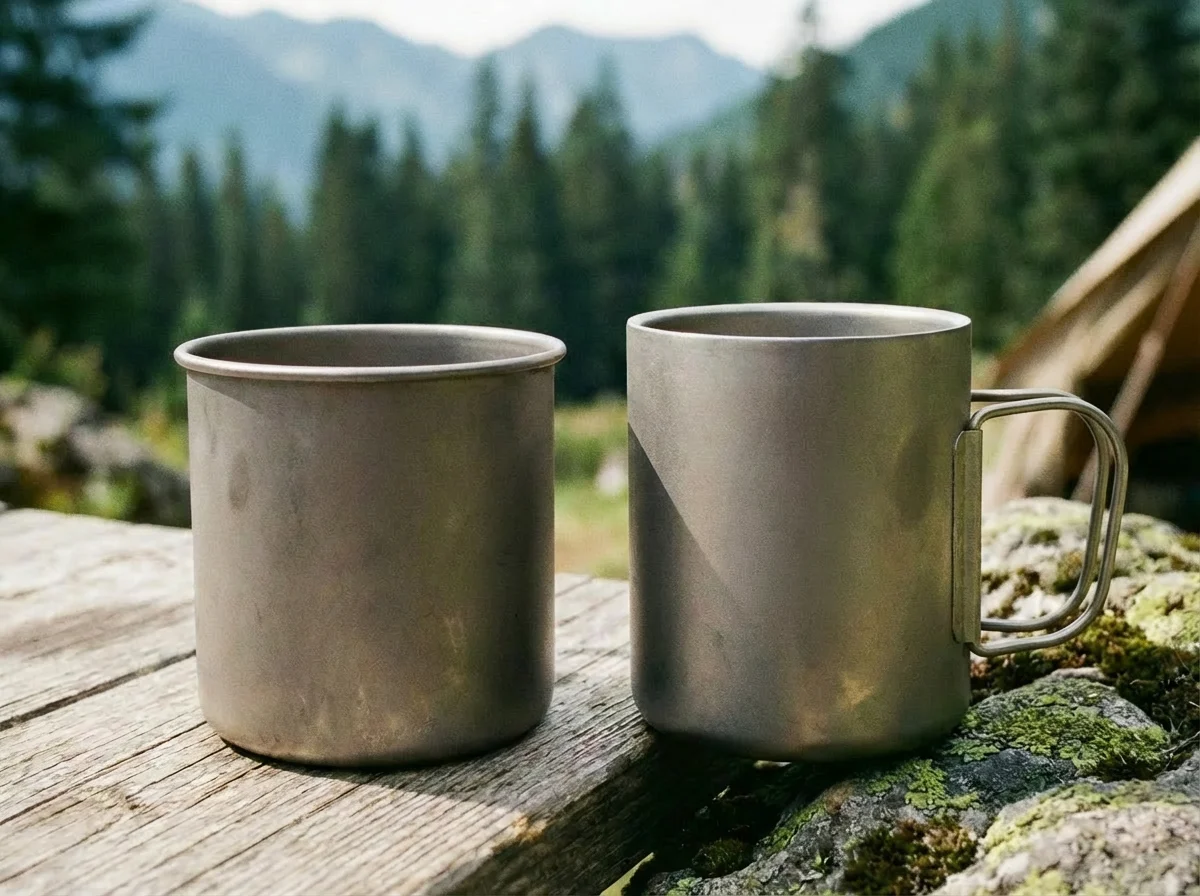
A single-wall titanium cup is exactly what it sounds like: one thin sheet of titanium pressed into the shape of a mug. It is simple, bombproof, and incredibly light.
A double-wall titanium cup consists of two layers of titanium welded together at the rim. Between these two layers is a sealed air gap (or sometimes a vacuum in very high-end models). This gap acts as a barrier to slow down heat transfer.
But here is the surprise: The weight penalty for going double-wall isn’t as massive as you might fear.
Let’s look at the industry standard, the Snow Peak 450ml mug, as an example:
- Single-Wall 450: Approx. 2.4 oz (68g)
- Double-Wall 450: Approx. 4.2 oz (118g)
The difference is roughly 1.8 ounces (50g).
To put that in perspective, that is about the weight of a Snickers bar or two AA batteries.
For the casual camper or office user: This weight difference is negligible. You won’t feel it in your hand or your day pack. The double-wall version still feels incredibly light compared to a standard ceramic or steel mug.
For the ultralight backpacker: This is a different story. When you are counting every gram to keep your base weight under 10 lbs, an extra 1.8 ounces for a “luxury” feature like insulation is hard to justify. In the world of long-distance hiking, lighter is always better.
However, weight isn’t the only factor. The biggest trade-off isn’t about grams—it’s about fire.
Can You Boil Water in a Double-Wall Cup?
If you only remember one thing from this guide, let it be this:
You absolutely cannot put a double-wall titanium cup on a stove or over a campfire.
Here is the physics: The air trapped between the two layers of titanium will expand rapidly when heated. Because the cup is sealed, that pressure has nowhere to go.
Best case scenario? The bottom of your expensive cup will bulge out, making it wobble on flat surfaces forever. Worst case scenario? The pressure builds until the cup bursts or explodes, sending hot metal shrapnel and boiling water everywhere.
This is where the Single-Wall Cup shines.
A single-wall titanium mug isn’t just a drinking vessel—it is cookware.
- Direct Heat: You can place it directly on a canister stove (like an MSR PocketRocket or BRS-3000T).
- Open Fire: You can nestle it right into the coals of a campfire to boil water.
- Versatility: This is the secret weapon of ultralight hikers. By using your mug as your pot, you eliminate the need to carry a separate cooking pot entirely. You boil your water in the mug, add your instant coffee or dehydrated meal, and eat/drink right from the same vessel.
If you are a “gram counter” or a minimalist, the single-wall cup is the only logical choice because it serves double duty.
If you buy a double-wall cup, it is strictly for drinking. You will still need to carry a separate pot to boil your water.
The Truth About Insulation and Burnt Lips
If the single-wall cup is the king of versatility, the double-wall cup is the king of comfort.
Titanium is a metal, and metals conduct heat very well. When you pour boiling water into a single-wall titanium cup, two things happen instantly:
- The cup becomes too hot to hold. You have to grab it by the handles (which can still get warm) or wait for it to cool down.
- The rim becomes a hazard. Taking a sip immediately is a recipe for burnt lips.
This is the primary reason people upgrade to the double-wall version.
Because of that air gap we mentioned earlier, a double-wall cup stays cool to the touch even when filled with boiling coffee. You can wrap your hands around it on a chilly morning to warm them up without getting burned. It also prevents condensation from forming on the outside when you’re drinking something cold, keeping your camp table (or office desk) dry.
But let’s manage your expectations:
Most double-wall titanium cups use air insulation, not the heavy-duty vacuum insulation found in a Yeti or a Hydro Flask.
- Don’t expect your coffee to stay hot for hours.
- Do expect it to stay hot for about 15–20 minutes longer than in a single-wall cup.
The double-wall feature is more about hand comfort than long-term heat retention.
The “Hot Lips” Hack: If you love the versatility of the single-wall cup but hate burning your mouth, there is a simple $5 solution: Silicone Lip Guards (often called “Hot Lips” by Snow Peak).
These little silicone pieces slide onto the rim of your single-wall cup. They protect your mouth from the hot titanium, allowing you to sip your coffee immediately while still enjoying the ultralight benefits of a single-wall mug. It’s the best of both worlds.
Will It Make Your Coffee Taste Like Metal?
If you have ever drunk cheap wine out of a stainless steel camping mug, you know exactly what I am talking about: that sharp, metallic tang that ruins the flavor.
This happens because acidic liquids (like coffee, tea, or juice) can react slightly with metals like steel or aluminum, leaching ions into your drink.
Here is where titanium justifies its price tag.
Titanium is biocompatible. It is the same material used in surgical implants and hip replacements because the human body does not reject it, and it is completely chemically inert.
When exposed to oxygen, titanium forms a thin, stable oxide film that prevents the metal from interacting with your beverage.
The result?
- No Metallic Taste: Your high-end pour-over coffee will taste exactly like coffee.
- No Odor Retention: You can drink spicy soup for dinner, rinse the cup, and have tea in the morning without any lingering flavors.
- Healthier: There is no risk of leaching heavy metals or toxins, even if the cup is scratched.
Whether you choose Single-Wall or Double-Wall, you get this benefit. It is an inherent property of the material itself.
If you are a coffee purist or someone with a sensitive palate, titanium isn’t just a lightweight luxury—it is the only metal cup you should be using.
Does Your Stove Fit Inside?
If you are a backpacker, you know that space in your pack is just as valuable as weight on your back. This is where the “Nesting Game” comes into play.
Nesting is the art of stacking your gear like Russian dolls—putting your fuel canister inside your cup, your stove inside the canister bag, and your cup inside your cooking pot.
Here is the Single-Wall advantage: Because a single-wall cup is made of paper-thin titanium, its internal diameter is almost identical to its external diameter.
This maximizes the usable space inside.
- The Classic Kit: A standard 750ml Single-Wall Pot/Mug is designed perfectly to hold a 110g isobutane fuel canister and a small stove (like a BRS-3000T or MSR PocketRocket) nestled on top. It is the ultimate compact kitchen.
- Small Mugs (450ml): Even in smaller single-wall mugs, you can easily stuff a lighter, a bandana, instant coffee packets, and a folding spork without issue.
The Double-Wall Disadvantage: A double-wall cup loses significant internal volume to create that air gap.
While a Double-Wall 450ml mug might look the same size on the outside as a Single-Wall 450ml, the inside is much tighter.
- Items that slide easily into a single-wall cup might get stuck or not fit at all in a double-wall version.
- If you are trying to build a perfectly nested “cook system” where everything clicks together, the thick walls of a double-wall cup often break that system.
Pro Tip: If you plan to store your stove inside your cup, wrap it in a small cloth or bandana first. Titanium is strong but scratches easily, and the rattling sound of metal-on-metal while hiking will drive you crazy.
Who Should Buy the Single-Wall Cup
If you fall into any of these categories, stop overthinking and buy the Single-Wall Titanium Cup:
- The Ultralight Backpacker: You weigh your gear in grams. You want a cup that doubles as a cooking pot. You are okay with your coffee cooling down a bit faster if it saves you carrying a separate stove.
- The Soloist: You often hike alone. A Single-Wall 600ml or 750ml Cup is the perfect “One-Pot System.” It holds your stove, fuel, and lighter inside, and it is the only cookware you need.
- The Budget-Conscious: You want the benefits of titanium (lightweight, durable, no taste) without paying the premium for double-wall construction.
- The Minimalist: You appreciate simplicity. A single sheet of metal is less likely to dent or fail than a complex double-wall structure.
Our Recommendation: Look for a 750ml Single-Wall Pot with Lid (like Toaks or Snow Peak). It is the most versatile size—big enough to cook a meal in, small enough to drink from.
Who Should Buy the Double-Wall Cup
If you value comfort and experience over raw utility, the Double-Wall Titanium Cup is for you:
- The Coffee/Tea Connoisseur: You are particular about your morning brew. You hate the metallic taste of steel but also hate burning your lips on a single-wall rim.
- The Office & Car Camper: Weight isn’t your primary concern. You want a mug that feels substantial in your hand, looks premium on your desk, and keeps your drink warm during a commute or a slow morning at camp.
- The Winter Camper: You camp in cold conditions where a single-wall cup would suck the heat out of your drink instantly. The insulation here makes a noticeable difference.
- The Gift Buyer: You are buying a gift for an outdoorsy person. A double-wall mug feels more like a “luxury item” and less like a piece of survival gear.
Our Recommendation: Go for a 450ml Double-Wall Mug (like Snow Peak H450 or Keith Ti). It is the perfect size for coffee, fits well in the hand, and the craftsmanship is often stunning.
Frequently Asked Questions (FAQ)
Q: Are titanium cups dishwasher safe?
A: Yes, generally. Plain titanium cups are dishwasher safe and will not rust. However, if your cup has a colored anodized finish (like blue or purple) or a logo decal, the harsh detergents in a dishwasher might fade the finish over time. For colored cups, hand washing is safer.
Q: Can I put a titanium cup in the microwave?
A: No. Titanium is a metal. Putting any metal in a microwave will cause electrical arcing (sparks), which can damage both your expensive cup and your microwave.
Q: Why is my titanium cup changing color?
A: This is normal! When titanium is exposed to high heat (like a gas stove), it develops a natural oxide layer that shifts colors (blue, purple, bronze). Many hikers consider this “heat patina” a badge of honor.
Q: Is titanium better than aluminum?
A: For health and durability, yes. Aluminum is reactive and can leach into acidic foods (like tomato soup or coffee), changing the taste. It also dents easily. Titanium is non-reactive, stronger, and biologically inert, though it is more expensive.
Bonus: How to Customize Your Titanium Cup
One final reason to love titanium? You can change its color with fire.
Because of how titanium oxidizes, you can create a unique, iridescent finish at home.
The DIY Method:
- Clean your Single-Wall cup thoroughly (oils from your fingers will leave marks).
- Use a butane torch (like for crème brûlée) or even your gas stove.
- Slowly heat the metal. As the temperature rises, the titanium will shift from silver to gold, then to purple, and finally to a deep blue.
Warning: Do not try this on a Double-Wall cup! The trapped air will expand and ruin the cup (remember the explosion risk?). This is a single-wall exclusive perk.
It’s a fun way to personalize your gear and make your $40 cup truly one-of-a-kind.