In the Norwegian North Sea, offshore platforms that once struggled with repeated stainless steel failures in chlorination and ballast systems began switching to titanium in the 1980s. By the late 1990s, a single deepwater platform installation was consuming several thousand tonnes of titanium. That shift wasn’t driven by novelty — it was driven by a clear engineering problem that steel and its alloys kept failing to solve: corrosion in chloride-rich, H2S-contaminated, high-pressure environments where maintenance access is either dangerous or impossible.
Today, titanium shows up in some of the most demanding positions in upstream oil and gas — deepwater risers at 3,000m water depth, downhole tool housings cycling through 200°C+ borehole temperatures, and subsea heat exchangers exposed permanently to seawater. Understanding where it makes sense, which grade to specify, and what its real limitations are is the difference between a well-engineered system and an overpriced one.
Why Titanium Belongs in Extreme Oil & Gas Environments
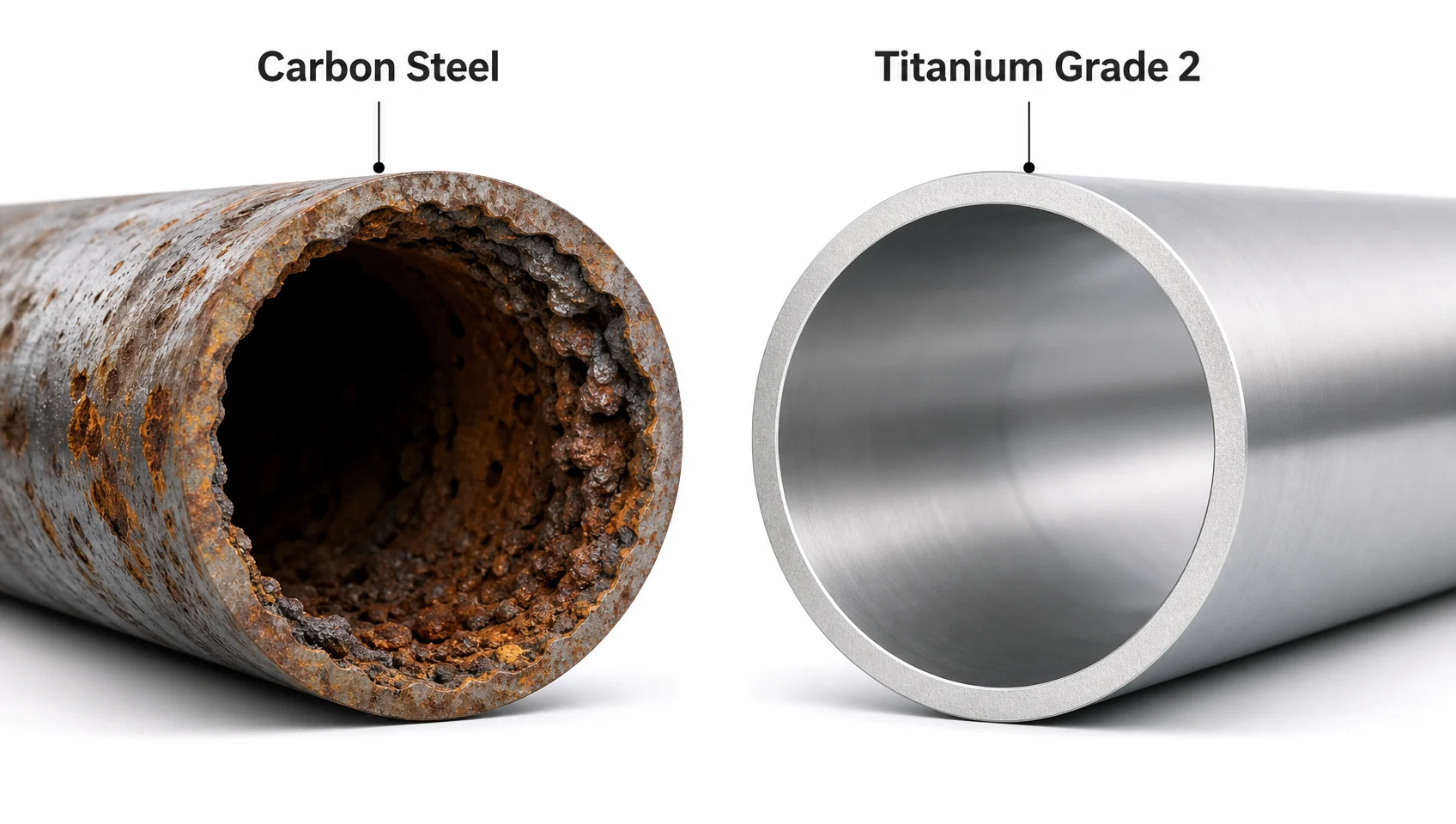
Titanium’s value proposition in oil and gas isn’t a single property — it’s the combination of three that steel alternatives rarely achieve simultaneously.
Density advantage: Titanium’s density is 4.51 g/cm³ vs carbon steel at 7.85 g/cm³ — about 43% lighter for the same volume. In a deepwater riser string running thousands of meters, that weight difference directly reduces top tension requirements and lets designers shrink the size of support structures. A lighter riser also means reduced fatigue loading from current-induced vortex shedding, which extends service life.
Corrosion resistance without coatings: Titanium forms a passive TiO₂ oxide layer within milliseconds of exposure to air or water. Unlike steel’s rust layer (which continues corroding) or stainless steel’s passive film (which breaks down in chloride environments above certain temperatures and concentrations), titanium’s oxide layer is stable in seawater, brine, H2S, CO2, acetic acid, and most organic acids encountered in production environments. Research published by Stanford’s geothermal program confirmed titanium is fully resistant in the standard NACE corrosion test solution containing 3,000 ppm dissolved H2S, 5% NaCl, and acetic acid — conditions that represent aggressive sour-service production fluids.
Strength where it matters: Commercial-purity grades (1–4) cover corrosion applications. Once you move to alloy grades — particularly Ti-6Al-4V (Grade 5) — yield strengths reach 830 MPa, comparable to high-strength alloy steels, but at nearly half the weight. That’s the combination that makes Grade 5 titanium viable for downhole tool mandrels and completion hardware that must survive jarring, pressure cycling, and tensile loads in the wellbore.
Titanium Grades Used in Oil & Gas: A Decision Matrix
Not all titanium is the same, and specifying the wrong grade is an expensive mistake. Here’s how the grades map to O&G applications:
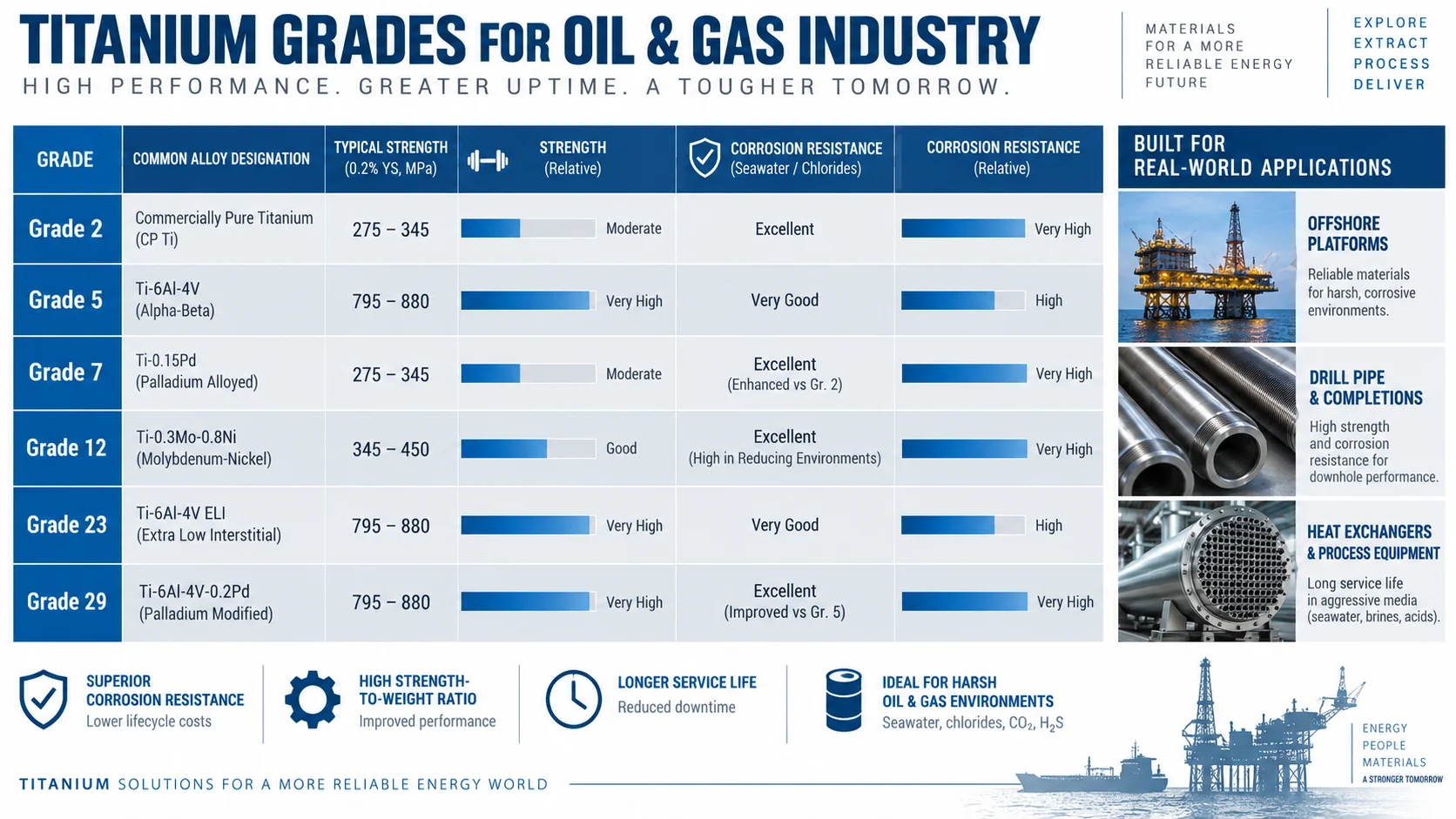
| Grade | Composition de l'alliage | Limite d'élasticité (MPa) | Avantage clé | Primary O&G Application |
|---|---|---|---|---|
| Niveau 2 | CP Ti (0.3% Fe, 0.25% O) | ~275 | Best weldability, corrosion resistance | Topside piping, fire water systems, HX shells |
| 5e année | Ti-6Al-4V | ~830 | Highest strength, machinability | Downhole tool bodies, MWD/LWD housings, wireline barrels |
| 7e année | Ti-0.2Pd | ~275 | Best crevice and SCC resistance | Sour-service fittings, subsea valve bodies |
| 12e année | Ti-0,3Mo-0,8Ni | ~345 | Crevice resistance at lower cost than Gr7 | Subsea heat exchangers, condenser tubing |
| Niveau 23 | Ti-6Al-4V ELI (Extra Low Interstitial) | ~760 | High toughness, weldable, fatigue resistant | Flexible risers, dynamic loading applications |
| Grade 29 | Ti-6Al-4V-0.1Ru | ~830 | Gr5 strength + enhanced crevice resistance | Deepwater rigid risers, HPHT completions |
The palladium or ruthenium additions in Grades 7 and 29 are what close the gap that CP titanium leaves open: crevice corrosion in hot, reducing-acid environments like the annular spaces in subsea connectors. If your application involves narrow gaps, stagnant seawater, or elevated temperatures (above 80°C in seawater), Grades 7 or 29 are worth the price premium over Grade 2 or 5.
Downhole Applications: Where Titanium Earns Its Keep
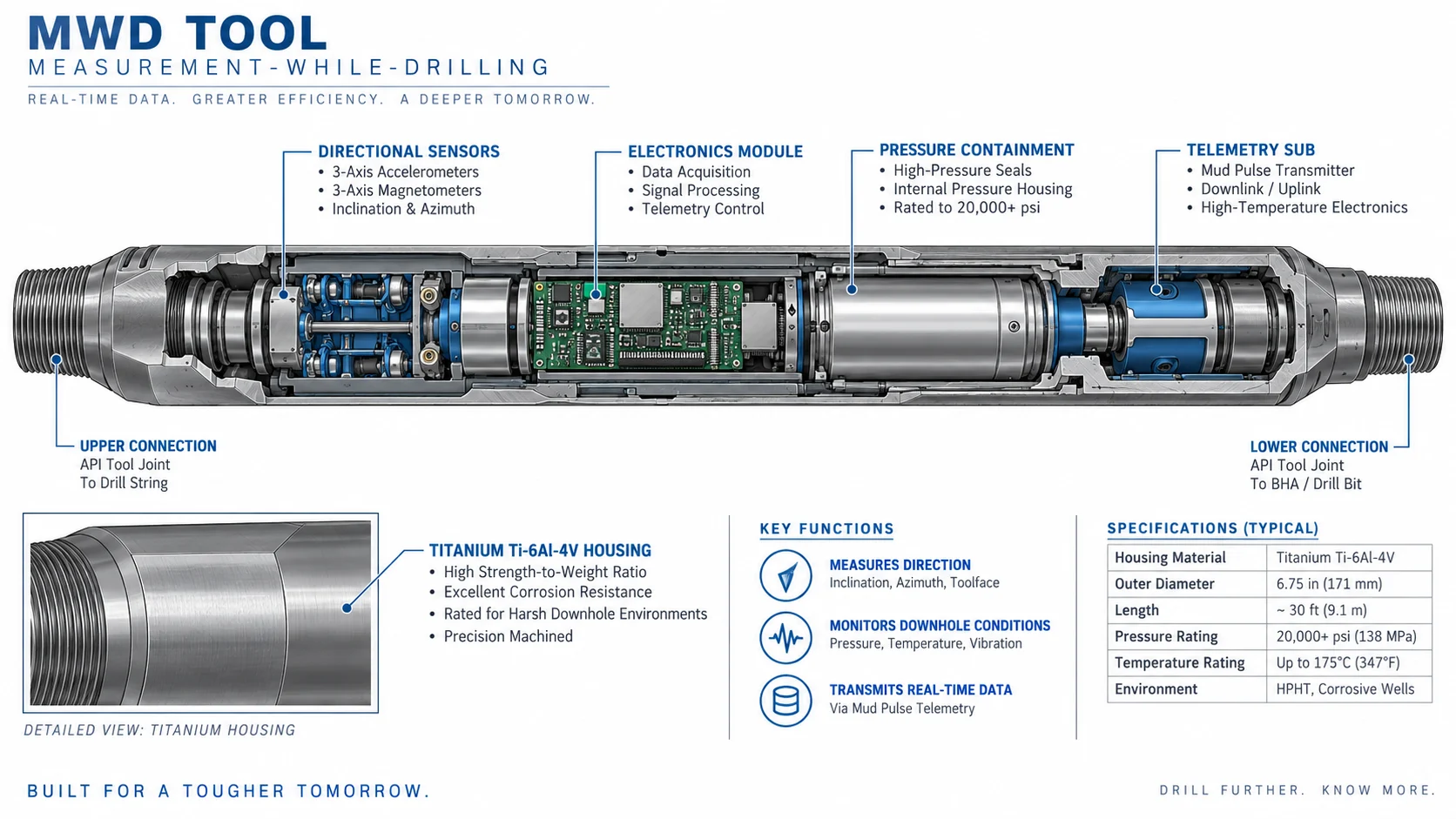
Downhole is where titanium’s strength-to-weight ratio, corrosion resistance, and non-magnetic properties converge to create a genuinely better solution.
MWD and LWD tool housings: Measurement-while-drilling and logging-while-drilling tools are packed into housings that see temperatures above 150°C, pressures exceeding 138 MPa (20,000 psi) in HPHT wells, and borehole fluids ranging from water-based muds to oil-based systems with varying chloride contents. Steel housings require internal coatings or careful alloy selection to prevent corrosion pitting that compromises pressure integrity. Grade 5 titanium housings — like the wireline barrels produced to NORSOK/MILS spec — hold pressure without corrosion allowance margins, and their non-magnetic property prevents interference with directional measurement sensors. A 60% reduction in tool weight (vs. equivalent steel housings) also reduces handling fatigue risk during rigging-up.
Downhole production tubing: Beta-C titanium (Ti-3Al-8V-6Cr-4Mo-4Zr) and Grade 5 have both been qualified for downhole casing and tubing. CNC BozeMetal’s Grade 5 tubing is rated for full ocean depth operation — 11,000 m, 110 MPa external pressure — with spherical and cylindrical collapse pressure margins over 2× the design requirement. The case for titanium tubing is strongest in wells with aggressive CO2 partial pressures, where carbon steel requires either expensive corrosion inhibitor programs or periodic replacement.
Completion tool components: Mandrels, packers, sliding sleeves, and safety valves operating in H2S-bearing formations fall under NACE MR0175/ISO 15156. Titanium is fully compliant with these requirements — the standard includes titanium alloys as acceptable CRAs (corrosion-resistant alloys) for sour service. This means titanium hardware can be specified directly in a material selection report without the hardness restrictions that apply to carbon steels and most CRAs.
Subsea Equipment: Handling Permanent Seawater Exposure
Subsea equipment presents a different challenge from downhole: the environment is relatively fixed (cold, oxygenated seawater in ambient conditions), but exposure is permanent and access for inspection or replacement is costly.
Heat exchangers and cooling systems: Grade 12 and Grade 2 titanium have become the standard material for compact heat exchangers and condenser tubing on offshore platforms. Their performance against biofouling, under-deposit corrosion, and chloride stress-corrosion cracking (which eliminates austenitic stainless steels in high-chloride seawater above 50°C) makes them virtually maintenance-free. North Sea operators report 20+ year service lives for titanium heat exchanger tube bundles with no corrosion-related replacements.
Subsea manifolds and trees: The case for titanium in subsea manifolds is compelling for certain production chemistries but requires careful evaluation of galvanic compatibility with carbon steel wellheads and subsea control module housings. Grade 5 and Grade 7 are both used for valve bodies, choke bodies, and connector hubs in high-H2S fields where duplex stainless can be susceptible to stress corrosion cracking under cathodic protection.
Umbilical terminations and connectors: Titanium connector bodies are specified for umbilical termination assemblies in deepwater where long-term exposure to seawater at elevated pressure is combined with cyclic mechanical loading. The non-corrosive nature eliminates the need for sacrificial anodes on titanium structures, although galvanic coupling with adjacent steel components must be managed with isolation flanges or insulating gaskets.
Riser Systems: The Application That Changed Deepwater Economics
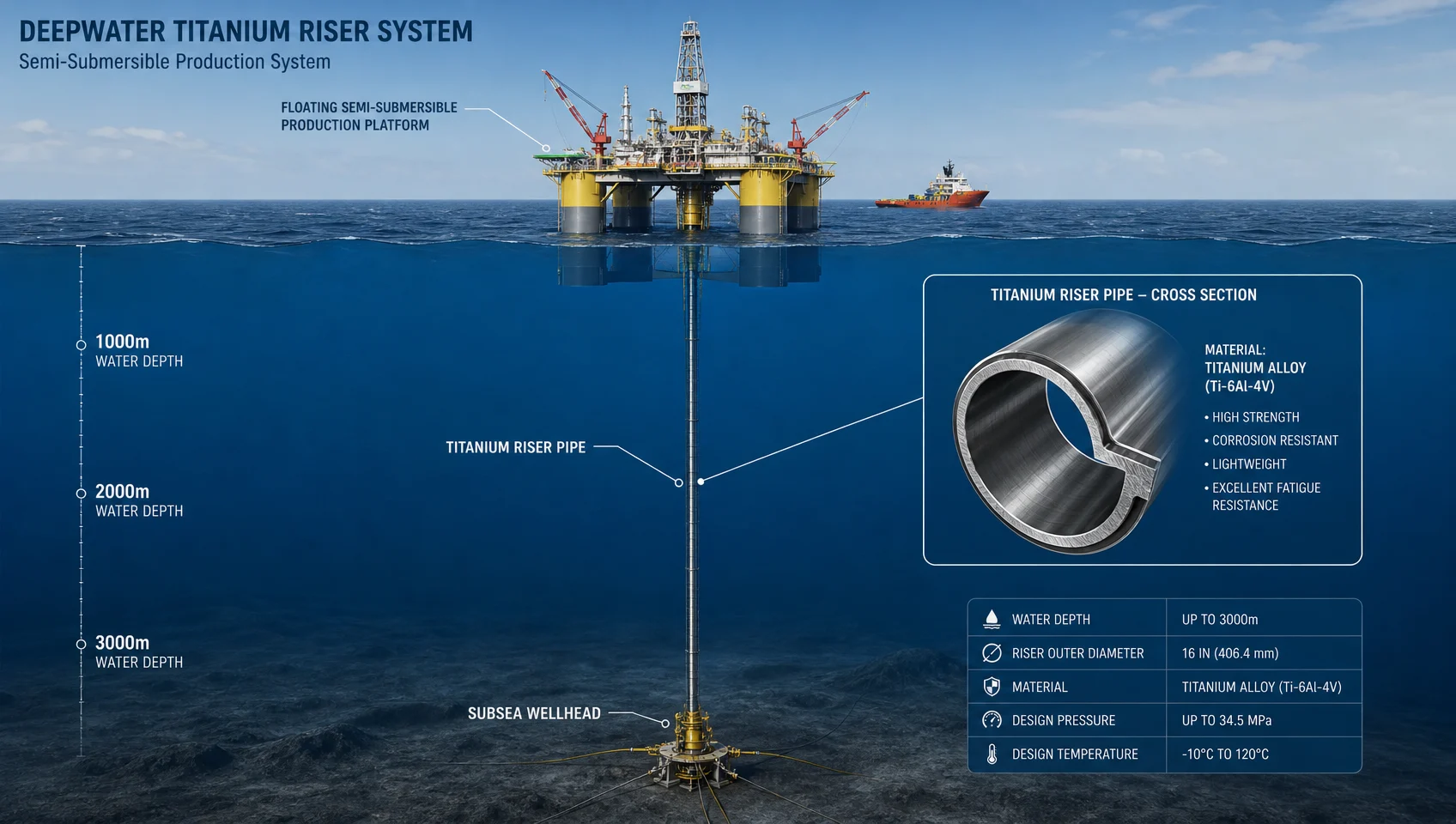
Riser applications were one of the first areas where the economics of titanium became demonstrably clear for offshore operators.
On a semi-submersible platform, every tonne of riser weight means additional topside structure, larger buoyancy compensation, and greater dynamic loading on the floating hull. When water depths moved past 1,000m in the Gulf of Mexico and Norwegian Sea, steel risers pushed the boundaries of what floaters could handle. Titanium Grade 23 and Grade 29 risers — governed by ASTM B861 for pipe and the titanium organization’s industry papers on riser applications — offered a path to deeper water by cutting riser string weight by nearly 45%.
The titanium riser story is not theoretical. The titanium industry (TTI/TIMET and industry papers presented at the World Conference on Titanium in 2007) documented full-scale installations using Grade 23/29 riser joints in the North Sea and Gulf of Mexico. Grade 29’s ruthenium addition gives it the corrosion resistance edge of Grade 7 with the strength of Grade 5 — purpose-engineered for this exact application.
Beyond the structural weight argument, titanium risers have fatigue advantages: the material’s fatigue limit-to-tensile strength ratio is high compared to steel, and titanium does not suffer the notch sensitivity that limits steel riser design in high-cycle fatigue regimes typical of deepwater current environments.
Topside Pipework: Where Titanium Replaced Steel at Scale
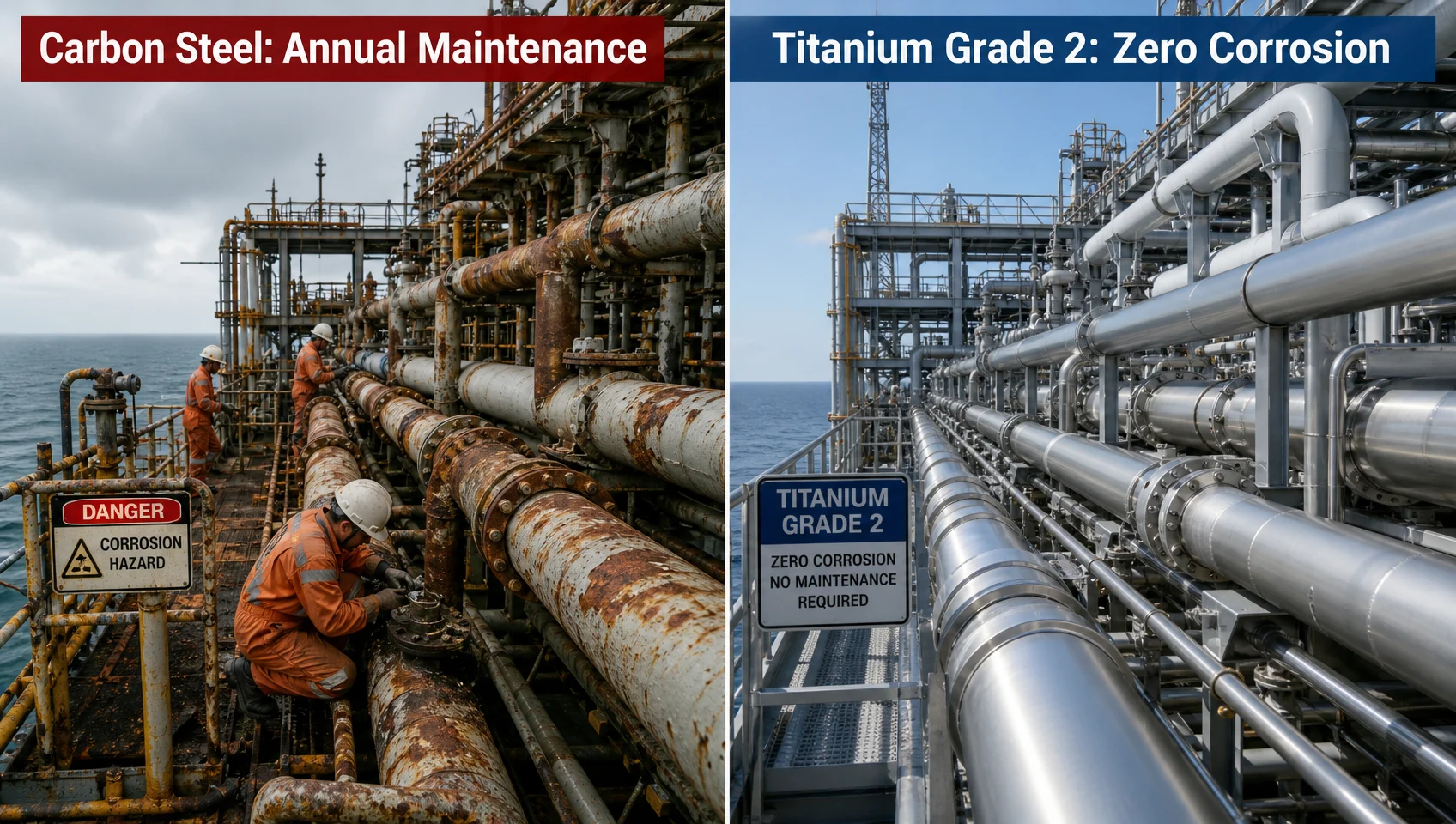
The first large-scale adoption of titanium in oil and gas wasn’t subsea or downhole — it was topside pipework for seawater systems.
Offshore platforms use seawater for fire suppression, ballast, cooling, and injection. Steel and copper-nickel alloys failed repeatedly in chlorination systems and low-pressure ballast lines because of crevice corrosion and microbiologically induced corrosion (MIC). When Norwegian operators began replacing these systems with Grade 2 titanium in the 1980s and 1990s, the maintenance calls stopped. Typical topside titanium pipework consumption is now 50–150 tonnes per platform for new North Sea installations, according to AZoM’s industry review of offshore titanium applications.
The economics here are driven by lifecycle cost, not initial cost. Grade 2 titanium pipe costs 3–5× more than carbon steel at purchase. Over a 25-year platform life, with no corrosion allowances, no coating maintenance, no MIC replacement campaigns, the total cost of ownership typically favors titanium by the 7–10 year mark.
What Titanium Won’t Do: Limitations Engineers Must Know
No material is a universal solution. Several limitations matter specifically in O&G applications.
Hydrogen embrittlement in cathodic protection zones: Titanium alloys (particularly Grade 5, Ti-6Al-4V) can absorb hydrogen under high cathodic polarization — such as aggressive impressed current cathodic protection (ICCP) systems. If titanium components are electrically coupled to steel structures with ICCP protection, the potential must be managed to stay above –0.8V (Ag/AgCl) to avoid hydrogen absorption. This is a real engineering constraint, not a theoretical one, and it requires explicit design attention in subsea structures.
Galling in threaded connections: Titanium galls severely against itself in threaded joints — the oxide layer that provides corrosion protection creates adhesive wear when mating titanium surfaces are torqued together. Downhole tool connections using titanium must use anti-galling coatings (titanium nitride, molybdenum disulfide, or appropriate thread compounds) or dissimilar mating materials.
Cost and supply chain: Grade 29 and Grade 23 riser pipe operates in a relatively thin supply chain. Long lead times (12–24 weeks for large-diameter seamless pipe) and higher per-kg costs vs. 316L stainless require early procurement planning. This doesn’t eliminate titanium’s case — it changes the project timeline calculus.
Weldability (alloy grades): Grade 2 and Grade 12 weld readily with standard TIG/GTAW processes. Grade 5 (Ti-6Al-4V) requires careful shielding gas coverage, clean preparation, and controlled heat input to avoid alpha-case formation — a brittle oxygen-rich zone that forms at weld interfaces if atmospheric contamination occurs during welding. Field welds on Grade 5 are challenging; most Grade 5 downhole tools use machined, threaded, or mechanically joined connections rather than field welds.
Titanium vs. Competing Materials in O&G
| Propriété | Titanium Gr 5 | ACIER INOXYDABLE 316L | 2205 Duplex | Alloy 625 (Inconel) |
|---|---|---|---|---|
| Densité (g/cm³) | 4.43 | 7.98 | 7.82 | 8.44 |
| Limite d'élasticité (MPa) | ~830 | ~170 | ~450 | ~415 |
| Seawater Corrosion | Excellent | Poor above 50°C | Bon | Excellent |
| H2S/Sour Service | Excellent (NACE compliant) | Limité | Good (with HRC limits) | Excellent |
| Relative Cost ($/kg) | High ($25–40) | Low ($4–8) | Medium ($10–15) | Very High ($40–70) |
| Weight vs. Steel | Briquet ~43% | Valeur de référence | ~similar | ~7% heavier |
| Soudabilité | Good (CP grades), moderate (Gr5) | Excellent | Bon | Bon |
For applications where weight is critical and corrosion resistance is paramount, titanium’s competitive advantage over duplex stainless is strongest. Against Inconel 625, titanium competes on weight savings and cost — Alloy 625 offers comparable corrosion resistance but at roughly double the weight of Grade 5 titanium and comparable-or-higher cost.
Titanium in Oil & Gas: Not Every Well Needs It
Titanium is not the default material for oil and gas. Carbon steel with appropriate corrosion allowances handles the majority of production pipework and wellbore tubulars. Duplex stainless covers most subsea structural applications where weight is less critical. The engineering case for titanium is strongest in four specific scenarios:
- Weight-critical deepwater structures — where riser or completion string weight drives platform design
- Permanently inaccessible subsea equipment — where corrosion failures mean costly ROV-assisted intervention
- Aggressive sour/chloride environments — where steel and standard CRAs require prohibitive maintenance programs
- Sensor-adjacent downhole tools — where non-magnetic housing is required for accurate directional measurement
In these four scenarios, the question isn’t whether titanium is worth the premium — it’s which grade to specify and how to manage the design constraints around galling and cathodic protection.
Questions fréquemment posées
What ASTM standards cover titanium for oil and gas applications?
ASTM B265 (sheet/plate), ASTM B337/B338 (tubes), ASTM B861 (seamless pipe), and ASTM B348 (bar/billet) are the primary product-form standards. For specific alloy requirements in sour service, NACE MR0175/ISO 15156 governs titanium CRA qualification.
Is titanium compliant with NACE MR0175 for H2S sour service?
Yes. Titanium alloys are listed as acceptable CRAs in ISO 15156-3 (Part 3 covers CRAs and other alloys). Titanium has demonstrated complete resistance to the standard NACE sour-service test environment: 3,000 ppm H2S, 5% NaCl, acetic acid solution. Unlike carbon steels, titanium is not subject to hardness restrictions under this standard.
Which titanium grade is best for downhole completion tools?
Grade 5 (Ti-6Al-4V) is the standard choice for high-strength downhole tool bodies, MWD housings, and wireline barrels due to its 830 MPa yield strength. Grade 29 (Ti-6Al-4V-0.1Ru) is preferred where additional crevice corrosion resistance is needed alongside high strength.
Can titanium be used in deep water at high pressure?
Yes. Grade 5 titanium has been rated for full ocean depth operation (11,000 m depth, 110 MPa external pressure). Titanium risers made from Grade 23/29 have been installed in production systems at water depths over 2,000 m.
Why doesn’t every oil and gas application use titanium?
Cost, supply chain lead times, and the galling risk in threaded connections make titanium impractical for commodity applications where carbon steel with corrosion allowances is adequate. Titanium’s premium is justified in weight-critical, permanently-installed, or corrosion-aggressive applications where total lifecycle cost favors the material.
What are the risks of using titanium near cathodic protection systems?
Titanium alloys can absorb hydrogen under strong cathodic polarization (below approximately –0.8V vs. Ag/AgCl). In subsea structures with ICCP protection, titanium components must be managed to avoid excessive cathodic polarization. CP Grade 2 is less susceptible than Ti-6Al-4V in this regard.
Titanium in Deep Water: The Material Built for Where Steel Fails
The oil and gas industry has spent decades finding titanium’s niche through hard experience — failed stainless fittings, corroded steel ballast lines, and weight-limited deepwater platform designs. The result is a clear map: titanium belongs in environments where corrosion is certain, where access for repair is limited, and where weight has a multiplier effect on system cost.
Grade selection is the critical engineering decision. CP grades (2, 7, 12) cover corrosion-dominated applications. Alloy grades (5, 23, 29) cover strength-dominated ones. The small ruthenium or palladium additions in Grades 7, 12, and 29 close the remaining gap — crevice and reducing-acid environments — that CP titanium leaves partly open. Specify the right grade, manage the galling and cathodic protection design constraints, and titanium delivers what steel rarely can: a maintenance-free service life measured in decades, not years.