
If you’ve been on TikTok or Instagram lately, you’ve definitely seen them. Titanium cutting boards are everywhere, with influencers calling them the “last cutting board you’ll ever buy.” But scroll down to the comments, or check a forum like Reddit, and it’s a totally different vibe—people are screaming about ruined knives and terrible noise.
So, who is right? As home cooks, we are often stuck choosing the lesser of two evils. We love wood boards for the feel, but hate the mold and the constant oiling. We use plastic boards because they’re easy, but we worry about the microplastics ending up in our dinner. Titanium promises to be the third option: clean, indestructible, and the safest cutting board material out there. But is it too good to be true? Let’s skip the sales pitch. We dug into the actual physics—comparing titanium’s hardness against kitchen steel—and combed through real feedback from knife enthusiasts. The goal? To figure out if these boards are a smart investment or just a quick way to dull your blades. Here is the unfiltered truth.

Hygiene: Why Health Experts Love It
Let’s start with the undeniable positives. If your main priority is keeping your kitchen 100% sanitary, titanium absolutely destroys the competition. Here’s why.
1. The End of Microplastics (Data-Backed Safety)
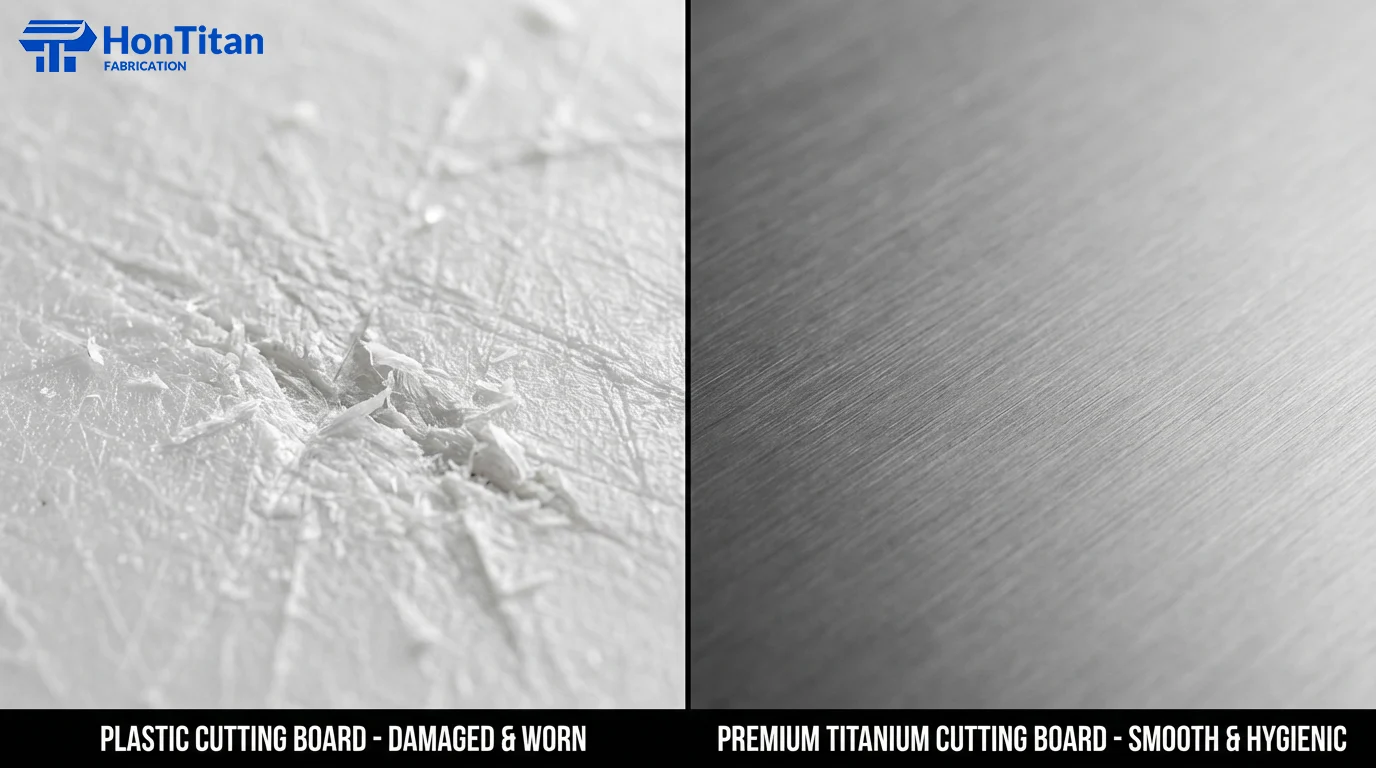
This is the single biggest reason families are making the switch. A study from North Dakota State University revealed that chopping on a standard plastic board can shed up to 50 grams of microplastics per year. That is equivalent to eating roughly 10 credit cards worth of plastic annually. To solve this, look for boards made from Grade 1 Commercially Pure Titanium (99.8%). This is medical-grade material—biocompatible and completely inert. Unlike plastic which degrades, titanium generates zero microplastics, ensuring the only thing entering your body is the food you actually cooked.
2. A Truly “Non-Porous” Surface (Mold-Free Guarantee)
We’ve all seen it: a wooden board that starts turning black in the corners no matter how much you scrub it. Wood and bamboo are porous; they drink up moisture, chicken juices, and bacteria like a sponge. Titanium is non-porous. Bacteria, salmonella, and strong odors (like garlic or onion) literally have nowhere to hide. You rinse it, and it’s gone. It’s a level of clean that wood just can’t compete with.
3. The “Dishwasher Safe” Convenience
Wood warps in the dishwasher. Plastic can melt or degrade. Titanium? It’s practically indestructible. You can toss it into the hottest dishwasher cycle for sterilization without a second thought. For busy parents or anyone who hates the high maintenance of oiling wooden boards, this is a massive win.
Knife Care: What Brands Won’t Tell You
Now, for the elephant in the room. If you ask a knife enthusiast about titanium boards, they will likely tell you to run away. Why? Because of one simple fact: Impact.
1. The Physics: Why It Dulls Blades (It’s Not Abrasion, It’s Rolling)
Here is a common misconception: people think titanium ruins knives because it is “harder” than steel. That is actually false. Grade 1 Titanium is technically softer (on the Rockwell scale) than most hardened kitchen knives. The real problem is “Compressive Give.” When your knife hits a wooden board, the fibers compress and absorb the energy, cushioning the blade. Titanium is rigid; it has zero shock absorption.
- The Result: Upon impact, the microscopic edge of your knife doesn’t chip away, it rolls over (deforms).
- The Reality: As shown in tests from knife experts (like Knifetime Story), whether you use a cheap supermarket knife or a $300 Japanese Gyuto, this lack of cushion will roll your knife’s edge. You aren’t grinding your knife away, but you will need to hone it (re-align the edge) significantly more often than with wood.
2. The Verdict: Is It a Deal-Breaker?
It depends on who you are.
- For the Knife Nerd: If you obsess over your razor-sharp, high-carbon Japanese knives, do not buy this board. It will frustrate you.
- For the Average Home Cook: If you use standard stainless steel knives (like Victorinox or Zwilling) and don’t mind honing them a bit more often, it’s manageable. The board won’t “destroy” your knife, but it will make it dull faster. You are trading edge retention for hygiene.
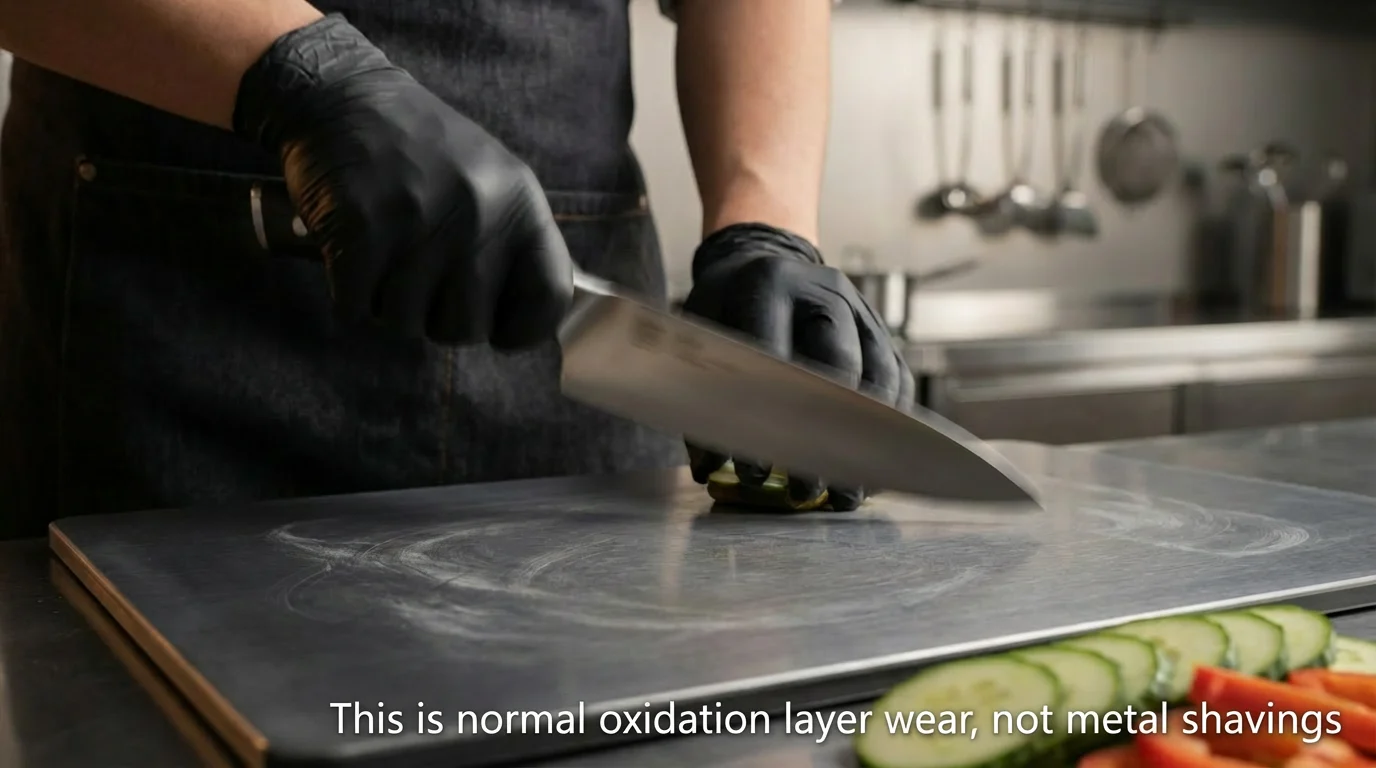
Sound, Feel & Safety
Beyond the science, what is it actually like to use one? We analyzed hours of user footage to break down the sensory experience.
1. The “Clang” Factor (The Sound)
There is no getting around it: this is metal on metal.
- Chopping: If you are forcefully chopping carrots or onions, it can be loud. Some users describe it as a high-pitched “clinking” sound.
- Slicing: If you use a slicing motion (pulling the knife back) rather than chopping up and down, the sound is much quieter.
2. The “Slip” Factor (Vital Safety Warning)
One detail often overlooked in reviews is grip. Unlike a heavy wooden block or a rubberized plastic mat, a thin titanium sheet can be slippery on a countertop.
- The Danger: As highlighted by reviewers like Kitchen Knife Guy, the knife edge can sometimes “skate” or drift across the hard metal surface rather than biting in.
- The Fix: If you buy one, make sure it comes with high-quality rubber feet or place a damp kitchen towel underneath it to lock it in place.
The “Defrosting” Hack
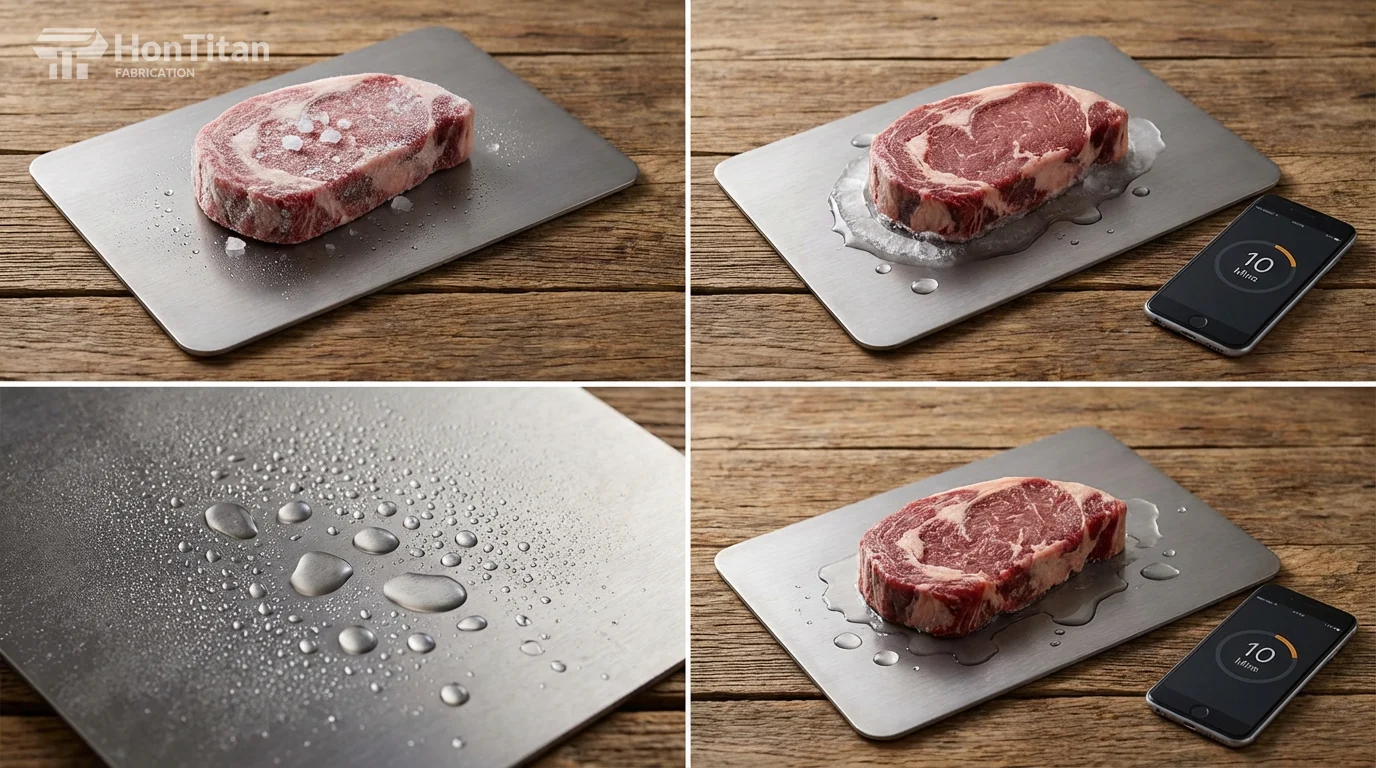
Here is a feature most people don’t realize until they own one. A titanium cutting board doubles as an incredibly effective rapid defrosting tray. If you’ve ever forgotten to take the chicken out of the freezer before work (we’ve all been there), this board is a lifesaver.
- The Physics: Titanium has a thermal conductivity roughly 100 times higher than wood.
- The Result: naturally draws the cold out of frozen food. In real-world tests, this means it thaws frozen steaks or chicken breasts about 3x faster than leaving them on a ceramic plate or wooden block.
Note: While it is not quite as instant as a dedicated aluminum thawing tray, titanium offers the perfect balance: it is fast enough to save dinner, but safe enough to eat off of.
Comparison: Titanium vs. Wood vs. Plastic
To make your decision easier, here is how titanium stacks up against the old-school options.
| Feature | Titanium | Wood (End Grain) | Plastic |
|---|---|---|---|
| Hygiene (Bacteria) | 🏆 Best (Non-porous) | Poor (Traps bacteria) | Medium |
| Microplastics | ✅ None | ✅ None | ❌ High Risk |
| Knife Friendliness | ⚠️ Poor (Dulls fast) | 🏆 Best | ⭐ Good |
| Maintenance | 🏆 Easy (Dishwasher Safe) | High (Needs Oil/Wax) | Easy |
| Durability | ⭐⭐⭐⭐⭐ (Lifetime) | ⭐⭐⭐ | ⭐⭐ |
| Defrosting | ⚡ Fast | Slow | Slow |
Final Verdict: Who Should Buy It?
So, is a titanium cutting board worth the hype? The answer is yes, but only for the right person.
✅ YES, Buy It If:
- You are “Health Conscious”: You are done with the idea of eating microplastics and scrubbing mold off wooden boards. You want the cleanest, most sterile surface possible for your family.
- You are a “Low-Maintenance” Cook: You want a board you can abuse, throw in the dishwasher, and never have to oil or sand.
- You Prep Raw Meat Often: The non-porous surface makes it the safest option for handling raw chicken or fish (Sashimi).
❌ NO, Skip It If:
- You are a Knife Enthusiast: If you own expensive Japanese high-carbon steel knives, this board will break your heart (and your edges). Stick to end-grain wood or Hasegawa rubber boards.
- You are Sensitive to Noise: If the sound of metal-on-metal makes you cringe, the “clang” of this board will drive you crazy.
Frequently Asked Questions (FAQ)
Q: Does titanium release heavy metals into food?
A: No. Grade 1 Titanium is chemically inert and biocompatible (it’s the same material used in medical implants). It does not react with acidic foods like lemons or tomatoes and will not leech metallic taste or toxins.
Q: Can I use a ceramic knife on titanium?
A: Absolutely not. Ceramic is brittle, and titanium is rigid. The impact could easily chip or snap a ceramic blade.
Q: How do I clean the scratches on the board?
A: Scratches are normal on titanium and are just cosmetic. Unlike deep gouges in plastic, they don’t harbor bacteria because of the metal’s self-healing oxide layer. You can buff them out with a Scotch-Brite pad if they bother you visually.
References
North Dakota State University Microplastics Study: Yadav, H., et al. (2023). “Cutting Boards: An Overlooked Source of Microplastics in Human Food?”. Environmental Science & Technology.
Reddit Discussion: r/Kitchen. (2024). “Anyone here tried a Titanium cutting board?”
Video Review A: Knifetime Story. (2024). “Titanium Cutting Board Review”. YouTube.
Video Review B: Kitchen Knife Guy. (2024). “Titanium Cutting Board Review”. YouTube.
Related Reading: Mini Mind Blows. “Do Titanium Cutting Boards Dull Knives? A Complete Comparison”. Medium.