What is Titanium Damascus?
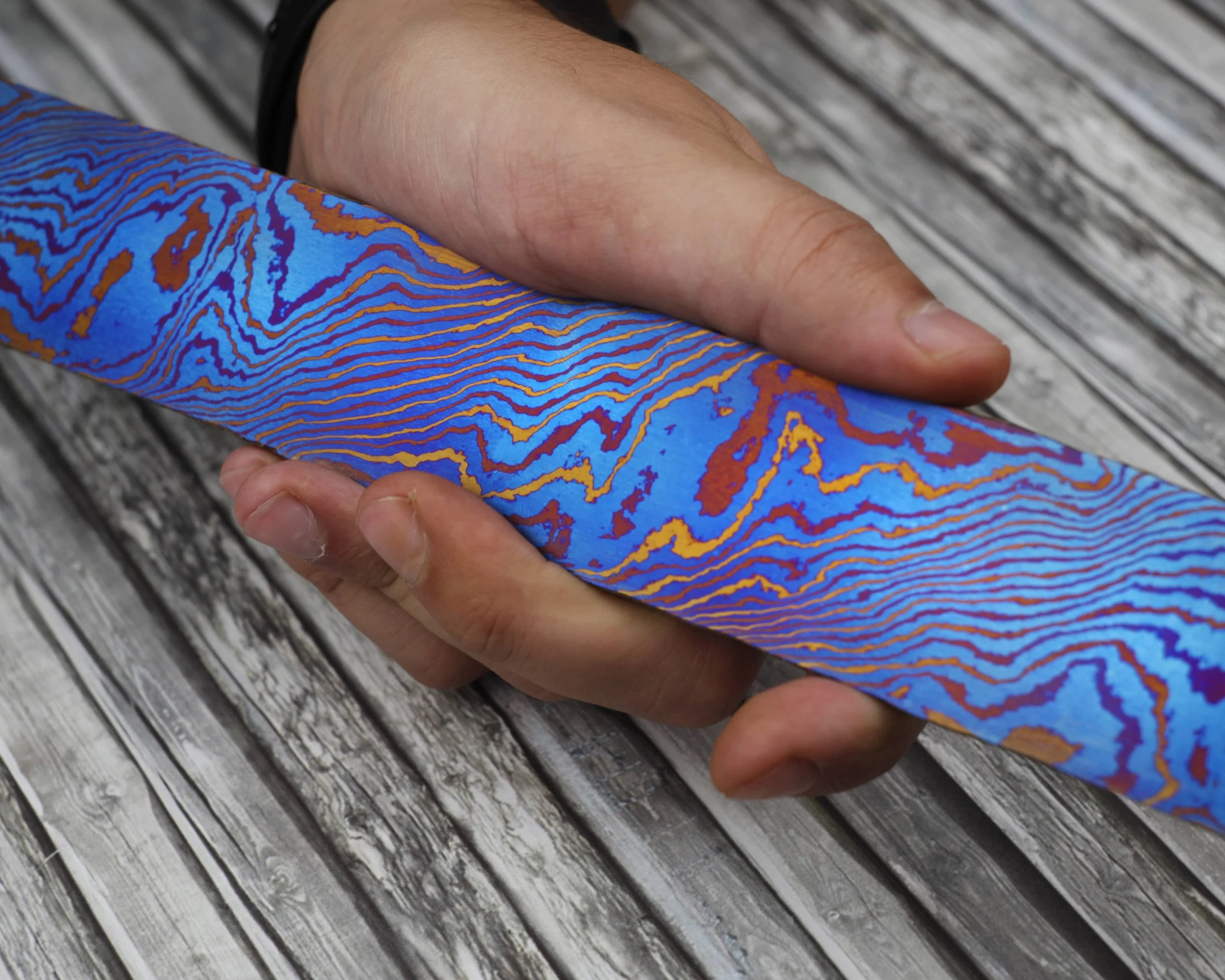
Titanium Damascus is a modern, exotic composite material produced by pattern-welding two or more distinct titanium alloys. Unlike historical Damascus steel, which was originally developed for its cutting performance, Titanium Damascus is engineered almost exclusively for its aesthetic appeal and lightweight properties.
At its core, this material is typically created by layering Grade 2 (Commercially Pure) titanium and Grade 5 (Ti-6Al-4V) titanium. Through a high-pressure, high-heat process known as diffusion bonding, these layers are fused together into a solid block, which is then forged, twisted, and manipulated to create complex internal patterns.
Quick Summary: Pros & Cons
| Pros | Cons |
|---|---|
| Hypoallergenic:Safe for sensitive skin. | Expensive:High material and production costs. |
| Rust-Proof:Zero maintenance against corrosion. | Soft:Cannot hold a sharp edge (not for blades). |
| Lightweight:~45% lighter than steel. | Fingerprint Magnet:Oils can temporarily dull colors. |
| Unique:No two patterns are identical. |
Not Steel, But Titanium
It is a common misconception that Titanium Damascus is a type of steel. It is not steel.
- Non-Magnetic: Unlike steel, it will not stick to a magnet.
- Rust-Proof: It is completely corrosion-resistant and will never rust.
- No Cutting Edge: Because titanium alloys cannot be hardened to the same level as high-carbon steel, Titanium Damascus cannot hold a sharp edge. Therefore, it is strictly used for structural or decorative parts—such as knife handles, pocket clips, and jewelry—never for the blade itself.
The material’s true magic is revealed during finishing. When heated or anodized, the different titanium layers oxidize at different rates, resulting in a high-contrast, multi-colored pattern that resembles a metallic oil painting.
Common Brands: Timascus vs. Mokuti
In the world of custom knives and EDC gear, terms are often used interchangeably, leading to confusion. Just as “Kleenex” is often used to refer to any facial tissue, specific brand names have become synonymous with the material itself.
Timascus™
Timascus is the most recognized name in the industry. It is a trademarked product created by the group Alpha Knife Supply, developed by master bladesmiths Tom Ferry and Bill Cottrell.
- Origin: It was the first widely available titanium laminate.
- Status: Because they pioneered the process, “Timascus” is frequently used by enthusiasts as a catch-all term for any titanium damascus, regardless of who made it.
Mokuti
Mokuti is another high-end titanium laminate, produced by Nichols Damascus (Chad Nichols).
- The Name: The name is a portmanteau of “Mokume-Gane” (a traditional Japanese metalworking procedure) and “Titanium.”
- Characteristics: Like Timascus, Mokuti is made from diffusion-bonded titanium alloys (usually 6Al-4V and Grade 1 or 2). While the science is similar, Nichols is known for distinct proprietary patterns and strict quality control.
Generic Titanium Damascus
With the popularity of these materials, other manufacturers (particularly from overseas markets) now produce unbranded “Titanium Damascus.” While often more affordable, the quality of the bond and the contrast of the colors can vary significantly compared to the established American brands like Timascus and Mokuti.
Key Takeaway: Whether it is labeled Timascus, Mokuti, or Pattern-Welded Titanium, the fundamental concept remains the same: layers of different titanium alloys forged together to create art.
Composition and Manufacturing Process
The stunning visuals of Titanium Damascus are not painted on; they are the result of advanced metallurgy. Understanding how it is made helps explain why this material is often as expensive as precious metals.
The Ingredients: Why Two Grades?
To create a contrasting pattern, you cannot simply forge two pieces of the same metal together. You need two alloys that behave differently when exposed to heat or electricity.
- Grade 2 (CP Titanium): This is Commercially Pure titanium. It is softer and forms a specific thickness of oxide layer at a given voltage.
- Grade 5 (Ti-6Al-4V): This is an alloy containing 6% Aluminum and 4% Vanadium. It is harder and forms a different oxide layer thickness under the same conditions.
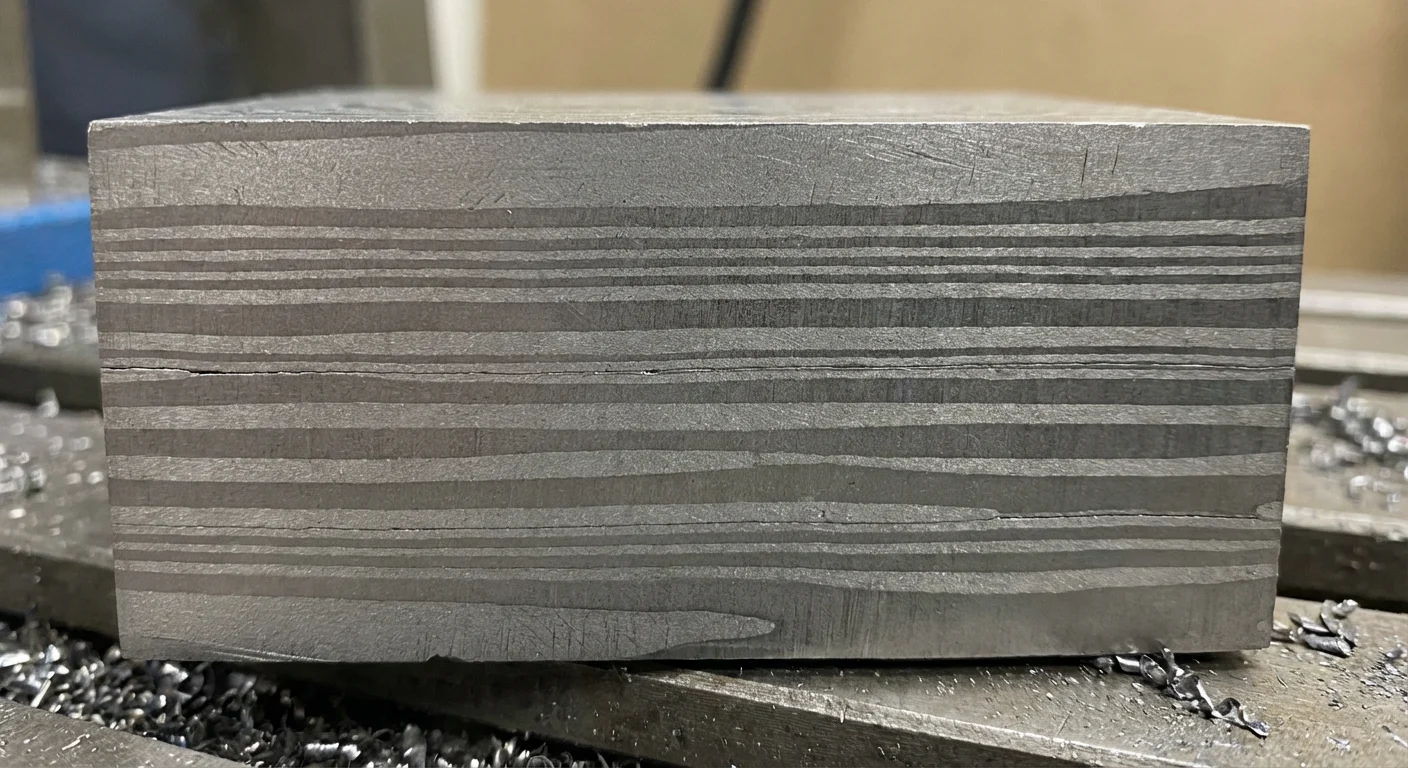
When these two are combined, one might turn purple while the other turns blue, revealing the hidden pattern.
The Process: Diffusion Bonding
Manufacturing Titanium Damascus is significantly more difficult than making steel damascus because titanium reacts poorly to oxygen when heated. The process typically involves:
- Stacking: Sheets of Grade 2 and Grade 5 titanium are stacked in alternating layers, like a sandwich.
- Encasing: To prevent oxidation (which ruins the bond), the stack is often welded inside a sealed, airtight steel canister or placed in a vacuum environment.
- Diffusion Bonding: The stack is heated to extreme temperatures and subjected to massive pressure (often using a hydraulic press). Unlike soldering, the metals do not melt; instead, atoms migrate across the joint boundary, fusing the layers into a solid “billet” at the molecular level.
- Patterning: Once bonded, the billet is forged, twisted, cut, and re-welded. This manipulation distorts the straight layers into swirls, raindrops, or mosaic patterns.
How Coloring Works: Heating and Anodizing
A raw, un-finished piece of Titanium Damascus looks like a plain, grey block of metal. The mesmerizing colors only appear when the surface is oxidized. This is not a dye or pigment; it is physics.
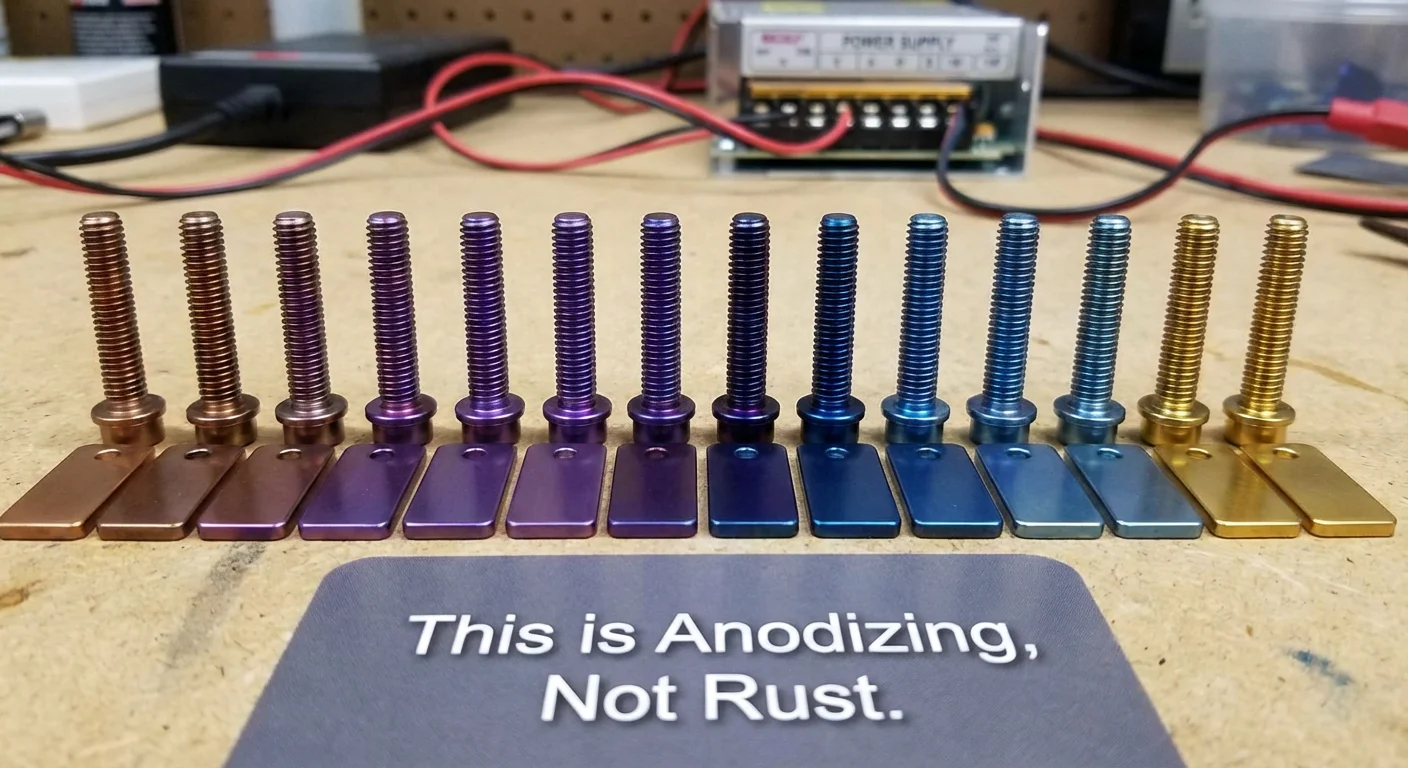
The colors are created by a transparent oxide layer that forms on the surface. This layer refracts light (similar to the rainbow colors on a soap bubble or an oil slick). By controlling the thickness of this oxide layer, makers can manipulate which color of the light spectrum is reflected back to your eye.
There are two primary methods to unlock these colors:
Method A: Flame Anodizing (Heat Coloring)
This is the “artistic” approach, favored for its organic, high-contrast look.
- Process: The maker uses a propane or MAP gas torch to heat the metal.
- Result: As the titanium heats up, it shifts through a spectrum of colors: Gold $\rightarrow$ Purple $\rightarrow$ Blue $\rightarrow$ Light Blue.
- The Look: Flame coloring tends to produce richer, deeper hues, but it is less precise. The temperature variation creates a natural, gradient transition between colors.
Method B: Electrical Anodizing
This is the “scientific” approach, favored for precision and specific color matching.
- Process: The piece is submerged in an electrolyte solution (like TSP or baking soda water) and connected to a DC power supply.
- Result: The voltage determines the exact color. Because Grade 2 and Grade 5 titanium grow oxides at different rates, a single voltage will produce two distinct colors on the same ring or knife handle.
For more technical details, see the principles of Titanium Anodizing.
Titanium Anodizing Voltage Spectrum (Approximate)
- 10V – 15V: Bronze / Dark Gold
- 20V – 25V: Dark Blue / Purple
- 28V – 30V: Bright Blue
- 50V – 55V: Yellow / Gold
- 70V – 75V: Pink / Magenta
- 90V+: Teal / Green
Note – The “Missing Red”: You might notice a lack of bright red or black on the spectrum. In standard titanium anodizing, true red is physically impossible to achieve due to the refractive index of the oxide. The closest you can get is a reddish-pink or magenta at higher voltages (~70V).
Titanium Damascus vs. Damascus Steel
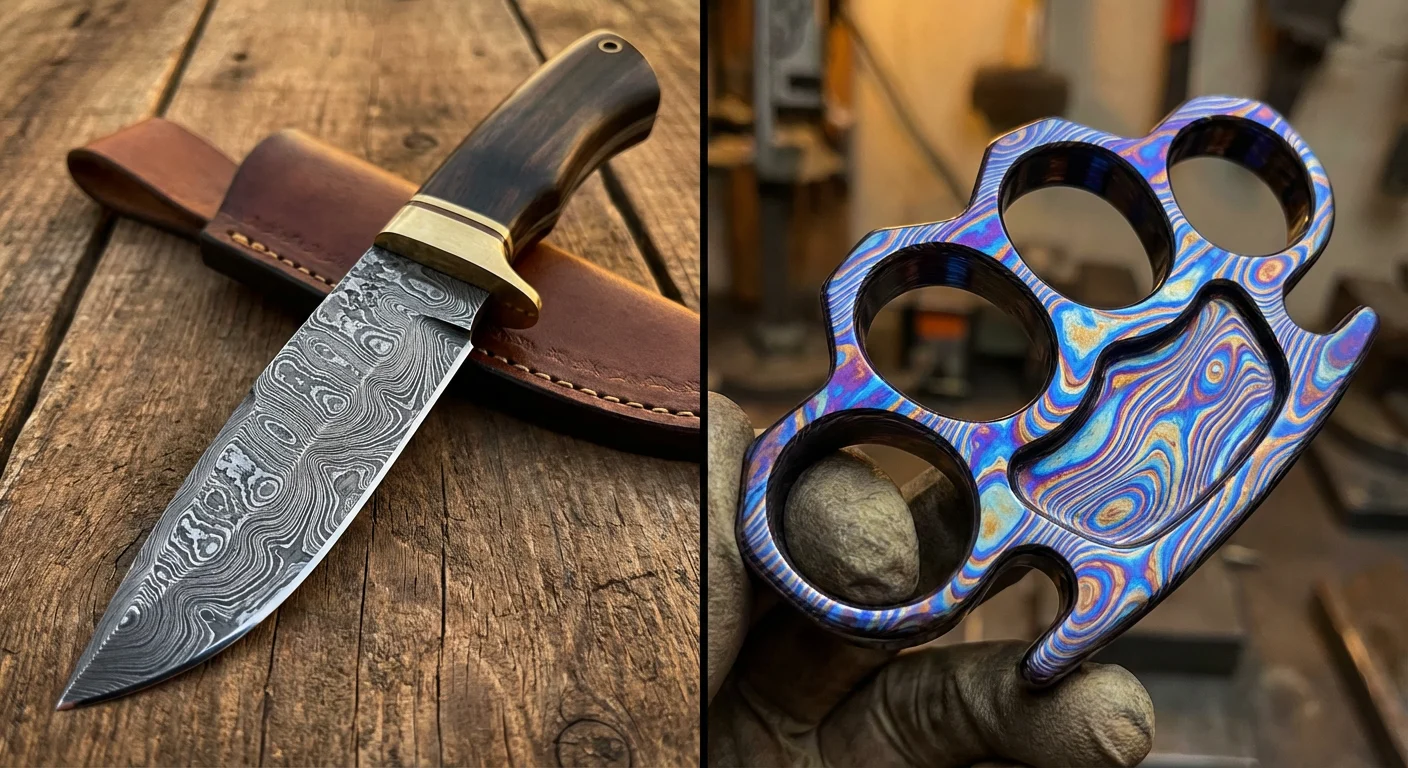
The shared name “Damascus” often confuses buyers. In this context, “Damascus” refers only to the pattern-welding process, not the material itself. They are fundamentally different metals with different physical properties.
Here is the critical breakdown:
Hardness and Utility (The Blade Issue)
This is the most important distinction.
- Damascus Steel: Is hardenable (typically 58-62 HRC). It holds a razor-sharp edge and is used for knife blades.
- Titanium Damascus: Is much softer (typically 30-40 HRC). It cannot hold a cutting edge and will dull almost immediately if sharpened. It is used strictly for knife handles, bolsters, and clips.
Warning: If you see a knife claiming to have a “Titanium Damascus Blade,” it is likely a decorative object or a letter opener, not a functional cutting tool.
Corrosion Resistance
- Damascus Steel: Composed of iron and carbon. It will rust if not oiled and maintained properly.
- Titanium Damascus: Composed of titanium alloys. It is 100% rust-proof and hypoallergenic. It requires zero maintenance against moisture, making it superior for jewelry and daily wear rings.
Weight and Magnetism
- Weight: Titanium is approximately 45% lighter than steel. A large Titanium Damascus ring will feel surprisingly light on the finger compared to a steel one.
- Magnetism: Titanium is non-magnetic.
Quick Comparison Chart
| Feature | Damascus Steel | Titanium Damascus (Timascus/Mokuti) |
|---|---|---|
| Primary Use | Knife Blades, Tools | Handles, Jewelry, EDC Gear |
| Hardness (HRC) | High (~60 HRC) | Low (~35 HRC) |
| Rust Resistance | Low (Needs Oil) | Excellent (Rust Proof) |
| Magnetic | Yes | No |
| Colors | Grey, Silver, Black | Blue, Purple, Gold, Green |
Common Uses and Applications
Because of its high cost and specific physical properties, Titanium Damascus is reserved for high-end applications where aesthetics and weight are paramount. It is rarely hidden; it is meant to be seen.
Knife Making (Handles & Hardware)
This is the original and most popular application. Custom knife makers use slabs of Timascus to elevate a functional tool into a piece of art.
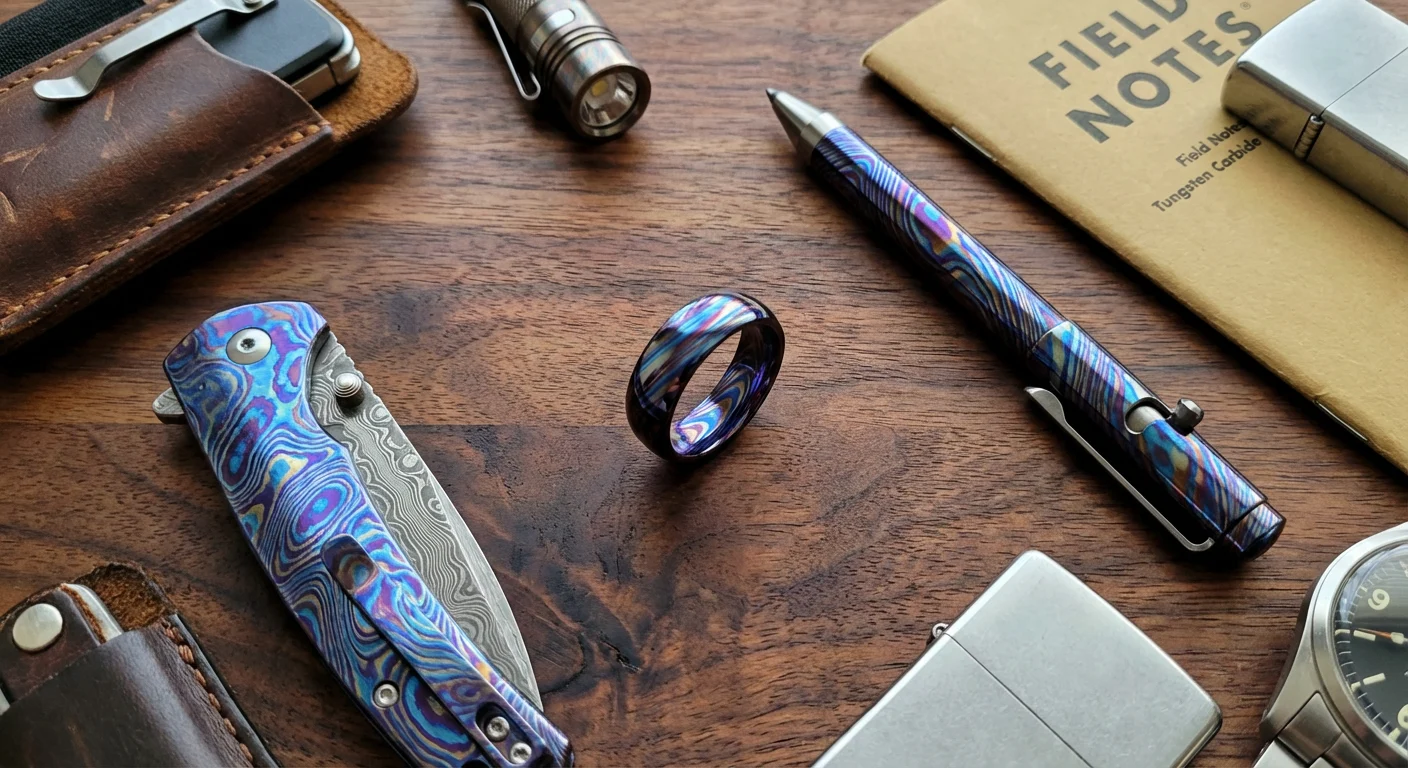
- Scales (Handles): The material is light but strong, making it perfect for handle scales on folding knives.
- Pocket Clips & Backspacers: Many enthusiasts upgrade their standard steel clips to Titanium Damascus clips (“pimping” their knife) to add a splash of color to an otherwise plain tool.
- Inlays: Small pieces are often inlaid into steel or carbon fiber handles as decorative accents.
Jewelry (Wedding Bands)
Titanium Damascus has exploded in popularity in the wedding ring market, offering a masculine, rugged alternative to gold or platinum.
- Hypoallergenic: Unlike nickel-heavy steel or some gold alloys, titanium is biocompatible. It will not turn your finger green or cause skin irritation.
- Lightweight: A broad man’s ring made of gold can feel heavy and intrusive. A Titanium Damascus ring is so light you might forget you are wearing it.
- Uniqueness: Because of the organic forging process, the pattern on every ring is like a fingerprint—no two are exactly alike.
High-End EDC Gear (“Pocket Jewelry”)
In the “Everyday Carry” community, items made from this material are often affectionately called “Pocket Jewelry.”
- Pens: Bolt-action pens milled entirely from Timascus rods.
- Flashlights: Custom torch bodies that act as status symbols.
- Lanyard Beads: Small, intricate beads tied to knife lanyards or keychains.
- Watch Cases: Luxury micro-brands occasionally use it for watch cases or bezels to create unique, one-of-a-kind timepieces.
Frequently Asked Questions (FAQ)
Here are the most common questions regarding Titanium Damascus, Timascus, and Mokuti.
Q: Why is Titanium Damascus so expensive?
A: It is due to the difficulty of manufacturing. Titanium reacts poorly to oxygen at high temperatures. To bond the layers, makers must use expensive vacuum presses or sealed canisters.
- Price Context: To give you an idea of the cost, a small raw billet (e.g., for a ring) can cost $50-$100, while a finished custom ring often starts at $250+. Compared to a standard $50 steel ring, it is a significant investment.
Q: Can you make a knife blade out of Timascus?
A: No. Titanium Damascus cannot be heat-treated to the hardness required for a cutting edge (typically 58+ HRC). While it is strong, it is too soft to hold an edge and will dull almost immediately. It is strictly used for handles, clips, and decorative hardware.
Q: Does Titanium Damascus rust?
A: No. One of the biggest advantages of this material is that it is 100% corrosion-resistant. Unlike Damascus Steel, which requires regular oiling to prevent rust, Titanium Damascus can be exposed to sweat, saltwater, and humidity without any maintenance.
Q: Will the color fade over time?
A: Yes, but it can be restored. The color comes from a thin oxide layer on the surface. Heavy friction can wear this layer down, causing the color to fade to dull grey. However, the color can easily be restored by re-anodizing or re-heating the piece.
Q: How do I clean and maintain it? (The Fingerprint Issue)
A: Titanium Damascus is a “fingerprint magnet.” Skin oils can settle into the oxide layer, changing the light refraction and making the colors look dull or faded. This is not permanent damage. Simply wipe the piece down with Windex (glass cleaner) or a bit of acetone/alcohol. This removes the oils, and the vibrant colors will return instantly.
Q: Is Timascus magnetic?
A: No. Titanium alloys are non-magnetic. This is the easiest way to tell if you are buying real Titanium Damascus or a steel imitation. If a magnet sticks to it, it is not titanium.
Conclusion
Titanium Damascus represents the perfect fusion of modern metallurgy and artistic expression. Whether you call it Timascus, Mokuti, or simply “Fancy Ti,” it offers a unique combination of lightweight performance, hypoallergenic safety, and unrivaled visual beauty. While it may not cut like steel, its ability to transform into a spectrum of colors makes it one of the most desirable materials in the world of EDC and jewelry.