Titanium is frequently marketed as a superior, nearly indestructible material in industries ranging from consumer electronics to aerospace. However, for engineers and informed buyers, understanding its true capabilities requires looking past the marketing reputation and focusing on the physical data.
When choosing between steel and titanium for tools, prototypes, or outdoor gear, the core question is often: Is titanium actually stronger than steel?
The answer depends on the specific definition of “strength” being used.
The Short Answer: Is Titanium Stronger Than Steel?
In terms of absolute hardness, high-carbon steel is harder and more resistant to surface scratching. However, Titanium is approximately 45% lighter than steel while offering comparable tensile strength. This results in a superior strength-to-weight ratio. While steel often surpasses titanium in raw hardness and absolute load-bearing capacity, titanium offers greater efficiency, corrosion resistance, and specific strength.
Clarifying “Strength”
Confusion often arises because “strength” can refer to different physical properties:
- Tensile Strength: The maximum stress a material can withstand while being stretched or pulled before breaking. (Titanium performs very well here).
- Hardness: The resistance of a material to localized deformation, such as scratching or indentation. (Titanium is softer than many heat-treated steels).
This guide compares Titanium vs. Steel vs. Aluminum based on density, mechanical properties, and practical applications.
Titanium vs. Steel vs. Aluminum: Material Comparison
To evaluate titanium’s performance, it is useful to compare it against its primary alternatives: Stainless Steel (durable but heavy) and Aluminum (lightweight but weaker).
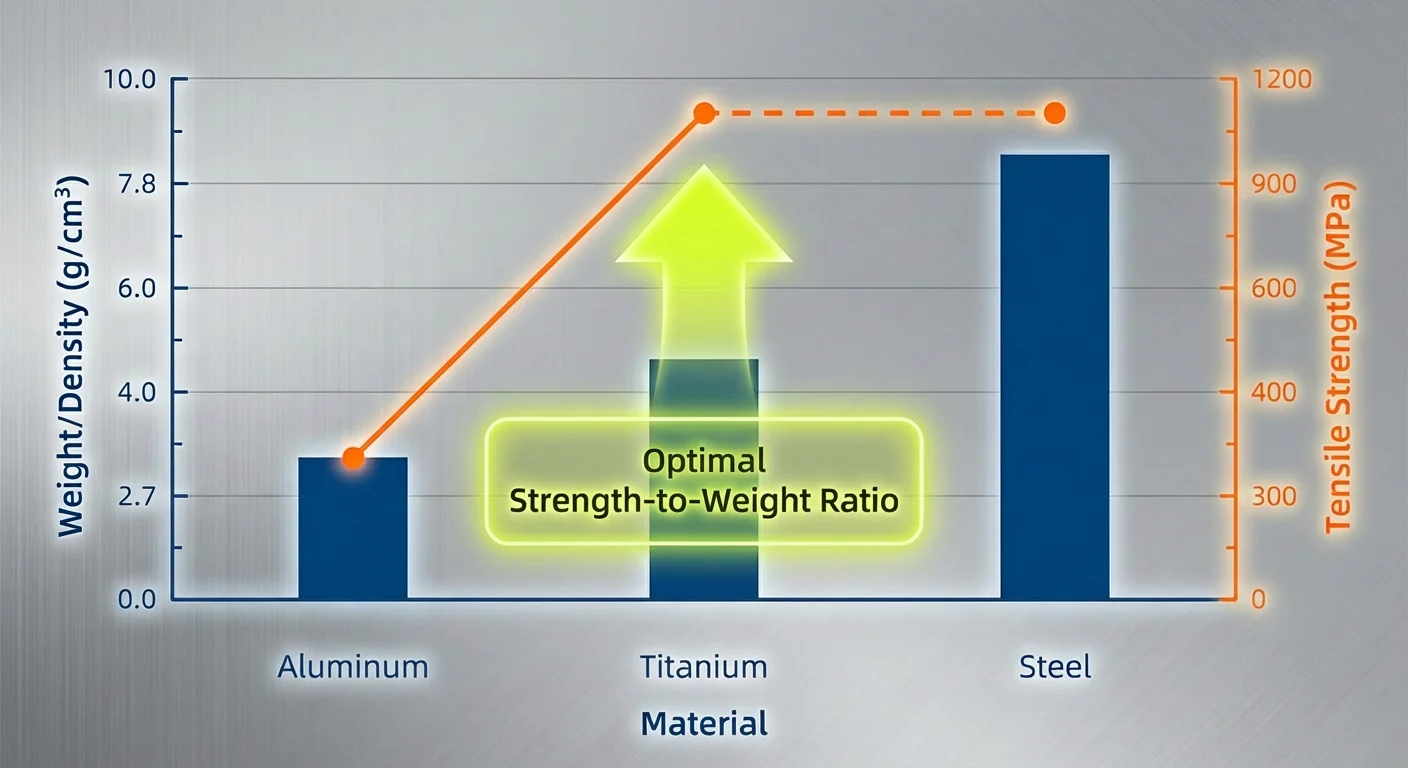
The following data compares common high-performance alloys: Titanium Grade 5 (Ti-6Al-4V), Stainless Steel (304), and Aluminum (7075-T6).
Property Data
| Property | Aluminum (7075-T6) | Titanium (Grade 5) | Stainless Steel (304) |
|---|---|---|---|
| Density (g/cm³) | ~2.81 (Lightest) | ~4.43 (Medium) | ~8.00 (Heaviest) |
| Tensile Strength (MPa) | ~572 MPa | ~950 – 1050 MPa | ~500 – 700 MPa |
| Hardness (Brinell) | ~150 | ~334 | ~200 |
| Strength-to-Weight Ratio | High | Superior (Highest) | Low |
| Corrosion Resistance | Moderate | Excellent | Good |
The Strength-to-Weight Ratio Advantage
The strength-to-weight ratio is the primary reason titanium is selected for high-performance applications.
As shown in the table, Titanium is approximately 60% heavier than Aluminum, but offers more than double the tensile strength. Conversely, it is 45% lighter than Steel, yet rivals many steel alloys in strength.
This balance makes titanium the preferred material for aerospace components and ultralight hiking gear. It occupies an optimal middle ground:
- Aluminum is lightweight but may lack the necessary strength for high-stress components.
- Steel offers high strength but comes with a significant weight penalty.
- Titanium provides steel-like strength at nearly half the weight.
Absolute Strength vs. Yield Strength
It is important to note that while Grade 5 Titanium is strong, specialized high-carbon steels can offer higher absolute load-bearing capacity.
However, Titanium has a high Yield Strength—the stress level at which a material begins to deform plastically. This property allows titanium components, such as tent stakes or pocket clips, to flex significantly under load and return to their original shape without permanent bending.
Strength vs. Hardness: Scratch Resistance
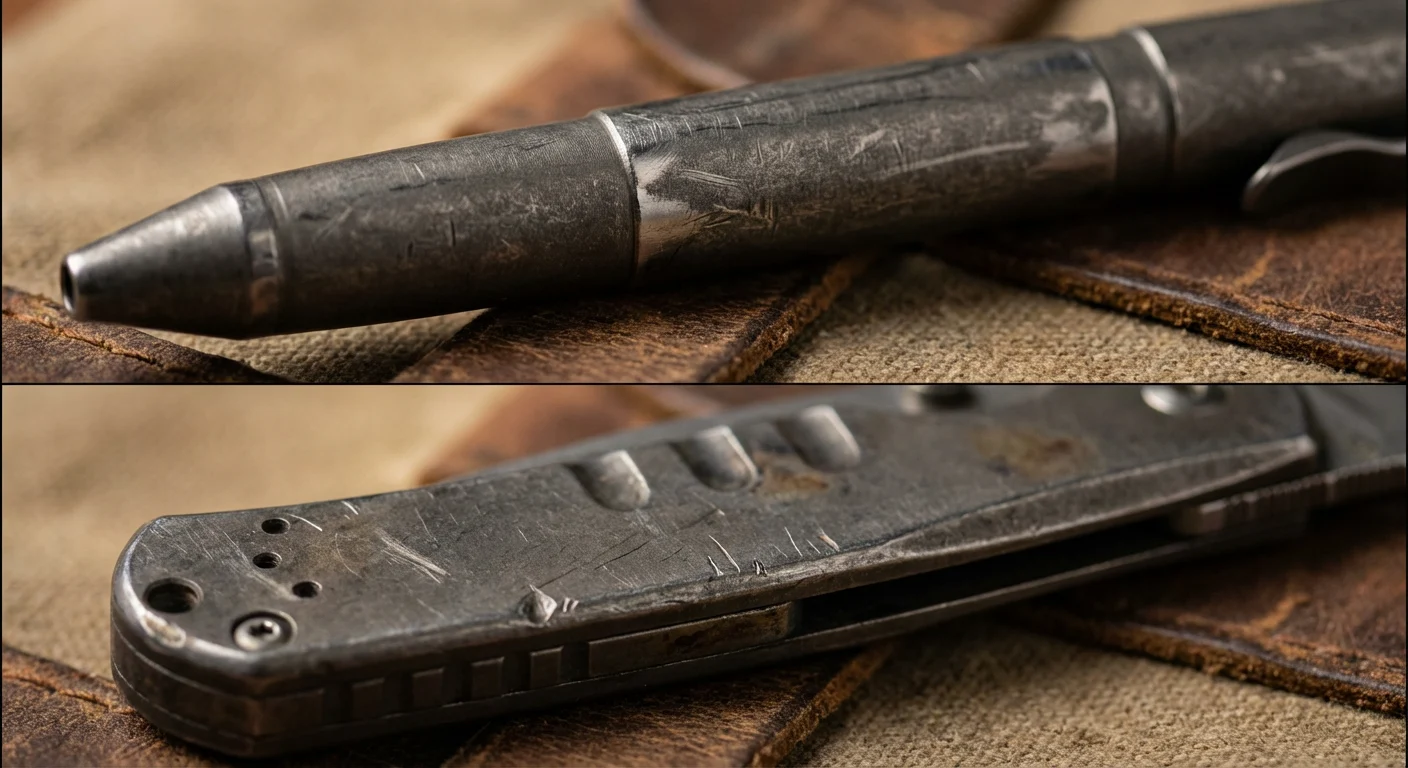
A common misconception is that titanium is scratch-proof. Consumers often expect titanium products to remain pristine, but the material is susceptible to surface markings.
This distinction lies between Strength and Hardness.
- Strength (Toughness): Resistance to fracture or breaking under tension.
- Hardness: Resistance to surface abrasion or scratching.
Why Titanium Scratches
On the Mohs Scale of Mineral Hardness, titanium ranks lower than hardened steel.
A hardened steel knife blade typically has a Rockwell C (HRC) hardness of 58-62, whereas untreated Titanium Grade 5 measures approximately HRC 36. Consequently, harder materials, such as steel keys or rocks, can scratch raw titanium surfaces.
However, titanium possesses a unique property: Oxidation. When scratched, titanium reacts with oxygen to reform a thin, protective oxide layer. Over time, surface scratches on raw titanium tend to blend into a uniform matte grey finish, often referred to as a patina.
Stiffness and Flexibility
Titanium also differs from steel in its Modulus of Elasticity.
- Steel is rigid.
- Titanium is more flexible.
Titanium is roughly half as stiff as steel. This flexibility is advantageous in specific applications. For instance, a titanium bicycle frame can absorb road vibrations more effectively than a rigid aluminum or steel frame, providing a smoother ride. Similarly, thin titanium components are less likely to snap under sudden impact compared to more brittle materials.
Titanium Grades: Grade 2 vs. Grade 5
Titanium is available in various grades, with the two most common being Grade 2 and Grade 5. Distinguishing between them is essential for selecting the right material.
Grade 2 (Commercially Pure Titanium)
Grade 2 is commercially pure titanium (>99% Ti).
- Strength: Tensile strength of approximately 344 MPa. It is strong, but comparable to high-strength aluminum alloys.
- Characteristics: Ductile, formable, and easy to weld.
- Best For: Applications requiring high formability and corrosion resistance, such as cookware, chemical piping, and medical tubing.
Grade 5 (Ti-6Al-4V)
Grade 5 is an alloy consisting of 90% Titanium, 6% Aluminum, and 4% Vanadium.
- Strength: Tensile strength of ~895 – 1000 MPa. It is nearly three times stronger than Grade 2.
- Characteristics: Heat-treatable and significantly harder than Grade 2. It is more difficult to machine but offers superior structural integrity.
- Best For: High-stress components such as knife handles, tactical gear, aerospace fasteners, and automotive parts.
💡 Note for Manufacturing: 3D Printing & Machining
- Machining: Grade 2 is softer and can be “gummy” during machining. Grade 5 is harder and generates more heat, requiring specific tooling speeds.
- 3D Printing: Most titanium 3D printing (DMLS/SLM) utilizes Grade 5 (Ti-6Al-4V) powder. This enables the production of complex, lightweight structures that maintain the high strength of the alloy.
Durability and Corrosion Resistance
Beyond mechanical strength, titanium offers superior Chemical Durability.
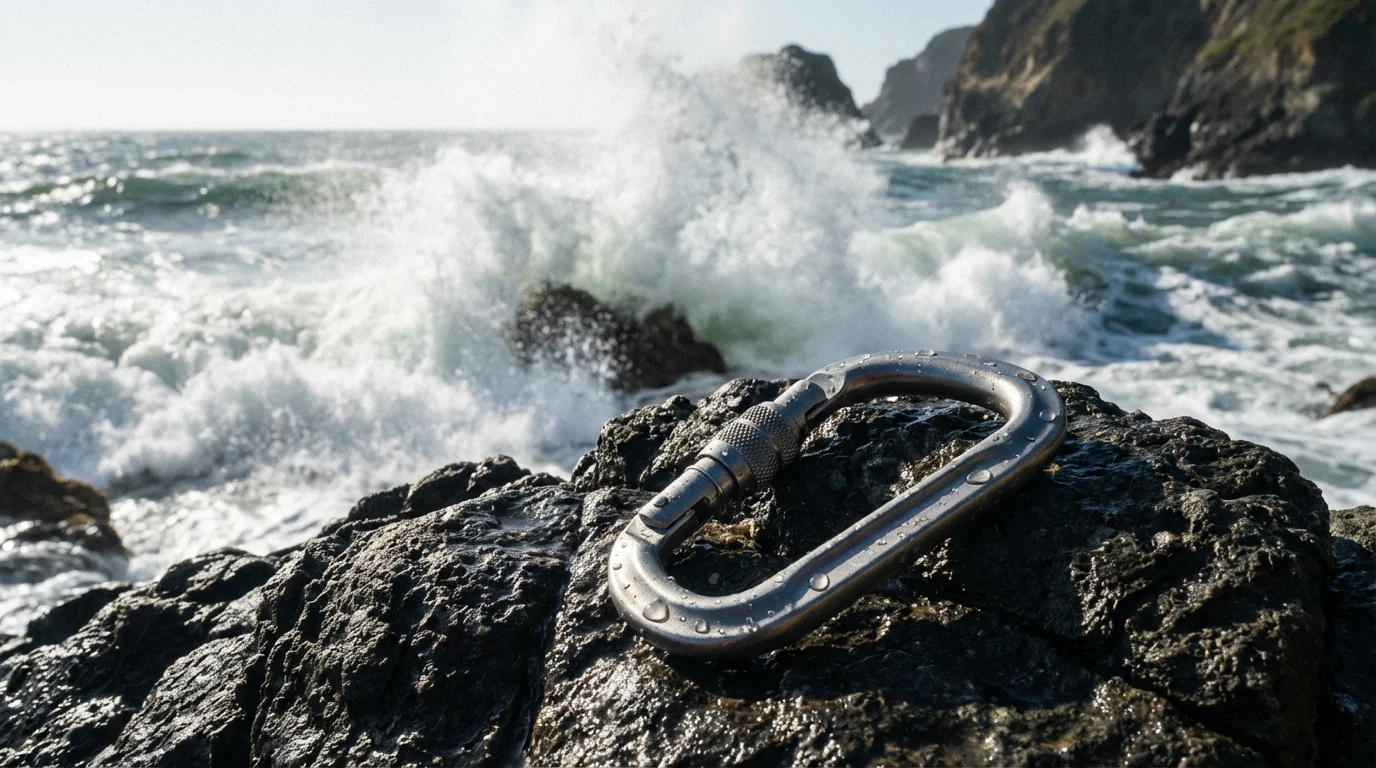
Standard steel relies on protective coatings or chromium content (in stainless steel) to resist rust. In harsh environments like saltwater, even stainless steel can eventually corrode. Aluminum relies on an anodized layer which, if damaged, exposes the base metal to oxidation.
Atmospheric Immunity
Titanium is virtually immune to atmospheric and saltwater corrosion. A piece of Grade 5 titanium can withstand long-term exposure to seawater without degrading. This is due to the stable, continuous oxide film that naturally forms on its surface and regenerates if damaged in the presence of oxygen.
Practical Benefits
- Low Maintenance: Unlike steel tools that may require oiling, titanium gear does not require rust prevention maintenance.
- Biocompatibility: Titanium is inert and hypoallergenic, making it suitable for users with metal sensitivities (e.g., nickel allergies).
- Neutral Taste: For food and beverage containers, titanium does not impart a metallic taste.
Applications: Selecting the Right Material
Based on the physical data, titanium is the optimal choice in specific scenarios.
1. Ultralight Outdoor Gear
For applications where weight reduction is critical.
- Cookware: High strength allows for very thin walls (0.3mm – 0.4mm), reducing weight significantly compared to steel.
- Structural Gear: High yield strength prevents permanent bending in items like tent stakes.
- Conclusion: Ideal for weight-sensitive outdoor activities.

2. Aerospace & Automotive
For applications requiring high performance and fuel efficiency.
- Components: Grade 5 Titanium is used for fasteners and structural parts to reduce mass without compromising safety standards.
- Conclusion: Ideal for performance-critical engineering.
3. Medical & Daily Wear
For applications requiring biocompatibility.
- Implants & Jewelry: Titanium’s inert nature allows for osseointegration (bone growth) and prevents skin irritation.
- Conclusion: Ideal for prolonged bodily contact.
Conclusion
Is titanium the strongest metal? If “strong” is defined as hardest, then no. Hardened steel offers better scratch resistance and edge retention. If “strong” is defined by efficiency and specific strength, then yes.
Summary:
- Select Steel for maximum hardness, sharp cutting edges, or cost-effectiveness.
- Select Aluminum for the absolute lightest weight in low-stress parts and budget constraints.
- Select Titanium for the optimal balance of high strength, low weight, and superior corrosion resistance.
Frequently Asked Questions (FAQ)
Is titanium bulletproof?
Not inherently. While titanium is used in some ballistic armor due to its high strength-to-weight ratio, standard titanium sheets used in consumer goods are not bulletproof. Stopping a projectile requires specific thickness and ballistic-rated alloys.
Why is titanium so expensive?
The high cost stems from the refining and processing difficulty. Extracting titanium from ore (the Kroll process) is energy-intensive. Furthermore, titanium is difficult to machine and weld, wearing out tools faster than steel, which increases manufacturing costs.
Can titanium rust?
For all practical purposes, no. Titanium is immune to naturally occurring corrosion, including saltwater, rain, and perspiration. It is far more corrosion-resistant than stainless steel.
How can I tell if my titanium is real?
Check the weight and magnetism. Titanium is non-magnetic (a magnet won’t stick) and feels surprisingly light compared to steel. For a definitive test, jewelers or scrap yards can use X-ray fluorescence (XRF) analyzers.
Is titanium toxic?
No. Titanium is biologically inert and hypoallergenic, which is why it is the standard material for surgical implants and body jewelry. It does not react with human tissue.