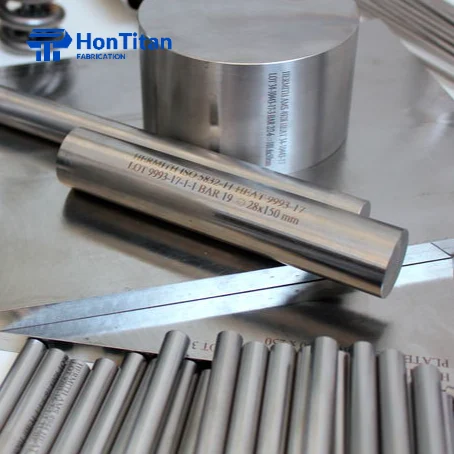
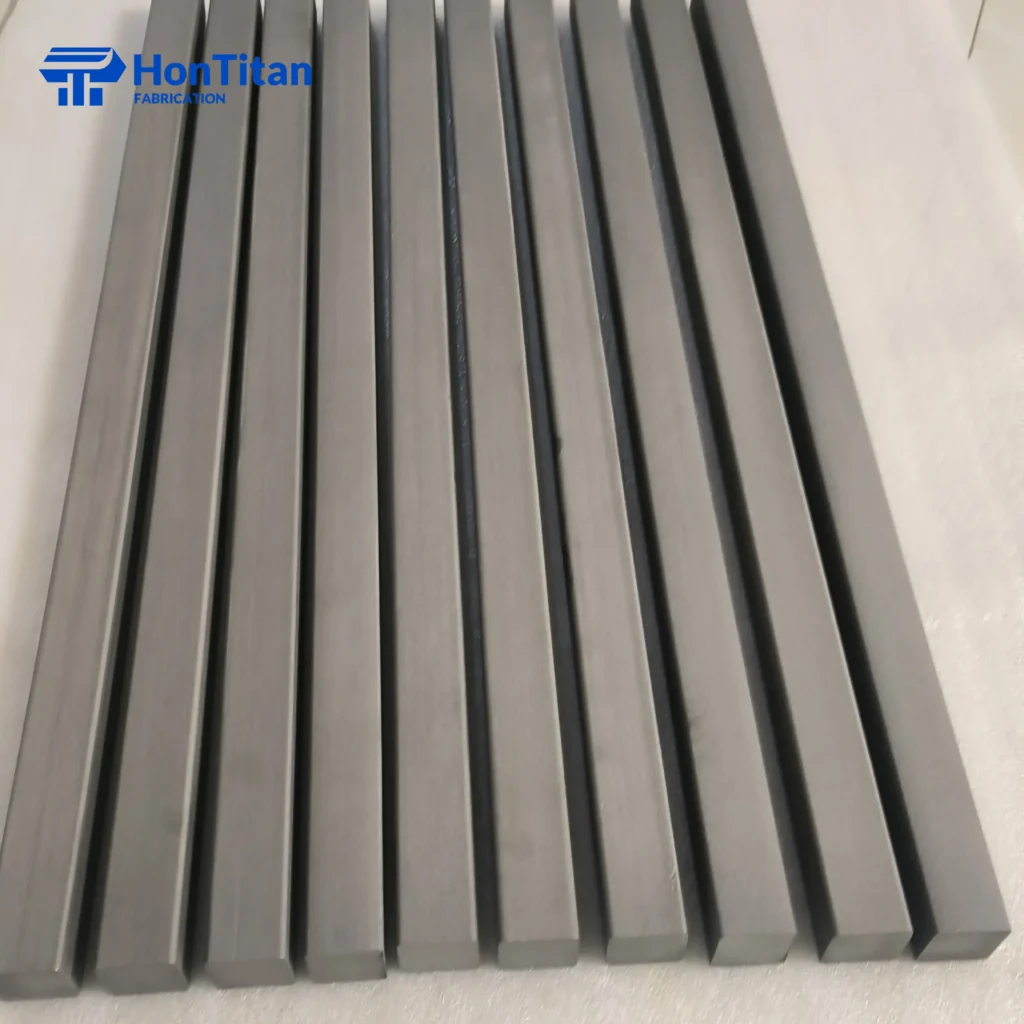
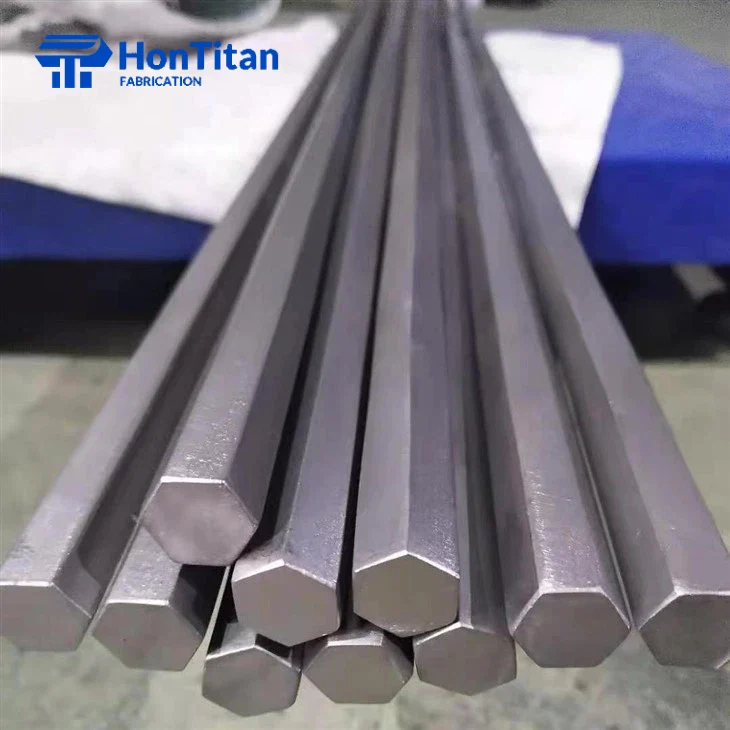
Ti-6242 (Ti-6Al-2Sn-4Zr-2Mo) is a near-alpha titanium alloy engineered for sustained structural performance at elevated temperatures, with a maximum service capability of approximately 538°C (1000°F) — significantly above the practical ceiling of Ti-6Al-4V. Round bar stock produced per AMS 4975 is the primary machining feedstock for aerospace compressor blades, discs, and airframe structural billet requiring reliable creep resistance and long-term thermal stability.
Quick Specifications
| Parameter |
Value |
| Alloy Designation |
Ti-6Al-2Sn-4Zr-2Mo (Ti-6242) |
| UNS |
R54620 |
| Primary Standard (Bar) |
AMS 4975 |
| Additional Standards |
AMS 4919 (Sheet/Plate), AMS 4976 (Forgings), MIL-T-9047 |
| Density |
4.54 g/cm³ (0.164 lb/in³) |
| Max Service Temperature |
~538°C (1000°F) |
| Diameter Range |
12–200 mm (custom sizes available) |
| Mill Test Certificate |
EN 10204 3.1 |
What Is Ti-6242 Titanium?
Ti-6242 is a near-alpha titanium alloy combining aluminum (Al), tin (Sn), zirconium (Zr), and molybdenum (Mo) to deliver exceptional thermal stability and creep resistance at temperatures where standard alpha-beta alloys such as Ti-6Al-4V begin to lose structural integrity.
The alloy classification — “near-alpha” — refers to a microstructure that is predominantly alpha phase with only a small fraction of retained beta. This configuration stabilizes the material’s properties at elevated service temperatures because the alpha phase is inherently more creep-resistant than beta-phase titanium. The deliberate addition of silicon (Si at 0.06–0.10%) further suppresses creep by pinning dislocation movement at grain boundaries, a mechanism that becomes critical in high-pressure compressor environments where components cycle through sustained thermal and mechanical loading.
Compared with Ti-6Al-4V (Grade 5), Ti-6242 offers approximately 140°C higher continuous service temperature and measurably lower creep strain rates under equivalent stress. This advantage comes at the cost of higher alloy complexity, more restricted weldability, and greater machining difficulty. As a result, Ti-6242 round bar is typically specified only when thermal exposure requirements genuinely necessitate the upgrade — primarily in jet engine high-pressure compressor (HPC) stages, gas turbine structural rings, and weight-sensitive high-temperature airframe applications.
Chemical Composition — AMS 4975
Chemical composition per AMS 4975, expressed as weight percent:
| Element |
Min (wt%) |
Max (wt%) |
| Aluminum (Al) |
5.50 |
6.50 |
| Tin (Sn) |
1.80 |
2.20 |
| Zirconium (Zr) |
3.60 |
4.40 |
| Molybdenum (Mo) |
1.80 |
2.20 |
| Silicon (Si) |
0.06 |
0.10 |
| Iron (Fe) |
— |
0.25 |
| Oxygen (O) |
— |
0.15 |
| Carbon © |
— |
0.05 |
| Nitrogen (N) |
— |
0.05 |
| Hydrogen (H) |
— |
0.015 |
| Yttrium (Y) |
— |
0.005 |
| Titanium (Ti) |
Balance |
— |
Melt process: Bar stock is produced via Vacuum Arc Remelting (VAR) or Electron Beam Cold Hearth Melting (EBCHM) to ensure compositional homogeneity and removal of high-density inclusions (HDIs). Double or triple VAR is standard for aerospace-critical bar.
Traceability: Each heat is assigned a unique heat number traceable through the full production chain, documented on the EN 10204 3.1 Mill Test Certificate (MTC).
Mechanical Properties
Minimum Requirements per AMS 4975 (Solution Treated and Aged)
The following minimums apply to round bar per AMS 4975 in the Solution Treated and Aged (STA) condition:
| Property |
Minimum Value (Metric) |
Minimum Value (Imperial) |
| Tensile Strength (UTS) |
896 MPa |
130,000 psi |
| Yield Strength (0.2% offset) |
827 MPa |
120,000 psi |
| Elongation in 4D |
10% |
10% |
| Reduction in Area |
25% |
25% |
Typical Properties (STA Condition)
| Property |
Typical Value |
| Tensile Strength (UTS) |
1050–1110 MPa |
| Yield Strength (0.2% offset) |
965–1050 MPa |
| Elongation |
10–15% |
| Reduction in Area |
25–35% |
| Hardness |
30–36 HRC (approx. 318–333 HV) |
Physical & Thermal Properties
| Property |
Value |
| Density |
4.54 g/cm³ (0.164 lb/in³) |
| Elastic Modulus |
113–118 GPa (16,400–17,100 ksi) |
| Shear Modulus |
44.5 GPa |
| Poisson’s Ratio |
0.325 |
| Thermal Conductivity |
~6.0–7.0 W/m·K |
| Coefficient of Thermal Expansion (CTE) |
~9.9 × 10⁻⁶ /°C (0–100°C range) |
| Beta Transus |
~1000°C (1832°F) |
| Melting Range |
~1634–1664°C |
Elevated Temperature Performance
Ti-6242 retains meaningful structural strength above 480°C, where tensile strength typically remains at approximately 700 MPa or higher under short-duration testing. Under sustained creep loading, the maximum recommended service temperature is 538°C (1000°F) — the threshold commonly cited across industry data sources including Smiths Advanced Metals and Smith Metal Products.
Ti-6242 vs. Ti-6Al-4V — Selecting the Right Grade
Ti-6242 and Ti-6Al-4V are both widely specified aerospace titanium alloys, but they serve fundamentally different application profiles. The table below provides a direct property comparison to support material selection decisions:
| Property |
Ti-6242 (AMS 4975) |
Ti-6Al-4V / Grade 5 (AMS 4928) |
| Alloy Classification |
Near-alpha |
Alpha-beta |
| UNS |
R54620 |
R56400 |
| Density |
4.54 g/cm³ |
4.43 g/cm³ |
| Tensile Strength (typical STA) |
1050–1110 MPa |
930–1000 MPa |
| Yield Strength (typical STA) |
965–1050 MPa |
860–910 MPa |
| Elastic Modulus |
113–118 GPa |
114 GPa |
| Max Continuous Service Temp |
~538°C (1000°F) |
~315–400°C (600–750°F) |
| Creep Resistance |
Superior |
Moderate |
| Weldability |
Fair (PWHT recommended) |
Good |
| Machinability |
More difficult |
Easier |
| Relative Cost |
Higher |
Lower |
| Primary Application |
Jet engine HPC stages, airframe STA billets |
Structural airframe, medical implants, industrial |
When to specify Ti-6242: The alloy is appropriate when operating temperature exceeds approximately 315°C under sustained load, when low creep strain is a structural requirement, or when compressor-stage components cycle through repeated thermal gradients in excess of 400°C.
When Ti-6Al-4V is sufficient: For structural applications at ambient or moderate temperatures (below ~315°C), Ti-6Al-4V offers lower material cost, easier machining, and broader supplier availability without meaningful property trade-off.
Aerospace & Industrial Applications
Ti-6242 round bar is machined or forged into components across the following application areas:
- Jet engine high-pressure compressor (HPC) blades and vanes — The alloy’s combination of elevated-temperature tensile strength and fatigue resistance makes it the material of choice for HPC stages in turbofan engines used in commercial and military aircraft.
- Compressor discs and bladed discs (blisks) — Large-diameter bar or billet is used as feedstock for disc forgings; the near-alpha microstructure supports resistance to low-cycle fatigue and dwell fatigue at operating temperature.
- Fan hubs and structural rings — Near-alpha alloys are preferred for engine structural components where creep under centrifugal load is a dimensionally critical concern.
- Airframe structural billet — Load-bearing structural members in high-performance military aircraft where both specific strength and elevated-temperature capability are required in a single material.
- Gas turbine industrial components — Industrial power generation turbines operating at elevated inlet temperatures utilize Ti-6242 for rotating components within titanium’s practical temperature envelope.
- High-performance automotive and motorsport — Limited use in racing engine compressor components and high-temperature structural parts where the weight-to-strength ratio justifies premium alloy cost.
Available Forms, Sizes, and Certifications
Product Forms Supplied
| Form |
Standard |
Condition |
| Round Bar |
AMS 4975 |
Solution Treated and Aged (STA) |
| Round Bar |
AMS 4975 |
Duplex Annealed |
| Billet (large-diameter) |
Customer spec / AMS 4976 basis |
As-forged or STA |
| Sheet / Plate |
AMS 4919 |
Duplex Annealed |
Round Bar — Available Sizes
| Parameter |
Range |
| Diameter |
12 mm – 200 mm (0.47″– 7.87″) |
| Length |
Up to 6,000 mm (standard); custom cut lengths available |
| Surface Finish |
Peeled, turned, or centerless ground |
| Straightness |
≤ 1.5 mm/m (ground bar) |
Note: Diameters outside the standard range and large-format billet are available on inquiry. Size availability subject to production schedule.
Certifications & Quality Documentation
- Mill Test Certificate (MTC): EN 10204 3.1 — includes chemical composition, mechanical test results, and heat number
- Ultrasonic Testing: Available per AMS 2631 on request
- Quality System: ISO 9001 / AS9100 (supplier qualification documentation available)
- Packaging: Moisture-protected, bundled per export requirements; ISPM 15 wood packaging where applicable
Frequently Asked Questions
What is Ti-6242 titanium alloy?
Ti-6242, formally designated Ti-6Al-2Sn-4Zr-2Mo (UNS R54620), is a near-alpha titanium alloy developed for aerospace applications requiring elevated-temperature structural stability. It contains aluminum, tin, zirconium, molybdenum, and a small silicon addition that enhances creep resistance. The alloy is specified primarily for jet engine compressor components and high-temperature airframe structures.
What standard governs Ti-6242 round bar?
Round bar and wire are covered by AMS 4975 (Titanium Alloy Bars, Wire, and Rings — 6Al-2Sn-4Zr-2Mo, Solution and Precipitation Heat Treated). AMS 4976 applies to forgings, and AMS 4919 applies to sheet, strip, and plate in the same alloy system. Military applications may additionally reference MIL-T-9047.
What is the maximum service temperature of Ti-6242?
Ti-6242 is rated for sustained structural use up to approximately 538°C (1000°F). This threshold reflects the alloy’s practical creep resistance limit under aerospace loading conditions. Above this temperature, creep strain rates increase to levels that are dimensionally unacceptable for rotating or load-bearing components.
How does Ti-6242 differ from Ti-6Al-4V (Grade 5)?
Ti-6242 is a near-alpha alloy; Ti-6Al-4V is an alpha-beta alloy. Ti-6242 offers approximately 140°C higher continuous service temperature, superior creep resistance, and higher tensile strength in the STA condition. However, it has lower density (4.54 vs. 4.43 g/cm³), more difficult machinability, limited weldability compared to Ti-6Al-4V, and higher material cost. It is selected when elevated-temperature exposure is the governing design requirement.
Is Ti-6242 weldable?
Ti-6242 has fair but limited weldability. Fusion welding using gas tungsten arc welding (GTAW) in inert atmosphere is technically feasible, but the alloy is sensitive to heat input and typically requires post-weld heat treatment (PWHT). In most aerospace applications, Ti-6242 is used in the forged or machined condition rather than in welded assemblies.
What Mill Test Certificate (MTC) is provided?
All bar stock is supplied with an EN 10204 3.1 Mill Test Certificate issued by an accredited third-party laboratory. The certificate includes the full chemical analysis (spectrometric), mechanical test results (tensile, yield, elongation, reduction in area), heat number, and material traceability data. Certificates reference AMS 4975 compliance.
What diameters and lengths are available?
Standard stocked diameters range from 12 mm to 200 mm. Lengths up to 6,000 mm are available; custom cut-to-length service is offered. Surface conditions include peeled, turned, and centerless ground. Inquiries for non-standard sizes or large-diameter billet are handled on a project basis.
What is the minimum order quantity (MOQ)?
For standard-stock diameters (12–100 mm) in STA condition, MOQ is typically 50–100 kg. Custom sizes, large-diameter billet, and special inspection requirements (AMS 2631 UT, specific OEM qualifications) are subject to minimum quantities and lead times confirmed at time of inquiry.