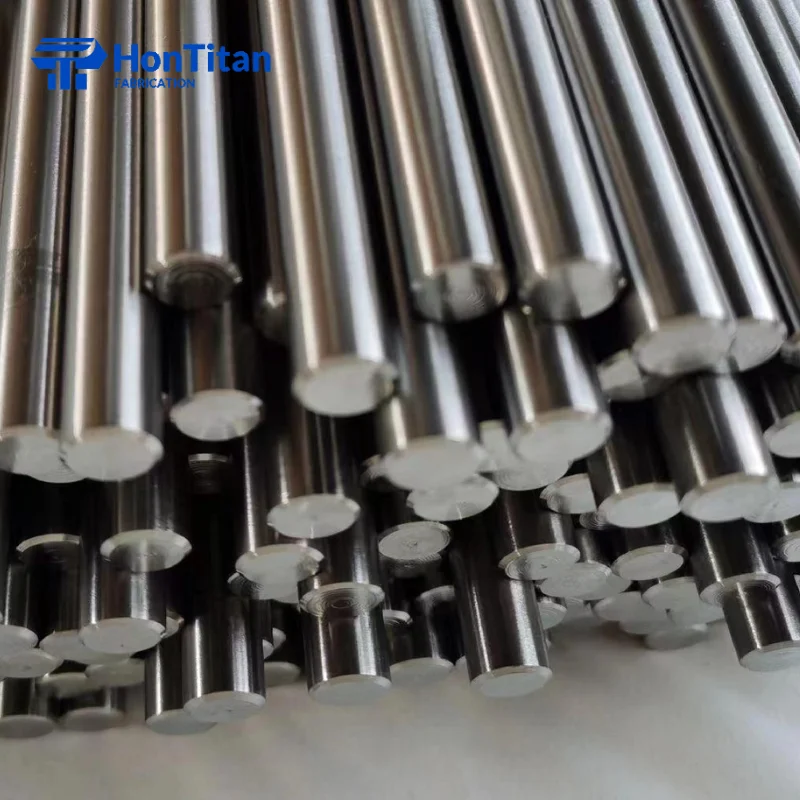
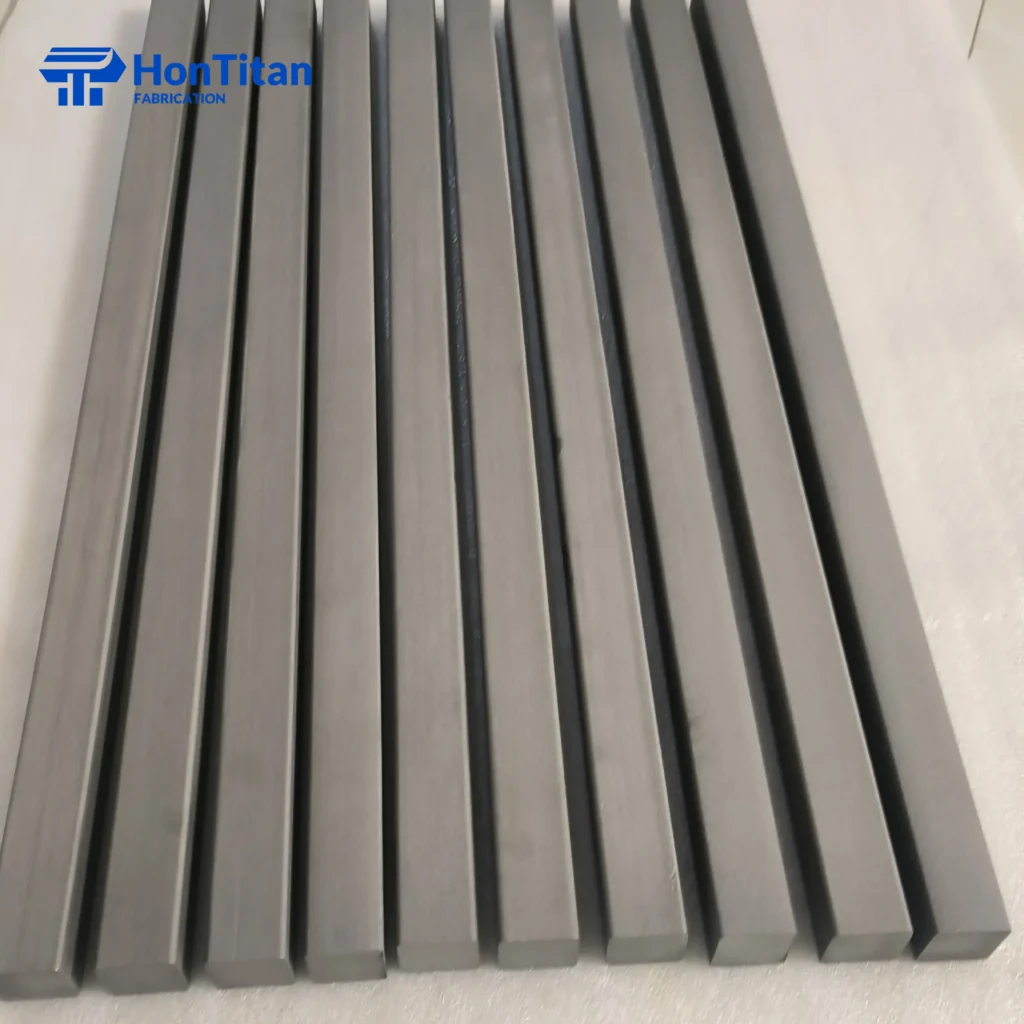
Grade 5 titanium (Ti-6Al-4V, UNS R56400) forged bar is the most widely specified titanium alloy product in aerospace structural and engine applications, manufactured through a controlled hot-forging process to ASTM B381 and AMS 4928. The alloy combines a density of 4.43 g/cm³ with a minimum tensile strength of 931 MPa (135 ksi) in sections up to Ø50.8 mm, delivering a strength-to-weight advantage no conventional steel or aluminum alloy can match. Available from Ø20 mm to Ø400 mm with EN 10204 3.1 Mill Test Certificates and optional ultrasonic inspection.
Quick Specifications
| Parameter |
Detail |
| Material Grade |
Grade 5 (Ti-6Al-4V), UNS R56400 |
| Primary Standards |
ASTM B381 / AMS 4928 / ISO 5832-3 |
| Alloy System |
Alpha-Beta (α+β) Titanium |
| Available Diameter |
Ø20 mm – Ø400 mm |
| Available Length |
Up to 6,000 mm (custom lengths available) |
| Surface Condition |
As-forged; turned; ground (Ra ≤ 1.6 µm); polished |
| Heat Treatment |
Annealed (standard); STA available on request |
| Tolerance |
As-forged per ASTM B381; h9–h11 (turned/ground) |
| MOQ |
100 kg |
| Lead Time |
2–4 weeks (standard sizes); 4–8 weeks (custom) |
| Mill Test Certificate |
EN 10204 3.1 included |
What Is Grade 5 Ti-6Al-4V Titanium Forged Bar?
Grade 5 titanium (Ti-6Al-4V, UNS R56400) forged bar is a dual-phase alpha-beta titanium alloy bar produced through controlled hot-forging, conforming to ASTM B381 and AMS 4928, with a minimum tensile strength of 931 MPa (135 ksi) in sections up to Ø50.8 mm — the benchmark specification for aerospace-grade titanium bar stock.
The alloy’s mechanical performance derives from two alloying elements: aluminum (5.50–6.75 wt%), which stabilizes the α-phase and sustains strength at elevated temperatures up to 400°C; and vanadium (3.50–4.50 wt%), which stabilizes the β-phase, enhances room-temperature ductility, and enables heat treatment to solution treated and aged (STA) condition for tensile strengths up to 1,170 MPa (170 ksi). The forging process — conducted above the beta transus temperature and finished in the alpha-beta range — produces a refined, directionally controlled grain structure that provides measurably superior fatigue resistance and mechanical uniformity across the bar cross-section compared with rolled or drawn bar of identical composition.
Chemical Composition — ASTM B381 / AMS 4928
| Element |
Symbol |
Min (wt%) |
Max (wt%) |
| Aluminum |
Al |
5.50 |
6.75 |
| Vanadium |
V |
3.50 |
4.50 |
| Iron |
Fe |
— |
0.30 |
| Oxygen |
O |
— |
0.20 |
| Carbon |
C |
— |
0.08 |
| Nitrogen |
N |
— |
0.05 |
| Hydrogen |
H |
— |
0.0125 |
| Yttrium |
Y |
— |
0.005 |
| Other elements, each |
— |
— |
0.10 |
| Other elements, total |
— |
— |
0.40 |
| Titanium |
Ti |
Balance |
— |
Mechanical Properties — Annealed Condition (ASTM B381 / AMS 4928)
Minimum mechanical property requirements vary by cross-section size per AMS 4928:
| Section Size |
Tensile Strength Min |
Yield Strength Min (0.2% offset) |
Elongation in 50 mm |
Reduction of Area |
| Ø ≤ 50.80 mm (2.000 in) |
931 MPa (135 ksi) |
862 MPa (125 ksi) |
10% min |
25% min |
| Ø 50.80–101.60 mm (2–4 in) |
896 MPa (130 ksi) |
827 MPa (120 ksi) |
10% min |
25% min |
| Ø 101.60–152.40 mm (4–6 in) |
896 MPa (130 ksi) |
827 MPa (120 ksi) |
10% min |
20% min |
Test method: ASTM E8 (tensile), ASTM E18 (hardness), room temperature.
Mechanical Properties — Solution Treated and Aged (STA) Condition
| Property |
Typical Value |
| Tensile Strength |
1,100–1,170 MPa (160–170 ksi) |
| Yield Strength (0.2% offset) |
965–1,035 MPa (140–150 ksi) |
| Elongation in 50 mm |
8–10% |
| Reduction of Area |
15–25% |
STA: solution treat at 954°C (1,750°F) for 1 hour, water quench; age at 538°C (1,000°F) for 4 hours, air cool. Properties depend on section size and specific process parameters.
Physical Properties
| Property |
Imperial |
Metric |
| Density |
0.160 lb/in³ |
4.43 g/cm³ |
| Modulus of Elasticity |
16.5 × 10⁶ psi |
114 GPa |
| Poisson’s Ratio |
0.342 |
0.342 |
| Thermal Conductivity |
4.2 BTU/(hr·ft·°F) |
7.2 W/(m·K) |
| Coefficient of Thermal Expansion |
4.9 × 10⁻⁶ /°F |
8.8 × 10⁻⁶ /°C |
| Specific Heat |
0.13 BTU/(lb·°F) |
560 J/(kg·K) |
| Melting Range |
2,995–3,020°F |
1,646–1,660°C |
| Service Temperature (continuous) |
−350°F to 750°F |
−210°C to 400°C |
| Density vs Carbon Steel |
~57% of steel |
~57% of steel |
Why Forging Improves Performance Over Rolled Bar
Titanium Grade 5 forged bar achieves superior fatigue resistance and cross-sectional mechanical uniformity compared with rolled or drawn bar because the forging process controls grain flow in alignment with the primary loading axis of the finished component.
During hot-forging above the beta transus (~995°C), followed by thermomechanical processing in the alpha-beta range, the microstructure develops a fine, equiaxed primary-alpha grain surrounded by a transformed beta matrix. This bimodal microstructure provides three quantifiable improvements over rolled bar:
- Fatigue strength: Controlled grain flow eliminates the weakening effect of grain boundaries oriented perpendicular to applied stress; fatigue limits in forged Ti-6Al-4V typically exceed those of rolled bar by 10–15% under equivalent loading conditions.
- Mechanical uniformity: Forging refines and homogenizes the microstructure across large diameters (Ø150–400 mm) where rolled bar exhibits center-to-surface property gradients due to limited deformation penetration.
- Absence of directional anisotropy: Closed-die and open-die forging processes distribute mechanical work more uniformly through the cross-section, reducing the longitudinal-to-transverse property ratio compared with heavily worked drawn bar.
For rotating components, pressure vessels, and fatigue-critical airframe structures, these advantages translate directly to longer in-service life and more predictable failure modes.
Available Dimensions and Surface Conditions
| Parameter |
Standard Range |
Notes |
| Diameter (round) |
Ø20–Ø400 mm |
Large diameters (>Ø200 mm) via open-die forging |
| Length |
Up to 6,000 mm |
Shorter sections available; custom lengths to order |
| Flat / Square bar |
Custom dimensions |
Available on request for structural applications |
| Surface: as-forged |
Scaled/oxide surface per ASTM B381 |
Typical for rough-machined component blanks |
| Surface: turned |
Ra ≤ 3.2 µm |
Standard machined finish, dimensional tolerance h11 |
| Surface: ground |
Ra ≤ 1.6 µm |
Precision-ground, tolerance h9 |
| Surface: polished |
Ra ≤ 0.8 µm |
Medical / corrosion-critical applications |
Custom diameter steps, special lengths, and near-net-shape forgings are available for high-volume programs. Contact the technical team for specific tolerance and roughness requirements.
Applications
Grade 5 Ti-6Al-4V forged bar per ASTM B381 and AMS 4928 is used across six primary industries where its combination of high strength, low density, corrosion resistance, and biocompatibility cannot be replicated by alternative alloys.
- Aerospace & Defense: Jet engine compressor discs, turbine shafts, airframe structural fittings, landing gear components, and high-load fasteners where the FAR 25 and MIL-SPEC structural weight budget drives alloy selection.
- Medical Implants: Orthopedic implant stems, spinal cages, dental abutments, and surgical instrument blanks manufactured to ISO 5832-3 and ASTM F1472; Grade 5 is specified where maximum strength is prioritized over the lower interstitial levels of Grade 23 ELI.
- Oil & Gas / Energy: Downhole tool mandrels, valve bodies, and subsea connector components requiring corrosion resistance in H₂S and seawater service per NACE MR0175/ISO 15156.
- Chemical Processing: Pump shafts, agitator shafts, and reactor internals for oxidizing acid environments where commercially pure titanium (Grades 1–4) lacks sufficient mechanical strength.
- Motorsport & Automotive: Formula 1 suspension uprights, connecting rods, and high-performance brake caliper blanks where weight reduction at equivalent stiffness is the governing design constraint.
- Marine & Offshore: Propeller shafts, fasteners, and structural components for offshore platforms, where the alloy’s resistance to crevice corrosion and stress-corrosion cracking in seawater surpasses stainless steel alternatives.
Grade 5 vs Grade 23 ELI: Selecting the Right Alloy
Grade 23 (Ti-6Al-4V ELI, Extra Low Interstitial, UNS R56401) is the biomedical variant of Grade 5 with tighter limits on oxygen, iron, nitrogen, and carbon, improving fracture toughness and fatigue crack growth resistance at the cost of slightly lower minimum tensile strength.
| Property |
Grade 5 (Ti-6Al-4V) |
Grade 23 ELI (Ti-6Al-4V ELI) |
| UNS Number |
R56400 |
R56401 |
| Primary Standard |
ASTM B381 / AMS 4928 |
ASTM F620 / AMS 4930 |
| Medical Standard |
ASTM F1472 |
ASTM F136 |
| Oxygen Max (wt%) |
0.20 |
0.13 |
| Iron Max (wt%) |
0.30 |
0.25 |
| Tensile Strength Min (≤Ø50 mm) |
931 MPa (135 ksi) |
896 MPa (130 ksi) |
| Yield Strength Min (≤Ø50 mm) |
862 MPa (125 ksi) |
827 MPa (120 ksi) |
| Fracture Toughness (Kᵢ꜀) |
~55–75 MPa√m |
~65–85 MPa√m |
| Primary Use Case |
Aerospace, industrial, general structural |
Load-bearing orthopaedic implants, cryogenic |
Specification guidance: Use Grade 5 for aerospace, industrial, oil & gas, and motorsport applications. Specify Grade 23 ELI for permanent load-bearing implants (hip, knee, spine) where fracture toughness under cyclic physiological loading is the primary design driver.
Quality Assurance and Certifications
Each production lot of Grade 5 Ti-6Al-4V forged bar undergoes the following quality steps before shipment:
- Chemical analysis: Inductively coupled plasma optical emission spectrometry (ICP-OES) per ASTM E2371 and combustion method (C, S, H, N, O) per ASTM E1409 and ASTM E1447
- Mechanical testing: Tensile per ASTM E8, hardness per ASTM E18 — one sample per heat/lot
- Ultrasonic inspection (UT): Available per ASTM E2375 (immersion UT for bar) or AMS 2154 upon request; mandatory for aerospace-critical applications
- Visual and dimensional inspection: Per ASTM B381 and customer drawing tolerances
- Mill Test Certificate: EN 10204 3.1 — signed by an independent third-party inspector or accredited laboratory, traceable to specific heat number and lot
Certifications available: ISO 9001:2015, AS9100D (upon request with qualification documentation). Third-party inspection by SGS, Bureau Veritas, and TÜV SÜD available at customer request.
Applicable Standards
| Standard |
Scope |
| ASTM B381 |
Titanium and Titanium Alloy Forgings — primary standard for forged bar product form |
| AMS 4928 |
Ti-6Al-4V bars, wire, forgings, forging stock, flash welded rings — annealed |
| AMS 4920 |
Ti-6Al-4V forgings — alpha-beta or beta processed, annealed |
| AMS 4965 |
Ti-6Al-4V bars and forgings — solution treated and aged |
| ASTM B348 |
Titanium and Titanium Alloy Bars and Billets (applicable to forging stock) |
| ASTM F1472 |
Wrought Ti-6Al-4V alloy for surgical implant applications |
| ISO 5832-3 |
Implants for surgery — metallic materials — Ti-6Al-4V alloy |
| MIL-T-9047 |
Titanium alloy bars and billets (defense applications) |
| EN 10204 3.1 |
Metallic products — types of inspection documents (Mill Test Certificate) |
Frequently Asked Questions
Is Grade 5 titanium the same as Ti-6Al-4V?
Yes. Grade 5 is the ASTM designation for the Ti-6Al-4V alloy (UNS R56400), the most widely used titanium alloy globally. The designations are interchangeable: Ti 64, TC4 (Chinese standard), DIN 3.7165, and SAE Grade 5 all refer to the same alloy composition with 5.50–6.75% aluminum and 3.50–4.50% vanadium.
What is the tensile strength of Grade 5 titanium forged bar?
Per AMS 4928 (annealed condition), minimum tensile strength is 931 MPa (135 ksi) for sections up to Ø50.80 mm, and 896 MPa (130 ksi) for sections Ø50.80–152.40 mm. In solution treated and aged (STA) condition, typical tensile strength reaches 1,100–1,170 MPa (160–170 ksi), depending on section size and heat treatment parameters.
What is the difference between ASTM B381 and AMS 4928 for titanium forged bar?
ASTM B381 is the ASTM International standard specifically governing titanium and titanium alloy forgings across all grades, covering general industrial, chemical, and marine applications. AMS 4928 is the SAE Aerospace Material Specification covering Ti-6Al-4V bar, forgings, and forging stock for aerospace-critical applications; it imposes tighter process controls and traceability requirements aligned with AS9100 quality systems. Aerospace procurement teams typically specify AMS 4928; industrial procurement teams may accept ASTM B381.
What are the machinability and weldability characteristics of Ti-6Al-4V forged bar?
Ti-6Al-4V machines at approximately 25–40% of the machinability rating of free-machining steels. Recommended practice: sharp carbide or ceramic tooling, slow cutting speeds (15–60 m/min), high feed rates, flood cooling with non-chlorinated coolant, and rigid workholding to minimize chatter. The alloy is weldable by GTAW (TIG), GMAW (MIG with inert shielding), and electron beam welding; all titanium welding requires 100% inert gas shielding on front and back surfaces to prevent oxygen/nitrogen embrittlement.
Can Grade 5 Ti-6Al-4V forged bar be used for medical implants?
Grade 5 is approved for surgical implant applications under ASTM F1472 and ISO 5832-3 when produced to the required purity levels. For permanent load-bearing implants (hip, knee, spine), many surgeons and OEM designers specify Grade 23 ELI (Ti-6Al-4V ELI, ASTM F136) instead, because its lower oxygen and iron limits (O max 0.13%, Fe max 0.25%) produce higher fracture toughness under cyclic physiological loading. Grade 5 is commonly used for surgical instruments, dental abutments, and non-permanent implant components.
What Mill Test Certificate (MTC) documentation is provided?
Each lot is supplied with an EN 10204 3.1 Mill Test Certificate documenting: heat number, melt/forge process, chemical composition per ICP-OES and combustion analysis, mechanical test results (tensile, hardness), applicable standard conformance, and inspector signature. EN 10204 3.1 requires the certificate to be validated by an authorized inspection representative independent of the manufacturing department — the recognized standard for aerospace and industrial procurement.
What is the corrosion resistance of Grade 5 titanium?
Ti-6Al-4V derives its corrosion resistance from a stable TiO₂ passive oxide film that reforms spontaneously in oxidizing environments. The alloy exhibits excellent resistance to seawater, chlorinated solutions, and most organic acids, and is classified for service in wet chlorine and chlorine dioxide. It is not recommended for anhydrous conditions (dry chlorine, red fuming nitric acid) where the passive film cannot form; ASTM B265 and NACE MR0175/ISO 15156 provide corrosion qualification guidance for sour service environments.