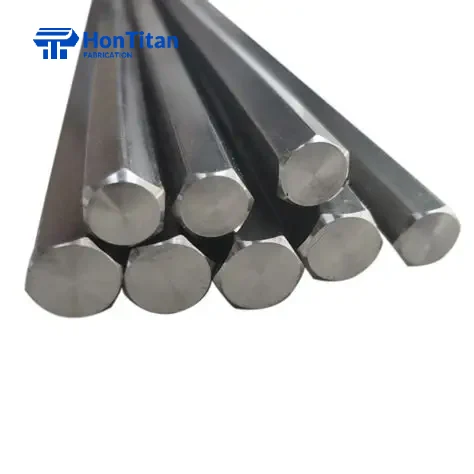
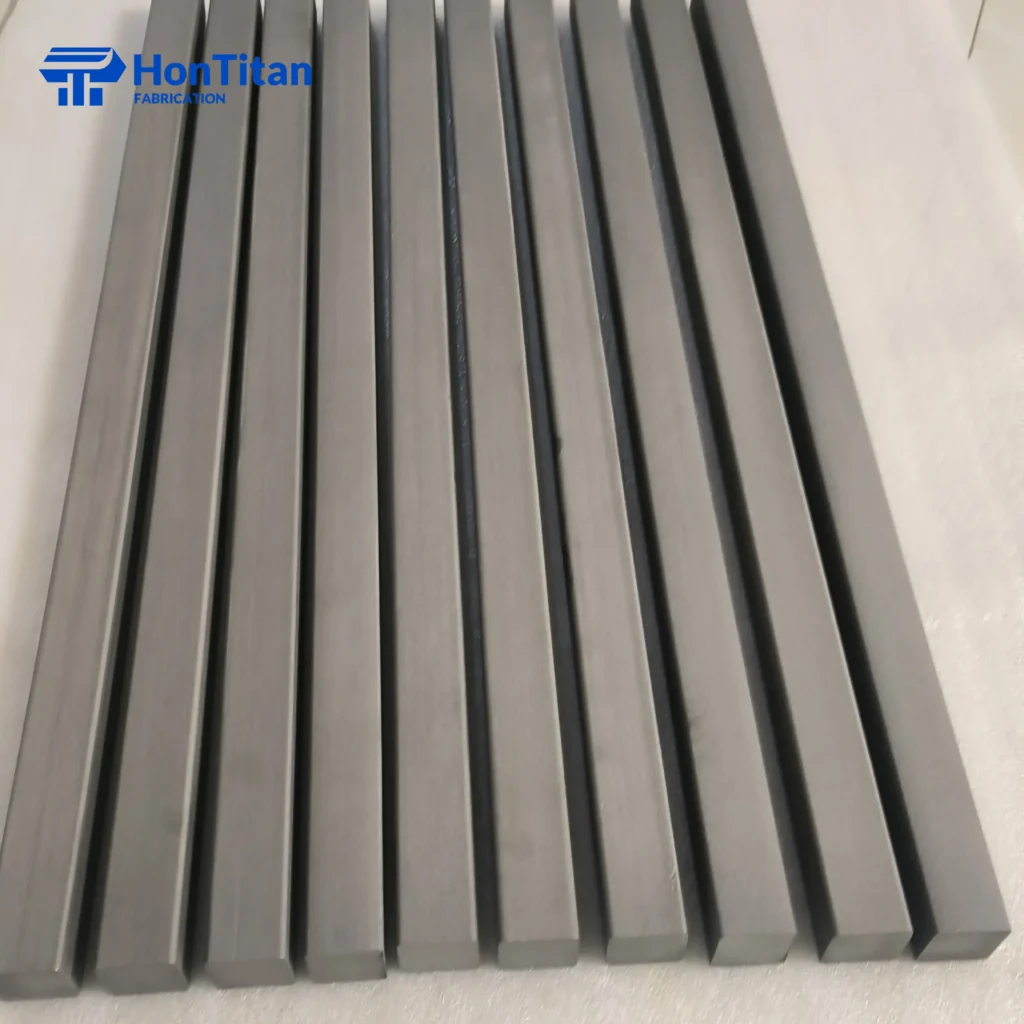
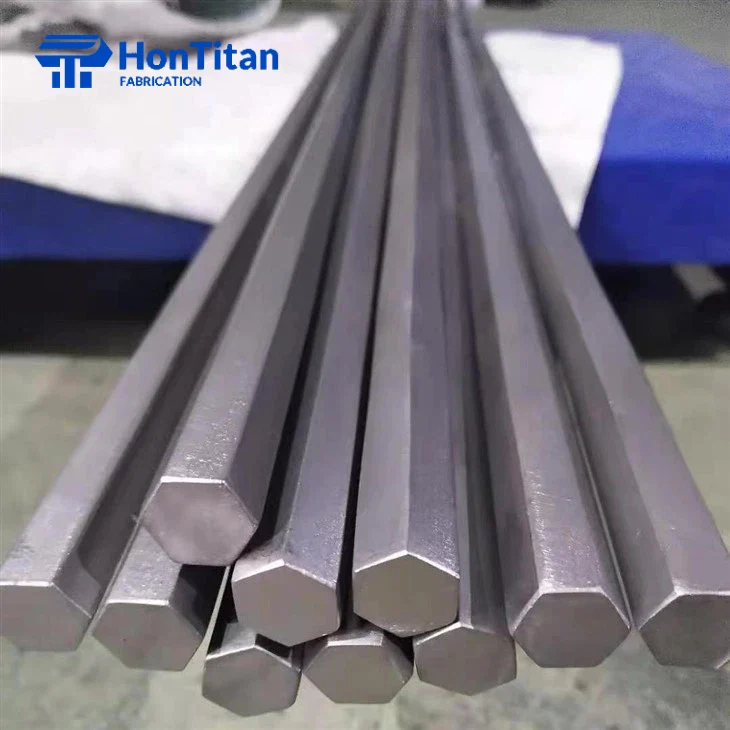
Grade 5 titanium hex bar (Ti-6Al-4V, UNS R56400) is the most widely specified titanium alloy for structural, aerospace, and medical applications, combining high strength with low density and excellent corrosion resistance. Available per ASTM B348-21 and AMS 4928W, with Mill Test Certificates to EN 10204 3.1 included as standard.
Quick Specifications
| Property |
Value |
| Material Grade |
Grade 5 / Ti-6Al-4V |
| UNS Number |
R56400 |
| Standards |
ASTM B348-21 / AMS 4928W / ISO 5832-3:2021 |
| Alloy System |
Alpha-Beta Titanium |
| Available Forms |
Hex Bar (hexagonal cross-section) |
| Across-Flats (AF) Range |
6 mm – 120 mm (0.25 in – 4.75 in) |
| Length |
Up to 6,000 mm (custom cut available) |
| Tolerance |
h9 (ground) / h11 (as-drawn); custom available |
| Surface Condition |
Mill finish, ground, polished |
| Condition |
Annealed (standard); Solution Treated & Aged (STA) on request |
| Mill Test Certificate |
EN 10204 3.1 — included |
| MOQ |
50 kg |
| Lead Time |
7–15 business days (stock sizes); 20–30 days (custom) |
Chemical Composition — ASTM B348-21 Grade 5 (UNS R56400)
Grade 5 titanium (Ti-6Al-4V) per ASTM B348-21 contains 5.50–6.75% aluminum and 3.50–4.50% vanadium as primary alloying elements, with strict limits on interstitial elements (oxygen, nitrogen, hydrogen, carbon) that govern mechanical performance.
| Element |
Min (wt.%) |
Max (wt.%) |
| Aluminum (Al) |
5.50 |
6.75 |
| Vanadium (V) |
3.50 |
4.50 |
| Iron (Fe) |
— |
0.40 |
| Carbon © |
— |
0.08 |
| Nitrogen (N) |
— |
0.05 |
| Hydrogen (H) |
— |
0.0125 |
| Oxygen (O) |
— |
0.20 |
| Other Elements (each) |
— |
0.10 |
| Other Elements (total) |
— |
0.40 |
| Titanium (Ti) |
Balance |
— |
Source: ASTM B348-21, Table 1, Composition Requirements for Grade 5.
Mechanical Properties
Annealed Condition — ASTM B348-21 Minimums
Grade 5 titanium hex bar in the annealed condition meets or exceeds the following ASTM B348-21 minimum property requirements, verified by tensile testing per ASTM E8/E8M.
| Property |
Minimum Value (SI) |
Minimum Value (Imperial) |
Test Method |
| Tensile Strength (UTS) |
895 MPa |
130,000 psi |
ASTM E8/E8M |
| Yield Strength (0.2% offset) |
828 MPa |
120,000 psi |
ASTM E8/E8M |
| Elongation in 4D gauge |
10% min. |
10% min. |
ASTM E8/E8M |
| Reduction of Area |
25% min. |
25% min. |
ASTM E8/E8M |
Solution Treated and Aged (STA) Condition — AMS 4965 (STA Bar and Forgings)
For applications requiring higher strength, Grade 5 titanium hex bar in the STA condition achieves the following representative properties per AMS 4965 (the STA specification for Ti-6Al-4V bar and forgings). Note: AMS 4928W governs annealed material; STA condition is governed by AMS 4965.
| Property |
Representative Value (SI) |
Representative Value (Imperial) |
| Tensile Strength (UTS) |
1,170 MPa |
170,000 psi |
| Yield Strength (0.2% offset) |
1,100 MPa |
160,000 psi |
| Elongation |
10% min. |
10% min. |
Additional Typical Physical Properties (Annealed)
| Property |
Value |
Unit |
| Density |
4.43 |
g/cm³ (0.160 lb/in³) |
| Elastic Modulus |
114 |
GPa (16.5 Msi) |
| Poisson’s Ratio |
0.342 |
— |
| Thermal Conductivity |
6.7 |
W/m·K |
| Coefficient of Thermal Expansion |
8.6 (20–100°C) / 9.2 (20–315°C) |
µm/m·°C |
| Melting Range |
1,604–1,660 |
°C |
Typical values per ASM International Handbook, Volume 2; not ASTM B348 minimums.
Available Sizes and Tolerances
Standard Across-Flats (AF) Sizes
Grade 5 Ti-6Al-4V hex bar is available in the following standard across-flats dimensions. Custom AF sizes and lengths available on inquiry.
| AF Size (mm) |
AF Size (in) |
Standard Length |
Tolerance Class |
| 6 |
0.236 |
1,000–3,000 mm |
h9 |
| 8 |
0.315 |
1,000–3,000 mm |
h9 |
| 10 |
0.394 |
1,000–3,000 mm |
h9 |
| 12 |
0.472 |
1,000–3,000 mm |
h9 |
| 14 |
0.551 |
1,000–3,000 mm |
h9 |
| 16 |
0.630 |
1,000–4,000 mm |
h9 |
| 19 |
0.748 |
1,000–4,000 mm |
h9 |
| 22 |
0.866 |
1,000–4,000 mm |
h9 |
| 25 |
0.984 |
1,000–6,000 mm |
h9/h11 |
| 30 |
1.181 |
1,000–6,000 mm |
h9/h11 |
| 36 |
1.417 |
1,000–6,000 mm |
h11 |
| 46 |
1.811 |
1,000–6,000 mm |
h11 |
| 50 |
1.969 |
1,000–6,000 mm |
h11 |
| 60 |
2.362 |
Up to 3,000 mm |
h11 |
| 75 |
2.953 |
Up to 3,000 mm |
h11 |
| 100 |
3.937 |
Up to 2,000 mm |
h11 |
| 120 |
4.724 |
Up to 2,000 mm |
As-forged / custom |
- h9 tolerance: Precision ground finish; tightest dimensional control for fastener blank and close-tolerance machining applications
- h11 tolerance: As-drawn or mill finish; standard for general structural and machining stock
- Custom tolerances (h8, special AF dimensions) available — submit RFQ with drawing
Technical Overview: Ti-6Al-4V Alpha-Beta Titanium
Grade 5 titanium (Ti-6Al-4V) is an alpha-beta alloy that accounts for approximately 50% of global titanium consumption, delivering the highest strength-to-weight ratio of any commercially produced titanium bar product while maintaining full corrosion resistance in most industrial environments.
The alloy derives its properties from a dual-phase microstructure: the alpha (α) phase, stabilized by aluminum, provides creep resistance and thermal stability up to approximately 400°C (750°F) for general service; the beta (β) phase, stabilized by vanadium, contributes ductility and enables response to heat treatment. In the annealed condition, the alloy achieves 895 MPa minimum tensile strength at a density of only 4.43 g/cm³ — approximately 57% of the density of AISI 4340 steel (43% lighter by volume).
The hexagonal cross-section profile offers specific machining and engineering advantages over round bar. The flat-to-flat geometry allows direct clamping without secondary operations for fastener blank production, reduces material waste in hex socket and valve stem turning operations, and provides positive anti-rotation geometry in assembly applications. Across-flats dimensions from 6 mm to 120 mm cover the full range from small fastener blanks to large structural connectors and valve bodies.
Corrosion resistance derives from a passive, self-healing TiO₂ oxide layer that forms spontaneously in air and aqueous environments. Grade 5 titanium resists attack from chlorinated media, seawater, and most dilute acids — though it is not recommended for service in fuming nitric acid, anhydrous chlorine, or hydrofluoric acid without additional corrosion assessment.
Weldability: Ti-6Al-4V hex bar is weldable by GTAW and EBW processes per AWS D1.9 and applicable aerospace welding specifications. Inert gas shielding is required during welding; post-weld stress relief at 540–650°C (1,000–1,200°F) is recommended for structural applications.
Why Hex Bar: Applications and Use Cases
Grade 5 titanium hex bar is specified across six primary application sectors where the combination of high strength, low weight, corrosion resistance, and hexagonal geometry delivers distinct engineering value.
Aerospace — Fastener Blanks and Structural Connectors
Ti-6Al-4V hex bar per AMS 4928W is the primary feedstock for aerospace-grade titanium fastener blanks, structural brackets, and connector bodies. The hex cross-section minimizes machining stock removal compared to round bar in bolt-head and nut-body applications. Applicable specifications: AMS 4928W, ASTM B348-20, Boeing BMS 7-323.
Medical Devices and Surgical Instruments
Grade 5 titanium hex bar per ISO 5832-3 is used in the manufacture of surgical instrument bodies, bone screw drivers, and orthopedic implant trial components. The material is biocompatible, non-magnetic for MRI compatibility, and resistant to body fluid corrosion. For permanent implant applications, Grade 23 (Ti-6Al-4V ELI, ASTM F136) is preferred due to lower oxygen content.
Oil, Gas, and Chemical Processing
Ti-6Al-4V hex bar is specified for valve stems, pump shafts, and flow-control components operating in chlorinated or sour-gas environments where stainless steel alloys have insufficient corrosion resistance. General service temperature is approximately 400°C (750°F); for fatigue-critical applications a conservative design limit of 315°C (600°F) is often applied.
Marine and Offshore Engineering
Titanium Grade 5 hex bar provides excellent resistance to seawater corrosion and biofouling in subsea hardware, connector components, and ROV structural members. Density advantage over stainless steel reduces topside weight in offshore installations.
High-Performance Automotive and Motorsport
Ti-6Al-4V hex bar is machined into suspension fasteners, shock absorber components, and engine hardware in motorsport applications where weight savings per component directly impact performance. The alloy meets FIA and sanctioning body material requirements for critical fasteners.
Industrial and Defense Equipment
Hex bar stock supplies valve bodies, precision drive shafts, and armament component blanks in defense and heavy industrial sectors. Solution-treated and aged (STA) material per AMS 4965 provides maximum tensile strength for demanding load-bearing applications.
Applicable Standards and Certifications
All Grade 5 Ti-6Al-4V hex bar is produced and tested in accordance with the following standards. Mill Test Certificates to EN 10204 3.1 are provided with every shipment.
Material Standards
| Standard |
Scope |
| ASTM B348-21 |
Titanium and titanium alloy bars and billets — commercial specification |
| AMS 4928W |
Ti-6Al-4V bar, wire, forgings, drawn shapes — annealed condition, aerospace/defense |
| AMS 4965 |
Ti-6Al-4V bar and forgings — solution treated and aged (STA) condition |
| ISO 5832-3:2021 |
Metallic materials for surgical implants — Ti-6Al-4V wrought alloy |
| ASME SB-381 |
Titanium and titanium alloy forgings (ASME Boiler & Pressure Vessel Code counterpart to ASTM B381) |
| W.-Nr. 3.7164 |
European material number for Ti-6Al-4V Grade 5 (3.7165 = Grade 23 ELI) |
Difference Between ASTM B348 and AMS 4928
ASTM B348-21 is the general commercial standard applicable to titanium bar for industrial, medical, and general engineering use, specifying minimum chemical composition and mechanical properties. AMS 4928W (SAE Aerospace Material Specification) governs the same alloy in annealed condition but imposes more stringent testing requirements — including ultrasonic inspection per AMS 2631G, tighter hydrogen limits, and additional certification documentation — specifically for aerospace and defense applications. For STA condition material, the applicable specification is AMS 4965. When sourcing for AS9100D-qualified production, AMS 4928W (annealed) or AMS 4965 (STA) certification should be requested.
Quality and Traceability Documentation
| Document |
Standard |
| Mill Test Certificate (MTC) |
EN 10204 3.1 — chemical composition + mechanical test results from the product lot |
| Dimensional Inspection Report |
Per customer drawing or applicable standard tolerances |
| Ultrasonic Test Certificate |
Per AMS 2631G (if specified for AMS 4928W orders) |
| Certificate of Conformance (CofC) |
AS9100D / ISO 9001:2015 quality management system |
Frequently Asked Questions
Is Grade 5 titanium the same as Ti-6Al-4V?
Yes. Grade 5 and Ti-6Al-4V are two names for the same alloy. “Grade 5” is the ASTM designation used in ASTM B348; “Ti-6Al-4V” describes the nominal composition (6% aluminum, 4% vanadium); and UNS R56400 is the unified numbering system identifier. All three designations refer to the same alloy, which carries the European material number W.-Nr. 3.7164 (not to be confused with 3.7165, which designates Grade 23 / Ti-6Al-4V ELI).
What is the difference between ASTM B348 and AMS 4928?
ASTM B348-21 is the commercial material specification for titanium bar, covering minimum chemical composition and mechanical properties for general industrial use. AMS 4928W (SAE) is the aerospace-grade specification covering annealed Ti-6Al-4V that requires stricter testing — including tighter hydrogen control, mandatory ultrasonic inspection per AMS 2631G, and traceability documentation aligned with AS9100D supply chain requirements. For solution treated and aged (STA) material, the applicable specification is AMS 4965. Aerospace and defense programs typically require AMS 4928W (annealed) or AMS 4965 (STA); general industrial applications typically accept ASTM B348.
What are the mechanical properties of Grade 5 titanium hex bar?
In the annealed condition per ASTM B348-21, Grade 5 titanium hex bar meets a minimum tensile strength of 895 MPa (130,000 psi) and minimum yield strength of 828 MPa (120,000 psi), with at least 10% elongation. In the solution treated and aged (STA) condition per AMS 4965, tensile strength reaches approximately 1,170 MPa (170,000 psi) with yield strength of approximately 1,100 MPa (160,000 psi) — the STA condition is used for the highest-load aerospace applications.
What is Grade 5 titanium used for?
Ti-6Al-4V hex bar is used primarily as feedstock for aerospace fastener blanks and structural connectors, surgical instrument components, oil and gas valve stems, marine subsea hardware, and motorsport suspension fasteners. The hexagonal cross-section is specifically valued for direct bolt-head and nut-body machining (minimizing scrap), anti-rotation assemblies, and valve stem applications.
Is Grade 5 titanium stronger than Grade 2?
Titanium Grade 5 (Ti-6Al-4V) is significantly stronger than Grade 2. Grade 2 is commercially pure titanium with a minimum tensile strength of approximately 345 MPa (50,000 psi), suitable for corrosion-resistance-focused applications with moderate loads. Grade 5 achieves 895 MPa minimum in the annealed condition — approximately 2.6× the tensile strength of Grade 2. Grade 2 retains advantages in formability, weldability, and biocompatibility for permanent implant use (Grade 23/ELI).
What is the density of Ti-6Al-4V?
The density of Grade 5 titanium (Ti-6Al-4V) is 4.43 g/cm³ (0.160 lb/in³). This is approximately 57% of the density of steel (7.85 g/cm³) — meaning titanium is approximately 43% lighter by volume — and substantially lighter than nickel-based superalloys, which typically range from 8.1 to 8.9 g/cm³. This density advantage is why the alloy is extensively used in weight-critical aerospace structures and rotating components.
Can Grade 5 titanium hex bar be welded?
Ti-6Al-4V hex bar is weldable by Gas Tungsten Arc Welding (GTAW) and Electron Beam Welding (EBW). Inert gas shielding (argon or helium) must be applied to the weld zone, heat-affected zone, and weld root to prevent atmospheric contamination. Post-weld stress relief at 540–650°C (1,000–1,200°F) is recommended for structural applications. Friction welding is also widely used for fastener head attachment in aerospace production.
Is Grade 5 titanium suitable for medical implants?
Grade 5 Ti-6Al-4V per ISO 5832-3 is approved for metallic surgical implant components such as instrument handles, trial implants, and non-permanent implant bodies. For permanent load-bearing implants (hip/knee stems, bone screws) in direct tissue contact, Grade 23 (Ti-6Al-4V ELI, ASTM F136) is typically specified due to its lower oxygen content and enhanced fatigue performance. Both grades are biocompatible and non-magnetic for MRI compatibility.