In multi-million dollar chemical processing, power generation, or desalination projects, specifying the wrong titanium standard isn’t just a minor purchasing error—it can lead to catastrophic equipment failure, ruptured pipelines, and costly facility downtime.
When reviewing a Bill of Materials (BOM), engineers and procurement managers often encounter “titanium tubing” and might assume the specifications are interchangeable. They absolutely are not. Choosing between ASTM B338 and ASTM B861 dictates the safety, efficiency, and overall cost of your system.
The critical distinction comes down to application and structural design. Simply put: ASTM B338 is engineered for thin-wall heat transfer (like in heat exchangers and surface condensers), while ASTM B861 is built strictly for heavy-duty, high-pressure fluid transport. Understanding this fundamental difference is the first step to ensuring you source the right material for the right job. Read on to discover exactly how these two vital standards compare.
Essential Distinctions Between Titanium Tubes and Pipes
Before diving into the specific ASTM standards, we must clear up the most common point of confusion in the industry: the difference between a “tube” and a “pipe.” While these terms are often used interchangeably in casual conversation, in engineering and procurement, they represent entirely different measuring systems and applications.
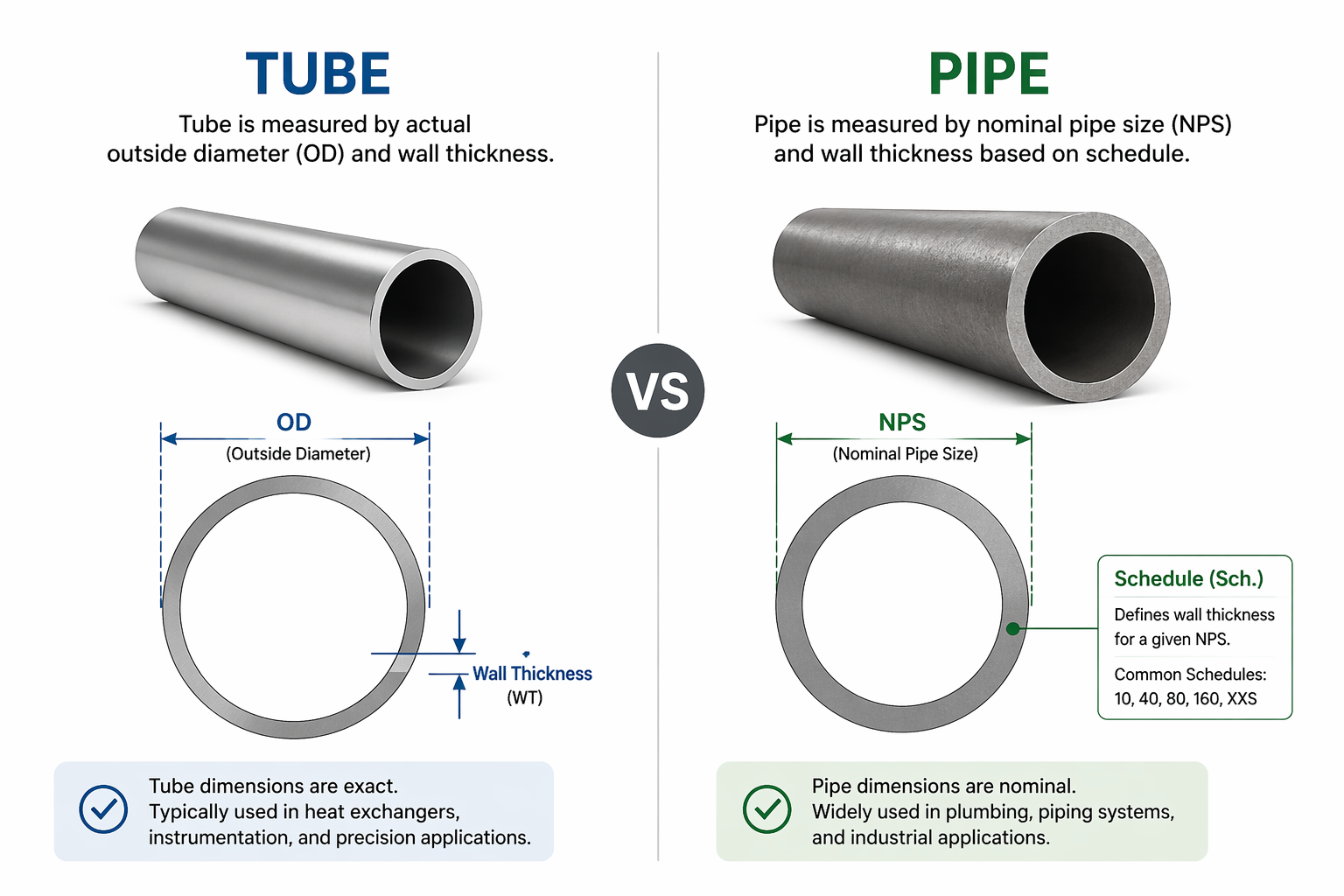
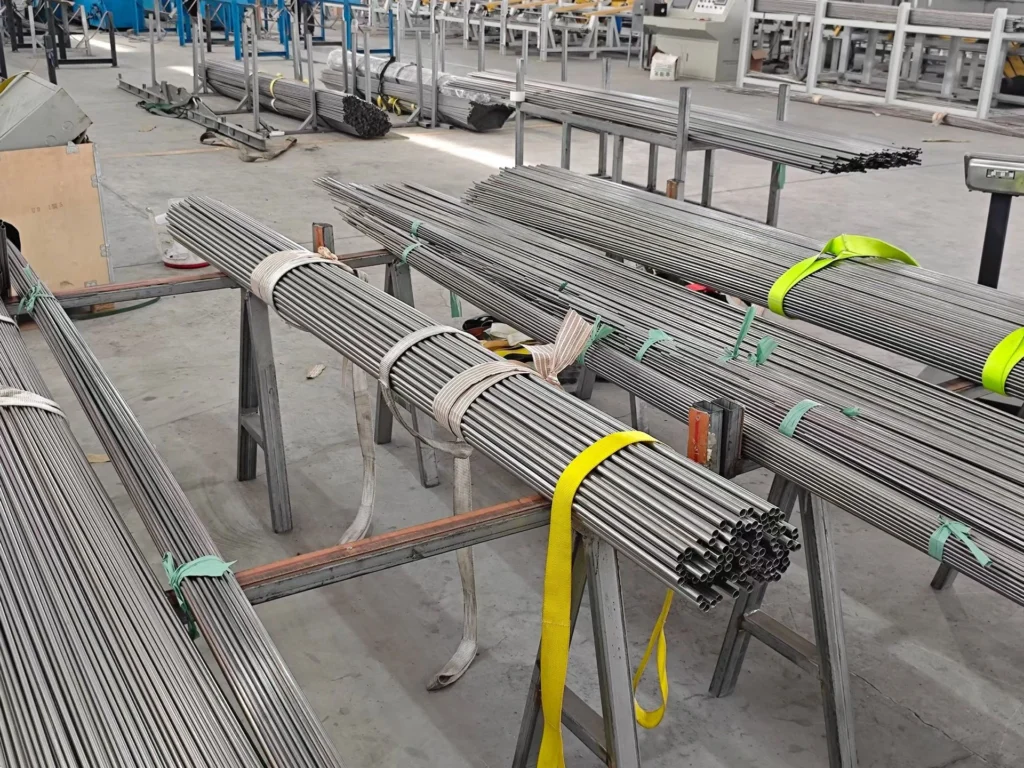
- Titanium Tube (The Precision Element): Tubes are measured by their exact Outside Diameter (OD) and a precise Wall Thickness (WT). Why? Because tubing is designed for precision and integration. In a heat exchanger, hundreds of tubes must fit perfectly into the exact holes of a tubesheet. The engineering focus here is on exact dimensional tolerances and efficient thermal conductivity.
- Titanium Pipe (The Structural Conduit): Pipes, on the other hand, are measured by a standard Nominal Pipe Size (NPS) and a Schedule (which dictates the wall thickness and pressure rating). The primary function of a pipe is to transport fluids or gases safely across a facility. Engineers size pipes based on internal flow capacity (volume) and structural integrity to contain pressure, rather than exact outside dimensions.
Therefore, the moment an ASTM standard specifies “Tube” (like ASTM B338) versus “Pipe” (like ASTM B861), it already tells you a story about its intended purpose: precision heat transfer versus heavy-duty fluid transport.
ASTM B338 Requirements for Heat Transfer Applications
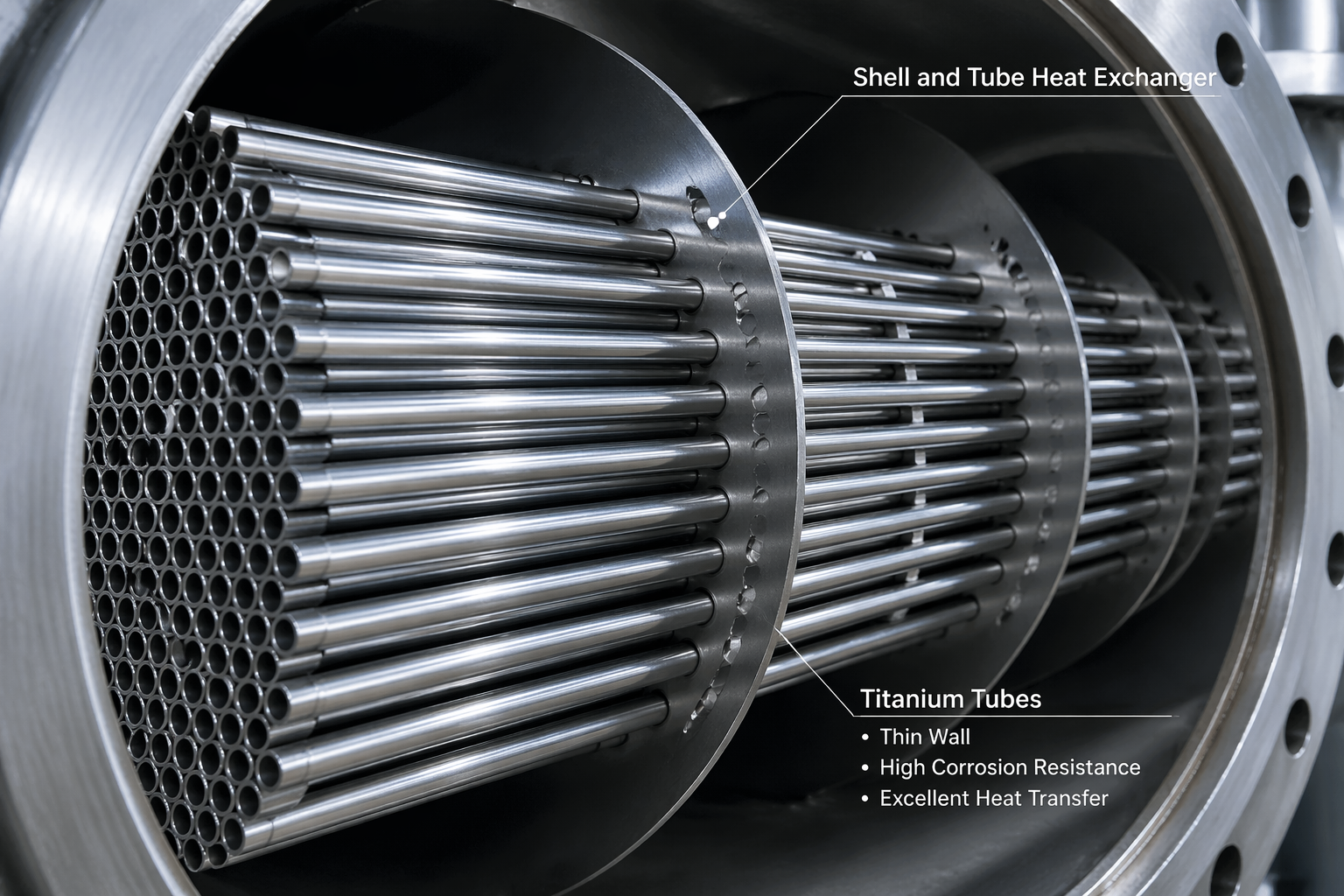
ASTM B338 is the definitive standard specification for titanium and titanium alloy tubes intended for surface condensers, evaporators, and heat exchangers. The most critical aspect of its scope is that it explicitly covers both seamless and welded manufacturing processes.
Engineered for Maximum Efficiency The primary mission of an ASTM B338 tube is thermal exchange. To maximize this heat transfer efficiency, these tubes are typically manufactured with relatively thin walls. The physics is straightforward: thinner walls allow for better thermal conductivity between the hot fluids and the cooling media (such as highly corrosive seawater). However, manufacturing thin-walled titanium requires exceptional metallurgical control and precision.
Zero Margin for Error: Strict Testing Requirements Because these tubes operate in environments where a single microscopic pinhole leak can contaminate an entire chemical process or power plant system, ASTM B338 mandates incredibly rigorous testing protocols. To ensure absolute reliability, the standard heavily emphasizes Non-Destructive Testing (NDT):
- Eddy Current and Ultrasonic Testing: 100% of ASTM B338 tubes must undergo stringent NDT to detect any hidden internal flaws, micro-cracks, or unacceptable variations in wall thickness.
- Flattening and Flaring Tests: During the fabrication of a shell-and-tube heat exchanger, the ends of these tubes must be mechanically expanded (rolled) to fit tightly into a tubesheet. Therefore, B338 requires specific flattening and flaring tests to prove the material’s ductility and ensure it will not crack or split under installation stress.
When you specify ASTM B338, you are not just buying a tube; you are buying a guaranteed, tested barrier for critical heat transfer applications.
ASTM B861 Standards for Fluid and Pressure Systems
ASTM B861 is the standard specification for titanium and titanium alloy seamless pipe intended for general corrosion-resisting and elevated-temperature service. It is the structural backbone of highly corrosive industrial environments, such as chlor-alkali chemical plants, offshore oil platforms, and high-pressure fluid transport networks.
The Golden Rule: Seamless Only There is one critical distinction you must remember about this standard: ASTM B861 dictates that the pipe must be strictly SEAMLESS. The manufacturing process typically involves extrusion or piercing, resulting in a pipe with no longitudinal weld seam. This eliminates the weld heat-affected zone (HAZ), which is often the weakest point in a piping system when exposed to aggressive chemicals under high pressure.
(Note for Procurement: If your project allows for a welded titanium piping system—often chosen to reduce costs on larger diameter lines—you must refer to a completely different standard: ASTM B862.)
Testing for Structural Integrity and Pressure Containment Unlike B338, which prioritizes thin-wall ductility for heat transfer, ASTM B861 focuses heavily on mechanical strength and pressure containment. A B861 pipe must survive the brutal realities of transporting hazardous, pressurized fluids day in and day out.
Therefore, the testing protocols for B861 are structurally focused:
- Hydrostatic Testing: This is a crucial requirement. The pipe is filled with liquid and pressurized to a specific level to ensure it can safely contain high internal pressures without leaking or bursting.
- Tension Tests: Rigorous testing is conducted to verify the material’s tensile strength, yield strength, and elongation, ensuring the pipe can withstand heavy mechanical loads, thermal expansion, and the constant stress of industrial fluid dynamics.
Quick Technical Comparison Summary
If you only have a minute to understand the differences between these two specifications, here is the essential breakdown.
This quick reference guide highlights why ASTM B338 and ASTM B861 cannot be substituted for one another:
| Feature | ASTM B338 (Titanium Tube) | ASTM B861 (Titanium Pipe) |
|---|---|---|
| Sizing & Measurement | Exact Outside Diameter (OD) & Wall Thickness | Nominal Pipe Size (NPS) & Schedule |
| Manufacturing Process | Seamless AND Welded | Strictly Seamless (For Welded, see ASTM B862) |
| Primary Application | Heat exchangers, surface condensers, evaporators | General fluid transport, high-pressure chemical lines |
| Design Priority | Thin walls for maximum thermal conductivity | Thick, robust walls for pressure containment |
| Key Testing Focus | Eddy Current, Ultrasonic (NDT), Flattening tests | Hydrostatic pressure testing, Tensile strength tests |
While both utilize the exceptional corrosion resistance of titanium, their engineering DNA is entirely different. You design with B338 to transfer heat, and you build with B861 to move dangerous fluids safely.
Popular Titanium Grades and Their Uses
While both ASTM B338 and ASTM B861 specifications cover a wide array of unalloyed and alloyed titanium grades, the reality of industrial procurement is that a select few dominate the market.
Choosing the right grade is just as important as choosing the correct standard. Here are the most commonly specified grades and why engineers choose them:
- Titanium Grade 2 (The Industry Workhorse): If you are ordering ASTM B338 or B861, there is a very high probability you will be specifying Grade 2. Known as “Commercially Pure” (CP) titanium, Grade 2 offers the perfect trifecta for industrial applications: excellent formability, moderate strength, and outstanding corrosion resistance (especially against seawater and oxidizing environments). Because it is the most widely produced grade, it is also the most readily available and cost-effective option for both heat exchangers and standard fluid piping.
- Titanium Grade 7 (The Extreme Corrosion Fighter): When Grade 2 isn’t enough to withstand highly aggressive environments, engineers upgrade to Grade 7. This grade is metallurgically identical to Grade 2 but with a small addition of Palladium (Pd). This slight alloy addition acts like a shield, giving Grade 7 unparalleled resistance to crevice corrosion and attack from severe reducing acids. It is significantly more expensive, but mandatory for specific, highly corrosive chemical processing lines.
- Titanium Grade 12 (The High-Heat Specialist): Grade 12 includes small additions of Molybdenum (Mo) and Nickel (Ni). It bridges the gap between commercially pure titanium and higher-strength alloys. It boasts superior strength at elevated temperatures compared to Grade 2, along with excellent resistance to crevice corrosion. You will frequently see Grade 12 specified for B338 heat exchanger tubes or B861 pipes operating in high-heat chemical manufacturing.
The Bottom Line for Buyers: Start with Grade 2 for standard corrosive environments. Only upgrade to the more expensive Grade 7 or Grade 12 if your process involves extreme localized corrosion risks or elevated temperatures.
Cost Efficiency and Ordering Guidelines
For procurement managers and supply chain teams, understanding the technical differences is only half the battle. The other half is managing project budgets and ensuring the RFQ (Request for Quote) is flawless to avoid costly delays.
Cost Dynamics: Seamless vs. Welded As a general rule, seamless titanium manufacturing (the extrusion or piercing process required for all B861 pipes and some B338 tubes) is more labor and energy-intensive, making it more expensive than the rolling and welding process. Therefore, a welded B338 tube will typically cost less than a seamless B338 tube or a B861 pipe.
However, never attempt to cut costs by substituting B338 tubing for a B861 piping application. Using a thin-walled tube optimized for heat transfer in a high-pressure fluid transport system is a severe safety violation and an engineering misapplication. Always align the material with the engineered design parameters, not just the price tag.
The Foolproof RFQ Checklist To get an accurate and fast quote from your titanium supplier, your inquiry must be crystal clear. Vague requests like “We need titanium pipes” will only result in endless back-and-forth emails.
When submitting your RFQ, ensure you explicitly state these four critical elements:
- The Exact Standard: State clearly whether you need ASTM B338 or ASTM B861 (or B862 for welded pipe).
- The Material Grade: Specify the exact titanium grade (e.g., Titanium Grade 2, Grade 7, or Grade 12).
- The Correct Sizing System: * If quoting B338: Provide the precise Outside Diameter (OD) and Wall Thickness (WT).
- If quoting B861: Provide the Nominal Pipe Size (NPS) and the Schedule (e.g., NPS 2″ Sch 40).
- The Manufacturing Condition: If you are ordering ASTM B338, you must specify whether you want the tubes Seamless (SMLS) or Welded (WELD). (Remember, if you order B861, it will automatically be seamless).
By providing this exact information, your supplier can bypass the guesswork and deliver an accurate quote with precise lead times immediately.
Commonly Asked Questions About Titanium Standards
When engineers and buyers navigate titanium procurement, a few common questions consistently arise. Here are the clear, definitive answers:
Q: Can I use ASTM B338 tubes to transport highly pressurized chemicals?
A: No. While ASTM B338 titanium is incredibly corrosion-resistant, these tubes are optimized for thermal conductivity and generally feature thinner walls. They lack the necessary structural integrity, wall thickness (Schedule), and specific pressure-containment testing required for safe, high-pressure fluid transport. For pressurized chemical lines, you must specify ASTM B861.
Q: Is ASTM B861 available in welded form?
A: No. The ASTM B861 specification strictly dictates that the pipe must be manufactured as seamless. If your project budget or engineering design permits the use of welded titanium pipes—which is common for larger diameter fluid transport lines—you need to change your specification to ASTM B862.
Q: Which standard is better for seawater desalination plants?
A: It depends entirely on the specific equipment. For the core thermal desalination components—like the evaporators and brine heaters where heat transfer is the goal—ASTM B338 (typically Grade 2) is the absolute industry standard. However, for the main structural piping networks that physically pump the corrosive seawater into and out of the facility, engineers rely on ASTM B861 (seamless) or ASTM B862 (welded) pipes.
Ensuring Proper Specification Selection
Whether you are designing a precision heat exchange system or engineering a rugged chemical piping network, selecting the correct titanium standard is your first and most critical step.
To recap: Choose ASTM B338 when your priority is thermal efficiency and precision tubing for condensers or evaporators. Choose ASTM B861 when your project demands seamless, heavy-duty pressure containment for dangerous fluid transport. Understanding this distinction not only guarantees the safety and longevity of your equipment but also ensures you are spending your procurement budget wisely.
Ready to source titanium for your next project?
Navigating metallurgical standards, material grades, and market pricing doesn’t have to be a headache. If you are still unsure which specification is right for your specific application, or if you are ready to price out your Bill of Materials (BOM), our team of titanium experts is here to help.
Send us your drawings or RFQ today for a free technical review and a fast, competitive quote.