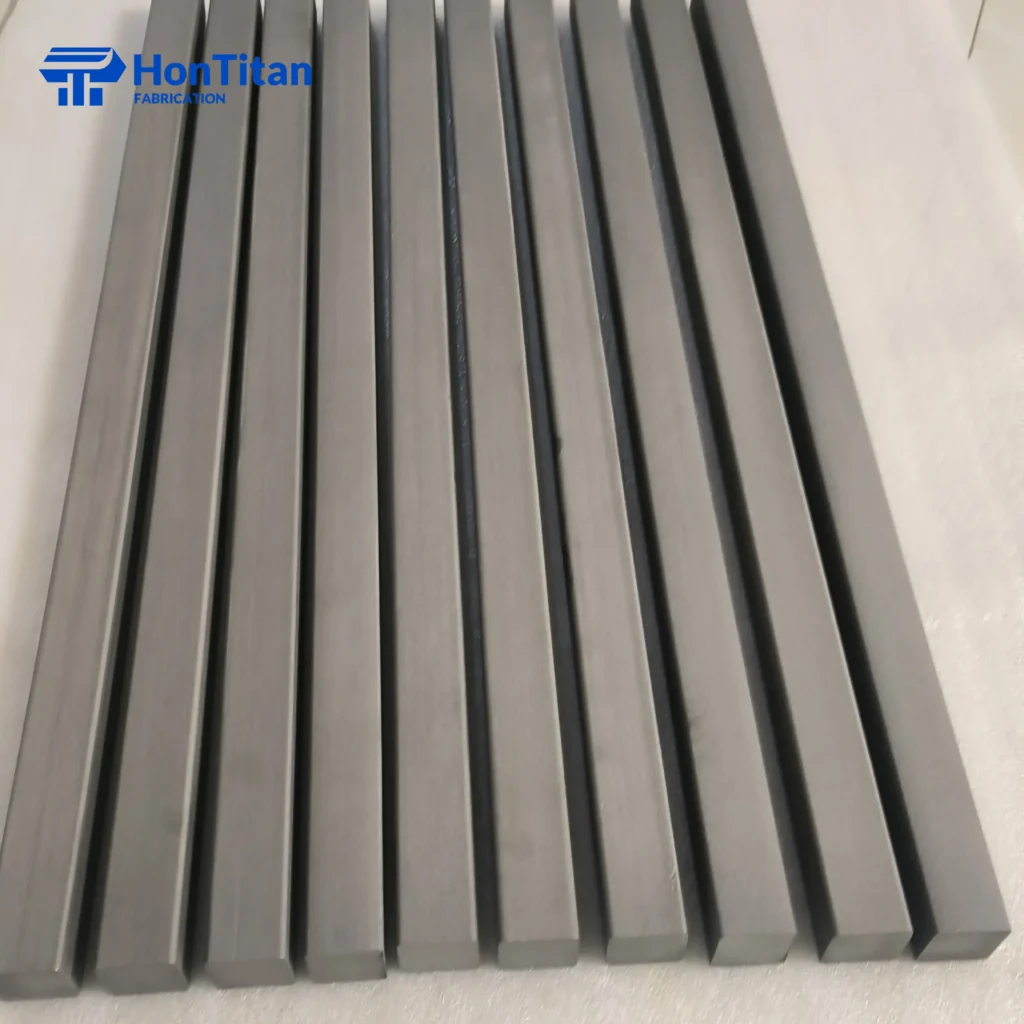
Long before it became the holy grail of high-performance automotive tuning, titanium was a material exclusively reserved for aerospace engineering and Formula 1 motorsports. Today, a premium titanium exhaust system commands a price tag often three to four times higher than its stainless steel counterpart. This glaring price gap leads many enthusiasts, track racers, and custom shop builders to ask the inevitable question: Is it really just a metal pipe? Are you merely paying a premium for those iconic “burnt blue” tips?
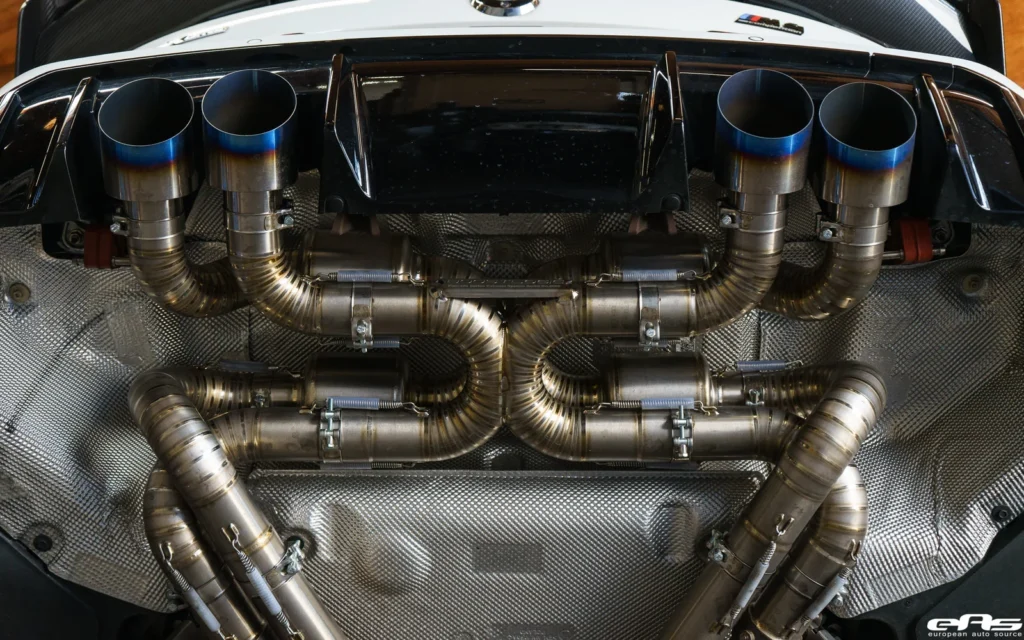
The short answer is no. A properly fabricated custom titanium exhaust is far more than a cosmetic upgrade. It is an uncompromising exercise in metallurgy, thermodynamics, and precision fabrication. When you upgrade to titanium, you are not just changing the sound of your vehicle; you are fundamentally altering its physical dynamics.
Let’s strip away the marketing fluff and dive deep into the hardcore engineering behind why titanium remains the ultimate, undisputed choice for those who refuse to compromise on mechanical perfection.
The Physics of Mass Reduction: A Game of Density and Inertia
When automotive engineers look for ways to shave seconds off a lap time, mass is the ultimate enemy. In the world of performance tuning, the most quantifiable benefit of a titanium exhaust lies in its radical impact on the vehicle’s curb weight and distribution.
The fundamental advantage of titanium is rooted in its atomic density. Commercially pure titanium (Grade 2) or aerospace-grade alloys (Grade 5) possess a density of approximately 4.5 g/cm³, whereas the industry-standard 304 stainless steel sits significantly higher at around 7.9 g/cm³. In practical engineering terms, a titanium exhaust system achieves the same structural integrity as steel while being roughly 43% to 50% lighter. For a full-length cat-back or turbo-back system, this often translates to an immediate weight saving of 15 to 30 pounds.
However, the true mechanical advantage isn’t just about the total pounds shed—it’s about where that mass is removed. Because the exhaust system is typically located at the furthest extremities of the chassis, often behind the rear axle, it has a disproportionate effect on the vehicle’s Polar Moment of Inertia. By stripping weight from the ends of the car, you are essentially reducing the force required to initiate a change in direction. This leads to a sharper turn-in response, reduced pendulum effect during high-speed transitions, and a more favorable power-to-weight ratio. When comparing titanium vs. stainless steel exhaust weight, you aren’t just buying a lighter part; you are optimizing the dynamic agility of the entire machine.
Engineering Logic: Not All “Titanium” is Created Equal (Grade 2 vs. Grade 5)
A common misconception among automotive enthusiasts is treating “titanium” as a single, uniform metal. In the realm of high-end fabrication, specifying the correct alloy grade is what separates a premium product from a brittle, failure-prone pipe. A meticulously engineered system doesn’t just blindly use the hardest material available; it applies the right material to the right application.
For the primary exhaust piping, top-tier manufacturers utilize Commercially Pure (CP) Grade 2 Titanium. Why? Grade 2 offers the perfect balance of yield strength and ductility. Exhaust tubing requires complex geometries to route around suspension components and driveshafts. Grade 2 possesses the necessary formability for seamless mandrel bending and precise pie-cut welding without fracturing. Furthermore, when B2B buyers look for premium titanium exhaust tubing wholesale, they are specifically seeking the unparalleled corrosion resistance and stable weldability that Grade 2 provides for the main gas flow channels.
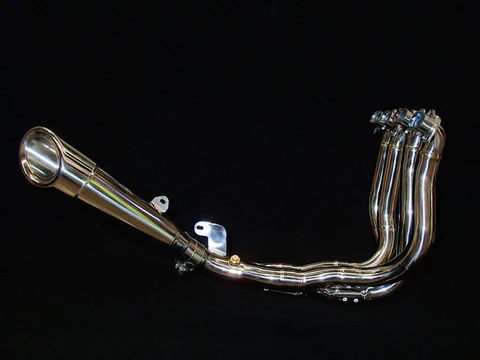
However, the structural demands change drastically at the connection points. This is where Grade 5 Titanium (Ti-6Al-4V) enters the equation. Composed of 6% aluminum and 4% vanadium, Grade 5 boasts significantly higher tensile strength and fatigue resistance compared to Grade 2. The areas connecting the exhaust to the engine block or turbocharger—such as flanges, V-band clamps, and mounting brackets—are subjected to extreme mechanical stress, intense thermal cycling, and constant engine vibration. Utilizing CNC-machined Grade 5 titanium exhaust flanges ensures that these high-stress mating surfaces will not warp, deform, or crack under immense pressure, guaranteeing a leak-free seal over the lifetime of the vehicle.
To better visualize these metallurgical differences, refer to the engineering comparison below:
| Feature / Specification | CP Grade 2 Titanium | Grade 5 Titanium (Ti-6Al-4V) |
|---|---|---|
| Alloy Composition | Commercially Pure Titanium (~99% Ti) | 90% Titanium, 6% Aluminum, 4% Vanadium |
| Yield Strength | ~275 – 350 MPa | ~828 – 880 MPa (Significantly Higher) |
| Ductility & Formability | Excellent (Ideal for complex mandrel bends) | Low (Prone to cracking under cold bending) |
| Primary Application | Main exhaust tubing, mufflers, pie-cuts | CNC-machined flanges, V-bands, brackets |
| Key Engineering Benefit | Optimal fluid dynamics & routing flexibility | Extreme mechanical stress & thermal fatigue resistance |
Ultimately, the best titanium exhausts represent a hybrid approach: Grade 2 for optimal fluid dynamics and routing flexibility, anchored by Grade 5 for unyielding structural integrity.
The 1.0mm Secret Behind That Exotic F1 Howl
For many high-performance enthusiasts, the decision to upgrade is driven by one visceral factor: the sound. When buyers ask, does titanium exhaust sound better? the answer is inherently subjective, but the physical science behind its unique acoustic profile is absolute.
A traditional stainless steel system typically produces a deep, guttural rumble. Titanium, conversely, is world-renowned for its crisp, exotic, high-pitched metallic shriek—a sound frequently compared to the golden era of Formula 1 cars. This distinctive acoustic signature is not magic; it is a direct result of material rigidity and precise tubing geometry.
Because titanium boasts an exceptionally high strength-to-weight ratio, master fabricators can safely construct the system using tubing with significantly thinner walls—typically measuring just 1.0mm to 1.2mm in thickness, compared to the standard 1.5mm or thicker walls of stainless steel. This ultra-thin construction, combined with the metal’s low mass and high stiffness, fundamentally alters the acoustic resonant frequency of the entire system.
As the engine climbs in RPM and the exhaust gas velocity reaches its peak, intense, high-pressure sonic pulses are fired through the piping. Instead of dampening and absorbing these sound waves like thicker, heavier steel does, the thin, highly tensioned titanium walls resonate at a much higher frequency. This structural resonance amplifies the sharp, higher-register exhaust notes while simultaneously helping to eliminate the annoying low-frequency drone inside the cabin. You are quite literally tuning the exhaust like a high-end musical instrument.
Thermodynamic Stability and the Truth About the “Burnt Blue”
High-performance engines generate immense thermal loads, and how an exhaust system manages that heat is critical for both consistent power delivery and vehicle safety. Traditional stainless steel has a tendency to retain thermal energy, leading to “heat soak” that can negatively impact surrounding drivetrain components, differentials, or sensitive carbon fiber aerodynamics. Titanium, however, excels in thermodynamic stability. It sheds heat remarkably fast; moments after a grueling track session, a titanium exhaust cools down significantly quicker than steel, effectively protecting the vehicle’s undercarriage.
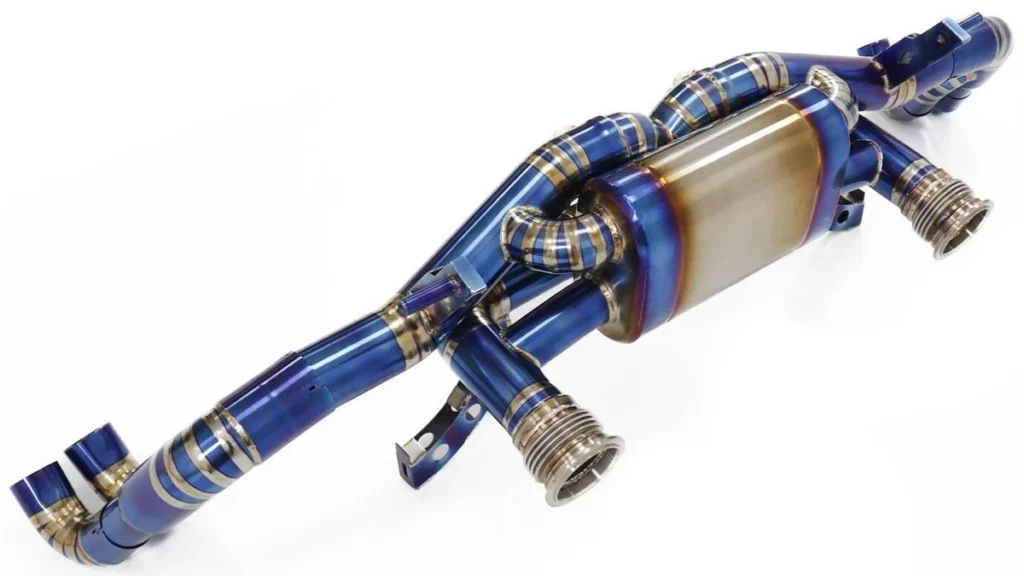
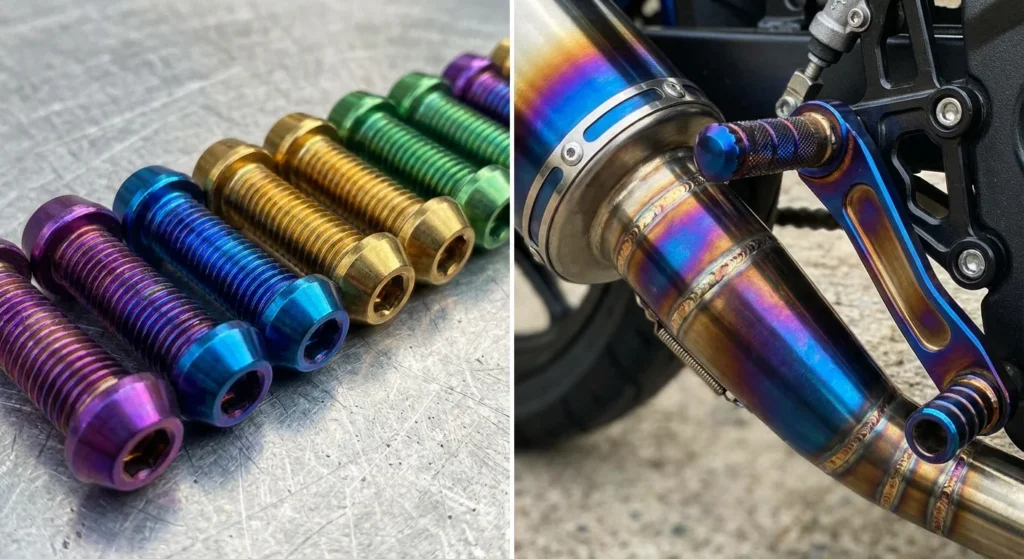
Then there is the aesthetic elephant in the room: the iconic “burnt blue” exhaust tips. A common myth among novices is that this coloring is achieved through a dye, paint, or artificial chemical coating. In reality, the famous titanium heat cycle color change is a strictly physical phenomenon.
When the raw metal is subjected to extreme exhaust gas temperatures (often exceeding 400°C to 600°C), its surface reacts with atmospheric oxygen to form a microscopic, highly dense passivation layer of titanium dioxide (TiO₂). As this oxide layer thickens at different temperature thresholds, it refracts light differently—much like a prism—producing a vibrant spectrum of colors ranging from straw gold to deep violet and brilliant blue.
Crucially, this oxidation is not just for show; it is an impenetrable suit of armor. This naturally occurring TiO₂ film makes titanium virtually impervious to environmental degradation. Unlike mild steel that inevitably rusts, or even 304 stainless steel that can pit and corrode when exposed to winter road salt or caustic moisture, titanium offers absolute, lifetime corrosion resistance. You are not paying for a pretty color; you are paying for an exhaust system engineered to outlast the car itself.
The Fabrication Wall: Why Do Some Titanium Exhausts Crack?
Despite its aerospace-grade strength, titanium possesses a notorious Achilles’ heel: it is exceptionally difficult to weld. A frequent question raised on automotive forums is, “If titanium is so strong, why do some aftermarket exhausts crack under track conditions?” The answer almost never lies in the material itself; it lies in compromised, cost-cutting fabrication.
At high temperatures, titanium becomes highly reactive. If the molten weld pool is exposed to ambient oxygen, nitrogen, or moisture, the metal rapidly absorbs these elements. This contamination leads to severe structural embrittlement—a fatal flaw commonly known in metallurgy as “sugaring” or alpha-case formation. A contaminated weld might look acceptable on the outside, but internally, it is as brittle as glass and will inevitably fracture under the intense vibration of a high-revving engine.
This is the ultimate dividing line between premium manufacturers and budget factories. The non-negotiable standard for high-end reliability is a meticulous process called titanium exhaust back purging. Before a single arc is struck during TIG welding titanium, master fabricators must seal the tubing and flood the internal cavity with 100% pure, inert argon gas. This continuous internal shielding prevents any atmospheric contamination, ensuring the weld penetrates cleanly and retains the native flexibility and strength of the base alloy.
Furthermore, manipulating the tubing requires equal precision. To optimize exhaust gas velocity without restricting flow, top-tier systems rely on CNC mandrel bending to maintain a constant inner diameter through every curve. However, for extremely tight clearances or aggressive routing, master welders will execute a pie cut titanium exhaust technique. This involves TIG welding dozens of precision-cut titanium slices to form a seamless curve, resulting in the iconic, visually stunning “dime-stacked” weld lines that serve as a hallmark of elite craftsmanship.
When you invest in a premium system, you are paying for the invisible quality—the expensive argon gas, the surgical cleanliness, and the hundreds of hours of masterful welding that guarantee your exhaust will never crack.
Frequently Asked Questions
Why do titanium exhausts turn blue?
Titanium exhausts turn blue due to a natural physical process called thermal oxidation. When exposed to extreme exhaust temperatures, the metal reacts with oxygen, forming a microscopic titanium dioxide layer. This dense film refracts light, creating vibrant colors while providing an impenetrable anti-corrosion barrier.
Do titanium exhausts crack easily?
A properly manufactured titanium exhaust is incredibly durable and will not crack. However, failures occur if the system is poorly welded without 100% argon back-purging, causing metal embrittlement. Lacking high-quality flex joints to manage thermal expansion can also lead to stress fractures.
Can you weld titanium to stainless steel?
No, you cannot directly weld titanium to stainless steel using traditional TIG or MIG methods. Their metallurgical structures and thermal expansion rates are incompatible, creating highly brittle intermetallic compounds. They must be joined mechanically using high-quality V-band clamps or specialized slip-on joints.
Does a titanium exhaust increase horsepower?
Yes, a well-engineered titanium exhaust increases horsepower by optimizing exhaust gas velocity and reducing backpressure. Furthermore, by shedding 40-50% of the exhaust system’s weight compared to steel, it significantly improves the vehicle’s overall power-to-weight ratio, leading to noticeably sharper acceleration.
Why is titanium exhaust so expensive?
Titanium exhausts are expensive due to the high cost of raw aerospace-grade alloys and the extremely labor-intensive fabrication process. Welding titanium requires highly specialized skills, surgically clean environments, and expensive inert gases like pure argon for constant internal and external shielding.
Conclusion: The Ultimate Investment in Mechanical Perfection
Upgrading to a titanium exhaust is not a decision made purely out of necessity; it is a commitment to mechanical perfection. It represents the ultimate bridge between aerospace engineering and automotive performance. While a standard steel pipe might get the job done, titanium fundamentally transforms the vehicle—shedding crucial unsprung weight, optimizing thermodynamic stability, and producing an acoustic resonance that is simply impossible to replicate with any other material. You are not just buying an exhaust system; you are investing in a masterclass of metallurgy and fabrication.
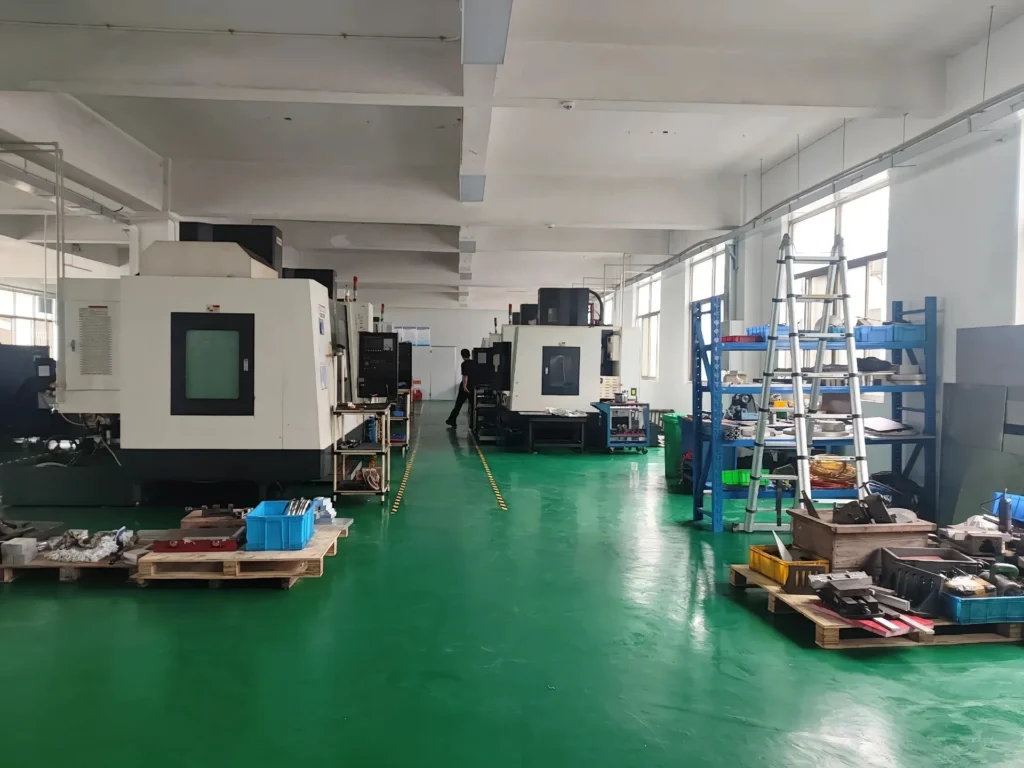
Looking for a reliable manufacturing partner?
As a premier facility equipped with state-of-the-art CNC mandrel bending and strict 100% argon back-purging TIG stations, we supply Grade 2 and Grade 5 titanium solutions to top-tier custom shops worldwide. Contact our engineering team today for wholesale tubing, custom flanges, or private-label fabrication quotes.