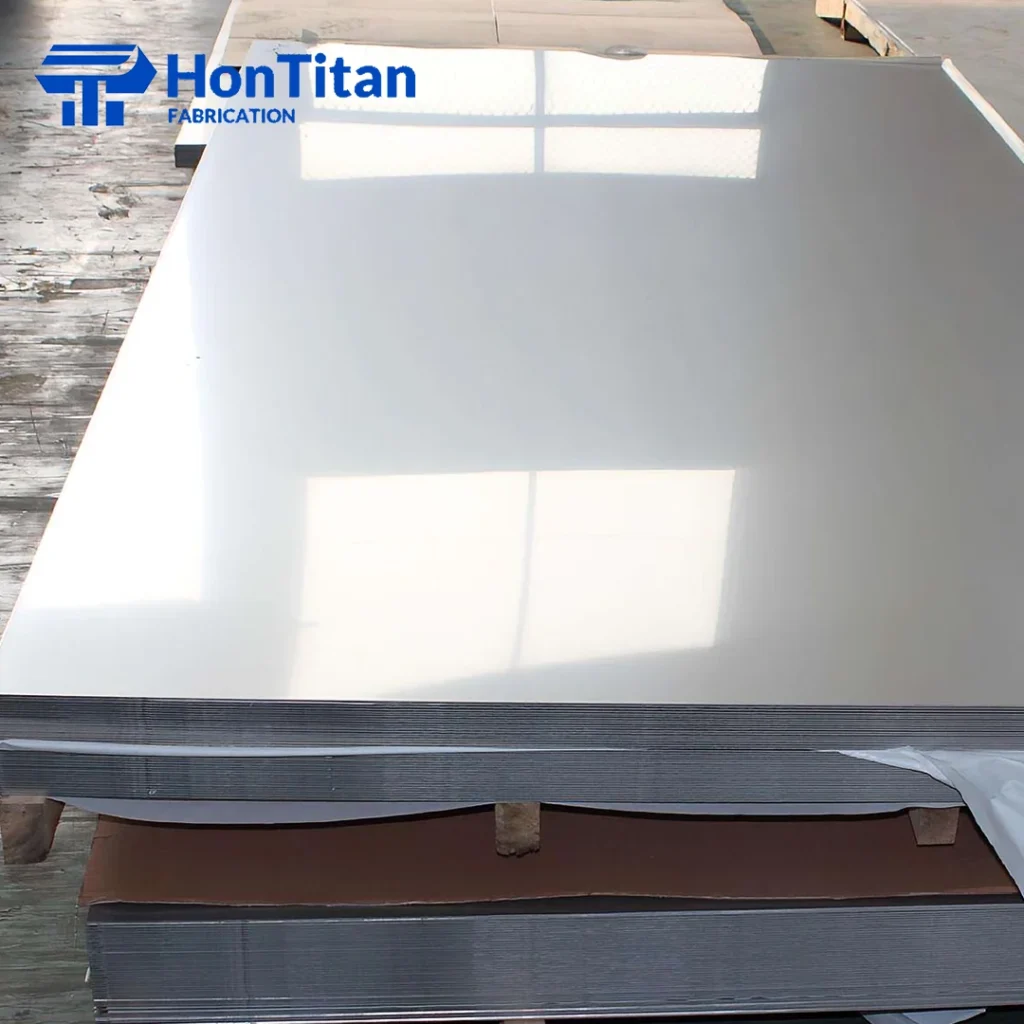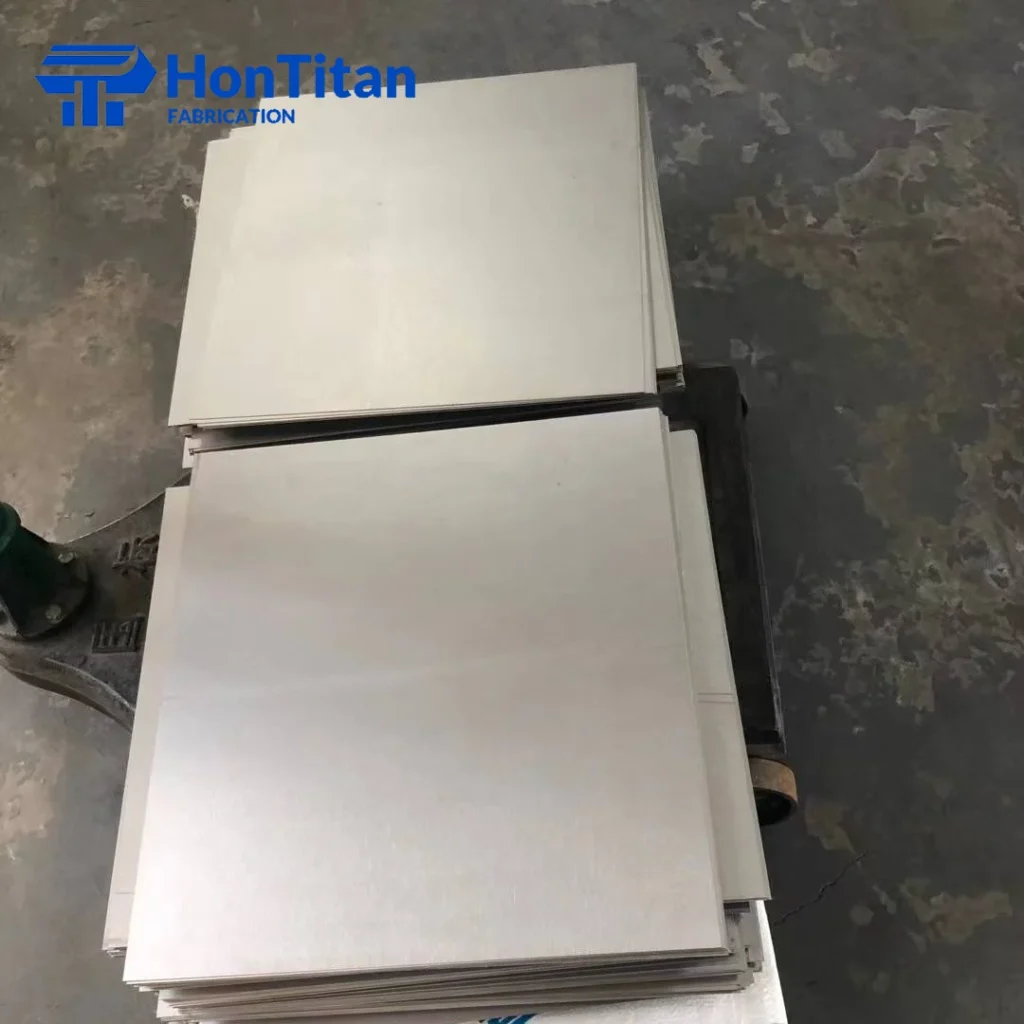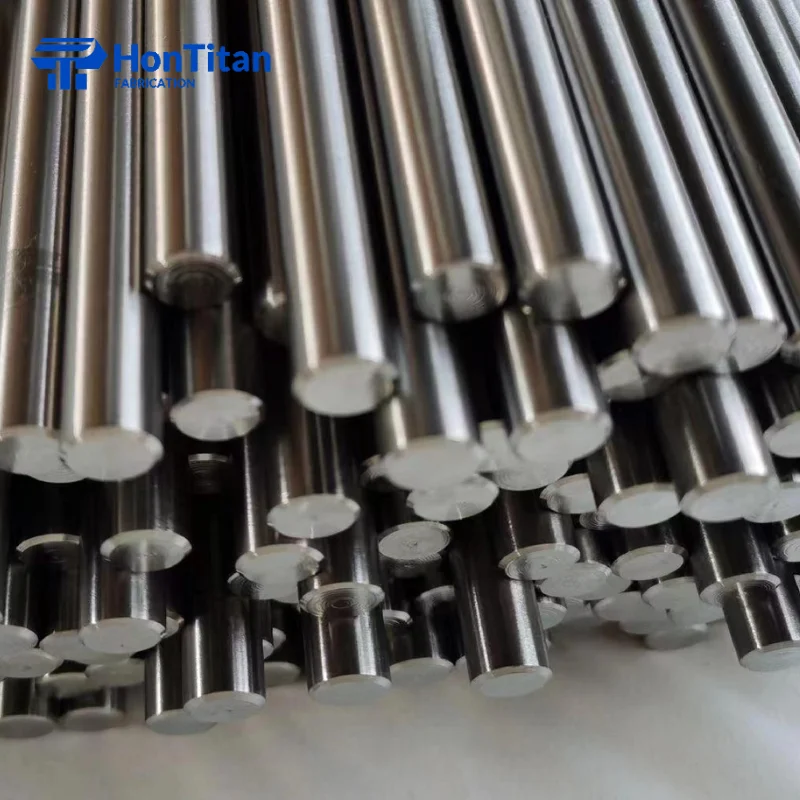
Titanium is quietly doing some of the hardest structural work in renewable energy — not because it’s fashionable, but because nothing else holds up under the same combination of acidic environments, cyclic loading, and 25-year asset lifetimes. This guide covers three sectors where titanium earns its cost premium: PEM electrolyzers and green hydrogen production, offshore wind turbine fastener systems, and solar thermal heat exchangers and next-generation photovoltaic cells. For each sector, we break down which ASTM grades are specified, what the tradeoffs are, and where titanium loses to alternatives — because understanding both sides is what a good spec decision requires.
Why Titanium Belongs in Renewable Energy Infrastructure
Renewable energy systems have one thing in common with aerospace: they operate in unforgiving environments for decades with zero tolerance for maintenance-driven downtime. A corroded fastener on a tower 30 km offshore costs ten times more to replace than the fastener itself. A failed bipolar plate in a PEM electrolyzer stack shuts down an entire hydrogen production train.
Titanium’s value proposition in these contexts rests on three verifiable properties:
- Densidad: 4.51 g/cm³ (Grade 2) and 4.43 g/cm³ (Grade 5/Ti-6Al-4V) — roughly 44% lighter than 316L stainless steel at ~8.0 g/cm³
- Passive oxide layer: Titanium spontaneously forms a stable TiO₂ film in air and aqueous environments, providing exceptional corrosion resistance in acids, chlorides, and oxidizing media
- Strength-to-weight ratio: Grade 5 (Ti-6Al-4V) achieves minimum tensile strength of 895 MPa (AMS 4928) — approximately three times the yield strength of 316L stainless steel — at that reduced density
What makes the renewable energy case particularly compelling is lifecycle economics. The global titanium market was valued at $29.64 billion in 2024 and is projected to reach $47.96 billion by 2032 (CAGR 6.2%), with renewable energy explicitly cited alongside aerospace as a primary growth driver. That growth is driven by procurement teams who have done the math on 25-year asset cost — and titanium wins that calculation more often than its upfront price suggests.
Titanium in PEM Fuel Cells and Green Hydrogen Electrolyzers
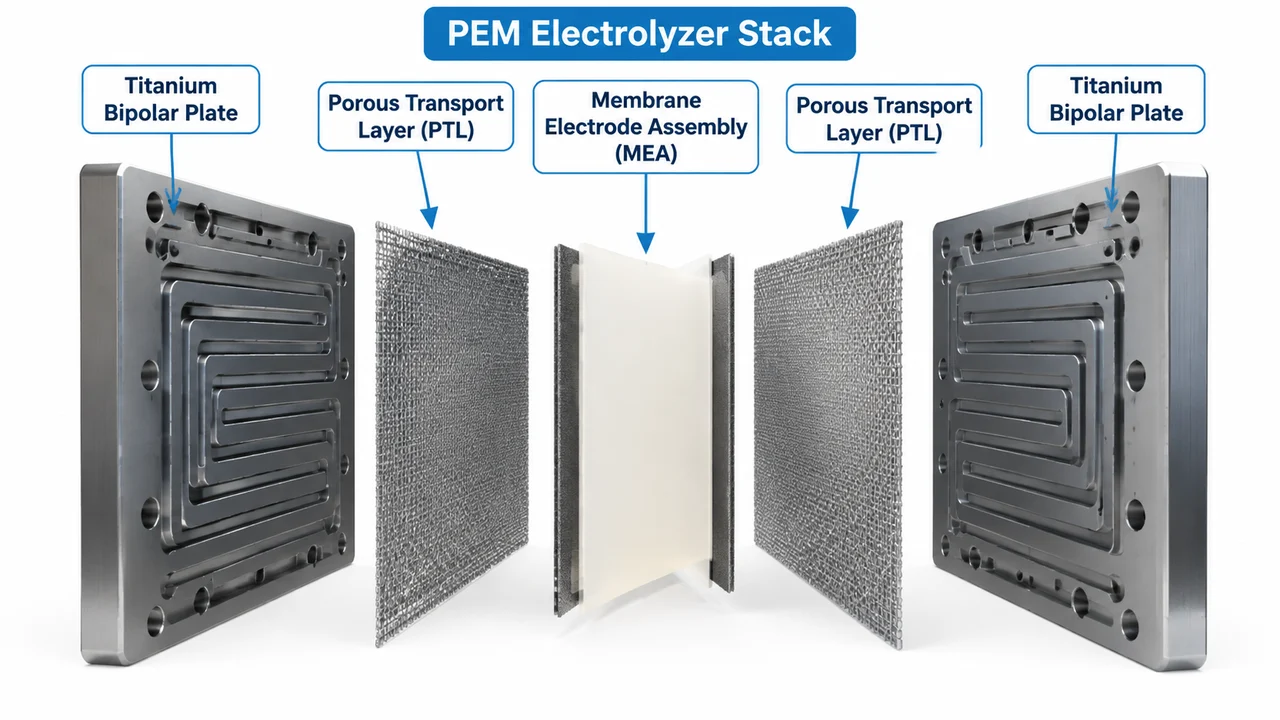
PEM (Proton Exchange Membrane) technology is the backbone of two overlapping industries: hydrogen fuel cells for power generation, and PEM electrolyzers for green hydrogen production. Titanium plays a critical structural role in both — and the technical demands are steep enough that most alternatives fail.
Bipolar Plates: Titanium vs. Graphite vs. Stainless Steel
Bipolar plates account for 60–80% of a PEM fuel cell stack’s total weight and a significant share of its cost. They need to be electrically conductive, mechanically strong, gas-tight, and chemically stable in environments with pH as low as 2 and operating temperatures up to 80°C. That eliminates most metals and creates a narrow field.
Graphite has been the industry standard: chemically inert and highly conductive. Its problems are physical — brittle, thick (minimum 3–5 mm required for mechanical integrity), and impossible to stamp into thin-profile configurations. Miniaturizing a fuel cell stack with graphite bipolar plates is an engineering dead-end.
Stainless steel 316L is cheaper and can be stamped to 0.1–0.3 mm profiles. The problem is the anode environment in a PEM electrolyzer, where oxidizing conditions are aggressive enough to dissolve iron, chromium, and nickel ions from the steel surface. Those ions migrate into the membrane, poisoning the catalyst layer and degrading cell performance over hundreds of hours.
Titanium (Grade 1 and Grade 2) solves the corrosion problem through its passive TiO₂ surface layer, which remains stable in acidic oxidizing environments. A 2026 RSC review concluded that “titanium can effectively replace commonly used BP materials such as graphite and stainless steel,” citing titanium’s highest strength-to-density ratio of any metallic element as a secondary advantage.
The tradeoff is real, though: the same TiO₂ layer that provides corrosion resistance also acts as an electrical insulator, increasing interfacial contact resistance (ICR) between the plate and the gas diffusion layer. The DOE’s target for bipolar plate ICR is <10 mΩ·cm² at 140 N/cm² compression — a threshold that bare titanium cannot meet without surface treatment.
Coating Solutions for Contact Resistance
The ICR problem has driven significant coating research. Three approaches are commercially relevant:
Titanium Nitride (TiN) coating: Applied via arc ion plating on Grade 1 titanium substrates, TiN provides low contact resistance while preserving the corrosion protection of the base metal. MDPI Coatings (2023) validated this approach against DOE targets. TiN is currently the most commercially mature coating option.
Gold (Au) and platinum (Pt) coatings: Excellent ICR performance, but material cost makes them non-viable for large-scale deployment. The DOE’s cost target of $5/kW at the stack level rules out precious metal coatings for mainstream PEM electrolyzers.
Magnéli phase Ti₄O₇: This sub-stoichiometric titanium oxide is electrically conductive while maintaining corrosion resistance. Research published in PMC (PMC7906596) validated Ti₄O₇-coated titanium plates for PEM water electrolysis as a low-cost alternative to Pt-coated substrates. This is the most promising pathway for cost reduction and is an active area of commercial development.
For procurement teams: Grade 1 titanium (softer, more formable, ASTM B265) is the standard substrate for bipolar plate stamping. Grade 2 (higher strength, also ASTM B265) is used where the bipolar plate doubles as a structural element.
Porous Transport Layers — The Anode Side Problem
In a PEM electrolyzer stack, the porous transport layer (PTL) sits between the membrane electrode assembly and the bipolar plate, allowing water in and oxygen out at the anode side. The anode environment is the most aggressive in the entire stack: low pH, high oxygen partial pressure, high electrochemical potential.
Stainless steel PTLs corrode under these conditions within hundreds of hours. Titanium PTLs (sintered titanium powder or titanium felt) are the standard choice for PEM electrolyzer anodes precisely because no other affordable material survives the operating conditions long enough to justify deployment.
The PEM electrolyzer market reflects this: valued at $5.09 billion in 2024 and projected to reach $17.38 billion by 2032 at a CAGR of 16.69% (Kings Research), the sector is one of the fastest-growing markets for titanium mill products. The titanium electrode mesh market alone — a subset — was valued at $496.8 million in 2025 with a projected trajectory past $1 billion by 2033.
Titanium in Hydrogen Storage and Pressure Vessels
For hydrogen storage at 350–700 bar operating pressures, Type III cylinders use a metallic liner — typically aluminum or titanium alloy — overwrapped with carbon fiber. Ti-6Al-4V (Grade 5) is specified for the most demanding Type III applications, particularly in aerospace heritage (NASA, SpaceX) and heavy-duty vehicle programs.
An important consideration in hydrogen service: commercially pure titanium grades (Grade 2) have significantly better hydrogen embrittlement resistance than high-strength steels at ambient conditions. Ti-6Al-4V (Grade 5), however, is susceptible to hydrogen embrittlement in certain high-pressure environments and requires careful design review for critical H₂ service — a point often glossed over in supplier literature. The tradeoff on carbon footprint is also real: a 2026 MDPI Hydrogen study found that titanium alloy pressure vessels produce approximately 80 kgCO₂eq per kg of vessel during manufacturing vs. 21.9 kgCO₂eq per kg of vessel for Type IV composite cylinders (HDPE liner with carbon fiber overwrap). For procurement teams with lifecycle carbon tracking requirements, this upstream carbon load belongs in the total cost model.
Titanium in Wind Turbine Components
Wind energy presents titanium with a different engineering problem: not chemical attack from acidic media, but mechanical fatigue in a corrosive environment. A wind turbine fastener system experiences cyclic loading millions of times over a 25-year lifespan, in conditions ranging from arctic humidity to tropical salt spray. Failure of a single critical fastener during a maintenance cycle is a site-shutdown event.
Fasteners and Bolting Systems — The Offshore Challenge
The offshore wind sector is where titanium fasteners are most firmly established. 316L stainless steel — the standard marine fastener material for onshore applications — has a documented failure mode in stagnant seawater: crevice corrosion develops under bolt heads, in threaded joints, and at flange interfaces, particularly at temperatures above ~30°C. In the North Sea and tropical offshore zones, this translates to fastener replacement cycles of 5–8 years for 316L hardware, against a 25-year turbine design life.
Titanium Grade 2 fasteners eliminate this failure mode. Commercially pure titanium’s pitting resistance in seawater has a documented threshold of approximately 82°C — meaning standard offshore operating conditions present no corrosion risk whatsoever. For the most aggressive applications (high-temperature seawater, reducing acid environments), 7º curso (Ti-0.2Pd, ASTM B265) extends that pitting threshold to approximately 150°C.
For structural bolting in tower sections and nacelle assemblies — where clamping force and fatigue life under cyclic loading are the primary requirements — Grado 5 (Ti-6Al-4V) is the specification. With tensile strength of 895 MPa minimum and a density of 4.43 g/cm³, it delivers roughly three times the yield strength of 316L stainless steel at 44% less weight. For high bolt counts in large rotor hub assemblies, that weight reduction has a secondary benefit: reduced dynamic imbalance loads on bearings.
One note of caution: titanium fasteners can gall (cold-weld) during installation if anti-seize lubricant is not applied. This is not a performance limitation in service, but it is an installation procedure issue that must be specified in the work instructions and confirmed with the fastener supplier.
The marine fasteners market was valued at $2.4 billion in 2026 and is projected to reach $3.99 billion by 2035 (5.80% CAGR). Offshore wind is cited as one of the primary demand drivers alongside offshore oil and gas.
Hub and Blade Root Components
Titanium alloys appear in wind turbine hubs and blade root attachment hardware for a combination of fatigue and weight reasons. At the blade root — where the highest bending loads occur during operation — the fatigue life of the fastening system is a design-limiting constraint. Ti-6Al-4V’s fatigue behavior under high-cycle loading is well-characterized and significantly better than lower-grade stainless steel alloys at equivalent weight.
Wind turbine blades themselves are carbon fiber or glass fiber composite — titanium is not used in the blade structure. But the hardware that attaches blades to the hub, and the hub components that bear the aggregated load from all blades, are candidates for titanium alloy where the weight-at-height calculation justifies the material cost.
Specific OEM adoption rates are not publicly disclosed by major turbine manufacturers (Vestas, Siemens Gamesa, GE Vernova), but titanium fasteners appear consistently in offshore wind project material specifications from EPC contractors.

Titanium in Solar Energy Systems
Solar is a more nuanced story than fuel cells or wind. Titanium’s role is real but sector-specific — concentrated in two areas: industrial heat transfer equipment for concentrated solar power (CSP) and next-generation photovoltaic cell chemistry.
TiO₂ in Dye-Sensitized Solar Cells
Dye-sensitized solar cells (DSSCs) use titanium dioxide (TiO₂) nanoparticles as the photoanode — the material that accepts electrons from the photosensitized dye and transports them to the external circuit. This is distinct from the structural titanium applications in wind and fuel cells; here titanium’s role is electrochemical.
The baseline efficiency of a standard TiO₂ nanoparticle DSSC photoanode is approximately 3.43% under standard illumination (AM 1.5G conditions) (Nature Scientific Reports, 2024). That figure sounds modest, but the technology is evolving rapidly:
- Fe/S-doped TiO₂ photoanodes improved efficiency to 6.46% — an approximately 88% gain over the pure TiO₂ baseline (RSC Advances, 2025)
- TiO₂ nanotube morphologies increased photocurrent efficiency by approximately 200% compared to nanoparticle substrates, from 1.19% to 2.45%, by expanding the active surface area available for dye adsorption (Heliyon, 2024)
- 1D TiO₂ nanostructures (nanotubes, nanorods) are considered the most promising direction for high-efficiency DSSC development
DSSC technology currently represents a small fraction of total solar installations — conventional silicon PV dominates at higher efficiency (22–26% for commercial modules). The DSSC case is relevant for B2B buyers in specialty applications: flexible solar, building-integrated photovoltaics (BIPV), and applications where low-light performance or aesthetic integration matters more than peak efficiency.
Titanium Heat Exchangers in Concentrated Solar Power
CSP plants use heat transfer fluids — molten salt, thermal oil, or supercritical CO₂ — to store solar energy as heat and drive steam turbines. The heat exchanger equipment that moves energy between the solar field and the power block is a critical long-life asset.
For heat exchanger tubes and shell-and-tube condensers in CSP plants, ASTM B338 covers seamless and welded titanium tubes for condenser and heat exchanger service. Grade 2 is the standard specification. Titanium’s advantages in this context are resistance to seawater cooling circuits (many CSP plants are built in coastal desert regions with seawater-cooled condensers), resistance to brine scaling, and extremely low fouling rates compared to stainless steel.
The practical temperature limitation is worth stating carefully, as it is grade-dependent. Commercially pure titanium (Grades 1, 2, 7, 12) is suitable for service up to approximately 300–400°C in most industrial environments. Near-alpha alloys (Ti-6Al-2Sn-4Zr-2Mo and similar) extend this to approximately 600°C in specialized applications. For CSP seawater-cooled condensers and lower-temperature heat exchange circuits — the primary titanium application in solar thermal plants — Grade 2 to ASTM B338 is well within its service envelope. Higher-temperature CSP cycles using supercritical CO₂ above 400–600°C require nickel-based alloys regardless of the titanium grade. For procurement teams: titanium is the right call for seawater-cooled condensers and lower-temperature heat exchange loops; nickel is the right call for the hottest sections of advanced CSP cycles.
Grade 12 (Ti-0.3Mo-0.8Ni, ASTM B265) offers improved crevice corrosion resistance compared to Grade 2 in saline environments, at a modest cost premium. For CSP plants in highly saline coastal environments, Grade 12 tube bundles are worth evaluating.

Grade Selection Matrix: Which Titanium Grade for Which Renewable Application
This is the question most articles avoid — and the one that matters most to a procurement engineer writing a material spec.
| Grado | Norma ASTM | Densidad (g/cm³) | Resistencia a la tracción (MPa) | Propiedades clave | Renewable Energy Application |
|---|---|---|---|---|---|
| Grado 1 | ASTM B265 | 4.51 | 240 min | Most formable CP grade, lowest strength | PEM bipolar plate stamping, thin-gauge applications |
| Grado 2 | ASTM B265 | 4.51 | 345 min | Best-balance CP grade, pitting threshold ~82°C seawater | PEM bipolar plates, PTLs, offshore fasteners, CSP heat exchanger tubes |
| 7º curso | ASTM B265 | 4.51 | 345 min | Pd-alloyed, pitting threshold ~150°C | Severe marine environments, high-temperature saline service |
| Grado 12 | ASTM B265 | 4.51 | 480 min | Mo-Ni alloyed, superior crevice corrosion | CSP saline condensers, offshore environments with crevice geometry |
| Grado 5 (Ti-6Al-4V) | AMS 4928 | 4.43 | 895 min | Highest strength, ~3× yield strength of 316L SS; note: susceptible to H₂ embrittlement at high pressure | Structural wind turbine fasteners, hub components; hydrogen pressure vessels (with H₂ embrittlement review) |
Selection rule of thumb:
- Corrosion is the dominant concern, budget is tight → Grado 2
- Corrosion is the dominant concern, environment is severe (high temperature, reducing acids) → 7º curso
- Crevice geometry is unavoidable in a saline environment → Grado 12
- Strength is the dominant concern (high cyclic load, structural joint) → 5º curso
- Formability is critical (thin-gauge bipolar plate stamping) → Grado 1
Lifecycle Cost vs. Upfront Price — The Real Calculation
Titanium typically costs 3–5× more per kilogram than stainless steel at the point of purchase. This is the number that creates budget friction in procurement reviews, and it deserves a direct answer rather than hand-waving.
The honest calculation depends on three variables:
1. Replacement frequency. Offshore wind fasteners in 316L stainless are typically replaced every 5–8 years in salt spray zones. Titanium Grade 2 or Grade 5 fasteners with a 25-year service life eliminate 2–4 replacement cycles. Each cycle costs not just the fastener price but mobilization, access equipment (often marine vessel day rates), labor, and turbine downtime. At offshore day rates, one avoided maintenance intervention can exceed the total cost of a titanium fastener upgrade.
2. Stack degradation costs. In a PEM electrolyzer, stainless steel component degradation releases metal ions that poison the membrane. A degraded membrane in a commercial-scale electrolyzer is a $50,000–$500,000 replacement event depending on stack size. Titanium’s chemical inertness eliminates this failure mode entirely.
3. Geometric efficiency. Titanium bipolar plates can be stamped to 0.1–0.5 mm thickness versus graphite’s minimum 3–5 mm. For a 100-kW PEM electrolyzer stack, that difference in plate thickness translates directly to stack size, weight, and balance-of-plant cost. The material cost premium shrinks considerably when you’re using far less material by volume.
The honest bottom line: titanium’s upfront premium almost always pencils out for 20+ year assets in corrosive environments. For short-lifespan applications or benign environments, it does not. The discipline is in correctly identifying which category your application falls into before writing the spec.
Preguntas frecuentes
Why is titanium used in PEM electrolyzers instead of stainless steel?
PEM electrolyzer anodes operate in a low-pH, high-oxygen-potential environment that corrodes stainless steel over hundreds of hours, releasing iron, chromium, and nickel ions that poison the membrane catalyst. Titanium’s passive TiO₂ surface layer resists this corrosion, making it the standard material for anode-side bipolar plates and porous transport layers (PTLs). The engineering tradeoff is that the same TiO₂ layer increases electrical contact resistance, which is addressed through surface coatings (TiN, Ti₄O₇).
What titanium grade is best for offshore wind fasteners?
Grade 2 (commercially pure titanium, ASTM B265) is the standard for marine fasteners where corrosion resistance is the primary requirement — its pitting threshold in seawater is approximately 82°C, covering normal offshore operating conditions. Grade 5 (Ti-6Al-4V) is used where high clamping force and fatigue life under cyclic loading are required, such as tower flange bolting and blade root attachment hardware. Grade 7 (Pd-alloyed) covers the most aggressive marine environments.
What is a porous transport layer (PTL) and why is it made from titanium?
A PTL is a porous metal component in a PEM electrolyzer stack that sits between the membrane electrode assembly and the bipolar plate, allowing water transport to the membrane and gas removal from it. At the anode side — where oxygen evolution creates highly oxidizing conditions — titanium is the only affordable metal that survives long-term service. Sintered titanium powder and titanium felt are the two common PTL forms.
Can titanium bipolar plates replace graphite in existing fuel cell stacks? Not as a drop-in replacement — the contact resistance characteristics differ, and titanium plates require surface coating to meet DOE’s ICR target of <10 mΩ·cm² at 140 N/cm² compression. However, titanium bipolar plates enable thinner plate geometries (stamped to 0.1–0.5 mm vs. graphite’s 3–5 mm minimum), which is a primary driver of stack miniaturization. New stack designs optimized for titanium plates can achieve significantly better volumetric power density.
Is titanium used in standard silicon solar panels?
Not in commercial silicon PV. Titanium’s main solar application is as TiO₂ in dye-sensitized solar cells (DSSCs), where it serves as the photoanode material. DSSCs are a niche but growing segment targeting flexible and building-integrated solar. For mainstream CSP plants, titanium is used in heat exchanger tubes and condenser equipment, particularly where seawater cooling circuits are involved (ASTM B338 tube specification).
What is the temperature limit for titanium in CSP applications?
Temperature limits for titanium are grade-dependent. Commercially pure grades (1, 2, 7, 12) are suitable for typical industrial service up to approximately 300–400°C. For CSP seawater-cooled condensers and lower-temperature heat exchange loops — the primary titanium application in solar thermal — Grade 2 tubes to ASTM B338 are well within this range. Near-alpha alloys extend service to ~600°C in specialized applications. Higher-temperature CSP cycles using supercritical CO₂ above these thresholds require nickel-based alloys.
Conclusión
Titanium earns its place in renewable energy infrastructure through the same logic that put it in aerospace: it handles environments that eliminate alternatives, and it does so for asset lifetimes where the upfront cost premium becomes irrelevant.
Across the three sectors covered here, the clearest cases are: titanium PTLs and bipolar plate substrates in PEM electrolyzers (nothing else survives the anode environment long-term), Grade 2 and Grade 5 fasteners in offshore wind (the lifecycle maintenance math is unambiguous), and ASTM B338 Grade 2 tubes in CSP heat exchangers with seawater cooling circuits (titanium’s fouling and corrosion resistance eliminates one of the main maintenance costs in solar thermal plants).
Where titanium doesn’t win: conventional silicon PV, high-temperature CSP sections above 400–600°C (grade-dependent), and low-budget applications with short service lives. Knowing both sides of that boundary is what separates a good material specification from an over-engineered one.