Introduction: The “Workhorse” of the Industry
Grade 5 Titanium, technically designated as Ti-6Al-4V (or TC4 in some international standards), is the most widely used titanium alloy in the world. Industry data suggests that it accounts for more than 50% of total titanium usage globally.
Unlike Commercially Pure (CP) titanium (such as Grade 1 or Grade 2), Grade 5 is an alloyed material. By introducing specific alloying elements, it retains the low density of titanium (approximately 4.43 g/cm³) while significantly enhancing its mechanical strength and toughness. This exceptional strength-to-weight ratio makes it the primary material choice for critical applications in aerospace airframes, offshore oil and gas components, and load-bearing medical implants.
Chemical Composition and Designation
The designation Ti-6Al-4V serves as a direct reference to the alloy’s chemical formulation. This specific combination of elements is engineered to balance strength, ductility, and fracture toughness.
According to standard specifications such as ASTM B348 (bars/billets) and ASTM B265 (sheet/plate), the nominal composition is:
- Balance – Titanium (Ti): The matrix element, providing corrosion resistance and low density.
- 6% – Aluminum (Al):
- Function: Aluminum acts as an alpha (α) stabilizer.
- Effect: It works primarily through solid-solution strengthening, significantly increasing the alloy’s tensile strength and creep resistance at elevated temperatures.
- 4% – Vanadium (V):
- Function: Vanadium acts as a beta (β) stabilizer.
- Effect: It lowers the transformation temperature and stabilizes the beta phase. The addition of vanadium improves the alloy’s toughness, fatigue strength, and enables the material to be responsive to heat treatment.
- Trace Elements: Impurities such as Iron (Fe), Oxygen (O), Nitrogen (N), and Hydrogen (H) are strictly controlled. Oxygen content, in particular, is critical; while it increases strength, excessive oxygen can cause embrittlement.
Microstructure and Classification
In metallurgical terms, Grade 5 is classified as an alpha-beta (α-β) alloy.
At room temperature, its microstructure consists of two distinct crystallographic phases:
- The Alpha Phase (α): Hexagonal Close-Packed (HCP) structure.
- The Beta Phase (β): Body-Centered Cubic (BCC) structure.
Engineering Significance: The dual-phase structure is what distinguishes Grade 5 from pure titanium grades. It allows the alloy to be heat treatable. Through processes such as Solution Treating and Aging (STA), engineers can manipulate the microstructure to adjust mechanical properties—balancing hardness against ductility—to suit specific operational requirements.
Mechanical Properties & Performance Data
To understand why Ti-6Al-4V is chosen for high-stress applications, we must look at the numbers. The table below outlines the typical mechanical and physical properties of Grade 5 Titanium in its annealed condition.
| Property | Metric | Imperial | Note |
|---|---|---|---|
| Density | 4.43 g/cm³ | 0.160 lb/in³ | ~60% heavier than aluminum, ~45% lighter than steel. |
| Tensile Strength (Ultimate) | ~950 – 1050 MPa | ~138 – 152 ksi | The point at which the material breaks under tension. |
| Yield Strength | ~880 – 920 MPa | ~128 – 134 ksi | The point at which permanent deformation occurs. |
| Hardness (Rockwell C) | 30 – 36 HRC | – | Significantly harder than pure titanium. |
| Modulus of Elasticity | 114 GPa | 16.5 x 10^6 psi | A measure of stiffness; lower than steel (200 GPa). |
| Melting Point | ~1660 °C | ~3020 °F | Excellent heat resistance. |
Note on Biocompatibility: Despite containing Aluminum and Vanadium, Grade 5 (specifically the ELI or Extra Low Interstitial variant, ASTM F136) is considered biocompatible and is widely used in medical implants.
Grade 5 (Ti-6Al-4V) vs. Grade 2 (CP Ti): What is the Difference?
The most common question in the titanium market is: “Why is Grade 5 so much more expensive than Grade 2?” The answer lies in the trade-off between strength and manufacturability.
A. Strength and Hardness
This is the defining difference.
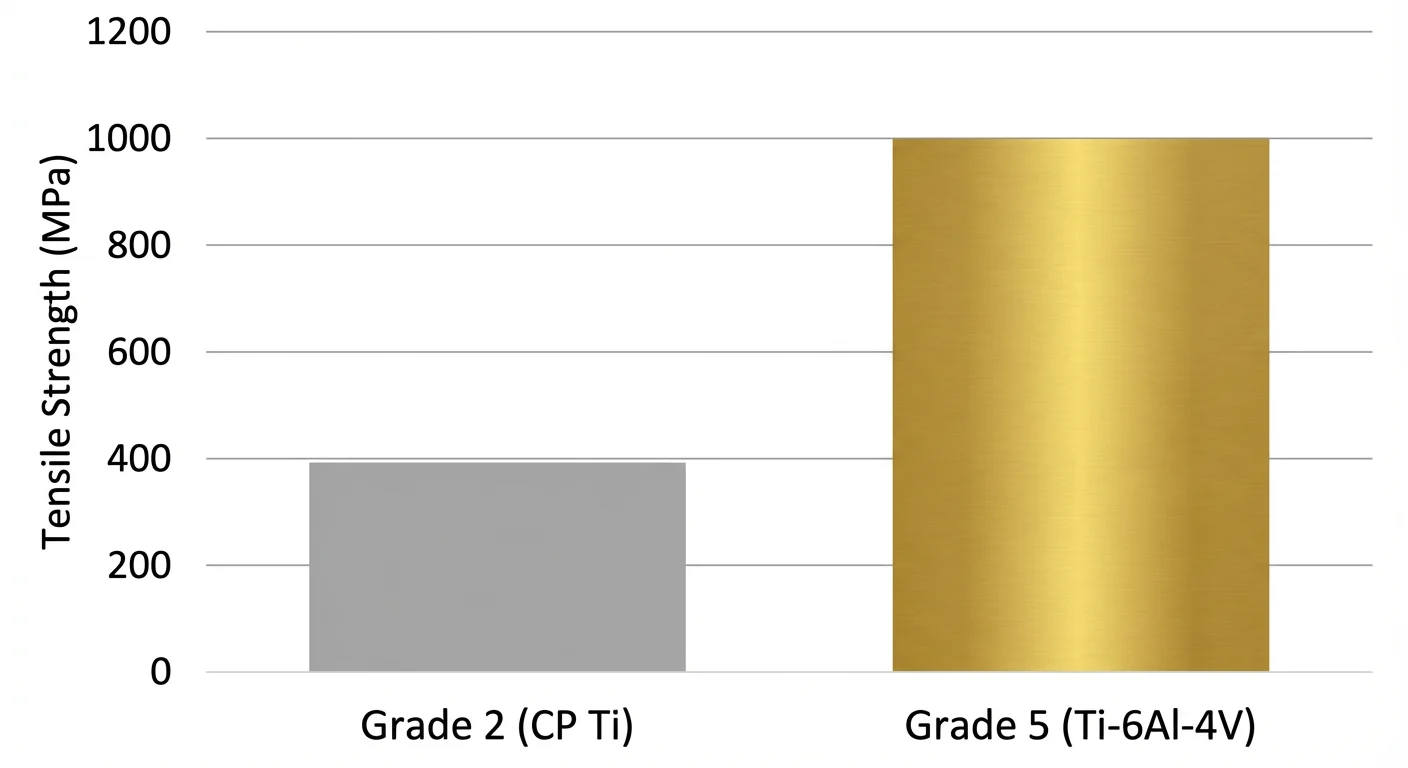
- Grade 5 (Ti-6Al-4V): With a tensile strength of nearly 1000 MPa, it is approximately 3.5x stronger than Grade 1 and roughly 2x stronger than Grade 2. It can withstand significant loads without deforming.
- Grade 2 (CP Ti): Offers moderate strength (approx. 340-400 MPa), comparable to common mild steels. It is ductile and easy to form but cannot support the same structural loads as Grade 5.
B. Corrosion Resistance
- Grade 2: As Commercially Pure titanium, Grade 2 possesses a slightly superior corrosion resistance profile, particularly in highly oxidizing environments or concentrated acids. It is the preferred choice for chemical processing equipment (heat exchangers, piping).
- Grade 5: While theoretically less resistant than pure titanium due to the alloying elements, its corrosion resistance is still superior to almost all stainless steels (including 316L). For most applications—including marine environments, sweat, and seawater—Grade 5 is virtually immune to corrosion.
C. Machinability and Cost
The price premium of Grade 5 is not just about raw material costs; it is largely about processing difficulty.
- Grade 2: Is relatively soft and “gummy” but can be cold-formed (bent) easily. It behaves somewhat like stainless steel during machining.
- Grade 5: Is notoriously difficult to machine. Its low thermal conductivity means heat builds up at the cutting edge rather than dissipating into the chip, leading to rapid tool wear. Furthermore, it has a high “spring-back” rate and cannot be easily cold-formed; it often requires hot forming.
Manufacturing Challenges: Why is Grade 5 So Expensive?
While the raw material cost of titanium is higher than steel or aluminum, a significant portion of the final price of a Grade 5 component comes from processing costs.
Ti-6Al-4V is widely regarded in the manufacturing industry as “difficult to machine.” This reputation stems from three inherent physical properties:
- Low Thermal Conductivity: This is the primary enemy of machinists. Unlike steel, which allows heat to dissipate into the chip (the waste metal), titanium retains heat. During CNC machining, thermal energy concentrates at the cutting edge of the tool.
- Consequence: This leads to rapid tool wear and failure unless high-pressure coolant and specific cutting speeds are used.
- Work Hardening: Grade 5 has a tendency to harden immediately as it is being cut. If a cutting tool dwells in one spot or if the feed rate is too low, the material surface becomes harder than the tool itself.
- Consequence: Machinists must maintain a constant, aggressive feed rate, which requires rigid, high-power machinery.
- Galling and Stickiness: At high pressures, titanium has a chemical affinity for tool materials (like High-Speed Steel or Carbide). It tends to weld or smear onto the tool surface—a phenomenon known as “galling.”
Real-World Applications: From the Sky to the Human Body
Due to its unique combination of high specific strength and biocompatibility, Ti-6Al-4V is utilized in environments where failure is not an option.

A. Aerospace & Aviation
The aerospace industry is the single largest consumer of Grade 5 titanium. It is used in areas where weight reduction is critical for fuel efficiency, yet structural integrity cannot be compromised.
- Turbine Engines: Used for compressor blades and discs where temperatures remain below 400°C (750°F).
- Airframes: Structural components, fasteners, and landing gear assemblies in modern aircraft like the Boeing 787 and Airbus A350.
B. Medical & Biomedical Implants
Titanium is one of the few materials that is biocompatible (non-toxic and not rejected by the body) and capable of osseointegration (where bone tissue grows directly onto the metal surface).
- Note on Grade 23 (ELI): For medical applications, a variant called Ti-6Al-4V ELI (Extra Low Interstitial) is often used. It has reduced oxygen and iron content to improve fracture toughness and ensure safety.
- Uses: Hip and knee replacements, bone screws, trauma plates, and dental implants.
C. Consumer Goods & EDC (Everyday Carry)
In recent years, Grade 5 has migrated from heavy industry to luxury consumer goods.
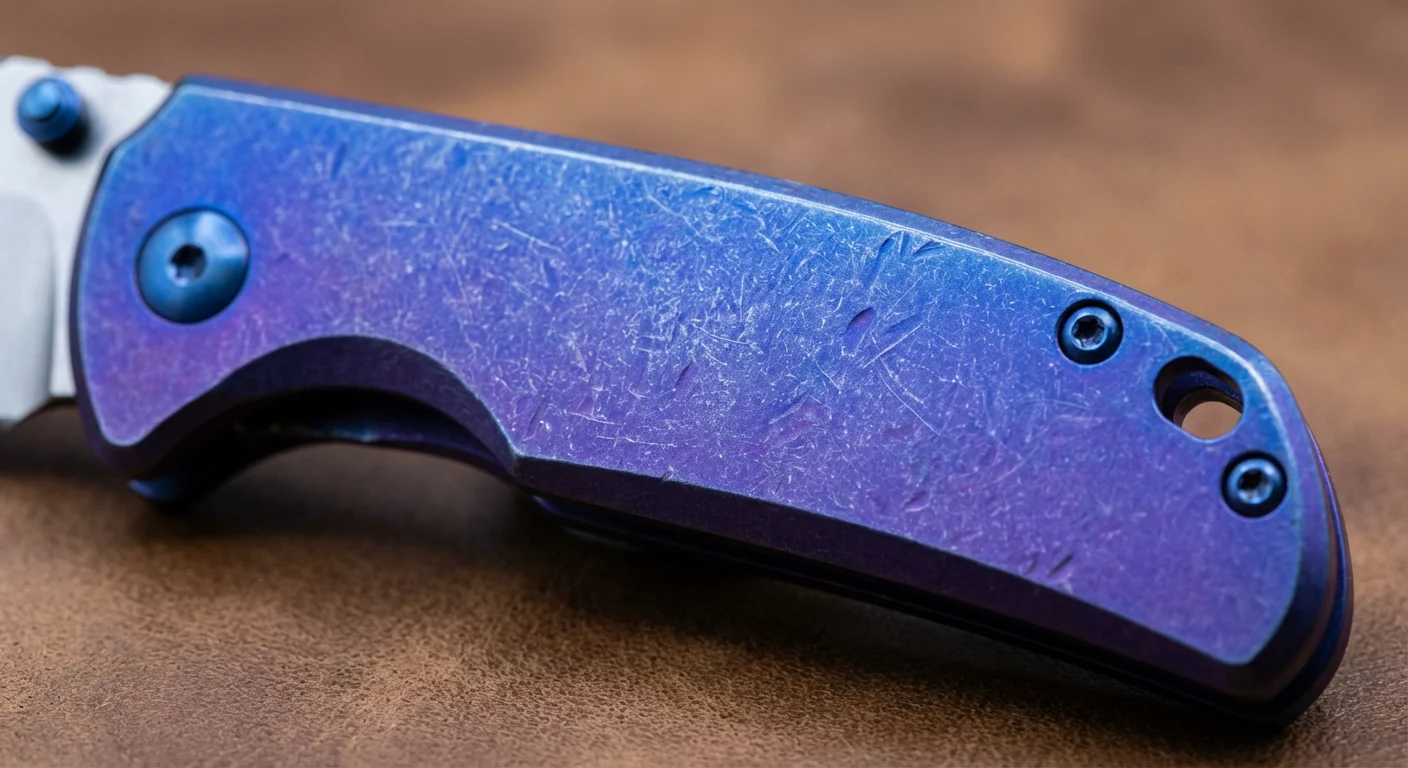
- High-End Knives: Used for handle scales and frame-locks due to its “springy” nature (low modulus of elasticity) and ability to be anodized into vibrant colors.
- Electronics: Premium device casings (e.g., Apple Watch Ultra, iPhone Pro models) utilize Grade 5 for its durability and premium tactile feel.
Buyer’s Guide: How to Identify Grade 5 Titanium
In the consumer market—especially regarding EDC gear, jewelry, and automotive parts—mislabeling can occur. Sellers often use the umbrella term “Titanium” without specifying the grade. Here is how you can distinguish Grade 5 (Ti-6Al-4V) from Grade 2 (Commercially Pure).
- Check the Markings:
- Grade 5: Reputable manufacturers will explicitly mark the product as “Ti-6Al-4V”, “TC4”, or “Grade 5”. If a product simply says “Titanium,” it is highly likely to be the cheaper Grade 2.
- Medical/Aerospace: Look for standard codes like ASTM F136 (Implant Grade) or AMS 4911 (Aerospace Grade).
- Visual Inspection (Color & Finish):
- Grade 2 Titanium: Has a metallic silver appearance, slightly darker than steel but still relatively bright.
- Grade 5 Titanium: In its raw, unpolished state, Grade 5 is visibly darker and greyer than Grade 2. It has a more muted, industrial “gunmetal” tone.
- The Magnet Test:
- While this cannot distinguish between Grade 2 and Grade 5, it is the quickest way to rule out steel. Titanium is non-magnetic. If a magnet sticks to your “titanium” exhaust or pen, it is likely steel or a ferrous alloy.
Frequently Asked Questions (FAQ)
Q: Is Grade 5 Titanium magnetic?
A: No. Like pure titanium, Ti-6Al-4V is non-magnetic. This property makes it essential for medical implants (safe for MRI scans) and military applications (non-magnetic tools for mine clearance).
Q: Does Grade 5 Titanium rust?
A: For all practical purposes, no. Titanium forms a stable, continuous oxide layer on its surface upon exposure to air. This layer renders it immune to corrosion from saltwater, sweat, and most acids. It does not rust like steel or pit like aluminum.
Q: Can you anodize Grade 5 Titanium?
A: Yes. In fact, Grade 5 is a favorite among customizers because it anodizes beautifully. By applying an electrical voltage, the thickness of the oxide layer changes, refracting light to produce vibrant colors (gold, blue, purple, green) without the use of dyes or paints.
Q: Is Grade 5 Titanium “bulletproof”?
A: While it has a high strength-to-weight ratio, “bulletproof” depends on thickness. A thin sheet of titanium will not stop a bullet. However, thick titanium plates are used in military armor because they offer similar ballistic protection to steel armor at a fraction of the weight.
Conclusion
Grade 5 Titanium (Ti-6Al-4V) is rightfully termed the “workhorse” of the titanium industry. It represents the engineering sweet spot: strong enough for aircraft structures, biocompatible enough for the human body, and light enough for high-performance sports.
While it commands a higher price tag due to raw material costs and manufacturing difficulties, the investment is justified in applications where failure is not an option or where every gram of weight matters.
Recommendation:
- For cosmetic or low-stress applications (camp mugs, exhaust tips), save money with Grade 2.
- For load-bearing, critical, or high-wear applications (pocket knife locks, structural bolts, implants), insist on Grade 5 (Ti-6Al-4V).
References & Industry Standards
For further technical details and official specifications, please refer to the following authoritative standards bodies:
- ASTM International:
- ASTM B348 – Standard Specification for Titanium and Titanium Alloy Bars and Billets
- ASTM B265 – Standard Specification for Titanium and Titanium Alloy Strip, Sheet, and Plate
- ASTM F136 – Standard Specification for Wrought Titanium-6Aluminum-4Vanadium ELI for Surgical Implant Applications
- SAE International:
- AMS 4911 – Aerospace Material Specification for Titanium Alloy, Sheet, Strip, and Plate
- Material Data Sources:
- MatWeb – Material Property Data
- AZoM – The A to Z of Materials