
Introduction
You’ve likely seen it in your workshop or at the hardware store: that unmistakable, brilliant gold finish on a high-speed drill bit, a custom firearm barrel, or a precision milling cutter. It looks like jewelry, but it is built for abuse.
This “gold” is actually Titanium Nitride (TiN) coating.
For decades, TiN coating has been the industry standard for extending the life of tools and improving the performance of precision parts. But for many DIY enthusiasts and entry-level machinists, questions remain: Is it real gold? Why is it so hard? And is it worth the extra cost compared to uncoated tools?
In this guide, we will break down everything you need to know about Titanium Nitride—from its ceramic chemistry and PVD application process to its incredible hardness. By the end, you’ll understand why this “liquid gold” is the ultimate upgrade for your gear.
What is Titanium Nitride (TiN)?
At its core, Titanium Nitride (chemical formula: TiN) is an extremely hard ceramic material. It is applied as a thin coating to metal surfaces—usually steel, titanium, or aluminum—to improve their surface properties.
While it is most famous for its decorative gold color, its primary purpose is purely functional. It acts as a shield, protecting the softer metal underneath from wear, friction, and corrosion. Think of it as a suit of armor for your tools, but one that is bonded at a molecular level.
Is TiN Coating Real Gold?
This is the most common question people ask on Google: “Is titanium nitride real gold?”
The short answer is no.
Although TiN looks strikingly similar to gold, it contains 0% actual gold. It is a compound formed by combining titanium and nitrogen atoms.
- Gold is a soft, malleable precious metal (great for jewelry, terrible for cutting metal).
- Titanium Nitride is an ultra-hard ceramic (harder than steel and chrome).
So, while it gives your tools a premium “gold plating” look, it offers industrial-grade protection that real gold never could.
Why is it Gold?
The gold color isn’t a dye or paint; it is the natural color of the titanium and nitrogen lattice structure when they bond. Interestingly, by adjusting the ratio of nitrogen gas during the coating process, the color can shift from a light yellow to a deep copper, but the standard “TiN Gold” is the most stable and common formulation used in the industry.
The Science: How Hard is TiN?
You might be asking: If it’s not gold, why do I care? The answer lies in the numbers.
To understand why engineers love Titanium Nitride, we need to look at the Vickers Hardness Test, a standard method used to verify the resistance of materials to deformation.
Here is how TiN compares to the materials you are familiar with:
| Material | Hardness (HV) | Description |
|---|---|---|
| Gold | ~20 HV | Extremely soft. Scratches easily with a fingernail. |
| Tool Steel (HSS) | ~600 – 800 HV | Standard material for drill bits and knives. |
| Hard Chrome | ~1,000 HV | Common plating for durability (e.g., car bumpers). |
| Titanium Nitride (TiN) | ~2,400 HV | 3x harder than steel, 2x harder than chrome. |

The Takeaway:
When you coat a steel drill bit with TiN, you are essentially wrapping a “soft” core in a ceramic shell that is three times harder than the metal itself. This is why a TiN-coated bit can cut through steel without dulling, while a standard black oxide bit burns out.
Will It Change My Part Dimensions? (Thickness)
For gunsmiths and machinists, adding a coating often brings the fear of ruining tight tolerances. Will my gun slide still fit? Will the bearing be too tight?
Don’t worry. TiN coating is applied at a microscopic thickness, typically between 2 to 5 microns (µm).
To put that in perspective:
- A human hair is about 70 microns thick.
- A sheet of paper is about 100 microns thick.
TiN coating is roughly 1/20th the thickness of a human hair. It adds extreme durability without measurably changing the size of your parts.
How It Works: The PVD Process
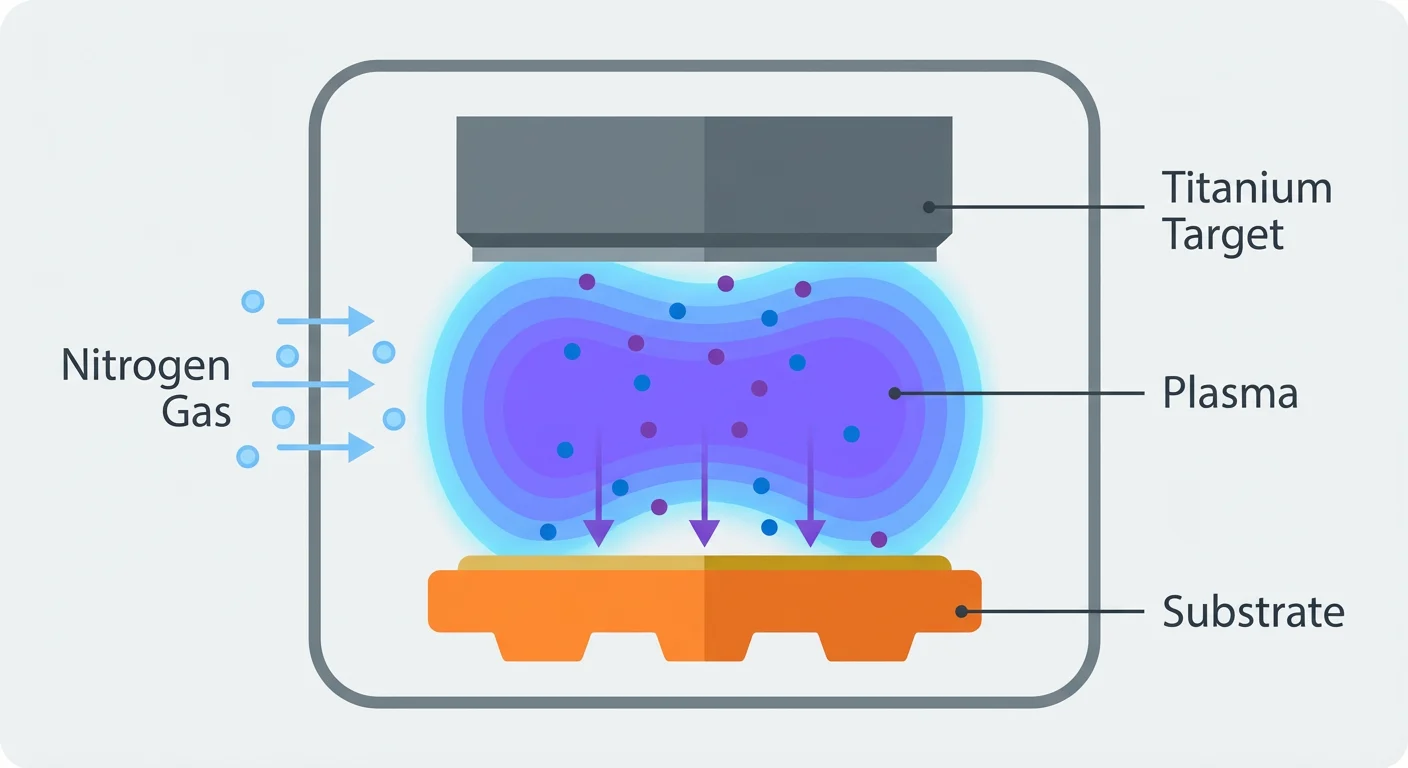
Unlike spray paint or electroplating (which can flake off like old nail polish), Titanium Nitride is applied using a high-tech method called Physical Vapor Deposition (PVD).
Here is the simplified version of what happens inside the PVD chamber:
- The Vacuum: Your parts (drill bits, gun barrels) are placed in a vacuum chamber.
- The Vapor: Solid Titanium is blasted with high-energy plasma until it turns into a vapor (gas).
- The Reaction: Nitrogen gas is introduced into the chamber.
- The Bonding: The titanium vapor and nitrogen gas combine and condense onto your parts.
Why This Matters:
Because this happens in a high-energy vacuum, the coating forms a molecular bond with the base metal. It doesn’t just “sit” on top; it digs into the surface.
This means TiN coating will not chip, peel, or flake under normal use. The only way to remove it is to grind it off or wear it down over thousands of cycles of use.
Top 3 Benefits of TiN Coating
Beyond just looking cool and being hard, why should you pay extra for TiN-coated gear? Here are the three practical benefits that make it worth the investment.
1. Extended Tool Life (Save Money)
Because TiN is harder than the steel it protects, it takes the beating so your tool doesn’t have to.
- The Result: A TiN-coated drill bit or end mill can last 3 to 10 times longer than an uncoated one.
- Why it matters: You spend less time sharpening dull tools and less money buying replacements.
2. Increased Lubricity (Run Smoother)
TiN acts like a permanent “dry lubricant.” It has a low friction coefficient (~0.4), which makes the surface incredibly slick compared to raw steel.
- For Machinists: Chips slide off the tool easily, preventing “chip welding” (gunk building up on the cutting edge).
- For Gun Owners: It makes moving parts like the Bolt Carrier Group (BCG) or trigger slide faster and smoother, reducing the chance of jams and making cleaning a breeze (carbon just wipes right off!).
3. Corrosion Resistance (No Rust)
Titanium Nitride is an inert ceramic material. It creates a sealed barrier that oxygen and moisture cannot penetrate.
- The Result: Even if you neglect your tools in a damp garage, the coated areas won’t rust. It’s perfect for humid environments.
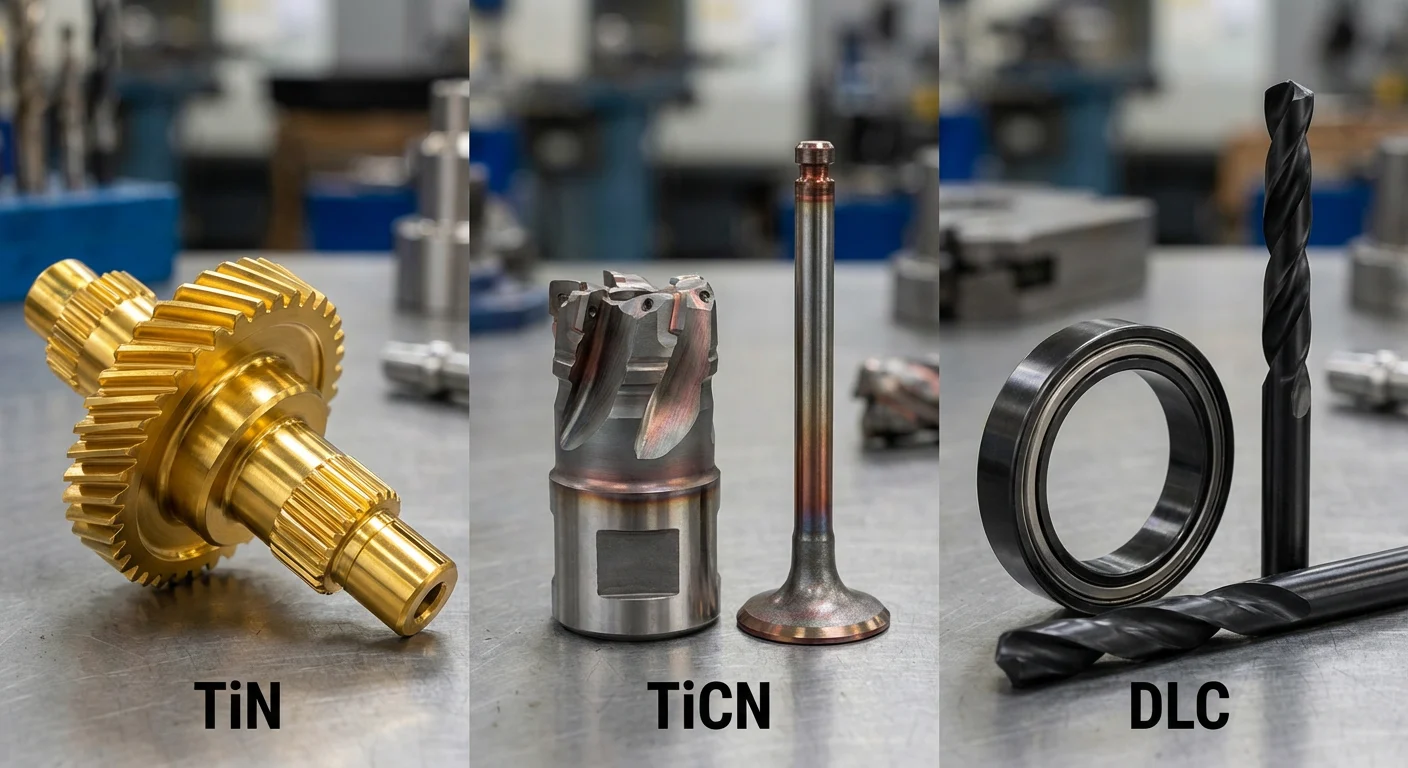
Comparison: TiN vs. DLC vs. TiCN
Shopping for coatings can be confusing. You’ll often see other acronyms like DLC (Diamond-Like Carbon) or TiCN (Titanium Carbonitride). Which one should you choose?
Here is a quick breakdown to help you decide:
| Feature | TiN (Titanium Nitride) | TiCN (Titanium Carbonitride) | DLC (Diamond-Like Carbon) |
|---|---|---|---|
| Color | Gold | Blue-Grey / Copper | Black |
| Hardness | High (~2400 HV) | Very High (~3000 HV) | Extreme (~4000+ HV) |
| Best For | General purpose, Looks, Value | Cutting hard metals (Stainless Steel) | High-end tactical gear, Heavy friction |
| Cost | 💲 (Most Affordable) | 💲💲 (Mid-Range) | 💲💲💲 (Expensive) |
Which One Should You Pick?
- Choose TiN (Gold) if you want the best bang for your buck. It offers a massive performance upgrade over uncoated steel at a very affordable price. It’s the perfect “do-it-all” coating for general drilling, milling, and cosmetic upgrades.
- Choose TiCN if you are a machinist cutting difficult materials like cast iron or stainless steel where heat buildup is a major issue.
- Choose DLC (Black) if budget is no object and you demand the absolute highest performance (or just prefer the tactical black look).
Common Applications: Where is TiN Used?
Because of its unique mix of hardness and beauty, you will find Titanium Nitride in three main industries.
1. Cutting Tools & Machining (The Workhorse)
This is the original and most common use.
- Drill Bits: TiN-coated bits can drill into harder materials and run at higher speeds than black oxide bits.
- End Mills & Hobs: For CNC machining, the coating allows for faster feed rates and cleaner cuts.
- Punches & Dies: Extending the life of metal forming tools.
2. Firearms & Tactical Gear (The Upgrade)
TiN is a favorite in the custom gun world, not just for the “bling” factor, but for reliability.
- Barrels: Look for “TiN Gold Barrels” for Glocks and other pistols.
- Bolt Carrier Groups (BCG): An AR-15 BCG coated in TiN requires less oil and wipes clean with a simple rag.
- Triggers: The slick surface creates a smoother, crisp trigger pull.
3. Medical & Consumer Goods (The Safe Choice)
Because TiN is biocompatible (non-toxic) and meets FDA standards for medical devices, it is safe to use inside the human body for surgical tools and implants.
- Surgical Instruments: Scalpels and bone saws.
- Implants: Hip and knee replacements.
- Watches & Jewelry: Offering a scratch-resistant gold look that won’t irritate the skin.
Frequently Asked Questions (FAQ)
Here are the answers to the most common questions about Titanium Nitride coating.
Q: Does TiN coating fade over time?
A: TiN does not “fade” like a dyed fabric. However, it can wear thin over time if subjected to extreme friction (like the cutting edge of a drill bit). But for decorative parts like a gun barrel, the color will last for years with normal use.
Q: Can you coat aluminum with TiN?
A: Yes, but it is tricky. The standard PVD process involves high heat (around 800°F+), which can melt or warp aluminum. Specialized “Low-Temp PVD” processes are required to safely coat aluminum parts.
Q: How do I remove TiN coating?
A: You cannot simply sand it off without damaging the part underneath (remember, it’s harder than steel!). It must be chemically stripped using specialized acid solutions, or blasted off with aggressive media.
Q: Is it expensive?
A: TiN is generally the most affordable of the high-performance PVD coatings. It is cheaper than DLC or TiCN, making it the best entry-level choice for performance upgrades.
Conclusion: Is TiN Coating Worth It?
So, is Titanium Nitride coating worth the hype?
Absolutely. While it isn’t “real gold,” in the world of tools and machinery, it is worth far more. It transforms ordinary steel into a wear-resistant, low-friction, rust-proof powerhouse.
Whether you are a machinist looking to save money on drill bits, or a gun enthusiast wanting a custom look that performs as good as it shines, TiN coating is the proven industry standard.
It’s tough, it’s slick, and yes—it looks fantastic.