 Is Titanium actually lighter than Aluminum? The answer lies in the physics of density versus specific strength.
In high-performance engineering sectors—ranging from aerospace and automotive to premium consumer electronics—the selection of materials is often dominated by two metals: Titanium and Aluminum.
A prevalent misconception among consumers and non-specialists is that Titanium is the inherently “lighter” material. This belief is largely driven by marketing narratives that associate Titanium with premium lightweight products. However, from a strict materials science perspective, this assumption is factually incorrect.
When evaluating physical density, Aluminum is significantly lighter than Titanium. Aluminum possesses a density of approximately 2.70 g/cm³, whereas Titanium is much denser at approximately 4.51 g/cm³. Consequently, if one were to manufacture two components of identical volume, the Titanium component would be roughly 67% heavier than its Aluminum counterpart.
This physical reality presents an engineering paradox: Why is a denser metal frequently selected for applications demanding weight reduction? The answer does not lie in the material’s mass per unit volume, but rather in its Specific Strength (also known as the strength-to-weight ratio). The following analysis differentiates between material density and structural efficiency to explain why, and when, Titanium is the superior choice for lightweight engineering.
The Physics: Specific Strength and Structural Efficiency
To understand how a material that is 67% denser can result in a lighter final product, one must analyze the Strength-to-Weight Ratio, technically referred to as Specific Strength. This metric is calculated by dividing a material’s yield strength by its density.

Yield Strength Comparison
The determining factor in most structural applications is Yield Strength—the stress limit at which a material begins to deform plastically.
- Aluminum (6061-T6): A standard alloy used in general manufacturing has a yield strength of approximately 276 MPa.
- Titanium (Grade 5 / Ti-6Al-4V): The most common aerospace Titanium alloy boasts a yield strength of approximately 880–950 MPa.
While Titanium is roughly 1.6 times denser than Aluminum, it creates alloys that can be 3 to 4 times stronger. This disparity is the foundation of lightweight engineering.
The Principle of Wall Thickness Reduction
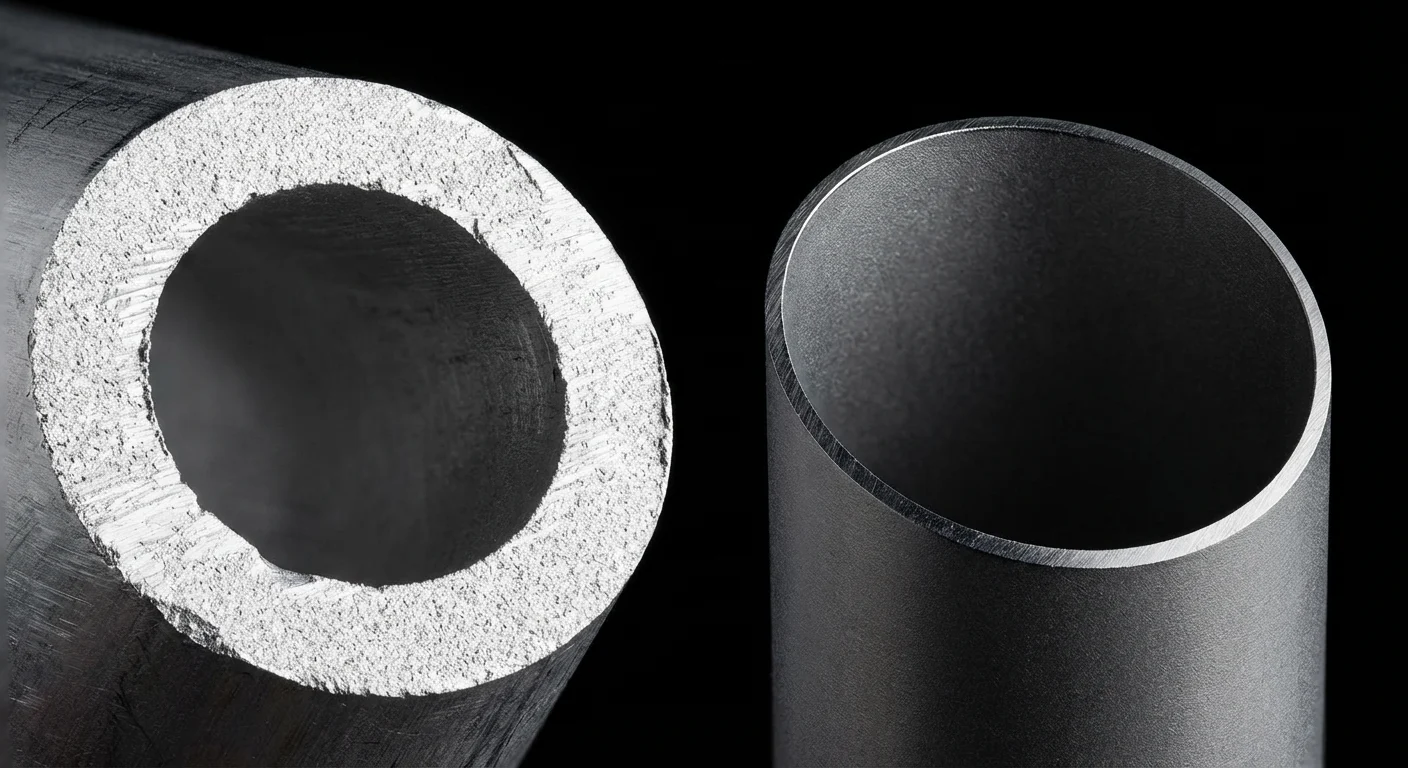
Because Titanium possesses such superior tensile and yield strength, engineers can radically alter the geometry of a component. In a structural application—such as a bicycle tube or an aerospace bulkhead—an Aluminum component requires a significant wall thickness to prevent buckling or failure under load. Conversely, a Titanium component can be engineered with extremely thin wall sections while maintaining the same load-bearing capacity.
The Net Result
The weight reduction is achieved through volume reduction. Although the material is heavier per cubic centimeter, the total volume of material required to perform a specific mechanical function is drastically lower. Therefore, a Titanium part is not lighter because of its density; it is lighter because its high specific strength allows for the removal of excess material volume that would be structurally necessary in an Aluminum design.
The Material Variable: 7075-T6 Aluminum vs. Grade 5 Titanium
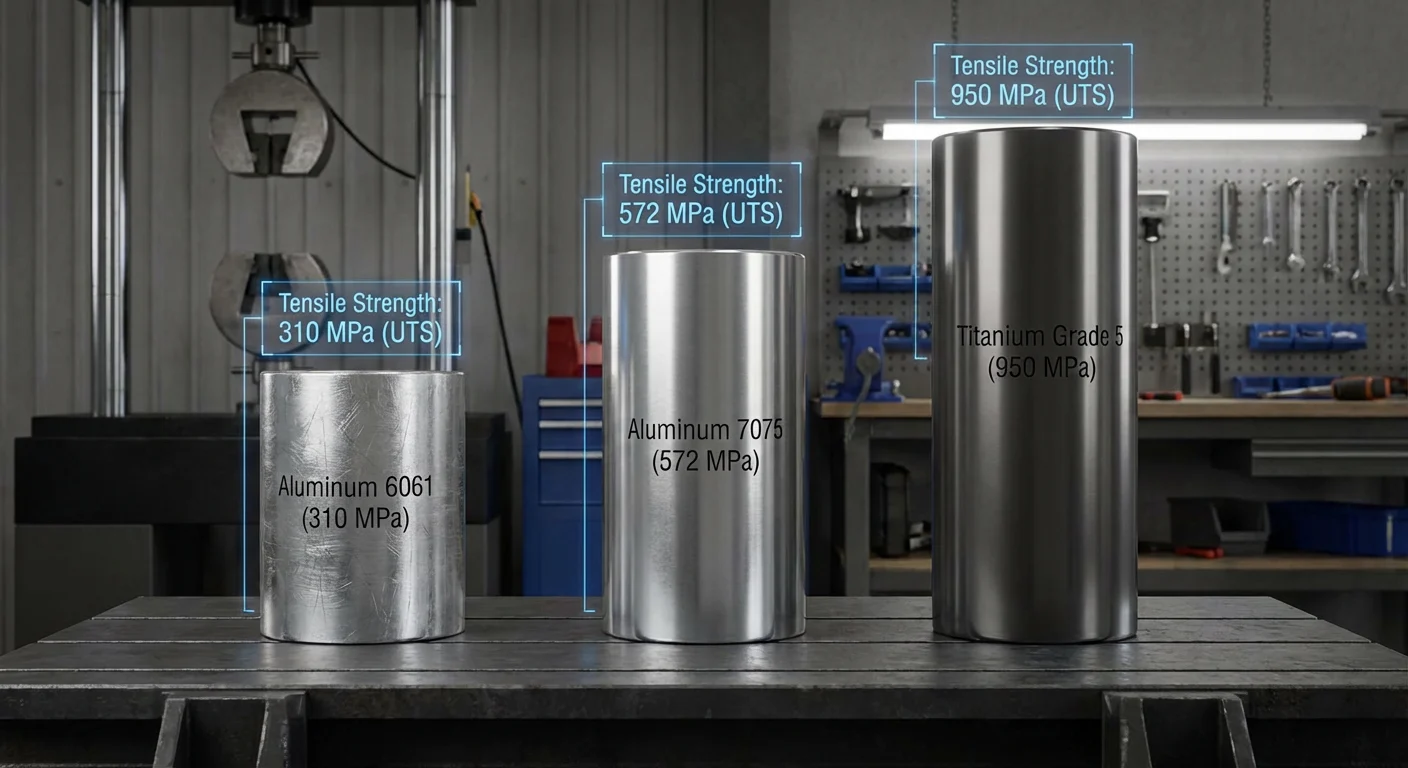
A comprehensive technical analysis must address the specific alloy grades being compared. A common error in general comparisons is evaluating high-performance Titanium (such as Grade 5 / Ti-6Al-4V) against standard architectural Aluminum (such as the 6000 series). To evaluate the true weight dynamics, one must consider 7075-T6 Aluminum, often referred to as “aerospace aluminum.”
The 7075-T6 Advantage
Unlike the softer 6061 alloy, 7075 series aluminum utilizes zinc as its primary alloying element. This results in a material with a yield strength of approximately 503 MPa—nearly double that of standard aluminum alloys and comparable to many structural steels. While Grade 5 Titanium still holds the absolute advantage in tensile strength (~900+ MPa), 7075 Aluminum narrows the gap significantly while maintaining the low density characteristic of aluminum (~2.81 g/cm³).
Specific Stiffness and Geometric Stiffness
Weight optimization is not solely about tensile strength; it is often about stiffness (resistance to bending).
- Young’s Modulus: Titanium (~114 GPa) is stiffer than Aluminum (~69 GPa) by material volume.
- The Geometric Factor: However, because Aluminum is less dense, engineers can increase the physical volume of a part (e.g., using a larger diameter tube for a bicycle frame) without a significant weight penalty. Increasing the diameter drastically increases the Moment of Inertia, resulting in a structure that is stiffer and lighter than a smaller-diameter Titanium equivalent.
The Engineering Verdict
In applications where volume is unconstrained—meaning the component is allowed to be physically larger—7075 Aluminum often provides a superior stiffness-to-weight ratio compared to Titanium. Titanium becomes the mathematical necessity only when space is limited. If a component must be small, thin, and strong (such as a screw, a valve spring, or a compact phone chassis), the high density of Titanium is acceptable because it is the only material that can handle the stress loads in such a confined volume.
Critical Performance Factors: Thermal Dynamics and Fatigue Life
While weight and strength are the primary metrics for material selection, two other physical properties often dictate the final engineering decision: Thermal Conductivity and Fatigue Resistance.
Thermal Conductivity: The Dissipation Factor
For consumer electronics (such as smartphones, laptops, and wearables) and automotive applications, thermal management is paramount. In this domain, the two metals behave in direct opposition.
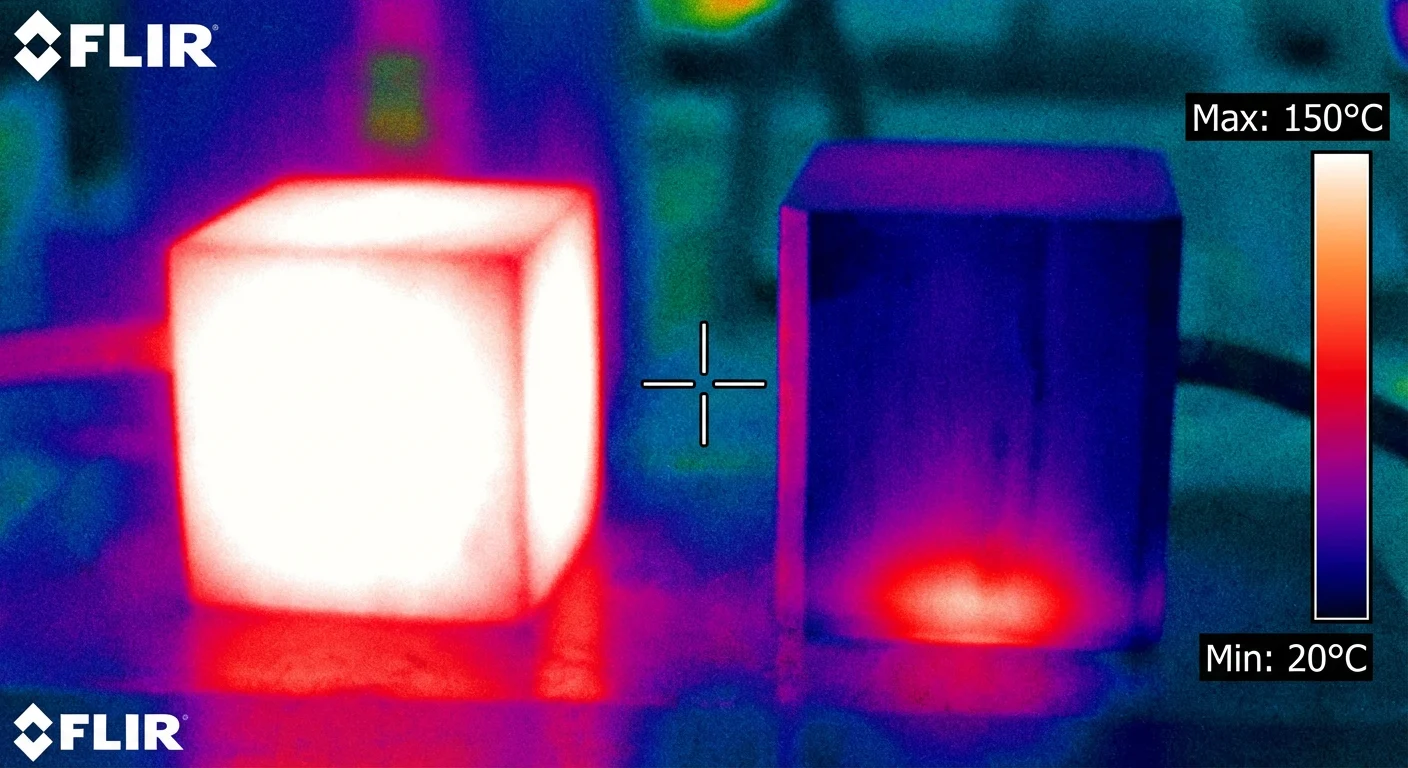
- Aluminum: An exceptional thermal conductor (~205 W/(m·K)). It acts as an efficient natural heat sink, rapidly transferring heat away from sensitive components like processors or braking systems.
- Titanium: A thermal insulator (~6.7 W/(m·K)). Its thermal conductivity is roughly 30 times lower than that of Aluminum.
Engineering Implication: In high-performance devices, using a Titanium chassis presents a thermal challenge. While it offers superior structural protection, it tends to trap heat internally. This requires engineers to implement advanced cooling solutions (such as vapor chambers or graphite sheets) to prevent thermal throttling. Conversely, Aluminum remains the standard for enclosures where passive cooling is required.
Fatigue Limit: The Cycle of Failure
For dynamic structures subjected to repeated loading and unloading (cyclic stress)—such as aircraft landing gear, suspension springs, or bicycle frames—Fatigue Life is the critical differentiator.
- Titanium: Possesses a distinct Endurance Limit. As long as the cyclic stress applied to the material remains below a specific threshold, Titanium can theoretically withstand an infinite number of load cycles without failing. This makes it ideal for critical aerospace fasteners and medical implants.
- Aluminum: Lacks a defined endurance limit. Regardless of how small the stress load is, micro-fractures will eventually accumulate over time. Given enough cycles, an Aluminum structure will inevitably reach failure.
Manufacturing Realities: The Cost of Machinability
The price differential between a finished Titanium component and an Aluminum one is rarely due to raw material costs alone; it is largely driven by machinability and processing difficulty.
The Machining Challenge
For precision engineering, Computer Numerical Control (CNC) machining is the standard production method. In this domain, Titanium presents unique metallurgical challenges that drastically increase production time and tool costs.
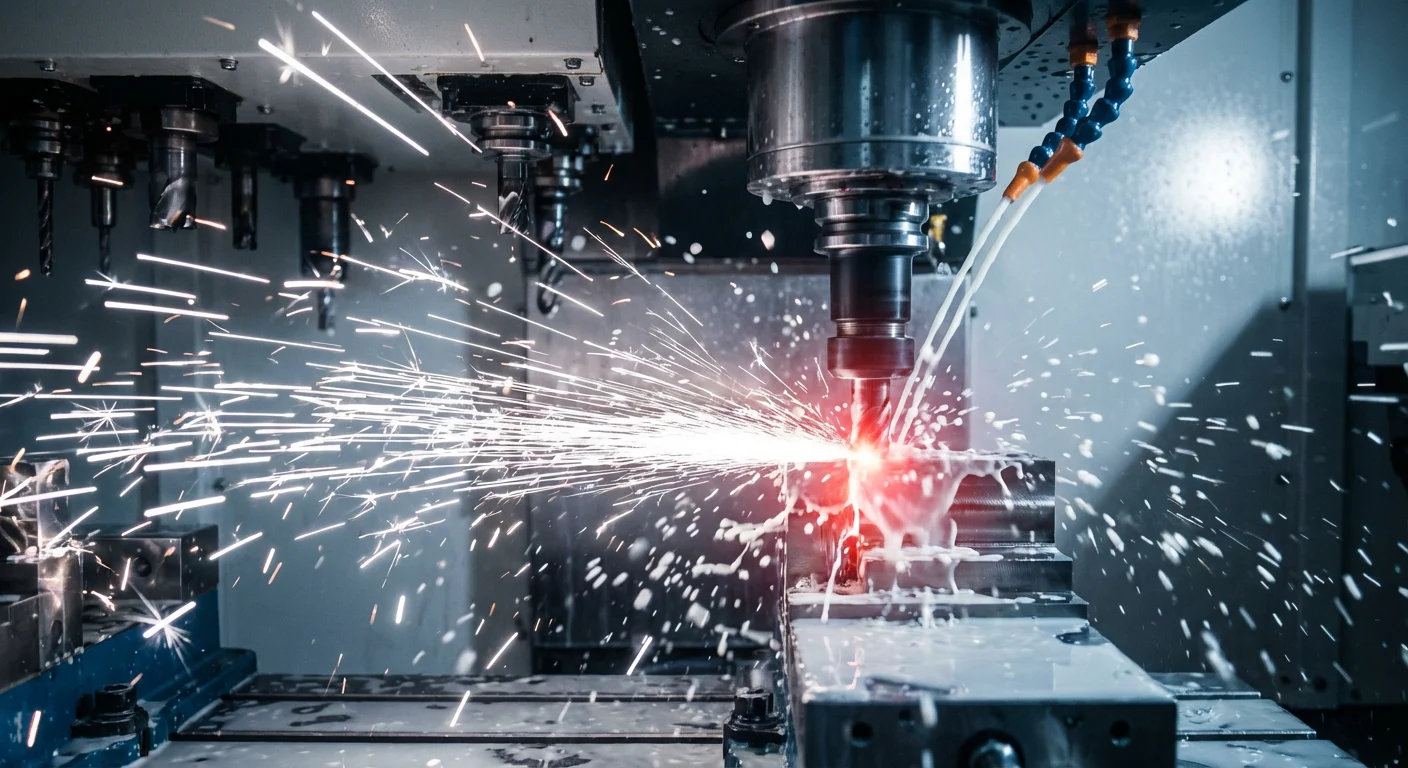
- Heat Concentration: As noted in the thermal analysis, Titanium is a poor conductor of heat. During machining, heat generated by friction does not dissipate into the workpiece (chips); instead, it concentrates on the cutting edge of the tool. This leads to rapid thermal degradation of carbide cutters.
- Galling and Work Hardening: Titanium has a chemical tendency to adhere or “weld” to cutting tools (galling). Furthermore, it is susceptible to work hardening—meaning the material becomes harder and more brittle as it is deformed by the cutting tool.
- Vibration (Chatter): Titanium’s lower modulus of elasticity (high flexibility) can cause the workpiece to deflect away from the cutter, leading to vibration or “chatter.”
The Economic Multiplier
Conversely, Aluminum is often described as “free-machining.” It dissipates heat well, exerts low cutting forces, and allows for high-speed material removal rates. A complex Titanium part can cost 5 to 10 times more to manufacture than an identical geometry in 7075 Aluminum.
Conclusion: The Decision Matrix
In the final analysis, the debate between Titanium and Aluminum is not a question of which metal is superior, but rather which material properties align with the specific constraints of the engineering application.
While Titanium is often marketed as the premium option, 7075-T6 Aluminum frequently offers a more efficient structural solution in scenarios where volume is not a limiting factor. Conversely, Grade 5 Titanium remains unrivaled in applications demanding high strength within a compact envelope, extreme corrosion resistance, or infinite fatigue life.
Engineering Decision Matrix
| Primary Constraint | Recommended Material | Technical Justification |
|---|---|---|
| Max Strength / Min Volume | Titanium (Grade 5) | Highest yield strength (900+ MPa) permits extremely thin walls and compact designs. |
| Max Stiffness / Min Weight | Aluminum (7075-T6) | Lower density allows for larger geometric cross-sections, increasing the Moment of Inertia. |
| Thermal Dissipation | Aluminum | High thermal conductivity (~205 W/(m·K)) prevents component overheating. |
| Environmental Durability | Titanium | Formation of a stable oxide film renders it immune to galvanic corrosion and saltwater. |
| Cyclic Loading (Fatigue) | Titanium | Presence of a distinct endurance limit ensures reliability in high-cycle dynamic applications. |
| Cost Efficiency | Aluminum | Significantly lower raw material costs and “free-machining” properties. |
Final Verdict: Is Titanium actually lighter than Aluminum? Physically, no. It is 67% denser. However, its exceptional specific strength allows for the reduction of material volume, enabling the creation of components that are lighter, stronger, and more durable—provided one is willing to pay the manufacturing premium.
Frequently Asked Questions (FAQ)
Q: How much heavier is Titanium than Aluminum exactly?
A: In terms of physical density, Titanium is approximately 67% heavier than Aluminum. Titanium has a density of ≈ 4.51 g/cm³, while Aluminum has a density of ≈ 2.70 g/cm³. Weight savings with Titanium are only achieved by reducing the volume of the part due to its higher strength.
Q: Does Titanium scratch more easily than Aluminum?
A: Titanium is harder than Aluminum (Mohs hardness ≈ 6.0 vs. ≈ 2.5), making it more resistant to deep gouges. However, bare Titanium forms a surface oxide layer that can show fine “micro-scratches.” In consumer electronics, PVD coatings are often used to enhance surface durability.
Q: Can you weld Titanium to Aluminum?
A: Direct fusion welding is generally not possible due to the formation of brittle intermetallic compounds (like TiAl3) that crack upon cooling. Joining typically requires mechanical fasteners, explosion welding, or friction stir welding.
Q: Why does Galvanic Corrosion matter when choosing these metals?
A: Titanium and Aluminum have different electrode potentials. If they are in direct contact in the presence of an electrolyte (like saltwater or sweat), Titanium (cathode) will cause Aluminum (anode) to corrode rapidly. Dielectric grease or anti-seize compounds must be used when joining them.
Q: Is 7075 Aluminum stronger than Titanium?
A: 7075-T6 Aluminum has a yield strength (~503 MPa) lower than Grade 5 Titanium (~880 MPa). However, it often offers a higher Specific Stiffness. For parts where stiffness matters more than pure tensile strength (like large tubes), 7075 can be the superior, lighter choice.
References & Data Sources
- ASM International Handbook, Vol 2:Properties and Selection: Nonferrous Alloys and Special-Purpose Materials.
- MatWeb Material Property Data:Titanium Ti-6Al-4V (Grade 5), Annealed & Aluminum 7075-T6.
- SAE International:Aerospace Material Specifications (AMS).
- AZoM (The Open Materials Science Dictionary):Thermal Properties of Metals.