Marketing teams love titanium. It is the “space-age” metal, synonymous with SR-71 Blackbirds and aerospace engineering. It is lightweight, non-magnetic, and chemically practically immortal. But does that pedigree actually translate to the tool in your pocket?
If you are asking, “Is titanium good for knives?”, the honest answer is: It depends entirely on what you are cutting.
If you need a blade that will survive 100 years at the bottom of the ocean without a spot of rust, titanium is the undisputed king. But if you expect it to slice through Amazon boxes day after day like a standard steel folder, you are going to be disappointed.
Before we dive into the metallurgy, we need to make one critical distinction that confuses 90% of buyers:
Important Distinction: Are you looking for a Titanium Handle or a Titanium Blade?
- Titanium Handles (Scales): Excellent. They are lightweight, strong, and premium. This guide is not about handles.
- Titanium Blades: This is a controversial topic. This guide focuses on the actual cutting edge.
Here is the data-backed reality of why titanium is not a “better steel”—it is a completely different animal.
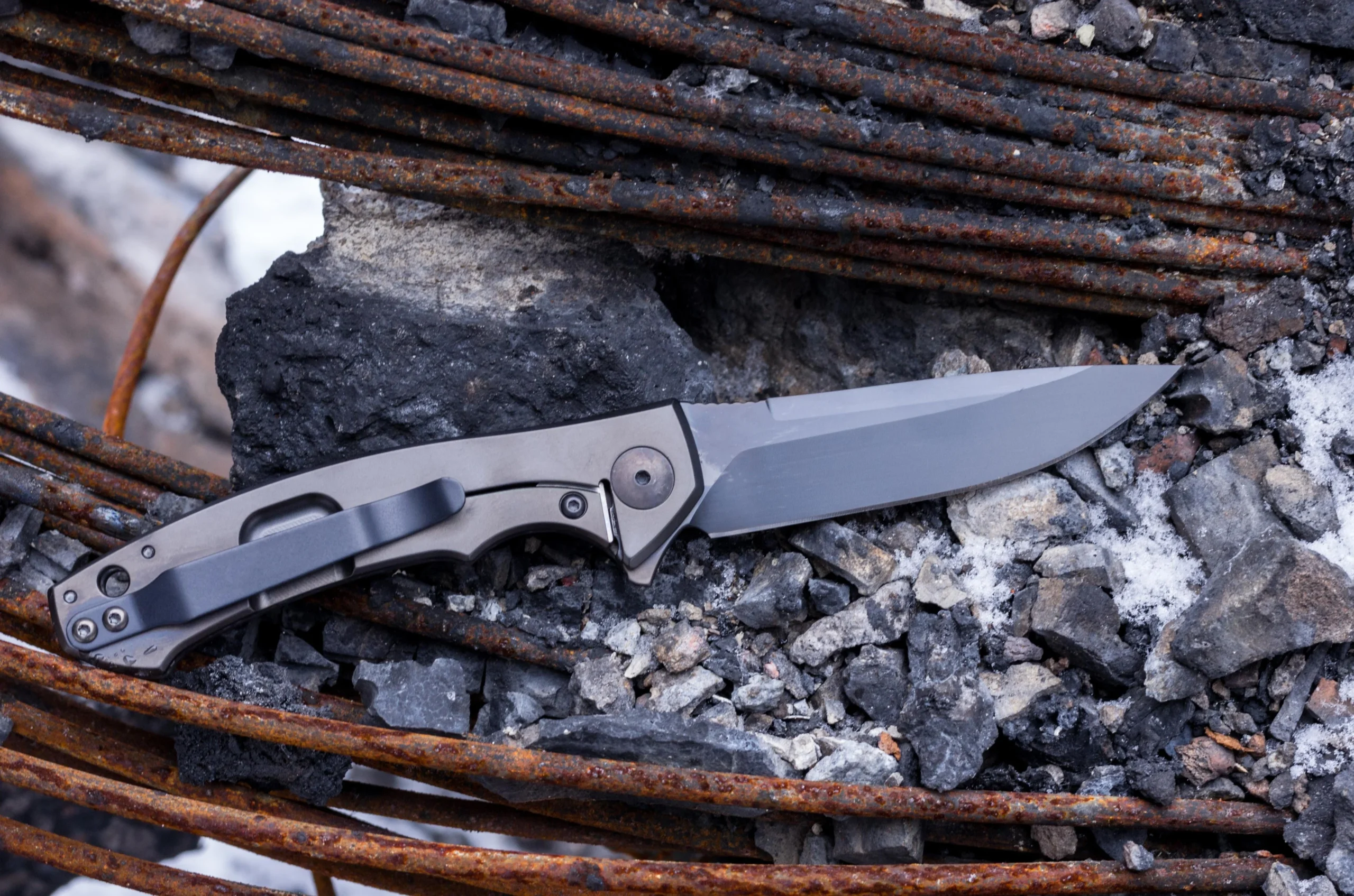
Titanium vs. Steel: The Physics of the Edge
To understand why titanium knives perform the way they do, we have to look at the numbers. The primary metric for knife performance is Hardness, usually measured on the Rockwell C Scale (HRC).
Why Hardness (HRC) Matters
In the knife world, hardness generally correlates with edge retention. The harder the material, the longer it holds a sharp apex without rolling or flattening.
- Premium Steel (e.g., CPM-S35VN): ~59–61 HRC
- Standard Titanium (Ti-6Al-4V / Grade 5): ~36–45 HRC
The Problem: Standard Grade 5 titanium—the most common alloy used in affordable titanium knives—is significantly softer than even cheap kitchen cutlery. Under high-stress cutting (like carving wood or cutting thick cardboard), the edge of a titanium knife doesn’t just chip; it rolls. It physically deforms because it lacks the yield strength to maintain that fine geometry against resistance.
The Corrosion Superpower: “Immunity” vs. “Resistance”
This is where titanium plays its ace card. Stainless steel contains chromium to resist rust, but given enough time, salt, and neglect, it will eventually corrode (especially in the pivot area where moisture gets trapped).
Titanium, however, is effectively immune to natural corrosion. When exposed to oxygen, it instantly forms a continuous, self-healing oxide layer ($TiO_2$).
- Real World Scenario: You can leave a titanium dive knife in a bucket of saltwater for a year. When you pull it out, it will look exactly the same as the day you dropped it in. For divers, sailors, and anglers, this maintenance-free reliability often outweighs the softer edge.
Expert Nuance: The “Micro-Serration” Effect
If titanium is so soft, how does it cut at all? This is a detail often missed in basic reviews.
While a polished titanium edge dulls quickly, titanium alloys tend to form a “toothy” edge structure during grinding. Even when the razor sharpness is gone, the material can retain a level of working sharpness similar to a microscopic saw.
The Result: A dull titanium knife will struggle to shave hair off your arm (push cutting), but it may still rip through synthetic rope or fibrous plants (slice cutting) surprisingly well due to this coarse, micro-serrated texture.
The “Mushy” Reality: Sharpening and Maintenance
If you decide to buy a standard titanium blade, you need to understand what happens when it gets dull. This is where the ownership experience differs drastically from steel.
The Galling Effect
Sharpening steel feels crisp; you can feel the stone cutting the metal. Sharpening titanium, however, often feels like rubbing a pencil eraser against a window.
This is due to galling (cold welding). Titanium has poor thermal conductivity and is chemically reactive. As you drag it across a sharpening stone, the friction generates heat that doesn’t dissipate, causing the metal to become sticky. It tends to “smear” onto the stone rather than grinding away cleanly, clogging up the pores of your sharpening media.
⚠️ Expert Tip: Put away your Arkansas stones or waterstones. They will clog almost instantly.
To sharpen titanium effectively, you need Diamond Plates. Diamond cuts aggressively enough to minimize heat buildup and galling. Using a little bit of soapy water or window cleaner as a lubricant is also non-negotiable to keep the swarf (metal filings) moving.
Removing the “Burr from Hell”
Every sharpener knows that forming a burr (a wire edge) is the first step to a sharp knife. But with titanium, getting rid of that burr is a nightmare. Because the material is so ductile (stretchy), the burr doesn’t snap off cleanly like it does on hard steel. It just flips back and forth.
The Fix: You cannot rely on the stone to remove the burr. You must use a leather strop loaded with diamond paste or CBN compound. You will need to strop it longer and more aggressively than you would with a steel knife to strip that stubborn wire edge away.
Advanced Solutions: How to Make Titanium Cut
So, is titanium doomed to be soft? Not necessarily. Knife makers have developed two primary ways to cheat the physics limit.
1. Carbidized Edges (The “Beaver Tooth” Method)
If you see a custom titanium knife that claims to hold an edge, it likely has a Carbidized Edge. This involves using a tungsten electrode to electrically fuse a layer of Tungsten Carbide (72+ HRC) onto one side of the blade’s edge.
This creates a composite structure:
- The Soft Side: Titanium backing (flexible, tough).
- The Hard Side: Tungsten Carbide coating (extremely hard).
As you use the knife, the soft titanium wears away faster than the hard carbide. This leaves the carbide protruding, creating a permanent, microscopic saw-tooth edge. It is a self-sharpening geometry similar to a beaver’s tooth. It cuts fibrous materials (cardboard, rope) aggressively but will never achieve a polished, hair-whittling edge.
2. The “Unicorn” Alloy: SM-100 (Nitinol 60)
This is the holy grail. SM-100 is not technically a standard titanium alloy; it is a Nickel-Titanium alloy originally developed for NASA ball bearings.
- Hardness: Can be heat-treated to 60–62 HRC (competing with premium steels).
- Corrosion: 100% Immune to rust.
- Magnetism: Non-magnetic.
The Catch? It is astronomically expensive and notoriously difficult to machine. A knife made from SM-100 often costs $500 to $1,000+. If you have the budget, this is the only material that offers the best of both worlds without compromise.
Verdict: Who Should Buy a Titanium Blade?
Let’s simplify the buying decision based on your actual use case.
| User Profile | Recommendation | Why? |
|---|---|---|
| The Saltwater Diver / Kayaker | BUY | Saltwater kills steel. A titanium blade is a safety tool that will work even if you neglect it for months in a wet gear bag. |
| The EOD / MRI Technician | BUY | Safety critical. The non-magnetic property is essential when working around magnetic sea mines or MRI machines. |
| The Ultralight Hiker | CONSIDER | If counting grams is your obsession, titanium saves weight. But for camp chores (whittling), a small steel blade is better. |
| The Everyday Carry (EDC) | AVOID | For opening packages and general tasks, modern stainless steels (MagnaCut, LC200N) offer 95% of the rust resistance with 300% better edge retention. |
Frequently Asked Questions (FAQ)
Q: Will a titanium knife break if I use it to pry?
A: Actually, titanium excels here. Grade 5 titanium has a lower modulus of elasticity than steel, meaning it is “springier.” It can flex significantly under load and return to true, whereas a hard steel blade might snap. It makes for a terrible knife edge, but an excellent pry bar.
Q: Can I use a titanium knife in a gas-filled environment (like a mine)?
A: NO. This is a dangerous myth. While titanium is non-magnetic, it is NOT non-sparking. In fact, if you strike titanium against a rock or steel, it produces intensely hot, blinding white sparks (titanium powder is used in fireworks). Do not use titanium tools in potentially explosive atmospheres.
Q: Is “Beta Titanium” better than standard titanium?
A: Yes. Beta alloys (like Beta-C) can be heat-treated to higher hardness levels (around 50-55 HRC) compared to standard Ti-6Al-4V (45 HRC). If you must have a titanium blade, look for Beta alloys.
Q: Does titanium hold an edge longer than steel?
A: Generally, no. Standard titanium alloys hold an edge significantly worse than even basic steels like 440C. However, specialized alloys like SM-100 can compete with high-end steel.
Conclusion: The Right Tool for the Specific Job
Is titanium good for knives? Yes, but only if “good” means “indestructible against nature.”
If your enemy is salt, sweat, or magnetism, titanium is the undisputed champion. It is a specialized tool for specialized environments. However, if your enemy is dullness, stick to steel.
Don’t buy a titanium knife expecting it to be a “Super Steel.” Buy it because you need a blade that will outlast you in the harshest environments on Earth—just don’t expect it to stay razor-sharp while doing it.