
Engineered Titanium Solutions for Critical Marine & Subsea Environments
ASTM/ASME compliant titanium mill products (Grade 2, 7, and 12) manufactured to defeat seawater pitting, crevice corrosion, and extreme hydrostatic pressure. Fully traceable from raw ingot to final CNC machining, backed by EN 10204 3.1 MTC.
- Zero-Corrosion Lifecycle: Eliminates maintenance costs in saline environments.
- Stringent NDT Testing: 100% UT, RT, and ECT inspected before dispatch.
- Mill-Direct Capabilities: From heavy-wall pipe extrusion to open-die forgings.
Corrosion Resistance Mechanisms of Marine-Grade Titanium
Marine environments present severe corrosion challenges due to high chloride ion concentrations and fluid velocities. Titanium mitigates these degradation issues through specific metallurgical mechanisms rather than applied temporary coatings.
Titanium Dioxide (TiO₂) Passivation and Repassivation Kinetics
Titanium oxidizes spontaneously in the presence of moisture or oxygen to form a highly stable, continuous TiO₂ passive film. If this layer is mechanically disrupted, it exhibits rapid repassivation kinetics (typically within milliseconds) provided trace amounts of oxygen are present. In ambient seawater, the general corrosion rate of commercially pure titanium (Grade 2) is measured at <0.001 mm/year.

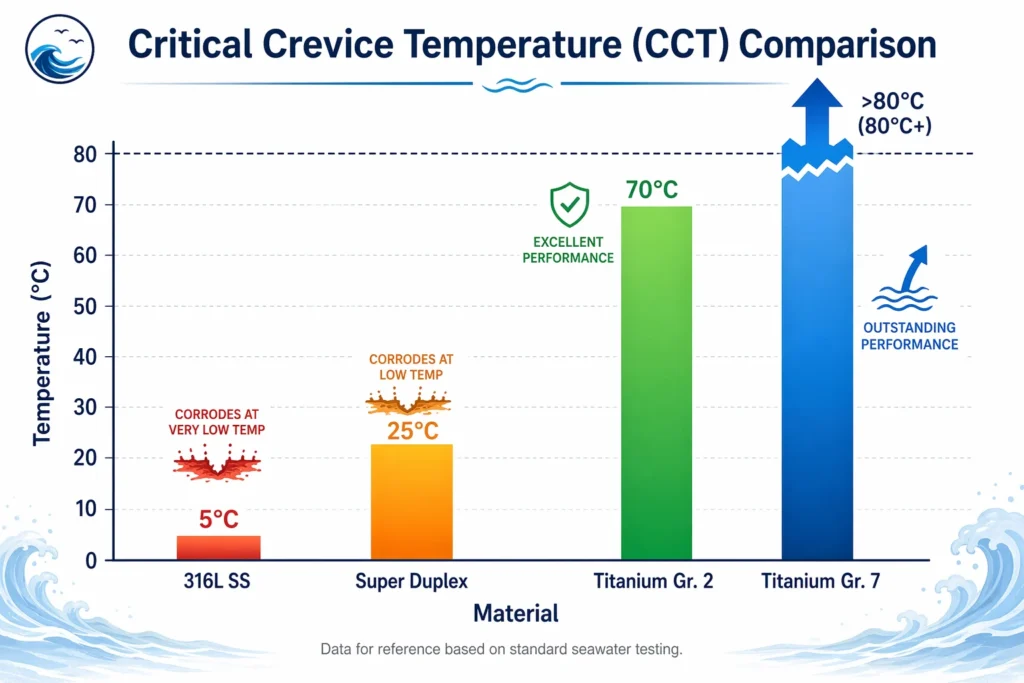
Resistance to Pitting and Crevice Corrosion
While traditional marine alloys rely on high Pitting Resistance Equivalent Numbers (PREN), they can still be susceptible to localized corrosion in stagnant zones or tight crevices at elevated temperatures. Unalloyed titanium exhibits high resistance to chloride-induced localized attack at ambient temperatures. For environments exceeding 80°C, such as multi-stage flash (MSF) desalination brines, Titanium Grade 7 (alloyed with 0.12-0.25% Pd) is specified. The palladium addition shifts the corrosion potential, significantly increasing the threshold temperature for crevice corrosion.
Lifecycle Cost Analysis (LCCA) & Structural Weight Impact
The initial material cost of titanium is higher than that of copper-nickel or duplex stainless steels. However, engineering economics favor titanium based on two verifiable metrics:
Maintenance Requirements: The inherent corrosion resistance minimizes the need for protective coatings or cathodic protection systems, lowering the Total Cost of Ownership (TCO) over typical 20-30 year project lifespans.
Density and Structural Load: Titanium has a density of 4.51 g/cm³, approximately 45% lower than carbon steel. In offshore platform design, utilizing titanium components reduces topside payload, which can proportionally decrease the structural mass requirements for the supporting jacket.

Precision-Engineered Titanium Products for Offshore Reliability
We supply fully traceable titanium mill products and custom-machined components strictly compliant with international standards including ASTM, ASME, DIN, and JIS. Backed by over 10 years of industry experience, our manufacturing limits are profiled to meet the specific dimensional and pressure requirements of desalination, shipbuilding, and subsea exploration.
Seamless & Welded Titanium Tubing
- Primary Applications: Heat exchangers, condensers, Multi-Stage Flash (MSF), and Reverse Osmosis (RO) desalination plants.
Manufacturing Standards: ASTM B337, ASTM B338, ASTM B861, ASTM B862, and other related standards.
- Dimensional Range (Seamless): Outer Diameter (OD) 3mm – 114mm.
- Dimensional Range (Welded): Outer Diameter (OD) 114mm – 1000mm.
- Wall Thickness (WT): 0.1mm – 15mm.
- Material Grades: Gr1, Gr2, Gr5, Gr7, Gr9, Gr11, and Gr12 supplied in Annealed, CW, or HW conditions.
Titanium Plates & Sheets
Primary Applications: Offshore platform splash zones, pressure vessel liners, and marine exhaust gas scrubber bodies.
Dimensional Range:
Thickness: 0.5mm – 100mm
Width: Up to 3000mm
Surface Finish: Available in descaled, pickled, or sandblasted conditions to meet specific structural coating adhesion requirements.
Structural Integrity: Homogeneous microstructure ensuring consistent tensile strength and fatigue resistance under cyclic offshore loads.
High-Pressure Forgings & Flanges
Primary Applications: Subsea manifolds, high-pressure ball valve bodies, and offshore riser stress joints.
Manufacturing Process: Open-die and closed-die forging processes utilized to consolidate internal grain structures and eliminate casting porosity.
Inspection Protocol: 100% Ultrasonic Testing (UT) and Penetrant Testing (PT) per ASME BPVC specifications.
Delivery Condition: Supplied as rough-forged blanks or precision CNC-machined components based on client CAD blueprints.
Titanium Fasteners & Custom Machining
Primary Applications: Submersible ROV frames, deep-sea sensor housings, and seawater pump shafts.
Material Grades: Emphasizing high-strength Ti-6Al-4V (Grade 5) for applications requiring high yield strength coupled with weight reduction.
Machining Capabilities: Multi-axis CNC milling and turning with micro-level precision.
Anti-Galling Solutions: Optional surface treatments (such as anodizing) applied to mitigate thread galling in high-torque subsea assemblies.
Marine Titanium Grades & Technical Specifications (ASTM / ASME)
Material selection in offshore engineering dictates project longevity. Our titanium products are precisely alloyed and tested to meet or exceed ASTM and ASME standards, ensuring predictable performance under extreme mechanical and corrosive stress.
Grade Selection Guide for Offshore & Subsea Use
Grade 2 (UNS R50400): The Industry Workhorse Commercially pure titanium offering the optimal balance of moderate strength and excellent corrosion resistance. Primarily used for general seawater piping systems, heat exchangers, and structural paneling.
Grade 7 (UNS R52400): Ultimate Crevice Corrosion Resistance Alloyed with 0.12% to 0.25% Palladium (Pd). Specifically designed for extreme environments where crevice corrosion is a critical risk, such as hot brine in Multi-Stage Flash (MSF) desalination exceeding 80°C.
Grade 12 (UNS R53400): High-Temperature Durability Alloyed with 0.3% Molybdenum (Mo) and 0.8% Nickel (Ni). Provides superior strength at elevated temperatures and excellent resistance to crevice corrosion, often utilized in high-temperature chemical processing and pressurized marine components.
Grade 5 (Ti-6Al-4V / UNS R56400): High Strength-to-Weight Ratio The most widely used titanium alloy, offering significantly higher tensile strength. Specified for subsea fasteners, ROV frames, and high-pressure pump shafts where weight reduction and structural rigidity are paramount.
Chemical Composition & Mechanical Properties (per ASTM B338 / B265)
| Grade | Nitrogen (N) | Carbon (C) | Hydrogen (H) | Iron (Fe) | Oxygen (O) | Added Alloying Elements | Titanium (Ti) |
|---|---|---|---|---|---|---|---|
| Grade 2 | 0.03 | 0.08 | 0.015 | 0.30 | 0.25 | – | Balance |
| Grade 7 | 0.03 | 0.08 | 0.015 | 0.30 | 0.25 | Palladium (Pd): 0.12–0.25 | Balance |
| Grade 12 | 0.03 | 0.08 | 0.015 | 0.30 | 0.25 | Molybdenum (Mo): 0.2–0.4 Nickel (Ni): 0.6–0.9 | Balance |
| Grade 5 | 0.05 | 0.08 | 0.015 | 0.40 | 0.20 | Aluminum (Al): 5.5–6.7 Vanadium (V): 3.5–4.5 | Balance |
Table 2: Tensile and Yield Strength Properties (Minimum Values)
| Grade | Tensile Strength (MPa / ksi) | Yield Strength (0.2% Offset) (MPa / ksi) | Elongation in 2 in. (%) | Typical Hardness |
|---|---|---|---|---|
| Grade 2 | 345 / 50 | 275 / 40 | 20 | 160 HB |
| Grade 7 | 345 / 50 | 275 / 40 | 20 | 160 HB |
| Grade 12 | 483 / 70 | 345 / 50 | 18 | 200 HB |
| Grade 5 | 895 / 130 | 828 / 120 | 10 | 330 HB |
Note: The properties listed above are minimum requirements based on standard ASTM specifications. Actual test results provided in the HonTitan EN 10204 3.1 MTC may vary.
Fully Traceable Manufacturing & Quality Assurance
We ensure complete material integrity and dimensional precision through a vertically integrated supply chain, from raw titanium processing to final CNC machining.
Primary Manufacturer
Headquartered in Baoji, China's "Titanium Valley," with over 10 years of industry experience. We maintain robust production capabilities and a comprehensive inventory to ensure global supply stability.
Micro-Precision CNC
Equipped with advanced 3/4/5-Axis CNC machining centers. Capable of complex turning, milling, and deep-hole drilling with stringent dimensional tolerances up to ±0.02mm.
Rigorous Inspection (CMM)
Dimensional accuracy verified via 2D/3D Coordinate Measuring Machines (CMM), Go/No-Go Gauges, and depth gauges. 100% material traceability backed by EN 10204 3.1 Material Test Certificates (MTC).
Structured Post-Sales SOP
A standardized error-correction workflow including rapid root cause analysis. We guarantee resolutions such as factory reworking, on-site reparation, or expedited goods exchanging to eliminate buyer risk.
Frequently Asked Technical Questions (FAQ)
What is the exact difference between Titanium Grade 2 and Grade 7 in hot seawater applications?
While both grades offer excellent general corrosion resistance, Grade 7 contains 0.12% to 0.25% Palladium (Pd). This small addition shifts the corrosion potential, making Grade 7 highly resistant to crevice corrosion at elevated temperatures. If your multi-stage flash (MSF) desalination or heat exchanger operates above 80°C (176°F) in a high-chloride environment, Grade 7 is the mandatory engineering choice to prevent localized attack. Grade 2 is typically sufficient for ambient seawater conditions.
Can titanium be directly welded to carbon steel or stainless steel structures on offshore rigs?
No, direct fusion welding of titanium to steel or other dissimilar metals is not possible due to the formation of brittle intermetallic compounds, which will lead to immediate cracking. To join titanium pipes or components to steel structures, you must use either mechanical fastening (flanges) with proper dielectric isolation kits (to prevent galvanic corrosion) or explosion-bonded transition joints.
Do your titanium products come with an EN 10204 3.1 Material Test Certificate?
Yes. Every batch of titanium mill products and machined components supplied by HonTitan is accompanied by a comprehensive EN 10204 3.1 Material Test Certificate (MTC). This document provides 100% traceability, detailing the precise chemical composition, mechanical properties (yield/tensile strength, elongation), and the results of Non-Destructive Testing (such as UT or PT) tied directly to the heat number of your materials.
What is the maximum wall thickness you can supply for subsea titanium tubing?
For high-pressure subsea environments, we manufacture heavy-wall seamless and welded titanium tubing. Based on ASTM B338/B861 standards, we can supply tubes with a Wall Thickness (WT) up to 15.0mm for outer diameters ranging from 50mm to over 114mm. For even higher pressure requirements, we supply custom open-die titanium forgings tested via 100% Ultrasonic Testing (UT).
Send Your Inquiry Today
Submit Your Project Blueprint for Technical Review
Upload your CAD files, PDF blueprints, or BOMs. Our metallurgical engineering team will evaluate your dimensional tolerances, material grades, and ASTM specifications, responding with a detailed feasibility report and quote within 24 hours.