Grade 2 and Grade 7 titanium share identical mechanical properties and nearly identical chemical compositions — the only difference is 0.12–0.25% palladium in Grade 7. That small addition changes everything in reducing acid environments. In boiling 5% HCl, Grade 7 corrodes at 0.18 mm/yr; Grade 2 loses more than 10 mm/yr. In boiling 5% H₂SO₄, Grade 7 sits at 0.50 mm/yr against Grade 2’s 48 mm/yr. If your process involves hydrochloric acid, sulfuric acid, formic acid, or other reducing-acid streams — especially at elevated temperature — Grade 7 is almost always the correct specification. If your environment is oxidizing, mildly acidic, or predominantly saline, Grade 2 handles it at a fraction of the cost. This guide gives you the data to make that call.
What Makes Grade 7 Different from Grade 2
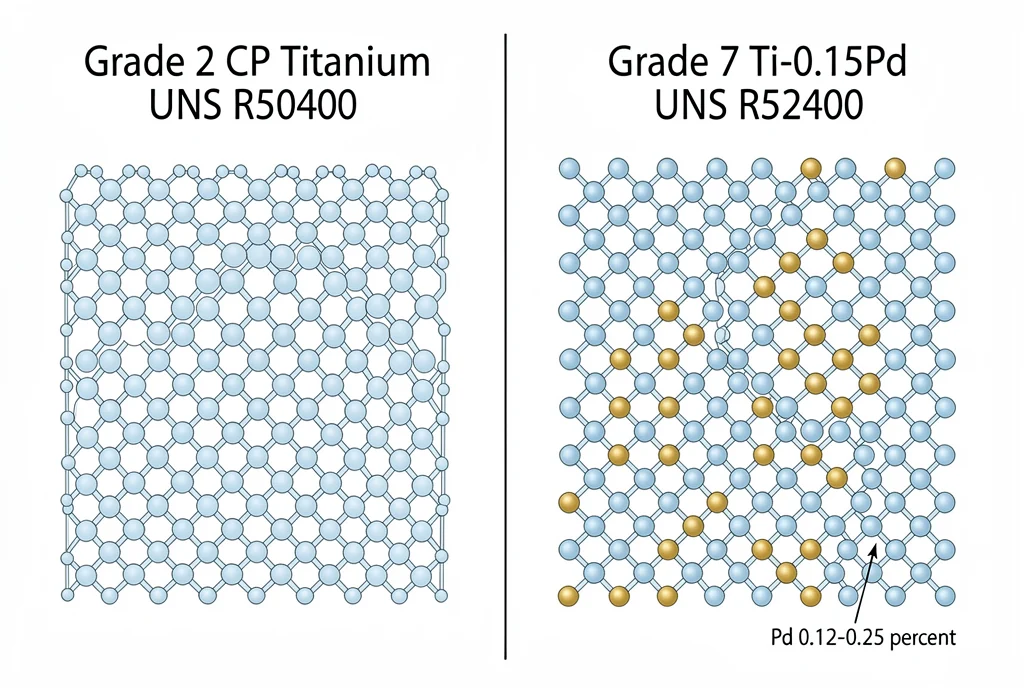
At the composition level, Grade 7 and Grade 2 are nearly the same material. Both are commercially pure (CP) titanium — alpha-phase alloys with no significant alloying additions beyond interstitial controls on oxygen, nitrogen, carbon, and hydrogen. The entire difference between them fits in a single line of the ASTM specification.
Grade 7 contains 0.12–0.25% palladium (ASTM B338 specifies this range). Grade 2 contains none.
That’s it. Same titanium matrix, same mechanical property floors, same fabrication behavior, same weldability, same density. You can weld Grade 7 to Grade 2 without compatibility issues. Their ASTM product specifications — B265 (sheet/plate), B337 (pipe), B338 (tube), B348 (bar), and B381 (forgings) — are identical except for the palladium requirement and the UNS designations: R50400 for Grade 2, R52400 for Grade 7.
The cost difference, however, is substantial. Palladium is a platinum-group metal. Grade 7 typically carries a 3–5× price premium over Grade 2, depending on current palladium spot prices and product form. For a large heat exchanger bundle, that premium adds up fast. Which is why knowing exactly when Grade 7 is necessary — and when Grade 2 is sufficient — matters to the project budget as much as it does to plant reliability.
Grade 7 vs Grade 2 at a Glance
The table below covers the full comparison across composition, mechanical performance, corrosion behavior, and practical considerations. Mechanical properties are identical; the differences are entirely in corrosion resistance and cost.
| Property | Grade 2 (CP-Ti) | Grade 7 (Ti-0.15Pd) |
|---|---|---|
| UNS Designation | R50400 | R52400 |
| Palladium Content | None | 0.12–0.25% |
| Tensile Strength (min) | 345 MPa | 345 MPa |
| Yield Strength (0.2%, min) | 275 MPa | 275 MPa |
| Elongation (min) | 20% | 20% |
| Density | 4.51 g/cm³ | 4.51 g/cm³ |
| Modulus of Elasticity | 103 GPa | 103 GPa |
| Melting Range | 1,668 ± 10°C | 1,668 ± 10°C |
| Thermal Conductivity | 11.4 W/m·°C | 11.4 W/m·°C |
| Oxidizing acid resistance | Excellent | Excellent |
| Reducing acid resistance | Limited | Excellent |
| Crevice corrosion resistance | Moderate | High |
| Hot chloride brine resistance | Good | Excellent |
| Weldability | Excellent | Excellent |
| Formability | Excellent | Excellent |
| Relative cost | Baseline | 3–5× higher |
| ASTM specifications | B265, B337, B338, B348, B381 | B265, B337, B338, B348, B381 |
The takeaway: if the service environment is oxidizing or mildly corrosive, the performance columns are identical and the cost premium for Grade 7 returns nothing. Grade 7 earns its price only in reducing acid or aggressive crevice conditions.
Why Palladium Works — The Electrochemistry
Most materials data sheets state that palladium improves titanium’s corrosion resistance without explaining how. Understanding the mechanism is worth the detour, because it tells you exactly which environments Grade 7 helps and which it does not.
Titanium’s corrosion resistance in oxidizing environments comes from its passive oxide film — a thin, self-healing layer of TiO₂ that forms instantly on exposure to air or water. In strongly oxidizing media, that film is stable and the metal barely corrodes. The problem is reducing environments, particularly reducing acids. There, the electrochemical driving force is toward film dissolution rather than film formation. The oxide breaks down, bare metal is exposed, and corrosion proceeds rapidly.
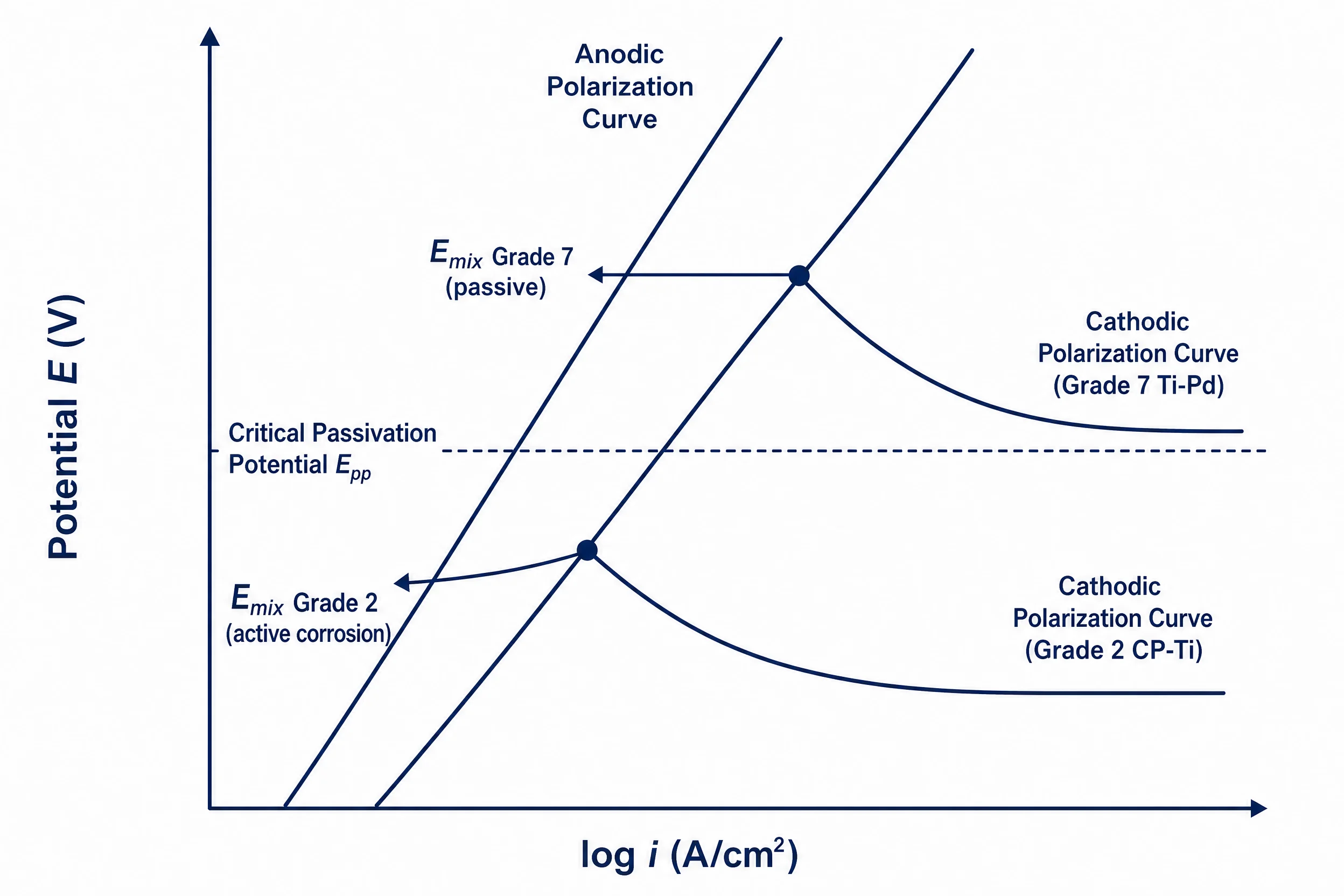
Palladium addresses this through a mechanism called cathodic depolarization. At low Pd concentrations (0.12–0.25% in Grade 7), palladium does not dissolve in the acid. Instead, it enriches at the metal surface as TiO₂ preferentially dissolves around it, forming small Pd-enriched intermetallic zones (principally TiPd). These Pd-rich sites act as efficient cathodic sites — they catalyze the reduction of hydrogen ions (H⁺ → H₂) far more effectively than titanium can.
This cathodic catalysis does two things: it accelerates the cathodic reaction rate, and it shifts the mixed potential of the metal surface upward, toward more noble (positive) values. If that mixed potential rises above the critical passivation potential of titanium in the specific medium, the titanium surface re-enters its passive state and effectively stops corroding.
In practice, this means Grade 7 can self-passivate in reducing acid concentrations and temperatures where Grade 2 would corrode through at tens of millimeters per year. The mechanism is not unlimited — at very high acid concentrations or very high temperatures, the driving force for film dissolution exceeds what Pd catalysis can counteract, and Grade 7 also corrodes. The Austral Wright data shows Grade 7 reaching 8.8 mm/yr in 10% HCl at 190°C under N₂ saturation — still better than Grade 2 (>28 mm/yr), but no longer near-passive.
One critical caveat: titanium’s oxide film requires the presence of moisture to re-form. In anhydrous (dry) reducing conditions — dry hydrogen chloride gas, dry HF, red fuming nitric acid — Grade 7 offers no advantage over Grade 2. Both can suffer rapid, potentially pyrophoric attack. This is not a commonly stated limitation in commercial datasheets, but it is a real one.
Corrosion Performance by Acid Type
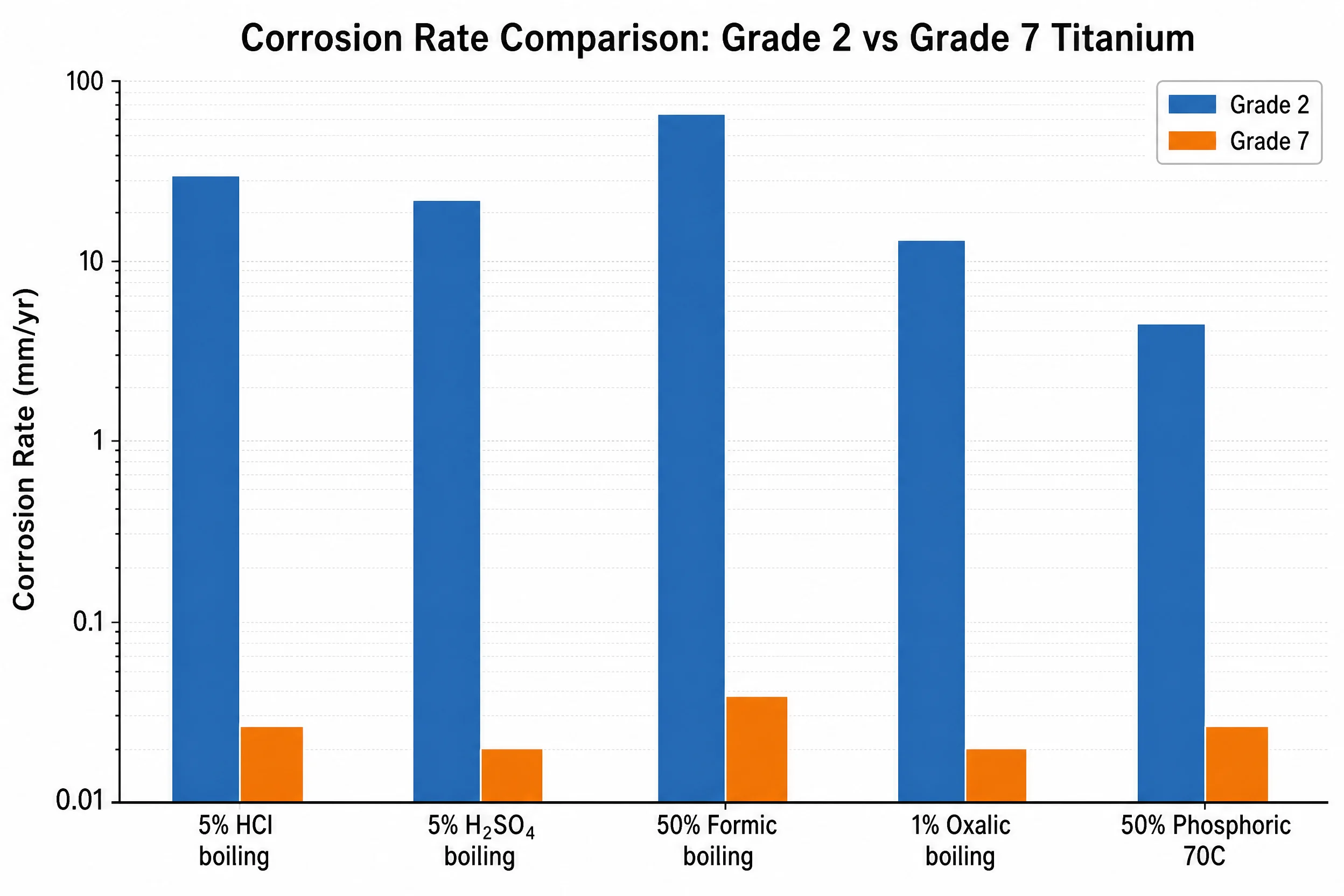
The following data comes from comparative testing of Grade 7 and Grade 2 under controlled conditions. Corrosion rates below 0.1 mm/yr are generally considered acceptable for long-term service; rates above 1.0 mm/yr typically indicate a material replacement is warranted.
Hydrochloric Acid (HCl)
HCl is a reducing acid, which makes it the clearest illustration of Grade 7’s advantage.
| Condition | Concentration | Temperature | Grade 7 (mm/yr) | Grade 2 (mm/yr) |
|---|---|---|---|---|
| Standard | 5% | Boiling | 0.18 | >10 |
| N₂-saturated | 3% | 190°C | 0.025 | >28 |
| N₂-saturated | 5% | 190°C | 0.10 | >28 |
| N₂-saturated | 10% | 190°C | 8.8 | >28 |
| O₂-saturated | 3% | 190°C | 0.13 | >28 |
| O₂-saturated | 5% | 190°C | 0.13 | >28 |
At room temperature, the practical limit for Grade 2 is approximately 7% HCl. Grade 7 extends that to approximately 27% HCl before corrosion rates become problematic. At boiling temperature, Grade 2 is essentially unsuitable above 1–2% HCl. Grade 7 remains serviceable up to 5% boiling, with marginal corrosion rates (0.18 mm/yr), and becomes unacceptable above 10% at elevated temperatures.
Sulfuric Acid (H₂SO₄)
Sulfuric acid is another reducing acid where the divergence is dramatic.
| Condition | Concentration | Temperature | Grade 7 (mm/yr) | Grade 2 (mm/yr) |
|---|---|---|---|---|
| Standard | 5% | Boiling | 0.50 | 48 |
| N₂-saturated | 1% | 100°C | — | 7 |
| N₂-saturated | 1% | 190°C | 0.13 | — |
| N₂-saturated | 5% | 190°C | 0.13 | — |
| N₂-saturated | 10% | 190°C | 1.5 | — |
Grade 2 in boiling 5% H₂SO₄ corrodes at 48 mm/yr — essentially dissolved within days. Grade 7 at the same condition produces 0.50 mm/yr, which is borderline acceptable for some applications. For dilute H₂SO₄ at elevated temperatures, Grade 7 at 1–5% concentration achieves near-passive rates below 0.15 mm/yr.
Organic Acids (Formic, Citric, Oxalic)
Organic acids present a mixed picture.
| Acid | Concentration | Temperature | Grade 7 (mm/yr) | Grade 2 (mm/yr) |
|---|---|---|---|---|
| Formic Acid | 50% | Boiling | 0.075 | 3.6 |
| Citric Acid | 50% | Boiling | <0.025 | 0.40 |
| Oxalic Acid | 1% | Boiling | 1.13 | 45 |
Formic and citric acid: Grade 7 performs well, Grade 2 corrodes at rates that would be problematic for long-term service. Oxalic acid is aggressive for both grades — Grade 7’s 1.13 mm/yr at boiling 1% oxalic acid is high, and Grade 2’s 45 mm/yr is catastrophic.
Phosphoric Acid (H₃PO₄)
| Concentration | Temperature | Grade 7 (mm/yr) | Grade 2 (mm/yr) |
|---|---|---|---|
| 50% | 70°C | 1.8 | 10 |
| 10% | Boiling | 3.2 | 11 |
Both grades struggle in concentrated phosphoric acid. Grade 7 performs better, but neither material provides the near-passive performance seen in dilute reducing acids. At 10% boiling, Grade 7’s 3.2 mm/yr may still be acceptable for certain process designs with planned maintenance cycles, but it is not a long-term, maintenance-free solution.
Chloride-Containing Media (Brines, AlCl₃)
| Medium | Concentration | Temperature | Grade 7 (mm/yr) | Grade 2 (mm/yr) |
|---|---|---|---|---|
| NaCl Brine | Sat. | 93°C | <0.025 | — |
| AlCl₃ | 10% | 100°C | <0.025 | <0.025 |
| AlCl₃ | 25% | 100°C | 0.025 | 50 |
In neutral to mildly alkaline brines, both grades perform well and Grade 2 is the cost-effective choice. In acidified or concentrated chloride media, Grade 7 pulls significantly ahead.
When Grade 2 Is the Right Call
Grade 7 gets most of the attention in corrosion engineering discussions, but a significant number of industrial applications are better served by Grade 2. Over-specifying Grade 7 where Grade 2 performs identically is a direct, unnecessary cost.
Oxidizing acid environments. In nitric acid — a strongly oxidizing acid — both grades perform comparably well. Titanium’s passive film is highly stable in oxidizing conditions regardless of palladium content. The same applies to chromic acid and other oxidizing media. Grade 2 at a fraction of the cost is the correct choice.
Dilute organic acids at moderate temperature. At low concentrations and temperatures well below boiling, the corrosion rates for Grade 2 in organic acids are often acceptable. A 50°C formic acid stream at 10% concentration is a different proposition from boiling 50% formic acid. Review your specific operating conditions against the corrosion data before defaulting to Grade 7.
Seawater, saline, and chloride service. In neutral-pH seawater and brines, both grades are essentially immune. The oxide film is stable, corrosion rates are negligible, and crevice corrosion risk — though real for both grades — does not significantly separate them in standard marine service temperatures. Grade 2 is the dominant material in offshore heat exchangers for seawater service.
Alkaline environments. Strong alkalis (caustic soda, potassium hydroxide) are not a challenge for either grade. Grade 2 handles them well and the palladium addition in Grade 7 contributes nothing in terms of corrosion performance here.
Cost-sensitive applications with shorter service life expectations. In some processing environments, periodic replacement of corroded components is engineered into the maintenance schedule. If the corrosion rate for Grade 2 results in a component life of, say, 3–5 years and that aligns with planned turnaround intervals, specifying Grade 7 purely for the longer life may not produce a positive return on investment.
The practical decision rule: if your process chemistry is not in the reducing acid family (HCl, H₂SO₄, H₃PO₄, organic acids), or if it is but only at low concentrations and moderate temperatures where Grade 2 corrosion rates are below 0.25 mm/yr, Grade 2 is sufficient. Add Grade 7 to the spec only when the data — specifically the corrosion rate in your acid at your operating temperature — supports it.
Applications Where Grade 7 Earns Its Premium
When the service conditions fall squarely in the reducing acid category, Grade 7’s cost premium is typically easy to justify on a lifecycle basis. Replacement cost, process downtime, and product contamination risk from a corroding vessel all factor into that calculation.
Chlor-alkali and chlorine chemistry. Cell components, anode assemblies, and piping in chlorine production see both wet chlorine gas and hydrochloric acid streams. Grade 7 is the standard material specification in many of these service environments. The combination of wet chlorine, HCl, and brine — with temperature cycling — is too aggressive for Grade 2 on wetted surfaces.
Chemical processing reactors and autoclaves. Reactor vessels handling reducing acid digestion — hydrometallurgy acid leach circuits for nickel, cobalt, and copper recovery are the classic example — operate at elevated temperatures with HCl or H₂SO₄ at concentrations that fall squarely in Grade 7’s serviceable range. A 2010 corrosion study of Ti-2 and Ti-7 in nickel acid leach chemistry (Vaughan, ScienceDirect) documented markedly different surface morphologies and corrosion behavior, with Ti-7 maintaining a smooth surface and significantly lower metal loss under conditions that produced severe roughening and grain boundary attack on Ti-2.
Heat exchangers in acid service. ASTM B338 exists specifically for titanium heat exchanger tubes. Grade 7 is specified for condensers and heat exchangers in acid environments — particularly where the shell-side or tube-side fluid is a reducing acid process stream, or where the unit handles alternating service conditions that could cycle between reducing and oxidizing chemistry.
Pharmaceutical and fine chemical production. Acid digestion vessels and process piping in pharmaceutical synthesis often involve formic acid, oxalic acid, or dilute HCl at temperatures approaching boiling. Product purity requirements make metal contamination intolerable, which further reinforces the case for near-passive corrosion rates. Grade 7 is the appropriate specification here.
Air pollution control. Wet scrubbers handling SO₂ and HCl gas streams — particularly those using acid wash liquors — see service conditions where Grade 2 has a documented corrosion history. Grade 7 is commonly specified for scrubber internals and packed bed supports.
AS1210/ASME pressure vessel service up to 300°C. Both codes pre-qualify Grade 7 for pressure vessel construction up to 300°C (ASME BPVC) and Grade 7 pipe up to 325°C (AS4041 pressure piping). When acid-service pressure vessels are designed to these codes, Grade 7 is the natural designation for the wetted pressure-containing components.
The Palladium Grade Family — Grades 7, 11, 16, and Grade 12
If you’re evaluating Grade 7, you should also be aware of the other palladium-containing grades and the molybdenum-nickel alternative (Grade 12), because the “just use Grade 7” answer is sometimes not the most cost-effective one.
| Grade | Key Alloy Addition | Pd Content | Base Strength | Primary Use Case |
|---|---|---|---|---|
| Grade 7 | 0.12–0.25% Pd | Full range | CP-Ti (Grade 2 equivalent) | Reducing acids, crevice service, standard applications |
| Grade 11 | 0.12–0.25% Pd | Full range | CP-Ti (Grade 1 base — lower O) | Pd variant of Grade 1; same corrosion performance as Grade 7, slightly lower strength |
| Grade 16 | 0.04–0.08% Pd | Reduced | CP-Ti | Cost-optimized alternative to Grade 7 in milder reducing conditions |
| Grade 12 | 0.3% Mo + 0.8% Ni | None | Higher than Grade 2 | Crevice corrosion in hot brines; no Pd (lower cost, different mechanism) |
Grade 7 vs Grade 11: These two grades have the same palladium range and therefore similar corrosion resistance. The key distinction is in the base metal: Grade 11 is to Grade 1 what Grade 7 is to Grade 2 — both are palladium-bearing variants, but at different oxygen tiers. Grade 11 uses a Grade 1 base (lower oxygen, ~0.18% max O vs Grade 2’s 0.25% max), which gives slightly lower interstitial strength. The practical corrosion performance difference is minor. For the vast majority of acid-service applications, Grade 7 and Grade 11 are interchangeable from a corrosion standpoint.
Grade 7 vs Grade 16: Grade 16 contains only 0.04–0.08% Pd — roughly half the lower limit of Grade 7. Its corrosion resistance in reducing acids is improved over Grade 2 but not as robust as Grade 7. Grade 16 is a cost-reduction measure for environments where the full Grade 7 performance margin is more than needed. If corrosion rate data at your specific conditions puts Grade 16 safely below 0.1 mm/yr, it can provide meaningful cost savings over Grade 7.
Grade 7 vs Grade 12: Grade 12 is a different approach entirely — it uses molybdenum and nickel rather than palladium. Grade 12 has higher strength than Grade 2 (tensile strength ≥ 483 MPa vs 345 MPa) and better crevice corrosion resistance in hot neutral-pH chloride environments. However, it does not match Grade 7’s performance in reducing acids. If the main concern is crevice corrosion in hot brines without significant acid exposure, Grade 12 can be the more cost-effective choice and offers the strength advantage. For genuine reducing acid service, Grade 7 is the correct selection.
Frequently Asked Questions
What is the difference between Grade 2 and Grade 7 titanium?
Grade 7 is Grade 2 with 0.12–0.25% palladium added. Both are commercially pure alpha-titanium with identical mechanical properties, density, and weldability. The only functional difference is corrosion resistance: Grade 7 dramatically outperforms Grade 2 in reducing acids (HCl, H₂SO₄, organic acids) through a palladium-catalyzed electrochemical mechanism that allows the metal to self-passivate in environments where Grade 2 would corrode at rates exceeding 10–50 mm/yr.
Which titanium grade is best for hydrochloric acid service?
For HCl service, Grade 7 is the standard recommendation. At room temperature, Grade 2 is limited to approximately 7% HCl; Grade 7 extends that to approximately 27%. At boiling temperature, Grade 2 corrodes at more than 10 mm/yr in 5% HCl, while Grade 7 produces 0.18 mm/yr. Above 10% HCl at elevated temperatures (190°C), even Grade 7’s protection diminishes substantially — consider Hastelloy C-276 or similar alloys for those extreme conditions.
Is Grade 7 titanium worth the cost premium?
It depends entirely on the service environment. In reducing acid service, Grade 7 prevents catastrophic corrosion failures that would necessitate vessel replacement, process downtime, and potential contamination incidents — the lifecycle cost calculus strongly favors Grade 7. In non-acid or oxidizing environments, Grade 7 provides zero additional corrosion benefit over Grade 2, and the 3–5× cost premium represents pure overspend. Match the grade to the service chemistry, not to a general preference for “better” materials.
Can Grade 2 titanium handle sulfuric acid?
Grade 2 corrodes severely in sulfuric acid at elevated temperatures. At boiling 5% H₂SO₄, Grade 2 corrodes at 48 mm/yr — effectively unusable. At room temperature and very low concentrations (below approximately 5%), Grade 2 corrosion rates are more modest, but the margin for error is thin if operating temperatures or concentrations vary. For any meaningful H₂SO₄ service, Grade 7 is the correct specification.
Does palladium prevent crevice corrosion in titanium?
Yes, to a significant degree. Crevice corrosion in titanium occurs when stagnant fluid in a crevice becomes depleted in oxidizing species, shifting the local electrochemistry toward reducing conditions. Palladium’s cathodic catalysis effect extends corrosion resistance into those locally reducing conditions, which is why Grade 7 is preferred over Grade 2 in applications with gaskets, tube-to-tubesheet joints, and bolted flanges in acid service.
What titanium grade should I specify for a reducing acid heat exchanger?
Specify Grade 7 to ASTM B338 (seamless or welded tube) for the tube bundle. For the shell, Grade 2 to ASTM B265 (plate) may be acceptable if the shell-side fluid is not a reducing acid. If both shell and tube sides carry reducing acid, specify Grade 7 throughout. Use AWS ERTi-7 filler metal for any field welds.
What is the UNS designation for Grade 7 titanium?
Grade 7 titanium is designated UNS R52400. Grade 2 is UNS R50400.
Are Grade 7 and Grade 11 interchangeable?
For most acid-service applications, yes. Both contain 0.12–0.25% Pd and produce similar corrosion resistance. Grade 11 is to Grade 1 what Grade 7 is to Grade 2 — a palladium-bearing variant at the same base oxygen tier. Grade 11’s lower interstitial oxygen content means it is slightly lower in strength than Grade 7. Where Grade 7 meets the mechanical requirements, it is generally preferred due to wider availability.
Summary
Grade 7 and Grade 2 titanium are the same material apart from one thing: palladium. That addition costs significantly more but delivers a dramatic improvement in one specific performance category — resistance to reducing acids. In boiling HCl and H₂SO₄, Grade 7 corrodes at rates 50–300 times lower than Grade 2. In oxidizing environments, saline service, and alkaline conditions, the two grades are identical and Grade 2 is the obvious choice.
The decision framework is straightforward: identify the primary corrosive agent in your process stream, look up the corrosion rate for that acid at your operating temperature and concentration, and select the grade whose rate falls below 0.1 mm/yr with adequate margin. If that answer is Grade 2, do not pay for Grade 7. If it is Grade 7, the lifecycle economics almost always justify the premium over the cost of a premature equipment failure.
For environments that fall in a gray zone — mild reducing acid conditions, variable service chemistry, or budget constraints — Grade 16 (reduced Pd) and Grade 12 (Mo-Ni) are worth evaluating as cost-intermediate alternatives before defaulting to full Grade 7 throughout a large-scale installation.