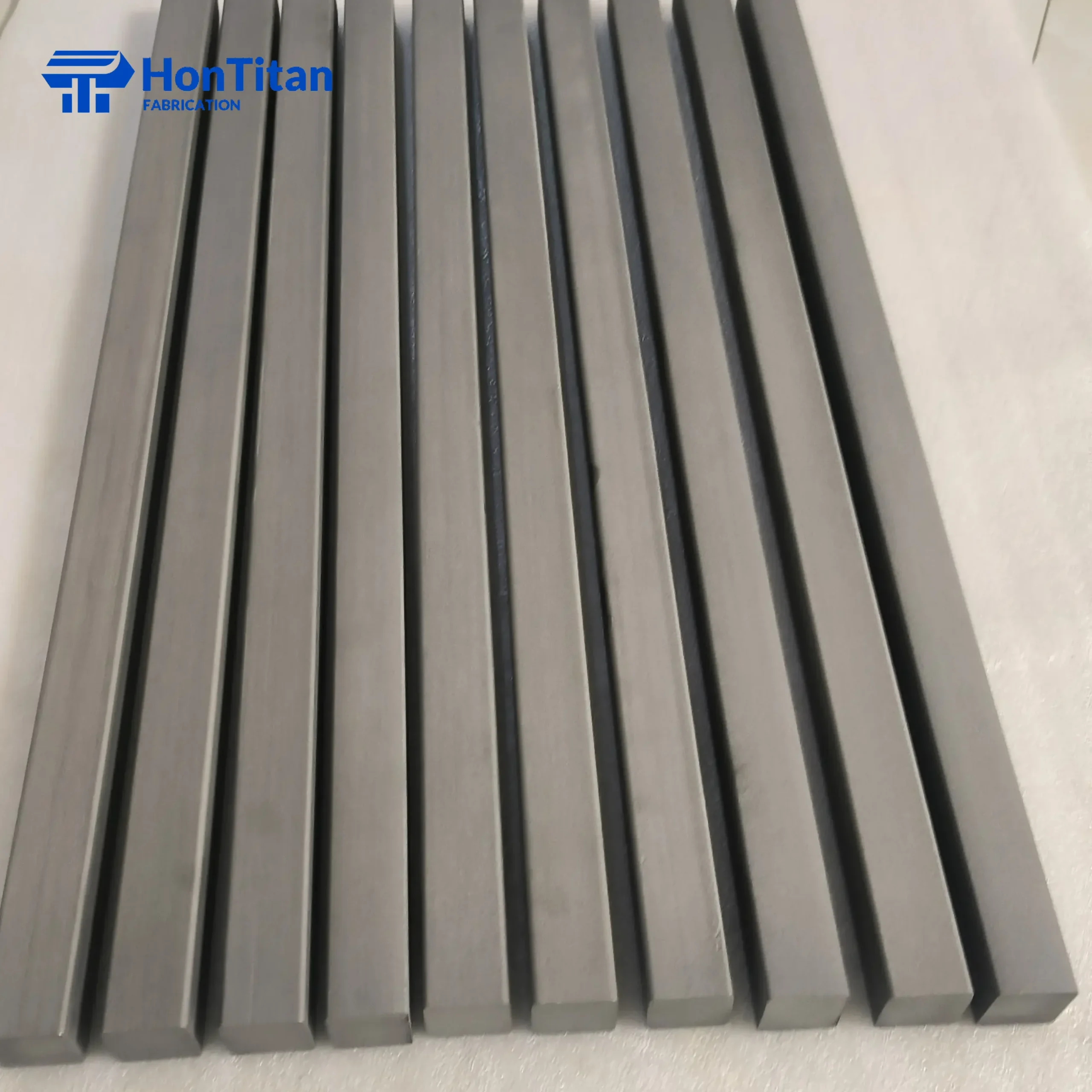
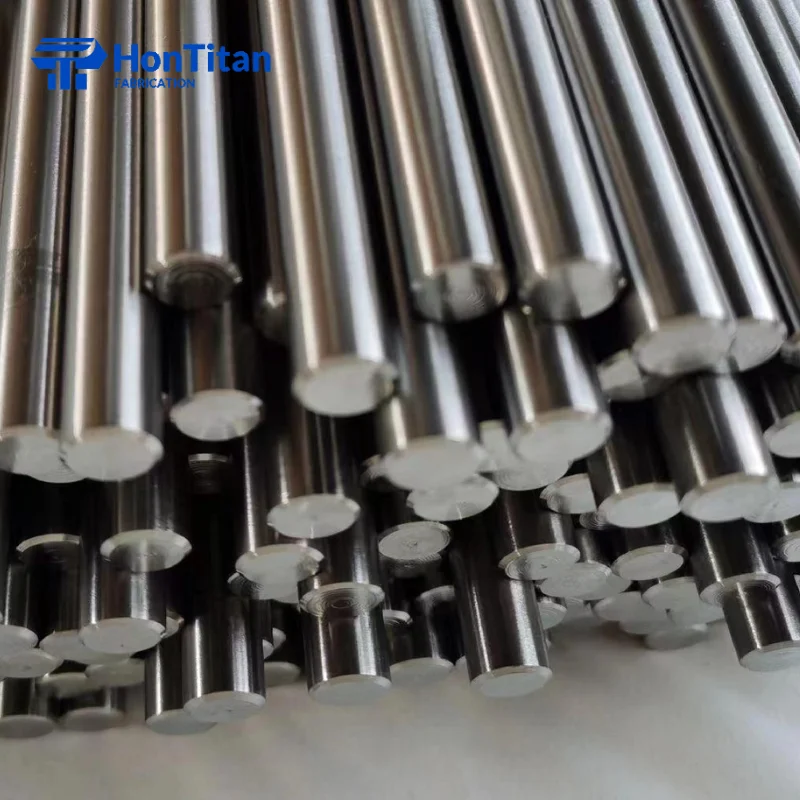
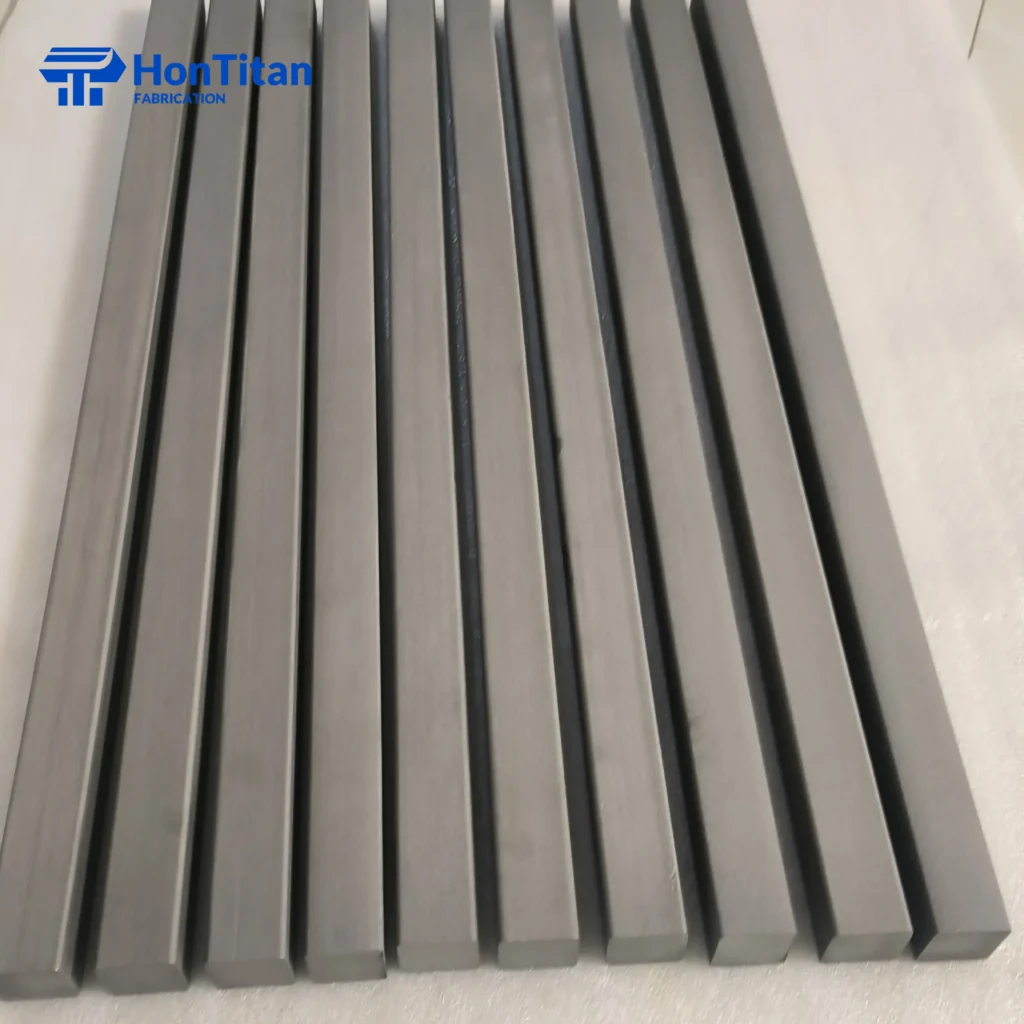
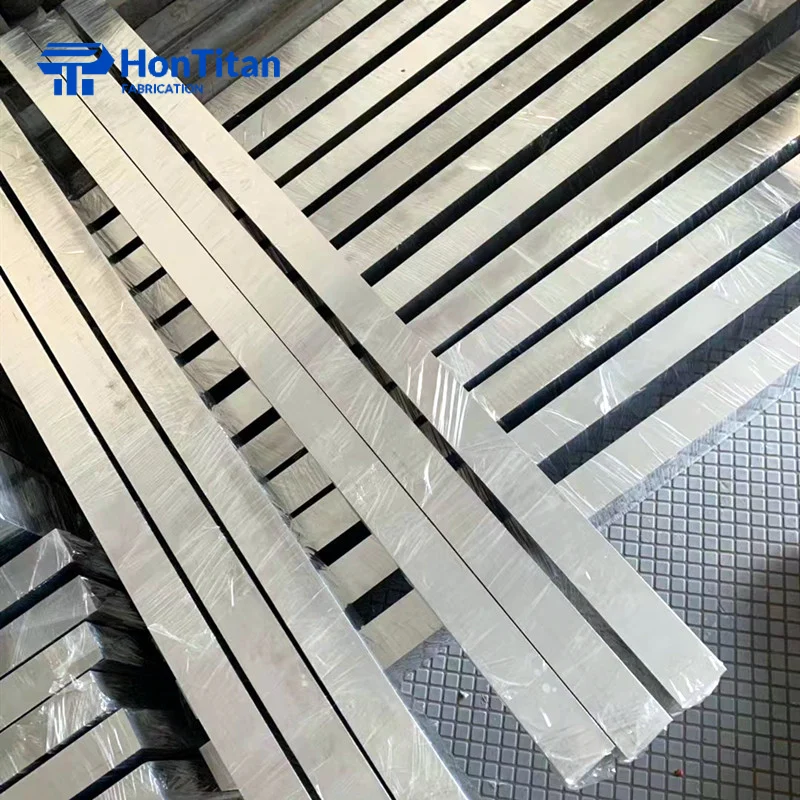
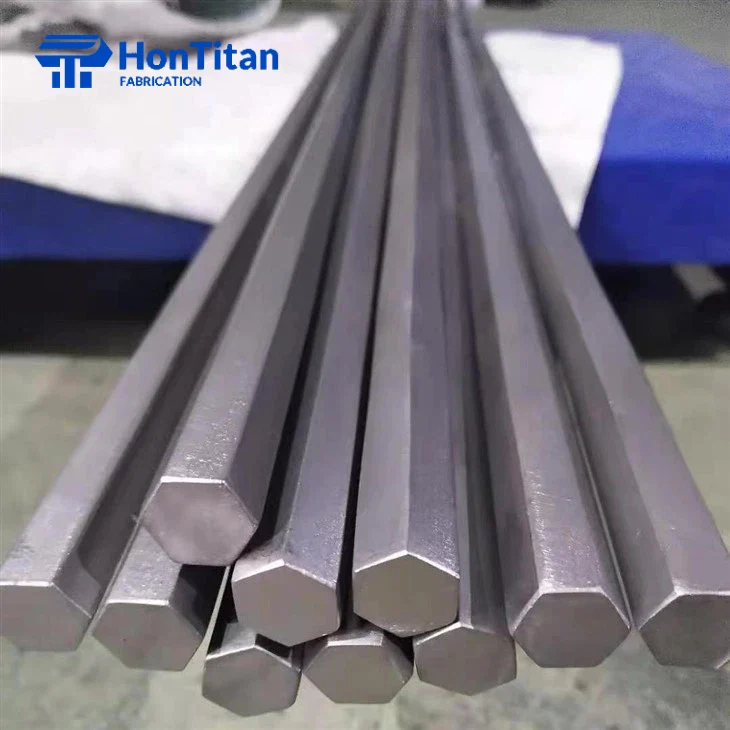
Grade 5 titanium square bar (Ti-6Al-4V, UNS R56400) is the most widely specified titanium alloy in aerospace, medical, and industrial procurement, accounting for more than 50% of global titanium mill product consumption. Manufactured to ASTM B348-19 and AMS 4928T, these bars combine a minimum tensile strength of 896 MPa (130 ksi) with a density of 4.43 g/cm³ — approximately 45% lighter than low-alloy steel at comparable structural strength. Available in side lengths from 6 mm to 150 mm across forged, hot-rolled, cold-rolled, and extruded processing variants. EN 10204 3.1 Mill Test Certificates are supplied as standard with every shipment.
Quick Specifications
| Parameter |
Details |
| Material Grade |
Grade 5 / Ti-6Al-4V / 6Al-4V |
| UNS Number |
R56400 |
| Standards |
ASTM B348-19, AMS 4928T, AMS 4967 (STA), ISO 5832-3 |
| Available Forms |
Forged, Hot-Rolled, Cold-Rolled, Extruded |
| Side Length Range |
6 mm – 150 mm (0.25″ – 6.0″) |
| Length Range |
Up to 6,000 mm; custom cut-to-length available |
| Dimensional Tolerance |
Per ASTM B348-19 (see tolerance tables below) |
| Supply Condition |
Mill Annealed (standard); STA per AMS 4967 on request |
| Mill Test Certificate |
EN 10204 3.1 standard; 3.2 on request |
| MOQ |
No minimum for standard stock sizes |
| Lead Time |
3–5 business days (stock); 2–4 weeks (custom) |
Chemical Composition
Grade 5 Ti-6Al-4V chemical composition limits per ASTM B348-19 and AMS 4928T (UNS R56400):
| Element |
Symbol |
ASTM B348-19 (max %) |
AMS 4928T (max %) |
| Aluminum |
Al |
5.50–6.75 |
5.50–6.75 |
| Vanadium |
V |
3.50–4.50 |
3.50–4.50 |
| Iron |
Fe |
≤ 0.40 |
≤ 0.30 |
| Oxygen |
O |
≤ 0.20 |
≤ 0.20 |
| Carbon |
C |
≤ 0.08 |
≤ 0.08 |
| Nitrogen |
N |
≤ 0.05 |
≤ 0.05 |
| Hydrogen |
H |
≤ 0.0150 |
≤ 0.0125 |
| Yttrium |
Y |
≤ 0.005 |
≤ 0.005 |
| Other (each) |
— |
≤ 0.10 |
≤ 0.10 |
| Other (total) |
— |
≤ 0.40 |
≤ 0.40 |
| Titanium |
Ti |
Balance |
Balance |
AMS 4928T applies tighter limits on iron and hydrogen versus the commercial ASTM B348-19 standard, reflecting the additional quality requirements of aerospace prime contractors. Chemical analysis per optical emission spectrometry (OES, ASTM E2594) and combustion/inert gas fusion (carbon: ASTM E1941; hydrogen: ASTM E1447). Each heat lot is certified on the EN 10204 3.1 MTC.
Mechanical Properties
Mill Annealed Condition — ASTM B348-19 / AMS 4928T
| Property |
Minimum Value |
Test Method |
| Ultimate Tensile Strength |
130 ksi (896 MPa) |
ASTM E8/E8M |
| 0.2% Offset Yield Strength |
120 ksi (827 MPa) |
ASTM E8/E8M |
| Elongation (gauge length = 4D) |
10% |
ASTM E8/E8M |
| Reduction of Area |
25% |
ASTM E8/E8M |
| Hardness (typical) |
30–36 HRC |
ASTM E18 |
Solution Treated and Aged (STA) — AMS 4967
| Property |
Minimum Value |
Test Method |
| Ultimate Tensile Strength |
160 ksi (1,103 MPa) |
ASTM E8/E8M |
| 0.2% Offset Yield Strength |
150 ksi (1,034 MPa) |
ASTM E8/E8M |
| Elongation (gauge length = 4D) |
8% |
ASTM E8/E8M |
| Reduction of Area |
20% |
ASTM E8/E8M |
Fatigue strength (annealed, smooth bar, R = −1): approximately 510 MPa at 10⁷ cycles per ASTM E466.
Fracture toughness K_IC (annealed): typically 55–75 MPa·√m (ASTM E399).
Physical Properties
| Property |
Value |
Condition / Test Reference |
| Density |
4.43 g/cm³ (0.160 lb/in³) |
25°C; ASTM B311 |
| Elastic (Young’s) Modulus |
114 GPa (16.5 × 10⁶ psi) |
25°C |
| Shear Modulus |
44 GPa (6.4 × 10⁶ psi) |
25°C |
| Poisson’s Ratio |
0.342 |
25°C |
| Thermal Conductivity |
7.2 W/m·K |
25°C |
| Specific Heat Capacity |
560 J/kg·K (0.134 Btu/lb·°F) |
25°C |
| Coefficient of Thermal Expansion (CTE) |
8.6 µm/m·°C |
21–316°C average |
| Electrical Resistivity |
~170 µΩ·cm |
25°C |
| Melting Range |
1,604–1,660°C (2,919–3,020°F) |
— |
| Beta Transus Temperature |
~995°C ± 15°C (1,823°F) |
— |
Technical Overview
Grade 5 titanium (Ti-6Al-4V, UNS R56400) is the most widely used titanium alloy globally, accounting for more than 50% of all titanium mill products, due to its balanced combination of high specific strength, chemical inertness, and versatile hot and cold workability. The alloy’s dual alpha-beta microstructure — aluminum acting as an alpha-phase stabilizer and vanadium as a beta-phase stabilizer — produces a minimum tensile strength of 896 MPa (ASTM E8/E8M) at a density of 4.43 g/cm³, delivering a specific strength approximately 1.8 times greater than Grade 304 stainless steel.
The self-healing TiO₂ passive oxide layer that forms instantaneously on exposure to air or aqueous media provides exceptional corrosion resistance across a service pH range of 3–11, including chloride-bearing environments, dilute reducing acids, and elevated-temperature steam. This resistance is sustained in seawater to depths beyond 3,000 m, making Ti-6Al-4V square bar a qualified material for subsea structures, desalination equipment, and offshore-grade mechanical components.
Square bar is produced by hot rolling (10–80 mm) or forging (20–150 mm), then annealed at 700–785°C followed by air cooling per AMS 2801 heat treatment requirements. Vacuum arc remelting (VAR) is the standard melting practice; double VAR is applied to critical aerospace material. Ultrasonic testing per ASTM B594 (Acceptance Class A) and AMS 2631 is performed on aerospace-grade bar. Each lot is assigned a traceable heat number documented on the EN 10204 3.1 Mill Test Certificate.
Processing Variants and Available Size Ranges
Four manufacturing routes are available, each optimized for different dimensional, structural, and surface finish requirements:
| Processing Method |
Side Length (mm) |
Length Range (mm) |
Key Characteristic |
| Forged |
20–150 |
500–2,000 |
Refined grain structure; highest strength uniformity for heavy-load or aerospace parts |
| Hot Rolled |
10–80 |
2,000–6,000 |
Good dimensional stability; standard commercial and industrial supply |
| Cold Rolled |
6–40 |
≤ 4,000 |
Tight dimensional accuracy; improved surface finish for precision machining |
| Extruded |
6–60 |
1,000–6,000 |
Continuous cross-section; dense structure for fastener and industrial part blanks |
Custom cut-to-length is available for all variants. Non-standard cross-section sizes outside the ranges above can be produced against confirmed order.
Standard Inch-Based Stock Sizes
| Side (in.) |
Side (mm) |
Available Length |
| 0.25″ × 0.25″ |
6.35 × 6.35 |
1–6 m |
| 0.375″ × 0.375″ |
9.53 × 9.53 |
1–6 m |
| 0.5″ × 0.5″ |
12.7 × 12.7 |
1–6 m |
| 0.75″ × 0.75″ |
19.05 × 19.05 |
1–6 m |
| 1″ × 1″ |
25.4 × 25.4 |
1–6 m |
| 1.5″ × 1.5″ |
38.1 × 38.1 |
1–6 m |
| 2″ × 2″ |
50.8 × 50.8 |
1–6 m |
| 3″ × 3″ |
76.2 × 76.2 |
1–6 m |
| 4″ × 4″ |
101.6 × 101.6 |
1–6 m |
Dimensional Tolerances — ASTM B348-19
Hot-Worked Titanium Square Bar
| Nominal Side (in.) / (mm) |
Dimensional Tolerance (in.) / (mm) |
Out-of-Square (in.) / (mm) |
| ¼ to 5⁄16 (6.35–7.94) |
±0.005 / ±0.13 |
0.008 / 0.20 |
| Over 5⁄16 to 7⁄16 (7.94–11.11) |
±0.006 / ±0.15 |
0.009 / 0.23 |
| Over 7⁄16 to 5⁄8 (11.11–15.88) |
±0.007 / ±0.18 |
0.010 / 0.25 |
| Over 5⁄8 to 7⁄8 (15.88–22.22) |
±0.008 / ±0.20 |
0.012 / 0.30 |
| Over 7⁄8 to 1 (22.22–25.40) |
±0.009 / ±0.23 |
0.013 / 0.33 |
| Over 1 to 1⅛ (25.40–28.58) |
±0.010 / ±0.25 |
0.015 / 0.38 |
| Over 1⅛ to 1¼ (28.58–31.75) |
±0.011 / ±0.28 |
0.018 / 0.46 |
| Over 1¼ to 1⅜ (31.75–34.92) |
±0.012 / ±0.30 |
0.018 / 0.46 |
| Over 1⅜ to 1½ (34.92–38.10) |
±0.014 / ±0.36 |
0.020 / 0.51 |
| Over 1½ to 2 (38.10–50.80) |
+1⁄64 / +0.40 |
0.023 / 0.58 |
| Over 2 to 2½ (50.80–63.50) |
+1⁄32 / +0.79 |
0.023 / 0.58 |
| Over 2½ to 3½ (63.50–88.90) |
+3⁄64 / +1.19 |
0.035 / 0.89 |
| Over 3½ to 4½ (88.90–114.30) |
+1⁄16 / +1.59 |
0.046 / 1.17 |
Cold-Worked Titanium Square Bar
| Nominal Side (in.) / (mm) |
Dimensional Tolerance |
| ½ to 1 (12.70–25.40) |
+0 / −0.004 in. (+0 / −0.10 mm) |
| Over 1 to 2 (25.40–50.80) |
+0 / −0.006 in. (+0 / −0.16 mm) |
| Over 2 to 3 (50.80–76.20) |
+0 / −0.008 in. (+0 / −0.20 mm) |
| Over 3 (76.20 mm+) |
+0 / −0.010 in. (+0 / −0.25 mm) |
If cold-worked bars are heat-treated after cold working, tolerances double per ASTM B348-19 Table 12.
Quality Assurance and Certifications
Grade 5 titanium square bar is manufactured and inspected under an ISO 9001:2015 and AS9100D quality management system. Standard quality controls per ASTM B348-19 and AMS 4928T include:
- Chemical Analysis: OES per ASTM E2594 on every heat lot; hydrogen by inert gas fusion per ASTM E1447; carbon by combustion per ASTM E1941
- Mechanical Testing: Tensile and reduction-of-area per ASTM E8/E8M; Rockwell hardness per ASTM E18; one test per lot per ASTM B348-19 Section 9
- Dimensional Inspection: CMM verification of cross-section dimensions, straightness, and out-of-square per ASTM B348-19 Table 12
- Ultrasonic Testing (aerospace orders): Immersion UT per ASTM B594, Acceptance Class A; AMS 2631 requirements available on request
- Material Traceability: Full heat and lot traceability from VAR ingot to finished bar; heat number on each piece
- Mill Test Certificate: EN 10204 3.1 standard; EN 10204 3.2 (third-party witnessed) on request
- DFARS Compliance: Melt and manufacture origin documentation available for US defense procurement requirements
Aerospace orders (AMS 4928T, AMS 4967) and medical orders (ASTM F1472 / ISO 5832-3) are processed under separate quality travelers with enhanced inspection records.
Applications of Grade 5 Titanium Square Bar
Ti-6Al-4V square bar is specified across industries where the alloy’s high specific strength, corrosion resistance, and biocompatibility are required in a square cross-section form factor:
Aerospace and Defense
Aircraft structural brackets, landing gear pin blanks, fastener preforms, missile fin stock, and satellite bus hardware — applications where the 896 MPa minimum tensile strength at 4.43 g/cm³ density reduces structural weight compared to high-strength steel or titanium-free aluminum structures.
Medical Device Manufacturing
Surgical instrument handles, orthopedic trial tool components, external fixation frame members, and MRI-compatible structural elements benefit from Ti-6Al-4V’s non-magnetic properties, corrosion resistance in saline environments, and biocompatibility. Grade 23 (ASTM F136) is specified for permanent orthopedic implants; Grade 5 serves non-implantable surgical and instrumentation applications.
Chemical Processing Equipment
Valve internals, pump impellers, reactor agitator shafts, and heat exchanger supports in chlorine-bearing service, nitric acid duty, and oxidizing environments where austenitic stainless grades experience pitting or stress corrosion cracking at elevated temperature.
Marine and Offshore Engineering
ROV structural frame sections, subsea connector blocks, tether termination hardware, and desalination system supports exposed to sustained seawater immersion. Measured corrosion rate in natural seawater at ambient temperature is below 0.01 mm/year.
Oil and Gas Downhole Tools
Tool body blanks, drill collar cross-sections, and packer components for high-pressure/high-temperature (HPHT) wellbore environments where both corrosion resistance and mechanical strength exceed commercially pure titanium capabilities.
Motorsport and High-Performance Automotive
Engine valve blanks, suspension link inserts, and anti-roll bar components in Formula-class and endurance racing programs, where the density advantage over steel (4.43 vs. 7.85 g/cm³) contributes measurable unsprung or reciprocating mass reduction.
Grade 5 vs Grade 23 Titanium Square Bar
Grade 23 (Ti-6Al-4V ELI, Extra Low Interstitial, UNS R56401) shares the same nominal alloy composition as Grade 5 but specifies tighter maximum limits on oxygen, iron, and hydrogen to improve fracture toughness and fatigue crack propagation resistance, particularly at low temperatures and in cyclic-load implant environments.
| Property |
Grade 5 (ASTM B348-19) |
Grade 23 / ELI (ASTM F136-13 / ISO 5832-3) |
| UNS Number |
R56400 |
R56401 |
| Oxygen max |
0.20% |
0.13% |
| Iron max |
0.40% (B348) / 0.30% (AMS 4928) |
0.25% |
| Nitrogen max |
0.05% |
0.05% |
| Tensile Strength (min, annealed) |
130 ksi (896 MPa) |
120 ksi (827 MPa) |
| Yield Strength (min, annealed) |
120 ksi (827 MPa) |
110 ksi (759 MPa) |
| Elongation (min) |
10% |
10% |
| Fracture Toughness K_IC (typical) |
55–75 MPa·√m |
80–110 MPa·√m |
| Primary Standard |
ASTM B348-19 / AMS 4928T |
ASTM F136-13 / ISO 5832-3 |
| Typical Application |
Aerospace, industrial, motorsport |
Orthopedic implants, cryogenic, high-cycle fatigue |
| Relative Material Cost |
Baseline |
+15–25% premium |
Grade 5 is appropriate for structural, aerospace, and industrial applications. Grade 23 is specified when regulatory compliance for permanent surgical implants (FDA, ISO) or exceptional fracture toughness at cryogenic temperature is required.
Frequently Asked Questions
Is Grade 5 titanium the same as Ti-6Al-4V?
Grade 5 is the ASTM numeric designation; Ti-6Al-4V is the nominal composition designator; and “6Al-4V” or “Ti 6-4” are the common shorthand trade names. All refer to the same alloy, UNS R56400, containing approximately 6% aluminum, 4% vanadium, and the balance titanium per ASTM B348-19 and AMS 4928T.
What is the chemical composition of Grade 5 titanium square bar?
Per ASTM B348-19: Al 5.50–6.75%, V 3.50–4.50%, Fe ≤ 0.40%, O ≤ 0.20%, C ≤ 0.08%, N ≤ 0.05%, H ≤ 0.0150%, Y ≤ 0.005%, other elements each ≤ 0.10% and total ≤ 0.40%, with titanium as the balance. AMS 4928T restricts Fe to ≤ 0.30% and H to ≤ 0.0125% for aerospace-grade bar. Each heat lot is verified by optical emission spectrometry and reported on the EN 10204 3.1 MTC.
What is the difference between ASTM B348-19 and AMS 4928T for titanium bar?
ASTM B348-19 is the general commercial standard for titanium bar and billet in all 38 grades; Grade 5 is one grade within the broader specification. AMS 4928T (SAE Aerospace Material Specification) covers Ti-6Al-4V annealed bar, billet, and rings exclusively, with additional aerospace requirements: tighter Fe and H limits, mandatory ultrasonic testing per AMS 2631, enhanced documentation, and conformance to prime contractor approved processor lists (Boeing, GE, Safran, Airbus). Mechanical property minimums and Al/V composition limits are identical between the two standards for Grade 5 annealed bar.
What size Grade 5 titanium square bars are available?
Hot-rolled bars: 10–80 mm side, up to 6,000 mm length. Forged bars: 20–150 mm side, up to 2,000 mm length. Cold-rolled bars: 6–40 mm side, up to 4,000 mm length. Standard inch inventory runs from 0.25″ × 0.25″ to 4″ × 4″. Custom cut-to-length is available on all variants; non-standard cross-sections can be produced to order.
What heat treatment condition does Grade 5 titanium square bar ship in?
Standard supply condition is mill annealed (MA), achieved by annealing at 700–785°C followed by air cooling per AMS 2801. Solution treated and aged (STA) condition per AMS 4967 — delivering a minimum tensile strength of 1,103 MPa (160 ksi) — is available on order. The heat treatment condition is stated on the EN 10204 3.1 Mill Test Certificate.
Can Grade 5 titanium square bar be welded?
Ti-6Al-4V is weldable by gas tungsten arc welding (GTAW/TIG) and electron beam welding (EBW). Inert gas shielding with argon (purity ≥ 99.998%, O₂ < 20 ppm) is required on all weld-zone surfaces to prevent oxygen and nitrogen embrittlement. Post-weld stress relief at 700°C for 2 hours improves residual stress distribution. Filler metal AWS A5.16 ERTi-6Al-4V is recommended for GTAW applications.
What is the difference between Grade 5 and Grade 23 titanium?
Grade 23 (Ti-6Al-4V ELI, UNS R56401) has lower oxygen (≤ 0.13% vs. 0.20%), lower iron (≤ 0.25% vs. 0.40%), and correspondingly higher fracture toughness than Grade 5. Grade 23 is specified for permanent orthopedic and dental implants (ASTM F136-13 / ISO 5832-3) and cryogenic applications requiring superior damage tolerance. Grade 5 is the standard choice for aerospace structures, industrial hardware, and motorsport components where the tighter interstitial control of ELI grade provides no functional benefit.
Is a Mill Test Certificate included with shipment?
An EN 10204 3.1 Mill Test Certificate is standard with every shipment. The MTC documents chemical composition by heat, mechanical test results by lot, heat treatment condition, applicable specification, and heat/lot number for full traceability. EN 10204 3.2 (third-party witnessed inspection) is available on request for nuclear, subsea, defense-critical, or customer-mandated QA programs.