Procurement engineers sourcing titanium tube for the first time often hit the same wall: the supplier asks for grade, OD, wall thickness, length, finish, and end condition — and if you don’t have all five nailed down upfront, you’re looking at back-and-forth emails that push your lead time by weeks.
This guide covers what you actually need to know to place a clean, unambiguous purchase order for titanium seamless tube.
What Is a Titanium Seamless Tube?
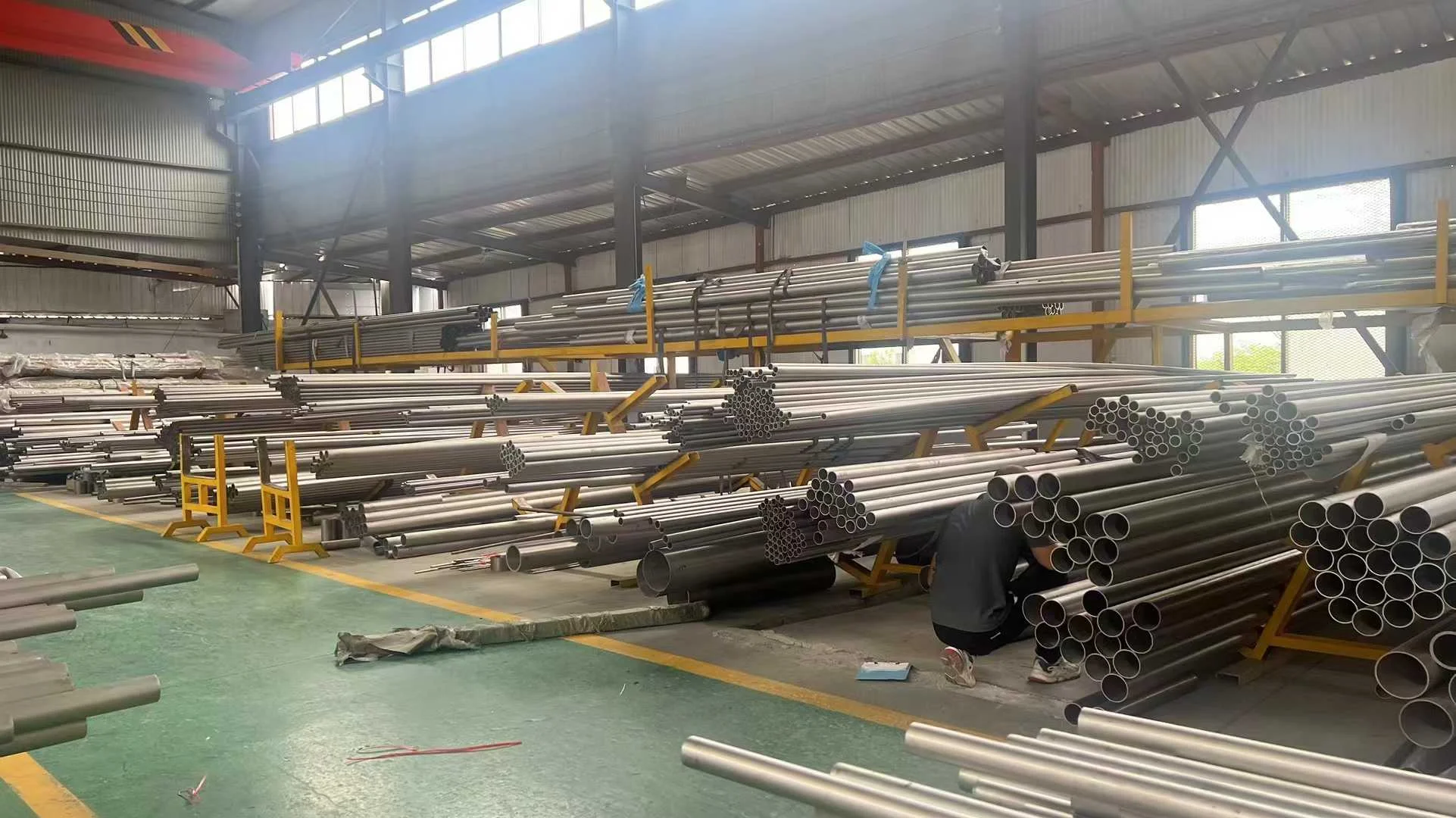
A seamless tube is extruded or drawn from a solid billet — there is no longitudinal weld seam anywhere along the tube wall. That single structural difference matters enormously in high-pressure or corrosion-critical service.
Welded titanium tube is made by rolling flat strip into a cylinder and fusing the seam. It’s cheaper and faster to produce in standard sizes. But the weld zone is a metallurgical boundary — residual stress, slightly different grain structure, and potential micro-porosity all live there. In cyclic pressure service, or where crevice corrosion is a risk, that seam is the first place a tube fails.
Seamless tube eliminates that failure mode entirely. The wall is uniform in composition and microstructure from OD to ID, end to end.
For heat exchanger bundles, offshore condensers, pharmaceutical process lines, and any application where a single tube failure means an unplanned shutdown, seamless is the specification that engineers reach for.
Typical dimensional range for ASTM B338 seamless tube:
- OD: 6.35 mm to 101.6 mm (¼ inch to 4 inch)
- Wall thickness: 0.5 mm to 6.35 mm
- Length: random (3–8 m) or cut-to-length per order
ASTM B338 Explained: The Standard That Governs Heat Exchanger Tube
ASTM B338 is the specification for Seamless and Welded Titanium and Titanium Alloy Tubes for Condensers and Heat Exchangers. It’s published by ASTM International and is the reference standard on virtually every heat exchanger datasheet that calls out titanium tube.
The standard covers:
- Grades: 1, 2, 3, 5, 7, 9, 11, 12, 26, 28 (and a few others)
- Tube types: seamless (Type S) and welded (Type W), with welded-and-drawn (Type WD) as a third option
- Mechanical property requirements by grade
- Dimensional tolerances for OD, wall thickness, straightness, and length
- Test requirements: flattening test, flaring test, hydrostatic or nondestructive electric test
- Certification and marking requirements
When a purchase order says “ASTM B338, Grade 2, Type S,” that string tells the mill exactly what to produce and test. Any deviation — wrong grade chemistry, missed mechanical property, failed flattening test — is a non-conformance that must be documented or the material is rejected.
Key Dimensional Tolerances Under B338
| Dimension | Tolerance |
|---|---|
| OD (≤ 25.4 mm) | ±0.13 mm |
| OD (> 25.4 mm) | ±0.25 mm |
| Wall thickness | ±12.5% of nominal |
| Straightness | 3.2 mm per 1500 mm |
| Length (cut-to-length) | +6.4 mm / −0 mm |
These tolerances feed directly into your heat exchanger tube sheet design. If your tube sheet holes are drilled to a tight fit, verify the OD tolerance class upfront — tighter tolerance tubes are available but cost more.
Grade Comparison: Grade 1, Grade 2, and Grade 9
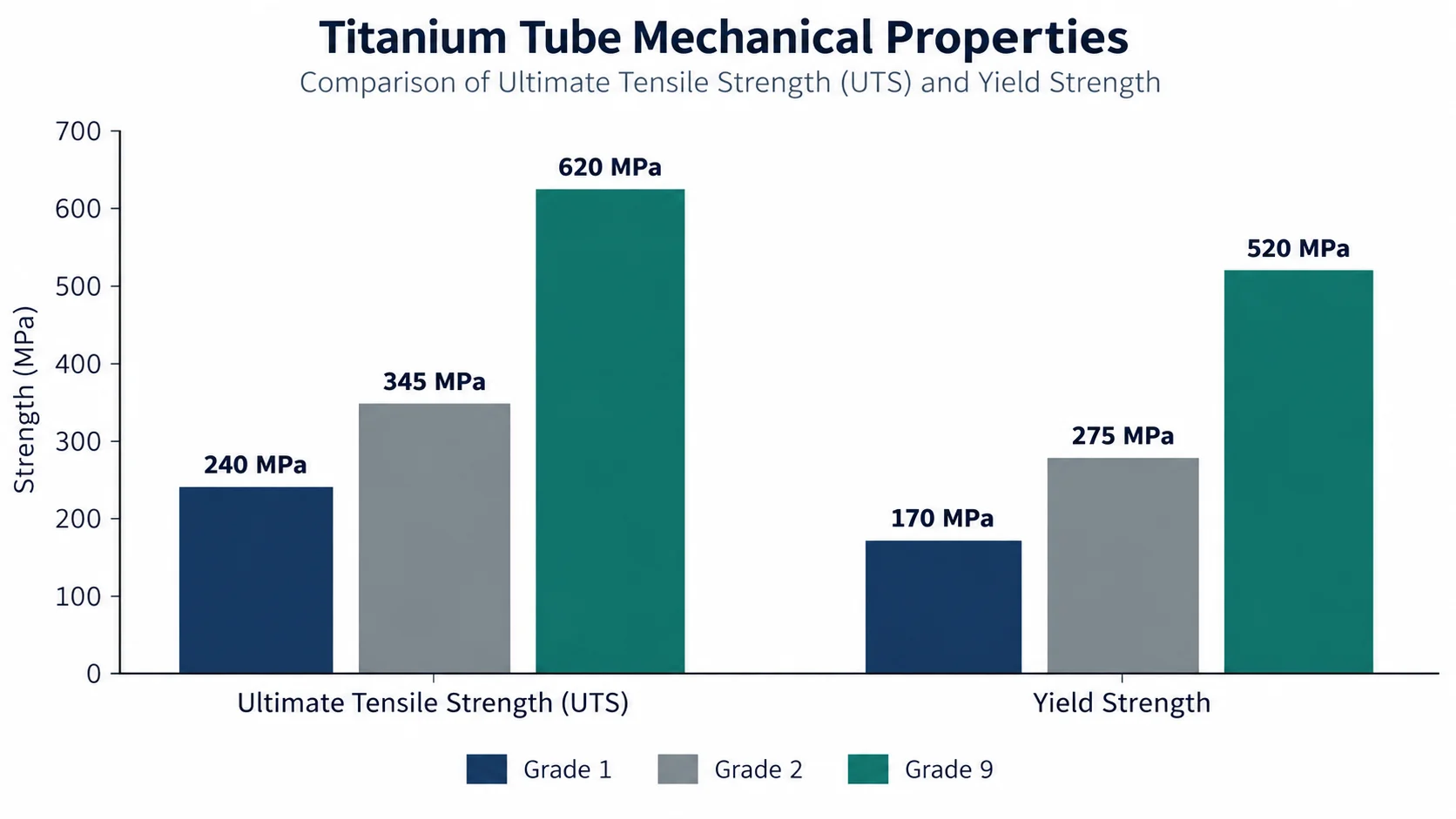
Most heat exchanger specifications default to Grade 2. But depending on operating conditions, Grade 1 or Grade 9 may be more appropriate. Here’s how they compare:
| Property | Grade 1 (CP-Ti) | Grade 2 (CP-Ti) | Grade 9 (Ti-3Al-2.5V) |
|---|---|---|---|
| UTS (min) | 240 MPa | 345 MPa | 620 MPa |
| Yield Strength (min) | 170 MPa | 275 MPa | 520 MPa |
| Elongation (min) | 24% | 20% | 15% |
| Corrosion resistance | Excellent | Excellent | Good (less than G1/G2) |
| Formability | Highest | High | Moderate |
| Cost (relative) | Lowest | Low-mid | Higher |
| Typical use | Thin-wall, high-formability | Heat exchangers, chemical | Aerospace, hydraulic lines |
Grade 2 is the workhorse. It balances corrosion resistance, mechanical strength, and cost for the majority of chemical process and marine heat exchanger applications.
Grade 1 is specified when the tube needs maximum ductility — for example, thin-wall tubes that undergo significant expansion during tube-to-tubesheet rolling. It also offers slightly better corrosion resistance in oxidizing acid environments.
Grade 9 (Ti-3Al-2.5V) is an alpha-beta alloy — stronger than commercial purity grades, but with lower corrosion resistance and higher price. It’s the standard for aerospace hydraulic tubing and bicycle frames, not the first choice for wet chemical service.
Other grades worth knowing:
- Grade 7: Grade 2 + 0.12–0.25% palladium. Dramatically improved resistance to reducing acids (HCl, H₂SO₄ at high temperature). Specified when Grade 2 would corrode.
- Grade 12: Grade 2 + molybdenum + nickel. Crevice corrosion resistance better than Grade 2, used in seawater and hot brine.
Where Titanium Seamless Tube Is Used
Heat exchangers and condensers account for the largest volume of ASTM B338 tube consumption. Titanium’s resistance to seawater, brine, chlorides, and most industrial acids makes it the material of choice when stainless steel fails prematurely. A power plant cooling water condenser that runs 20+ years on titanium tube would cycle through multiple stainless steel bundles in the same timeframe.
Chemical processing — pharmaceutical, chlor-alkali, fertilizer, and petrochemical plants all have process streams that attack stainless and copper alloys. Titanium tube handles hypochlorite, dilute sulfuric acid, and organic acids that would destroy other metals.
Desalination — multi-stage flash (MSF) and multi-effect distillation (MED) plants use titanium tube extensively in brine heaters and heat recovery sections. The combination of elevated temperature, high chloride concentration, and thermal cycling is exactly where titanium earns its premium.
Aerospace and defense — hydraulic lines, fuel systems, and structural tubing use Grade 9 and Grade 5 (Ti-6Al-4V) seamless tube where weight savings justify the cost.
Medical and semiconductor — high-purity applications where contamination from iron or nickel would be catastrophic.
How to Specify and Order Titanium Seamless Tube
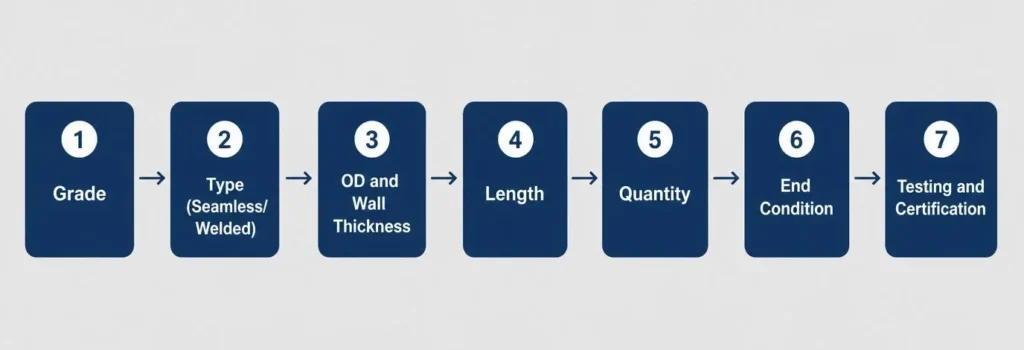
Placing a clear PO requires seven pieces of information. Missing any one of them leads to clarification requests and delays.
Step 1: Grade
Specify the ASTM B338 grade. “Grade 2” is correct. “Commercially pure titanium” alone is not a specification.
Step 2: Type
Seamless = Type S. Welded = Type W. If you need seamless, say so explicitly — some suppliers quote welded by default when seamless isn’t specified.
Step 3: OD and Wall Thickness
State OD × wall thickness in mm or inches. Example: 19.05 mm OD × 1.24 mm wall. If you’re working from a tube sheet drawing, confirm the OD tolerance class you need.
Step 4: Length
Random length (typically 3–8 m, mill discretion) is cheaper. Cut-to-length (exact dimension with tolerance) adds cost but saves shop labor.
Step 5: Quantity
State quantity in pieces or kg. For heat exchanger procurement, pieces × length is clearest. Mills typically have minimum order quantities — for uncommon sizes, 100–500 kg MOQ is common.
Step 6: End Condition
Plain ends (cut, no bevel) are standard. Square-cut ends, chamfered ends, or specific finish (bright annealed, pickled) must be called out.
Step 7: Testing and Certification
Specify which tests you require:
- Hydrostatic test or nondestructive electric test (NDET) — B338 allows either
- Mill Test Report (MTR/CMTR) — always required; certifies chemistry and mechanical properties
- Third-party inspection — required for nuclear, offshore, or defense procurement
A complete line item looks like this:
ASTM B338, Grade 2, Type S, 19.05 mm OD × 1.24 mm wall, 6000 mm cut-to-length ±3 mm, plain ends, NDET tested, MTR required. Qty: 200 pcs.
What to Verify Before Releasing the PO
1. Mill Test Report (MTR) format
The MTR must show heat number, chemistry analysis (matching B338 Grade 2 limits), and mechanical test results from the same heat. A generic certificate without heat traceability is not acceptable for most industrial applications.
2. Country of origin and mill certifications
Many projects (nuclear, defense, certain petrochemical) specify approved mills. Verify the supplier can provide tubes from a qualified source. Reputable suppliers like HonTitan can provide documentation linking each batch to the originating mill.
3. Dimensional inspection report
For tight-tolerance applications, request a dimensional inspection report (OD, wall, straightness per tube or per lot). Some suppliers include this; others charge extra.
4. Lead time — stock vs. custom
- Stock sizes (common ODs in Grade 2): typically 1–2 weeks
- Custom sizes or less-common grades: 4–8 weeks from mill
- Grades 7, 12, or alloys (Grade 9, Grade 5): 6–12 weeks is realistic; plan accordingly
5. Packaging
Titanium tube scratches and oxidizes at surface contact points. Proper packaging — end caps, inter-layer separators, bundled with no metal-to-metal contact — matters for long shipments. Clarify packaging spec before order if the application is appearance-critical or involves thin walls.
6. Price per kg vs. per piece
Get both. Price per kg is standard for trading, but price per piece is what your budget needs. Confirm whether the quoted price includes cut-to-length or only random length.
FAQ
What is the difference between ASTM B338 and ASTM B337?
B338 covers tubes for heat exchangers and condensers. B337 covers seamless and welded tubes for general service (pipe-like applications with higher working pressures). They share similar grade coverage but have different dimensional, testing, and application scopes. Specify the correct standard for your application — a heat exchanger engineer should use B338.
Can I use Grade 2 titanium tube for seawater service?
Yes — Grade 2 has excellent resistance to seawater, brackish water, and most chloride environments at temperatures up to roughly 130°C. For elevated-temperature brine or crevice-prone geometries, Grade 12 (with Mo+Ni additions) offers better crevice corrosion resistance and is worth the modest price premium.
What wall thickness should I specify for a shell-and-tube heat exchanger?
The most common wall for heat exchanger service is 0.7 mm to 1.65 mm (0.028″ to 0.065″ BWG). TEMA standards give minimum wall recommendations based on tube OD and design pressure. For most cooling water service at moderate pressure, 0.7 mm or 0.9 mm wall in a 19.05 mm OD tube is the standard starting point.
How do I verify that titanium tube is actually titanium and not a substitution?
Request the MTR and cross-check the heat number against the physical markings on the tube. For critical applications, XRF (X-ray fluorescence) spot-testing is a fast, non-destructive way to confirm alloy identity at incoming inspection. Some project specifications require third-party verification.
What is the lead time for small quantities of ASTM B338 Grade 2 tube?
Distributors who stock common sizes (typically 6.35 mm to 25.4 mm OD in standard wall) can ship within 1–2 weeks. For non-stock sizes, less common grades, or cut-to-length requirements, plan for 4–8 weeks from a mill order. Grade 7 and Grade 12 typically run 6–10 weeks.
Spec It Right the First Time
Titanium seamless tube is not a commodity buy — a wrong grade, missed tolerance, or untraceable certificate can mean a rejected bundle and a four-week delay at the worst possible moment in a project schedule.
The framework is straightforward: know your service conditions, pick the right grade, write a complete line-item specification, and require full traceability documentation before the material ships. Whether you’re sourcing 50 pieces for a pilot heat exchanger or 5,000 pieces for a full bundle replacement, the same discipline applies.
For Grade 2 seamless tube, budget $30–$80/kg depending on wall thickness, OD, quantity, and cut-to-length requirements. Thin-wall small-diameter tube sits at the higher end; large-OD thick-wall orders at volume pull the price down. Get quotes with MTR included — if a supplier can’t provide that, move on.
Suppliers who specialize in titanium industrial tube — such as HonTitan — can advise on grade equivalencies, available stock sizes, and documentation packages for specific project requirements.