Titanium has moved from aerospace and medical implants into fine jewelry over the past two decades — and for good reason. It weighs roughly 60% less than gold and 78% less than platinum, resists corrosion and skin reactions, and can be anodized into a spectrum of colors impossible with precious metals. Manufacturing titanium jewelry requires CNC machining rather than traditional casting, and the choice of alloy grade (Grade 1, 2, 5, or 23) directly determines what’s possible in terms of finish, forming, and biocompatibility. This guide covers the full manufacturing process, a data-backed comparison with gold and platinum, and an honest look at where titanium falls short — written for jewelry manufacturers, OEM buyers, and product developers evaluating titanium as a material category.
What Makes Titanium a Viable Fine Jewelry Material?
Titanium’s case for fine jewelry comes down to three properties that precious metals simply can’t match: weight, biocompatibility, and color versatility through anodizing.
Titanium (Ti, atomic number 22) has a density of approximately 4.51 g/cm³ — compared to 18K gold at ~15.5 g/cm³ and pure platinum at 21.45 g/cm³ (Pt-950 alloy: ~20.1 g/cm³). A titanium ring of identical geometry to a platinum ring weighs roughly 78% less. For everyday wearers, particularly with larger statement pieces or long-wear medical jewelry, that difference is immediately perceptible.
The biocompatibility story is backed by ISO 10993-1 (Biological Evaluation of Medical Devices), under which commercially pure titanium and Ti-6Al-4V ELI (Grade 23) are classified as biocompatible materials. This is why implant-grade titanium is the default material for surgical piercing jewelry — it produces no nickel leaching and minimal inflammatory response even in healing tissue.
Then there’s anodizing. By passing an electrical current through titanium in an electrolytic bath, the surface oxide layer thickens and creates structural color through light interference — no dyes, no coatings. Voltage controls color: approximately 15–20V yields gold tones, 40–50V produces blue and purple, and 100V+ pushes into the green-pink range. No other common jewelry metal offers this without external coating.
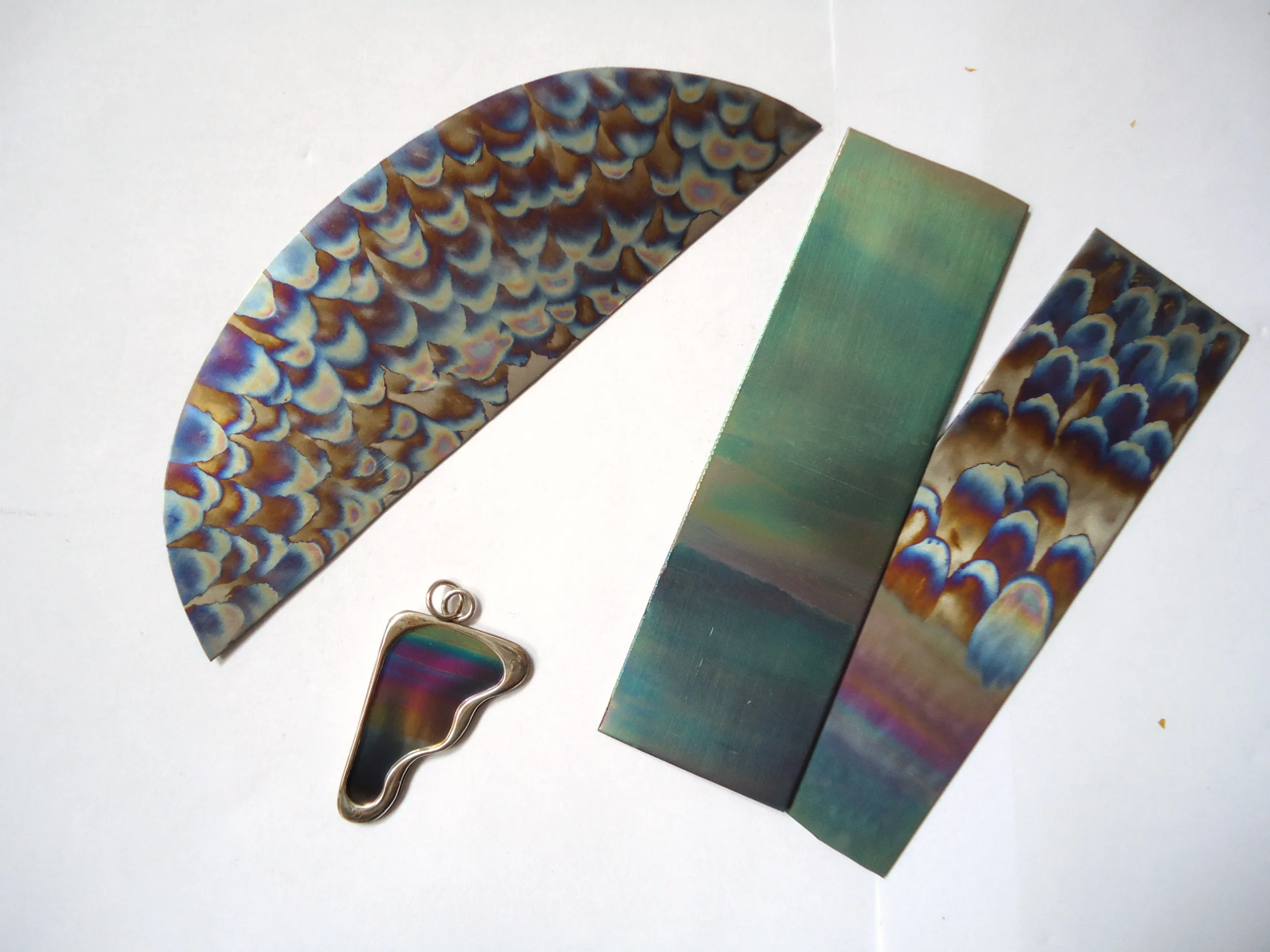
Anodized titanium jewelry by Mauro Cateb (CC BY-SA 2.0, Wikimedia Commons)
Titanium Alloy Grades for Jewelry: Which One to Use?
Not all titanium is equal — the grade you specify determines machinability, strength, formability, and whether a piece can be marketed as implant-grade.
| Grade | Designation | Composition | Hardness (Vickers) | Best Use in Jewelry |
|---|---|---|---|---|
| Grade 1 | CP-Ti (commercially pure) | 99.5% Ti | ~120 HV | Delicate wire work, thin sheet forming |
| Grade 2 | CP-Ti | 99.2% Ti | ~145 HV | General jewelry, anodized pieces, affordable option |
| Grade 5 | Ti-6Al-4V | 90% Ti, 6% Al, 4% V | ~310 HV | High-strength rings, structural components |
| Grade 23 | Ti-6Al-4V ELI | Same as Grade 5, lower interstitials | ~295 HV | Implant-grade body jewelry, medical-adjacent pieces |
Grade 2 is the industry workhorse for decorative titanium jewelry — soft enough to machine efficiently, anodizes cleanly, and priced accessibly. Grade 23 commands a premium and is the standard for body jewelry that contacts healing tissue. Grade 5 is used where structural integrity matters more than formability, though it anodizes less predictably than Grade 2.
One nuance that trips up first-time titanium buyers: Grade 5 contains aluminum and vanadium. In standard concentrations these are not biologically problematic for intact skin, but if you’re sourcing for a brand positioning around “implant safe” or marketing to the piercing market, Grade 23 (ELI — Extra Low Interstitials) is the correct specification to require from your supplier.
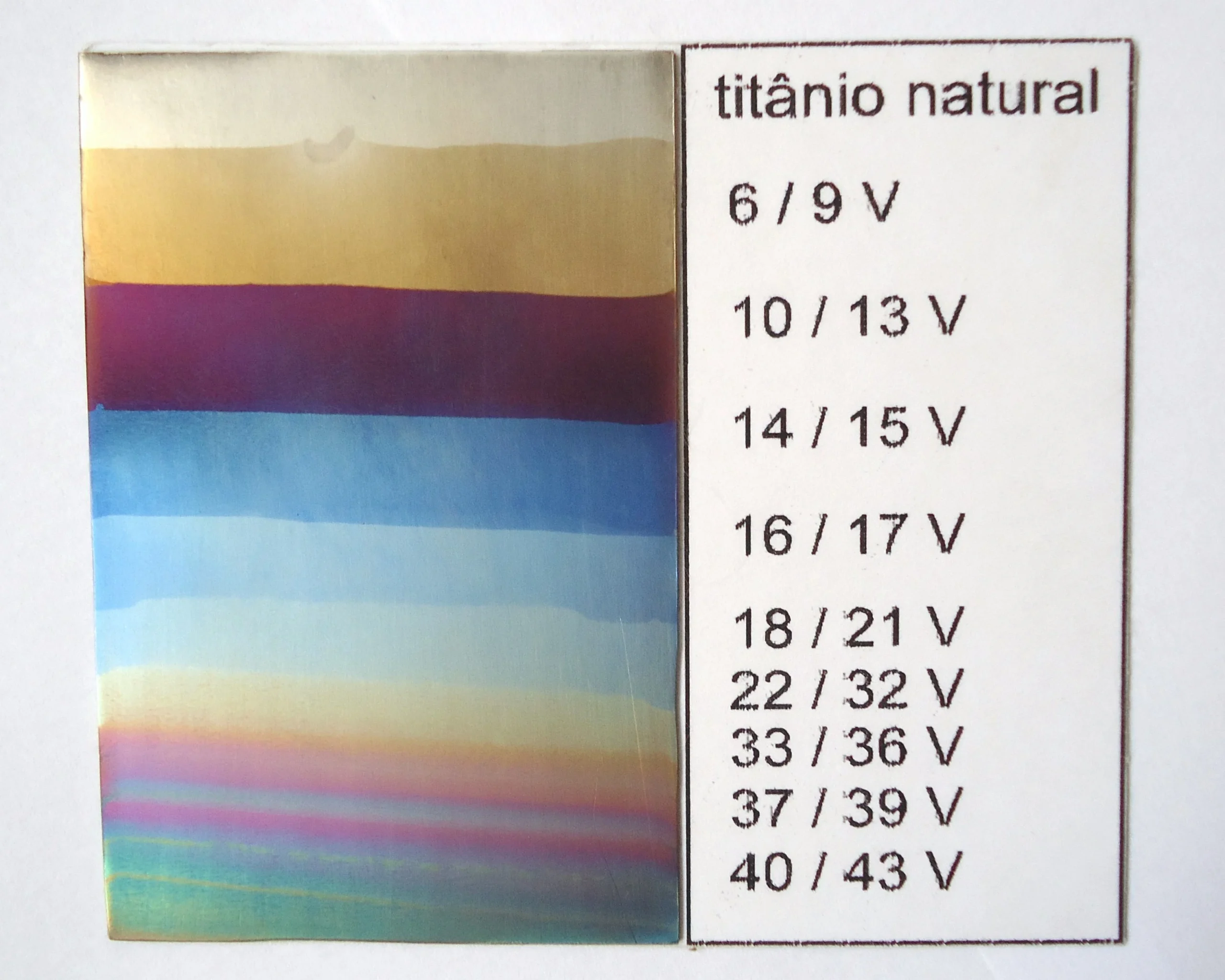
Voltage-to-color relationship for anodized titanium — by Mauro Cateb (CC BY-SA 2.0, Wikimedia Commons)
How Titanium Jewelry Is Manufactured: The Process Step by Step
Titanium cannot be cast using traditional lost-wax methods — its reactivity at high temperatures means it absorbs oxygen and becomes brittle. Every piece starts from bar stock, tube, or sheet.
Step 1: Design and CAD Modeling
Titanium jewelry almost always begins with CAD. Because subtractive machining is the dominant production method, tolerances need to be dialed in before any metal is touched. For rings, the standard starting form is titanium tube stock (outer diameter slightly larger than finished size, inner diameter slightly smaller).
Step 2: CNC Turning and Milling
A CNC lathe turns the ring to final outer profile and bores the inner diameter to size. Titanium work-hardens quickly — cutting speeds are typically 30–60% slower than for stainless steel, and carbide tooling is mandatory. Flood coolant prevents built-up edge (where titanium welds to the cutting tool). This is the step where most manufacturers unfamiliar with titanium run into trouble: running it like stainless steel burns tools and produces poor surface finish.
Step 3: Finishing — Polishing and Surface Texture
Titanium takes a mirror polish well, though it requires more passes than gold. Brushed (satin) and blasted finishes are common. One advantage: because titanium is harder than gold, a brushed finish holds up significantly longer in daily wear without repolishing.
Step 4: Stone Setting (Where It Gets Complicated)
Prong setting in titanium requires precision machining rather than hand-forming — titanium’s spring-back and hardness make hand-bending prongs impractical. Most titanium pieces with stones use bezel settings (full or partial) machined directly into the design. Flush/gypsy settings are also viable via CNC. Traditional prong setting as practiced with gold is not directly transferable to titanium — this is one of the material’s real limitations for complex fine jewelry applications.
Step 5: Anodizing
Anodizing is titanium’s unique finishing capability. The piece is cleaned, then connected as the anode in a dilute electrolytic solution (often TSP or ammonium sulfate). Voltage is ramped up precisely to achieve target color. The entire process produces no coating — only a thickened oxide layer — so there’s nothing to chip or peel. Colors are permanent under normal wear conditions.
Step 6: Quality Control
Dimensional check against CAD spec, surface inspection under 10× loupe, anodizing uniformity check. For implant-grade pieces destined for the body jewelry market, material certification traceability (mill cert confirming Grade 23 spec) should be standard.
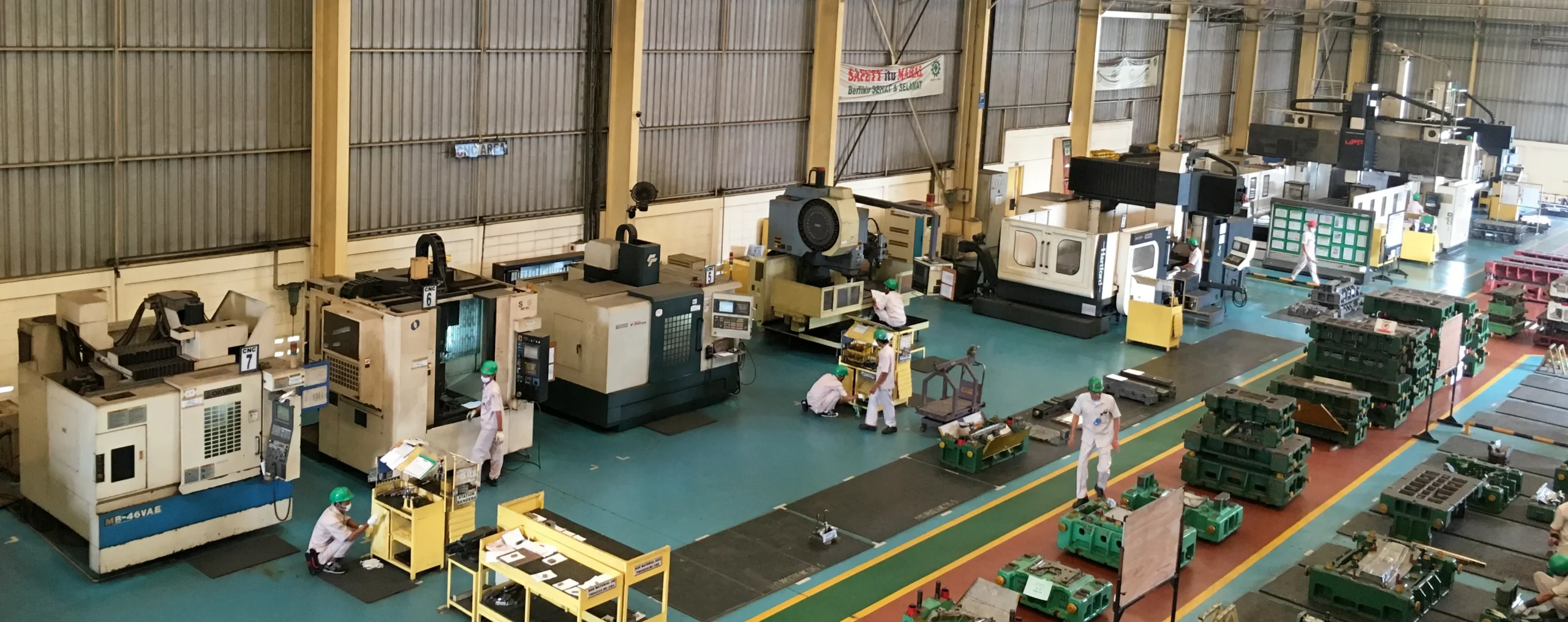
CNC machine facility (CC BY-SA 3.0, Wikimedia Commons)
Titanium vs Gold vs Platinum: A Direct Material Comparison
Here’s the data-backed comparison most jewelry sourcing articles skip.
| Property | Titanium (Grade 2) | 14K Gold | 18K Gold | Platinum (950) |
|---|---|---|---|---|
| Density (g/cm³) | 4.51 | 13.0 | 15.5 | 20.1 |
| Vickers Hardness | ~145 HV | ~120 HV (annealed) | ~100 HV (annealed) | ~120–130 HV (annealed) |
| Melting Point (°C) | 1,668 | ~874 (varies by alloy) | ~904 (varies by alloy) | 1,768 |
| Biocompatibility | ISO 10993-1 certified | Varies (alloy-dependent) | Varies | Generally good |
| Resizable? | No (standard) | Yes | Yes | Yes |
| Color options | Natural + anodized spectrum | Yellow, white, rose (alloy) | Yellow, white, rose | White/silver only |
| Approx. material cost (per gram, 2025) | ~$0.05–0.15 | ~$60–65 | ~$60–65 | ~$30–35 |
| Castable? | No (vacuum required) | Yes | Yes | Yes |
A few things stand out from this table:
Weight: A 10g platinum ring becomes a 2.2g titanium ring of identical geometry. For wide-band wedding rings and statement pieces, this weight difference defines how the piece feels on the hand.
Cost: Material cost is not where titanium saves money — at a few cents per gram, the raw material is trivially cheap compared to gold or platinum. The cost difference comes from not needing to account for precious metal loss during manufacturing. You can charge a premium on titanium jewelry based on engineering complexity and finish, not material weight.
Hardness: Titanium is harder than 18K gold and platinum in everyday wear scenarios. This translates to better scratch resistance over time — particularly relevant for men’s wedding bands that see daily physical work.
Machinability: Titanium’s melting point (1,668°C) is actually lower than platinum (1,768°C), but its chemical reactivity and work-hardening behavior make vacuum casting necessary when casting is attempted at all. Most manufacturers avoid casting titanium altogether and use CNC exclusively.
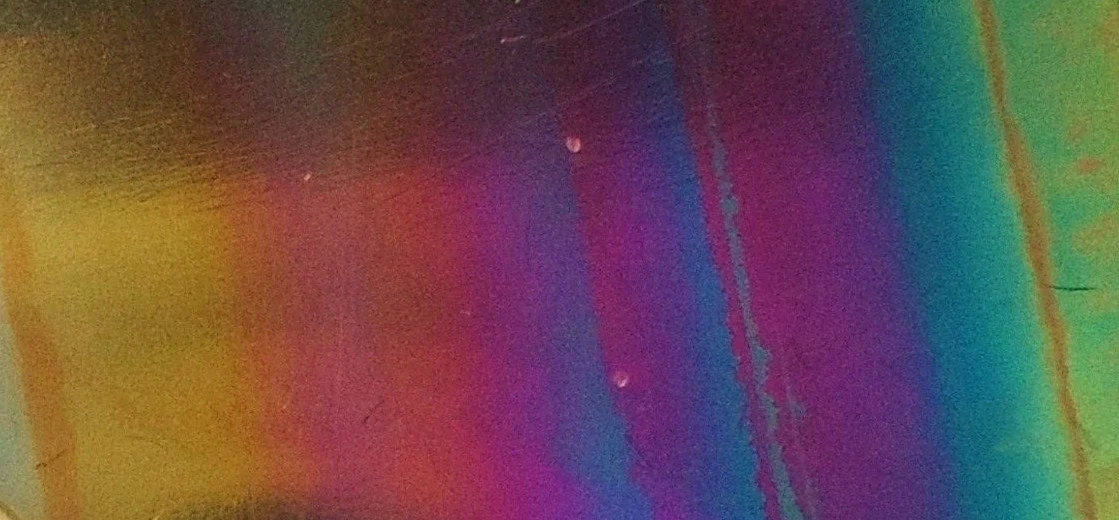
Anodized titanium close-up — Mauro Cateb (CC BY-SA 2.0, Wikimedia Commons)
Where Titanium Falls Short: An Honest Assessment
Titanium’s limitations are real, and understanding them upfront prevents sourcing regret.
The Resize Problem
This is the single biggest complaint across every consumer forum and Reddit thread on titanium rings. Because titanium cannot be soldered or easily stretched/compressed at room temperature, standard ring resizing is not possible. The solution most manufacturers offer is to remake the ring — which means keeping accurate records of the customer’s size at purchase. For B2B buyers producing a retail line, this has customer service implications that need to be built into the return/exchange policy.
Some manufacturers offer a “sizing bar” insert for rings sized slightly large, but this is a workaround, not a true resize. Comfort-fit profiles (slightly domed interior) help accommodate minor size variations.
Gemstone Setting Limitations
As noted above, complex prong settings are not compatible with standard jewelry-making hand techniques. If your product line requires cathedral settings, pave, or intricate filigree prong work, titanium either requires full CNC execution (expensive per piece) or isn’t the right material. Bezel and flush settings are titanium’s natural territory.
Perception vs. Precious Metal Status
Titanium is not classified as a precious metal. In markets where jewelry is purchased as an investment asset or status signal (particularly parts of Asia and the Middle East), titanium’s low material cost can undermine perceived value — regardless of workmanship. For B2B buyers targeting those markets, titanium may be better positioned as a secondary category rather than a flagship material.
Limited Repair Options
Scratches on titanium can be re-polished, but deeper damage (dents, bent shanks) is difficult to repair without specialized equipment. Unlike gold, you can’t just anneal it at the bench and reshape. For a retail-facing business, this means managing customer expectations on repairability.
B2B Sourcing Considerations: Who Should Add Titanium to Their Line?
Titanium makes the most commercial sense for specific product categories and buyer profiles — not every jewelry brand needs it.
Strong fit:
- Men’s wedding band manufacturers (weight + durability + price positioning)
- Body jewelry / piercing jewelry brands (Grade 23 implant standard is table stakes here)
- Outdoor/active lifestyle jewelry (corrosion resistance, scratch resistance)
- Medical-adjacent jewelry (post-surgical, MRI-compatible — titanium is non-ferromagnetic)
- Contemporary/minimalist brands where anodized color is a design differentiator
Weaker fit:
- Traditional fine jewelry with complex stone settings
- Markets where jewelry serves as an asset/investment
- Brands without CNC manufacturing capability or supplier relationships with machine shops
When sourcing titanium jewelry from a manufacturer, verify: (1) material certification for the stated grade, (2) whether anodizing is done in-house or outsourced, and (3) the manufacturer’s experience with your target surface finish. Ask for sample pieces with and without anodizing before committing to a production run.
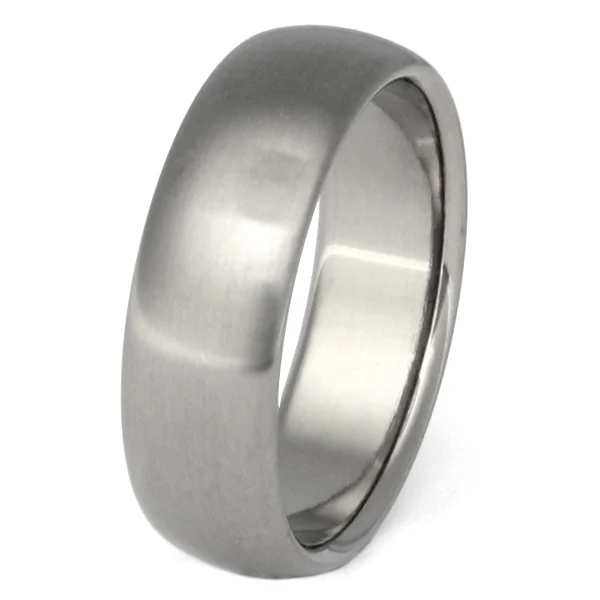
Titanium wedding band (CC0, Wikimedia Commons)
Frequently Asked Questions
Is titanium considered fine jewelry?
Technically, “fine jewelry” traditionally refers to pieces made from precious metals (gold, silver, platinum). Titanium does not qualify under that definition. However, the industry has increasingly adopted “contemporary fine jewelry” or “alternative metal fine jewelry” to describe high-quality titanium pieces — particularly in the men’s wedding band segment. The craftsmanship and finish standards can absolutely match fine jewelry, even if the material classification differs.
Which titanium grade is best for jewelry?
For most decorative jewelry: Grade 2 (commercially pure titanium) — it anodizes cleanly and machines well. For body jewelry or pieces contacting healing tissue: Grade 23 (Ti-6Al-4V ELI) — the implant-grade standard. For maximum strength in structural components: Grade 5 (Ti-6Al-4V), though it anodizes less predictably.
Can titanium rings be resized?
Not through standard jeweler methods. Titanium cannot be soldered or thermally resized like gold or platinum. Most manufacturers handle size changes by remaking the ring. This is a real limitation that should be communicated clearly at point of sale.
How does titanium jewelry hold up over 5+ years?
Well, in most respects. The metal itself resists corrosion, tarnish, and deformation better than gold at equivalent hardness. Anodized colors can fade slightly with heavy abrasion over years (the oxide layer is still there, just thinned), and mirror-polished surfaces will acquire fine scratches. A re-polish restores the surface. Users on Reddit’s r/jewelry and r/weddingring report titanium bands looking essentially the same after 5–10 years of daily wear with minimal maintenance.
Is titanium jewelry hypoallergenic?
Commercially pure titanium and Grade 23 are effectively nickel-free and produce minimal allergic response in nearly all users. ISO 10993-1 classifies these grades as biocompatible for body contact. This makes titanium one of the safest jewelry metals for sensitive-skin wearers — better than white gold (which typically contains nickel alloys) and on par with platinum in this respect.
What’s the price difference between titanium and gold jewelry for the same design?
The material cost difference is dramatic (titanium costs pennies per gram vs. $60+ for gold), but manufacturing complexity partially offsets this. A CNC-machined titanium ring might cost $15–40 in fabrication for a comparable form that costs $200+ in gold materials alone. The manufacturing cost structures are different rather than simply cheaper.
Conclusion: Titanium’s Place in the Modern Jewelry Industry
Titanium isn’t trying to replace gold or platinum — and it doesn’t need to. What it offers is a materially different proposition: extreme lightness, certified biocompatibility, manufacturing precision, and color versatility through anodizing that precious metals simply cannot replicate. For the right product categories — men’s bands, body jewelry, medical-adjacent pieces, lifestyle-oriented contemporary jewelry — titanium is genuinely the better material, not just the cheaper one.
The manufacturing shift it requires is real. You need CNC capability, carbide tooling, and a supplier who understands grade differences and anodizing chemistry. But manufacturers who’ve made that transition consistently report that titanium opens design possibilities — particularly in color and geometric precision — that are impossible or prohibitively expensive with gold or platinum.
The resize limitation and the perception gap in certain markets are legitimate. Any serious B2B buyer should plan around them, not ignore them. But for the categories where titanium fits, the combination of functional performance and design flexibility is genuinely hard to match.