Sourcing titanium heat exchanger tubes — especially Grade 2 U-bend or straight condenser tubes — requires more than finding the lowest price per meter. This guide covers grade selection (Gr2 vs Gr7 vs Gr12), ASTM B338 compliance, U-bend procurement specifics, and the supplier qualification steps that separate a 20-year tube bundle from one that fails in five. Whether you’re in chemical processing, power generation, or desalination, these are the specs and questions that matter before you issue an RFQ.
Why Procurement Teams Get Grade Selection Wrong
Grade 2 titanium is the default recommendation for most heat exchanger tube applications, but that shorthand gets misapplied constantly. I’ve seen procurement teams over-specify Grade 7 when Gr2 was the right call — and then absorb a 30–40% cost premium for zero practical benefit. The reverse happens too: engineers defaulting to Gr2 in chloride-concentrated or under-deposit-corrosion environments where Grade 12 would have been the cost-effective, long-life choice.
The grade decision should start with the fluid chemistry, not the price list. Here’s the framework that metallurgists at firms like Tricor Metals actually use.
| Titanium Grade | Composition | Tensile Strength | Best For | Not Ideal For |
|---|---|---|---|---|
| Grade 1 | Commercially pure (CP), lowest O₂ | ~240 MPa | Plate & frame exchangers, low-pressure | Shell & tube requiring structural strength |
| Grade 2 | CP titanium (UNS R50400) | 485 MPa UTS / 345 MPa yield | General chemical, seawater, steam, chloride service | High-temp crevice environments (>80°C seawater) |
| Grade 7 | Gr2 + 0.12–0.25% palladium | Equivalent to Gr2 | Reducing acid environments, enhanced crevice resistance | Cost-sensitive general service (premium for Pd) |
| Grade 9 | Ti-3Al-2.5V | ~620 MPa | High-strength applications, weight-critical | When max corrosion resistance is needed |
| Grade 12 | Ti + 0.3% Mo + 0.8% Ni | Higher than Gr2 | Crevice corrosion, under-deposit, elevated-temp seawater | General service (cost premium over Gr2) |
Source: ASTM B338-17(2021); Chuck Young, Metallurgist, Tricor Metals (Heat Exchanger World, 2021)
The practical rule: For most chemical processing, power plant condensers, and seawater cooling applications, Grade 2 is the correct choice. It’s commercially pure titanium with a density of 4.51 g/cm³ (about 56% of steel), a minimum yield strength of 345 MPa, and thermal conductivity of approximately 21.97 W/mK. It’s immune to microbiologically induced corrosion (MIC) — a failure mode that has forced multiple facilities to replace duplex stainless steel bundles ahead of schedule.
The upgrade to Grade 7 or Grade 12 only makes sense when your process metallurgist specifically flags reducing acid exposure or concentrated crevice-corrosion risk. Don’t pay for palladium you don’t need.
ASTM B338: The Only Standard That Matters for Condenser Tube Procurement
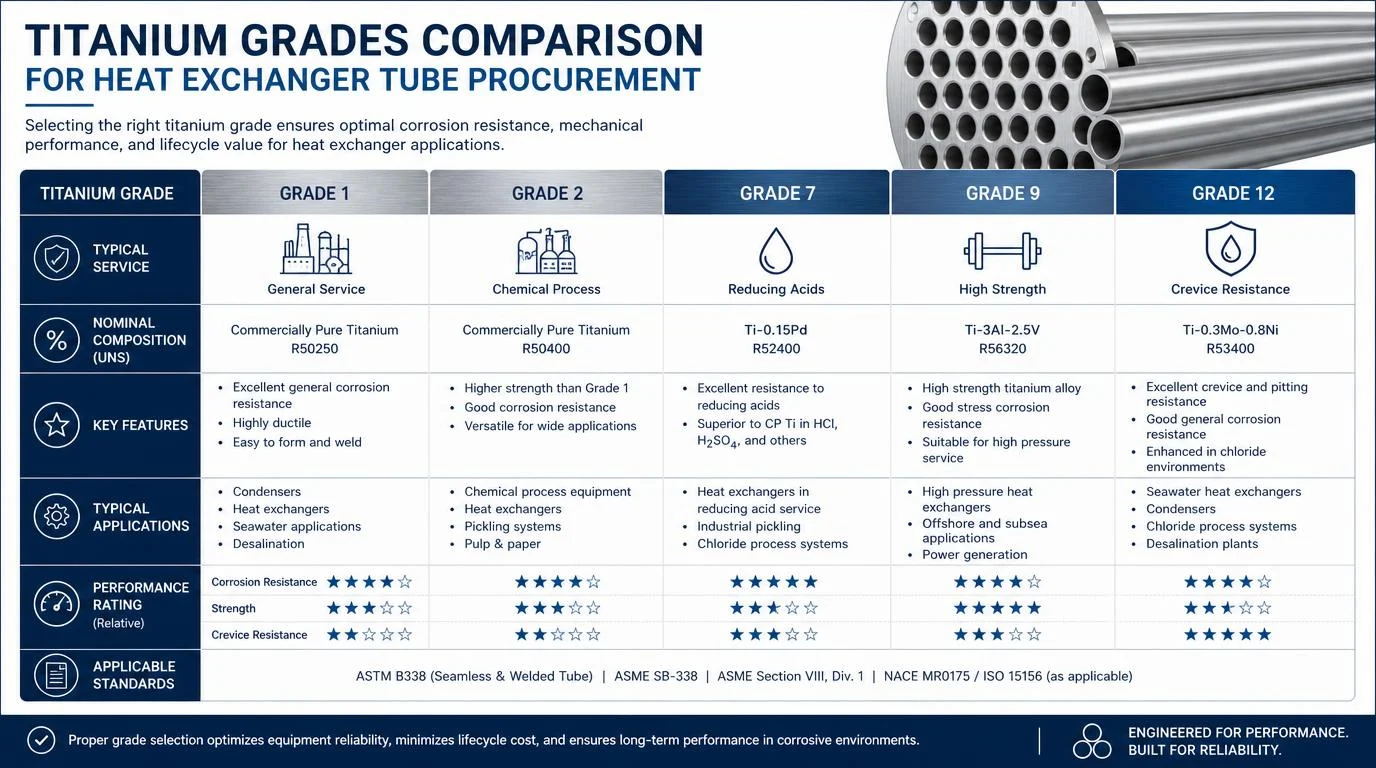
ASTM B338 is the governing specification for seamless and welded titanium and titanium alloy tubes used in surface condensers, evaporators, and heat exchangers. It covers 28 grades — but in practice, procurement conversations focus on Grades 1, 2, 7, 9, and 12.
When evaluating any titanium tube supplier, the minimum documentation you should demand is a Certified Material Test Report (CMTR) that references ASTM B338 and shows:
- Heat/lot number traceable to the mill
- Chemical composition (matching Table 1 of B338)
- Mechanical properties (tensile, yield, elongation)
- Hydrostatic or eddy current test result (Section 12 of B338)
- Visual inspection pass
The equivalent ASME code is SB-338, which mirrors B338 for pressure vessel applications. If your plant operates under ASME jurisdiction, confirm whether SB-338 dual certification is required on the CMTR.
One thing that regularly trips up procurement teams: Grade 2H. ASTM B338 includes Grade 2H, which is essentially Grade 2 with a minimum hardness requirement. It has identical chemical composition to Grade 2, but higher minimum UTS (483 MPa vs 345 MPa yield). Some heat exchanger designers specify 2H specifically for thin-wall tube applications where the Gr2 yield strength has insufficient safety factor. If your engineer’s drawing says “Gr2H,” make sure your supplier can pull that specific certification — not substitute plain Gr2.
Grade 2 Titanium U-Bend Tubes: What the Spec Sheet Doesn’t Tell You
U-bend tubes are a procurement category where the details get technical fast. A straight condenser tube and a U-bend for a floating-head heat exchanger have the same starting material, but the bend introduces mechanical and dimensional variables that affect both fitment and long-term performance.
Wall thinning on the outer radius: During cold bending, the outer radius of the bend experiences tensile stress and the wall thins. The accepted industry tolerance is typically ≤12.5% wall thinning on the outer radius — equivalent to the ASME B31.3 minimum wall formula. When ordering U-bend tubes, always specify the minimum wall thickness after bending, not just the nominal wall of the straight tube.
Bend radius (R/D ratio): The standard tight-radius U-bend for shell-and-tube heat exchangers is typically 1.5×D to 3×D. Tighter bends require annealing between bends. For Grade 2 specifically, the cold-forming ductility is excellent — elongation of ≥20% per ASTM B338 — which means 1.5×D bends are achievable without intermediate anneal on standard wall thicknesses. Confirm with your fabricator whether bends will be stress-relieved post-forming.
Ovality tolerance: Oval cross-sections at the bend will cause uneven contact at tube-to-tubesheet joints, a common source of crevice initiation. ASTM B338 specifies ovality tolerance in Section 9; suppliers should confirm compliance on U-bend sections specifically, not just on straight lengths.
The table below shows standard sizing ranges for Grade 2 U-bend condenser tubes available from established Chinese suppliers:
| OD (mm) | Wall Thickness (mm) | Standard Bend Radius | ASTM B338 Grade | Application |
|---|---|---|---|---|
| 19.05 (3/4″) | 0.7 – 1.24 | 1.5D – 3D | Gr2 | Power plant condensers |
| 25.4 (1″) | 1.0 – 1.65 | 2D – 3D | Gr2 | Chemical process coolers |
| 15.88 (5/8″) | 0.7 – 1.0 | 1.5D | Gr2 | Desalination, marine |
| 25.4 (1″) | 1.0 – 1.65 | 2D – 3D | Gr7 | Reducing acid service |
| 19.05 (3/4″) | 0.7 – 1.24 | 1.5D – 3D | Gr12 | Elevated-temp seawater |
The 5-Point Supplier Qualification Checklist
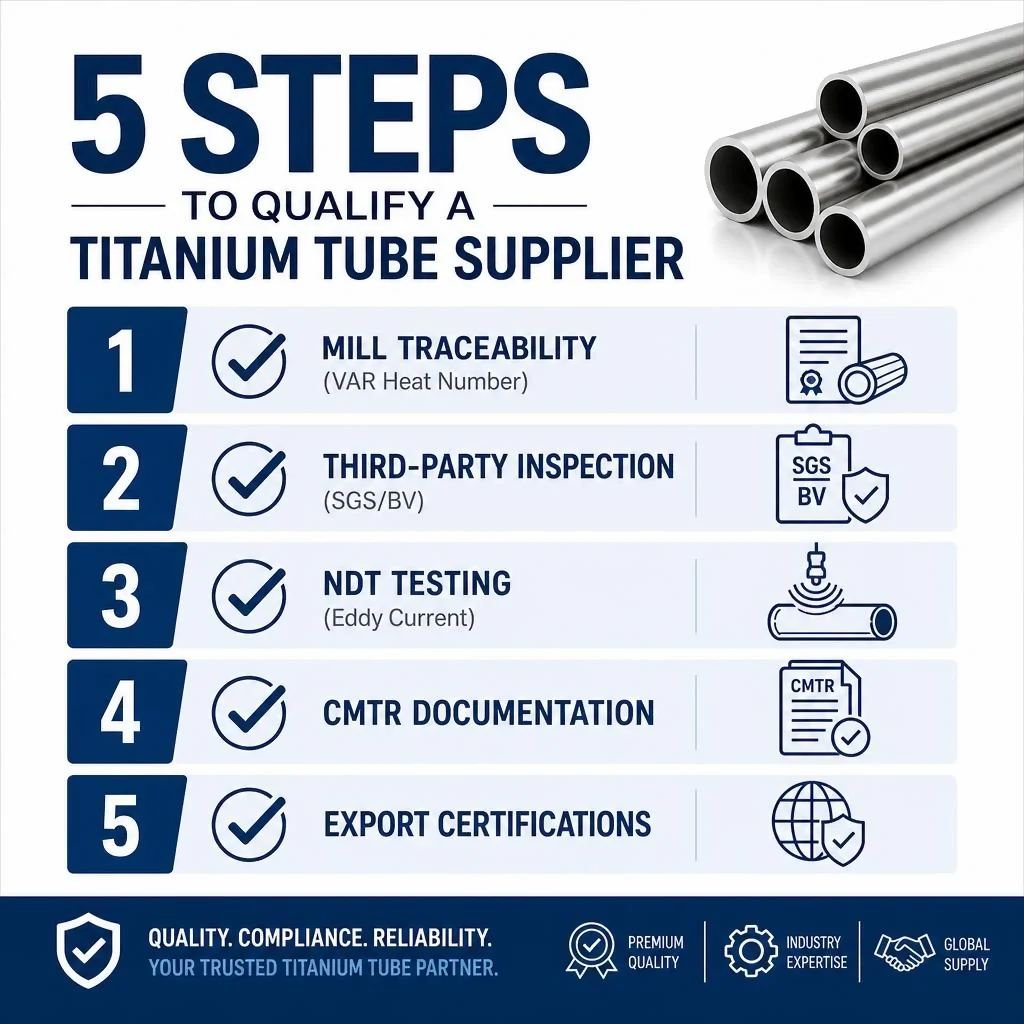
The difference between a reliable titanium heat exchanger tube source and a problematic one usually comes down to five verifiable checkpoints. Price is not one of them — it’s a downstream result.
1. Mill traceability
Every tube order should trace back to a specific smelting heat. Ask for the VAR (vacuum arc remelting) heat number and cross-reference it on the CMTR. Reputable Chinese mills — Baoji Titanium Industry, Western Metal Materials, AESHA — operate multi-ton VAR furnaces with documented traceability chains. If a supplier can’t provide heat-level traceability, stop there.
2. Third-party inspection availability
Acceptable programs: SGS, Bureau Veritas, TÜV, or Lloyd’s Register. For large procurement volumes (>500 meters), on-site third-party inspection at the mill before shipment is standard practice and should be budgeted in. The cost is typically <1% of the material value and avoids non-conformance disputes on arrival.
3. NDT capability
ASTM B338 Section 12 requires each tube to pass either hydrostatic testing or eddy current testing (or both, depending on the purchase order). Eddy current testing is preferred for thin-wall tubes because it catches subsurface discontinuities the hydro test misses. Confirm which NDT method your supplier uses, and ask for sample test records.
4. Dimensional and tolerance documentation
OD, wall thickness, and straightness tolerances should be documented per ASTM B338 Table 5 (wall) and Table 4 (OD). A compliant supplier will provide these without being asked. For U-bend tubes, also request ovality measurements at the bend apex.
5. Export certifications
For shipments to the US and EU: EN 10204 Type 3.1 or 3.2 inspection certificates are the standard. US buyers should also confirm whether the supplier holds any DFARS-compliant or import documentation for Section 232 tariff reporting.
HonTitan, based in Shaanxi, China with manufacturing partners in Baoji, provides ASTM B338 Grade 2 condenser tubes with EN 10204 3.1 certificates and full CMTR documentation. Their manufacturing base uses VAR furnaces and CNC processing, and they hold AS9100, ISO 13485, and REACH certifications — the same standard set demanded by aerospace and medical buyers, which significantly de-risks industrial procurement.
Wholesale vs Direct Mill: Pricing Structure and Lead Times
For procurement teams comparing wholesale distributors against direct mill sourcing, the cost-versus-lead-time tradeoff is real and worth mapping before RFQ.
Wholesale/trading (MOQ 50–200 kg):
- Faster delivery from in-stock inventory: typically 7–15 days
- Price range: $15–$40/meter for Gr2 straight tube (OD 19.05–25.4mm, wall 0.7–1.0mm)
- Limited customization (wall thickness, length, special tolerances)
- CMTR available but may not include mill-level heat traceability
Direct mill (MOQ 200–500 kg, or 100–200 meters):
- Lead time: 3–6 weeks for straight tube; 5–8 weeks for U-bends
- Price range: $10–$22/meter at volume for equivalent Gr2 specs
- Full documentation chain from VAR heat to finished tube
- Custom OD, wall, finish, and bending available
For tube bundle replacements in scheduled turnaround windows, the lead time determines which route is viable. If your maintenance window is 3 weeks out, wholesale stock is your only option. If you’re planning 2–3 months ahead, direct mill procurement delivers better documentation and typically lower cost at volume.
Application Matching: Which Titanium Grade for Your Industry?
The industrial case studies below represent commonly documented scenarios — not marketing claims.
Power plant surface condensers (seawater cooling):
Grade 2 is the standard choice. Titanium has been used in power plant condensers since the 1960s and effectively has a zero-corrosion-limit design philosophy, meaning wall thickness is not eroded over service life. A facility that upgraded from admiralty brass tubes to Gr2 titanium documented a service life increase from ~7 years to 30+ years with no re-tube. (Source: Industry consensus across Plymouth Tube / Tricor Metals technical literature.)
Chemical processing (chlorine, bleach, terephthalic acid):
Grade 2 handles oxidizing environments including wet chlorine gas and hypochlorite solutions. For reducing acid exposure (HCl, dilute H₂SO₄), Grade 7’s palladium addition provides significantly better resistance. When there is uncertainty about whether the process will ever cycle into reducing conditions, Grade 7 is specified as a conservative upgrade.
Desalination and marine:
Grade 2 is immune to seawater corrosion at temperatures below approximately 80°C. Above 80°C in concentrated chloride environments, crevice corrosion risk increases — a Gr2 limitation documented in peer-reviewed corrosion research (Romanovski et al., 2021, ScienceDirect). For high-temperature marine applications, Grade 12 provides crevice corrosion protection that Gr2 cannot guarantee.
Pharmaceutical and food processing:
Grade 2 is FDA-acceptable and inert to most CIP (clean-in-place) solutions. Its immunity to MIC makes it the preferred choice where bio-film formation is a risk — the bacteria that drives MIC in stainless steel have no mechanism to corrode passive titanium oxide.
The Real Cost of Getting It Wrong
A heat exchanger tube bundle failure is rarely just a materials cost. The hidden cost is the unplanned downtime: production loss, emergency contractor mobilization, expedited freight on replacement tubes. For a mid-size chemical plant, an unplanned heat exchanger outage can cost $100K–$1M per incident depending on process criticality.
The procurement decision to verify ASTM B338 compliance, demand heat-level CMTR documentation, and qualify suppliers against NDT capability typically adds <2% to the total material cost. It eliminates the tail risk that can multiply that cost by 50×.
When we evaluate a new titanium tube supplier — whether for straight condenser tubes or Grade 2 U-bends — the documentation package is the first filter, before any price discussion. A supplier that pushes back on providing Type 3.1 certificates or heat traceability is a supplier whose material cannot be trusted in a pressure boundary application.
Frequently Asked Questions
What is the difference between ASTM B338 and ASME SB-338?
ASTM B338 is the material specification published by ASTM International for titanium tubes used in heat exchangers and condensers. ASME SB-338 is ASME’s adopted version of the same specification, used specifically for pressure vessel and piping applications under the ASME Boiler and Pressure Vessel Code. The technical requirements are identical; the difference is the jurisdictional reference. US plants designed to ASME code typically require SB-338 on the CMTR.
Why is Grade 2 titanium the most common choice for heat exchanger tubes?
Grade 2 (UNS R50400) is commercially pure titanium. It combines the highest practical corrosion resistance for general industrial service with good mechanical properties (345 MPa yield strength, ≥20% elongation), excellent weldability, and the best cost-to-performance ratio among titanium grades. For the majority of heat exchanger applications — seawater cooling, steam heating, chemical service below 80°C — Gr2 is the appropriate specification. Higher grades like Gr7 or Gr12 add specific corrosion resistance for specific chemistries at higher cost.
How do I verify that titanium tubes are genuinely ASTM B338 Grade 2 and not a cheaper titanium or substitution?
Request a Certified Material Test Report (CMTR) with a heat number that traces back to the VAR (vacuum arc remelting) furnace record. The CMTR must show chemical composition within the B338 Table 1 limits for Grade 2: max 0.03% N, 0.10% C, 0.015% H, 0.30% Fe, 0.25% O, and Ti as balance. For critical applications, budget for third-party verification by SGS, Bureau Veritas, or equivalent at the mill before shipment.
What certifications should a Grade 2 titanium U-bend tube supplier have?
Minimum: ISO 9001 quality management and EN 10204 Type 3.1 inspection certificates. For supply chains that need broader validation: AS9100 (aerospace quality), ISO 13485 (medical device quality), and REACH compliance for EU imports. The presence of AS9100 in particular signals that the supplier’s quality system has been audited against demanding traceability and process control requirements.
What lead time should I expect for Grade 2 titanium U-bend tubes?
From a direct mill source in China, standard lead times run 5–8 weeks for U-bend tubes (slightly longer than straight tube due to bending, annealing, and dimensional inspection). If your project timeline requires less than 4 weeks, confirm whether your supplier holds stock of pre-bent U-bends in your required size. Some distributors and trading companies maintain standard U-bend inventory for common power plant condenser sizes.
Titanium Lasts. The Procurement Decisions That Get You There Are Made Before Delivery
Titanium Grade 2 heat exchanger tubing, sourced to ASTM B338, offers a service life measured in decades rather than years — but only when the documentation, the grade selection, and the supplier qualification are done correctly. The metallurgy is excellent. The standard is well-defined. The gap in most procurement failures is the verification chain between the mill and the job site.
Choose Grade 2 for general service. Upgrade to Grade 7 for reducing acid environments or Grade 12 for elevated-temperature crevice risk. Demand heat-traceable CMTRs and NDT records from every supplier — including established ones. And if you’re sourcing from China, suppliers like HonTitan combine Baoji-based manufacturing with international certification stacks that make documentation compliance straightforward, not a negotiation.
The 20-year tube bundle is achievable. It starts with the RFQ.