Yes — you can electroplate metals onto titanium, but it takes specialist pre-treatment because titanium’s surface oxide layer blocks adhesion. You cannot electroplate titanium onto other metals using conventional aqueous methods. For decorative gold or chrome finishes, PVD (Physical Vapor Deposition) is usually the more reliable industrial route. This guide explains why titanium is difficult to plate, what actually works, and how to choose between electroplating, PVD, and anodizing for your specific application.

The Titanium Plating Confusion — Two Very Different Questions
Before going further, it’s worth clarifying the distinction that almost every article on this topic glosses over. When people ask “can titanium be electroplated?” they usually mean one of two different things:
- Can you electroplate a coating (chrome, gold, nickel) onto a titanium substrate?
- Can you deposit titanium as a coating onto another metal?
The answers are completely different.
For question one — yes, with the right pre-treatment. Metals like nickel, gold, chrome, silver, and copper can all be electroplated onto titanium, though the process is significantly more complex than plating most other metals.
For question two — no, not by conventional electroplating. Titanium is too reactive for standard aqueous electroplating onto another substrate. The only commercially viable way to deposit a titanium-based coating is through vacuum-based processes like PVD or CVD (Chemical Vapor Deposition).
Most manufacturers working with titanium parts are in the first category — they want a functional or decorative coating on their titanium component. That’s what this guide covers.
Why Titanium Is So Hard to Plate: The Oxide Layer Problem

Titanium is reactive in a way that works against the electroplating process. The moment titanium is exposed to air — or to the oxygen generated during electroplating — it instantly forms a thin, chemically stable titanium dioxide (TiO₂) layer on its surface. This passive film is only a few nanometers thick, but it bonds tightly to the metal and is highly resistant to most chemical attack.
This oxide film is the core problem. Electroplating depends on bare metal-to-metal bonding at the surface. The TiO₂ layer acts as an insulator and adhesion barrier — the deposited coating has nothing to grip. The result is either complete delamination or a peel-prone coating that fails quickly under any mechanical stress.
Two additional complications make this worse:
- Hydrogen embrittlement: The electroplating process releases hydrogen ions. Titanium alloys are particularly susceptible to hydrogen absorption, which can cause microscopic fractures — a serious concern for structural aerospace and medical parts.
- Low electrical conductivity: Titanium conducts electricity poorly compared to copper or steel. Achieving a uniform current density across the surface during plating requires careful bath formulation and racking.
The industry consensus, backed by decades of aerospace plating experience, is that titanium plating is one of the most demanding substrate challenges in metal finishing. Only a small number of specialist companies can do it reliably.
The Pre-Treatment Process: How to Get Plating to Stick
For electroplating on titanium to succeed, the oxide layer must be completely removed immediately before plating — and kept away for the entire duration of the plating process. Any re-oxidation between steps will cause the coating to fail.
Here are the standard steps used by industrial specialists:
Step 1 — Mechanical cleaning
Bead blasting, vapor degreasing, and alkaline cleaning remove surface contaminants, oils, and machining residues. This step is standard for any substrate but especially critical for titanium because contamination has more consequences.
Step 2 — Oxide removal
The TiO₂ layer is removed through acid etching — typically using a mixture of ammonium bifluoride and nitric acid, or dilute hydrofluoric acid solutions. Electrochemical etching (anodic etching) is also used. Timing matters: leaving the part in acid too long can etch the base metal; too short leaves oxide patches.
Step 3 — Activation
After etching, the titanium surface needs to be “activated” — brought to a state where it can accept bonding. Liquid abrasive blasting or zinc-strike plating achieves this without using heat, which would trigger rapid re-oxidation.
Step 4 — Nickel strike (for most coatings)
This is the most common and reliable approach. A thin layer of nickel is deposited onto the activated titanium via electroless nickel plating — an autocatalytic process that doesn’t require electrical current and applies an even Ni-P (nickel-phosphorus) alloy coating. This nickel layer serves as the bonding intermediate: titanium won’t directly accept most metals, but nickel will bond to it, and most metals plate readily onto nickel.
Step 5 — Final coating
Gold, silver, copper, platinum, or additional nickel layers are then applied over the nickel undercoat using standard electroplating.
The entire sequence from oxide removal to final plating must happen quickly and without exposing the part to air between steps. That’s why titanium plating requires purpose-built processing lines — and why you can’t replicate it in a hobbyist setup with any reliability.
Chrome on Titanium: Industrial Wear Applications
Chrome plating on titanium is primarily an industrial process, not a decorative one. Hard chrome provides dramatic improvements in wear resistance and reduces the coefficient of friction — properties that matter in hydraulic systems, engine components, landing gear, and other tribological applications.
The challenge with chrome on titanium is even greater than with gold or nickel. Chrome plating generates significant oxygen at the anode during deposition, accelerating TiO₂ re-formation exactly when you need a bare surface.
Most electroplating operations that attempt chrome on titanium use a nickel strike intermediate layer first. However, U.S. Chrome Corporation (uschrome.com) has developed a proprietary process that allows direct hard chromium deposition onto titanium alloys without a nickel intermediate. Their process controls the bath chemistry and current profile to prevent oxide regeneration during deposition.
The deposit thickness from hard chrome on titanium can be precisely controlled from 0.0002 inch to over 0.020 inch, which is useful for dimensional restoration — rebuilding worn titanium parts back to original tolerances.
For decorative chrome appearance on titanium parts, PVD is almost always the practical choice (see the comparison section below).
Gold on Titanium: Decorative and Functional Options
Gold plating on titanium comes up most often in three contexts: jewelry and watches, medical/dental implants, and aerospace electrical contacts.
The standard industrial process:
- Full TiO₂ removal (acid etch)
- Electroless nickel undercoat
- Gold electroplating over nickel
Without the nickel undercoat, gold deposits on titanium are riddled with pinholes and microcracks because the oxide layer can’t be fully eliminated in a single step. The nickel layer both enables adhesion and fills surface microdefects before gold goes on.
Chemical displacement gold plating is an alternative for low-wear decorative applications. It uses an immersion gold bath where titanium displaces gold ions from solution. This creates a thin (0.05–0.1 µm) gold flash without electroplating current — but the layer is too thin for demanding use.
A note on jewelry: For body-contact jewelry in titanium, many manufacturers skip electroplating entirely and use PVD gold or anodizing instead. Here’s why that matters — and why the finish you see labeled “gold titanium” on jewelry may not be electroplated gold at all.
PVD vs Electroplating: What’s Actually Happening
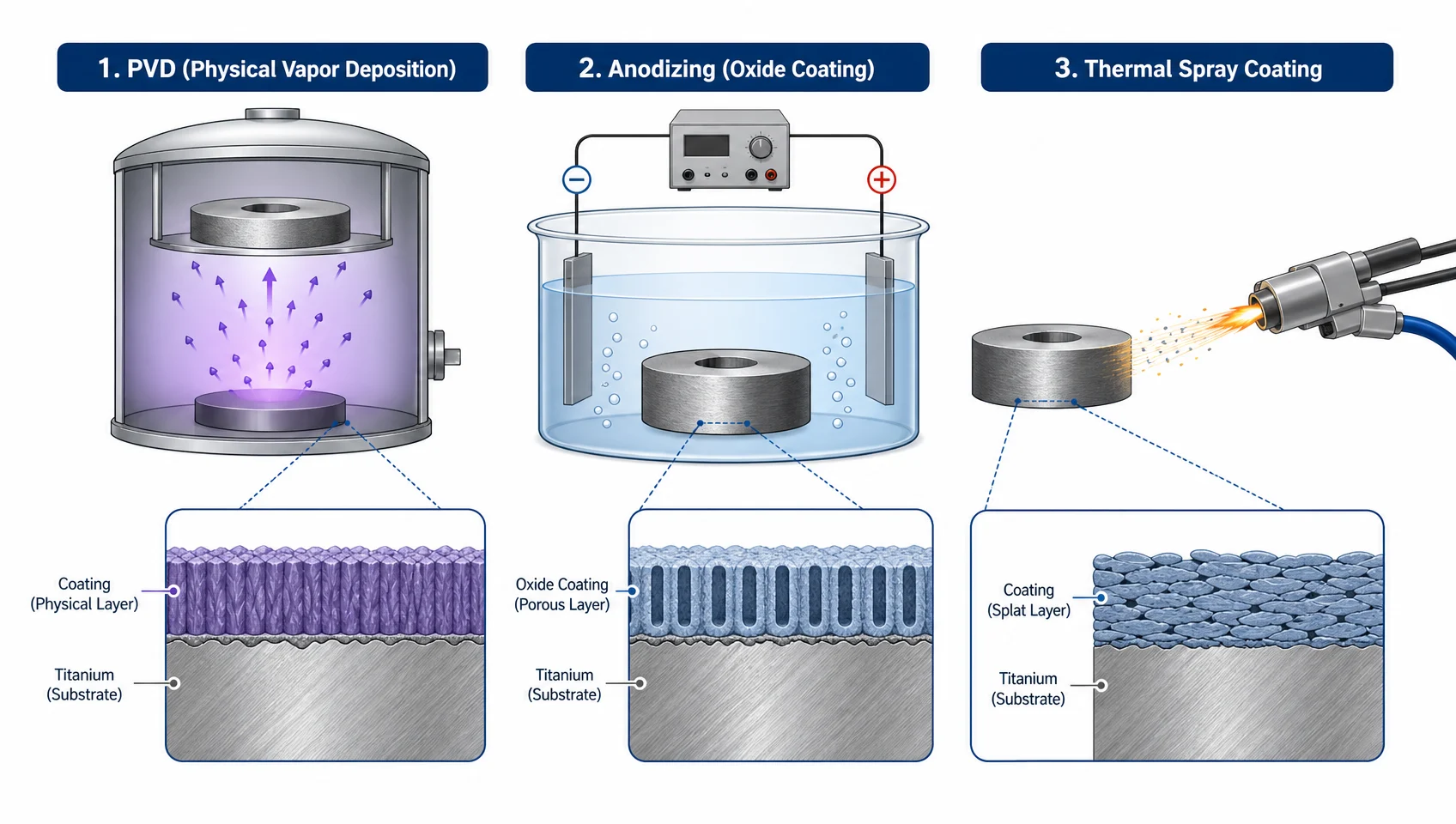
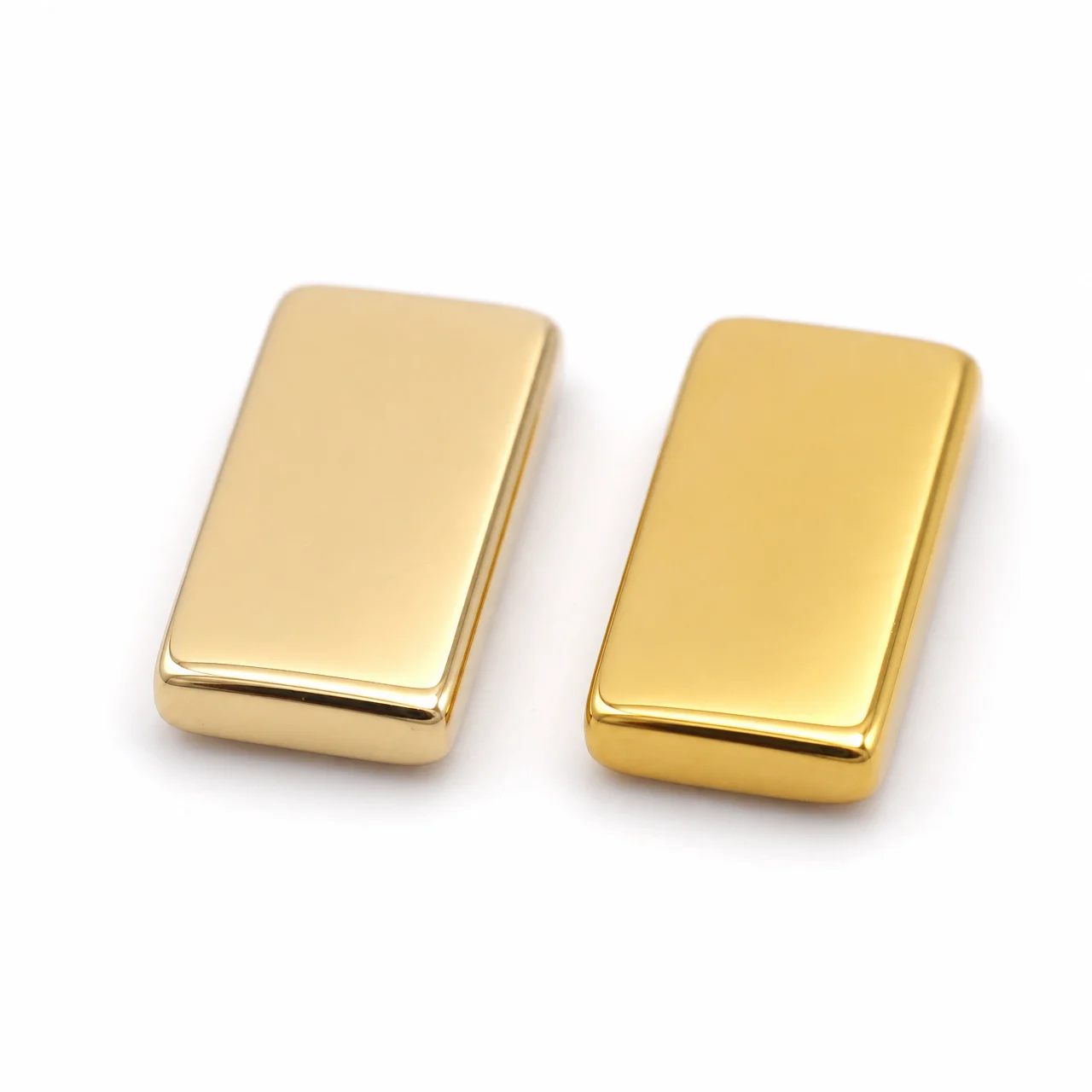
This is where the industry terminology gets confusing, and where most buyers make purchasing mistakes. “Gold titanium” or “titanium gold finish” on a watch or piece of jewelry can mean one of three completely different things:
| Method | What It Deposits | Color | Hardness | Nickel-Free? | Relative Cost |
|---|---|---|---|---|---|
| Electroplating (gold) | Real gold (karatage measurable) | True gold yellow | 130–250 HV | Usually no (nickel undercoat) | Moderate |
| PVD – TiN coating | Titanium nitride | Gold-colored | 2,000–3,000 HV | Yes | 5–10x chrome plating |
| Anodizing | No deposit — thickened TiO₂ | Interference colors (greenish gold) | Same as base oxide | Yes | Low |
PVD (Physical Vapor Deposition) vaporizes a target material — often titanium combined with nitrogen — in a vacuum chamber and deposits it as a hard, dense film. When titanium nitride (TiN) is deposited, the result is a gold-colored surface. When chromium nitride (CrN) is deposited, you get a silver-chrome look. Neither is pure gold or pure chrome — both are ceramic-metallic compounds.
PVD coatings are 10–15x harder than gold electroplate and generally outperform it on wear resistance. They don’t peel or chip because they’re deposited in a vacuum at very high energy, forming a dense bond rather than an electrolytic attachment. The tradeoff is equipment cost — PVD requires a vacuum chamber setup not found in standard plating shops.
For body jewelry specifically, PVD often carries a nickel warning. Some PVD processes use nickel-containing binders or intermediate layers. Anodized titanium remains the safest choice for implant-grade pieces, as the color comes from the oxide layer itself — nothing external is deposited.
Anodizing Titanium: The Third Option

Anodizing is not a coating process in the conventional sense. It uses electrolysis to thicken titanium’s natural TiO₂ layer in a controlled way. As the oxide grows thicker, it creates interference effects with light — similar to an oil film on water — producing vivid colors without any deposited metal.
The colors available through anodizing depend entirely on the voltage applied:
- ~15–20V → yellow/gold-adjacent tones
- ~25V → purple
- ~35–40V → blue
- ~50–55V → green
Here’s the catch that many buyers miss: anodized “gold” titanium is not gold-colored. At the voltage that produces a gold-adjacent tint, the result is usually yellow-green. You cannot achieve a warm, saturated gold comparable to 14K electroplated gold through anodizing alone — the color is always slightly different.
Anodizing is ideal for:
- Body jewelry (ASTM F136 implant-grade titanium)
- Aerospace fasteners needing color coding
- Decorative architectural titanium
- Any application where zero deposited metals are required
Which Titanium Finishing Method Should You Use?
Here’s a decision framework based on the application:
For industrial wear/friction reduction (aerospace, hydraulics, engines):
→ Hard chrome electroplating on titanium. Specialist service required. Contact companies like U.S. Chrome with titanium-specific capability.
For medical/dental implants needing a gold appearance:
→ PVD TiN coating. Nickel-free, biocompatible, high hardness.
For jewelry — true gold color matching 14K gold:
→ PVD TiN (closest match to 14K color). Electroplated gold is an option but requires nickel undercoat, which may cause sensitivity reactions.
For body-safe piercing jewelry:
→ Anodizing on ASTM F136 titanium. No deposited metals, completely biocompatible.
For electrical contacts needing gold (aerospace/electronics):
→ Electroplated gold over electroless nickel on titanium. This is a well-established process with ASTM and AMS standards.
For decorative chrome look (consumer goods, hardware):
→ PVD CrN or chromium-based PVD. Far more practical than electroplating for decorative chrome on titanium.
Can You Electroplate Titanium at Home?
Technically, no — not with any reliable or safe outcome. A Reddit thread in r/electroplating put it clearly: “It’s possible. But it’s VERY difficult. It is not something that a hobbyist would be able to successfully (nor safely) tackle.”
The oxide removal step uses hydrofluoric acid or ammonium bifluoride — both are highly hazardous chemicals that require specialist handling, ventilation, and disposal. The activation and strike plating steps need to happen in sequence with no air exposure between them, which requires a processing line purpose-built for titanium.
If you’re working with titanium and need a plated finish, outsource to a qualified industrial plater. Attempting it at home risks coating failure, chemical injury, and potential hydrogen embrittlement of any structural titanium parts.
FAQ: Titanium Electroplating
Can you plate titanium with chrome?
Yes. Hard chrome plating on titanium is commercially done for industrial wear applications. It requires either a nickel intermediate layer or a specialist process that prevents oxide regeneration during deposition. It is not typically used for decorative purposes — PVD is preferred for chrome-look finishes.
Is PVD gold plating real gold?
No. PVD “gold” on titanium is typically titanium nitride (TiN), a ceramic compound that is gold-colored but contains no gold. It is harder and more durable than real electroplated gold. If you need actual gold content (for conductivity, solderability, or assay), use electroplated gold over an electroless nickel undercoat.
Why can’t titanium be electroplated onto other metals?
Titanium is too chemically reactive for aqueous electroplating. It immediately forms oxides in contact with water and oxygen, preventing the electrochemical deposition process. Commercially, titanium is deposited onto surfaces via PVD or CVD in vacuum environments, not by electroplating.
What metals can be electroplated onto titanium?
Nickel (most common intermediate), gold, silver, copper, platinum, and chrome (with correct pre-treatment) can all be electroplated onto titanium. Nickel is almost always the first layer applied, creating a bondable surface for subsequent coatings.
Does titanium anodizing look like gold?
Not exactly. Anodized titanium can produce a gold-adjacent interference color, but it tends toward yellow-green rather than the warm yellow of real gold. It cannot match 14K or 18K gold color accurately. For a true gold appearance, PVD TiN is the closest non-gold option.
How long does a plated finish last on titanium?
With proper preparation and a nickel undercoat, electroplated gold or silver on titanium can last 5–10 years in low-wear applications. Hard chrome on titanium lasts significantly longer in industrial wear scenarios. PVD coatings on titanium typically outlast electroplated finishes due to their greater hardness (2,000–3,000 HV vs 130–250 HV for gold).
Titanium Takes More Effort — But It’s Worth Getting Right
Titanium’s passive oxide layer is both its greatest asset (corrosion resistance, biocompatibility) and its biggest challenge for surface finishing. The oxide that makes titanium so reliable as a structural material is exactly what makes electroplating it a specialist discipline.
The key takeaway for anyone sourcing titanium plating: the process works, but it requires the right expertise and pre-treatment sequence. For decorative finishes on high-volume consumer goods, PVD is almost always the better investment. For industrial wear coatings, hard chrome or electroless nickel on titanium can extend component life significantly. And for body-contact applications, anodized titanium remains the standard the industry keeps coming back to.
If you’re sourcing titanium plating commercially, ask your plating supplier specifically about their oxide removal protocol and whether they use a nickel strike. Those two factors determine whether the coating will hold.