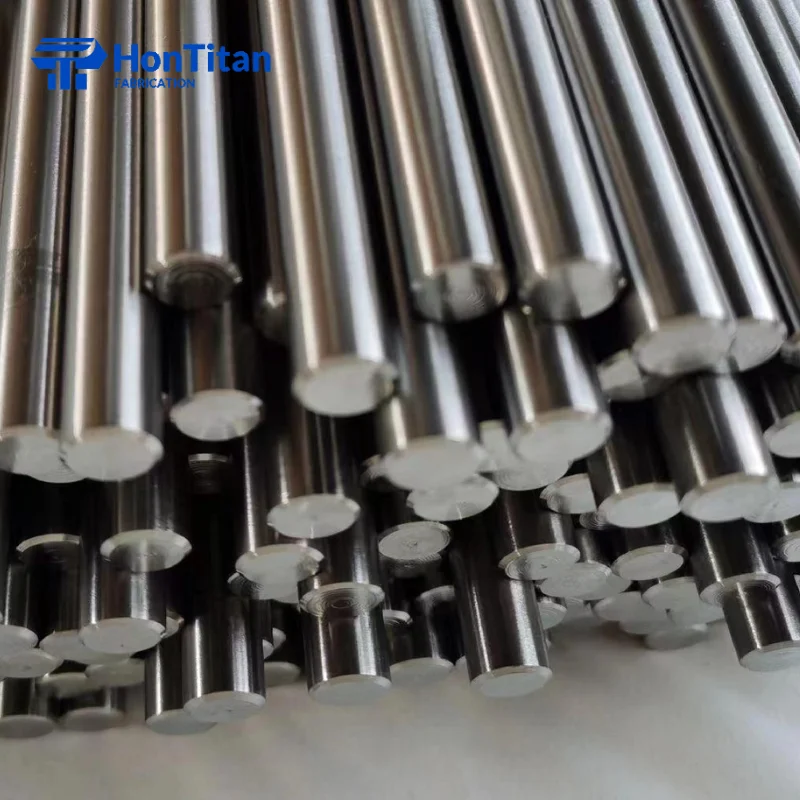
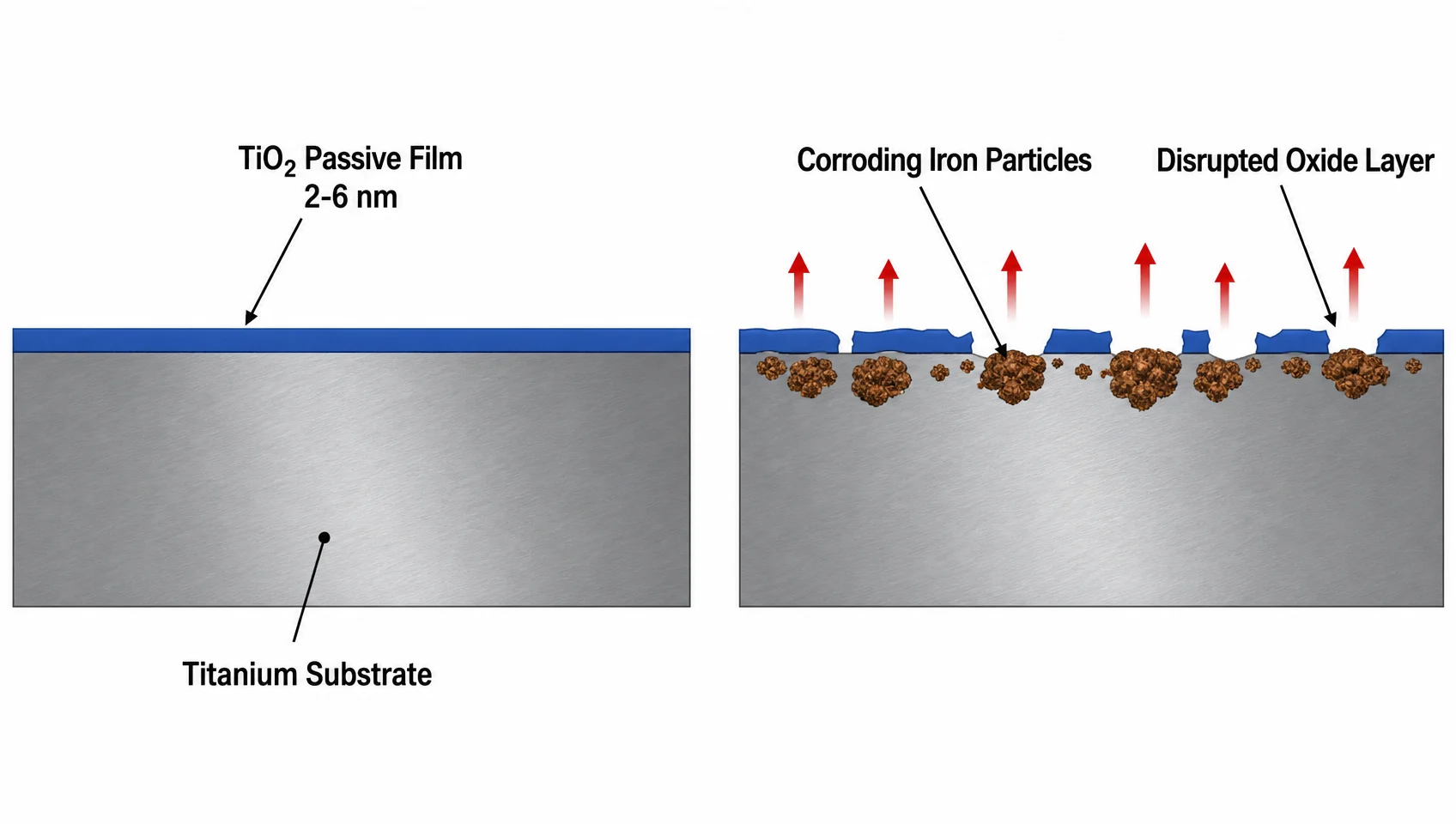
Titanium forms a protective TiO2 oxide layer spontaneously, but machining, welding, and handling damage this layer and introduce free iron contamination that defeats it. Chemical passivation — using nitric acid or citric acid in a controlled bath — removes that contamination and restores the passive film. The correct standards depend on application: ASTM B600 for industrial and medical device descaling/cleaning, ASTM F86 for surgical implants (nitric acid only), and AMS 2487/2488 for aerospace anodizing. ASTM A380 is a stainless steel standard and does not formally cover titanium, despite being widely cited by finishing shops. This guide covers the process parameters, acid tradeoffs, alloy-specific considerations, and verification methods — all titanium-specific, no stainless steel detours.
What Titanium Passivation Actually Does
Passivation on titanium is less about creating a protective layer and more about restoring the one that machining destroyed.
Titanium self-passivates. When freshly exposed metal contacts air or oxygen, a TiO2 film forms spontaneously — repassivation after mechanical disruption occurs within milliseconds. The oxide grows through intermediate sub-oxide phases (TiO, then Ti2O3) before reaching the stable TiO2 state. The resulting film is only 2–6 nm thick — roughly 20 to 60 times thinner than the wavelength of visible light — but it is dense, ionically resistive, and self-healing. Scratch it, and it reforms on its own as long as oxygen or moisture is present.
The problem is machining. Turning, milling, grinding, and wire-EDM all embed iron particles from tooling, fixtures, and workholding into the titanium surface. Those iron particles corrode in service, undercutting the passive film from below and creating pitting that the surrounding TiO2 layer cannot repair. Heat treatment and welding add a second problem: oxide scale that builds up unevenly, leaving thick zones that resist the natural passivation process. Chemical passivation removes both — the iron contamination and the scale — so the titanium surface is clean enough to form a uniform, uninterrupted passive film.
This is the key difference from stainless steel passivation. On stainless steel, the passive film is chromium oxide (Cr2O3), and passivation chemistry is designed to dissolve iron while leaving chromium enriched at the surface. On titanium, there is no chromium — the passive film is entirely TiO2, and passivation is primarily a cleaning step. Different chemistry, different standards, different verification methods.
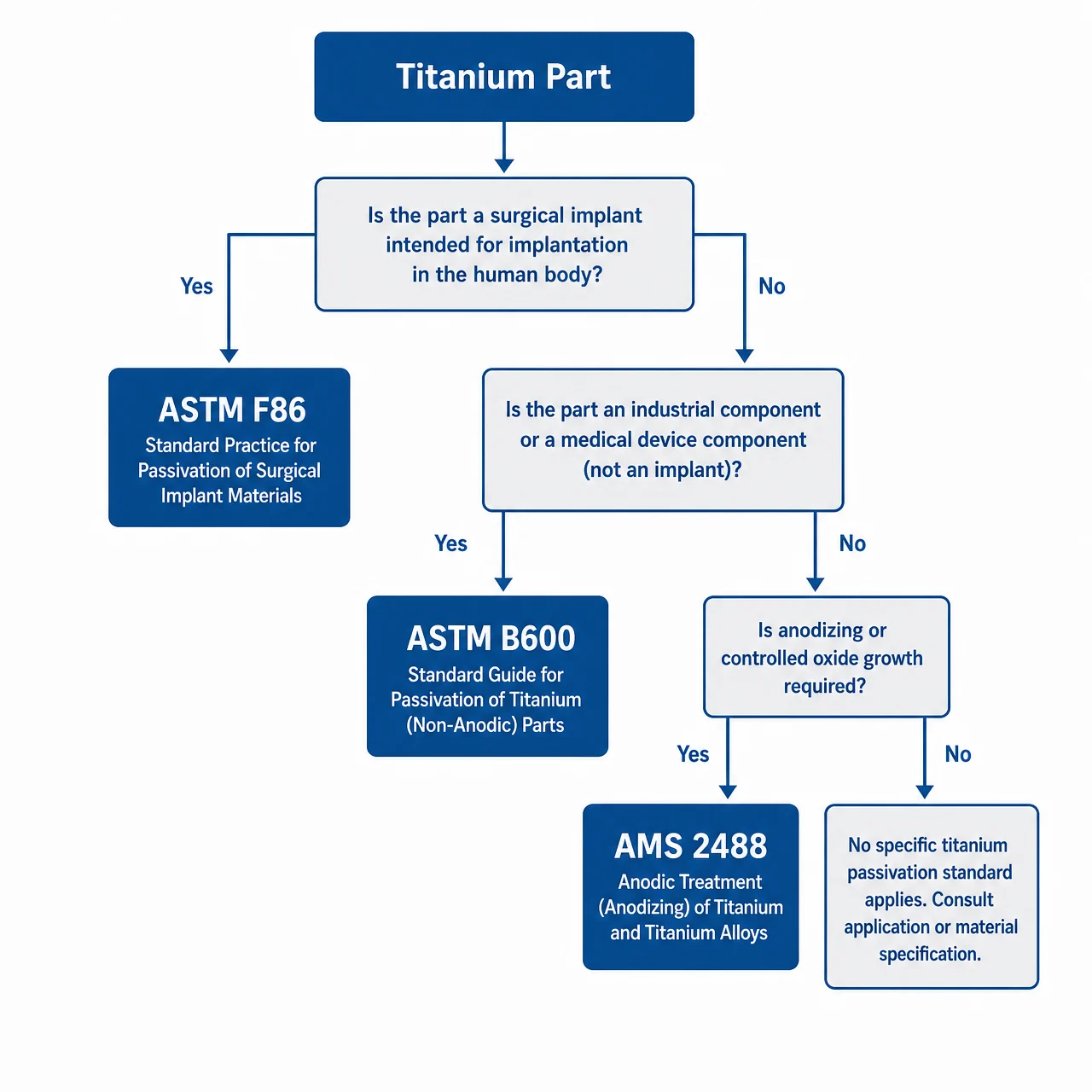
ASTM Standards for Titanium Passivation — Which One Applies
Four ASTM numbers get cited for titanium passivation; two of them are stainless steel standards that do not formally cover titanium.
This is where most specification errors start. Understanding which standard applies to your part takes less than five minutes, but the consequences of getting it wrong — a medical device with a nonconforming surface treatment, an aerospace fastener passivated to the wrong spec — are significant.
| Standard | Formal Scope | Process Method | Primary Industry |
|---|---|---|---|
| ASTM B600 | Titanium and titanium alloys | Descaling (HNO3/HF pickling or mechanical) + passivation (A967-based treatments, including citric acid options) | Industrial, medical device, aerospace fabricators |
| ASTM F86 | Metallic surgical implants (including titanium) | Nitric acid only (20–45%, 20–30°C, 30 min min) | Medical devices and implants |
| ASTM A380 | Stainless steel only (200, 300, 400 series) | Nitric acid (stainless-specific procedures) | Stainless steel parts — pas titane |
| ASTM A967 | Stainless steel only | Nitric acid or citric acid (multiple method options) | Stainless steel parts — pas titane |
| AMS 2487 | Titanium alloys — electrically-insulating anodic coating | Electrochemical anodizing (pH 12.4 max bath) | Aerospace (electrical isolation applications) |
| AMS 2488 | Titanium alloys — hard coat anodizing | Type I: thin decorative; Type II: thick wear-resistant | Aerospace fasteners, structural brackets |
ASTM B600 is the standard written specifically for titanium. It covers descaling and cleaning of titanium and titanium alloy surfaces for producers, fabricators, and end users. The primary descaling method in B600 uses an HNO3/HF pickling solution (or mechanical descaling) to remove scale, followed by passivation treatments drawn from ASTM A967 — which permits both nitric acid and citric acid options depending on application. One common B600-compliant sequence used in medical device manufacturing: glass bead blasting with iron-free media to remove scale, followed by a citric acid passivation bath using A967-based parameters. Parts that came directly from CNC machining without heat treatment often skip mechanical descaling and go straight to the acid passivation step.
ASTM F86 is the passivation standard for metallic surgical implants — the highest-stakes titanium application. It specifies only nitric acid for titanium. The standard defines two conditions: the Regular condition (20–45% v/v HNO3, 20–30°C, minimum 30 minutes) and an Accelerated condition (20–25% v/v HNO3, 50–60°C, shorter dwell). Citric acid is not a permitted substitute under ASTM F86. If your part is a titanium implant or is implanted in the body, F86 governs, and any process substitution is a nonconformance unless formally validated.
Why is ASTM A380 on so many titanium drawings? Because finishing shops have been applying A380’s nitric acid procedures to titanium for decades, and the acid chemistry works similarly. A380 defines nitric acid passivation codes (20–50% HNO3 at various temperatures and times) that shops apply to titanium out of habit or convenience. The standard’s formal scope is stainless steel, and A380 does not include titanium-specific procedures, descaling guidance for titanium’s oxide scale, or alloy-specific notes. If your drawing references A380 for a titanium part, the intent is almost certainly to invoke the nitric acid procedure — but the correct reference is B600 or F86 depending on application.
ASTM A967 is in the same position as A380: a stainless steel specification that finishing shops sometimes cite for titanium. A967 defines multiple citric acid and nitric acid method options with specific parameters. Its methods are valid for stainless; they are not formally validated for titanium by the standard.
For aerospace components that require electrochemical passivation (anodizing), AMS 2487 (electrically-insulating anodic coating, used for electrical isolation applications) and AMS 2488 (hard coat — Type I thin decorative, Type II thick wear-resistant) are the applicable SAE specifications. AMS 2488 Type II produces a grayish, wear-resistant oxide layer used on fasteners, structural brackets, and subsea connectors.
Nitric Acid vs. Citric Acid — Choosing the Right Method
For medical implants, ASTM F86 mandates nitric acid — citric acid is not an option. For everything else, the choice depends on safety, environmental requirements, and process time.
Both acids remove the same thing — free iron and surface contamination — through different mechanisms. Nitric acid is a strong oxidizing acid that dissolves iron rapidly and simultaneously passivates the titanium surface. Citric acid is a mild organic acid (environmentally classified as GRAS — generally recognized as safe by the FDA) that chelates and dissolves iron without attacking the alloy structure.
| Paramètres | Nitric Acid (HNO3) | Acide citrique |
|---|---|---|
| Concentration | 20–45% v/v | 4–10% w/v |
| Température | 20–30°C (ASTM F86) | 70–160°F / 21–71°C (varies by method) |
| Minimum immersion time | 30 minutes | 4–20 minutes |
| Governing standard (Ti) | ASTM F86 (medical); A380/A967 procedures applied by convention | ASTM B600 |
| Permits for medical implants (F86) | Yes — mandated | No — not permitted |
| Environmental / safety | Toxic fumes (NOx), requires fume extraction and acid disposal | Biodegradable, no toxic gas, lower PPE burden |
| Flash attack risk | Moderate (higher at elevated temperature or concentration) | Plus bas |
| Hydrogen embrittlement risk | Faible | Faible |
| Typical facility cost | Higher (ventilation, neutralization, disposal) | Plus bas |
Flash attack is the primary process risk with nitric acid on titanium: if concentration is too high, temperature elevated, or dwell time extended, the acid can etch or pit the surface rather than passivate it. Staying within ASTM F86’s specified range (20–45% HNO3, 20–30°C) minimizes this risk. Shops that run stainless steel and titanium in the same bath should be aware that the higher-temperature stainless procedures (some A380 codes run 120–160°F) are outside F86’s temperature range for titanium.
Citric acid is the preferred choice for non-medical applications where shop safety and environmental compliance drive the decision. ASTM B600’s citric acid procedure (4–10 w% solution, room temperature to 71°C, 4–20 minutes) is straightforward to implement without fume extraction systems. The tradeoff: citric acid alone does not replace the descaling function of glass bead blasting for heavily scaled parts. B600’s two-step sequence (mechanical descaling first, citric acid passivation second) is the complete treatment.
Ti-6Al-4V vs. Commercially Pure Titanium — Does the Alloy Change Passivation?
The alloy grade affects which passivation procedure applies, how the surface chemistry behaves, and which medical standard governs — not just the passivation chemistry itself.
Titanium for industrial use falls into two broad categories: commercially pure (cp-Ti, Grades 1–4) and alloys (Grade 5 and above). Both form TiO2 passive films through the same mechanism, but their microstructure, surface chemistry after machining, and regulatory context differ in ways that matter for passivation.
Commercially pure titanium (cp-Ti, Grades 1–4) is unalloyed titanium with trace impurities (oxygen, nitrogen, iron, carbon). Grade 2 is the most widely used cp-Ti grade — balanced corrosion resistance and formability, used in chemical processing equipment, heat exchangers, and desalination. Grade 4 has the highest strength in the cp-Ti family and is used in some orthopedic implant components. Under ASTM B600, cp-Ti parts respond predictably to both glass bead blasting and citric acid passivation. The alpha-phase microstructure of cp-Ti is uniform, which means the acid etches evenly — flash attack risk is lower than in two-phase alloys.
Ti-6Al-4V (grade 5) is the dominant industrial titanium alloy, accounting for roughly 50% of total titanium production. Its alpha-beta two-phase microstructure (aluminum-stabilized alpha + vanadium-stabilized beta phases) means the two phases have different electrochemical potentials. In aggressive acid conditions, the beta phase can preferentially etch, creating a phenomenon sometimes called selective phase attack. This is not the same as flash attack, but it reinforces the importance of staying within ASTM F86’s conservative parameters: 20–45% HNO3 at room temperature (20–30°C) keeps the driving force for preferential attack low.
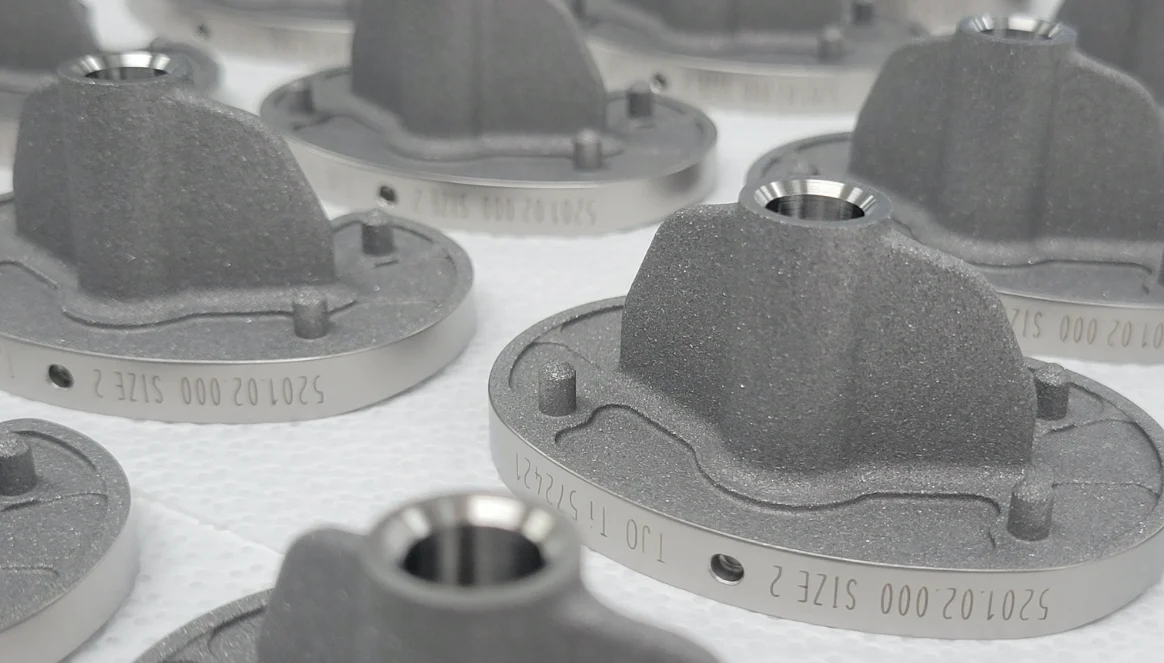
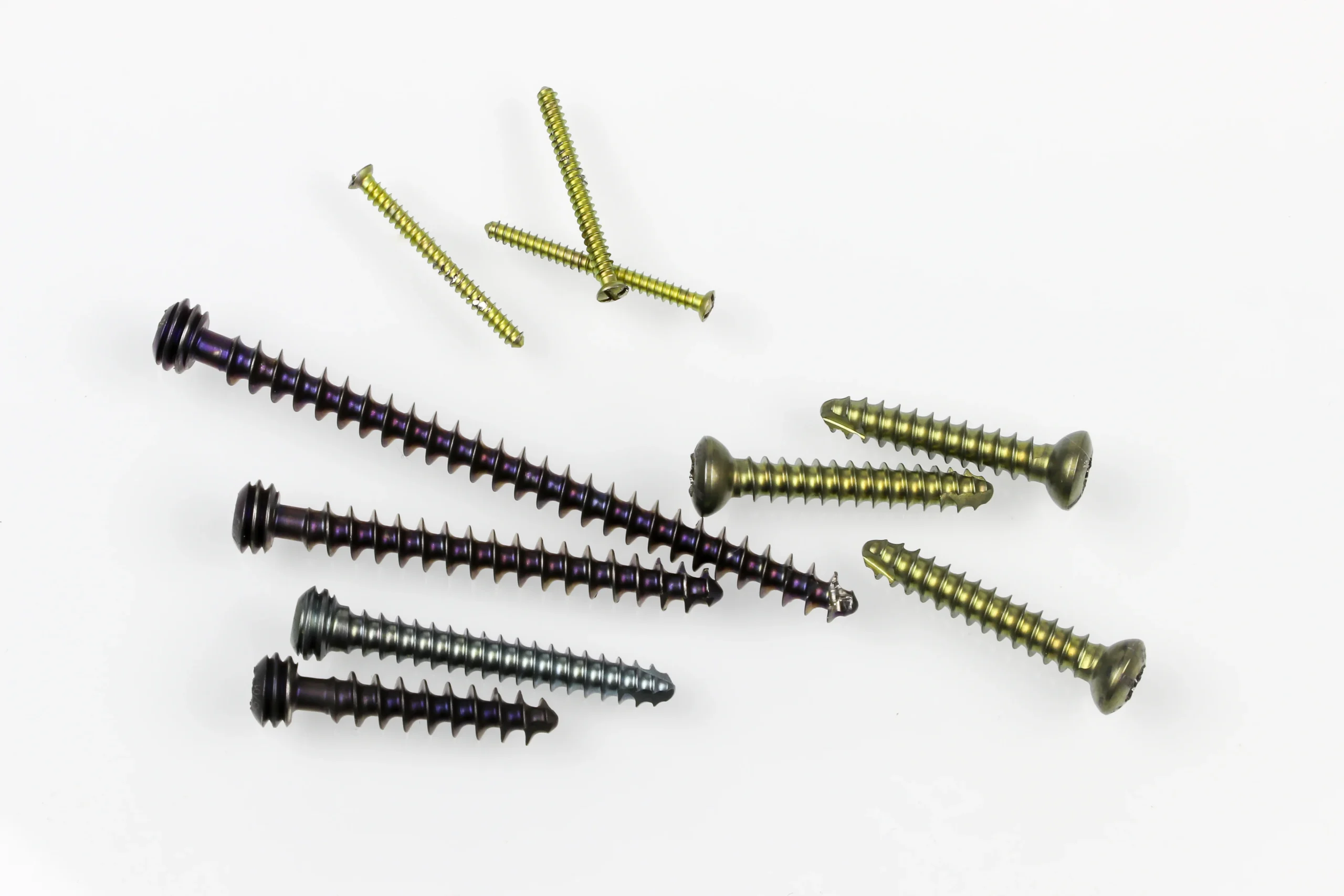
Ti-6Al-4V ELI (Grade 23) is the extra-low interstitial variant specified for load-bearing surgical implants: hip stems, knee components, spinal fixation rods. “ELI” means reduced oxygen, nitrogen, and iron compared to Grade 5. The surface preparation spec for Grade 23 implants is ASTM F86 without exception — and the cleanliness requirements are more stringent than industrial components because the part will be in contact with bone and tissue for decades.
| Grade | Alliage | Applications courantes | Passivation Standard |
|---|---|---|---|
| Première année | cp-Ti | Chemical processing, jewelry | ASTM B600 |
| Niveau 2 | cp-Ti | Heat exchangers, desalination, piping | ASTM B600 |
| Grade 4 | cp-Ti | Orthopedic implant components, fasteners | ASTM B600 / ASTM F86 |
| Grade 5 (Ti-6Al-4V) | Ti-6Al-4V | Aerospace, industrial, medical devices | ASTM B600 / AMS 2487 |
| Grade 23 (Ti-6Al-4V ELI) | Ti-6Al-4V ELI | Load-bearing surgical implants | ASTM F86 (mandatory) |
One practical note: when machining Grade 5 and Grade 23 parts in the same shop run, the passivation specifications may differ. A Grade 5 aerospace bracket and a Grade 23 femoral stem cannot necessarily share the same bath or be processed to the same spec.
Step-by-Step: How to Passivate Titanium Parts
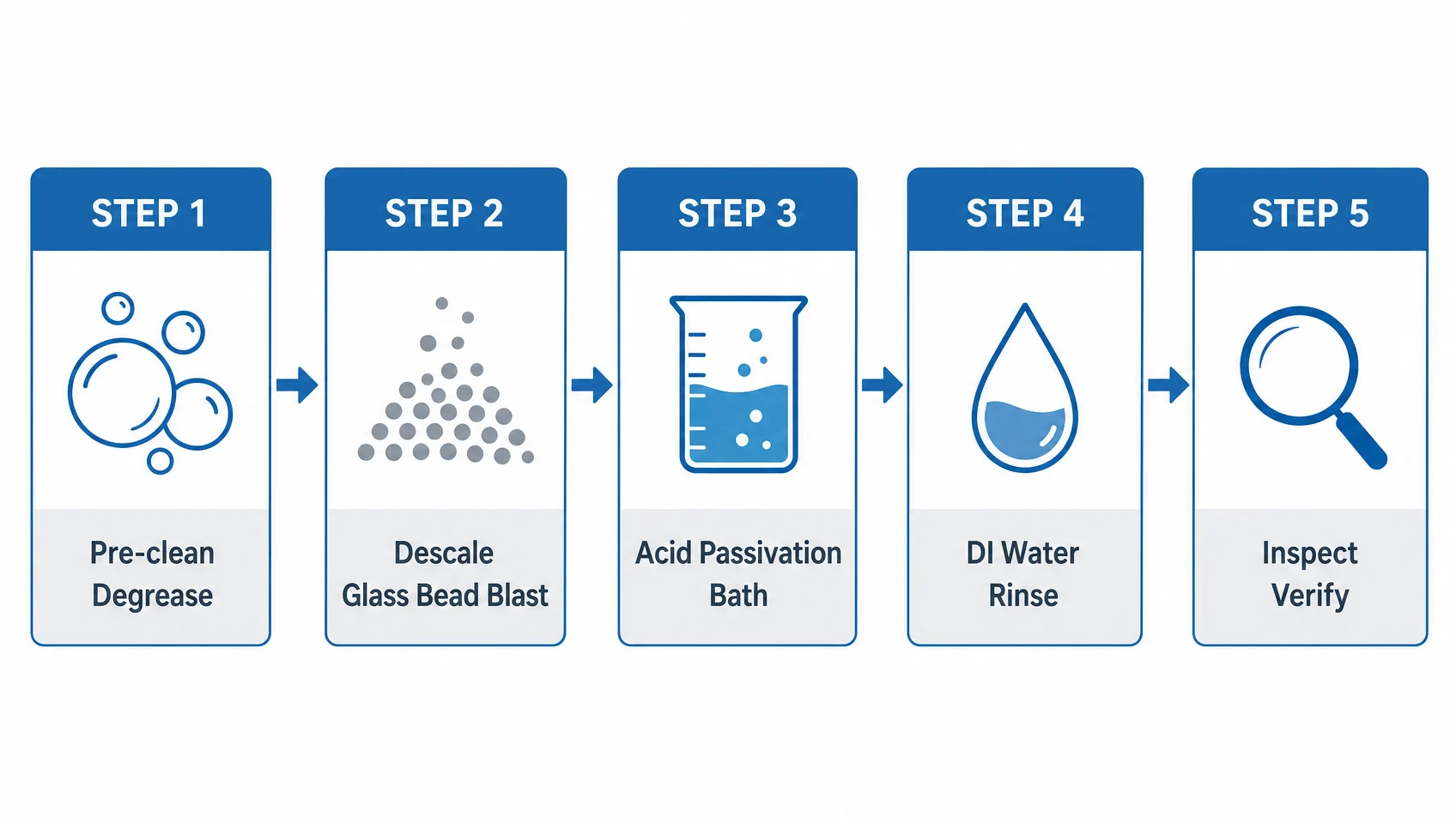
A compliant titanium passivation process follows a five-stage sequence: clean, descale, passivate, rinse, verify — with the correct parameters at each stage.
This procedure reflects ASTM B600 for industrial and non-implant medical device applications. For surgical implants, substitute the ASTM F86 nitric acid bath at Step 3 and add any additional cleaning or marking steps your device master record requires.
Step 1 — Pre-clean and degrease
Remove all machining oils, coolants, and loose metallic debris before the acid bath. Alkaline detergent wash or ultrasonic cleaning in a mild aqueous solution works well for titanium. Avoid chlorinated solvents on titanium — while titanium is resistant to most chemicals, chloride-containing environments at elevated temperature can cause stress corrosion cracking in some alloys. Rinse thoroughly with deionized water. A water break test (see Verification section) should confirm the surface is clean before proceeding.
Step 2 — Descale (if applicable)
Parts that have been heat-treated, annealed, welded, or heated during forming will have oxide scale. Run glass bead blasting with iron-free media — this is critical. Using steel shot or carbon steel blast media embeds iron into the titanium surface and defeats the purpose of the subsequent passivation. ASTM B600 specifies iron-free glass bead media for this reason. Parts that came directly from CNC machining without heat treatment can skip mechanical descaling and proceed to the acid bath.
Step 3 — Acid passivation bath
For citric acid (per ASTM A967 methods, cross-referenced in ASTM B600 — for non-implant applications):
- Solution: 4–10 w% citric acid in deionized water
- Temperature: room temperature is adequate for most parts; elevated temperature (up to 70°C) shortens immersion time
- Immersion time: 4 minutes minimum at high temperature; 20 minutes minimum at room temperature
- Agitation optional but improves uniformity on complex geometries
For nitric acid (ASTM F86, surgical implants — Regular condition):
- Solution: 20–45% v/v nitric acid (HNO3) in deionized water
- Temperature: 20–30°C — do not heat this bath beyond F86 Regular range
- Immersion time: minimum 30 minutes
- Ventilation required: nitric acid at room temperature still produces NOx fumes; process in a fume hood or enclosed acid-resistant cabinet
- Accelerated condition available: 20–25% v/v HNO3 at 50–60°C (shorter dwell time) per F86
Monitor bath concentration periodically — as passivation removes iron from parts, the bath loads with dissolved metals over time. Establish a bath life protocol based on parts processed per batch.
Step 4 — Rinse
Rinse immediately after removing parts from the acid bath. Double-rinse: first in a flowing water rinse to remove bulk acid, then in deionized water to prevent mineral deposits. For medical device parts, final rinse with high-purity deionized water (resistivity ≥ 1 MΩ·cm) is standard practice.
Step 5 — Dry and inspect
Dry with filtered compressed air or in a clean oven (below 150°C to avoid initiating thermal oxidation). Inspect under magnification for any staining, etch marks, or discoloration that might indicate flash attack or inadequate rinse. Parts with any discoloration other than a slight brightening of the natural titanium surface should be quarantined for root cause analysis.
Passivation vs. Anodizing — When to Use Each
Passivation restores the native oxide; anodizing builds a new, thicker oxide layer with controllable thickness, color, and wear resistance — different tools for different requirements.
Chemical passivation and electrochemical anodizing are both “passivation” in the broad sense (both produce a protective oxide layer), but they are fundamentally different processes with different outcomes.
Chemical passivation is a cleaning and restoration process. The 2–6 nm natural oxide is maintained; passivation removes contaminants that prevent it from forming uniformly. The surface looks the same as untreated titanium — no color change, no dimensional change. It is not a coating; it is surface preparation.
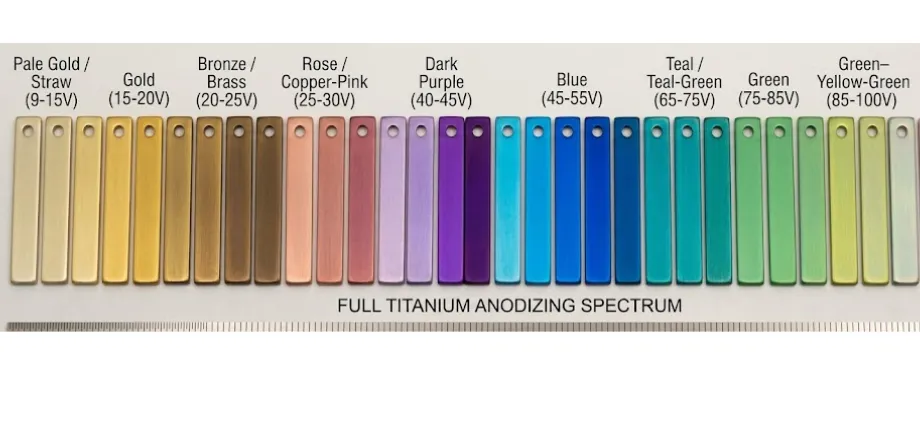
Anodizing is an electrochemical process where the titanium part is connected as the anode in an electrolyte bath and a DC voltage is applied. Oxygen ions from the electrolyte are driven into the titanium surface, growing TiO2 from the metal itself — pas depositing a foreign film. Film thickness is controlled directly by applied voltage, at approximately 2 nm per volt. Because thin-film optical interference depends on oxide thickness, the anodized surface produces colors without dye: the oxide thickness determines which wavelengths of light reinforce or cancel.
Representative colors by voltage (values are electrolyte-dependent and vary significantly by process conditions — these are approximate ranges, not fixed values):
- 10–15 V: bronze / brown
- 20–25 V: purple / violet
- 30–35 V: blue
- 40–50 V: teal / sky blue
- 70–90 V: green to yellow (second-cycle interference)
| Critères | Chemical Passivation | Anodisation |
|---|---|---|
| Épaisseur de l'oxyde | 2–6 nm (native) | Up to several hundred nm (decorative); micrometer range (hard coat) |
| Couleur | None — natural titanium | Voltage-controlled color without dye |
| Dimensional change | None measurable | Minimal (<1 µm for decorative; up to 10 µm for hard coat) |
| Résistance à l'usure | Not improved | Improved (AMS 2488 Type II hard coat) |
| Governing standard (aerospace) | ASTM B600 / F86 | AMS 2487 (electrically-insulating) / AMS 2488 (anti-galling / hard coat) |
| Process type | Chemical (no current required) | Electrochemical (DC power supply required) |
| Typical use case | Implants, machined parts, chemical equipment | Aerospace fasteners (AMS 2488 Type II), elevated-temp forming (AMS 2488 Type I), surgical instruments needing color-coding |
| Coût | Plus bas | Plus élevé |
Use passivation when the goal is clean, compliant surfaces — removing contamination so the native TiO2 film can protect the part. Use anodizing when you need identification color, enhanced wear resistance, or a substantially thicker protective layer.
Verifying Passivation Success on Titanium
Verification for titanium is not the same as for stainless steel — the copper sulfate test has limited utility because titanium contains no native iron, and the test is not required by ASTM B600 or F86.
The copper sulfate test is the standard post-passivation check for stainless steel. A reddish deposit after applying copper sulfate solution indicates free iron on the surface — a sign that passivation failed. On titanium, the test has limited value: titanium’s base alloy contains no iron to detect (unlike steel alloys where iron is the matrix element). The test can still indicate iron contamination introduced during machining, but it is not specified by ASTM B600 or F86 as a required titanium verification method, and most titanium passivation specifications omit it entirely. Applying the copper sulfate test to titanium and treating a clean result as passivation verification generates misleading confidence — a clean result means no iron contamination was detected, not that the TiO2 film has been properly restored.
These are the verification methods that work for titanium:
Water break test (pre-passivation cleanliness check)
Before the acid bath, verify surface cleanliness by rinsing with deionized water. A clean surface shows a uniform, unbroken water film (water “sheets”). Surface contamination causes the water to bead up or “break” into droplets. The water break test is a pass/fail pre-check; it confirms the cleaning step worked before passivation begins.
Visual inspection under magnification
After passivation and drying, inspect under 10–40x magnification. The surface should be uniformly bright with the natural titanium matte or semi-matte finish. Flash attack appears as irregular pitting, matte etching, or surface roughening. Residual scale appears as dull, uneven patches. Parts with either defect should be rejected and the process parameters reviewed.
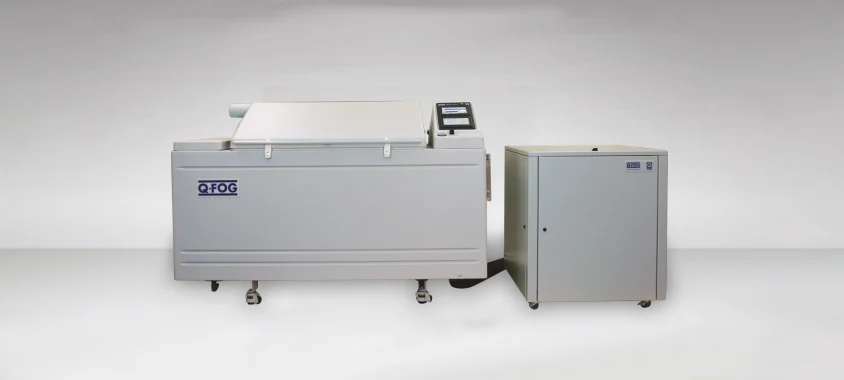
Salt spray testing (ASTM B117)
Salt spray exposure in a controlled chamber (5% NaCl, 35°C) provides an accelerated corrosion resistance check. Well-passivated titanium should show no pitting or corrosion product after 72–168 hours depending on application requirements. This is a destructive lot-acceptance test, not an inspection method for individual parts.
XPS (X-ray photoelectron spectroscopy)
Used in research and medical device validation rather than production. XPS characterizes the passive film composition, thickness, and the ratio of TiO2 to other titanium oxide phases (TiO, Ti2O3). It confirms the oxide is in the TiO2 phase rather than a lower, less protective oxide. XPS is not a production floor test — it requires specialized equipment and is used to validate a passivation process during qualification, not to inspect every lot.
FAQ
Can you passivate titanium?
Yes. Titanium can be passivated through both chemical and electrochemical methods. Chemical passivation using nitric acid (per ASTM F86) or citric acid (per ASTM B600) removes surface contamination and restores the naturally occurring TiO2 film. Electrochemical passivation (anodizing) grows a substantially thicker oxide layer. Titanium’s self-passivating nature means the baseline oxide is always present — passivation removes the contamination that prevents it from forming uniformly.
What is the difference between ASTM A380 and ASTM F86 for titanium?
ASTM A380 is a stainless steel standard. Its formal scope is the cleaning, descaling, and passivation of stainless steel parts (200, 300, and 400 series). Finishing shops cite it for titanium because A380’s nitric acid procedures are similar to what they apply to titanium — but A380 does not include titanium-specific procedures, descaling guidance for titanium’s oxide scale, or alloy-specific process notes. ASTM F86 is the correct medical standard for titanium — it governs surface preparation of metallic surgical implants and specifies nitric acid passivation in two conditions: Regular (20–45% HNO3, 20–30°C, 30 minutes minimum) and Accelerated (20–25% HNO3, 50–60°C). If your titanium part is a surgical implant, F86 governs. For non-implant industrial titanium, ASTM B600 is the correct reference.
Does titanium passivation change the color or dimensions?
Chemical passivation does not change the color or dimensions of titanium parts. The acid bath removes contamination and surface scale; it does not deposit material or build up a coating. Parts emerge with the natural titanium surface — slightly brighter in some cases as machining marks and scale are removed. Dimensional change is not measurable within machining tolerances. Anodizing, by contrast, does produce color and adds a small amount of oxide thickness (typically under 1 µm for decorative applications).
Can citric acid be used for medical titanium passivation?
It depends on the application. For non-implant medical device components (surgical instruments, trays, instrument handles), citric acid under ASTM B600 is acceptable. For surgical implants that are implanted in the body, ASTM F86 applies — and F86 specifies only nitric acid. Citric acid is not a permitted substitute for ASTM F86 passivation regardless of the part’s surface finish outcome. Substituting citric acid on an F86-specified implant creates a process nonconformance.
How long does titanium passivation last?
The TiO2 passive film is permanent under normal service conditions — titanium’s passivity is its inherent chemistry, not a coating that wears off. As long as the part is not machined, abraded back to bare metal, or exposed to environments that destroy the oxide (concentrated hydrofluoric acid, for example), the passive film self-heals from minor scratches and remains intact. The practical answer: passivated titanium in typical service (medical, aerospace, chemical processing) does not require periodic re-passivation the way some metals do. Re-passivation is required after subsequent machining operations that could re-introduce iron contamination.
What happens if titanium is not passivated after machining?
Iron particles from machining tools remain embedded in the surface. These particles corrode in service, creating reddish rust staining that looks like the titanium itself is corroding (it is not). More seriously, the iron corrosion products undercut the TiO2 film locally, creating pitting that the surrounding oxide cannot repair. In medical applications, surface contamination introduces biological risks and can cause elevated metal ion release. In chemical processing, unpassivated titanium in aggressive environments can show localized pitting. For cosmetic or non-structural consumer titanium, the practical consequence is surface staining.
The Oxide Layer That Never Shows Its Work
Titanium’s passive film is one of the most effective corrosion barriers in engineering — and the least visible. Two to six nanometers of TiO2, spontaneously forming and self-healing, has put titanium in orthopedic implants, aerospace fasteners, chemical reactors, and subsea pipelines. The reason passivation still matters is not that the film is inadequate — it is that manufacturing damages it, contaminates it, and blocks it from forming where it needs to be.
Getting the process right is straightforward once the standards are clear: ASTM B600 for industrial and non-implant medical components, ASTM F86 for surgical implants with nitric acid only, and AMS 2487/2488 for aerospace anodizing. ASTM A380 belongs to stainless steel, whatever the drawing says. The acid selection follows the standard: F86 locks you to nitric acid; everything else gives you the choice to use citric acid where its safety and environmental advantages matter.
Parts that come out of a compliant passivation process look nearly identical to how they went in — same color, same dimensions, no visible coating. The difference is a surface ready to hold its TiO2 film uniformly for the life of the part.