Grade 2 (UNS R50400) is commercially pure titanium — the workhorse of the chemical process industry, easy to form and weld, with excellent general corrosion resistance. Grade 12 (UNS R53400, Ti-0.3Mo-0.8Ni) adds 0.8% nickel and 0.3% molybdenum to push yield strength ~25% higher and extend crevice corrosion resistance to temperatures Grade 2 simply cannot handle. The tradeoff is a ~13% higher unit price, but at elevated pressure and temperature, Grade 12 vessels require thinner walls — and the total project cost can actually run 21% lower. This guide compares both grades property by property, includes ASME Section VIII design allowables, and gives you a clear decision framework for when the upgrade makes engineering and economic sense.
At a Glance: Grade 12 vs Grade 2 Titanium
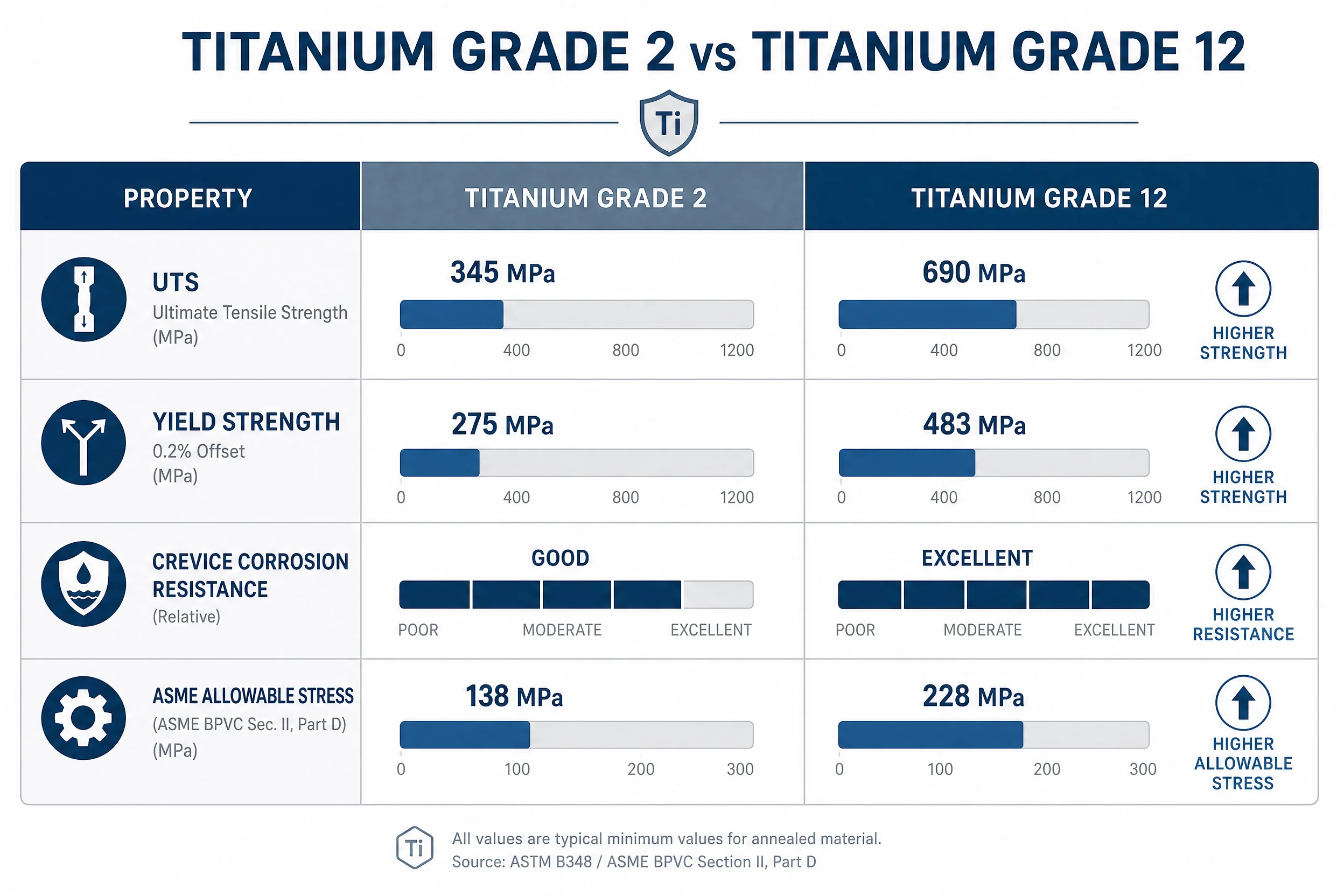
| Property | Grade 2 (R50400) | Grade 12 (R53400) | Winner |
|---|---|---|---|
| Composition | 99%+ Ti (CP) | Ti + 0.8% Ni + 0.3% Mo | — |
| UTS (min, ASTM B265) | 345 MPa (50 ksi) | 483 MPa (70 ksi) | Grade 12 |
| Yield Strength (min) | 275 MPa (40 ksi) | 345 MPa (50 ksi) | Grade 12 |
| Elongation (min) | 20% | 18% | Grade 2 |
| Density | 4.51 g/cm³ | 4.51 g/cm³ | Tie |
| Thermal Conductivity | 22 W/mK | 19–21 W/mK | Grade 2 |
| Fatigue Strength | ~250 MPa | ~280 MPa | Grade 12 |
| General Corrosion | Excellent | Excellent | Tie |
| Crevice Corrosion (hot brine) | Vulnerable above ~80°C | Resistant to ~240°C at pH > 2 | Grade 12 |
| Boiling HCl Resistance | Up to ~0.1% conc. | Up to ~1% conc. | Grade 12 |
| Weldability | Excellent | Excellent | Tie |
| ASME Allowable at 300°F | 12,000 psi | 16,200 psi | Grade 12 |
| Material Cost | Lower (~$13/lb) | Higher (~$15/lb, ~13% premium) | Grade 2 |
| System Cost (elevated T/P) | Higher (thicker walls) | Often lower (thinner walls) | Grade 12 |
| ASTM Standards | B265 Gr2, B337, B338, B348 | B265 Gr12, B337, B338, B348, B381 | — |
| Typical Applications | General CPI, marine, medical | Hot brine, CPI, desalination, geothermal | — |
What Makes Grade 12 Different from Grade 2?
Grade 12 is Grade 2 with two deliberate additions: 0.8% nickel and 0.3% molybdenum. That’s the entire compositional difference. Both grades share identical limits on carbon (0.08% max), nitrogen (0.03% max), oxygen (0.25% max), hydrogen (0.015% max), and iron (0.30% max). The titanium balance runs from approximately 97.6–99.2% in Grade 12 versus 98.9–100% in Grade 2.
These small additions produce changes that are disproportionate to their mass fractions.
Why Nickel?
Nickel (Ni, 0.6–0.9%) raises the threshold temperature at which titanium’s passive oxide film breaks down in chloride environments. In pure titanium, the protective TiO₂ film becomes susceptible to crevice attack in hot, concentrated chloride solutions — primarily because the crevice geometry creates localized acidic, oxygen-depleted conditions that the oxide film can’t sustain at elevated temperature. Nickel stabilizes the passive film under these conditions, shifting the corrosion onset threshold significantly upward.
This is why Grade 12 is specified for brine heaters in desalination plants, where Grade 2 would require either a palladium-containing grade (far more expensive) or an operating temperature cap that limits plant efficiency.
Why Molybdenum?
Molybdenum (Mo, 0.2–0.4%) works by a different mechanism. In reducing acid environments — particularly hydrochloric acid service — molybdenum improves the alloy’s resistance to uniform corrosion. This is the same role molybdenum plays in Type 316 stainless steel, where its 2–3% Mo addition is the primary reason that grade handles HCl and dilute sulfuric acid far better than Type 304.
In Grade 12, the amount is much lower, but it measurably extends service into dilute acid concentrations where Grade 2 corrodes at rates that exceed the typical 5 mils per year (mpy) engineering threshold.
Together, Ni and Mo make Grade 12 what the industry calls a “near-commercially-pure” or “lean alloy” titanium — it retains the excellent formability and weldability of Grade 2 while pushing corrosion resistance significantly further, particularly in aggressive reducing or variable oxidizing-reducing environments.
Mechanical Properties: Grade 12 vs Grade 2
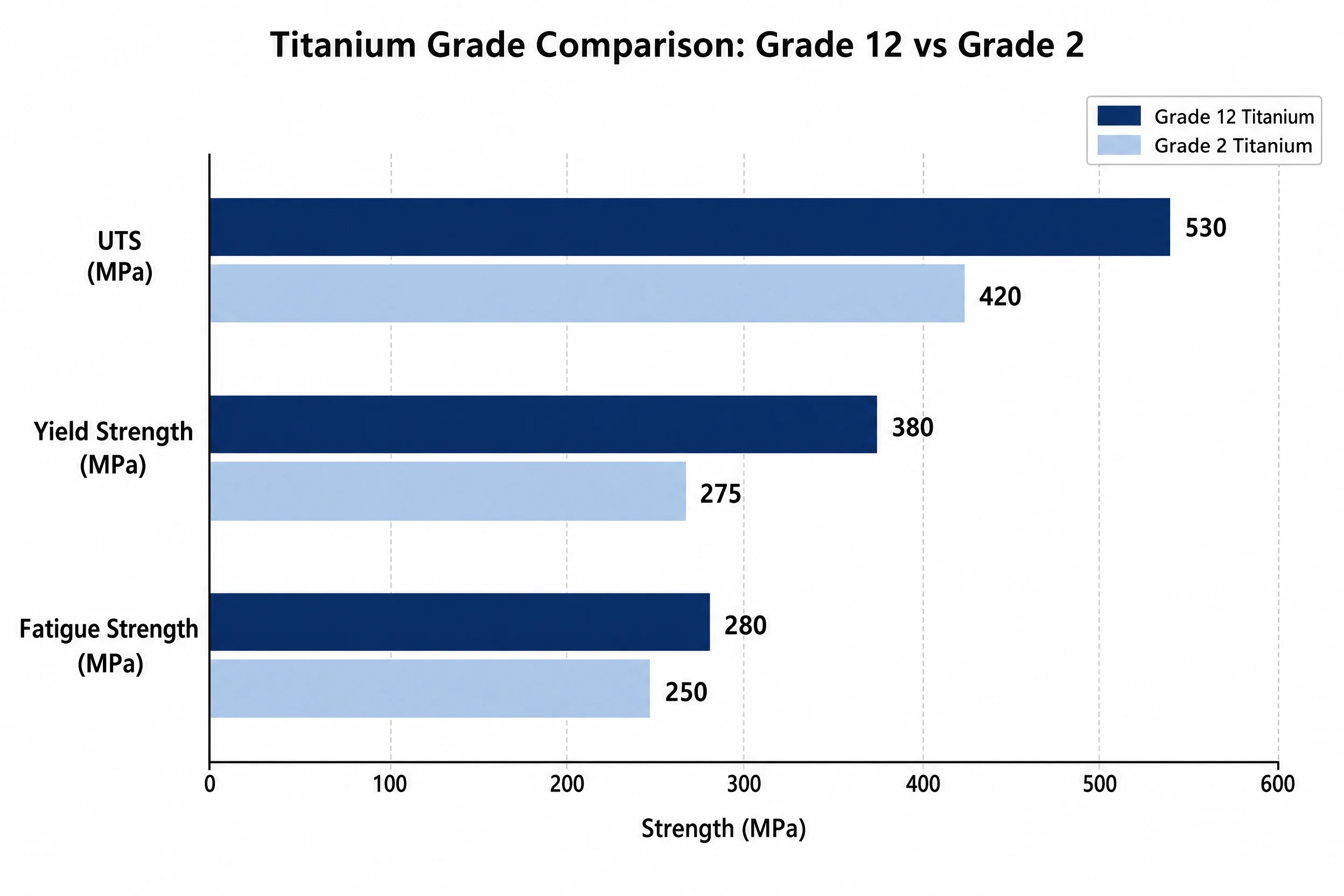
Grade 12 is meaningfully stronger than Grade 2 — not marginally. The ASTM B265 minimum UTS is 483 MPa (70 ksi) for Grade 12 versus 345 MPa (50 ksi) for Grade 2, a 40% difference at the specification floor. Typical values narrow that gap: 530–550 MPa vs 420–515 MPa, but Grade 12 still delivers 15–26% higher UTS in practice.
The strength advantage compounds in pressure vessel and piping design because ASME allowable stresses scale with ultimate tensile and yield strength. When you run the numbers through Section VIII, Division 1 at elevated temperatures, the Grade 12 advantage becomes the basis for thinner walls — which directly offsets its higher unit cost.
Full Mechanical Property Comparison
| Property | Grade 2 (R50400) | Grade 12 (R53400) | Source |
|---|---|---|---|
| UTS, minimum | 345 MPa (50 ksi) | 483 MPa (70 ksi) | ASTM B265 |
| UTS, typical annealed | 345–515 MPa | 530–550 MPa | MatWeb, AZoM |
| Yield Strength, minimum | 275 MPa (40 ksi) | 345 MPa (50 ksi) | ASTM B265 |
| Yield Strength, typical | 275–410 MPa | 380–410 MPa | MatWeb, AZoM |
| Elongation at break, min | 20% | 18% (sheet) | ASTM B265 |
| Elongation, typical | 23–28% | 21% | MakeItFrom |
| Reduction in Area | 37% | 28% | MakeItFrom |
| Elastic Modulus | 110 GPa | 105–110 GPa | AZoM, MakeItFrom |
| Shear Strength | 270 MPa | 330 MPa | MakeItFrom |
| Fatigue Strength | ~250 MPa | ~280 MPa | MakeItFrom |
| Hardness, Brinell | ~120–160 HB | 180–235 HB | AZoM |
| Density | 4.51 g/cm³ | 4.51 g/cm³ | ASTM B265 |
| Thermal Conductivity | 22 W/mK | 19–21 W/mK | MakeItFrom, AZoM |
| Thermal Expansion | 9.0 µm/m·K | 8.6–9.6 µm/m·K | AZoM, MakeItFrom |
What the Ductility Numbers Mean
Grade 2 shows slightly higher elongation (23% typical vs 21% for Grade 12) and significantly higher reduction in area (37% vs 28%). This means Grade 2 is more forgiving under cold forming operations — it stretches further before cracking. For complex formed shapes, Grade 2 remains the easier material to work with.
Grade 12’s higher hardness (up to 235 HB vs 160 HB for Grade 2) means it’s more wear resistant, which matters in pump and valve applications with abrasive media. It does machine slightly harder — slower speeds and carbide tooling (C1–C4 designation) are recommended.
Density and Weight
Both grades have essentially identical density (4.50–4.51 g/cm³), which is approximately 56% of stainless steel’s density. The weight advantage of titanium over steel is preserved regardless of which grade you choose. When evaluating Grade 12 vs Grade 2 for weight-sensitive designs, density is not a differentiator.
Corrosion Resistance: Where Grade 12 Earns Its Premium
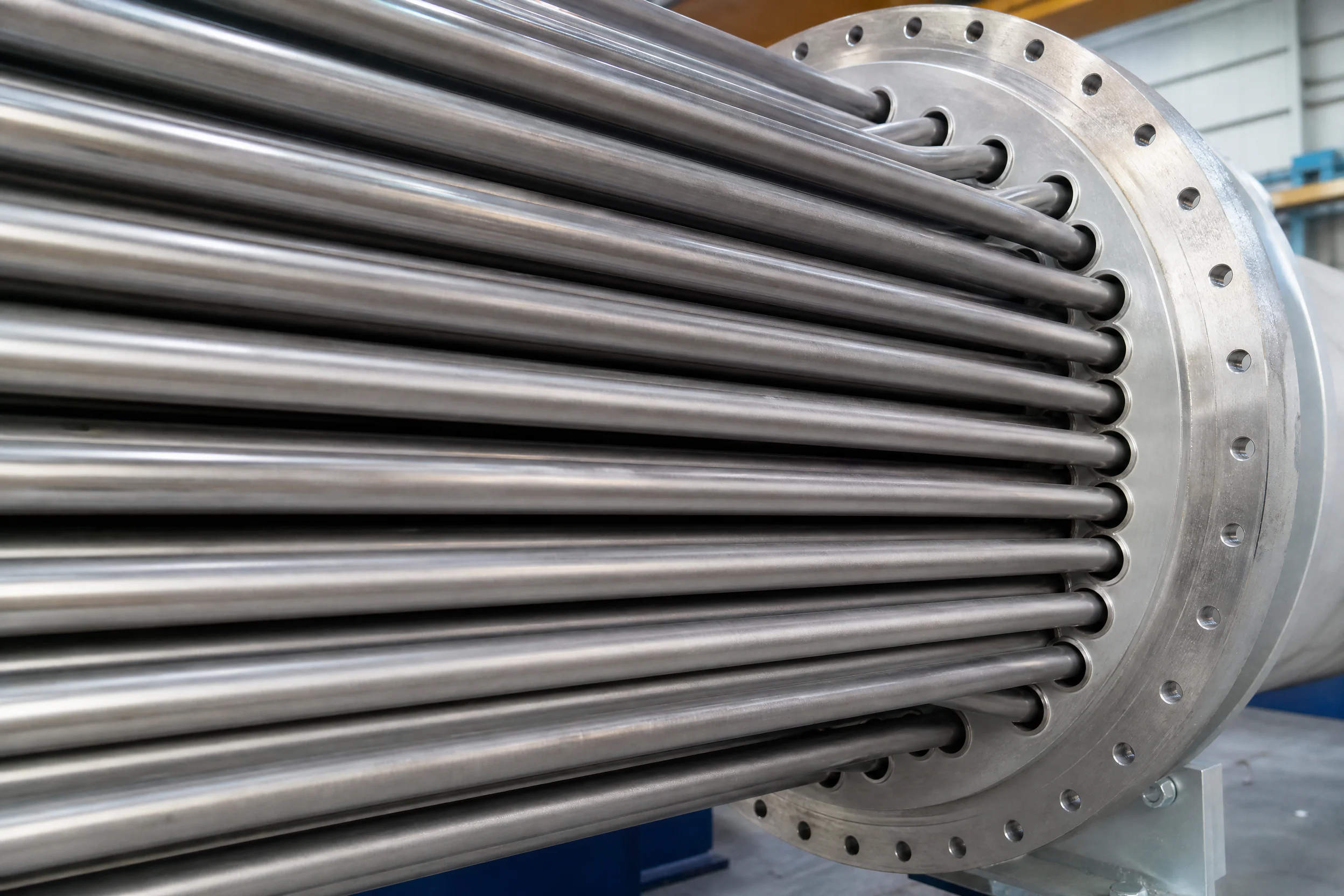
Both grades have excellent general corrosion resistance — that’s not where the decision gets interesting. Pure titanium’s passive TiO₂ film makes both Grade 2 and Grade 12 essentially immune to seawater, dilute salt solutions, most organic acids, and oxidizing environments at moderate temperatures. In applications where neither grade corrodes, Grade 12’s premium is hard to justify.
The differentiation shows up in three specific scenarios: crevice corrosion in hot chloride solutions, reducing acid environments, and service above 80°C in brines.
Crevice Corrosion: The Critical Differentiator
Crevice corrosion is the Achilles’ heel of commercially pure titanium. It develops when crevice geometry (under gaskets, in threaded connections, between tube and tubesheet) creates a stagnant, oxygen-depleted zone in a hot chloride solution. The local chemistry drops in pH and the oxide film breaks down. For Grade 2, this typically becomes a concern above 70–80°C in concentrated chloride environments.
Grade 12 pushes that threshold to approximately 240°C (464°F) at pH values above 2. The nickel addition is the primary driver. Published corrosion data (from the Tricor Metals MTI Connect 2020 technical publication, drawing on industry testing data) shows that in saturated brine:
- Grade 2/2H experiences crevice corrosion at elevated temperatures even at pH 2
- Grade 12 remains free from crevice corrosion at pH > 2 up to 240°C
This is not a marginal improvement — it’s roughly a 3× expansion of the safe operating envelope for hot chloride service. Desalination brine heaters, geothermal heat exchangers, and chemical plant heat exchangers operating above 80°C in chloride service represent exactly the applications where Grade 12 pays off.
A key point worth emphasizing: neither grade experiences hydrogen pickup in hot brine at neutral-to-acidic pH. Grade 2 remains a valid choice for chloride service as long as temperatures stay below ~80°C and crevice geometry is managed.
Hydrochloric Acid Service
In boiling hydrochloric acid, the concentration boundary separates the two grades decisively:
| HCl Concentration (boiling) | Grade 2 | Grade 12 |
|---|---|---|
| 0.05% (≈pH 2) | ≤5 mpy ✓ | ≤5 mpy ✓ |
| 0.1% | Marginal | ≤5 mpy ✓ |
| 0.5% | >5 mpy ✗ | ≤5 mpy ✓ |
| 1.0% | High rate ✗ | ≤5 mpy ✓ |
| 2.0% | Very high rate ✗ | >5 mpy — corroding ✗ |
| 5.0% | Severe ✗ | Severe ✗ |
Data based on Tricor Metals MTI CONNECT publication, referencing industry corrosion testing. 5 mpy (0.127 mm/yr) is a commonly applied engineering threshold.
Grade 2 is almost never specified for HCl service. Grade 12 is useful up to approximately 1% boiling HCl concentration — still well short of the palladium-containing grades (7, 11, 16, 17) that handle highly reducing environments, but sufficient for many chemical processing streams where trace HCl is present.
Reducing vs Oxidizing Environments
Unalloyed titanium (Grade 2) performs excellently in oxidizing environments because the passive oxide film is thermodynamically stable. It struggles in reducing environments — dilute mineral acids without dissolved oxidants — because the film isn’t maintained. Grade 12’s molybdenum addition specifically targets this gap: Mo stabilizes the film under slightly reducing conditions and extends the range of mixed or variable oxidizing-reducing service.
The practical takeaway: if your process stream alternates between oxidizing and reducing conditions (common in batch chemical reactors), Grade 12 is considerably more reliable than Grade 2.
ASME Design Allowables: The Economic Case for Grade 12
The per-pound price difference between Grade 12 and Grade 2 tells only part of the story. Grade 12 typically costs ~13% more per pound (roughly $15.07 vs $13.34/lb based on Tricor Metals 2020 data; current market prices vary, but the relative premium is similar). For engineers focused only on material purchase price, that premium looks like a cost disadvantage. The ASME design allowable comparison reveals why that framing is incomplete.
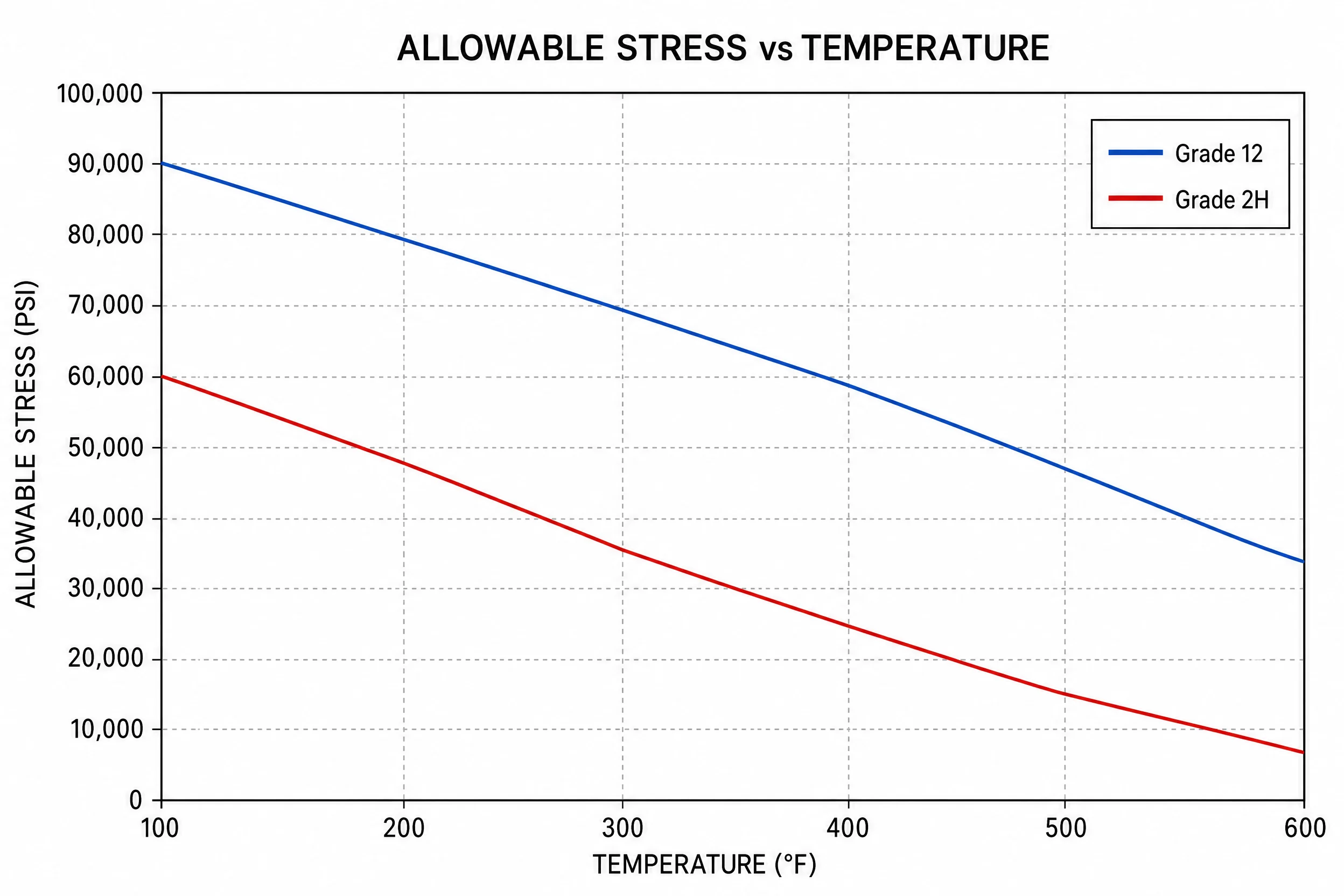
ASME Section VIII, Division 1 sets allowable design stresses for pressure vessels. Grade 12 carries higher allowables at every temperature:
ASME Section VIII Div. 1 Design Allowable Stresses
| Temperature | Grade 2H (R50400) | Grade 12 (R53400) | Gr12 Advantage |
|---|---|---|---|
| 100°F (38°C) | 16,600 psi | 20,000 psi | +20% |
| 150°F (66°C) | 15,900 psi | 20,000 psi | +26% |
| 200°F (93°C) | 14,400 psi | 18,700 psi | +30% |
| 250°F (121°C) | 13,100 psi | 17,400 psi | +33% |
| 300°F (149°C) | 12,000 psi | 16,200 psi | +35% |
| 400°F (204°C) | 10,200 psi | 14,300 psi | +40% |
| 500°F (260°C) | 8,800 psi | 13,100 psi | +49% |
| 600°F (315°C) | 7,600 psi | 12,300 psi | +62% |
Source: ASME Boiler and Pressure Vessel Code, Section VIII Div. 1, as reported in Tricor Metals MTI Connect 2020.
The allowable stress advantage grows with temperature. At 600°F, Grade 12 carries 62% higher allowable stress than Grade 2H. This directly translates into wall thickness — and therefore total material weight.
Real Vessel Calculation
For a vessel at 300°F (149°C) and 300 psi:
| Grade 2H | Grade 12 | |
|---|---|---|
| Calculated min. thickness | 1.53 in. | 1.14 in. |
| Stock plate used | 1.75 in. (1-3/4″) | 1.25 in. (1-1/4″) |
| Material weight difference | 40% more | Baseline |
| Material cost per pound | $13.34 | $15.07 |
| Total material cost | 29% more | Baseline |
Calculated per ASME Section VIII Div. 1 using design allowables above. Source: Tricor Metals MTI Connect 2020.
At 100°F and 100 psi, the advantage is smaller but still present (Grade 2H requires 0.40″ plate vs Grade 12’s 0.33″). At elevated pressure and temperature — exactly the conditions where crevice corrosion risk also increases — Grade 12 offers both a corrosion advantage and a cost advantage simultaneously.
The net result: vessels fabricated from Grade 12 can cost approximately 21% less total than equivalent vessels in Grade 2H when operating at elevated temperature and pressure. The fabrication cost is comparable since both grades weld and form similarly.
This math doesn’t always favor Grade 12. In low-pressure, low-temperature chloride service where crevice geometry can be engineered out (e.g., welded joints vs. gasketed flanges), Grade 2’s lower unit cost wins.
Fabrication: Welding, Forming, and Machining
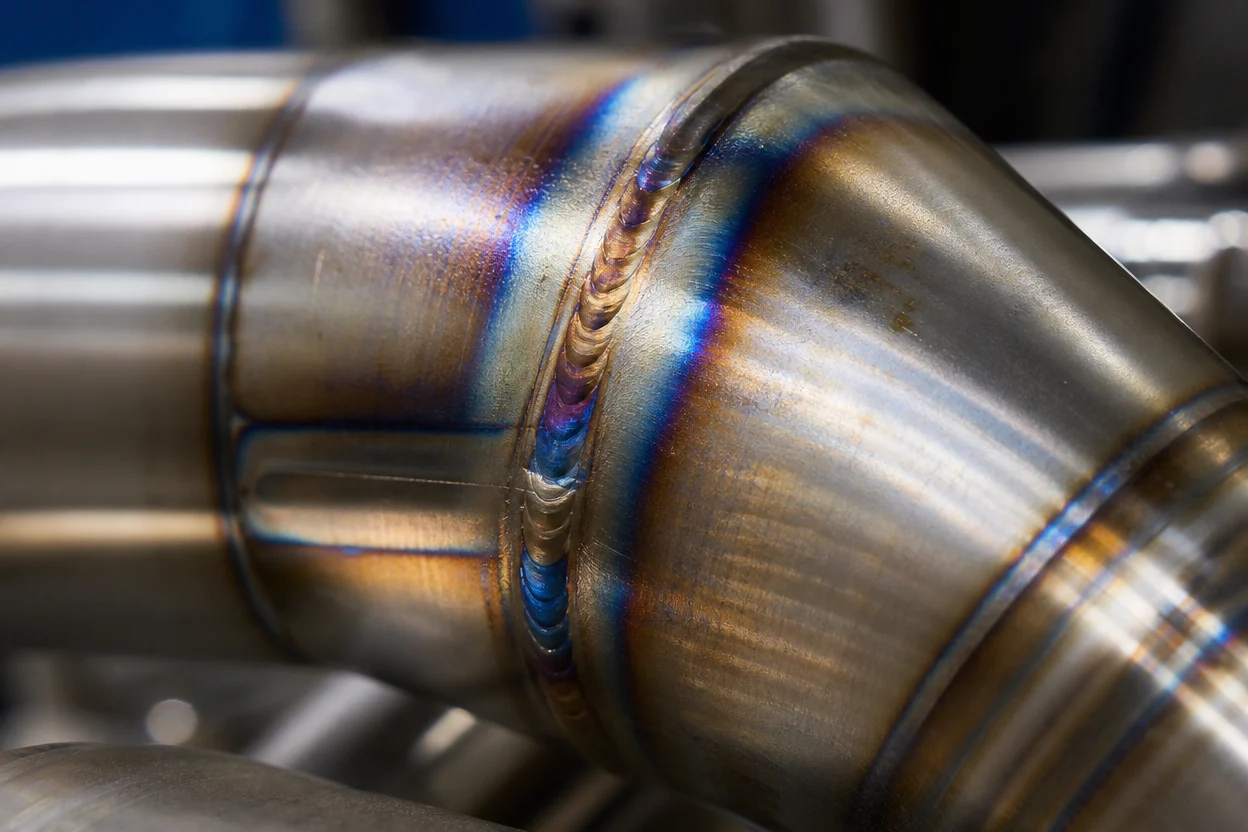
From a fabricator’s standpoint, Grade 12 and Grade 2 behave similarly. Both are rated excellent for weldability and can be hot or cold formed. This is one reason Grade 12 is sometimes described as a “drop-in upgrade” in specifications — shops that work with Grade 2 regularly can handle Grade 12 without retooling or retraining.
Welding
Both grades weld using standard titanium procedures: gas tungsten arc welding (GTAW/TIG) with Grade-matching filler (ERTi-12 for Grade 12, ERTi-2 for Grade 2), full inert gas shielding with no atmospheric exposure during welding and cooling to below 400°F. Argon or helium shielding applies to the weld pool, heat-affected zone, and weld root simultaneously.
Grade 12 weld microstructure is slightly different due to the Ni-Mo content, but the weld joints maintain corrosion resistance equivalent to the base metal when proper procedures are followed. Weld joint efficiency factors and procedure qualifications under ASME Section IX apply to both grades.
One practical note: post-weld annealing is sometimes specified for Grade 12 in aggressive service. The annealing window is 732–816°C (1350–1500°F), held for 2 hours, air cooled. Intermediate stress relief: 538–649°C (1000–1200°F) for 1 hour, air cooled.
Forming
Both grades cold form similarly to austenitic stainless steel in terms of springback behavior. Grade 12 is slightly harder (Brinell up to 235 HB vs 160 HB for Grade 2), so forming forces and die wear are modestly higher. For deep drawing or severe cold forming operations, Grade 2’s greater ductility (37% reduction in area vs 28% for Grade 12) provides more working latitude.
Hot forming improves ductility in both grades. Grade 12 rough forging temperatures run at 871°C (1600°F), with finish forging at 788–843°C (1450–1550°F).
Post-cold-working annealing is recommended for Grade 12 to restore optimal corrosion resistance and eliminate residual stresses.
Machining
Grade 12’s higher hardness means slower cutting speeds, higher tool pressure, and more heat generation compared to Grade 2. Recommended tooling: tungsten carbide (C1–C4 designations) or cobalt-based. Adequate coolant flow is critical — titanium’s low thermal conductivity (19–21 W/mK) means heat concentrates at the cutting edge rather than dissipating into the chip. High feed rates reduce the risk of work hardening.
If a shop is already proficient with Grade 2 machining, Grade 12 requires the same discipline plus slightly more conservative speed settings. The jump is not dramatic.
Applications: Where Each Grade Belongs
Grade 2 and Grade 12 serve overlapping but distinct application spaces. The right choice depends on service conditions — temperature, chloride concentration, acid environment — more than industry sector.
Grade 2 Applications
Grade 2 is the standard titanium for:
- General chemical processing equipment in oxidizing environments at moderate temperatures (below 80°C chloride service)
- Marine hardware — fasteners, heat exchanger tubes, condensers in seawater cooling (ambient to 60°C)
- Medical devices — implants (Grade 4 is more common for higher-stress implants, but Grade 2 is used for low-stress applications)
- Aerospace non-structural components — access panels, brackets, fairings
- Desalination plant components in low-temperature service where crevice geometry can be controlled
- Chlorine and bleach handling — titanium passivates well in wet chlorine gas and sodium hypochlorite
- Storage tanks for nitric acid and other oxidizing acids
Grade 2’s advantages: lowest cost among structural titanium grades, widest availability, easiest to form, most fabricator familiarity.
Grade 12 Applications
Grade 12 earns its place when one or more of the following applies:
- Hot brine service above 80°C — desalination brine heaters, evaporators, multi-effect distillation (MED) equipment
- Geothermal heat exchangers — grade 12 is documented as well-suited for geothermal fluids (Thomas, Stanford Geothermal Workshop)
- Chemical process equipment at elevated temperature and pressure — particularly where design code compliance requires thicker Grade 2 walls that aren’t cost-effective
- Reducing or variable redox environments — streams with dilute HCl, variable oxidizing-reducing conditions
- Pumps and valves in hot, high-chloride service where crevice corrosion at the pump casing or valve seat is a risk
- Pipe and fittings in high-pressure chemical transfer (ASTM B337, B338 applicable to both)
Decision Framework
Use this table when deciding whether to upgrade from Grade 2 to Grade 12:
| Condition | Grade 2 Adequate? | Grade 12 Recommended? |
|---|---|---|
| Temperature < 80°C, chloride service | ✓ Usually yes | Not required |
| Temperature 80–240°C, chloride service | Marginal — evaluate crevice risk | ✓ Yes |
| Temperature > 240°C, chloride service | No | Consider Gr7 or Gr16 (Pd-bearing) |
| Operating pressure requires wall > 1″ at elevated temp | Check ASME allowable | ✓ Run the thickness comparison |
| Boiling dilute HCl < 0.1% | ✓ Grade 2 borderline | ✓ Grade 12 preferred |
| Boiling dilute HCl 0.1–2% | ✗ Not suitable | ✓ Grade 12 works |
| Boiling dilute HCl > 2% | ✗ | Consider Gr7/Gr16 |
| Oxidizing environment only, ambient temp | ✓ Grade 2 is ideal | Not required |
| Reducing environment (no oxidants) | Borderline | ✓ Grade 12 preferred |
| Variable oxidizing-reducing | Risky | ✓ Grade 12 preferred |
| Marine, low-temperature seawater | ✓ Grade 2 | Not required |
| Geothermal or hydrothermal fluids | Evaluate temp | ✓ Grade 12 well-documented |
| Design requires ASME code compliance, >200°F | Check allowables | ✓ Run the comparison |
| Budget-constrained, ambient service | ✓ Grade 2 wins | Not needed |
When Engineers Switch from Grade 2 to Grade 12
The way Grade 12 gets specified in practice doesn’t usually start with a corrosion science discussion. It starts with a failure review.
In the chemical process industry, the typical scenario runs like this: a Grade 2 heat exchanger or pump body performs flawlessly for years, then develops localized pitting or a crevice attack under a gasket or behind a bolt — invariably in a high-temperature zone. The rest of the equipment is fine. The investigation traces the failure to a specific combination of temperature, chloride concentration, and crevice geometry that Grade 2 isn’t rated for at those conditions. Grade 12 is evaluated as the next step up before committing to the more expensive palladium-bearing grades.
What often surprises engineers doing this evaluation for the first time is the ASME allowable story. The expectation going in is that Grade 12 will cost more — because on a per-pound basis, it does. The realization that a Grade 12 vessel can be designed thinner — and that the total installed cost can actually come in lower at the pressure and temperature combinations that triggered the evaluation in the first place — changes the economic calculus.
I’ve reviewed the Tricor Metals MTI Connect 2020 technical publication on this topic extensively, and the data there is the most complete single-source comparison between Grade 2H and Grade 12 in the context of the Chemical Processing Industry that I’ve seen in open literature. Their vessel thickness examples at 300°F/300 psi are particularly instructive: Grade 2H requires 1-3/4″ nominal plate; Grade 12 drops to 1-1/4″ nominal. The math on total material cost favors Grade 12 by ~29% in that scenario, even before factoring in any corrosion-life considerations.
The other pattern worth noting: fabricators who regularly work with Grade 2 and have good titanium welding procedures rarely encounter significant process changes when they move to Grade 12. The alloy behaves similarly enough that ERTi-12 filler and the same shielding gas practices transfer directly. The argument that Grade 12 is “more difficult to fabricate” generally comes from shops with limited titanium experience overall, not from shops that have worked with Grade 2 at scale.
Frequently Asked Questions
What is the main difference between Grade 2 and Grade 12 titanium?
Grade 12 is essentially Grade 2 with 0.8% nickel and 0.3% molybdenum added. These alloying elements increase yield strength (~25% higher minimum), improve crevice corrosion resistance in hot chloride environments (Grade 12 resists crevice attack to ~240°C vs ~80°C for Grade 2), and extend service life in dilute reducing acid environments like hydrochloric acid.
Is Grade 12 titanium stronger than Grade 2?
Yes, significantly. ASTM B265 minimum UTS is 483 MPa (70 ksi) for Grade 12 vs 345 MPa (50 ksi) for Grade 2 — a 40% higher floor. Typical values are 530–550 MPa vs 420 MPa. Yield strength minimums are 345 MPa (Grade 12) vs 275 MPa (Grade 2). Grade 2 retains slightly higher elongation and reduction-in-area, making it more ductile for severe cold forming operations.
Does Grade 12 cost more than Grade 2?
Per pound, yes — approximately 13% more (based on Tricor Metals 2020 data; current market prices vary). However, Grade 12’s higher ASME design allowables allow thinner vessel walls at elevated temperature and pressure. In some scenarios, total project material cost is 21–29% lower with Grade 12 despite the higher unit price.
What ASTM standards cover Grade 12 titanium?
Grade 12 is covered by ASTM B265 (strip/sheet/plate, Grade 12), ASTM B337 (seamless and welded pipe, Grade 12), ASTM B338 (tubes for heat exchangers, Grade 12), ASTM B348 (bar and billet, Grade 12), and ASTM B381 (forgings, F-12). The UNS designation is R53400. The DIN/EN material number is 3.7105.
Can Grade 12 be substituted directly for Grade 2 in existing designs?
In most cases, Grade 12 is a straightforward substitution that adds strength and corrosion resistance. It uses the same ASTM product forms, compatible welding filler (ERTi-12 vs ERTi-2), and similar fabrication procedures. Designers should verify that the higher ASME allowables are applied in any pressure vessel redesign to capture the cost benefit. Material procurement lead times may be longer than Grade 2 due to lower stock availability.
When should I choose Grade 7 or Grade 16 instead of Grade 12?
Palladium-bearing grades (7, 11, 16, 17) are the next step up in corrosion resistance beyond Grade 12. They are specified when service temperatures exceed ~240°C in chloride brine, when HCl concentrations exceed ~1%, or in strongly reducing environments without oxidants. The tradeoff is significantly higher cost (palladium is an expensive alloying element). If Grade 12 meets the corrosion requirements of your service, it is almost always the more cost-effective choice over palladium-bearing grades.
Why is Grade 12 better for crevice corrosion than Grade 2?
Nickel stabilizes titanium’s passive TiO₂ oxide film under the low-oxygen, acidic conditions found in crevice geometries at elevated temperature. In Grade 2, the film breaks down under these conditions above ~80°C in concentrated chloride. The nickel addition in Grade 12 maintains film stability to ~240°C at pH > 2. Molybdenum provides additional protection in reducing acid environments through a separate mechanism similar to its role in Type 316 stainless steel.
Summary
The core decision is straightforward once you know the thresholds. Grade 2 is the right choice for the majority of titanium applications: ambient-to-moderate temperature corrosion service, general chemical processing, marine hardware, and anywhere budget efficiency matters and service conditions don’t push against its limits. It’s available in all product forms, well-understood by fabricators, and provides outstanding corrosion resistance in its design envelope.
Grade 12 earns specification when the service pushes past Grade 2’s crevice corrosion limits — typically above 80°C in chloride environments — or when ASME pressure vessel design at elevated temperature makes the thinner-wall advantage significant enough to offset the higher unit price. The 0.8% Ni and 0.3% Mo additions deliver a quantifiable, standards-backed performance improvement that doesn’t require guesswork to evaluate: the ASME allowable tables, the crevice corrosion pH/temperature curves, and the vessel thickness calculations are all available, and they consistently favor Grade 12 in the conditions where it’s specified.
The most common mistake engineers make is evaluating the two grades only on unit material cost. The project-level cost comparison, incorporating ASME allowable stresses and the resulting wall thickness calculation, regularly reverses the Grade 2 cost advantage at elevated operating conditions.
If you’re evaluating a Grade 2 to Grade 12 upgrade, the first steps are: define your operating temperature, identify the worst-case chloride concentration and pH, check for crevice geometry in your design, and run the ASME allowable comparison for your design pressure. In many cases, the data will make the decision obvious.