Titanium travel mugs weigh 40–60% less than stainless steel, never impart a metallic taste, and are among the safest drinkware materials available — the same Grade 1–2 CP titanium used in surgical implants. The trade-off: double-wall titanium keeps coffee drinkably hot for 45–60 minutes, not 6–12 hours like a vacuum thermos. Single-wall titanium cools in ~20 minutes but can go directly on a camp stove. If you’re counting grams on a multi-day trail, titanium wins decisively. For all-day heat retention at the office, a vacuum-insulated stainless thermos still outperforms. This guide covers the real insulation data, the safety science, and the best titanium travel mugs for every use case in 2026.

The Insulation Reality Check No One Talks About
Most buyers discover this the hard way, so let’s get it out front.
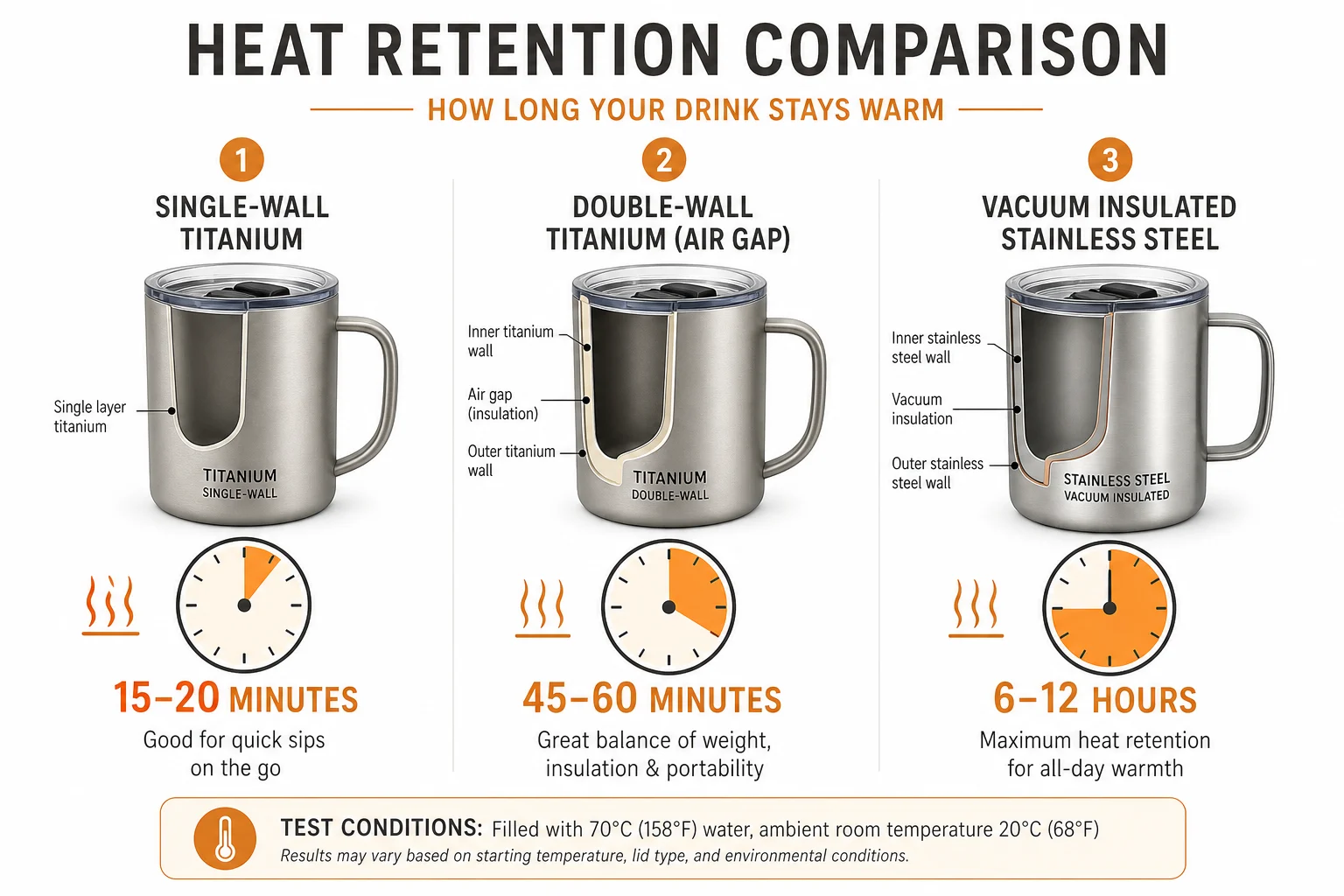
Double-wall titanium mugs keep coffee hot for roughly 45–60 minutes. Not 6 hours. Not “all day.” That’s how long you have before a cup drops from hot to warm, based on real-world reports from r/snowpeak, r/Ultralight, and extended field testing.
This surprises people because “double-wall” sounds like it should mean serious insulation. It does — but there are two different technologies sharing that name:
- Double-wall air gap (titanium mugs): Two layers of metal with a trapped air pocket between them. Air is a decent insulator, but heat still escapes at the rim and through convection in the gap.
- Vacuum-insulated double wall (stainless thermos): Same two layers, but the air is evacuated, creating a near-perfect insulating vacuum. A quality vacuum-insulated Yeti or Hydro Flask keeps coffee hot for 6–12 hours.
Snow Peak’s Ti-Double 450 — the category benchmark — uses air-gap insulation, not vacuum. That’s not a knock on it. It keeps your drink drinkably warm through a 45-minute morning hike far better than a single-wall cup. But if your goal is hot coffee from 7am until noon at a desk, a $35 stainless vacuum thermos beats a $50 titanium double-wall every time.
Where does that leave single-wall titanium? Coffee stays hot for about 15–20 minutes at room temperature. That sounds terrible until you realize: single-wall titanium can go on a camp stove. You fill it with water, boil directly in the cup, pour in your coffee, and drink. For backpackers, this multi-tool function is the whole point.
| Type | Heat Retention | Stove-Safe | Typical Weight (450ml) | Price |
|---|---|---|---|---|
| Single-wall titanium | ~15–20 min | ✅ Yes | 48–76g | $20–$35 |
| Double-wall titanium (air gap) | ~45–60 min | ❌ No | 77–104g | $40–$60 |
| Vacuum-insulated stainless | 6–12 hours | ❌ No | 200–450g | $25–$55 |
| Double-wall stainless | ~2–3 hours | ❌ No | 180–300g | $20–$45 |
Set the right expectations first. Then decide which trade-offs fit your life.
Titanium vs Stainless Steel: What the Numbers Actually Mean
Here’s the full material comparison, using verified specs rather than marketing copy.
| Property | Pure Titanium (Grade 2 CP) | Stainless Steel 304 |
|---|---|---|
| Density | 4.51 g/cm³ | 7.9 g/cm³ |
| Thermal conductivity | ~16.4 W/m·K | ~16.2 W/m·K (304 grade) |
| Melting point | 1,668°C | ~1,400°C |
| Weight savings vs SS | ~43% lighter | — |
| Rust/corrosion | Zero (permanent oxide layer) | Highly resistant, not rustproof |
| Food safety | Inert, no leaching | Can leach trace nickel/chromium at elevated pH/heat |
| Taste impact | None (taste-neutral) | Can be metallic, especially with acidic drinks |
| Dent resistance | Lower (0.3–0.5mm walls) | Higher (thicker gauge walls) |
| Price premium | 2–3× vs comparable SS | Baseline |
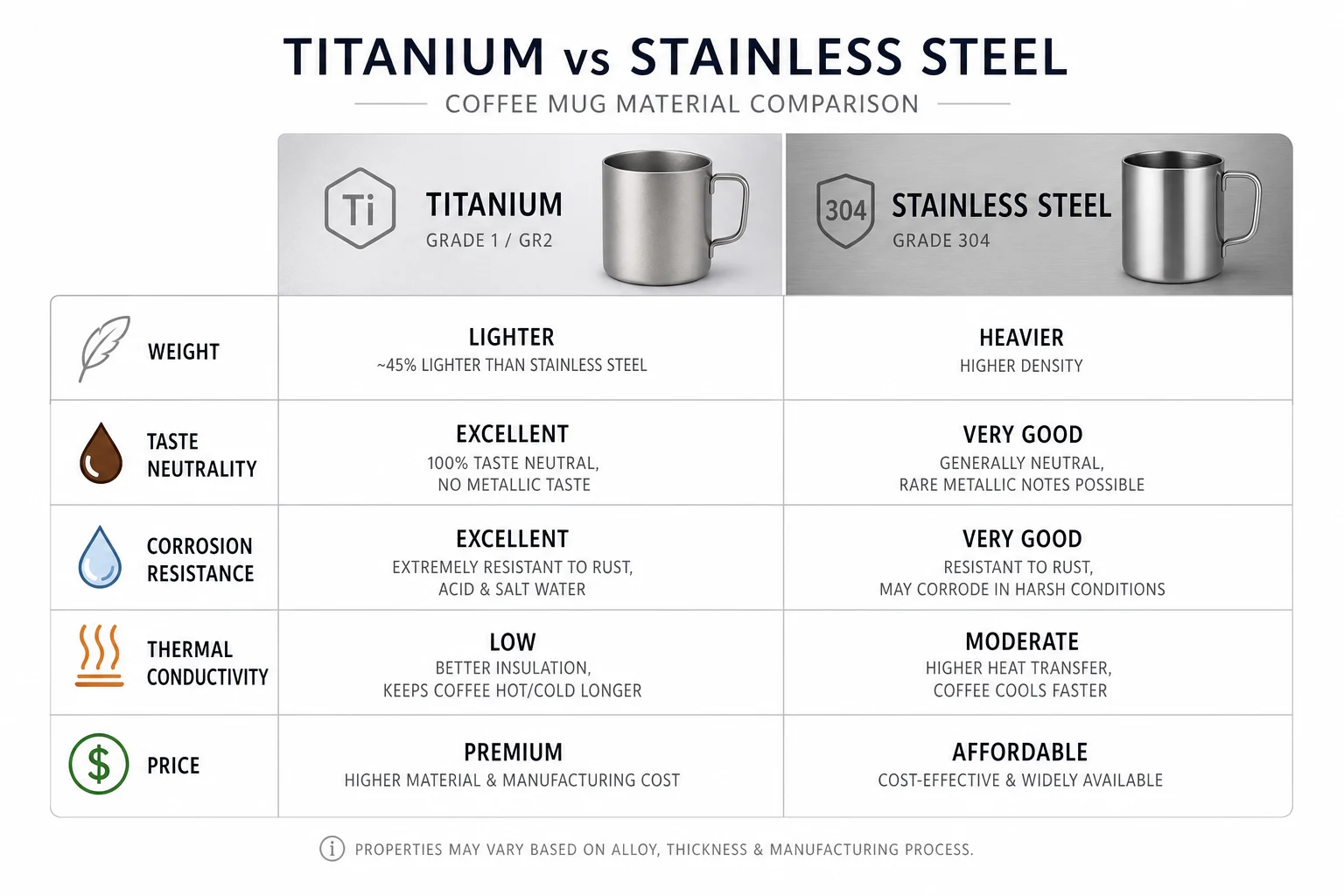
A note on thermal conductivity: you’ll see conflicting numbers online — and some marketing copy claims titanium is a particularly poor heat conductor that inherently keeps drinks warm. The actual values don’t support that. Grade 2 CP titanium measures ~16.4 W/m·K; 304 stainless steel runs ~16.2 W/m·K. They are nearly identical in this regard. The insulation in a double-wall Ti mug comes entirely from the trapped air gap between the walls, not from titanium being unusually resistant to heat flow. Single-wall titanium and single-wall stainless perform similarly in cooling rate.
Weight: Where Titanium Wins Decisively
A 450ml single-wall TOAKS titanium mug weighs 76g. A comparable Yeti Rambler 14oz stainless tumbler weighs around 450g. That’s a 374g difference — roughly the weight of a full can of soda.
For a backpacker already carrying food, shelter, and water, that difference is felt in the shoulders by mile 8. For someone walking from a parking garage to an office, it’s irrelevant.
Taste: Titanium Wins for Coffee Drinkers
A side-by-side pour test — same Ethiopian light roast, same temperature, same brew time — tells you something no spec sheet does. Stainless steel develops a metallic aftertaste after 10–15 minutes, particularly with acidic coffees. Titanium doesn’t. This is consistent across r/Coffee, r/tea, and multiple independent testers.
The chemistry: titanium forms an extremely stable titanium dioxide surface layer (TiO₂) on contact with oxygen. This layer is chemically inert in the pH range of coffee (pH ~5) and tea. Stainless steel’s chromium-oxide passivation layer is also stable, but under heat and acidity it can catalyze trace reactions — particularly in lower-grade steel. If you’ve ever noticed coffee tasting “sharper” or “metallic” in a travel mug, material is likely the cause.
Is Titanium Safe? Clearing Up the Confusion
Short answer: yes. But the reasoning is worth understanding because there’s a real source of confusion.
Pure titanium (Grades 1–4 CP) is FDA-cleared for long-term medical implantation. Hip replacements, bone plates, dental implants — they’re all titanium. The human body tolerates titanium better than almost any other metal. If your body can carry a titanium plate in your femur for 30 years, your morning coffee in a titanium mug is not a concern.
The confusion arises from titanium dioxide (TiO₂) — a different story entirely. TiO₂ is a whitening agent used in some food additives and ceramic non-stick coatings. In 2021, the European Food Safety Authority (EFSA) published its opinion that titanium dioxide (E171) could “no longer be considered safe as a food additive” due to concerns about nanoparticle genotoxicity. The EU formally banned it in 2022. This ruling applies specifically to TiO₂ particles as a food additive — not to solid metal objects.
A solid titanium mug does not shed TiO₂ nanoparticles into your drink. It’s one piece of metal with a stable, non-shedding oxide surface. The EFSA ruling has nothing to do with titanium drinkware.
All reputable titanium mug brands — Snow Peak, TOAKS, Vargo, SilverAnt, Fire Maple — use commercially pure Grade 1 or Grade 2 titanium. These are 99%+ titanium by weight, no coatings, no alloying agents that could leach.
Single-Wall vs Double-Wall: The Decision That Matters Most
If there’s one choice that determines whether a titanium mug works for you, it’s this one — not which brand you buy.
Choose single-wall if:
- You backpack or camp and want to boil water or heat food directly in the mug
- Weight is your primary metric (48–76g vs 77–104g)
- You drink your coffee within 15–20 minutes of pouring
- You’re on a budget ($15–$35 range)
Choose double-wall if:
- You want a desktop/commute mug and don’t need stove compatibility
- You want the exterior to stay cool (no burned hands, no condensation ring on your desk)
- You’ll drink coffee over 30–60 minutes at a workstation or campsite
- You’re willing to pay $40–$60 for better thermal performance
One nuance: Snow Peak’s double-wall design is air-gap, not vacuum. This is why the Snow Peak Ti-Double 450 community on Reddit often describes it as “keeps my coffee warm enough for a leisurely camp breakfast” rather than “keeps it hot for hours.” That’s accurate and still useful — it’s just a different performance tier than a vacuum thermos.
Best Titanium Travel Mugs in 2026

Based on manufacturer specs, user feedback across r/Ultralight, r/snowpeak, and verified Amazon reviews.
Best Budget Pick: TOAKS 450ml Single-Wall (~$15)
76g, Grade 1 titanium, 0.5mm walls, folding handles, mesh storage bag included. 1,900+ Amazon ratings at 4.8 stars. Stove-safe. The default recommendation for anyone new to titanium — cheap enough to try without commitment, performs well enough that most users never feel the need to upgrade. (Ultralight 0.3mm version is ~$20.)
Best Double-Wall: Snow Peak Ti-Double 450 ($49.95)
104g, Japanese manufacturing, 450ml. The gold standard for double-wall titanium. Cool exterior, no handle (which keeps the insulating layer intact), and nests with the Ti-Single 300 for compact stacking. Made in Japan. No lid included, not stove-safe. Worth the price if you value build quality; the TOAKS double-wall ($39.95, 77g) is a solid $10-cheaper alternative with comparable insulation.
Best for Minimalist Backpackers: Fire Maple Alti 300 ($21.99)
63g, 300ml, 0.4mm single-wall, folding handles, 3-year warranty. 4.72 stars from 3,000+ reviews. 84mm diameter fits inside most camp pots, which is the real reason minimalists choose it — it packs inside your cooking system rather than outside it.
Best Single-Wall with Lid: Vargo Titanium 450 Travel Mug ($34.95)
85g, single-wall, 450ml, includes a leakproof silicone-gasket lid and Vargo’s folding “Bot Handle.” If you want a single-wall mug that won’t spill on the trail, this is the one. Most single-wall titanium mugs have no lid or just a loose cover.
Best with Handles + Lifetime Warranty: SilverAnt Double-Wall 450 (~$45)
Grade 1 titanium, double-wall, folding handles (unlike the handle-less Snow Peak design), lifetime warranty. Good option if you find the Snow Peak’s handle-less form awkward and want long-term manufacturer support.
Which Titanium Mug for Your Life?
Not everyone buying a titanium mug is planning a 50-mile thru-hike. Here’s a quick decision map:
You backpack 2+ days at a time: Single-wall titanium (TOAKS 450 or Fire Maple Alti 300). Weight and stove compatibility over heat retention.
You want a premium desk/home mug: Snow Peak Ti-Double 450 or TOAKS Double-Wall 450. The cool exterior and 45–60 minute warmth window suits leisurely morning routines.
You commute by transit and sip coffee for 2+ hours: Skip titanium. A vacuum-insulated stainless thermos (Zojirushi, Stanley, or Hydro Flask) with 6+ hour retention is the right tool here.
You’re a coffee purist who hates metallic taste: Any titanium mug. Single-wall at ~$15 will demonstrate the taste difference without financial risk.
You camp at a car campsite: Either material works fine. Stainless steel at half the price makes more financial sense when weight doesn’t matter.
Care and Longevity
Titanium mugs don’t need much:
- Hand-wash with mild soap and warm water. Titanium is non-reactive, so most cleaning agents work fine, but bleach-based cleaners can attack the surface on prolonged contact.
- Coffee stains respond to baking soda paste or a small amount of Bar Keepers Friend.
- Double-wall models should never go in the dishwasher — the high-heat cycles stress the welds that seal the air gap, potentially compromising insulation over time.
- Single-wall mugs are technically dishwasher-tolerant, but repeated cycles leave a cloudy surface finish over time.
What actually damages titanium: hard impacts on rock or concrete, which dent the thin walls. A dented mug still functions, but the dent is permanent — titanium doesn’t spring back. If you’re prone to dropping things, the thicker walls of stainless steel are more forgiving.
Titanium doesn’t rust, doesn’t hold odors, and doesn’t permanently stain. A well-used titanium mug develops a character — scuffs, minor dents — that tells the story of where it’s been.
FAQ
Is a titanium mug better than stainless steel?
For weight and taste: yes. A 450ml titanium mug weighs 60–104g vs 180–450g for stainless steel. Titanium produces no metallic aftertaste with acidic drinks. For heat retention (6+ hours) and dent resistance, stainless steel still wins. Choose based on your priorities.
Are titanium mugs safe to drink from?
Yes. Pure titanium (Grade 1–2 CP) is FDA-cleared for medical implants and chemically inert in contact with food and beverages. Don’t confuse solid titanium with titanium dioxide coatings — they’re different materials with different risk profiles. All major titanium mug brands use uncoated, solid CP titanium.
How long does a titanium travel mug keep coffee hot?
Double-wall titanium (Snow Peak Ti-Double, TOAKS double-wall) keeps coffee drinkably hot for 45–60 minutes. Single-wall titanium cools to warm within 15–20 minutes at room temperature. For all-day heat retention, a vacuum-insulated stainless thermos outperforms both.
Can you put a titanium mug on a camp stove?
Single-wall only. Single-wall titanium mugs (TOAKS, Fire Maple, Vargo single-wall) are stove-safe — gas, alcohol burner, campfire. Double-wall titanium mugs (Snow Peak Ti-Double, TOAKS double-wall) cannot go on a heat source. The trapped air expands and can burst the welds.
Does titanium affect the taste of coffee?
No — titanium is taste-neutral. Its stable oxide surface doesn’t react with coffee’s acids. Side-by-side taste tests consistently show no flavor difference between titanium and ceramic. Stainless steel can produce a metallic aftertaste, especially with light-roast acidic coffees after 10–15 minutes.
Why is titanium more expensive than stainless steel?
Titanium is harder to mine, process, and machine than steel. It requires specialized welding equipment and more precise manufacturing tolerances, particularly for the thin-wall construction of camping mugs (0.3–0.5mm). The TOAKS 450 single-wall at ~$15 carries only a modest premium over comparable stainless mugs. The Snow Peak Ti-Double 450 at $49.95 commands more, reflecting Japanese manufacturing quality and the complexity of welding a thin-wall double shell.
The Bottom Line
Titanium travel mugs earn their reputation for one specific use case: outdoor performance where weight matters and metallic taste is a dealbreaker. For backpackers, they’re the right tool. For daily coffee drinkers who prioritize taste over everything, they’re a genuinely better experience than most stainless options.
They don’t replace a vacuum thermos for all-day heat retention — and no titanium-specific marketing should convince you otherwise. Set that expectation correctly, and a titanium mug becomes one of the most satisfying pieces of drinkware you’ll own.
Start with the TOAKS 450 single-wall at ~$15. If titanium converts you — and it usually does — the Snow Peak Ti-Double 450 is the natural next stop.