
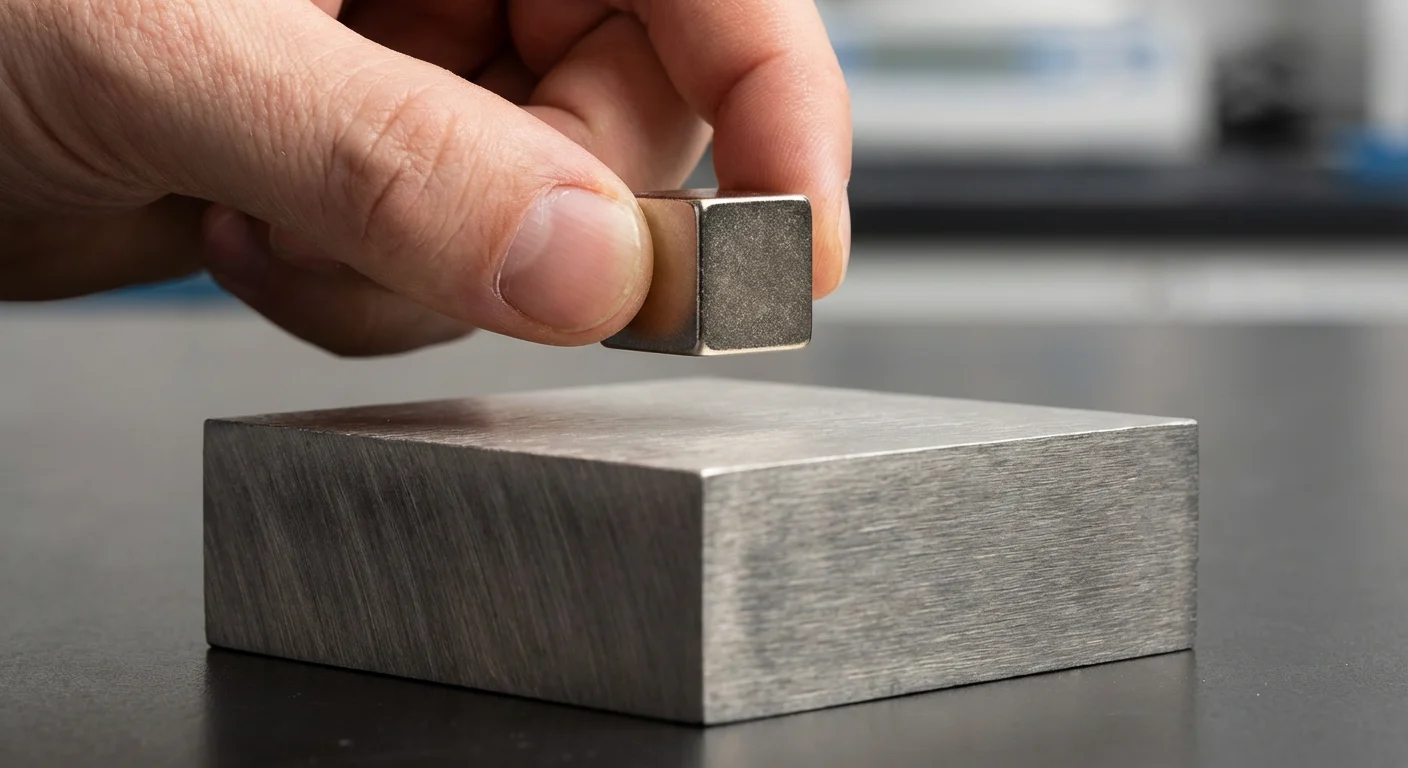
When you hold a piece of titanium, you feel its surprising lightness and strength. But a common question arises, especially when considering its use in everything from high-tech aerospace components to medical implants: is titanium magnetic?
The short and direct answer is: no, pure titanium is not magnetic.
However, the complete story is slightly more nuanced and far more interesting. Titanium is technically classified as a paramagnetic material. This means that while it is very weakly attracted to a magnetic field, the force is so incredibly slight that for all practical purposes, it is considered non-magnetic. You could press the strongest magnet you can find against a piece of pure titanium, and you would feel no pull or “sticking” whatsoever.
In this guide, we will dive deep into the science behind titanium’s unique magnetic properties. We’ll explore why it behaves this way, how titanium alloys can differ, and why this non-magnetic characteristic is one of its most critical superpowers in the modern world.
The Scientific Reason Titanium Isn’t Magnetic
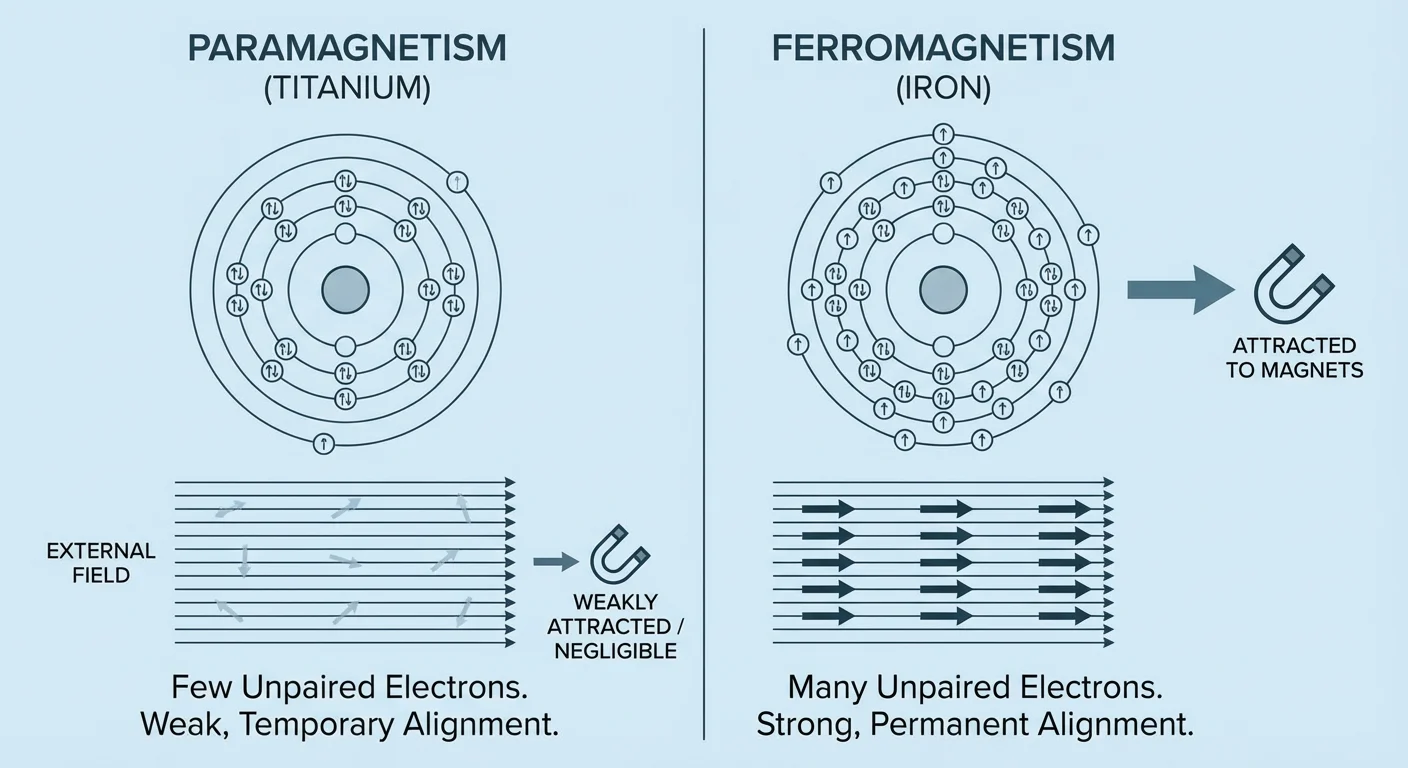
To understand why titanium doesn’t stick to a magnet, we need to look at what’s happening at the atomic level. The answer lies in its unique electron structure, which sets it apart from strongly magnetic metals like iron.
The Key is in its Electron Structure
Imagine an atom’s magnetic potential as the noise level in a room full of people.
In a piece of iron, each atom’s “room” is filled with many active, unpaired electrons. Think of these as loud, energetic individuals all moving around, creating a huge amount of collective noise. When an external magnetic field is applied, it’s like a conductor stepping in and directing all these individuals to shout in the same direction, creating a powerful, unified magnetic force.
Now, consider titanium. Its “room” is much quieter. Most of its electrons are neatly paired up, like quiet couples sitting together. There are only a few unpaired electrons wandering around. While these few lone electrons can be weakly influenced by a magnetic field, there simply aren’t enough of them to create any significant magnetic “noise.” This is the essence of paramagnetism and why you feel no magnetic pull.
Paramagnetic vs. Ferromagnetic: A Simple Comparison
The clearest way to understand titanium’s behavior is to see it side-by-side with a truly magnetic material like iron.
| Feature | Paramagnetic (e.g., Titanium) | Ferromagnetic (e.g., Iron) |
|---|---|---|
| Reaction to a Magnet | Very weakly attracted, practically unnoticeable. | Strongly attracted, “sticks” to the magnet. |
| After Magnet is Removed | Instantly loses all magnetic properties. | Can retain some magnetism (become magnetized). |
| Real-World Feel | Feels completely non-magnetic. | Feels powerfully magnetic. |
| Example Metals | Titanium, Aluminum, Platinum, Tungsten | Iron, Nickel, Cobalt |
This fundamental difference is why titanium is chosen for applications where strong magnetic interference is a problem, while iron is the king of applications that require strong magnetic force.
Are Titanium Alloys Magnetic? It’s Complicated
Now that we’ve established that pure titanium is non-magnetic, we need to address a crucial point: most of the titanium you encounter in everyday life is actually a titanium alloy. An alloy is a metal mixture, where other elements are added to titanium to enhance properties like hardness or heat resistance.
So, does this change its magnetic properties? The answer is: it depends entirely on what the titanium is mixed with.
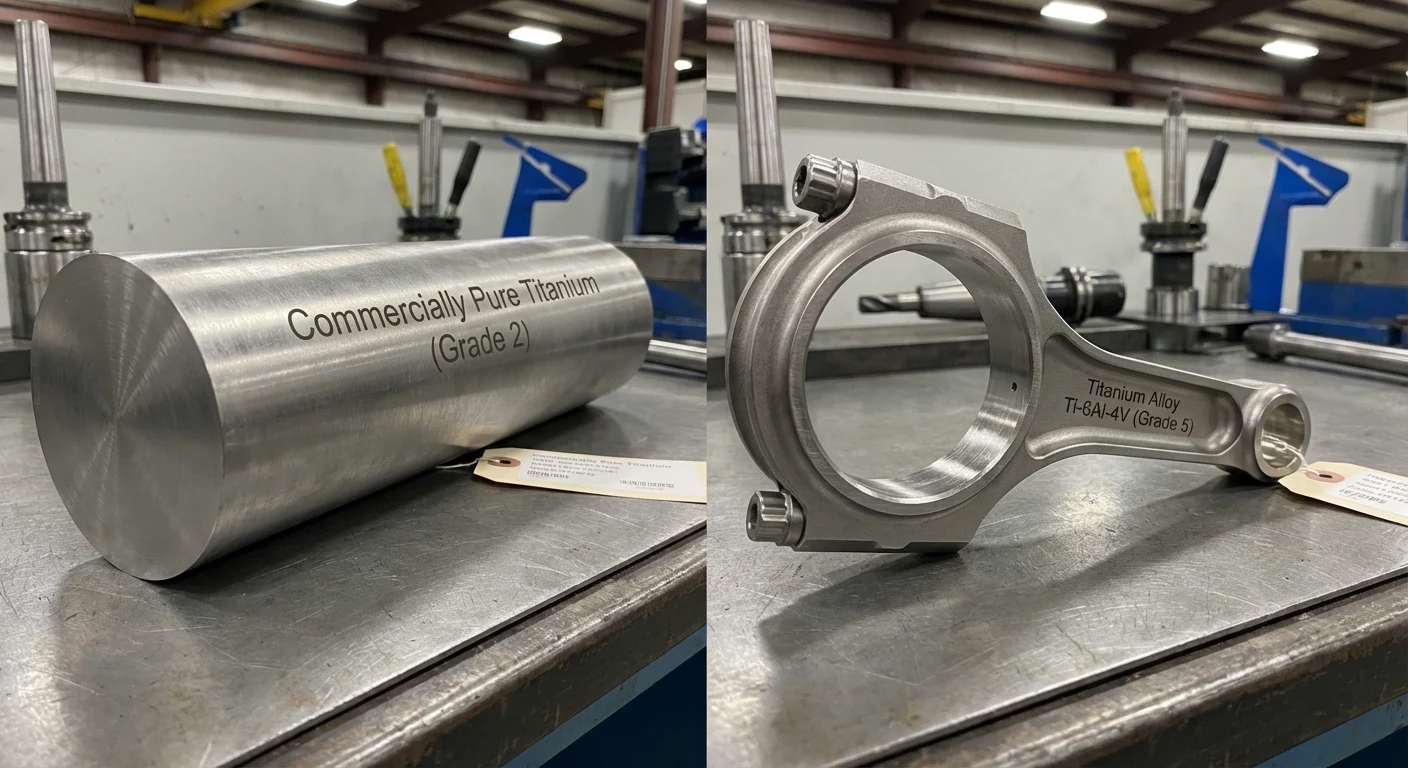
Case Study: Is Grade 5 Titanium (Ti-6Al-4V) Magnetic?
Let’s start with the world’s most popular titanium alloy, Grade 5 (also known as Ti-6Al-4V). It makes up over 50% of all titanium used globally, found in everything from aircraft frames to surgical implants.
For all practical purposes, the answer is still a resounding no, Grade 5 titanium is not magnetic.
The reason is simple: its main alloying elements are Aluminum (Al) and Vanadium (V), both of which are, like titanium, paramagnetic. Since you are mixing non-magnetic metals together, the resulting alloy remains non-magnetic. It is completely safe for MRI machines and other magnetically sensitive environments.
When Can a Titanium Alloy Be Magnetic?
A titanium alloy will only exhibit noticeable magnetic properties if it is mixed with a sufficient amount of a ferromagnetic metal. The most common culprit here is iron (Fe).
Some specialized alloys, for instance certain types used in the automotive industry, might contain a higher percentage of iron to achieve specific performance characteristics. In these cases, the alloy might be weakly magnetic. However, this is the exception, not the rule. For medical, aerospace, and high-performance consumer applications, manufacturers specifically choose alloy compositions that are functionally non-magnetic.
Why It Matters: Key Applications of Non-Magnetic Titanium
The fact that titanium is a strong, lightweight, corrosion-resistant, and non-magnetic metal is what makes it a true “super material.” This unique combination of properties unlocks applications where other metals simply cannot perform.

1. The Medical Field: A Lifesaving Property
This is where titanium’s non-magnetic nature is most critical.
- MRI and CT Scans: Powerful imaging machines like MRI (Magnetic Resonance Imaging) use incredibly strong magnetic fields. If a patient has an implant made of a magnetic material, it could lead to disastrous consequences, including tissue damage or distortion of the diagnostic image. Because medical-grade titanium is non-magnetic, it is the gold standard for implants like joint replacements, bone plates and screws, dental implants, and cardiovascular stents. Patients with these devices can safely undergo MRI scans.
- Surgical Instruments: Surgeons often use titanium instruments because they are lightweight, durable, and won’t be attracted to other instruments or metallic objects in a sterile field.

2. Aerospace & Aviation: Ensuring Navigational Accuracy
An aircraft is a complex web of sensitive electronics and navigational equipment. Instruments like a magnetic compass are highly susceptible to interference from nearby metallic objects. By using non-magnetic titanium for structural components, fasteners, and landing gear, engineers can reduce “magnetic noise,” ensuring the reliability and accuracy of critical flight systems.
3. Electronics & Scientific Instruments: Preventing Interference
In environments where even the slightest magnetic field can disrupt performance, titanium is an ideal choice. This includes manufacturing components for hard disk drives, where magnetic interference could corrupt data, and building specialized scientific instruments used in physics labs that require a magnetically neutral environment.
4. Consumer Goods: Quality You Can Feel
Why are high-end watches, premium laptop bodies, and designer eyewear often made of titanium? Beyond being lightweight and hypoallergenic, the non-magnetic property adds to the quality. A pilot wearing a titanium watch, for example, doesn’t have to worry about it interfering with the instruments in the cockpit.
5. Marine Engineering: Corrosion and Compass Safe
On a ship or submarine, titanium’s famous resistance to saltwater corrosion is its main selling point. However, its non-magnetic nature is a significant secondary benefit. Using it for propellers, shafts, and hull components ensures it won’t interfere with the ship’s vital magnetic compass and navigation systems.
DIY Guide: How to Tell if a Metal is Titanium Yourself
So you have a piece of metal that you suspect is titanium, but you’re not sure. While a definitive analysis requires professional equipment, you can perform a few simple, non-destructive tests at home to get a very good idea.
1. The Magnet Test: The Easiest First Step
This is the most direct test for magnetic properties.
- What you need: A strong magnet. A small, powerful rare-earth magnet (neodymium magnet) works best, but a strong kitchen magnet can also work.
- How to do it: Simply press the magnet firmly against the surface of the metal.
- What to look for: If the metal is pure titanium or a common titanium alloy like Grade 5, you will feel absolutely no pull or stickiness. It will feel the same as pressing the magnet against a piece of wood or plastic. If the magnet sticks, you have a ferromagnetic metal like steel or iron.
2. The Weight Test: The “Heft” Factor
This test relies on titanium’s famously low density.
- What you need: Your hands, and ideally, a piece of steel of a similar size for comparison.
- How to do it: Hold the mystery metal in one hand and the piece of steel (like a wrench or a pair of pliers) in the other.
- What to look for: Titanium is about 45% lighter than steel. The difference is immediately noticeable. The titanium piece will feel surprisingly and unnaturally light for its size, almost like a high-quality aluminum, but with a harder, more solid feel.

3. The Spark Test (For Advanced Users)
This test is more definitive but requires safety equipment and should only be performed by those with workshop experience.
- What you need: A bench grinder, safety glasses, and gloves.
- How to do it: Lightly touch the metal to the spinning grinder wheel in a dimly lit area.
- What to look for: Steel produces a shower of yellow-orange sparks. Titanium, on the other hand, emits a brilliant and distinctive shower of bright white sparks. The effect is dramatic and a clear giveaway for titanium.
Frequently Asked Questions (FAQ)
Q: So, will a magnet stick to my titanium ring or watch?
A: No. Jewelry and watches are almost always made from commercially pure titanium or Grade 5 alloy, neither of which is magnetic.
Q: Can I have an MRI scan if I have a titanium medical implant?
A: Yes. This is one of the primary reasons medical-grade titanium is used for implants. It is considered “MRI safe.” Always inform your doctor and MRI technician about any implants you have, but you can be confident that your titanium implant is not a risk.
Q: Will my titanium hip replacement or dental implant set off airport metal detectors?
A: Yes, it is very likely it will. Metal detectors are designed to detect all types of metal, not just magnetic ones. However, you have nothing to worry about. Simply inform the security agent about your medical implant; they are trained for this situation and will use a secondary screening method.
Conclusion: Titanium – The Versatile, Non-Magnetic Powerhouse
So, we come back to our original question: is titanium magnetic?
The simple answer is no. For all practical intents and purposes, the pure metal and its most common alloys are functionally non-magnetic. This property, born from its unique atomic structure, is not just a scientific curiosity—it’s a critical feature that makes titanium an indispensable material.
From safeguarding a patient’s life inside an MRI machine to ensuring a pilot’s compass remains true, titanium’s lack of magnetism is a silent superpower. It is this combination of strength, lightness, corrosion resistance, and non-magnetic performance that truly solidifies its status as a modern powerhouse material.