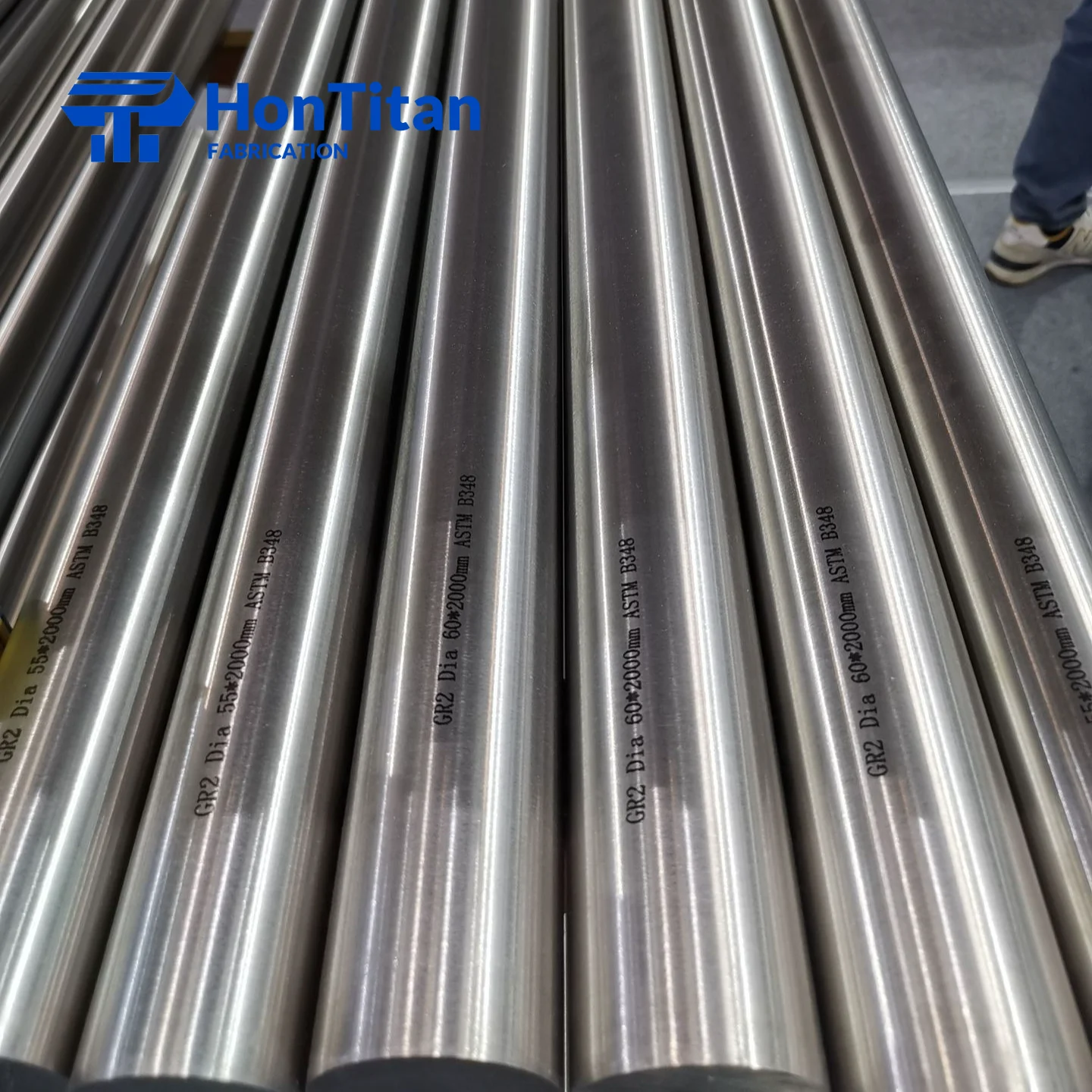
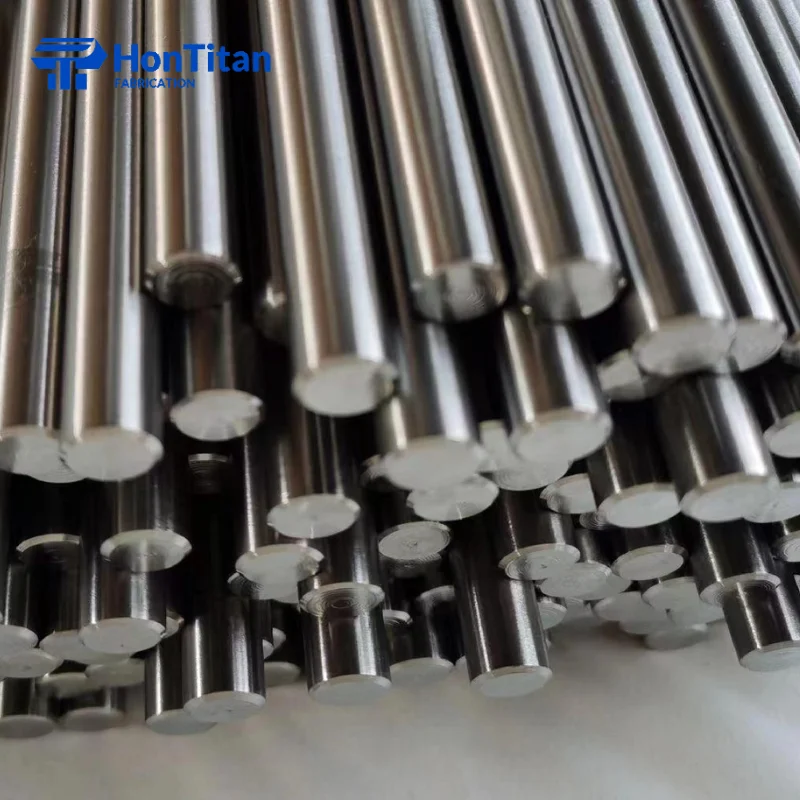
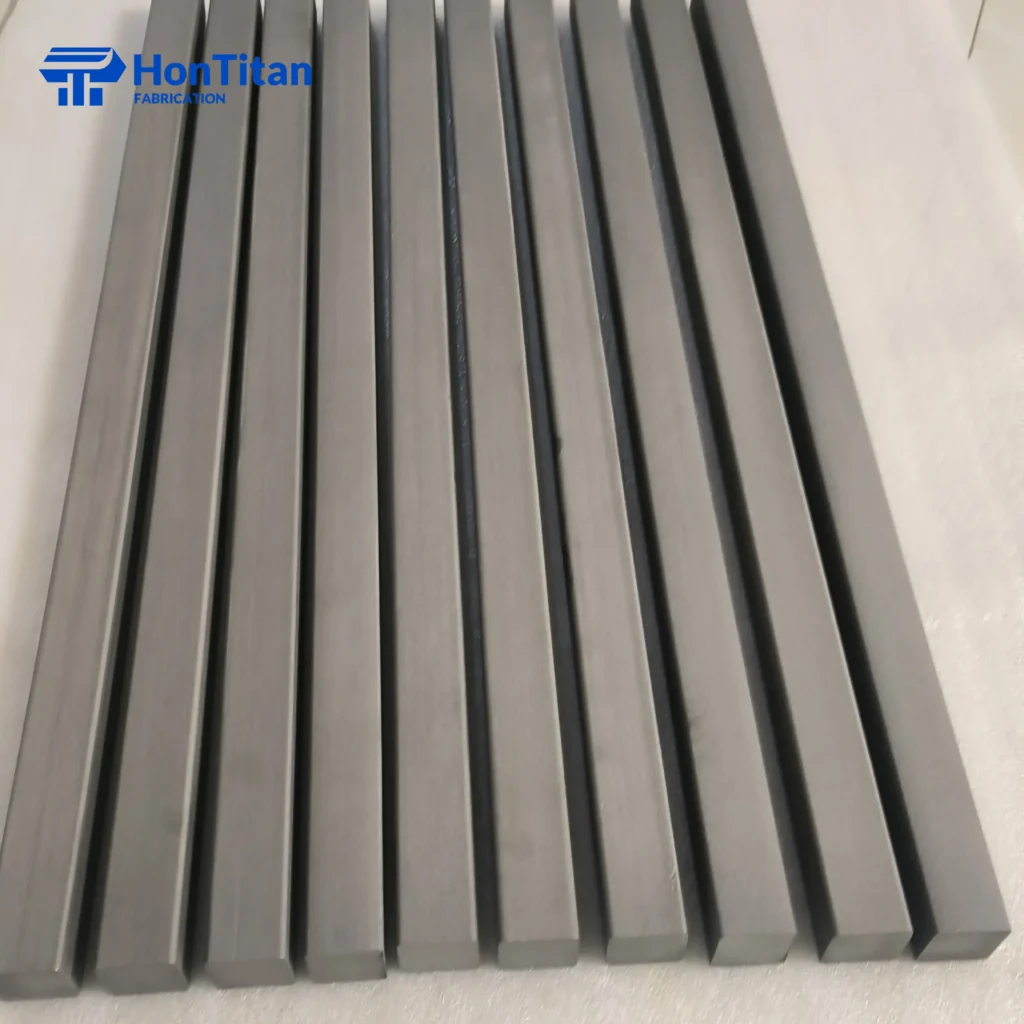
Grade 2 Titanium Round Bar — Quick Specifications
| Parameter |
Value |
| Material |
Commercially Pure Titanium (CP Ti Grade 2) |
| UNS Designation |
R50400 |
| Primary Standard |
ASTM B348 / ASME SB-348 |
| Medical Standard |
ASTM F67 / ISO 5832-2 |
| Diameter Range |
6 mm – 300 mm |
| Length |
Up to 6,000 mm (cut-to-length available) |
| Condition |
Annealed |
| Surface Finish |
As-rolled, turned, or ground (h9–h11) |
| Mill Test Certificate |
EN 10204 3.1 |
| MOQ |
10 kg |
| Lead Time |
3–7 business days (stock) / 2–4 weeks (custom) |
Chemical Composition of Grade 2 Titanium — Per ASTM B348
Grade 2 titanium is classified as commercially pure (CP) titanium — an unalloyed form of titanium consisting primarily of titanium with tightly controlled limits on interstitial and residual elements. At service temperature, CP Grade 2 exists entirely as a hexagonal close-packed (HCP) alpha phase, with no alloying additions to form a beta phase. This single-phase alpha structure is the basis of its outstanding weldability and formability.
Composition Table (ASTM B348, wt%)
| Element |
Maximum (wt%) |
| Titanium |
Balance |
| Oxygen (O) |
0.25 |
| Iron (Fe) |
0.30 |
| Carbon © |
0.08 |
| Nitrogen (N) |
0.03 |
| Hydrogen (H) |
0.015 |
| Other elements, each |
0.10 |
| Other elements, total |
0.40 |
Source: ASTM B348-19, Table 1 — Chemical Requirements
Understanding “Commercially Pure” Titanium
CP titanium grades (1 through 4) are differentiated by their allowable oxygen and iron content, which controls yield strength. Grade 2 occupies the middle range:
- Grade 1 — lowest O and Fe limits; highest ductility, lowest strength
- Grade 2 — moderate O (max 0.25%) and Fe (max 0.30%); balance of strength and formability
- Grade 3 — higher O and Fe; increased strength, reduced ductility
- Grade 4 — highest CP grade strength; reduced weldability compared to Grades 1–2
The absence of alloying elements means Grade 2 retains the natural corrosion resistance and biocompatibility of pure titanium, making it suitable for both chemical-contact and implantable medical applications (ASTM F67, ISO 5832-2).
Mechanical Properties of Grade 2 Titanium Bar — ASTM B348 Minimums
Grade 2 titanium bar in the annealed condition meets the following minimum mechanical property requirements per ASTM B348-19. Actual mill values typically exceed these minimums; EN 10204 3.1 test reports document heat-specific results for each order.
Room Temperature Mechanical Properties
| Property |
Minimum Value |
Unit |
Test Method |
| Ultimate Tensile Strength (UTS) |
345 |
MPa (50 ksi) |
ASTM E8 |
| Yield Strength (0.2% offset) |
275 |
MPa (40 ksi) |
ASTM E8 |
| Elongation in 50 mm (2 in.) |
20 |
% |
ASTM E8 |
| Reduction of Area |
30 |
% |
ASTM E8 |
All values are minimums per ASTM B348-19, Table 3. Material supplied in annealed condition.
Physical Properties
| Property |
Value |
Unit |
| Density |
4.51 |
g/cm³ |
| Elastic Modulus |
103 |
GPa |
| Thermal Conductivity |
16.4 |
W/m·K |
| Coefficient of Thermal Expansion (20–100°C) |
8.6 |
µm/m·°C |
| Melting Range |
1,668 |
°C (3,034°F) |
| Alpha-Beta Transformation Temperature |
882.5 |
°C (1,620°F) |
Service Temperature Range
Grade 2 titanium maintains adequate mechanical properties across a broad temperature range:
- Cryogenic service: Approved for use down to −59°C (−75°F) under ASME Boiler and Pressure Vessel Code (BPVC) guidelines
- Continuous elevated-temperature service: Up to 427°C (800°F)
- Intermittent service: Up to 538°C (1,000°F)
These capabilities make Grade 2 bar suitable for cryogenic vessel components, heat exchanger tubing supports, and chemical reactor internals operating at moderate elevated temperatures.
Corrosion Resistance of Grade 2 Titanium in Industrial Environments
Grade 2 titanium derives its corrosion resistance from a stable, self-healing titanium dioxide (TiO₂) passive oxide layer that forms spontaneously on exposure to oxygen or moisture. This film is typically 2–10 nm thick, highly adherent, and re-forms within milliseconds when damaged, provided a trace of oxygen or water is present in the environment.
Performance in Key Industrial Media
| Environment |
Performance |
Notes |
| Seawater (up to 315°C / 600°F) |
Excellent |
Fully resistant; design to avoid tight crevices |
| Oxidizing acids (HNO₃, dilute H₂SO₄) |
Excellent |
Including concentrated HNO₃ |
| Aqueous salt solutions |
Excellent |
Including NaCl, MgCl₂ brines |
| Alkaline media (NaOH, KOH) |
Excellent |
Broad concentration and temperature range |
| Organic compounds and acids |
Excellent |
Including acetic, lactic, citric acids |
| Wet chlorine and bromine gas |
Excellent |
Requires trace moisture or oxygen present |
| Mildly reducing acids |
Good |
With passivating inhibitors |
| Strongly reducing acids (HCl, H₂SO₄ concentrated) |
Not recommended |
Active dissolution risk |
| Alkaline peroxide solutions |
Not recommended |
Chemical attack |
| Molten chloride salts |
Not recommended |
High-temperature corrosion |
Comparison with 316L Stainless Steel
In chemical processing environments, Grade 2 titanium consistently outperforms 316L stainless steel in:
- Chloride environments — titanium is immune to chloride-induced pitting and stress corrosion cracking (SCC) that affect austenitic stainless steels
- Oxidizing acid resistance — stable in nitric acid across wide concentration ranges where stainless steel degrades
- Seawater and brine service — no pitting risk at temperatures below 315°C (600°F)
The weight advantage is also significant: at 4.51 g/cm³, Grade 2 titanium is approximately 43% lighter than 316L stainless steel (7.98 g/cm³), reducing structural load in pressure vessel and piping applications.
Crevice Corrosion Considerations
Crevice corrosion can occur in hot halide or sulfate solutions exceeding 1,000 ppm concentration at temperatures above 75°C. Component design should eliminate tight crevices in marine and high-chloride chemical service.
Industrial Applications of Grade 2 Titanium Round Bar
Grade 2 commercially pure titanium round bar is selected across multiple industries where corrosion resistance, light weight, and reliable weldability are engineering priorities.
Chemical Processing Equipment
Grade 2 titanium bar is widely used to fabricate agitator shafts, reaction vessel internals, pump shafts, valve stems, and fasteners in chemical plant environments. The material withstands oxidizing acids, chlorinated process streams, and saline solutions that cause rapid failure in carbon steel and stainless steel components. Typical process environments include chlor-alkali production, pharmaceutical synthesis, and fertilizer manufacturing.
Marine & Offshore Engineering
Offshore platforms, subsea pipelines, and vessel hull fittings fabricated from Grade 2 titanium bar benefit from full resistance to seawater corrosion up to 315°C (600°F). Marine hardware including propeller shafts, rudder pintles, and mooring fasteners are fabricated from Grade 2 bar to eliminate the galvanic corrosion and biofouling problems associated with bronze and stainless steel in seawater service.
Desalination Plants
Tube sheets, condenser components, and structural bar stock used in multi-stage flash (MSF) and reverse osmosis (RO) desalination facilities are produced from ASTM B348 Grade 2 titanium. The material’s immunity to brine corrosion and scaling makes it a standard material of construction in desalination project specifications globally.
Medical Devices & Implants
For non-implantable medical device frames, instrument components, and certain surgical instruments, Grade 2 bar is used under ASTM F67 and ISO 5832-2. Its biocompatibility is established through ISO 10993 biological evaluation protocols. For load-bearing orthopedic implants requiring higher strength, Grade 4 or Grade 23 (Ti-6Al-4V ELI) are typically specified instead.
Heat Exchangers & Condensers
Grade 2 titanium bar stock is machined into tube sheet blanks, baffle supports, and tie rods for shell-and-tube heat exchangers operating in aggressive chemical or saline service. The combination of thermal conductivity (16.4 W/m·K), corrosion resistance, and low density makes Grade 2 a cost-effective long-term alternative to copper-nickel alloys in corrosive duty heat exchangers.
Electroplating & Electrolytic Industry
Cathode blanks, anode bars, basket frames, and jig components for electroplating operations are routinely produced from Grade 2 titanium. The material is inert in most electrolyte baths, resists anodic dissolution, and maintains dimensional stability through repeated thermal cycling — properties that reduce replacement frequency and improve plating bath purity.
Weldability and Machinability of Grade 2 Titanium Bar
Weldability
Grade 2 titanium is considered one of the most readily weldable titanium grades. Its single-phase alpha microstructure contains no alloying elements that create intermetallic phases or heat-affected zone (HAZ) embrittlement during welding — a significant advantage over alloyed grades such as Grade 5 (Ti-6Al-4V).
Recommended welding parameters:
| Parameter |
Specification |
| Filler metal |
ERTi-2 per AWS A5.16 / SFA-5.16 |
| Process |
GTAW (TIG), GMAW (MIG), electron beam, laser |
| Shielding gas |
Argon (99.999% purity minimum), Ar/He mixtures |
| Trailing shield |
Required — protect weld zone until below 427°C (800°F) |
| Pre-heat |
Not required for most thicknesses |
| Post-weld heat treatment |
Stress relief at 480–595°C (900–1,100°F) for residual stress reduction |
Critical requirement: Titanium welds must be fully protected from atmospheric contamination (oxygen, nitrogen, hydrogen) during and after welding until the metal cools below 427°C (800°F). Oxygen or nitrogen pickup above this temperature causes surface discoloration and embrittlement. A gold, silver-gray, or light straw weld color indicates adequate shielding; blue, gray, or white indicates contamination.
Machinability
Grade 2 titanium is machinable but requires specific practices to prevent tool wear and work hardening:
- Cutting speed: Use lower speeds than for steel — typically 30–60 m/min for turning operations
- Tooling: Sharp, uncoated carbide or high-speed steel (HSS) tools; TiN-coated tools may cause galling
- Feed rate: Maintain consistent chip formation; avoid rubbing, which accelerates work hardening
- Coolant: Copious flood coolant (water-soluble) is essential — titanium’s low thermal conductivity concentrates heat at the cutting edge
- Chip evacuation: Titanium chips are combustible at elevated temperature; keep chips clear of cutting zone
Grade 2 is generally regarded as more machinable than Grade 5 (Ti-6Al-4V), due to its lower strength and absence of hard alloying phases.
Standard Sizes, Tolerances, and Delivery Conditions
Diameter Range & Surface Conditions
| Diameter Range |
Surface Condition |
Typical Tolerance |
Straightness |
| 6 – 25 mm |
Cold drawn / turned |
h9 |
≤ 1 mm/m |
| 26 – 80 mm |
Hot rolled / turned |
h10–h11 |
≤ 1.5 mm/m |
| 81 – 150 mm |
Hot rolled / forged |
h11 |
≤ 2 mm/m |
| 151 – 300 mm |
As-forged / rough turned |
±3 mm |
By agreement |
Tighter tolerances (e.g., h8 ground finish) available on request. All tolerances per ISO 286-1 shaft basis.
Standard Length Options
| Length |
Description |
| 500 – 3,000 mm |
Standard stock lengths |
| Up to 6,000 mm |
Extended length, mill order |
| Cut-to-length |
±2 mm standard saw cut tolerance |
| Custom |
Any length available with minimum order quantity |
Delivery Conditions
Grade 2 titanium round bar is supplied in the annealed condition unless otherwise specified. Alternative conditions available by agreement:
- Annealed (standard): Fully recrystallized microstructure; optimum combination of ductility, weldability, and corrosion resistance
- As-rolled / as-forged: For customers performing in-house heat treatment or annealing
- Stress relieved: Post-processing stress relief available (480–595°C per ASTM B348 requirements)
Traceability & Documentation
Each order is supported by:
- EN 10204 3.1 Mill Test Certificate (MTC) — chemical analysis and mechanical test results certified by independent third-party laboratory
- Heat/lot number marked on bar ends or attached tag
- Dimensional inspection report on request
- Ultrasonic testing (UT) available per ASTM B265 supplementary requirements on request
Grade 2 vs Grade 5 Titanium Bar: Which Grade to Choose?
The two most commonly specified titanium bar grades are Grade 2 (commercially pure, UNS R50400) and Grade 5 (Ti-6Al-4V alloy, UNS R56400). Selection depends on the application’s balance of strength, corrosion resistance, weldability, and formability requirements.
Direct Property Comparison
| Property |
Grade 2 (CP Ti) |
Grade 5 (Ti-6Al-4V) |
| UNS |
R50400 |
R56400 |
| Primary Standard |
ASTM B348 |
ASTM B348 / AMS 4928 |
| Min. Tensile Strength |
345 MPa (50 ksi) |
895 MPa (130 ksi) |
| Min. Yield Strength |
275 MPa (40 ksi) |
828 MPa (120 ksi) |
| Density |
4.51 g/cm³ |
4.43 g/cm³ |
| Weldability |
Excellent (ERTi-2) |
Good — requires strict inert shielding and PWHT |
| Formability |
Excellent |
Moderate (requires elevated temperature forming) |
| Corrosion Resistance |
Excellent |
Excellent |
| Machinability |
Moderate |
More difficult (higher strength) |
| Microstructure |
Single-phase alpha |
Dual-phase alpha-beta |
| Biocompatibility |
High (ASTM F67, ISO 5832-2) |
High (ASTM F1472, ISO 5832-3) |
| Typical Applications |
Chemical equipment, marine, desalination, electroplating |
Aerospace structures, orthopedic implants, high-load fasteners |
When to Specify Grade 2
Engineers typically select Grade 2 when:
- The application involves corrosive chemical or marine environments where weldability and formability are critical
- Moderate mechanical loads are involved and the weight-to-strength advantage of Grade 5 is not required
- Components must be welded in field or shop conditions without complex post-weld heat treatment
- The specification calls for ASTM F67 or ISO 5832-2 (medical, implant-adjacent, or pharmaceutical applications)
- Cost efficiency is a priority — Grade 2 CP titanium is typically priced lower per kg than Grade 5 alloy
When to Specify Grade 5 Instead
Grade 5 (Ti-6Al-4V) is the appropriate selection when:
- Structural or mechanical loads require yield strengths above 275 MPa
- Aerospace primary structures or load-bearing orthopedic implants are involved (per AMS 4928 or ASTM F1472)
- Fatigue resistance in dynamic loading environments is a design driver
Frequently Asked Questions — Grade 2 Titanium Round Bar
What is the difference between Grade 2 and Grade 5 titanium?
Grade 2 is commercially pure (unalloyed) titanium with a minimum tensile strength of 345 MPa. Grade 5 (Ti-6Al-4V) is an alloy containing 6% aluminum and 4% vanadium, delivering approximately 2.6× higher minimum tensile strength (895 MPa). Grade 2 is preferred where superior weldability, formability, and corrosion resistance are required; Grade 5 is selected for applications requiring high structural strength and fatigue resistance.
What standards apply to Grade 2 titanium round bar?
The primary specification is ASTM B348 (and ASME SB-348 for pressure vessel use), which covers titanium and titanium alloy bar and billet. For medical applications, ASTM F67 (surgical implants — commercially pure titanium) and ISO 5832-2 apply. Mill Test Certificates are issued per EN 10204 3.1.
Is Grade 2 titanium weldable, and what filler metal is used?
Grade 2 titanium welds readily using GTAW (TIG) or GMAW (MIG) processes. The recommended filler metal is ERTi-2 per AWS A5.16 / SFA-5.16. Welding must be performed under high-purity argon shielding (99.999% minimum), with trailing shield protection maintained until the weld zone cools below 427°C (800°F). Correct shielding produces a silver-gray or light straw weld color; blue or white discoloration indicates oxygen contamination.
Can Grade 2 titanium bar be used in seawater environments?
Grade 2 titanium is fully resistant to seawater corrosion at temperatures up to 315°C (600°F) — a performance level that carbon steel and most stainless steels cannot match. Crevice corrosion is a potential concern in hot, concentrated brine above 75°C; component design should eliminate tight crevices in such service conditions.
What are the mechanical properties of Grade 2 titanium bar per ASTM B348?
Per ASTM B348-19 (annealed condition): minimum ultimate tensile strength 345 MPa (50 ksi), minimum yield strength 275 MPa (40 ksi, 0.2% offset), minimum elongation 20% (in 50 mm), and minimum reduction of area 30%. Actual mill values are documented in the EN 10204 3.1 Mill Test Certificate supplied with each order.
What size range and tolerances are available for Grade 2 titanium round bar?
Stock diameters range from 6 mm to 300 mm. Standard tolerances are h9 to h11 per ISO 286-1 depending on diameter and surface condition (turned, cold-drawn, or as-rolled). Lengths up to 6,000 mm are available; cut-to-length service is available with ±2 mm saw cut tolerance. Ground finishes to h8 and tighter are available on inquiry.
Do you provide EN 10204 3.1 Mill Test Certificates?
EN 10204 3.1 certification is standard on all orders. The MTC documents actual chemical composition and mechanical test results, certified by an independent third-party inspection body and traceable to the heat/lot number. Certificates reference the applicable standard (ASTM B348, ASTM F67, or other as specified).
What is the minimum order quantity (MOQ) and typical lead time?
The minimum order quantity is 10 kg. Lead time for stock items is typically 3–7 business days. Custom sizes, special tolerances, or large-volume orders have a lead time of 2–4 weeks depending on diameter and quantity. Contact the sales team for specific stock availability and RFQ response within 24 hours.