When designing industrial systems for highly corrosive environments, extreme temperatures, or high-pressure applications, specifying titanium is often a straightforward engineering decision. However, when it comes time to finalize the procurement budget, project managers and engineers inevitably face a classic, high-stakes dilemma: Should you allocate a premium budget for seamless titanium tubes, or opt for the highly cost-effective welded titanium tubes?
For decades, a lingering question has dominated industrial procurement discussions: Is a welded titanium tube really as strong and reliable as a seamless one? The short answer is that in modern metallurgy, there is no absolute “better”—there is only the most suitable choice for your specific application. Over-engineering with seamless tubes in low-pressure systems burns unnecessary capital, while under-engineering in critical, high-stress environments can severely compromise safety. To navigate this, you need more than just a basic spec sheet; you need to understand how the material behaves over its entire lifecycle.
This comprehensive guide will break down the fundamental differences between seamless and welded titanium tubing. By analyzing the core manufacturing processes, international compliance standards (such as ASTM B338 and ASTM B861), structural integrity, and Total Cost of Ownership (TCO), we will provide you with a data-driven roadmap to make the smartest, most cost-effective material selection for your next engineering project.
The High-Performance Benchmark of Seamless Titanium Tubes
To evaluate whether a seamless tube is necessary for your project, it is essential to first understand how it is made. Seamless titanium pipes are manufactured through a highly complex titanium extrusion process. The production begins with a solid titanium billet that is heated, pierced through its center, and then extruded into a hollow tube. To achieve the final, precise dimensional tolerances, the extruded tube typically undergoes subsequent cold-rolling or cold-drawing processes.
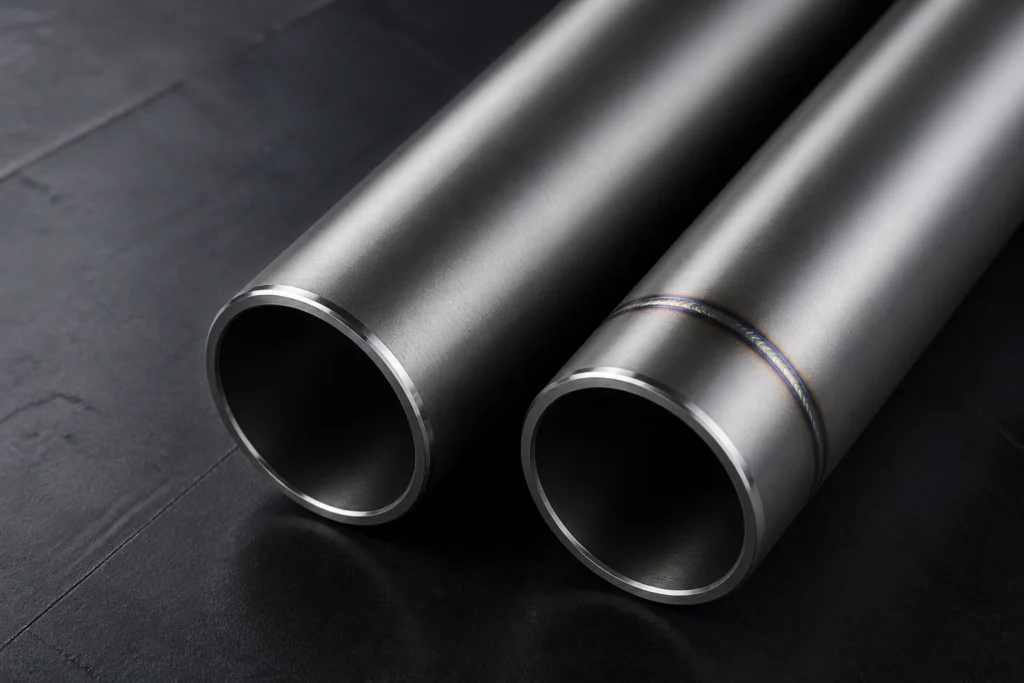
The Structural Advantages The defining characteristic—and the primary selling point—of a seamless tube is its complete absence of a longitudinal weld seam. From a mechanical engineering perspective, this is a massive advantage. Because the pipe’s circumference is formed from a single, continuous piece of metal, there is no “weld factor” to account for in pressure calculations. The uniform grain structure across the entire body allows the seamless tube to withstand extreme internal and external pressures, endure severe mechanical fatigue, and maintain absolute structural integrity in highly volatile environments. Furthermore, the lack of a heat-affected zone (HAZ) guarantees 100% uniform corrosion resistance throughout the entire pipe, which is critical when handling highly aggressive or highly pressurized chemical fluids.
The Commercial Limitations However, this unparalleled structural integrity comes with significant commercial trade-offs. If seamless tubes are so perfect, why aren’t they used universally?
- Prohibitive Cost: The cost of seamless titanium tubing is substantially higher—often 30% to 60% more expensive than welded alternatives. This price premium is driven by the energy-intensive extrusion process and a significantly higher scrap rate (lower material yield) during production.
- Extended Lead Times: The complexity of piercing, extruding, and drawing means that the production cycle is naturally slower. Purchasing seamless tubes often requires a longer project lead time, which can disrupt urgent maintenance or fast-tracked construction schedules.
- Size Limitations: Due to the physical limitations of extrusion machinery, it is exceptionally difficult and economically unviable to produce seamless titanium pipes with very large outer diameters (OD) or extremely thin walls.
In short, seamless titanium tubing is the undisputed champion for extreme, high-stress environments, but specifying it by default can lead to severe and unnecessary budget overruns.
Modern Welded Titanium Tubes and Advanced Manufacturing
Decades ago, engineers were understandably hesitant to use welded tubes in critical infrastructure, fearing that the longitudinal weld seam would act as a weak point prone to stress corrosion cracking or mechanical failure. Today, that stigma is entirely outdated. Thanks to quantum leaps in metallurgy and automated fabrication, modern welded titanium tubes offer a level of reliability that rivals, and in some specific aspects exceeds, that of seamless counterparts.
Advanced Manufacturing and Microstructural Harmony Unlike the extrusion process, a welded tube begins its life as a flat, cold-rolled titanium coil or sheet. The strip is passed through a series of rollers to form a tubular shape, and the edges are seamlessly joined using highly automated TIG (Tungsten Inert Gas) welding or plasma arc welding—crucially, without the addition of any filler metal.
The true magic, however, happens post-welding. To eliminate residual stresses and the Heat-Affected Zone (HAZ), the tubes undergo strict vacuum annealing. This thermal treatment causes the weld seam’s microstructure to recrystallize, effectively making the physical and chemical properties of the weld zone virtually indistinguishable from the base metal.
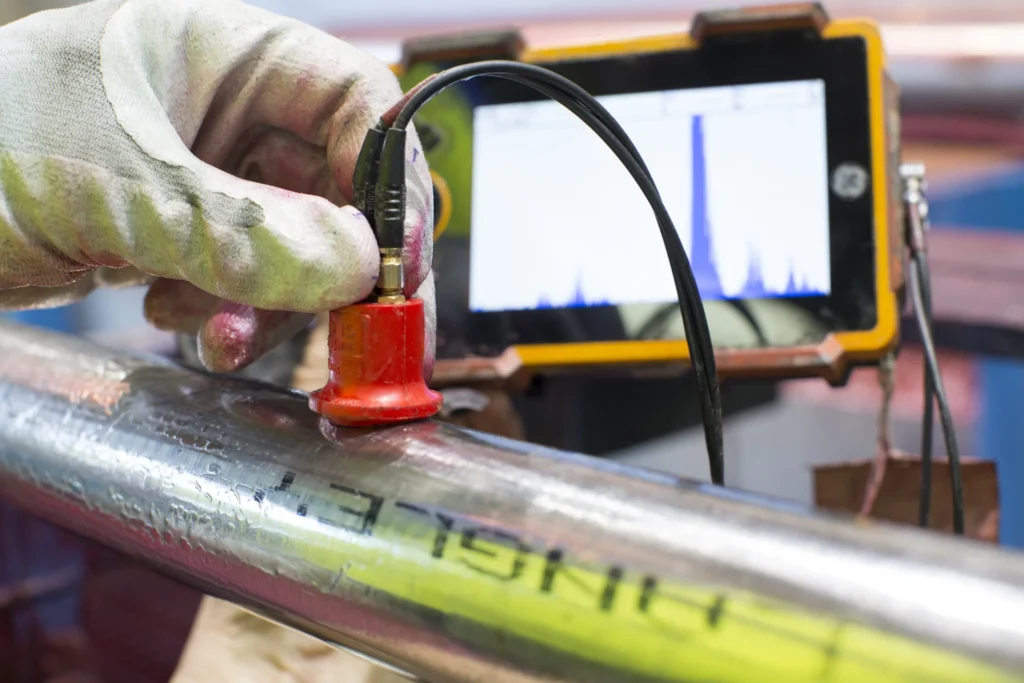
Uncompromising Quality Assurance (NDT) To guarantee safety in demanding applications, top-tier manufacturers subject welded titanium tubes to rigorous Non-Destructive Testing (NDT) in strict accordance with international standards like ASTM B338. Before a welded tube ever leaves the facility, it typically undergoes:
- 100% Eddy Current Testing (ECT) to detect microscopic surface or near-surface defects.
- Ultrasonic Testing (UT) to ensure internal material integrity.
- Hydrostatic or Pneumatic Testing to verify its pressure rating and ensure zero leakage.
The Strategic Advantages of Welded Tubing When produced under these stringent modern controls, welded titanium tubing unlocks several distinct advantages for industrial projects:
- Superior Wall Thickness Uniformity: Because it is formed from a precisely milled flat strip, a welded tube boasts exceptionally tight wall thickness tolerances and concentricity. This is a critical requirement for high-efficiency heat transfer applications.
- Unbeatable Cost-Effectiveness and Speed: With a much higher material yield and a streamlined manufacturing process, welded tubes are significantly more affordable and have much shorter lead times, keeping your project on budget and on schedule.
- Infinite Size Flexibility: When a project calls for a large diameter welded titanium pipe (e.g., for power plant cooling water lines), welding is often the only economically and technically viable manufacturing method.
By embracing modern welded titanium tubes, engineers can achieve uncompromising safety while unlocking substantial capital savings for their procurement budgets.
A Comprehensive Buyer’s Decision Matrix
When evaluating seamless and welded titanium pipes, engineers and procurement teams must balance performance requirements against project budgets and timelines. To simplify this process, we have compiled the core differences into a direct, parameter-by-parameter comparison matrix.
| Key Parameter | Seamless Titanium Tube | Welded Titanium Tube |
|---|---|---|
| Manufacturing Cost | High (Premium pricing due to lower yield) | Low (Highly cost-effective) |
| Lead Time | Slower (Complex extrusion process) | Faster (Streamlined rolling and welding) |
| Wall Thickness Tolerance | Good (Minor variations are inherent) | Excellent (Highly uniform from flat sheets) |
| Pressure Rating | Ultra-High (Zero weld factor) | Medium to High (Suitable for most standard industrial uses) |
| Outer Diameter (OD) Range | Limited (Challenging for very large ODs) | Vast (Easily accommodates large diameters) |
The Total Cost of Ownership (TCO) Perspective In industrial project management, there is a golden rule: Over-engineering is burning money.
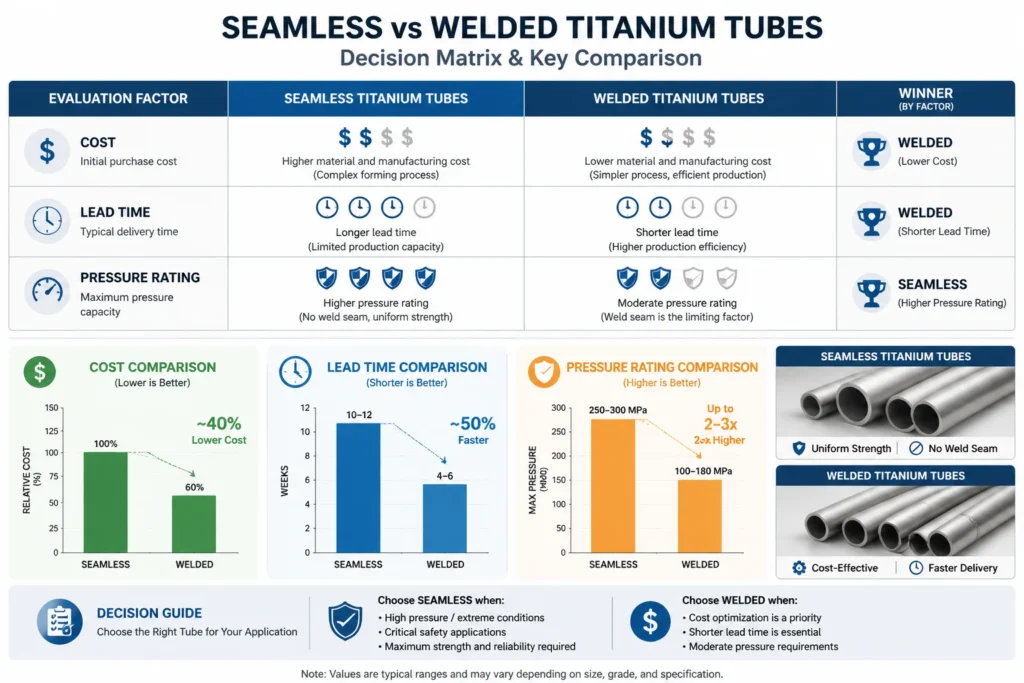
While the absolute structural perfection of a seamless tube is undeniable, demanding it for every single application is financially inefficient. If your piping system or heat exchanger operates within the standard, safe working pressure limits that a modern welded tube can easily handle, opting for seamless material does not increase your functional safety—it only inflates your initial capital expenditure.
When evaluating the Total Cost of Ownership (TCO) for large-scale infrastructure like chemical plants, power generation facilities, or desalination plants, welded titanium tubes drastically reduce upfront material costs and accelerate construction schedules. By matching the tube’s capabilities precisely to the system’s actual operational demands, you maximize the project’s Return on Investment (ROI) without compromising on the legendary corrosion resistance of titanium.
How Material Grades Impact Tube Performance
When evaluating manufacturing processes, it is crucial to remember that “titanium” is a broad category. The debate between seamless and welded can shift dramatically depending on the specific titanium grade (the chemical composition) required for your project. The material’s inherent weldability plays a massive role in the final performance of a welded tube.
Commercially Pure (CP) Titanium: The Case for Welded Grade 2 ASTM B338 Grade 2 is the undisputed workhorse of the industrial and chemical processing sectors. Because it is unalloyed (commercially pure), it possesses exceptional ductility and outstanding weldability. When Grade 2 titanium is processed using modern TIG welding and vacuum annealing, the weld seam seamlessly integrates with the base metal, leaving virtually no weak points. For the vast majority of Grade 2 applications, welded tubes deliver 100% of the required mechanical and chemical performance, making them the ultimate high-ROI alternative to seamless tubes.
Titanium Alloys: The Case for Seamless Grade 9 The narrative changes when dealing with high-strength titanium alloys, such as Grade 9 (Ti-3Al-2.5V). The addition of alloying elements like aluminum and vanadium significantly increases the metal’s tensile strength, but it also alters its welding dynamics. Alloys can be more susceptible to embrittlement or micro-segregation in the heat-affected zone if not managed flawlessly.
Typically, if an engineer specifies Grade 9 titanium, the application demands extreme mechanical strength under severe stress (such as aerospace hydraulic lines or specialized sporting equipment). In these ultra-demanding scenarios, the continuous, flawless grain structure of a seamless Grade 9 tube remains the safest, most reliable, and often mandatory choice.
In summary: If you are using CP Titanium (like Grade 2) for standard industrial corrosion resistance, welded is the smart financial choice. If you require the extreme strength of an alloy (like Grade 9), lean toward seamless.
Practical Application Guide for Different Environments
Understanding the metallurgical data is only half the battle; the real test is applying that knowledge to your specific engineering environment. To help you finalize your specification, here is a practical application guide based on industry best practices.
When to Specify Seamless Titanium Tubes Seamless tubes are the ultimate insurance policy for extreme environments where failure is not an option and internal/external pressures are off the charts. You should default to seamless tubing for:
- Aerospace and Aviation: High-pressure hydraulic lines where weight reduction and absolute fatigue resistance are critical.
- Deep-Sea and Subsea Exploration: Underwater housings, offshore drilling components, and submersibles that must withstand crushing external hydrostatic pressure.
- Ultra-High-Pressure Chemical Processing: Piping systems handling highly reactive, toxic, or flammable fluids at extreme pressure thresholds that exceed standard ASME welded pipe ratings.
When to Specify Welded Titanium Tubes (The Industrial Standard) For the vast majority of large-scale industrial, chemical, and power generation applications, welded titanium tubes are not just an alternative—they are the industry standard. Their uniform wall thickness and cost-efficiency make them the superior choice for:
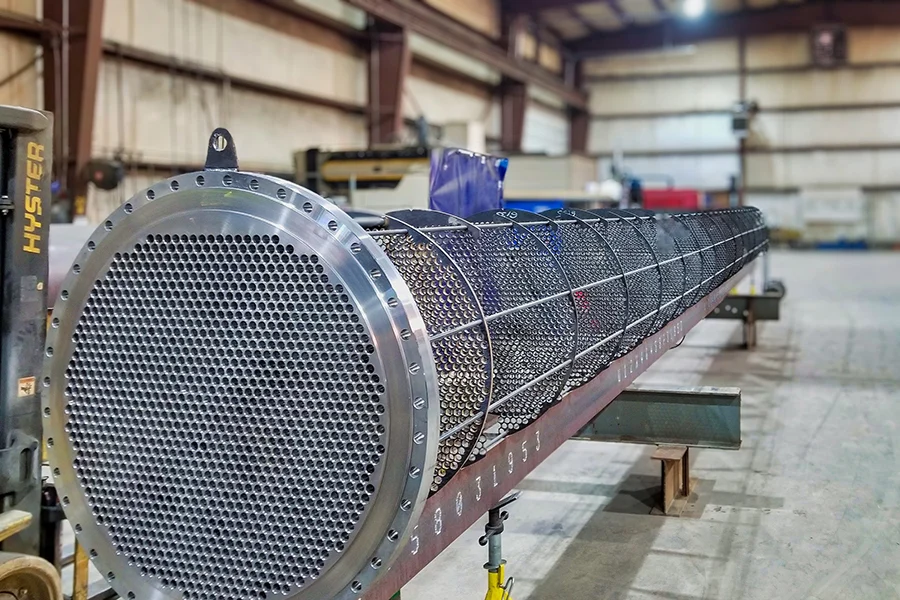
- Heat Exchangers: In a titanium shell and tube heat exchanger, thermal efficiency is heavily dependent on consistent wall thickness. The tight dimensional tolerances of welded tubes make them the perfect fit for these critical thermal transfer applications.
- Power Generation and Desalination: Facilities require miles of titanium condenser tubes to cool steam or process seawater. Using seamless tubes for this sheer volume of material would bankrupt a project. Welded tubes provide the necessary corrosion resistance against chlorides at a fraction of the cost.
- Low-to-Medium Pressure Chemical Piping: General chemical plant infrastructure, water treatment facilities, and pharmaceutical processing lines operate well within the safe pressure ratings of welded tubes, making them the most logical and economical choice.
By aligning your tube selection with the realistic demands of your application, you guarantee both the mechanical safety and the financial viability of your project.
Frequently Asked Questions (FAQ)
Is the weld seam a weak point in titanium tubes, especially regarding corrosion?
No, not with modern manufacturing processes. In the past, untreated weld seams were susceptible to stress corrosion cracking (SCC) due to residual stresses. However, today’s high-quality welded titanium tubes undergo complete vacuum annealing. This thermal treatment recrystallizes the microstructure of the weld zone, aligning its mechanical and chemical properties almost perfectly with the base metal. When paired with 100% Eddy Current Testing, the weld seam is virtually eliminated as a weak point in standard industrial environments.
Can I use welded titanium tubes for high-pressure applications?
Yes, up to a certain threshold. Welded titanium tubes are perfectly capable of handling moderate to high pressures, which is why they are standard in large-scale chemical processing. However, when calculating safe working pressures, engineers must apply a “weld joint efficiency factor” as dictated by codes like the ASME Boiler and Pressure Vessel Code (BPVC). If your system’s operational pressure exceeds the calculated safe limits for a welded tube under these strict ASME guidelines, you must upgrade to a seamless tube.
Why do heat exchanger manufacturers prefer welded over seamless titanium tubes?
Thermal efficiency in a heat exchanger relies heavily on consistent wall thickness. Because welded tubes are formed from precision-rolled titanium sheets, their concentricity and wall thickness tolerance are vastly superior to those of extruded seamless tubes. This uniformity prevents localized hot spots, improves overall heat transfer rates, and allows for much easier and more secure expansion into the titanium tube sheet during assembly.
Final Recommendations for Your Project
Ultimately, the debate between seamless and welded titanium tubes isn’t about which one is universally better. It is about matching the right manufacturing technology to your specific operational demands.
Choose seamless titanium tubes when extreme high-pressure thresholds and absolute structural perfection are non-negotiable, such as in aerospace or deep-sea environments. Conversely, opt for welded titanium tubes when your project demands unbeatable cost-effectiveness, precise wall thickness, and reliable performance for large-scale heat transfer, desalination, or chemical processing.
Need Expert Guidance on Your Next Procurement? Still weighing your options? You don’t have to make this critical material decision alone. Send us your project blueprints, working pressures, and corrosive medium parameters. Our expert material engineers will review your specifications and provide a customized, highly competitive quote and selection advice within 24 hours.
Your One-Stop Titanium Solution Beyond high-quality tubing, we provide everything you need to build a secure and efficient system. To ensure seamless integration across your entire project, we also supply premium, dimensionally compatible titanium pipe fittings, titanium flanges, and precision-machined titanium tube sheets.
Contact us today to secure the best titanium materials for your next high-performance engineering project.