Titanium straws are inherently BPA-free — titanium is a pure metal, not a plastic, so it cannot contain BPA by definition. Food-safe titanium (Grade 1 or Grade 2 CP) is hypoallergenic, contains zero nickel, and forms a self-healing oxide surface layer that prevents both metallic taste and ion leaching. Stainless steel straws are safe for most people but contain 8–14% nickel (depending on grade), which matters for an estimated 17% of women and 3% of men with nickel sensitivity. For everyday use, Grade 1 or Grade 2 titanium is the cleaner, lighter, and tasteless choice — though it costs more upfront. This guide covers material grades, safety certifications, a head-to-head comparison, and the one question nobody else answers: what does “BPA-free” even mean for a metal straw?
The Simple Truth About Titanium and BPA
Titanium straws are 100% BPA-free — not because of a special manufacturing process, but because BPA cannot exist in a metal.
BPA stands for Bisphenol A, a synthetic compound used to harden polycarbonate plastics and line epoxy resin coatings. It’s a polymer chemistry problem, not a metals problem. Titanium is a pure element (atomic number 22). There is no step in its manufacturing process where BPA could enter the material.
So why do so many titanium straw listings make “BPA-free” a feature? Partly because it’s a common search term people use when shopping for plastic-free alternatives. Partly because the straw market is crowded with products that actually do contain plastic components — silicone tips, plastic carrying cases, or hybrid construction — and the “BPA-free” label helps distinguish a pure-metal product.
The more meaningful safety question for a titanium straw isn’t about BPA. It’s about which grade of titanium you’re getting, and whether the metal itself can leach anything into your drink. That’s where things get interesting.
Not All “Titanium” Straws Are Created Equal — Know Your Grades
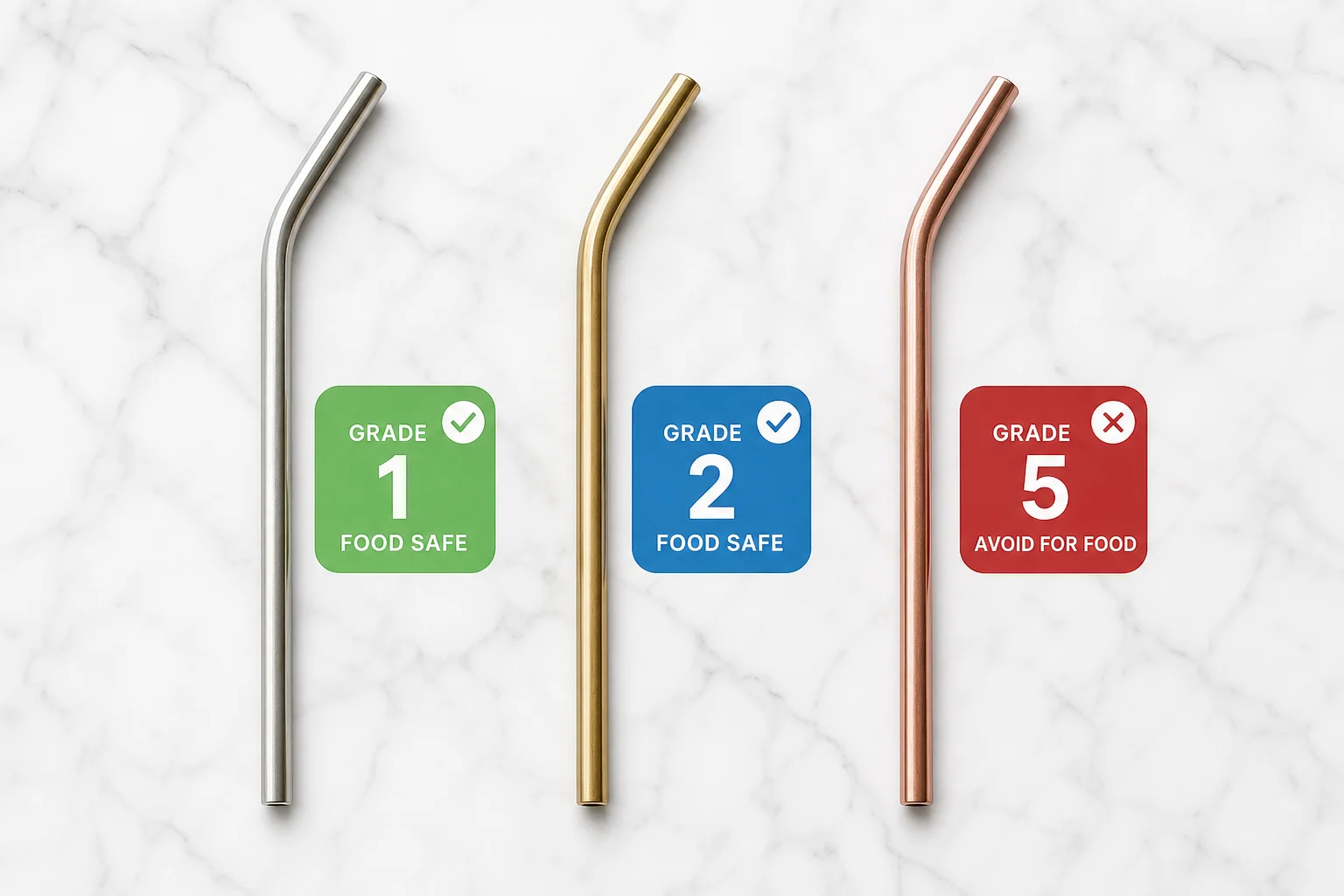
The word “titanium” on a product listing tells you less than you’d think. There are multiple titanium grades, and one of them you genuinely don’t want touching your food.
Grade 1 CP (Commercially Pure): The gold standard for food contact. Contains at least 99.5% pure titanium with minimal oxygen and iron. It forms the most stable TiO₂ (titanium dioxide) passive oxide layer on its surface — the same chemistry that makes titanium safe in dental implants and hip replacements. ASTM F67 is the standard specification. Density: 4.51 g/cm³.
Grade 2 CP: The most widely used commercial grade. Slightly higher oxygen and iron tolerance than Grade 1, marginally higher tensile strength, still excellent corrosion resistance. Also food-safe. Most reputable titanium straw brands use Grade 1 or Grade 2.
Grade 5 (Ti-6Al-4V): This is the grade that concerns material scientists. It contains 6% aluminum and 4% vanadium — added for aerospace and surgical implant applications where extreme strength matters. Both aluminum and vanadium are potentially problematic at elevated exposure levels. Grade 5 is commonly marketed as “surgical grade” or “aerospace grade” titanium, which sounds premium but doesn’t mean it’s appropriate for daily food contact.
What to look for when buying: Ask for “CP Grade 1” or “CP Grade 2” explicitly. If a listing only says “surgical grade titanium” without specifying the alloy composition, that’s a red flag. Reputable brands like Valtcan, SilverAnt, and King Cage publish their material specifications. SGS or LFGB test reports add an extra layer of verification.
The LFGB certification (Germany’s food-contact law, EC No 1935/2004) is worth understanding: it tests metal migration using 3% acetic acid simulant at 100°C for 4 hours — a far more aggressive test than standard FDA compliance. If a titanium straw has LFGB certification, its leaching data is about as rigorous as you can get.
Titanium vs. Stainless Steel: What the Numbers Actually Show
Here’s the head-to-head comparison that no other straw article has put together with source data:
| Property | Titanium Grade 1/2 CP | Stainless Steel 304 | Stainless Steel 316 |
|---|---|---|---|
| Density | 4.51 g/cm³ | 7.9 g/cm³ | 8.0 g/cm³ |
| Weight vs. steel | ~43% lighter | — | — |
| Nickel content | 0% | 8–12% | 10–14% |
| Chromium content | 0% | 18–20% | 16–18% |
| Ion leaching (acidic) | <0.01 ppm | Up to 3.84 mg/kg (long exposure) | Better than 304 |
| Self-healing surface | Yes (TiO₂ reforms instantly) | No | No |
| Corrosion resistance | Superior | Good | Better than 304 in salt |
| Biocompatibility | Excellent (ISO 10993-1 framework) | Good | Good |
| Nickel allergy risk | None | Present | Present |
| Metallic taste | None reported | Occasional (especially plain water) | Less than 304 |
| Typical straw price | $15–30 | $5–15 | $8–18 |
| Dishwasher safe | Yes | Yes | Yes |
The weight gap is the most practical difference for daily use. A titanium straw is roughly 43% lighter than an identical-geometry steel straw. That matters less for sitting at a desk and more for outdoor use, travel, or carrying in a bag. It also means less thermal mass — titanium absorbs and releases heat (and cold) faster but has less total heat capacity per unit length, so it doesn’t stay uncomfortably hot or cold against your lips the way a heavier steel straw can.
316L stainless steel is meaningfully safer than 304 if you’re committed to a steel straw. The “L” designation indicates lower carbon content, and the added molybdenum in 316 reduces pitting corrosion in acidic environments. If you see a cheap SS straw without a grade marking, assume it’s 304.
The Nickel Issue in Stainless Steel Straws
Here’s the part most comparison articles skip.
Standard stainless steel (304 grade) contains 8–12% nickel by mass, and 316 contains 10–14%. For most people, this presents no meaningful risk in a straw context — contact time is brief, and the surface area is small compared to a cooking pot.
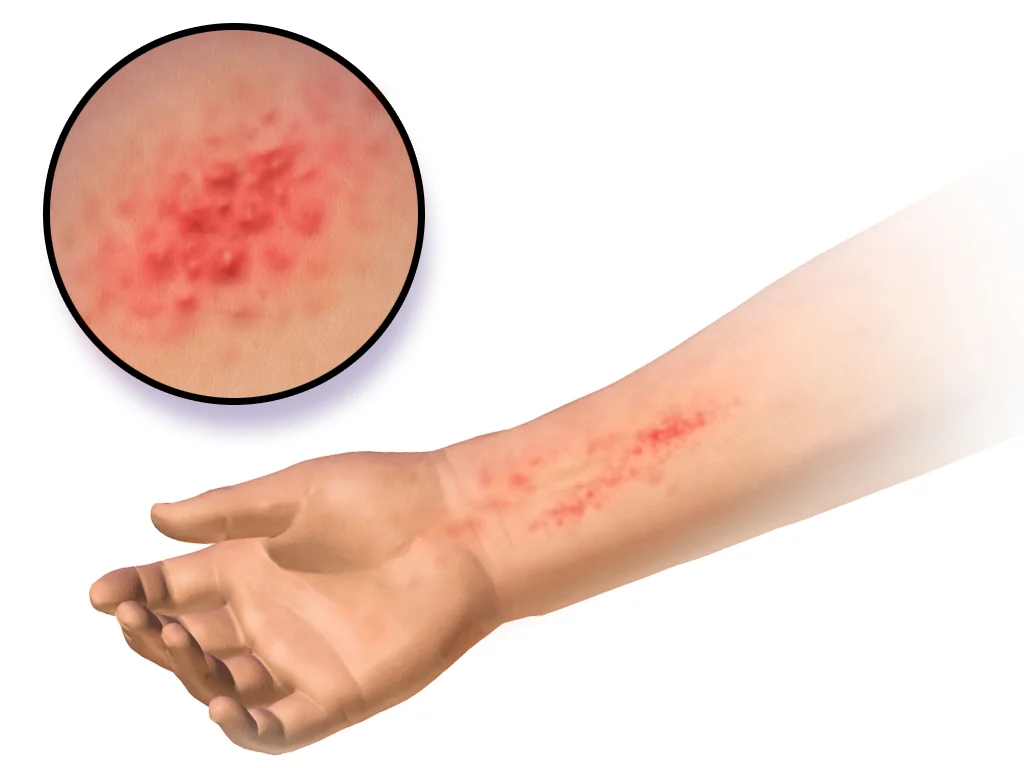
But for an estimated 17% of women and roughly 3% of men with nickel sensitivity — current research puts overall adult prevalence between 8–17% — even low-level nickel contact with oral mucosa can trigger reactions ranging from lip irritation to systemic dermatitis.
A 2013 peer-reviewed study published in the Journal of Agricultural and Food Chemistry (PMC4284091, Kamerud et al.) provides the most-cited data on stainless steel leaching. In that study, new SS 304 cookware cooked with tomato sauce at pH 4.2 showed up to a 26-fold increase in nickel leaching after 6 hours. Those numbers apply to cooking pots with sustained heat and large surface-to-volume ratios — not straws. A straw’s contact time and surface area are far smaller.
That said, there’s an important nuance: oral mucosa (the inside of your mouth and lips) is more permeable to metal ions than skin. The REACH nickel regulation (EU 1907/2006) applies specifically to items intended for prolonged skin contact — earrings, watchbands, belt buckles — and sets limits based on release rates of ≤0.2 µg/cm²/week. No equivalent EU regulation currently governs straws specifically, which means the burden is on consumers to evaluate their own sensitivity.
If you or your child have a known nickel allergy, titanium is the only metal straw that fully eliminates that risk. Grade 1 or Grade 2 CP titanium contains no nickel and no chromium.
Why Titanium Straws Don’t Taste Like Metal
The most consistent piece of feedback from people who switch to titanium from stainless steel is this: “I can’t taste it.”
That’s not marketing language — there’s a straightforward material science explanation.
Titanium Grade 1/2 forms a passive TiO₂ (titanium dioxide) oxide layer on its surface the moment it contacts oxygen. This layer is chemically inert: it doesn’t react with acids, bases, salts, or the range of temperatures in any cold or hot beverage. Because no ions transfer from the metal surface to your drink, there’s no metallic flavor.
What makes this layer particularly valuable compared to stainless steel’s chromium oxide layer is that it self-repairs. Scratch a titanium straw with a cleaning brush and the TiO₂ layer reforms instantly in air. Stainless steel’s passive layer is more durable initially but doesn’t have the same automatic recovery — mechanical scratches can expose the underlying alloy and, in theory, increase ion migration over time.
Stainless steel straws that impart metallic taste tend to be lower-grade 304 SS. Users on Reddit’s r/BuyItForLife and r/ZeroWaste consistently note that higher-grade steel straws (316L) have significantly less taste transfer, but titanium is the standard that approaches zero.
The anodized color versions — where titanium is electrochemically treated to produce gold, blue, or rainbow finishes — are worth a note here. Anodization thickens the TiO₂ layer; it doesn’t add any chemical coating. The color is the oxide layer itself, not a paint or lacquer. Anodized titanium is considered just as food-safe as raw titanium.
Two Years With a Titanium Straw — What I Actually Found

I switched from a 316L stainless steel straw to a Grade 2 CP titanium straw about two years ago. A few concrete observations:
The weight difference is real and more noticeable than you’d expect from a 10-gram difference. In a travel pouch, it genuinely feels like carrying nothing. In a tall tumbler, you don’t feel the straw pulling against the lip of a lid.
Taste is flat — genuinely zero. Not “less metallic than my old steel straw,” but undetectable. I drink plain water and black coffee through it, and neither tastes different than from a glass.
The one honest downside: titanium straws cost more, and the premium brand options (Valtcan, SilverAnt) run $20–30 for a single straw. Whether that’s worth it versus a quality 316L stainless straw at $10–15 depends on whether nickel sensitivity, weight, or taste neutrality matters to you specifically.
After two years of daily use and dishwasher cleaning approximately 3–4 times per week, there’s no visible corrosion, no surface degradation, and no change in taste. The straw looks essentially new.
Cleaning and Maintenance
Both titanium and stainless steel straws clean the same way — a narrow pipe cleaner or the included cleaning brush, warm soapy water, and a rinse. Both are dishwasher-safe.
The one area where titanium has a genuine edge: it’s more tolerant of acidic cleaning solutions. If you clean with diluted citric acid or white vinegar to remove residue, titanium’s inert oxide layer handles that chemistry without risk. SS 304 in particular can show microscopic surface changes with repeated acid cleaning over long periods.
For both materials: avoid abrasive scrubbers. Titanium’s surface layer self-repairs, but there’s no reason to add unnecessary scratches. Stainless steel benefits even more from gentle cleaning to preserve its passive layer.
If a titanium straw develops superficial water spots from hard water, a gentle wipe with diluted white vinegar removes them without any issue.
Who Should Choose Titanium (and When Stainless Steel Is Fine)
Titanium is the right choice if you:
- Have a known nickel allergy or sensitivity (titanium contains zero nickel)
- Regularly drink highly acidic beverages like lemon water, citrus juice, or kombucha through a straw
- Prioritize minimum weight for travel, backpacking, or carrying in a bag
- Notice a metallic taste with your current steel straw, even with a quality grade
- Are sourcing straws for children whose parents want the most inert material possible
Stainless steel 316L is fine if you:
- Have no nickel sensitivity and want a lower upfront cost
- Mostly use the straw for plain water or non-acidic drinks
- Already own quality 316L straws and have no complaints
Both materials are better than:
- Unspecified-grade SS straws from unbranded Amazon listings (assume 304, assume no grade verification)
- “Titanium-coated” steel products (titanium coating ≠ solid titanium)
- Paper straws with PFAS coatings — a 2023 Belgium study detected PFAS in 18 of 20 paper straw brands tested
Frequently Asked Questions
Are titanium straws safe for daily use?
Yes. Grade 1 and Grade 2 commercially pure titanium is biocompatible under ISO 10993-1 — the same standard used for medical implants. It doesn’t leach detectable ions into beverages at normal use conditions, and it has no known allergy risk in the general population. The only caveat is choosing the right grade: avoid products that use Grade 5 titanium alloy (Ti-6Al-4V), which contains aluminum and vanadium.
Is a titanium straw actually BPA-free?
Yes — and not just “tested BPA-free” but BPA-impossible. BPA is a chemical used in plastics manufacturing. Titanium is a pure metal element with no plastic chemistry involved in its production. It cannot contain BPA. The BPA-free label on titanium products is accurate but somewhat redundant; it’s mainly useful as a shorthand that the straw has no plastic components.
Do titanium straws have a metallic taste?
No, consistently. The titanium dioxide (TiO₂) passive layer on the surface is chemically inert and transfers no ions to beverages. Multiple user reports on Reddit, verified purchase reviews on King Cage and Amazon, and the material science behind it all point to the same conclusion: titanium imparts no taste. If anything, titanium straws have the most neutral taste of any metal straw option.
What is the safest reusable straw material?
For chemical inertness, biocompatibility, and allergy profile: Grade 1 or Grade 2 CP titanium is the cleanest option. Glass is a comparable alternative for people who want zero metal content. High-quality 316L stainless steel is safe for most people but not suitable for those with nickel sensitivity. Silicone is safe and flexible but some users prefer to avoid materials with off-gassing potential in hot beverages.
Is Grade 1 or Grade 2 titanium better for straws?
Grade 1 has slightly higher purity and corrosion resistance; Grade 2 has slightly higher tensile strength and is more widely available. In the context of a straw — room-temperature or cold beverage contact, no sustained heat — the practical difference between Grade 1 and Grade 2 is negligible. Both are appropriate. Grade 1 is the better marketing claim; Grade 2 is the better engineering value. Either is a sound choice from a food-safety standpoint.
Final Take
Titanium straws earn their reputation as the cleanest metal option on the market. The BPA-free claim is technically redundant but practically useful — it’s shorthand for “no plastic, no coatings, no alloys you’d rather not ingest.” The more meaningful differentiators are the zero nickel content, the self-healing oxide surface, and the tastelessness that stainless steel straws can’t fully match at lower price points.
The decision tree is simple: If you have nickel sensitivity, drink acidic beverages regularly, or want the most inert possible material, go with Grade 1 or Grade 2 CP titanium and verify the grade specification before you buy. If you have no sensitivities and want to keep costs low, 316L stainless steel is a reasonable, proven choice. What neither group should default to is an unspecified “stainless steel” straw at the cheapest price point — grade matters, and the difference between 304 and 316L SS is more significant than the price gap suggests.