In the high-stakes world of precision manufacturing, two metals consistently dominate the conversation: Titanium and Aluminum.
At a glance, they can look deceptively similar. Both are silver-grey, non-ferrous, and celebrated for their lightweight properties. Yet, beneath the surface, their price tags, performance characteristics, and manufacturing realities couldn’t be more different.
For product designers and procurement managers, the choice often creates a critical dilemma:
- Aluminum is the industry workhorse—cost-effective, lightweight, and incredibly easy to machine.
- Titanium is the high-performance option—offering legendary strength and corrosion resistance, but at a price premium that can be 10x higher than aluminum.
Is the performance upgrade really worth the massive jump in cost? Or is aluminum actually the smarter engineering choice for your specific project?
This guide moves beyond basic textbook definitions. We compare Titanium vs. Aluminum through the lens of manufacturing reality—analyzing strength-to-weight ratios, the hidden costs of machining, galvanic corrosion risks, and Total Cost of Ownership (TCO) to help you make the right investment.

Summary: Titanium vs. Aluminum Property Comparison
If you need a quick technical answer, the table below pits the two most common aerospace-grade alloys against each other: Titanium Grade 5 (Ti-6Al-4V) vs. Aluminum 6061-T6.
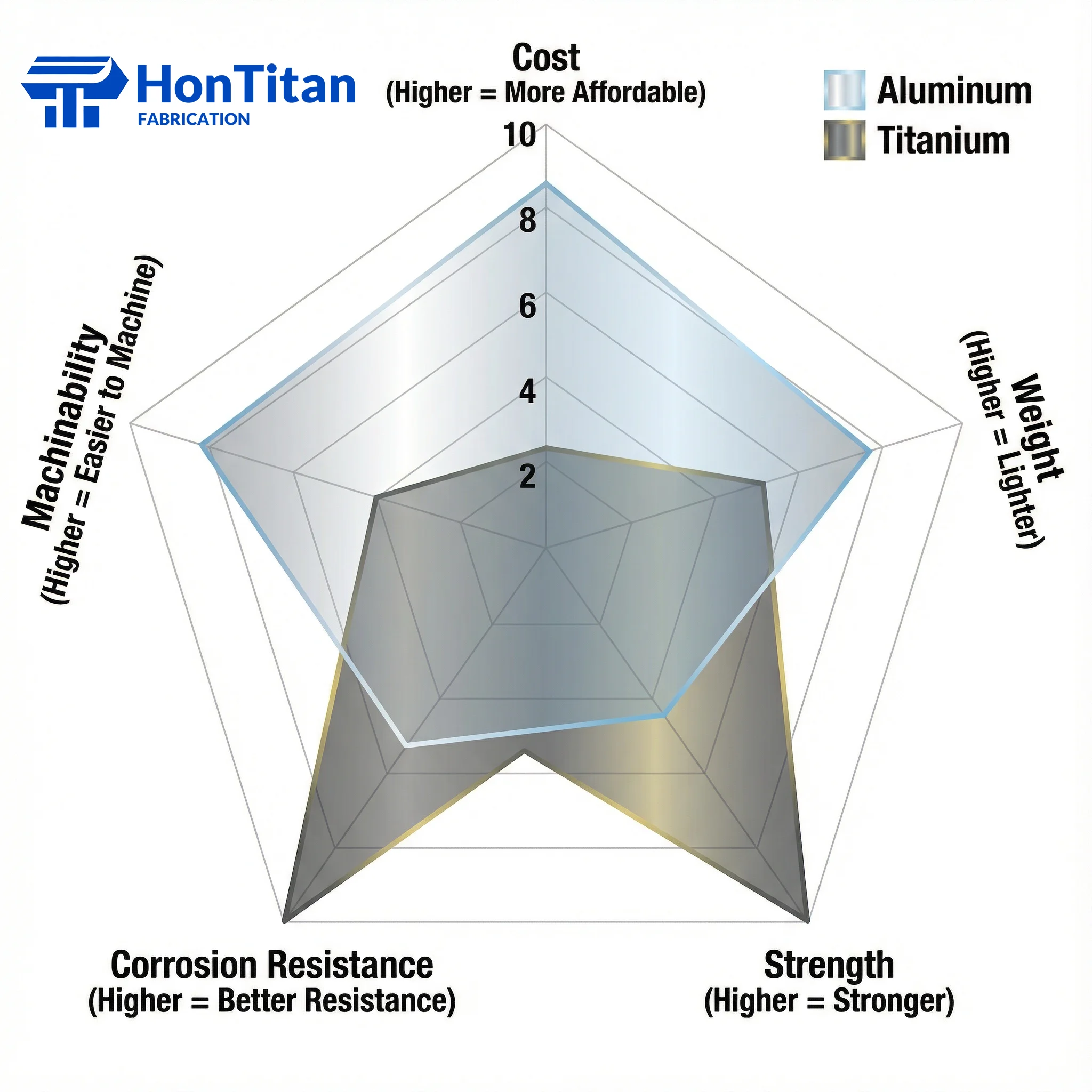
(Note: This data is critical for initial material selection)
| Feature | Aluminum (6061-T6) | Titanium (Grade 5) | Comparative Advantage |
|---|---|---|---|
| Density (Weight) | ~2.7 g/cm³ (Lightest) | ~4.43 g/cm³ (60% Heavier) | Aluminum (Lower Density) |
| Tensile Strength | ~310 MPa | ~950 MPa | Titanium (Higher Strength) |
| Strength-to-Weight | Good | Excellent | Titanium |
| Melting Point | ~660°C (1,220°F) | ~1,660°C (3,020°F) | Titanium (High Heat Resistance) |
| Corrosion Resistance | Good (Oxidizes) | Excellent (Immune to Salt) | Titanium |
| Thermal Conductivity | High (Heat Sink) | Low (Insulator) | Application Dependent |
| Machinability | Easy & Fast | Difficult & Slow | Aluminum |
| Raw Material Cost | $ | $$$$$ | Aluminum |
Interpreting this chart reveals three key takeaways. First, aluminum is physically lighter by volume; if you machine two identical blocks, the aluminum one will weigh significantly less. Second, Titanium (specifically Grade 5) is drastically stronger, allowing engineers to use less material to support the same load, which is the secret behind its “lightweight” reputation in aerospace. Finally, regarding heat management, aluminum melts relatively early, making it unsuitable for engine internals, whereas titanium thrives in high-temperature environments.
Density and Strength-to-Weight Ratio
There is a common misconception among those new to material science that “Titanium is lighter than Aluminum.
Let’s be clear: It is not.
Aluminum is the undisputed king of low density, weighing approximately 2.7 g/cm³. In contrast, Titanium is significantly heavier, weighing approximately 4.43 g/cm³.
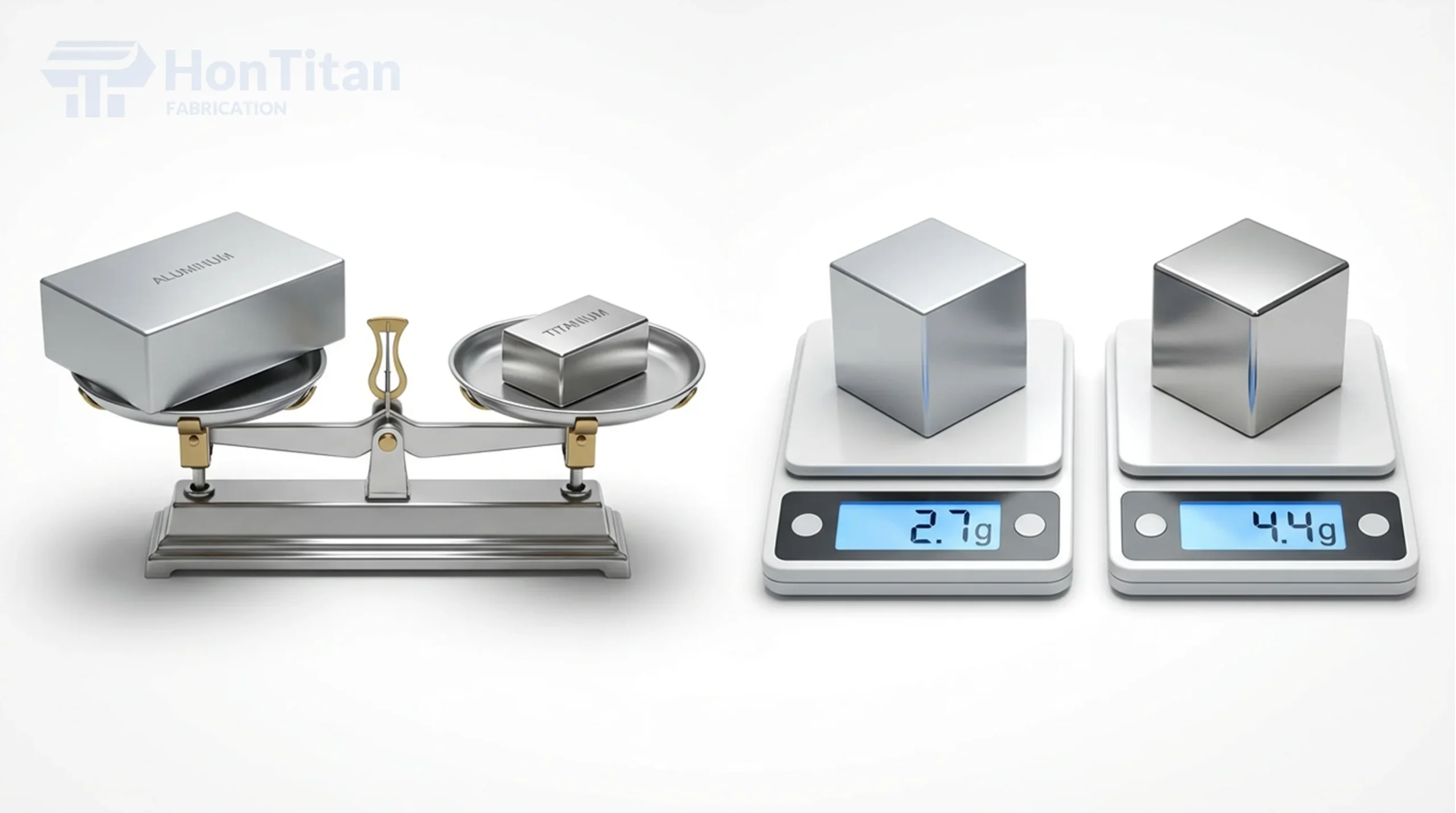
If you were to machine two identical parts—one from aluminum and one from titanium—the titanium part would be roughly 60% heavier. So, why is titanium often marketed as a “lightweight” solution in aerospace and racing? The answer lies in the Strength-to-Weight Ratio (Specific Strength).
Comparison of Aerospace Grades: Ti-6Al-4V vs. 7075-T6
To make a fair comparison, we shouldn’t compare generic aluminum to high-end titanium. Instead, let’s look at the two standard alloys of the aerospace industry: 7075-T6 (Zinc-alloyed Aluminum) and Grade 5 Titanium (Ti-6Al-4V).
7075-T6 Aluminum, known as “aircraft aluminum,” has a tensile strength of roughly 572 MPa. It is incredibly strong for its weight but still brittle compared to steel. However, Grade 5 Titanium delivers a tensile strength of roughly 950 MPa.
The Engineering Reality: Because Titanium Grade 5 is nearly twice as strong as even the strongest aluminum, engineers can use less material to support the same load. You can make a titanium suspension arm thinner, hollower, and more compact than an aluminum one.
The result? A finished titanium assembly that is lighter than its aluminum counterpart, not because the metal is lighter, but because the design is more efficient.
Fatigue Limit and Cyclic Loading
Beyond raw strength, Fatigue Life is often the deciding factor for moving parts like valve retainers or bicycle frames.
Aluminum has no fatigue limit. This means that even small, repeated stresses will eventually cause microscopic cracks. Given enough cycles—whether it’s road vibration or engine RPM—an aluminum part will fail. Titanium, however, possesses a distinct fatigue limit. As long as the stress stays below a certain threshold, titanium acts like a “super spring.” It can flex and return to its original shape for an infinite number of cycles without failing.
Environmental Durability and Corrosion Resistance
If your project involves saltwater, harsh chemicals, or outdoor exposure, the battle between titanium and aluminum is usually won here.
Oxidation Characteristics
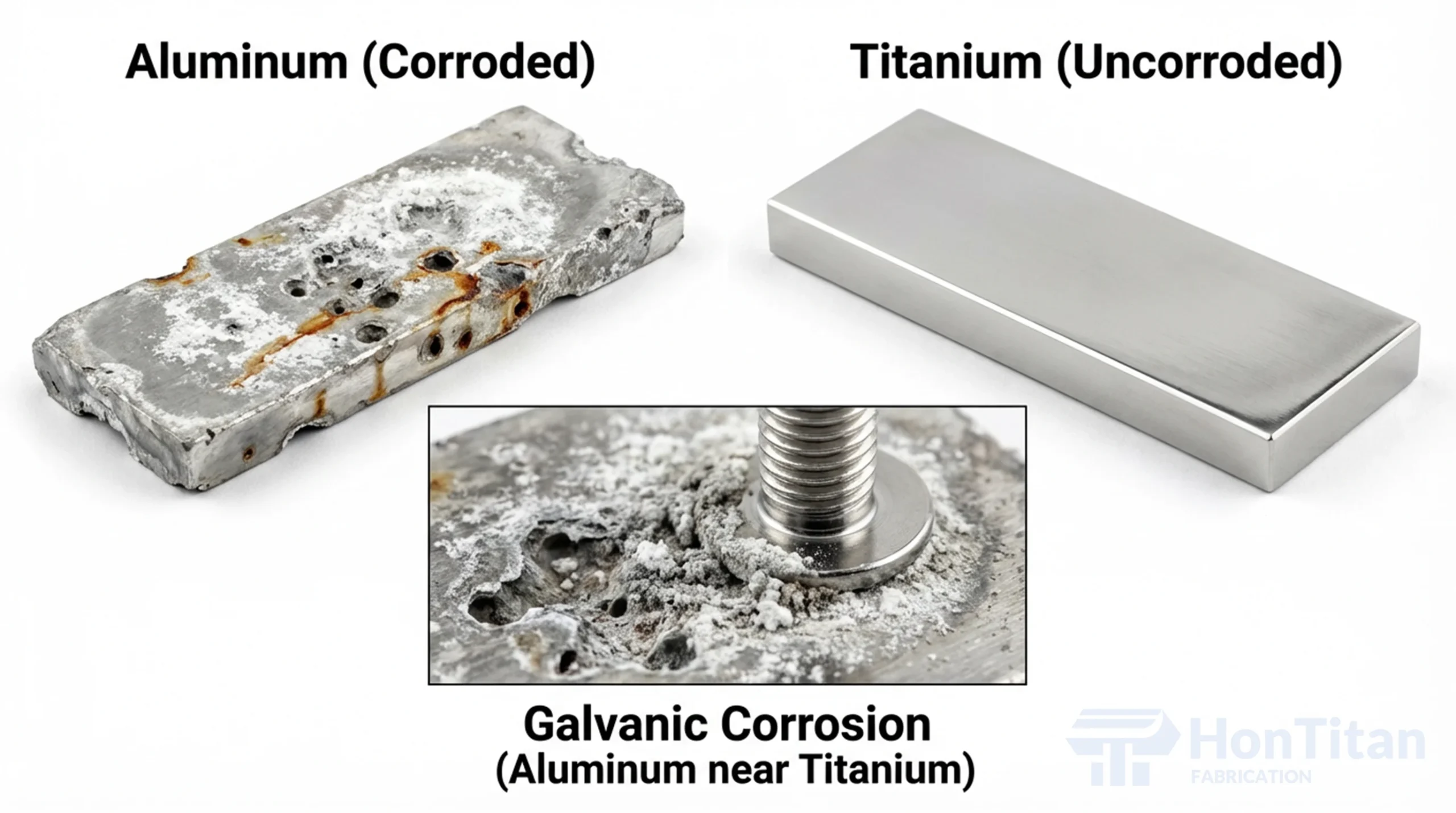
Aluminum is naturally corrosion-resistant because it forms a thin oxide layer when exposed to air. This protects it from general rust. However, in chloride-rich environments like seawater or salted winter roads, aluminum is prone to pitting—where the protective layer breaks down, and corrosion eats deep holes into the metal.
Titanium is different. It is virtually immune to atmospheric corrosion and saltwater. You could leave a titanium block at the bottom of the ocean for a century, and it would look almost new. This makes it the standard for subsea connectors, propeller shafts, and chemical processing equipment.
Galvanic Corrosion Risks
This is the most critical warning for engineers mixing these two metals.
Galvanic Corrosion occurs when two dissimilar metals are in electrical contact in the presence of an electrolyte (like saltwater). Titanium is a “noble” metal, while Aluminum is an “active” metal.
What happens if you bolt a Titanium screw into an Aluminum plate? In a wet environment, the titanium will remain pristine, but it will act as a cathode, stealing electrons from the aluminum (the anode). This causes the aluminum to corrode at an accelerated rate, turning into white powder and causing the joint to fail catastrophically.
How to prevent it: If you must mix Titanium and Aluminum—a common practice to save weight—you must take precautions:
- Anodize the Aluminum: Create a protective barrier.
- Use Insulation: Use plastic washers or ceramic pastes (like Tef-Gel) to physically break the electrical connection between the titanium bolt and the aluminum thread.
Cost Analysis: Raw Material vs. Total Cost of Ownership
Cost is a primary driver in decision-making, and the reality is stark: Titanium is expensive.
In terms of raw material cost, titanium bar stock can cost 5x to 10x more than the equivalent aluminum bar. This price difference stems from the extraction process. While aluminum is refined relatively easily from bauxite, titanium requires the labor-intensive Kroll process, which involves high vacuum, high heat, and magnesium to separate the metal from the ore.
However, smart procurement managers look beyond the initial purchase order. They look at Total Cost of Ownership (TCO).
Lifecycle Cost Scenarios
Consider a component for an offshore drilling rig or a chemical pump:
- Scenario A (Aluminum): You choose Aluminum 6061 to save money. The part costs $100. However, due to salt spray corrosion, the part pits and seizes every 2 years. Each replacement requires machine downtime, labor costs for a technician, and a new part. Over 10 years, you spend $1,500.
- Scenario B (Titanium): You choose Titanium Grade 5. The part costs $400 upfront. However, it lasts for the entire 20-year lifespan of the machine with zero maintenance. The total cost remains $400.
Verdict: For disposable prototypes or indoor consumer goods, Aluminum wins. But for critical infrastructure, marine applications, or difficult-to-access machinery, Titanium is often the cheaper long-term investment.
Machinability and Manufacturing Considerations
If you send a drawing to a machine shop and ask for a quote in both Aluminum and Titanium, be prepared: the Titanium quote will be significantly higher, often 30% to 50% more for the manufacturing labor alone.
Why? It’s not just about the material price; it’s about the machinability.
Machining Properties of Aluminum
Aluminum is soft, thermally conductive, and forgiving. When a CNC machine cuts aluminum, the heat generated by friction is transferred into the chip (the waste metal), which flies away from the part. This keeps the cutting tool cool. Machines can run at high RPMs with fast feed rates, keeping production costs low.
Machining Challenges of Titanium
Titanium presents a unique challenge that experts at Titans of CNC describe as “Heat Stacking.” The difficulty arises from three main factors:
- Poor Thermal Conductivity: Titanium is a terrible conductor of heat. Instead of the heat leaving with the chip, it gets trapped at the cutting edge of the tool.
- Tool Wear: This concentrated heat causes standard drill bits and end mills to burn up and dull almost instantly.
- Low Modulus of Elasticity: Titanium is “gummy” and springy. Under the pressure of a cutter, the material tends to bounce back or deflect, causing vibration (“chatter”) and poor surface finishes.
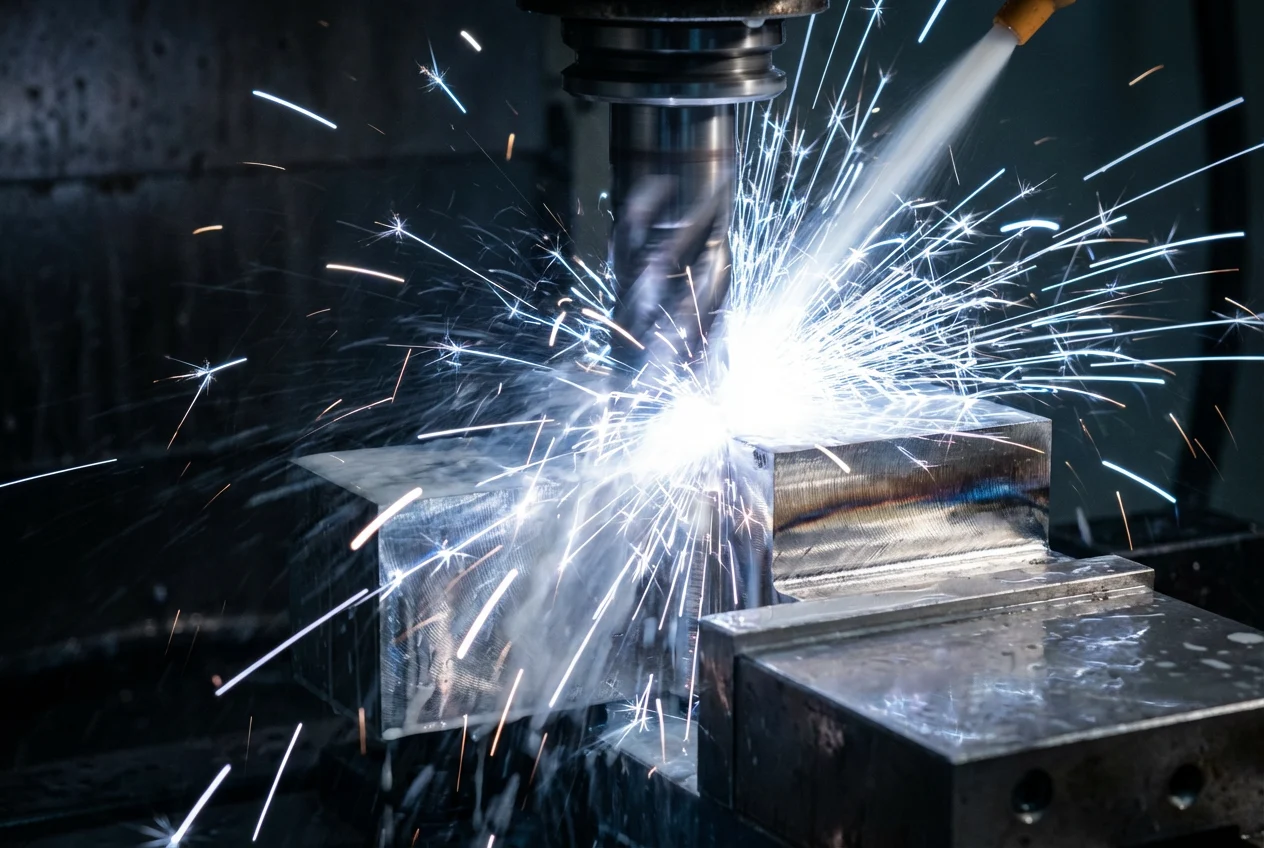
The Manufacturing Reality: To machine titanium successfully, we cannot rush. It requires a dedicated approach using slower speeds, specialized carbide tooling, and high-pressure coolant to forcibly blast heat away from the cutting zone. That extra machine time and specialized equipment is what you are paying for.
Typical Industrial Applications
Understanding the theory is one thing; seeing where these metals are used in the real world helps finalize the decision.

Automotive and Performance Engineering
In the automotive world, the battle often revolves around Unsprung Weight and Heat:
- Aluminum: Used for large structural components like engine blocks, cylinder heads, and suspension arms because it sheds heat quickly and keeps the vehicle light.
- Titanium: Reserved for high-end performance applications. Titanium exhausts are highly coveted for their unique, thin-walled acoustic resonance and weight savings. Similarly, Titanium valve retainers and lug nuts are used to reduce reciprocating mass, which improves engine response.
Marine and Subsea Equipment
- Aluminum: Widely used for boat hulls and masts due to cost-effectiveness. However, it requires rigorous anodizing and constant monitoring of sacrificial anodes to prevent corrosion.
- Titanium: The long-term durability solution. It is the standard for propeller shafts, heat exchangers in desalination plants, and deep-sea ROV components where hardware replacement is difficult or impossible.
Aerospace Structures
- Aluminum: Forms the skin of most aircraft, with 7075 and 2024 aluminum alloys making up the majority of fuselage and wing structures.
- Titanium: Serves as the backbone. It is crucial for landing gear, where it must absorb landing impact without fatigue failure, and in jet engine sections where operating temperatures exceed aluminum’s melting point.
Selection Guide: Material Decision Matrix
Still undecided? Here is a simplified guide to choosing the right metal for your manufacturing project.
When to Choose Aluminum (6061 / 7075):
- Budget is Priority #1: You need a cost-effective material for mass production.
- Thermal Conductivity is Needed: The part needs to act as a heat sink (e.g., electronic enclosures, radiators).
- Weight by Volume: You need the lightest possible part, and space (volume) is not a constraint.
- Machining Speed: You need rapid prototyping or fast turnaround times.
When to Choose Titanium (Grade 5):
- Strength-to-Weight is Critical: You have limited space and need maximum strength in a small package.
- Corrosion is a Threat: The part will be exposed to saltwater, acids, or bodily fluids.
- High Temperature: The operating environment exceeds 150°C – 200°C.
- Cyclic Fatigue: The part is a spring or suspension component subject to millions of stress cycles.
- Long-Term Value: You want to minimize maintenance and replacement costs over the product’s life.
Frequently Asked Questions (FAQ)
Q: Is titanium stronger than aircraft-grade aluminum?
A: Yes. Titanium Grade 5 (Ti-6Al-4V) has a tensile strength of ~950 MPa, while 7075-T6 Aluminum (the strongest common aluminum alloy) tops out around 570 MPa. Titanium is roughly twice as strong.
Q: Can I weld titanium to aluminum?
A: No. You cannot directly fusion weld them using standard TIG/MIG processes. Doing so creates brittle intermetallic compounds that will crack instantly. They must be joined using mechanical fasteners (bolts) or specialized friction welding techniques.
A: Virtually never. Titanium is immune to environmental corrosion, including saltwater exposure that would typically corrode aluminum or rust steel.
Q: How can I tell the difference between titanium and aluminum?
A: The “Spark Test” is the easiest workshop method. Touch the metal to a grinding wheel: Aluminum produces no sparks, while Titanium produces brilliant, bright white sparks.
Ready to Manufacture?
Choosing between Titanium and Aluminum is just the first step. The next challenge is finding a manufacturer who can truly handle the complexities of titanium.
At HonTitan, we don’t just machine metal; we are Titanium Specialists.
While many general CNC shops struggle with the high tool wear, heat generation, and material costs of titanium alloys, our facility is purpose-built to handle them. From aerospace-grade Grade 5 (Ti-6Al-4V) components to corrosion-resistant marine hardware, we deliver the precision you need without the manufacturing headaches.