Titanium resists corrosion not because of its bulk chemistry but because of an invisible oxide film — just 2–6 nanometers thick — that forms on its surface within microseconds of oxygen exposure. This film, composed primarily of titanium dioxide (TiO₂), acts as a dense ionic barrier that physically isolates the underlying metal from corrosive environments. When damaged, it rebuilds itself spontaneously as long as oxygen or water is present. This article explains the film’s structure, how it forms, why it works, where it fails, and how it compares to the passive films on stainless steel and aluminum.
What Is the Titanium Oxide Layer?
The titanium oxide layer is a nanometer-scale film of titanium dioxide (TiO₂) that forms spontaneously on any titanium surface exposed to air or moisture. It is not a coating you apply — it grows autonomously through a chemical reaction between the metal and oxygen, and it does so whether you want it to or not.
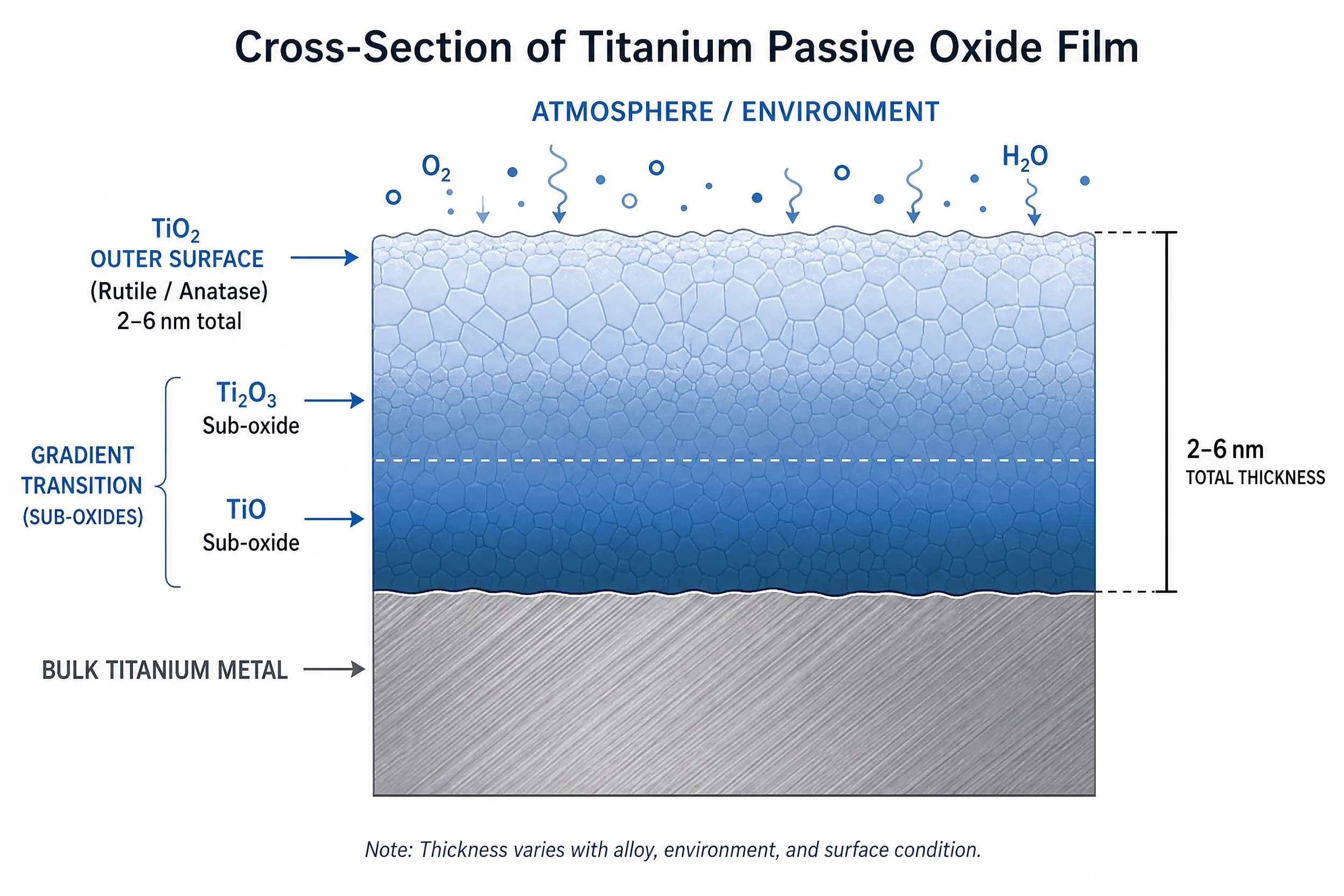
The film is genuinely thin. At ambient temperature and pressure, a freshly exposed titanium surface develops a passive layer roughly 2–6 nm thick. For context, that is about 20–60 times thinner than the wavelength of visible light. You cannot see it, feel it, or remove it by wiping. It exists as a molecular-scale shell bonded directly to the titanium substrate.
Despite its almost inconceivable thinness, this film is the single factor most responsible for titanium’s behavior in virtually every corrosive environment encountered in industrial, marine, and biomedical applications. When materials engineers say titanium is “corrosion resistant,” they are, almost entirely, describing the behavior of this oxide film — not the bare metal beneath it.
The film is chemically classified as a mixed-valence oxide. The outermost surface is predominantly TiO₂ (titanium(IV) oxide), where titanium exists in its +4 oxidation state. Moving inward toward the metal interface, the film transitions through sub-stoichiometric oxides: first Ti₂O₃ (titanium(III) oxide, Ti³⁺), then TiO (titanium(II) oxide, Ti²⁺), and finally the bulk titanium metal (Ti⁰). This gradient structure is not random — it reflects the oxygen chemical potential gradient from atmosphere to metal and is confirmed by X-ray photoelectron spectroscopy (XPS) analysis of titanium surfaces.
The film can grow thicker under certain conditions. Elevated temperature pushes growth toward approximately 15–25 nm at 250°C, and electrochemical anodization can artificially thicken it to hundreds of nanometers — which also produces the interference colors seen on anodized titanium jewelry. But the spontaneously formed ambient film in the 2–6 nm range is what you encounter on virtually all engineering titanium components.
How the Passive Film Forms — The Chemistry
Titanium’s oxide film forms through one of the fastest solid-state surface reactions in materials science: bare titanium reacts with oxygen or water vapor and develops a protective TiO₂ layer in less than 10⁻⁴ seconds — faster than any mechanical damage event can fully propagate.
The core reaction in air is straightforward:
Ti + O₂ → TiO₂
In aqueous environments, water contributes the oxygen source:
Ti + 2H₂O → TiO₂ + 4H⁺ + 4e⁻
What makes this fast is titanium’s strong thermodynamic drive to oxidize. The Gibbs free energy of TiO₂ formation is highly negative (ΔGf° ≈ −889 kJ/mol at 298 K for rutile TiO₂, per NIST thermochemical data), meaning the reaction proceeds spontaneously and releases substantial energy. Titanium wants to form this oxide — it is thermodynamically favorable under almost any atmospheric condition.
The growth mechanism is diffusion-controlled. Once the initial monolayers of TiO₂ form, further thickening requires either oxygen ions to migrate inward through the existing film, or titanium ions to migrate outward. Both processes become progressively slower as the film thickens — this is why the film is self-limiting. At ambient temperature, the film reaches its equilibrium thickness in the 2–5 nm range and effectively stops growing at any measurable rate. The energetic cost of ionic diffusion through an increasingly thick oxide layer eventually equals the thermodynamic driving force, and growth halts.
This self-limiting character is important for engineering purposes. Unlike iron oxide (rust), which grows without limit by cracking and spalling to expose fresh metal, the titanium oxide film stabilizes at a thin but highly dense configuration. The film is amorphous or low-crystalline at room temperature, which means it has no grain boundaries through which corrosive species can channel. At higher temperatures it can crystallize into the anatase or rutile phases of TiO₂, both of which are highly stable in their own right.
One detail that surprises engineers encountering titanium for the first time: the film forms in essentially any oxidizing environment — distilled water, humid air, dilute acids (within limits), and even certain biological fluids. You do not need a special treatment or passivation bath. The atmosphere itself is sufficient. Cut a titanium rod in a machine shop and the newly exposed surface is already passivated before the cut is complete.
Why the TiO₂ Film Is Such an Effective Corrosion Barrier
The passive film works because it is dense, adherent, non-porous, and highly resistant to dissolution — it physically blocks the electrochemical reactions that drive corrosion before they can start.
Corrosion of a metal in an aqueous environment requires two simultaneous reactions: an anodic reaction (metal oxidation, releasing electrons) and a cathodic reaction (typically oxygen reduction or hydrogen evolution). For this to proceed continuously, metal ions must be able to migrate from the metal surface into the electrolyte. The TiO₂ film interrupts this pathway.
The film acts as an ionic insulator. The diffusion coefficient of oxygen ions through a dense, room-temperature TiO₂ film is extraordinarily low — on the order of 10⁻³⁰ m²/s or less — which effectively means ionic transport through the film is near zero at ambient conditions. Corrosive ions from the environment (chloride, sulfate, protons) cannot reach the underlying titanium. Titanium ions cannot migrate outward into the electrolyte. Without these transport pathways, the electrochemical corrosion circuit cannot close.
The film also offers exceptional chemical stability across a wide pH range. TiO₂ is amphoteric but its dissolution rate is negligible between approximately pH 1 and pH 12 in most common electrolytes. In neutral seawater, in body fluids (pH ~7.4), in dilute acids, and in alkaline cleaning solutions, the film remains essentially intact and continues protecting the substrate.
The adhesion of the film to the underlying metal is also critical. The TiO₂ layer is not simply deposited on top of titanium — it grows from the metal surface outward, sharing atomic-scale bonding with the substrate. This means it does not peel, blister, or delaminate under mechanical stress the way a painted or plated coating can. Thermal expansion mismatch stresses are managed through the film’s amorphous structure and its capacity to plastically deform at the nanoscale.
The result: titanium Grade 2 shows a uniform corrosion rate of less than 0.0001 mm/year in seawater at 25°C, compared to approximately 0.001–0.010 mm/year for 316L stainless steel under equivalent conditions. The difference is still an order of magnitude, but the dominant failure mode for 316L in seawater is not uniform dissolution — it is pitting and crevice corrosion, which initiates at relatively low temperatures.
The Self-Healing Mechanism: What Happens When the Film Is Scratched
When the titanium passive film is mechanically damaged — scratched, abraded, or fractured — it spontaneously rebuilds itself within milliseconds to seconds, provided oxygen or moisture is available. This is the defining advantage over non-passive metals like carbon steel, where a scratch initiates rust propagation rather than a healing response.
The mechanism is reoxidation. At a damage site, bare titanium metal is suddenly exposed to the environment. The same thermodynamic driving force that formed the original film immediately activates — Ti⁰ oxidizes to Ti²⁺, Ti³⁺, and ultimately Ti⁴⁺, and the new oxide film grows from the damage point outward. Because the Gibbs free energy driving force is enormous and the required film thickness is only a few nanometers, the repair is essentially complete before the damage event has finished from an engineering time perspective.
Testing has confirmed this in practical contexts. A titanium surface scratched while submerged in oxygenated water shows repassivation current peaks (the electrochemical signature of rapid oxide regrowth) lasting only a few milliseconds, after which the surface returns to passive-state behavior. The film in this context is functioning less like a static barrier and more like living skin — continuously monitoring its own integrity and repairing damage.
The critical dependency is oxygen. Self-healing requires an oxidizing agent, and in practice that means dissolved oxygen in solution (minimum approximately 1 ppm) or atmospheric oxygen in air.
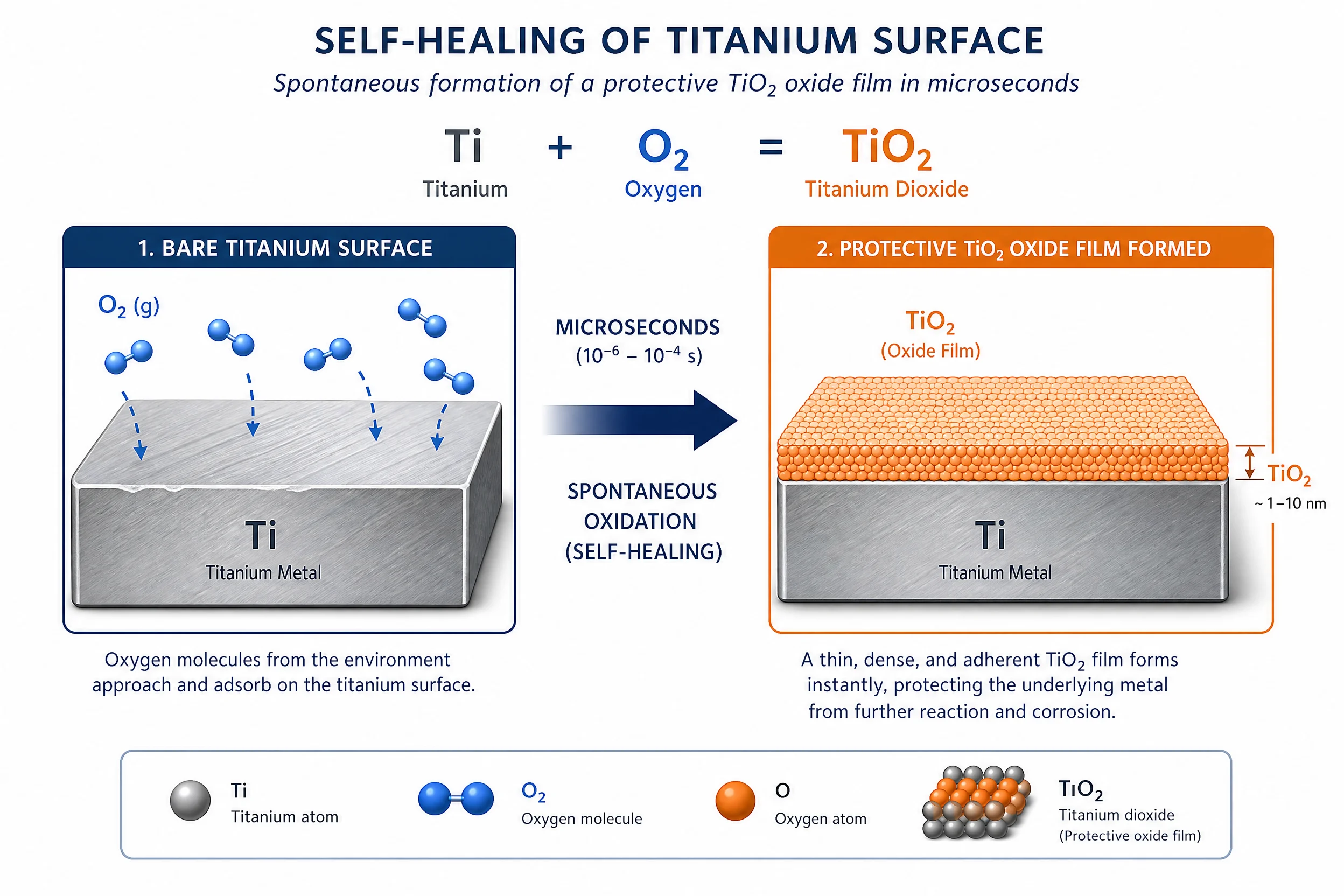
Without oxygen, the thermodynamic driving force for TiO₂ formation disappears. In oxygen-depleted environments — sealed crevices, anaerobic biological environments, certain reducing chemical processes — repassivation becomes incomplete or fails entirely.
There is an important nuance worth noting. A 2022 study published in npj Materials Degradation (Nature portfolio) found that repassivation of titanium biomaterials after mechanical damage is not always immediate or complete, particularly under inflammatory biological conditions where hydrogen peroxide and reactive oxygen species are present alongside mechanical damage. Under these specific conditions, partial oxide dissolution competes with regrowth, potentially exposing the metal longer than commonly assumed. This does not negate titanium’s exceptional corrosion resistance in normal service, but it is a relevant caveat for implant design engineers who assume perfect instantaneous repassivation.
When the Titanium Passive Film Actually Fails
Titanium is not universally corrosion-proof. The passive film has specific failure conditions, and understanding them is as important as understanding its strengths.
Fluoride ions in acidic environments are the most common practical threat. Fluoride attacks TiO₂ by forming soluble titanium fluoride complexes (TiF₄²⁻, TiF₆²⁻), dissolving the film chemically. Research published in the Journal of Dental Research found that when hydrofluoric acid (HF) concentration in solution exceeds approximately 30 ppm at low pH, passivation breaks down and titanium corrodes actively. This matters directly in dental implant applications, where fluoride-containing mouthwashes are common, and in chemical processing environments where fluoride cleaning agents are used.
Strongly reducing mineral acids that contain no oxidizing component also compromise the film. Concentrated hydrochloric acid (HCl) and sulfuric acid (H₂SO₄) at elevated temperatures can attack titanium because they provide neither the oxygen nor the electrochemical potential required for TiO₂ stability. Standard Grade 2 titanium should not be used in concentrated HCl or hot concentrated H₂SO₄.
Oxygen-depleted crevice conditions represent a mechanical-geometric failure mode. In a tight crevice, dissolved oxygen is rapidly consumed by cathodic reactions and cannot be replenished fast enough from the bulk environment. Once O₂ drops below approximately 1 ppm, the self-healing mechanism stalls. The pH in the crevice also drops as metal ion hydrolysis proceeds, further destabilizing the film. For high-temperature or high-chloride crevice environments, Grade 7 or Grade 12 titanium (palladium-alloyed grades) is specified precisely because palladium lowers the critical pitting potential and extends passive film stability.
Extreme pH at either end of the scale — strongly oxidizing alkaline solutions or strongly concentrated acids — can exceed the TiO₂ film’s stability window, though the range is generous. The film is generally reliable from pH 1 to pH 12, covering the vast majority of industrial and biological environments.
Elevated temperature in chloride-rich environments raises the risk of crevice corrosion — not pitting — in unalloyed titanium. The critical crevice corrosion temperature (CCT) for Grade 2 titanium in seawater is approximately 80–82°C. Below this temperature, titanium Grade 2 is effectively immune to localized attack even at high chloride concentrations. Above this threshold, or in aggressive chloride-plus-reducing-acid combinations, upgrading to a palladium-alloyed grade is necessary. Note that titanium Grade 2 does not pit in seawater in the conventional sense — its localized corrosion risk is crevice-geometry dependent, not potential-driven pitting as seen in stainless steel.
Titanium vs. Stainless Steel vs. Aluminum — Passive Film Comparison
All three metals owe their corrosion resistance to a self-forming passive oxide film, but the composition, stability, and performance of these films differ in ways that matter for material selection.
| Property | Titanium (TiO₂) | Stainless Steel (Cr₂O₃) | Aluminum (Al₂O₃) |
|---|---|---|---|
| Film composition | TiO₂ (primarily) | Cr₂O₃ | Al₂O₃ |
| Typical film thickness | 2–5 nm | 1–3 nm | 2–8 nm |
| Formation speed | < 10⁻⁴ s | ~milliseconds | < 1 s |
| Uniform corrosion rate in seawater (25°C) | < 0.0001 mm/year | ~0.001–0.010 mm/year | 0.001–0.01 mm/year |
| Crevice/pitting threshold in seawater (Gr 2 / 316L) | ~82°C (crevice) | ~16–25°C (pitting) | ~25°C (pitting, salt) |
| Stable pH range | 1–12 | 4–10 | 4–9 |
| Chloride resistance | Excellent | Moderate | Poor in saline |
| Self-healing in reducing environments | Limited | Very limited | Moderate |
| Safe flow velocity in seawater (m/s) | ≥ 30 | 6–9 | 4 |
The most practically significant differences are in localized corrosion resistance. Stainless steel’s Cr₂O₃ film breaks down at relatively modest temperatures in chloride-rich water — the critical pitting temperature of 316L in seawater is approximately 16–25°C depending on test method, which is why 316L requires Mo additions and still cannot match titanium in hot saline or seawater service. Titanium Grade 2’s critical crevice corrosion temperature of ~80–82°C sits far above typical operating conditions for most marine and chemical plant equipment.
Aluminum’s Al₂O₃ film is less chemically stable in both acidic and alkaline conditions. Aluminum corrodes rapidly in salt spray and cannot be reliably used in continuous marine splash zones without additional surface treatment, whereas titanium Grade 2 survives indefinitely.
Stainless steel’s Cr₂O₃ film is also more vulnerable to mechanical repassivation failure in reducing environments — once the passive film is locally disrupted in a crevice, stainless steel tends to experience aggressive pit propagation rather than self-repair. The lower Cr²O₃ stability relative to TiO₂ in chloride environments is well-documented and is the reason titanium dominates in high-value marine and chemical processing applications despite its cost premium.
Real-World Applications Where the Passive Film Does the Work
The passive film is not just a laboratory curiosity — it directly explains why titanium is specified for the applications it dominates.
Biomedical implants rely on the TiO₂ film for two distinct reasons. First, it prevents titanium ion release into body fluids — because the film blocks ionic diffusion, the underlying metal does not corrode and does not introduce metal ions into surrounding tissue. Second, proteins like fibronectin and laminin adsorb readily onto TiO₂ surfaces through electrostatic and hydrogen-bonding interactions, which promotes osseointegration — the direct bonding of bone to the implant surface. The passive film is thus both a corrosion barrier and a biological interface. Titanium dental implants and orthopedic hip/knee components are among the most tested long-term implant materials in clinical use.
Marine and offshore engineering benefits from the pitting resistance advantage shown in the comparison table above. Desalination plant heat exchangers, offshore oil platform fasteners, and submarine hydraulic systems all operate in environments (hot, chloride-rich, sometimes biofouled) that would cause rapid pitting in 316L stainless steel but that fall well within titanium’s passive film stability window.
Chemical processing exploits titanium’s resistance to oxidizing acids (nitric acid, chromic acid, hypochlorite) where stainless steel fails. TiO₂ is particularly stable in the presence of oxidizing species because these conditions actively support film regeneration. Titanium heat exchangers in nitric acid plants and bleaching equipment in pulp/paper mills operate for years without meaningful wall-thickness loss.
Aerospace and high-performance structural applications value the passive film indirectly — it means titanium components can be manufactured, stored, and assembled without the corrosion protection coatings (primers, anodizing, painting) required for aluminum or steel, reducing both weight and maintenance requirements. Aircraft fasteners, bulkhead fittings, and nacelle components in titanium are designed on the assumption that the passive film will maintain corrosion protection throughout the service life.
People Also Ask
Why is titanium corrosion resistant?
Titanium resists corrosion because it forms a stable, adherent titanium dioxide (TiO₂) passive film on its surface within microseconds of oxygen exposure. This film — 2–5 nm thick — acts as a physical barrier that prevents corrosive species in the environment from reaching the underlying metal, and prevents titanium ions from migrating outward into the electrolyte. The film is self-limiting, non-porous, and self-healing in oxygenated environments.
How thick is the titanium oxide layer?
At ambient temperature and pressure, the natural passive film on titanium is 2–5 nanometers thick. The film can grow to approximately 20 nm at 250°C, and electrochemical anodization can thicken it to hundreds of nanometers artificially. The 2–5 nm ambient film is dense enough to provide full corrosion protection.
Does the titanium oxide layer self-heal?
Yes. When mechanically damaged — scratched, machined, or abraded — the film reforms spontaneously within milliseconds in any oxygen-containing environment (air, oxygenated water, body fluids). The self-healing process requires dissolved oxygen of at least approximately 1 ppm. In oxygen-depleted environments like sealed crevices, healing is incomplete, which is why crevice geometry is a critical design consideration for titanium components.
Does titanium rust?
No. Rust is a specific term for iron oxide (Fe₂O₃/Fe₃O₄), which forms on iron and steel through an uncontrolled, progressive corrosion process. Titanium forms TiO₂, a different oxide that is chemically stable, self-limiting, and non-expansive. Titanium does not rust in the sense of visible red-brown flaking degradation.
What destroys the titanium passive film?
The most common threat is fluoride ions in acidic solution — HF concentrations above approximately 30 ppm at low pH chemically dissolve TiO₂. Strongly reducing mineral acids (concentrated HCl, hot H₂SO₄), oxygen-depleted crevice conditions, and environments outside the stable pH range of approximately 1–12 can also compromise the film.
Is titanium’s passive film better than stainless steel’s?
In most marine, biological, and high-chloride environments, yes. TiO₂ is more stable than stainless steel’s Cr₂O₃ film in chloride solutions, particularly at elevated temperatures. Titanium Grade 2 has a pitting threshold of approximately 82°C in seawater, versus 25–30°C for 316L stainless steel. This is the primary technical reason titanium is specified for high-value marine, biomedical, and chemical processing applications despite its higher cost.
Summary
Titanium’s reputation as a near-indestructible material in corrosive environments traces entirely to a film you cannot see. The TiO₂ passive layer — spontaneously formed, self-limiting, non-porous, and self-healing — is 2–5 nm thick and forms in under 100 microseconds. Its dense ionic structure blocks the electrochemical reactions required for corrosion before they can start.
Understanding the film also means understanding its limits: fluoride ions at low pH, oxygen-depleted crevices, and strongly reducing acids are the conditions where the passive film loses its advantage. Knowing where it excels and where it fails is what separates intelligent titanium specification from marketing-driven material selection.
For engineers working with titanium for the first time, one thing stands out in practice: the film is the reason you can machine, weld, and handle titanium in standard workshop conditions without any passivation treatment — the metal is passivating itself continuously, every time a fresh surface is created.