Titanium’s corrosion resistance comes from a 2–10 nm TiO2 oxide film that forms within milliseconds of exposure to air or water and self-heals when damaged. In natural seawater at 25°C, commercially pure titanium (Grade 2) corrodes at less than 0.0005 mm/year — effectively zero. But titanium is not inert in every environment. Crevice corrosion can begin above 75°C in hot concentrated chloride solutions, fluoride ions can destroy the passive film, and galvanic coupling with aluminum causes accelerated attack. This guide breaks down the mechanism, grade-by-grade temperature limits, failure environments, and how to choose the right alloy for marine and chemical process applications.
The Passivation Mechanism: What Actually Protects Titanium
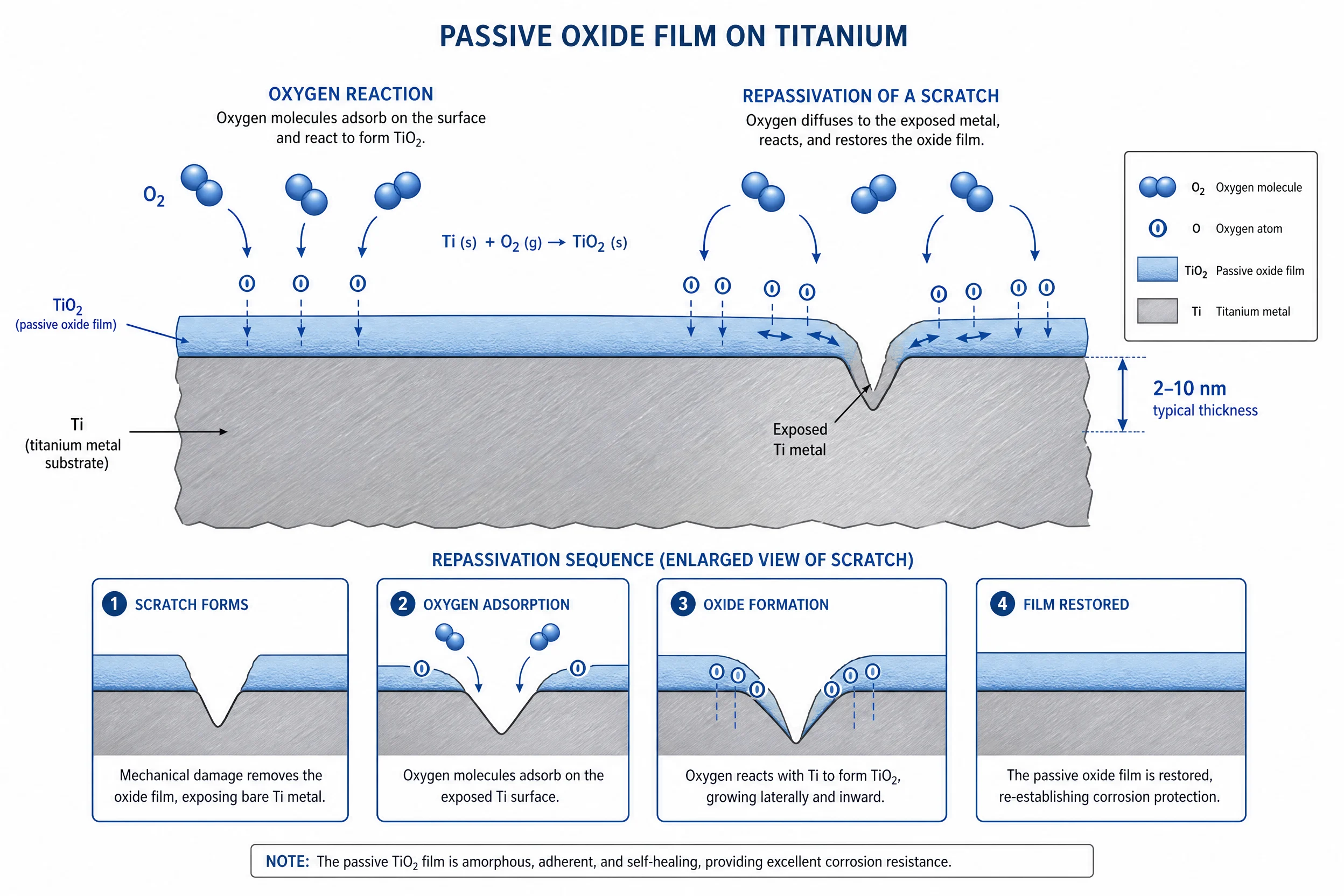
Titanium sits at –1.63 V on the standard electrode potential scale. By that number alone, it should corrode faster than iron. It does not — and the reason is a thin, tenacious oxide layer.
When titanium contacts oxygen, moisture, or any oxidizing environment, it reacts almost immediately to form titanium dioxide (TiO2). The film is 2 to 10 nanometers thick, but it is dense, chemically stable, and strongly adherent to the base metal. More important: it re-forms within milliseconds whenever it is scratched, abraded, or mechanically disrupted, provided oxygen or water is present.
This is called spontaneous repassivation. In a 2021 electrochemical study of TA2 titanium in simulated seawater, researchers found that even after deliberate scratch damage, the passive film reformed and the corrosion potential stabilized at approximately +0.09 V — a markedly noble value for a metal that starts at –1.63 V thermodynamically. The TiO2 film shifts the effective corrosion potential by over 1.7 V in the positive (protected) direction.
The passive film’s protective quality depends on oxidizing conditions. In solutions that maintain dissolved oxygen or other oxidants, TiO2 stays stable and the corrosion rate is negligible. In strongly reducing environments — concentrated hydrochloric acid, concentrated sulfuric acid without oxidizing additions — the film cannot maintain itself. That is the key vulnerability, and it is covered later under failure environments.
The takeaway: Titanium is not inherently corrosion-resistant as a material property. It is corrosion-resistant because of its passive film. Anything that destroys or prevents that film eliminates the protection.
Corrosion Rate Data: What the Numbers Actually Mean
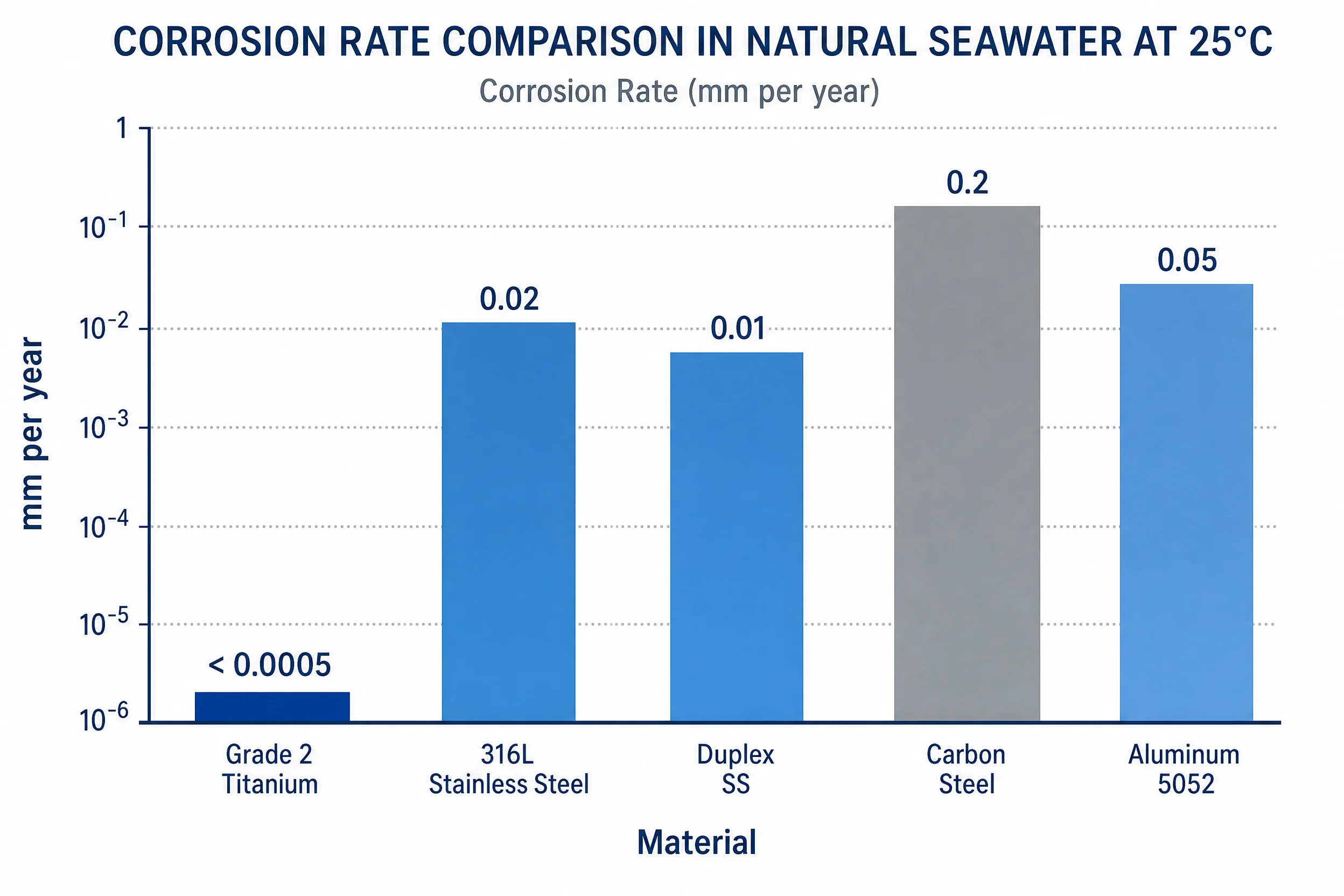
Corrosion rates for engineering materials are typically reported in millimeters per year (mm/y). A rate below 0.025 mm/y is generally considered “excellent” for industrial applications. Grade 2 commercially pure titanium (CP-Ti) in natural seawater at 25°C shows a corrosion rate below 0.0005 mm/y — roughly 50 times lower than the threshold for “excellent.”
For context:
| Material | Corrosion Rate in Natural Seawater (25°C) |
|---|---|
| Grade 2 Ti (CP-Ti) | <0.0005 mm/y |
| 316L Stainless Steel | 0.002–0.05 mm/y (varies with chloride concentration) |
| Duplex SS 2205 | 0.001–0.02 mm/y |
| Carbon Steel | 0.1–0.3 mm/y |
| Aluminum 5052 | 0.01–0.1 mm/y (pitting can be severe) |
These numbers explain why titanium is specified for seawater heat exchangers, offshore desalination equipment, and submarine hardware where maintenance access is limited or impossible.
One thing the data does not show: the difference between uniform corrosion and localized corrosion. Titanium’s resistance to uniform corrosion in seawater is exceptional across all grades. The exposure limits and grade distinctions become critical when crevice geometry, elevated temperature, or concentrated chlorides are involved.
Titanium in Seawater: Grades, Temperature Limits, and Crevice Risk
Grade 2 performs well in seawater under most ambient conditions. The problem starts when temperature rises. In tight crevices — bolted joints, tube-to-tubesheet interfaces, overlapping plates — the local chemistry inside the crevice becomes more concentrated and more acidic over time. Above a threshold temperature, the TiO2 film can no longer maintain itself in those conditions.
Based on published data from corrosion studies of titanium alloys in high-temperature seawater:
| Grade | Composition | Crevice Corrosion Threshold (Seawater) | Typical Use |
|---|---|---|---|
| Grade 1 (CP-Ti) | Pure Ti | ~70°C | Low-stress marine sheet, gaskets |
| Grade 2 (CP-Ti) | Pure Ti + trace Fe, O | ~75–80°C | Heat exchangers, desalination, pipe |
| Grade 5 (Ti-6Al-4V) | Ti + 6%Al + 4%V | ~200°C | High-strength marine, subsea structures |
| Grade 7 (Ti-0.2Pd) | Ti + 0.2% Pd | ~260°C (500°F) | High-T seawater, aggressive chloride |
| Grade 12 (Ti-0.3Mo-0.8Ni) | Ti + Mo + Ni | ~260°C (500°F) | Cost-effective alternative to Gr7 |
The addition of palladium in Grade 7 is specifically for this purpose: Pd acts as a cathodic catalyst that supports the passive film in reducing or hot chloride environments. The improvement in crevice resistance over Grade 2 is dramatic — approximately 180°C higher threshold — which is why Grade 7 appears in high-temperature desalination and chemical process equipment despite its cost premium.
For most seawater applications at ambient temperature (offshore piping, fasteners, pump components below 60°C), Grade 2 is the standard specification and provides effectively unlimited service life.
Galvanic Corrosion: The Risk That Catches Engineers Off Guard
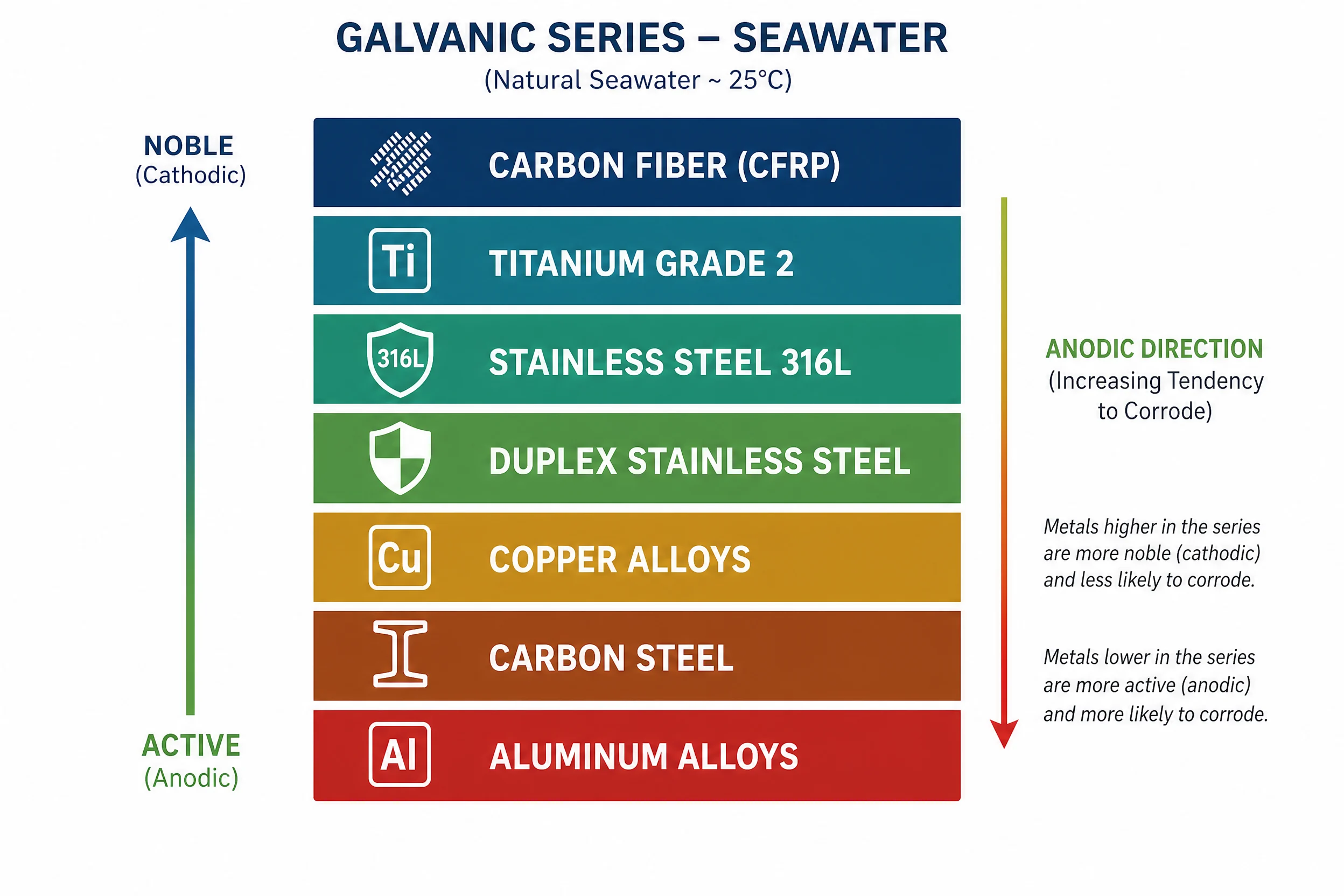
Titanium sits near the noble end of the galvanic series in seawater — more noble than stainless steels, copper alloys, and aluminum. This creates a specific risk: when titanium is in electrical contact with a less noble metal in a conducting electrolyte (like seawater), the less noble metal corrodes faster, and titanium is protected. This sounds like a benefit for titanium, but it accelerates destruction of the coupled metal.
Practical implications:
| Metal Coupled to Titanium | Effect on Coupled Metal | Effect on Ti | Risk Level |
|---|---|---|---|
| Aluminum alloys | Severe accelerated corrosion of Al | Ti protected | High — avoid |
| Carbon steel / mild steel | Accelerated corrosion of steel | Ti protected | High — isolate |
| Carbon fiber (CFRP) | Ti is less noble; Ti corrodes slightly | Moderate Ti attack | Medium — isolate in seawater |
| 316L Stainless Steel | Slight acceleration of SS corrosion | Ti protected | Low–Medium |
| Duplex Stainless Steel | Minimal effect | Ti protected | Low |
| Other titanium alloys | No galvanic effect | None | Safe |
The carbon fiber case deserves specific attention. Carbon fiber reinforced polymers (CFRP) are more noble than titanium in seawater — the carbon fiber acts as a large cathode and drives oxidation of titanium. In aerospace and marine structures where titanium fasteners are used with carbon fiber panels, electrical isolation is required: PTFE or nylon bushings, insulating sleeves, and sealant at the interface. This is standard practice in aircraft structures (Boeing specification D6-51991 covers this pairing), but it is frequently overlooked in marine structures built by teams without aerospace background.
When Titanium’s Corrosion Resistance Fails
Titanium is not resistant to every environment. The failure cases are well-documented, and a specification engineer who ignores them will encounter expensive surprises.
Fluoride environments. Fluoride ions (F⁻) attack TiO2 by forming soluble hexafluorotitanate complexes ([TiF6]²⁻), destroying the passive film. The corrosion risk depends primarily on the concentration of undissociated hydrofluoric acid (HF), not total fluoride. At neutral pH, nearly all fluoride exists as F⁻ rather than HF, so titanium can tolerate relatively high total fluoride concentrations without significant attack. Risk rises sharply as pH drops below 4–5, where HF fraction increases. The practical threshold for passive film breakdown is approximately 30 ppm free HF. This makes titanium unsuitable for HF service and for strongly acidic fluoride environments, but not necessarily incompatible with dilute fluoride at neutral pH.
Reducing acids without oxidizers. Hydrochloric acid (HCl) and sulfuric acid (H₂SO₄) at moderate to high concentrations in the absence of oxidizing species will dissolve titanium. The passive film depends on oxidants to maintain itself; strip those away and bare metal is exposed to an acid. Grade 7 and Grade 11 (with palladium additions) extend resistance into reducing acid service because Pd supports repassivation through cathodic hydrogen recombination, but even these have concentration and temperature limits.
Hot concentrated brines with crevices. As noted in the grade comparison above, crevice corrosion in concentrated chloride at elevated temperature is the most common real-world failure mode. It rarely occurs in open-flow geometries; the geometry must trap the electrolyte and allow local chemistry to concentrate. Design engineers should minimize crevice geometry when operating above 60°C.
Red fuming nitric acid (RFNA). This deserves special mention because the failure mode is not ordinary corrosion — it is pyrophoric ignition. Titanium reacts violently with red fuming nitric acid under certain conditions, particularly with impact or shock. This is a safety issue, not just a corrosion issue. RFNA is never specified with titanium.
Dry chlorine gas. Above approximately 150°C in dry chlorine gas (without moisture), titanium ignites. Wet chlorine and dilute chlorine solutions are handled safely; dry chlorine at elevated temperature is not.
Selecting the Right Titanium Grade for Corrosion-Resistant Applications
The grade decision for corrosion-resistant service comes down to four factors: temperature, crevice geometry, chemical environment, and strength requirement.
For ambient-temperature seawater with no tight crevices: Grade 2 is the default. It handles virtually all marine exposure below 60°C with negligible corrosion and is the lowest-cost corrosion-resistant titanium grade.
For elevated-temperature seawater or chloride service (60–200°C): Grade 12 (Ti-0.3Mo-0.8Ni) offers an economically attractive alternative to Grade 7, with a crevice threshold also around 260°C (500°F) in seawater — though Grade 7 typically performs better in the most aggressive conditions. Grade 7 (Ti-0.2Pd) is the primary choice for the most demanding high-temperature applications.
For high-strength structural marine applications where corrosion resistance must coexist with mechanical load: Grade 5 (Ti-6Al-4V) is the standard selection. It maintains excellent corrosion resistance in seawater up to ~200°C and is widely qualified in offshore and subsea structural codes.
For reducing acid service (chemical processing, oil and gas downhole): Grades 7 and 11 (palladium-bearing) are specified. Grade 9 (Ti-3Al-2.5V) offers a middle-ground option for mildly reducing environments.
For fluoride or HF environments: titanium is not appropriate regardless of grade. Zirconium or tantalum are typically specified instead.
FAQ
Why does titanium not rust like steel?
Steel corrodes because iron oxide (rust) is porous and non-protective — water and oxygen continue reaching the base metal. Titanium forms titanium dioxide (TiO2), which is dense, adherent, and self-healing. Once TiO2 forms, it seals the surface and stops further oxidation. The passive film also reforms within milliseconds if damaged, provided oxygen or water is present.
Is titanium completely immune to seawater corrosion?
Titanium Grade 2 is effectively immune to uniform corrosion in seawater at ambient temperatures, with rates below 0.0005 mm/y. It is not immune to crevice corrosion above ~75–80°C in tight joint geometries with concentrated chlorides. The distinction between open-surface corrosion (essentially nil) and crevice corrosion at elevated temperature is the key nuance that separates informed from uninformed specifications.
Can titanium corrode in contact with other metals?
Yes — galvanic corrosion is a real risk when titanium is electrically coupled to less noble metals (aluminum, steel) in seawater. The less noble metal corrodes faster. When coupled to carbon fiber (more noble than Ti), titanium itself experiences mild galvanic attack. Electrical isolation is the standard engineering control.
Why is Grade 7 titanium more corrosion-resistant than Grade 2?
The 0.2% palladium addition in Grade 7 acts as a cathodic catalyst. Pd supports hydrogen recombination at the metal surface, which sustains the passive film in reducing environments and hot concentrated chloride. This pushes the crevice corrosion threshold from ~80°C (Grade 2) to approximately 260°C (500°F) — an ~180°C improvement.
Does titanium corrode in hydrochloric acid?
Standard Grade 2 titanium is attacked by HCl at concentrations above approximately 5% and temperatures above 50°C. In dilute HCl with dissolved oxygen or other oxidizers, the passive film can maintain itself and corrosion rates are low. For reliable service in reducing acid environments, Grade 7 or Grade 11 (Pd-bearing) must be specified.
What environments absolutely cannot use titanium?
Red fuming nitric acid (pyrophoric risk), dry chlorine gas above 150°C, concentrated fluoride solutions (HF), and highly reducing concentrated mineral acids (concentrated HCl >10%, concentrated H₂SO₄ >70%) without oxidizing additions. These are hard exclusions regardless of grade.
Summary
Titanium’s corrosion resistance is not a marketing claim — it is a consequence of TiO2 passive film chemistry that is well-characterized across decades of electrochemical research and field service. The film is thin, self-healing, and thermodynamically stable in an enormous range of environments.
The practical engineering picture is more nuanced than “titanium doesn’t corrode.” Grade selection matters at elevated temperatures. Crevice geometry matters in hot chloride service. Galvanic compatibility matters when titanium touches dissimilar metals. And a short list of failure environments — fluorides, reducing acids, dry hot chlorine — must be recognized and designed around.
For marine, chemical process, and subsea applications where service life, maintenance access, and reliability define the cost calculation, titanium consistently outperforms lower-cost stainless alternatives over a 15–25 year operational horizon. The premium in material cost is routinely offset by avoided maintenance and replacement.