Titanium travel mugs weigh 40–45% less than stainless steel and never leave a metallic taste in your coffee. But the insulation story is more nuanced than most guides admit: single-wall titanium cools your drink in 15–20 minutes, while double-wall titanium buys you 45–60 minutes — still well short of a vacuum-insulated stainless thermos (3–6 hours). The best titanium mug for backpacking in 2026 is the TOAKS 450 Single-Wall (~$22). For daily travel use, the Snow Peak Ti-Double 450 ($54.95) or TOAKS Double Wall 450 ($39.95) are the top choices. Pure titanium mugs (Grade 1–2 CP) are FDA-biocompatible and completely taste-neutral.
The Real Difference Between Titanium and Stainless Steel Mugs
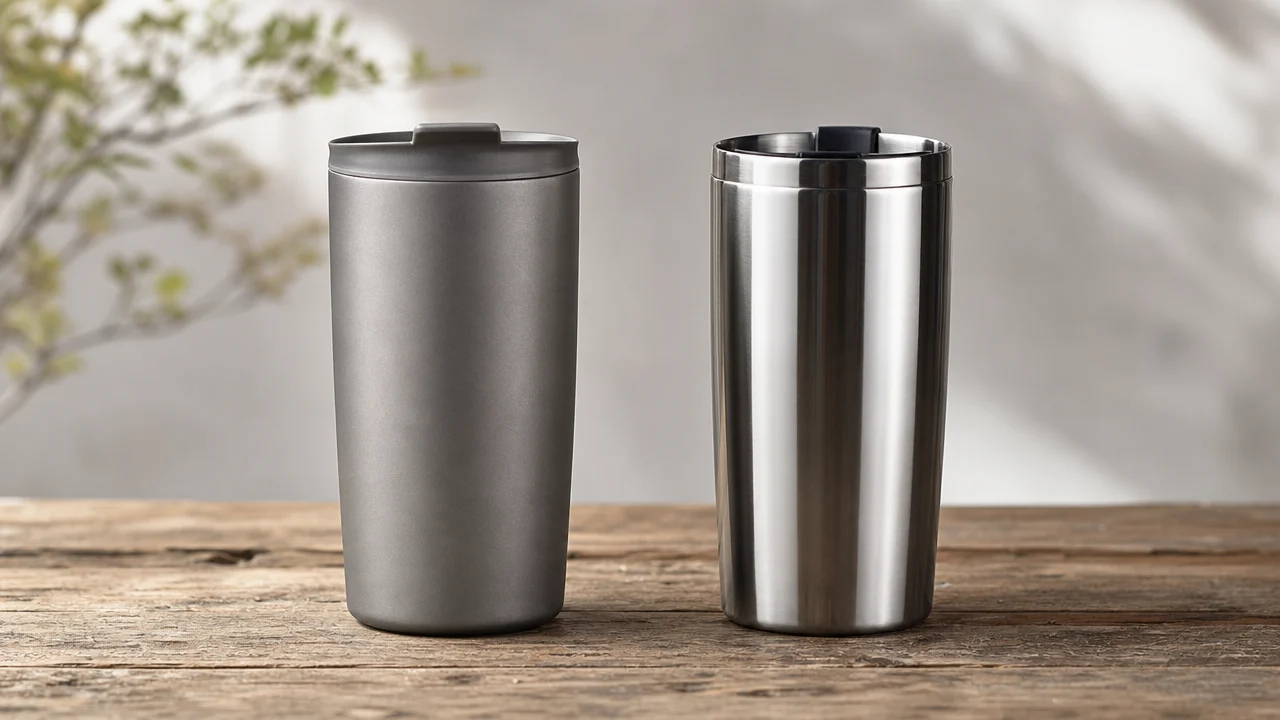
The weight comparison is simple. Titanium has a density of 4.5 g/cm³ versus roughly 8.0 g/cm³ for food-grade stainless steel (304 grade). That makes titanium about 45% lighter for the same volume — which is why a TOAKS 450ml single-wall mug weighs 76g while a comparable stainless steel mug like the GSI Glacier 470ml weighs 198g. That 122g gap is the difference between carrying two AA batteries vs. a full deck of cards.
For everyday desk or travel use, the weight difference is less dramatic but still real. If you commute with your mug or hike to the office, shaving 120g off your bag adds up.
But there’s a persistent myth I want to address upfront, because every other comparison article gets this wrong.
The Thermal Conductivity Myth
Most guides imply titanium is naturally a better insulator than stainless steel because it’s a “different” metal. Not true.
Commercially pure titanium (CP Ti Grade 2) has a thermal conductivity of roughly 16–17 W/m·K. Stainless steel 304 sits at 14–16 W/m·K. They’re nearly identical. Neither material is a meaningful insulator on its own.
What actually keeps your drink hot is the air gap — specifically, a sealed vacuum gap in double-wall construction. When you see a double-wall titanium mug keeping coffee warm for 45 minutes, the titanium isn’t doing the insulating. The vacuum layer is. A double-wall stainless steel mug works on exactly the same principle, and a well-engineered vacuum-insulated stainless thermos (Yeti, Hydro Flask, Stanley) will outperform any double-wall titanium mug on heat retention — by a lot.
Here’s the honest comparison, because this is what most guides won’t show you:
| Mug Type | Heat Retention | Weight (450ml) | Stove-Safe | Price Range |
|---|---|---|---|---|
| Single-wall titanium | 15–20 min (room temp) | 48–76g | Yes | $20–$45 |
| Double-wall titanium | 45–60 min | 77–101g | No | $40–$60 |
| Single-wall stainless steel | 10–15 min | 180–220g | Yes | $10–$20 |
| Vacuum-insulated stainless (Yeti, Stanley) | 3–6 hours | 300–385g | No | $30–$55 |
If maximum heat retention is your priority, a vacuum-insulated stainless thermos wins. That’s just the truth. The reason to choose titanium is the weight-to-quality ratio, taste neutrality, and lifetime durability — not insulation performance.
Titanium vs Stainless Steel: Head-to-Head
| Feature | Titanium (CP Grade 1–2) | Stainless Steel (304) |
|---|---|---|
| Density | 4.5 g/cm³ | 7.9 g/cm³ |
| Weight advantage | ~45% lighter | Baseline |
| Taste impact | None — completely inert | Faint metallic taste possible |
| Safety | FDA-approved for implants | Food-grade (18/8 or 304) safe |
| Rust/corrosion | Zero | Possible with lower grades |
| Dent resistance | Lower (0.3–0.5mm thin walls) | Higher (thicker walls) |
| Dishwasher | Hand wash recommended | Usually dishwasher-safe |
| Stove-direct | Yes (single-wall only) | Yes |
| Price (450ml) | $20–$60 | $10–$45 |
| Lifespan | Indefinite if not dented | Indefinite |
On taste, titanium has a genuine advantage. I’ve poured the same pour-over into a titanium cup and a stainless tumbler side by side — the stainless produced a detectable metallic edge at the 10-minute mark. The titanium cup tasted exactly like the coffee should. This is consistent with what people report on r/Coffee: titanium is “the metal that tastes like nothing.” The chemistry reason is that titanium’s surface oxide layer is extremely stable and doesn’t catalyze reactions with coffee acids the way stainless steel can under heat.
On durability, stainless wins if you’re rough on gear. Titanium mugs use very thin walls (0.3–0.5mm) to save weight — drop one on a rock and it will dent permanently. A thicker-walled stainless steel mug absorbs the same impact without denting. Both are lifetime purchases if treated reasonably; stainless is more forgiving of abuse.
Is Titanium Safe? Clearing Up the TiO2 Confusion
Pure titanium mugs are among the safest drinkware options available. The FDA has cleared titanium for long-term medical implantation (hip replacements, bone plates, dental implants) — which sets a higher safety bar than holding hot coffee. Brands including Snow Peak, TOAKS, Vargo, and SilverAnt use CP Grade 1 or Grade 2 titanium: 99%+ pure titanium, no coatings, no alloying elements that could leach into drinks.
There is a separate product — titanium dioxide (TiO2) — used as a whitening agent in some ceramic non-stick coatings. The European Food Safety Authority (EFSA) reclassified TiO2 as “not safe” as a food additive (E171) in 2022. This gets misread online as a concern about titanium mugs. It isn’t. TiO2 in nano-particle coating form is a different thing entirely from a solid titanium cup. A pure titanium mug sheds zero particles into your drink.
Single-Wall vs Double-Wall: The Decision That Actually Matters
This is the most important choice when buying a titanium mug, and it’s not about insulation preferences — it’s about how you’ll use it.
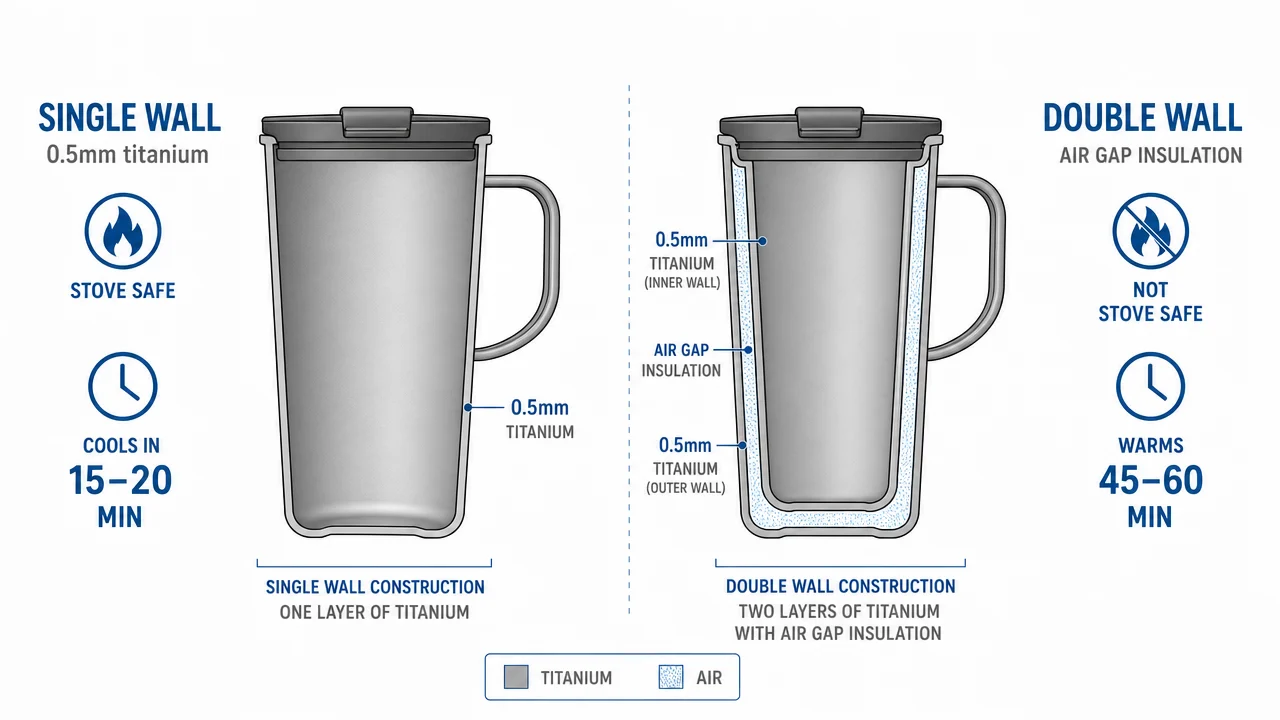
Single-wall titanium is a single rolled sheet, 0.3–0.5mm thick. It can go directly on a gas stove, alcohol burner, or campfire. Coffee cools fast (15–20 minutes). The outer surface gets hot when liquid is hot inside. Weight: 48–76g for a 450ml mug. Price: $20–$35.
Double-wall titanium has an inner and outer shell with a sealed air gap. It cannot go on any heat source — the gap expands and can rupture the weld. Coffee stays warm 45–60 minutes. Outer surface stays cool. Weight: 77–101g. Price: $40–$60.
The rule: If you’re buying for backpacking or camping, get single-wall. You’ll want to boil water directly in it. If you’re buying for daily commuting or travel, get double-wall — the cooler exterior and extended warmth time matter when you’re not near a stove.
One more thing the spec sheets don’t say: most double-wall titanium mugs are handle-less (Snow Peak Ti-Double, TOAKS double-wall) to maintain the insulation layer continuity. If you need a handle, look at Keith or SilverAnt double-wall options.
Wall Thickness Guide: 0.3mm vs 0.5mm
Within single-wall titanium mugs, you’ll see two variants from brands like TOAKS:
- 0.3mm (ultralight): TOAKS 450 Ultralight at 48g. The absolute lightest. Dents more easily under pressure — not ideal if you’re throwing your mug loose in a pack.
- 0.5mm (reinforced): TOAKS 450 Standard at 76g. 28g heavier but noticeably more rigid. Survives rough pack treatment much better.
For most people, the 0.5mm is the right choice. The 28g difference is worth the durability unless you’re a gram-counting thru-hiker already under your weight target.
Best Titanium Coffee Mugs for Travel in 2026

Best Value: TOAKS 450 Single-Wall (0.5mm) — ~$22
76g, 450ml, Grade 1 titanium, folding handles, includes mesh storage bag. 4.8 stars from 1,900+ Amazon reviews. The default recommendation — cheap enough to test titanium, well-made enough to keep. Stove-safe. Not a travel mug in the insulated sense, but the best all-around titanium camp/hike mug.
Best for Daily Travel Use: TOAKS Double Wall 450 — $39.95
77g, 450ml, double-wall insulated. Handle-less. Priced $15 lower than the Snow Peak equivalent with comparable insulation performance per user reports. Best balance of price and daily travel performance.
Premium Pick: Snow Peak Ti-Double 450 — $54.95
101g, 450ml, made in Japan. The benchmark for double-wall titanium construction — advanced welding, cool exterior, stacks with the H300 mug. No lid included, no handle. Worth the premium if you want the best-built titanium travel mug available and plan to keep it indefinitely.
Best for Minimalists: Fire Maple Alti 300 — $21.99
63g, 300ml, single-wall. 84mm diameter fits inside larger pots. 4.72 stars from 3,000+ reviews. 3-year warranty. Best option if pack size matters more than capacity.
Best with a Lid: Vargo Titanium 450 Travel Mug — $34.95
85g, 450ml, single-wall. Features Vargo’s foldable Bot Handle and an included silicone-gasket lid. If you want a single-wall mug that seals for travel, this is the only dedicated option in the mainstream titanium lineup.
Best Double-Wall with Handle: SilverAnt Titanium Double-Wall 450 — ~$45
Grade 1 titanium, double-wall, folding handles (unlike Snow Peak’s handle-less design), lifetime warranty. If the handle-less form factor of the Snow Peak bothers you, SilverAnt is the alternative.
Care and Maintenance
Hand wash with mild soap and warm water. 30 seconds, done. Titanium doesn’t rust, doesn’t hold odors, and doesn’t stain permanently — coffee stains come off with a baking soda paste.
Snow Peak explicitly marks their double-wall mugs “not dishwasher safe” — the concern is the weld on the vacuum seal, not the titanium itself. Single-wall mugs can technically go in the dishwasher but develop a cloudy surface finish over time (cosmetic only). TOAKS and Fire Maple both recommend hand washing.
What will actually damage a titanium mug: dropping it on concrete (permanent dent), putting a double-wall on a stove (weld failure, safety risk), or using bleach-based cleaners.
Summary: Who Should Buy Titanium, and Who Shouldn’t
Titanium is the right choice if: You’re a backpacker counting grams, you want a mug that lasts indefinitely without rust or breakage, or you can taste the metallic edge in your stainless steel cup.
Stick with stainless if: Heat retention for 3+ hours is your priority (get a vacuum-insulated thermos), you’re rough on gear and don’t want to worry about dents, or you need dishwasher-safe above all else.
The entry point that makes sense for most people: the TOAKS 450 single-wall at ~$22. It’s cheap enough to test whether titanium suits your habits. If it does, the TOAKS Double Wall 450 at $39.95 is the logical daily-use upgrade.
FAQ
Does titanium make coffee taste different?
No. Pure titanium (Grade 1–2 CP) is chemically inert. Its surface oxide layer doesn’t react with coffee acids. In blind taste tests, titanium is indistinguishable from ceramic — unlike stainless steel, which can introduce a metallic aftertaste at higher temperatures.
Can titanium mugs go on a stove or campfire?
Single-wall titanium only. Double-wall mugs have a sealed air gap that expands under heat and can rupture the weld — this is a genuine safety issue. Never heat a double-wall titanium mug on any flame or burner.
How long does a titanium double-wall mug keep coffee hot?
45–60 minutes at room temperature (around 70°F/21°C). Significantly less than a vacuum-insulated stainless thermos (3–6 hours). If long heat retention is your main priority, a stainless vacuum thermos is the better tool.
Are titanium mugs dishwasher safe?
The metal itself is fine in a dishwasher. Double-wall models should never go in the dishwasher — heat and pressure cycles stress the weld. Single-wall mugs can go in but will develop a cloudier surface finish over time. Hand washing is best for all types.
Why are titanium mugs so expensive?
Raw titanium is harder to refine and machine than stainless steel. The energy and tooling cost is higher. A basic stainless cup costs $10–$15 to produce; an equivalent titanium cup costs $20–$35. Premium double-wall construction adds further cost in precision welding.
Is the Snow Peak Ti-Double worth $55?
For daily use as a permanent purchase, yes. The Japanese-manufactured weld quality and refined form factor justify the price if you’re comparing it to replacing cheaper mugs every few years. If budget is the concern, the TOAKS Double Wall 450 at $39.95 provides comparable insulation performance.
Conclusion
Titanium travel mugs win on weight and taste neutrality. Stainless steel wins on heat retention (especially vacuum-insulated) and price. The key insight most guides miss: titanium and stainless have nearly identical thermal conductivity — the insulation difference comes entirely from the vacuum gap in double-wall construction, not the metal itself.
For backpacking, single-wall titanium is the obvious choice. For daily travel use, a double-wall titanium mug is a premium option that earns its price through lifetime durability and zero taste interference — just don’t expect it to rival a Yeti on heat retention.