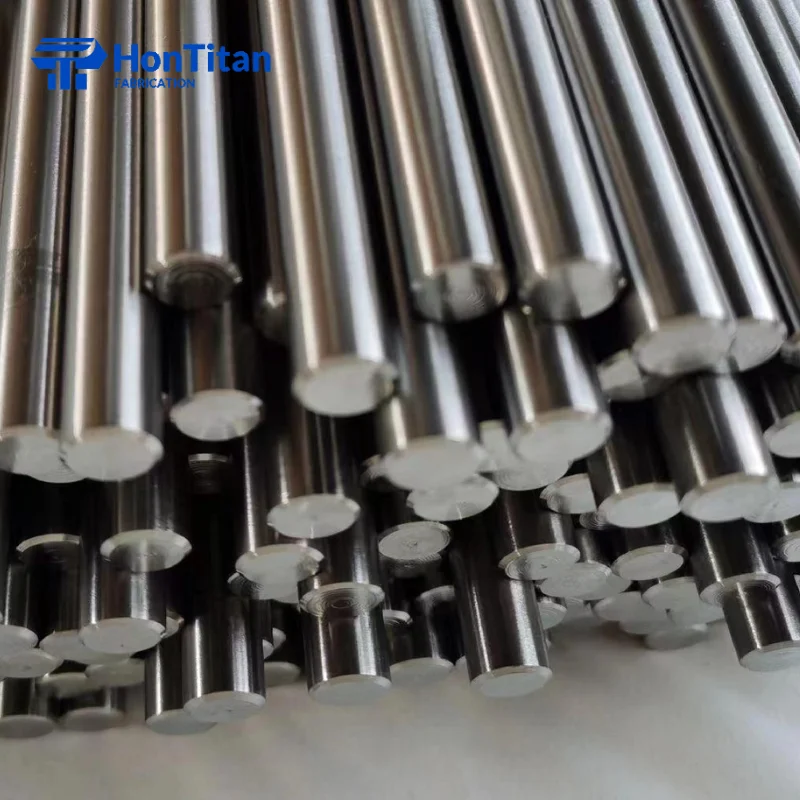
La réactivité extrême du titane avec l'oxygène rend le moulage en sable standard impraticable pour la plupart des applications — le titane fondu s'enflamme à l'air libre. La méthode dominante est coulée à la cire perdue sous vide, qui combine un procédé de carapace céramique à cire perdue avec une chambre sous vide étanche et un four à creuset froid en cuivre refroidi à l'eau. D'autres méthodes, notamment le moulage sous vide en coquille et la coulée centrifuge, existent dans des créneaux limités. Ce guide détaille chaque méthode de coulée du titane viable, explique l'exigence obligatoire du vide, compare les économies des procédés et couvre les étapes de post-traitement (HIP, élimination de la couche alpha‑case, traitement thermique) que les acheteurs du secteur aérospatial et médical négligent systématiquement lors de l'établissement des budgets.
Pourquoi la coulée du titane est fondamentalement différente de celle des autres métaux
La plupart des métaux peuvent être fondus et coulés dans un moule en sable à l'air libre. Le titane, non.
À des températures supérieures à environ 1100 °C, le titane fondu réagit violemment avec l'oxygène et l'azote. Il dissout les gaz atmosphériques dans le bain de fusion, formant une couche de surface fragile enrichie en oxygène appelée cas alpha — et en cas d'exposition sévère, le métal peut s'enflammer. Il ne s'agit pas d'un simple inconvénient de manipulation. C'est une réalité métallurgique qui élimine des catégories entières de méthodes de coulée qui fonctionnent parfaitement pour l'acier, l'aluminium ou même les superalliages à base de nickel.
La conséquence : pratiquement toutes les méthodes de coulée du titane viables nécessitent un environnement sous vide ou sous atmosphère inerte contrôlée. Cette seule contrainte modifie tout — les équipements, l'outillage, le temps de cycle, la qualification des fournisseurs et les coûts.
Comprendre cela dès le départ permet d'éviter des cycles de demandes de devis inutiles auprès de fonderies qui “ font de la coulée ” mais ne disposent pas de l'infrastructure adaptée au titane.
Les quatre principales méthodes de coulée et leur compatibilité avec le titane
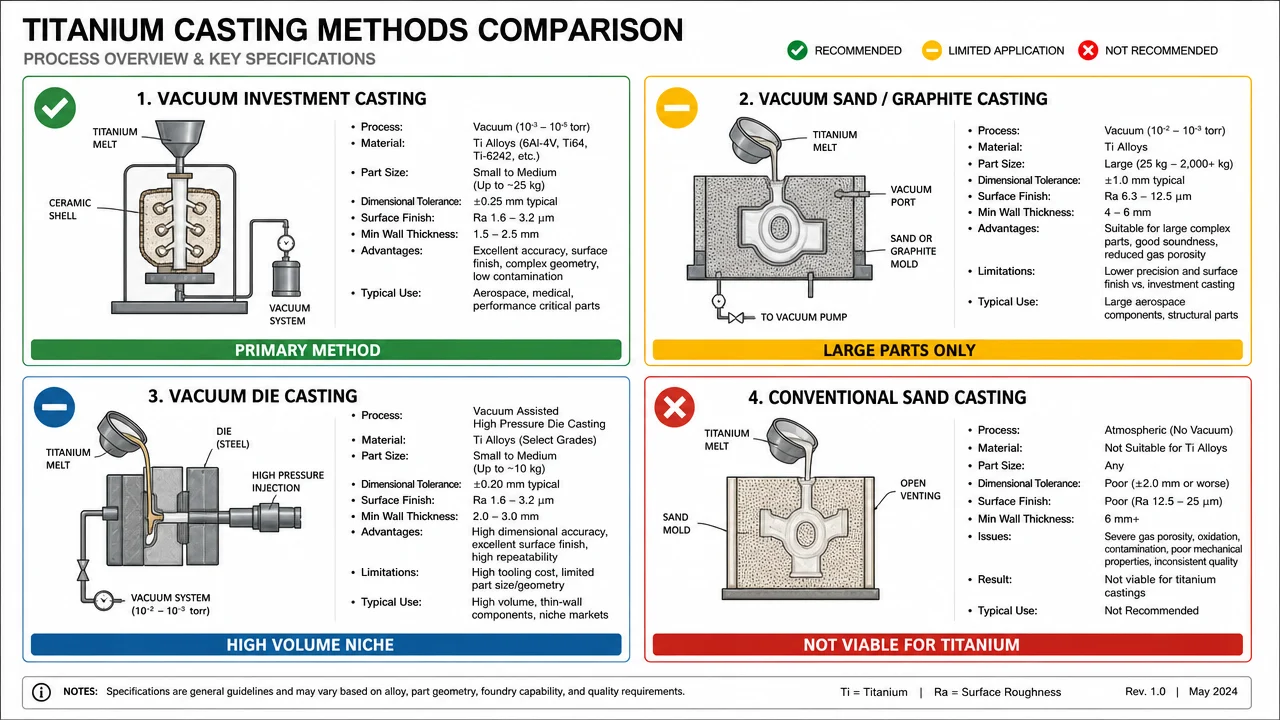
| Méthode | Compatible avec le titane ? | Pourquoi / Pourquoi pas |
|---|---|---|
| Coulée à la cire perdue sous vide | ✅ Oui — méthode principale | La chambre sous vide étanche et la carapace céramique préviennent la contamination atmosphérique |
| Moulage sous vide en coquille | ✅ Oui — créneau limité | Le moulage sous pression élevée sous vide est viable ; nécessite un équipement spécialisé |
| Coulée centrifuge | ✅ Oui — spécialisé | Utilisé pour les anneaux et tubes ; environnement sous vide requis |
| Moulage en sable | ⚠️ Très limité | Le moulage en sable conventionnel provoque une couche alpha‑case sévère ; le moulage en sable sous vide existe mais est rarement utilisé pour le titane |
| Coulée par gravité en moule permanent | ❌ Non viable | Le titane fondu réagit avec les outillages en acier ou en fonte |
| Moulage sous pression standard | ❌ Non viable | La pression d'injection est incompatible avec la réactivité du titane ; absence de contrôle du vide |
Le reste de ce guide se concentre sur les trois méthodes viables en usage pratique : la coulée à la cire perdue sous vide, le moulage sous pression sous vide, et — le cas échéant — le moulage en sable du titane.
Coulée à la cire perdue sous vide : le procédé dominant pour le titane
La coulée à la cire perdue sous vide (également appelée coulée à cire perdue sous vide) représente 85–90% des pièces moulées en titane à usage commercial. C'est la méthode que la plupart des fonderies désignent lorsqu'elles parlent de “ moulage du titane ” sans autre précision.
Pourquoi ce procédé domine-t-il : La capacité quasi-net-shape de la coulée à la cire perdue minimise l'usinage post-coulée d'un matériau coûteux et difficile à usiner. La carapace céramique tolère le point de fusion élevé point de fusion du titane (1668°C / 3034°F). Et le procédé est intrinsèquement évolutif par lots — une seule campagne de four sous vide peut couler simultanément des dizaines de pièces.
Le procédé de coulée à la cire perdue sous vide, étape par étape
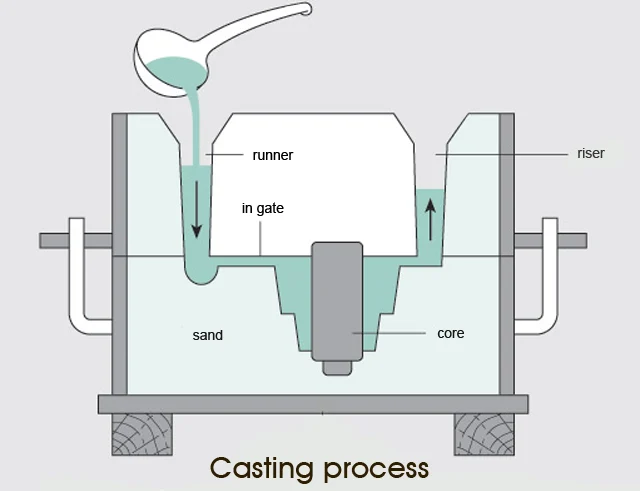
1. Fabrication du modèle
Des modèles en cire ou en thermoplastique du composant cible sont moulés par injection à l'aide d'outillages usinés avec précision. Pour les pièces aérospatiales de haute précision tolérance, les modèles en cire usinés par CNC sont de plus en plus courants afin d'éliminer les variations dimensionnelles liées à l'outillage d'injection.
2. Construction de la carapace
Les modèles sont trempés à plusieurs reprises dans une barbotine céramique et enrobés de sable réfractaire. Pour le titane en particulier, les carapaces standard à base de silice sont inadéquates — le titane en fusion réduit la silice (SiO₂), contaminant ainsi le bain. La norme industrielle utilise zircone stabilisée à l'yttria (YSZ) ou des couches de parement en zircone stabilisée à la chaux, qui sont chimiquement inertes vis-à-vis du titane liquide. Une carapace titane typique nécessite 8 à 12 couches de trempage et atteint une épaisseur de paroi de 8 à 12 mm épaisseur de paroi.
3. Décirage et préchauffage
Les moules en céramique sont chauffés pour éliminer le modèle en cire, laissant des cavités céramiques creuses. Les moules sont ensuite préchauffés à 150–300 °C avant la coulée afin d'améliorer le remplissage et de réduire le choc thermique.
4. Préparation de l'électrode
Plutôt que d'utiliser des matières de charge conventionnelles, les fonderies de titane utilisent généralement une électrode consommable — une barre compactée d'alliage de titane qui sert à la fois de matière première et d'anode dans le processus de fusion à l'arc. La composition de l'électrode doit correspondre à la spécification de l'alliage cible (par ex., AMS 4991 pour les pièces coulées en Ti-6Al-4V).
5. Chargement et mise sous vide de la chambre
La carapace céramique préchauffée et l'électrode en titane sont chargées dans la chambre de coulée. La chambre est hermétiquement fermée et mise sous vide poussé — généralement inférieur à 10⁻³ mbar — afin d'éliminer l'oxygène atmosphérique et l'azote avant tout chauffage.
6. Fusion en creuset froid (procédé VAR)
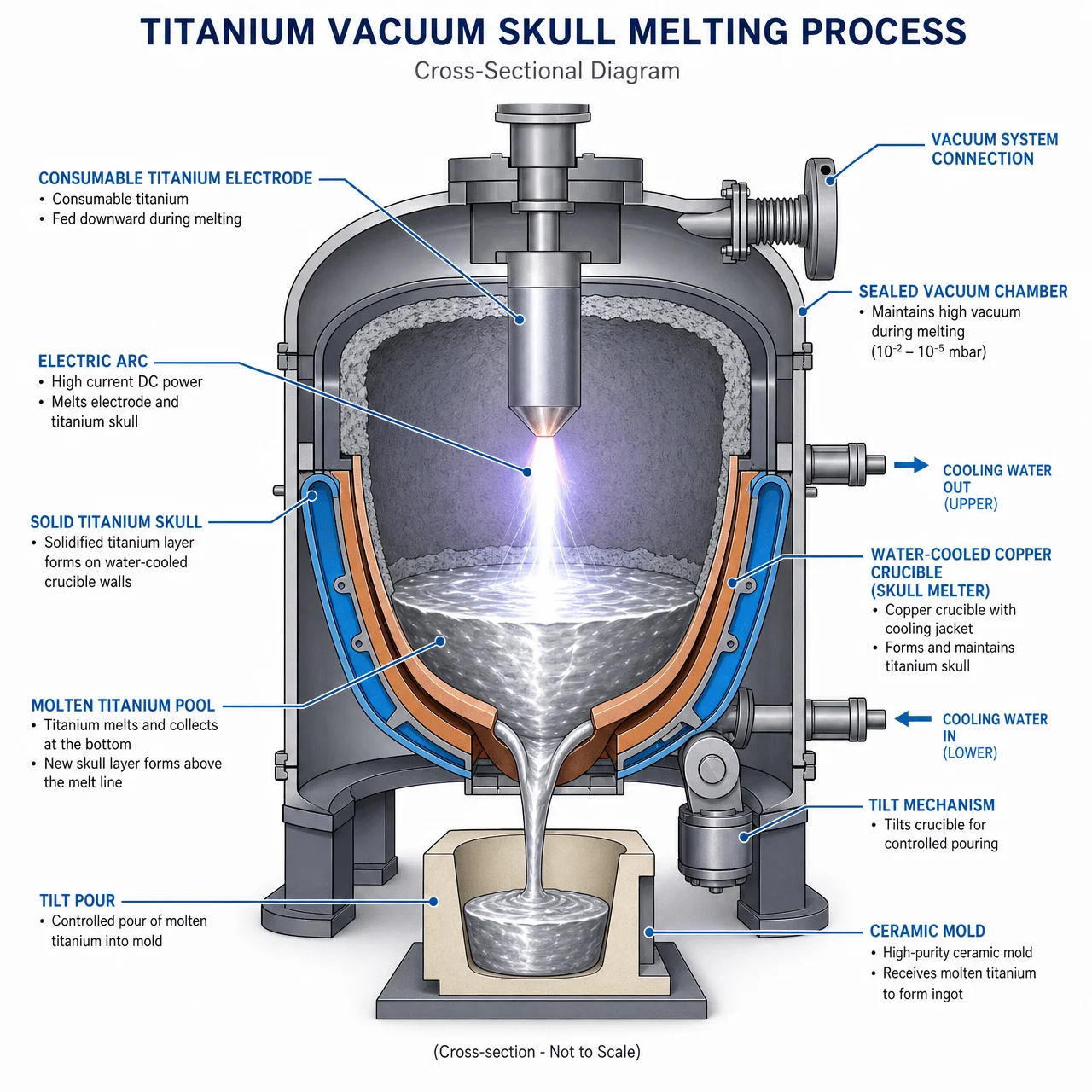
Il s'agit de l'étape qui distingue le plus le titane des autres métaux coulés par moulage à la cire perdue. Un creuset en cuivre refroidi à l'eau (skull melter) est utilisé plutôt qu'un creuset céramique conventionnel, car le titane en fusion réagit avec les céramiques oxydes. Un arc électrique est amorcé entre l'électrode consommable et une petite quantité de matériau de démarrage dans le creuset. Le titane fond à partir de l'extrémité de l'électrode et s'accumule dans le bol en cuivre refroidi à l'eau.
The outer layer of the titanium pool solidifies against the copper walls — forming the “skull” — while the interior remains liquid. This skull of solid titanium physically prevents contact between the molten pool and the copper. Temperatures in the melt pool exceed 1700°C.
7. Tilt Pour or Centrifugal Pour
Once the required melt volume is achieved, the chamber tilts (or a centrifuge mechanism engages) to pour molten titanium into the preheated shell. The entire pour happens within the sealed vacuum environment. Centrifugal casting variants spin the shell at 200–500 RPM during pouring to improve fill of thin sections.
8. Controlled Cooling and Shell Removal
Castings cool in the vacuum or inert atmosphere before the chamber is opened. Ceramic shell is removed by mechanical knockout, vibratory decladding, or high-pressure water blasting.
9. Cutoff and Initial Inspection
Gates and risers are removed. Initial dimensional inspection and visual inspection follow. For aerospace applications, first-article inspection typically includes coordinate measuring machine (CMM) dimensional verification.
What Tolerances Can You Expect?
Titanium investment castings typically achieve:
- Linear dimensional tolérance: ±0.005 in/in (±0.13 mm/mm) per ASTM B372 / industry practice
- Surface finish: Ra 1.6–3.2 µm (63–125 µin) as-cast — significantly better than sand casting
- Minimum épaisseur de paroi: 1.5–2mm for most alloys
These tolerances assume proper tooling design and shell quality. Complex internal passages, cores, or thin sections require design-for-manufacturing review.
Titanium Sand Casting: When It Works and When It Doesn’t
Sand casting is the world’s most common metal casting process — but titanium makes it far more complicated than casting iron or steel.
The fundamental problem: conventional silica sand contains SiO₂ (silicon dioxide). At titanium casting temperatures, molten titanium aggressively reduces SiO₂, pulling oxygen into the melt and depositing silicon contamination. The result is a brittle, oxygen-enriched alpha-case layer on the casting surface that can extend several millimeters deep, requires aggressive chemical milling to remove, and represents a structural liability in load-bearing applications.
This is why the common statement “sand casting can be used for titanium” is technically true but practically misleading for most engineering applications.
Where Titanium Sand Casting Is Actually Used
Titanium sand casting does exist — but it uses non-reactive refractory aggregates, not conventional silica sand. Viable mold materials include:
- Graphite molds (most common for larger titanium parts)
- CaO-stabilized zirconia aggregate
- Calcia (CaO) or yttria (Y₂O₃) face-coat sand molds
And the entire process still requires a vacuum or inert-atmosphere environment for melting and pouring. Open-air titanium sand casting is not viable at production quality.
In practice, titanium “sand casting” (usually graphite mold casting) is used for:
- Large structural aerospace parts (wing carry-through structures, fuselage frames) where the geometry is too large for standard investment casting equipment
- Parts up to 500 kg where investment casting tooling costs are prohibitive
- Low-volume or prototype parts where shell tooling isn’t justified
Trade-offs vs. investment casting:
| Paramètres | Coulée à la cire perdue sous vide | Vacuum Sand/Graphite Casting |
|---|---|---|
| Surface finish (as-cast) | Ra 1.6–3.2 µm | Ra 6.3–12.5 µm (rougher) |
| Dimensional tolérance | ±0.005 in/in | ±0.010–0.015 in/in |
| Max part size | ~25–50 kg (typical equipment) | 500+ kg feasible |
| Coût de l'outillage | Moderate (wax/ceramic tooling) | Lower (graphite machining) |
| Alpha-case depth | 0.1–0.3 mm (ceramic shell) | 0.3–0.8 mm (graphite mold) |
| Applications typiques | Aerospace brackets, medical implants, industrial valves | Airframe structures, large pump casings |
The key takeaway: for any precision or structural titanium casting under ~50 kg, vacuum investment casting delivers better dimensional control and surface finish at comparable cost. Graphite mold casting becomes the practical choice when part size exceeds standard investment casting furnace capacity.
Vacuum Die Casting for Titanium: The High-Pressure Alternative
Vacuum die casting of titanium occupies a narrow but real niche, primarily studied and commercialized in the 1990s–2000s as a route to lower-cost titanium components. Research at ORNL and other institutions demonstrated that vacuum die casting can produce near-net-shape titanium parts with wall thicknesses down to 1mm at cycle times much faster than investment casting.
How it differs from conventional die casting:
- The die cavity is evacuated before injection
- Tooling must be compatible with titanium’s reactivity (specialized die coatings or materials)
- Shot speeds and pressures are modified to prevent turbulence that entraps gas
The catch: titanium’s high point de fusion (1668°C) and reactivity with most tool steels makes die longevity a persistent challenge. Standard H13 tool steel dies used for aluminum die casting are not suitable — titanium solders to them and erodes them rapidly. This has limited widespread commercial adoption.
Where vacuum die casting for titanium currently sees use:
- High-volume consumer/automotive Ti components where investment casting tooling amortization is slow
- Thin-wall structural shapes that investment casting struggles to fill consistently
For most aerospace and medical procurement engineers, vacuum investment casting remains the default and the safe choice.
Post-Processing: The Part of Titanium Casting That Surprises Buyers
One of the most common budget surprises in titanium procurement: the casting itself is only part of the cost. Aerospace and medical applications require additional processing steps that add 30–70% to the part cost.
Pressage isostatique à chaud (HIP)
Titanium investment castings contain micro-porosity from gas entrapment and solidification shrinkage. For structural applications, this porosity must be eliminated. HIP subjects the casting to simultaneous high temperature (~900–950°C) and high isostatic pressure (100–175 MPa / ~15,000–25,000 PSI) in an inert argon atmosphere. This collapses internal voids without changing external dimensions.
HIP is mandatory for flight-critical aerospace castings and for load-bearing medical implants. It is not optional if your part specification calls out AMS 2175 (castings standard) or AMS 2801 (heat treatment). Budget approximately 15–25% cost addition for HIP.
Alpha-Case Removal
Even with a good vacuum, the outermost surface of titanium castings develops a brittle, oxygen-enriched alpha-case layer. For investment castings with yttria-stabilized zirconia shells, this layer is typically 0.05–0.2 mm thick. For graphite mold castings, it can reach 0.5–1.0 mm.
Alpha case must be removed before the part is used in structural applications. Methods:
- Chemical milling (acid etching): Most common; HF/HNO₃ solutions dissolve the surface layer uniformly
- Mechanical removal: Electrochemical machining (ECM) or controlled abrasive blasting in some configurations
NADCAP-certified processing is standard for aerospace applications.
Traitement thermique
Ti-6Al-4V and other alpha-beta alloys typically receive a stress relief anneal or full solution treat + age cycle after casting to achieve target mechanical properties. Required parameters are alloy-specific and specified in AMS 2801 or the customer’s engineering specification.
NDT Requirements
Aerospace castings commonly require:
- X-ray or CT scanning (ASTM E1742 / MIL-STD-453)
- Fluorescent penetrant inspection (FPI per ASTM E1417)
- Chemical analysis (per-heat traceability to AMS or ASTM spec)
These add cost but are non-negotiable for flight hardware. Medical implants add biocompatibility certification requirements (ISO 10993, ASTM F136 for implant-grade Ti-6Al-4V TRÈS FAIBLE TENEUR INTERSTITIELLE).
Selecting the Right Titanium Casting Method: A Decision Framework
The right casting method depends on four variables: part size, required tolérance, production volume, and application criticality.
| Facteur de décision | Coulée à la cire perdue sous vide | Graphite/Sand Mold Casting | Moulage sous vide en coquille |
|---|---|---|---|
| Part weight | <25–50 kg | Up to 500+ kg | <5 kg (typical) |
| Tolérance requirement | Tight (±0.005 in/in) | Moderate (±0.010–0.015) | Tight (±0.003–0.005) |
| Surface finish priority | Haut | Low-moderate | Haut |
| Volume | Low to medium | Faible | Medium to high |
| Geometric complexity | High — thin walls, internal passages | Low-moderate | Moderate — thin walls |
| Aerospace/medical certifiable | Yes — industry standard | Yes — for large structures | Limited — less established |
| Relative tooling cost | Modéré | Faible | High (die cost) |
Practical selection rules:
- Part under 25 kg + complex geometry + aerospace/medical = coulée à la cire perdue sous vide
- Part over 100 kg + simpler geometry + cost-sensitive = vacuum graphite mold casting
- High-volume + thin wall + consumer/automotive = vacuum die casting (if supplier is qualified)
- “Can we sand cast this titanium bracket?” from a conventional foundry = non — redirect to vacuum investment casting
Titanium Casting Grades: Which Alloy to Specify
Three titanium grades represent approximately 95% of castings in production:
CP Titanium Grade 2 (Commercially Pure)
- Density: 4.51 g/cm³; Résistance à la traction: ~345 MPa as-cast
- Standards: ASTM B367, ASME SB367, ASTM F67 (for medical)
- Best for: Maximum résistance à la corrosion applications — chemical process equipment, marine hardware, non-structural medical housings
- Don’t use for: Any load-bearing structural application
Ti-6Al-4V (Grade 5 / AMS 4991)
- Density: 4.43 g/cm³; Résistance à la traction: 895–930 MPa (as-cast, post-HIP)
- Standards: AMS 4991 (casting), ASTM F136 (implant-grade TRÈS FAIBLE TENEUR INTERSTITIELLE variant)
- Best for: Aerospace brackets, engine mounts, orthopedic implants, racing components
- Note: “Ti-6Al-4V” and “ASTM F136” are not interchangeable — medical implants require the TRÈS FAIBLE TENEUR INTERSTITIELLE (Extra Low Interstitial) variant with tighter oxygen/nitrogen/hydrogen limits
Ti-6Al-2Sn-4Zr-2Mo (Grade 6 / AMS 4999)
- Density: 4.54 g/cm³; significantly higher fluage resistance than Gr 5
- Standards: AMS 4999
- Best for: Jet engine stators, high-temperature actuators, components with sustained loads above 315°C (600°F)
- Cost: 2–3× Ti-6Al-4V; only justified when operating temperature demands it
Real Cost Ranges for Titanium Castings
Cost transparency is rare in titanium casting. Based on supplier data and industry benchmarks:
| Component Type | Alliage | Rough Cost Range | Key Cost Driver |
|---|---|---|---|
| Simple valve body (50–200g) | CP Gr 2 | $800–$1,500/unit | Small volume, vacuum overhead |
| Aerospace bracket (0.5–2 kg) | Ti-6Al-4V | $1,800–$3,500/unit | HIP + X-ray + cert requirements |
| Medical hip stem (0.3–0.8 kg) | Ti-6Al-4V ELI | $4,000–$7,500/unit | ASTM F136 cert + electropolishing |
| Large structural frame (10–25 kg) | Ti-6Al-4V | $8,000–$25,000/unit | Furnace cycle cost, post-processing |
Raw material cost for Ti-6Al-4V is approximately $80–$120/kg for casting-grade sponge/electrode. But material is typically only 25–40% of total part cost — vacuum processing overhead, specialty ceramics, HIP, NDT, and certification compliance dominate.
The rule of thumb: titanium castings cost 5–10× equivalent stainless steel castings and 15–20× equivalent aluminum castings. This premium is justified when the application demands the strength-to-weight ratio, résistance à la corrosion, or biocompatibility that titanium uniquely provides.
Qualifying a Titanium Casting Supplier: What to Ask
Most foundries cannot produce titanium castings. The equipment investment — vacuum arc melting furnaces, copper skull melters, yttria shell systems — runs $2–5M+, and the process expertise takes years to develop. Before sending an RFQ, verify:
Equipment:
- Does the foundry have its own vacuum arc remelting (VAR) or skull melting equipment? (Not outsourced)
- What is the maximum furnace capacity (kg per heat)?
- Is HIP done in-house or at a NADCAP-certified subcontractor?
Certifications :
- AS9100 Rev D (aerospace quality management) for aerospace parts
- NADCAP accreditation in casting (AC7102) and applicable special processes
- ISO 13485 for medical device applications
- Per-heat material traceability to AMS 4991 or ASTM F136
Process Controls:
- What ceramic shell system do they use? (Answer should reference yttria or calcia face coats — not generic silica)
- What vacuum level is achieved before pour? (Should be sub-10⁻³ mbar)
- What is their documented scrap rate for titanium? (Expect 10–20% for complex parts; significantly higher is a red flag)
Red flags: “We occasionally do titanium” / no dedicated vacuum furnace / generic material certs not tied to heat numbers.
Questions fréquemment posées
Can titanium be sand cast?
Titanium can be cast in graphite or calcia/yttria-stabilized sand molds, but conventional silica sand reacts with molten titanium and is not suitable. Any titanium sand or graphite mold casting still requires a vacuum or inert-atmosphere environment for the melt and pour. For most precision applications under 50 kg, vacuum investment casting offers better results.
Why does titanium casting require a vacuum?
Molten titanium reacts aggressively with oxygen and nitrogen at its casting temperature (above 1668°C). These reactions form brittle interstitial phases and an alpha-case surface layer that compromises mechanical properties. A vacuum environment prevents atmospheric exposure during melting and pouring.
What is alpha case in titanium casting?
Alpha case is a brittle, oxygen-enriched surface layer that forms when molten titanium contacts oxygen or nitrogen. It is harder than the bulk material and has significantly reduced ductilité and fatigue life. For structural applications, alpha case must be removed by chemical milling (acid etching) before part acceptance.
What is HIP and why is it required for titanium castings?
Hot Isostatic Pressing (HIP) uses simultaneous heat (~900°C) and high inert gas pressure (~175 MPa) to collapse internal micro-porosity in the casting. For aerospace and load-bearing medical applications, the internal integrity HIP provides is a specification requirement, not a supplier option.
Is Ti-6Al-4V the best alloy for titanium castings?
For most applications, yes. Ti-6Al-4V (AMS 4991) offers the best combination of strength, castability, and available certification data. CP Gr 2 is preferred when maximum résistance à la corrosion matters more than strength. Ti-6Al-2Sn-4Zr-2Mo (AMS 4999) is only justified for high-temperature applications above ~315°C sustained service temperature.
How long does titanium investment casting typically take from order to shipment?
Lead times for aerospace/medical titanium castings typically run 12–20 weeks for new parts (including tooling production, first-article inspection, and post-processing). Repeat production of qualified parts can be 8–12 weeks. This is significantly longer than aluminum or steel investment casting due to the complexity of post-processing and qualification requirements.
Résumé
Titanium’s reactivity with oxygen is the defining fact of all titanium casting — it eliminates conventional sand casting, open-pour die casting, and any method that exposes molten metal to air. Vacuum investment casting using copper skull melters and yttria-stabilized ceramic shells is the industry-standard process because it handles complex geometries at near-net-shape precision while keeping the melt in a sealed vacuum environment.
Sand/graphite mold casting remains viable for large titanium structures that exceed standard investment casting furnace capacity, but requires the same vacuum environment and produces rougher surfaces and wider tolerances. Vacuum die casting handles niche high-volume thin-wall applications.
For buyers: the part cost is only the beginning. Budget for HIP, alpha-case removal, heat treatment, and NDT — these post-processing steps are mandatory for aerospace and medical parts and add 30–70% to casting cost. Verify your supplier’s equipment and certifications before sending drawings.