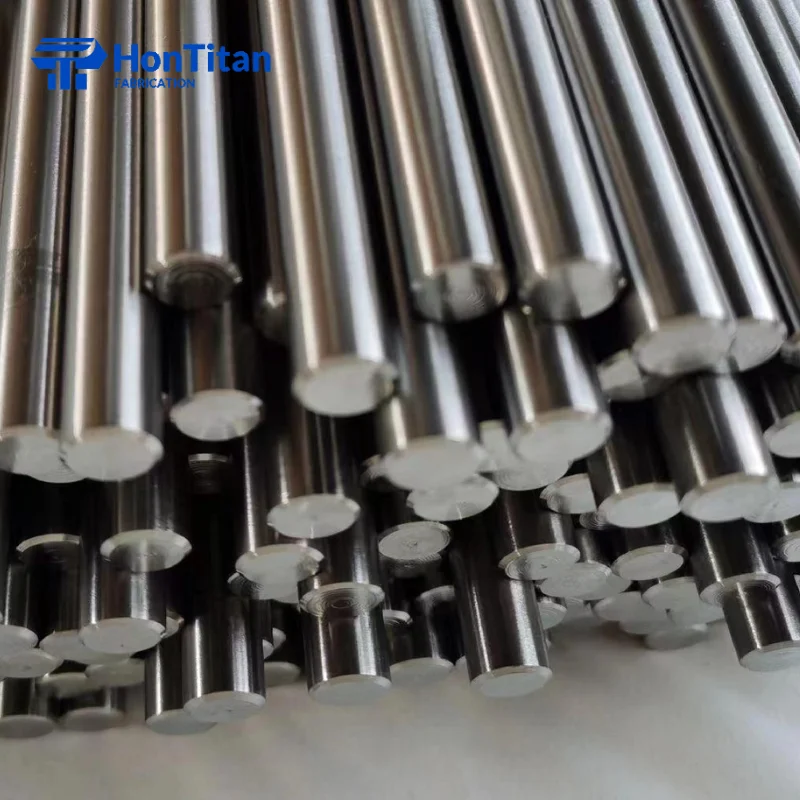
La extrema reactividad del titanio con el oxígeno hace que la fundición en arena estándar sea impráctica para la mayoría de las aplicaciones — el titanio fundido se inflama en el aire libre. El método predominante es fundición a la cera perdida al vacío, que combina un proceso de molde cerámico de cera perdida con una cámara de vacío sellada y un horno de crisol de cobre con enfriamiento por agua. Existen otros métodos, incluida la fundición a presión al vacío y la fundición centrífuga, en nichos limitados. Esta guía detalla todos los métodos viables de fundición de titanio, explica el requisito obligatorio de vacío, compara la economía de los procesos y cubre los pasos de postprocesamiento (HIP, eliminación de capa alpha‑case, tratamiento térmico) que los compradores del sector aeroespacial y médico pasan por alto sistemáticamente al presupuestar.
Por qué la fundición de titanio es fundamentalmente diferente a la de otros metales
La mayoría de los metales pueden fundirse y verterse en un molde de arena al aire libre. El titanio no.
A temperaturas superiores a aproximadamente 1100 °C, el titanio fundido reacciona violentamente con el oxígeno y el nitrógeno. Disuelve los gases atmosféricos en la masa fundida, formando una capa superficial frágil enriquecida con oxígeno denominada caso alfa — y en casos de exposición severa, el metal puede inflamarse. Esto no es una mera inconveniencia de manipulación. Es una realidad metalúrgica que elimina categorías enteras de métodos de fundición que funcionan perfectamente bien para el acero, el aluminio o incluso las superaleaciones de níquel.
La consecuencia: prácticamente todos los métodos viables de fundición de titanio requieren un entorno de vacío o de atmósfera inerte controlada. Esa única restricción lo reconfigura todo: equipos, utillaje, tiempo de ciclo, cualificación de proveedores y costes.
Comprender esto desde el principio evita ciclos de solicitud de cotización desperdiciados con fundiciones que “hacen fundición” pero no disponen de la infraestructura adecuada para el titanio.
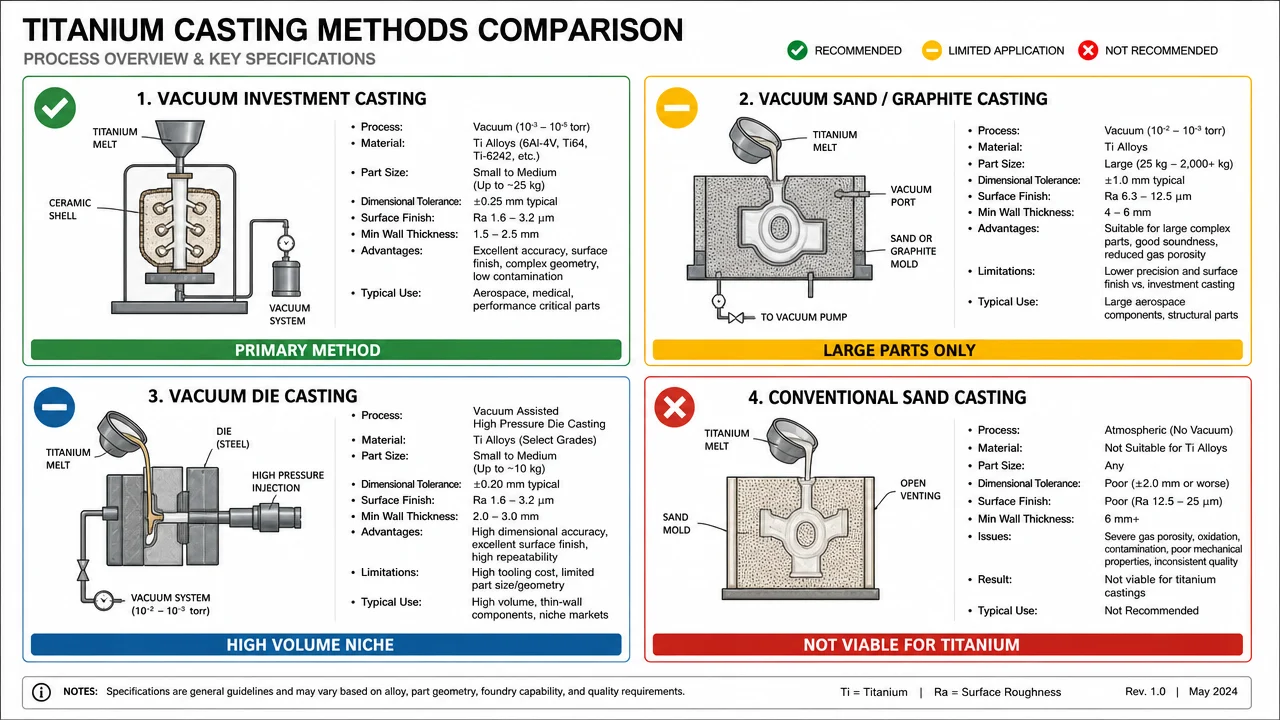
Los cuatro métodos principales de fundición y su compatibilidad con el titanio
| Método | ¿Compatible con titanio? | Por qué sí / Por qué no |
|---|---|---|
| Fundición a la cera perdida al vacío | ✅ Sí — método principal | La cámara de vacío sellada y el molde cerámico evitan la contaminación atmosférica |
| Fundición a presión al vacío | ✅ Sí — nicho limitado | La fundición a presión al vacío de alta presión es viable; requiere equipos especializados |
| Fundición Centrífuga | ✅ Sí — especializada | Utilizada para anillos y tubos; se requiere entorno de vacío |
| Fundición en Arena | ⚠️ Severamente limitada | La fundición convencional en arena provoca una capa alpha‑case severa; existe la fundición en arena al vacío, pero rara vez se utiliza para Ti |
| Colada en Coquilla por Gravedad (Molde Permanente) | ❌ No viable | El Ti fundido reacciona con las herramientas de acero o hierro |
| Fundición en Matriz Estándar | ❌ No viable | La presión de inyección es incompatible con la reactividad del Ti; sin control de vacío |
El resto de esta guía se centra en los tres métodos viables de uso práctico: fundición a la cera perdida al vacío, fundición en matriz al vacío y — donde aplica — fundición en arena de titanio.
Fundición a la Cera Perdida al Vacío: El Proceso Dominante del Titanio
La fundición a la cera perdida al vacío (también denominada fundición por modelo desechable al vacío) gestiona el 85–90% de las piezas de titanio fundido comerciales. Es el método al que la mayoría de las fundiciones se refieren cuando hablan de “fundición de titanio” sin ninguna calificación adicional.
Por qué domina: La capacidad de forma casi neta de la fundición a la cera perdida minimiza el mecanizado posterior a la fundición de un material que es costoso y difícil de mecanizar. La cáscara cerámica tolera el elevado punto de fusión del titanio (1668°C / 3034°F). Y el proceso es intrínsecamente escalable por lotes: una sola pasada en horno de vacío puede fundir docenas de piezas simultáneamente.
El Proceso de Fundición a la Cera Perdida al Vacío, Paso a Paso
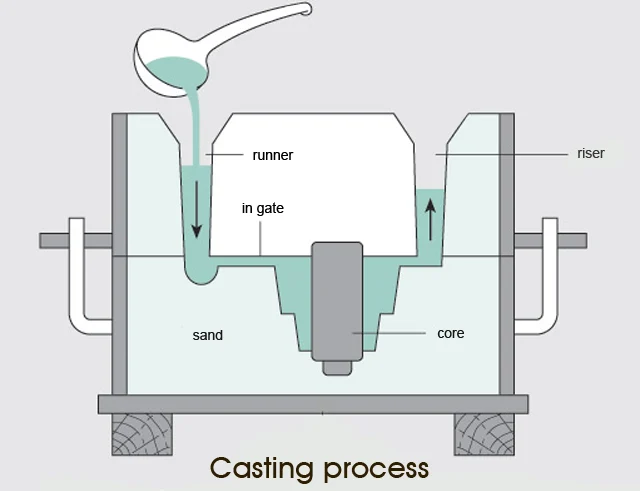
1. Producción de Modelos
Los modelos de cera o termoplástico del componente objetivo se inyectan en molde mediante utillaje mecanizado con precisión. Para piezas aeroespaciales de alta tolerancia, los modelos de cera mecanizados por CNC son cada vez más habituales para eliminar la variación dimensional derivada del utillaje de inyección.
2. Construcción de la Cáscara
Los patrones se sumergen repetidamente en suspensión cerámica y se recubren con arena refractaria. Para el titanio específicamente, las carcasas estándar a base de sílice son inadecuadas: el titanio fundido reduce la sílice (SiO₂), contaminando la colada. El estándar de la industria utiliza circonio estabilizado con itria (YSZ) o revestimientos faciales de circonio estabilizado con cal, que son químicamente inertes al titanio líquido. Una carcasa de titanio típica requiere entre 8 y 12 capas de inmersión y alcanza un espesor de pared de 8 a 12 mm.
3. Desvaxado y precalentamiento
Los moldes cerámicos se calientan para eliminar el patrón de cera, dejando cavidades cerámicas huecas. Los moldes se precalientan luego a 150–300 °C antes del vertido para mejorar el llenado y reducir el choque térmico.
4. Preparación del electrodo
En lugar de materiales de carga convencionales, las fundiciones de titanio utilizan típicamente un electrodo consumible — una barra compactada de aleación de titanio que sirve tanto de materia prima como de ánodo en el proceso de fusión por arco. La composición del electrodo debe coincidir con la especificación de la aleación objetivo (p. ej., AMS 4991 para piezas fundidas de Ti-6Al-4V).
5. Carga y evacuación de la cámara de vacío
La carcasa cerámica precalentada y el electrodo de titanio se cargan en la cámara de colada. La cámara se sella y se evacúa hasta alcanzar un alto vacío —normalmente por debajo de 10⁻³ mbar— para eliminar el oxígeno atmosférico y el nitrógeno antes de iniciar cualquier calentamiento.
6. Fusión en crisol frío (proceso VAR)
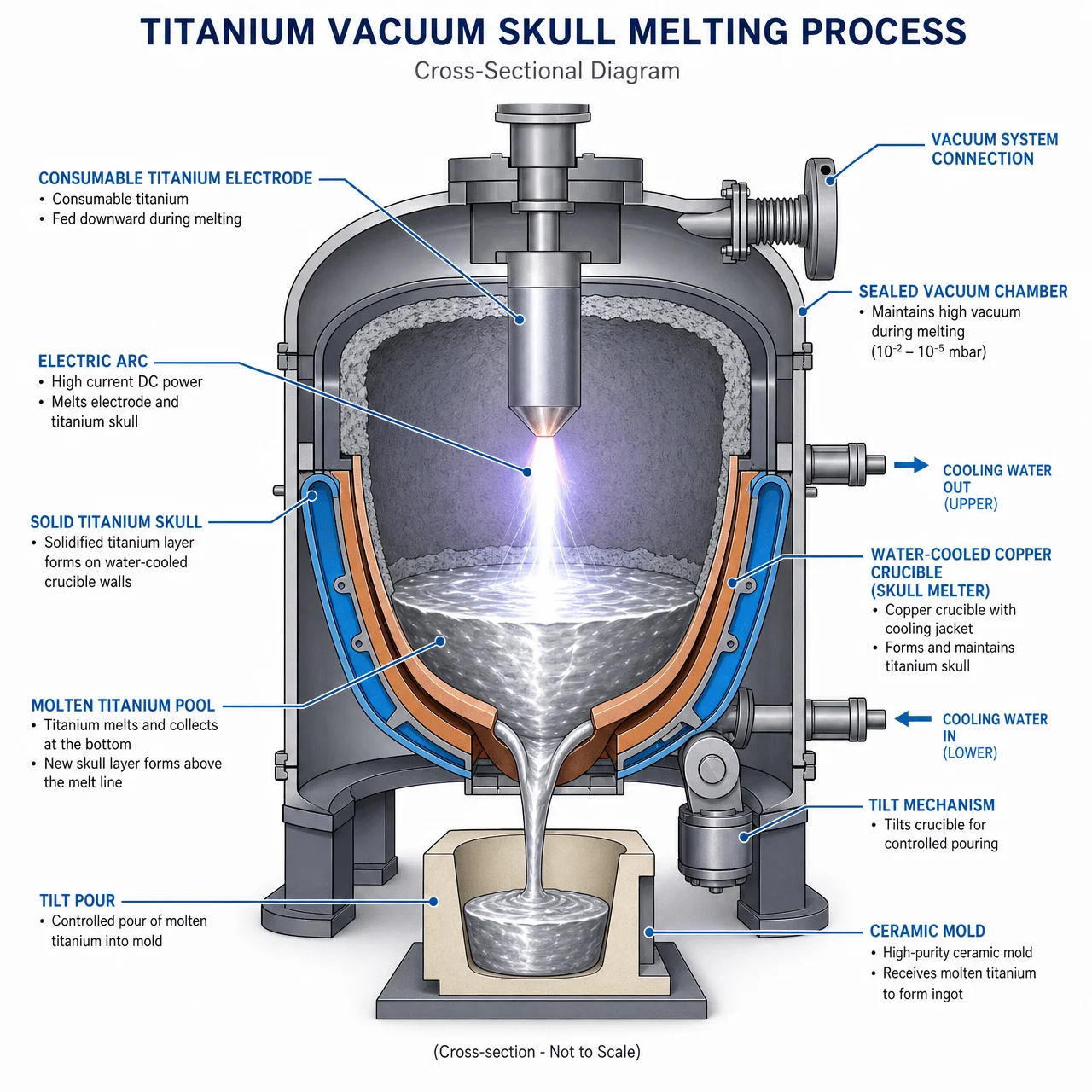
Este es el paso que más distingue al titanio de otros metales fundidos por moldeo a la cera perdida. Se utiliza un crisol de cobre enfriado por agua (fusión en crisol frío) en lugar de un crisol cerámico convencional, ya que el titanio fundido reacciona con las cerámicas de óxido. Un arco eléctrico se establece entre el electrodo consumible y una pequeña cantidad de material de inicio en el crisol. El titanio se funde desde la punta del electrodo y se acumula en el recipiente de cobre enfriado por agua.
La capa exterior del caudal de titanio se solidifica contra las paredes de cobre —formando la “cáscara”— mientras que el interior permanece líquido. Esta cáscara de titanio sólido impide físicamente el contacto entre el baño fundido y el cobre. Las temperaturas en el baño fundido superan los 1700 °C.
7. Vertido por inclinación o vertido centrífugo
Una vez alcanzado el volumen de fusión requerido, la cámara se inclina (o se activa un mecanismo centrífugo) para verter el titanio fundido en la carcasa precalentada. Todo el vertido ocurre dentro del entorno de vacío sellado. Las variantes de colada centrífuga hacen girar la carcasa a 200–500 RPM durante el vertido para mejorar el llenado de secciones delgadas.
8. Enfriamiento controlado y desmoldeo
Las piezas fundidas se enfrían en vacío o en atmósfera inerte antes de abrir la cámara. La carcasa cerámica se retira mediante desmoldeo mecánico, descascarillado vibratorio o chorro de agua a alta presión.
9. Cutoff and Initial Inspection
Gates and risers are removed. Initial dimensional inspection and visual inspection follow. For aerospace applications, first-article inspection typically includes coordinate measuring machine (CMM) dimensional verification.
What Tolerances Can You Expect?
Titanium investment castings typically achieve:
- Linear dimensional tolerancia: ±0.005 in/in (±0.13 mm/mm) per ASTM B372 / industry practice
- Surface finish: Ra 1.6–3.2 µm (63–125 µin) as-cast — significantly better than sand casting
- Minimum espesor de pared: 1.5–2mm for most alloys
These tolerances assume proper tooling design and shell quality. Complex internal passages, cores, or thin sections require design-for-manufacturing review.
Titanium Sand Casting: When It Works and When It Doesn’t
Sand casting is the world’s most common metal casting process — but titanium makes it far more complicated than casting iron or steel.
The fundamental problem: conventional silica sand contains SiO₂ (silicon dioxide). At titanium casting temperatures, molten titanium aggressively reduces SiO₂, pulling oxygen into the melt and depositing silicon contamination. The result is a brittle, oxygen-enriched alpha-case layer on the casting surface that can extend several millimeters deep, requires aggressive chemical milling to remove, and represents a structural liability in load-bearing applications.
This is why the common statement “sand casting can be used for titanium” is technically true but practically misleading for most engineering applications.
Where Titanium Sand Casting Is Actually Used
Titanium sand casting does exist — but it uses non-reactive refractory aggregates, not conventional silica sand. Viable mold materials include:
- Graphite molds (most common for larger titanium parts)
- CaO-stabilized zirconia aggregate
- Calcia (CaO) or yttria (Y₂O₃) face-coat sand molds
And the entire process still requires a vacuum or inert-atmosphere environment for melting and pouring. Open-air titanium sand casting is not viable at production quality.
In practice, titanium “sand casting” (usually graphite mold casting) is used for:
- Large structural aerospace parts (wing carry-through structures, fuselage frames) where the geometry is too large for standard investment casting equipment
- Parts up to 500 kg where investment casting tooling costs are prohibitive
- Low-volume or prototype parts where shell tooling isn’t justified
Trade-offs vs. investment casting:
| Parámetro | Fundición a la cera perdida al vacío | Vacuum Sand/Graphite Casting |
|---|---|---|
| Surface finish (as-cast) | Ra 1.6–3.2 µm | Ra 6.3–12.5 µm (rougher) |
| Dimensional tolerancia | ±0.005 in/in | ±0.010–0.015 in/in |
| Max part size | ~25–50 kg (typical equipment) | 500+ kg feasible |
| Coste de las herramientas | Moderate (wax/ceramic tooling) | Lower (graphite machining) |
| Alpha-case depth | 0.1–0.3 mm (ceramic shell) | 0.3–0.8 mm (graphite mold) |
| Aplicaciones típicas | Aerospace brackets, medical implants, industrial valves | Airframe structures, large pump casings |
The key takeaway: for any precision or structural titanium casting under ~50 kg, vacuum investment casting delivers better dimensional control and surface finish at comparable cost. Graphite mold casting becomes the practical choice when part size exceeds standard investment casting furnace capacity.
Vacuum Die Casting for Titanium: The High-Pressure Alternative
Vacuum die casting of titanium occupies a narrow but real niche, primarily studied and commercialized in the 1990s–2000s as a route to lower-cost titanium components. Research at ORNL and other institutions demonstrated that vacuum die casting can produce near-net-shape titanium parts with wall thicknesses down to 1mm at cycle times much faster than investment casting.
How it differs from conventional die casting:
- The die cavity is evacuated before injection
- Tooling must be compatible with titanium’s reactivity (specialized die coatings or materials)
- Shot speeds and pressures are modified to prevent turbulence that entraps gas
The catch: titanium’s high punto de fusión (1668°C) and reactivity with most tool steels makes die longevity a persistent challenge. Standard H13 tool steel dies used for aluminum die casting are not suitable — titanium solders to them and erodes them rapidly. This has limited widespread commercial adoption.
Where vacuum die casting for titanium currently sees use:
- High-volume consumer/automotive Ti components where investment casting tooling amortization is slow
- Thin-wall structural shapes that investment casting struggles to fill consistently
For most aerospace and medical procurement engineers, vacuum investment casting remains the default and the safe choice.
Post-Processing: The Part of Titanium Casting That Surprises Buyers
One of the most common budget surprises in titanium procurement: the casting itself is only part of the cost. Aerospace and medical applications require additional processing steps that add 30–70% to the part cost.
Prensado isostático en caliente (HIP)
Titanium investment castings contain micro-porosity from gas entrapment and solidification shrinkage. For structural applications, this porosity must be eliminated. HIP subjects the casting to simultaneous high temperature (~900–950°C) and high isostatic pressure (100–175 MPa / ~15,000–25,000 PSI) in an inert argon atmosphere. This collapses internal voids without changing external dimensions.
HIP is mandatory for flight-critical aerospace castings and for load-bearing medical implants. It is not optional if your part specification calls out AMS 2175 (castings standard) or AMS 2801 (heat treatment). Budget approximately 15–25% cost addition for HIP.
Alpha-Case Removal
Even with a good vacuum, the outermost surface of titanium castings develops a brittle, oxygen-enriched alpha-case layer. For investment castings with yttria-stabilized zirconia shells, this layer is typically 0.05–0.2 mm thick. For graphite mold castings, it can reach 0.5–1.0 mm.
Alpha case must be removed before the part is used in structural applications. Methods:
- Chemical milling (acid etching): Most common; HF/HNO₃ solutions dissolve the surface layer uniformly
- Mechanical removal: Electrochemical machining (ECM) or controlled abrasive blasting in some configurations
NADCAP-certified processing is standard for aerospace applications.
Tratamiento térmico
Ti-6Al-4V and other alpha-beta alloys typically receive a stress relief anneal or full solution treat + age cycle after casting to achieve target mechanical properties. Required parameters are alloy-specific and specified in AMS 2801 or the customer’s engineering specification.
NDT Requirements
Aerospace castings commonly require:
- X-ray or CT scanning (ASTM E1742 / MIL-STD-453)
- Fluorescent penetrant inspection (FPI per ASTM E1417)
- Chemical analysis (per-heat traceability to AMS or ASTM spec)
These add cost but are non-negotiable for flight hardware. Medical implants add biocompatibility certification requirements (ISO 10993, ASTM F136 for implant-grade Ti-6Al-4V BAJO CONTENIDO INTERSTICIAL).
Selecting the Right Titanium Casting Method: A Decision Framework
The right casting method depends on four variables: part size, required tolerancia, production volume, and application criticality.
| Factor de decisión | Fundición a la cera perdida al vacío | Graphite/Sand Mold Casting | Fundición a presión al vacío |
|---|---|---|---|
| Part weight | <25–50 kg | Up to 500+ kg | <5 kg (typical) |
| Tolerancia requirement | Tight (±0.005 in/in) | Moderate (±0.010–0.015) | Tight (±0.003–0.005) |
| Surface finish priority | Alta | Low-moderate | Alta |
| Volumen | Low to medium | Bajo | Medium to high |
| Geometric complexity | High — thin walls, internal passages | Low-moderate | Moderate — thin walls |
| Aerospace/medical certifiable | Yes — industry standard | Yes — for large structures | Limited — less established |
| Relative tooling cost | Moderado | Bajo | High (die cost) |
Practical selection rules:
- Part under 25 kg + complex geometry + aerospace/medical = fundición a la cera perdida al vacío
- Part over 100 kg + simpler geometry + cost-sensitive = vacuum graphite mold casting
- High-volume + thin wall + consumer/automotive = vacuum die casting (if supplier is qualified)
- “Can we sand cast this titanium bracket?” from a conventional foundry = no — redirect to vacuum investment casting
Titanium Casting Grades: Which Alloy to Specify
Three titanium grades represent approximately 95% of castings in production:
CP Titanium Grado 2 (Commercially Pure)
- Density: 4.51 g/cm³; Resistencia a la tracción: ~345 MPa as-cast
- Standards: ASTM B367, ASME SB367, ASTM F67 (for medical)
- Best for: Maximum resistencia a la corrosión applications — chemical process equipment, marine hardware, non-structural medical housings
- Don’t use for: Any load-bearing structural application
Ti-6Al-4V (Grado 5 / AMS 4991)
- Density: 4.43 g/cm³; Resistencia a la tracción: 895–930 MPa (as-cast, post-HIP)
- Standards: AMS 4991 (casting), ASTM F136 (implant-grade BAJO CONTENIDO INTERSTICIAL variant)
- Best for: Aerospace brackets, engine mounts, orthopedic implants, racing components
- Note: “Ti-6Al-4V” and “ASTM F136” are not interchangeable — medical implants require the BAJO CONTENIDO INTERSTICIAL (Extra Low Interstitial) variant with tighter oxygen/nitrogen/hydrogen limits
Ti-6Al-2Sn-4Zr-2Mo (Grade 6 / AMS 4999)
- Density: 4.54 g/cm³; significantly higher fluencia resistance than Gr 5
- Standards: AMS 4999
- Best for: Jet engine stators, high-temperature actuators, components with sustained loads above 315°C (600°F)
- Cost: 2–3× Ti-6Al-4V; only justified when operating temperature demands it
Real Cost Ranges for Titanium Castings
Cost transparency is rare in titanium casting. Based on supplier data and industry benchmarks:
| Component Type | Aleación | Rough Cost Range | Key Cost Driver |
|---|---|---|---|
| Simple valve body (50–200g) | CP Gr 2 | $800–$1,500/unit | Small volume, vacuum overhead |
| Aerospace bracket (0.5–2 kg) | Ti-6Al-4V | $1,800–$3,500/unit | HIP + X-ray + cert requirements |
| Medical hip stem (0.3–0.8 kg) | Ti-6Al-4V ELI | $4,000–$7,500/unit | ASTM F136 cert + electropolishing |
| Large structural frame (10–25 kg) | Ti-6Al-4V | $8,000–$25,000/unit | Furnace cycle cost, post-processing |
Raw material cost for Ti-6Al-4V is approximately $80–$120/kg for casting-grade sponge/electrode. But material is typically only 25–40% of total part cost — vacuum processing overhead, specialty ceramics, HIP, NDT, and certification compliance dominate.
The rule of thumb: titanium castings cost 5–10× equivalent stainless steel castings and 15–20× equivalent aluminum castings. This premium is justified when the application demands the strength-to-weight ratio, resistencia a la corrosión, or biocompatibility that titanium uniquely provides.
Qualifying a Titanium Casting Supplier: What to Ask
Most foundries cannot produce titanium castings. The equipment investment — vacuum arc melting furnaces, copper skull melters, yttria shell systems — runs $2–5M+, and the process expertise takes years to develop. Before sending an RFQ, verify:
Equipment:
- Does the foundry have its own vacuum arc remelting (VAR) or skull melting equipment? (Not outsourced)
- What is the maximum furnace capacity (kg per heat)?
- Is HIP done in-house or at a NADCAP-certified subcontractor?
Certificaciones:
- AS9100 Rev D (aerospace quality management) for aerospace parts
- NADCAP accreditation in casting (AC7102) and applicable special processes
- ISO 13485 for medical device applications
- Per-heat material traceability to AMS 4991 or ASTM F136
Process Controls:
- What ceramic shell system do they use? (Answer should reference yttria or calcia face coats — not generic silica)
- What vacuum level is achieved before pour? (Should be sub-10⁻³ mbar)
- What is their documented scrap rate for titanium? (Expect 10–20% for complex parts; significantly higher is a red flag)
Red flags: “We occasionally do titanium” / no dedicated vacuum furnace / generic material certs not tied to heat numbers.
Preguntas frecuentes
Can titanium be sand cast?
Titanium can be cast in graphite or calcia/yttria-stabilized sand molds, but conventional silica sand reacts with molten titanium and is not suitable. Any titanium sand or graphite mold casting still requires a vacuum or inert-atmosphere environment for the melt and pour. For most precision applications under 50 kg, vacuum investment casting offers better results.
Why does titanium casting require a vacuum?
Molten titanium reacts aggressively with oxygen and nitrogen at its casting temperature (above 1668°C). These reactions form brittle interstitial phases and an alpha-case surface layer that compromises mechanical properties. A vacuum environment prevents atmospheric exposure during melting and pouring.
What is alpha case in titanium casting?
Alpha case is a brittle, oxygen-enriched surface layer that forms when molten titanium contacts oxygen or nitrogen. It is harder than the bulk material and has significantly reduced ductilidad and fatigue life. For structural applications, alpha case must be removed by chemical milling (acid etching) before part acceptance.
What is HIP and why is it required for titanium castings?
Hot Isostatic Pressing (HIP) uses simultaneous heat (~900°C) and high inert gas pressure (~175 MPa) to collapse internal micro-porosity in the casting. For aerospace and load-bearing medical applications, the internal integrity HIP provides is a specification requirement, not a supplier option.
Is Ti-6Al-4V the best alloy for titanium castings?
For most applications, yes. Ti-6Al-4V (AMS 4991) offers the best combination of strength, castability, and available certification data. CP Gr 2 is preferred when maximum resistencia a la corrosión matters more than strength. Ti-6Al-2Sn-4Zr-2Mo (AMS 4999) is only justified for high-temperature applications above ~315°C sustained service temperature.
How long does titanium investment casting typically take from order to shipment?
Lead times for aerospace/medical titanium castings typically run 12–20 weeks for new parts (including tooling production, first-article inspection, and post-processing). Repeat production of qualified parts can be 8–12 weeks. This is significantly longer than aluminum or steel investment casting due to the complexity of post-processing and qualification requirements.
Resumen
Titanium’s reactivity with oxygen is the defining fact of all titanium casting — it eliminates conventional sand casting, open-pour die casting, and any method that exposes molten metal to air. Vacuum investment casting using copper skull melters and yttria-stabilized ceramic shells is the industry-standard process because it handles complex geometries at near-net-shape precision while keeping the melt in a sealed vacuum environment.
Sand/graphite mold casting remains viable for large titanium structures that exceed standard investment casting furnace capacity, but requires the same vacuum environment and produces rougher surfaces and wider tolerances. Vacuum die casting handles niche high-volume thin-wall applications.
For buyers: the part cost is only the beginning. Budget for HIP, alpha-case removal, heat treatment, and NDT — these post-processing steps are mandatory for aerospace and medical parts and add 30–70% to casting cost. Verify your supplier’s equipment and certifications before sending drawings.