L'estrema reattività del titanio con l'ossigeno rende la fusione in sabbia standard impraticabile per la maggior parte delle applicazioni — il titanio fuso si incendia all'aria aperta. Il metodo predominante è fusione a cera persa sotto vuoto, che combina un processo di guscio ceramico a cera persa con una camera a vuoto sigillata e un forno a crogiolo di rame raffreddato ad acqua. Esistono altri metodi, tra cui la fusione sotto vuoto in conchiglia e la fusione centrifuga, in nicchie limitate. Questa guida analizza ogni metodo di fusione del titanio praticabile, spiega il requisito obbligatorio del vuoto, confronta l'economia dei processi e tratta le fasi di post-lavorazione (HIP, rimozione dello strato alfa‑case, trattamento termico) che i buyer aerospaziali e medicali trascurano sistematicamente in fase di budgeting.
Perché la fusione del titanio è fondamentalmente diversa da quella degli altri metalli
La maggior parte dei metalli può essere fusa e colata in uno stampo di sabbia all'aria aperta. Il titanio no.
A temperature superiori a circa 1100°C, il titanio fuso reagisce violentemente con l'ossigeno e l'azoto. Dissolve i gas atmosferici nel bagno metallico, formando uno strato superficiale fragile e ricco di ossigeno chiamato caso alfa — e in caso di esposizione severa, il metallo può incendiarsi. Non si tratta di un semplice problema di manipolazione. È una realtà metallurgica che esclude intere categorie di metodi di fusione che funzionano perfettamente per l'acciaio, l'alluminio o persino le superleghe di nichel.
La conseguenza: praticamente tutti i metodi di fusione del titanio praticabili richiedono un ambiente sotto vuoto o in atmosfera inerte controllata. Questo singolo vincolo ridisegna tutto — attrezzature, utensili, tempi di ciclo, qualifica dei fornitori e costi.
Comprendere questo fin dall'inizio evita cicli di RFQ sprecati con fonderie che “fanno fusione” ma non dispongono dell'infrastruttura adeguata per il titanio.
I quattro principali metodi di fusione e la loro compatibilità con il titanio
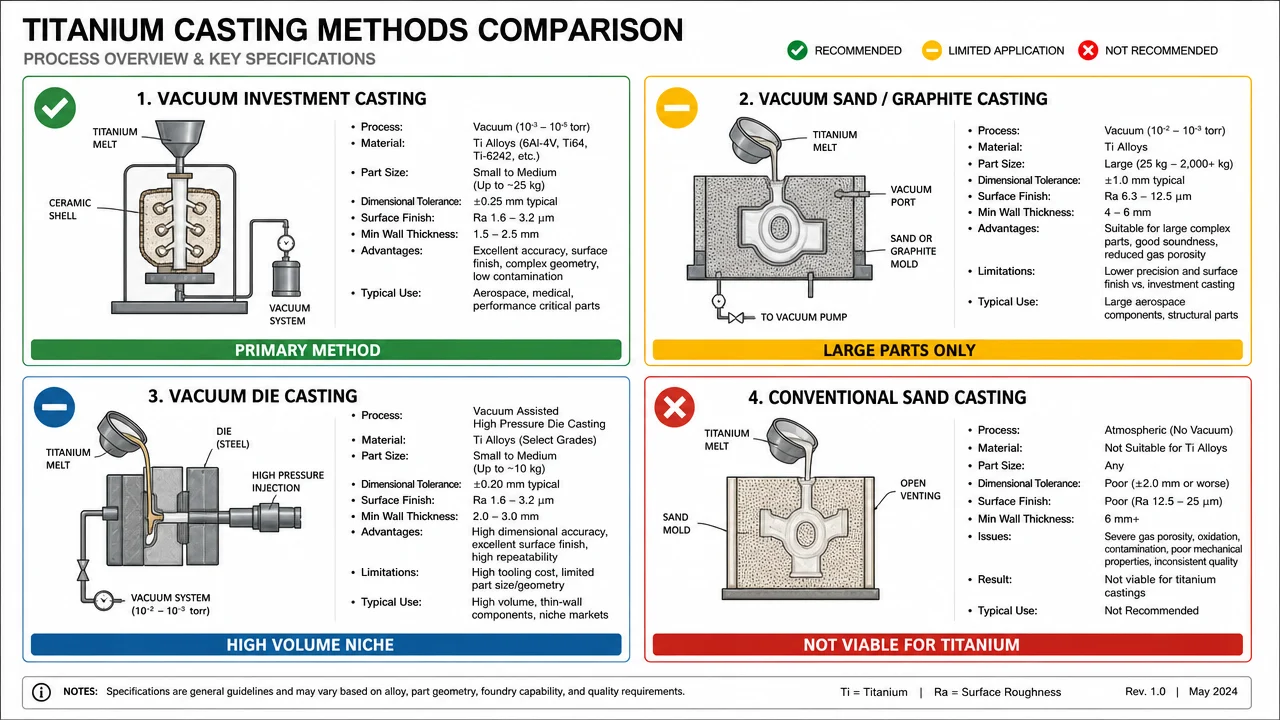
| Metodo | Compatibile con il titanio? | Perché sì / Perché no |
|---|---|---|
| Fusione a cera persa sotto vuoto | ✅ Sì — metodo principale | La camera a vuoto sigillata e il guscio ceramico prevengono la contaminazione atmosferica |
| Fusione sotto vuoto in conchiglia | ✅ Sì — nicchia limitata | La fusione sotto vuoto ad alta pressione è praticabile; richiede attrezzature specializzate |
| Colata Centrifuga | ✅ Sì — specializzata | Utilizzata per anelli e tubi; richiede ambiente sotto vuoto |
| Colata in Sabbia | ⚠️ Gravemente limitata | La colata in sabbia convenzionale causa un grave strato alfa‑case; esiste la colata in sabbia sotto vuoto, ma è raramente utilizzata per il titanio |
| Colata in Conchiglia per Gravità (Stampo Permanente) | ❌ Non applicabile | Il titanio fuso reagisce con gli utensili in acciaio o ghisa |
| Pressofusione Standard | ❌ Non applicabile | La pressione di iniezione è incompatibile con la reattività del titanio; nessun controllo del vuoto |
Il resto di questa guida si concentra sui tre metodi praticabili nell'uso concreto: la fusione a cera persa sotto vuoto, la pressofusione sotto vuoto e — ove applicabile — la colata in sabbia del titanio.
Fusione a Cera Persa sotto Vuoto: Il Processo Dominante per il Titanio
La fusione a cera persa sotto vuoto (denominata anche fusione a cera persa in ambiente vacuum) gestisce l“85–90% delle fusioni commerciali in titanio. È il metodo a cui la maggior parte delle fonderie fa riferimento quando parlano di ”fusione del titanio" senza ulteriori specifiche.
Perché è dominante: La capacità di produzione near-net-shape della fusione a cera persa riduce al minimo le lavorazioni meccaniche post-fusione di un materiale costoso e difficile da lavorare. Il guscio ceramico tollera l'elevato punto di fusione del titanio (1668°C / 3034°F). Inoltre, il processo è intrinsecamente scalabile in lotti — un singolo ciclo di forno sotto vuoto può fondere decine di pezzi simultaneamente.
Il Processo di Fusione a Cera Persa sotto Vuoto, Passo dopo Passo
1. Produzione del Modello
I modelli in cera o in materiale termoplastico del componente da realizzare vengono prodotti per iniezione utilizzando attrezzature lavorate con precisione. Per i componenti aerospaziali ad alta tolleranza, i modelli in cera lavorati al CNC sono sempre più comuni, al fine di eliminare le variazioni dimensionali derivanti dagli stampi di iniezione.
2. Costruzione del Guscio
I pattern vengono immersi ripetutamente in una barbottina ceramica e rivestiti con sabbia refrattaria. Per il titanio in particolare, i gusci standard a base di silice sono inadeguati — il titanio fuso riduce la silice (SiO₂), contaminando il bagno. Lo standard del settore utilizza zirconia stabilizzata con ittria (YSZ) o rivestimenti superficiali in zirconia stabilizzata con calcia, chimicamente inerti al titanio liquido. Un guscio tipico per titanio prevede 8–12 strati di immersione e raggiunge uno spessore della parete di 8–12 mm.
3. Eliminazione della cera e preriscaldo
I gusci in ceramica vengono riscaldati per eliminare il pattern in cera, lasciando cavità ceramiche cave. I gusci vengono quindi preriscaldati a 150–300°C prima della colata per migliorare il riempimento e ridurre lo shock termico.
4. Preparazione dell'elettrodo
Anziché materiali di carica convenzionali, le fonderie di titanio utilizzano tipicamente un elettrodo consumabile — una barra compattata di lega di titanio che funge sia da materia prima che da anodo nel processo di fusione ad arco. La composizione dell'elettrodo deve corrispondere alla specifica della lega obiettivo (ad es. AMS 4991 per getti in Ti-6Al-4V).
5. Caricamento ed evacuazione della camera a vuoto
Il guscio ceramico preriscaldato e l'elettrodo in titanio vengono caricati nella camera di colata. La camera viene sigillata ed evacuata fino a un alto vuoto — tipicamente inferiore a 10⁻³ mbar — per rimuovere ossigeno e azoto atmosferici prima di qualsiasi riscaldamento.
6. Fusione a scull (processo VAR)
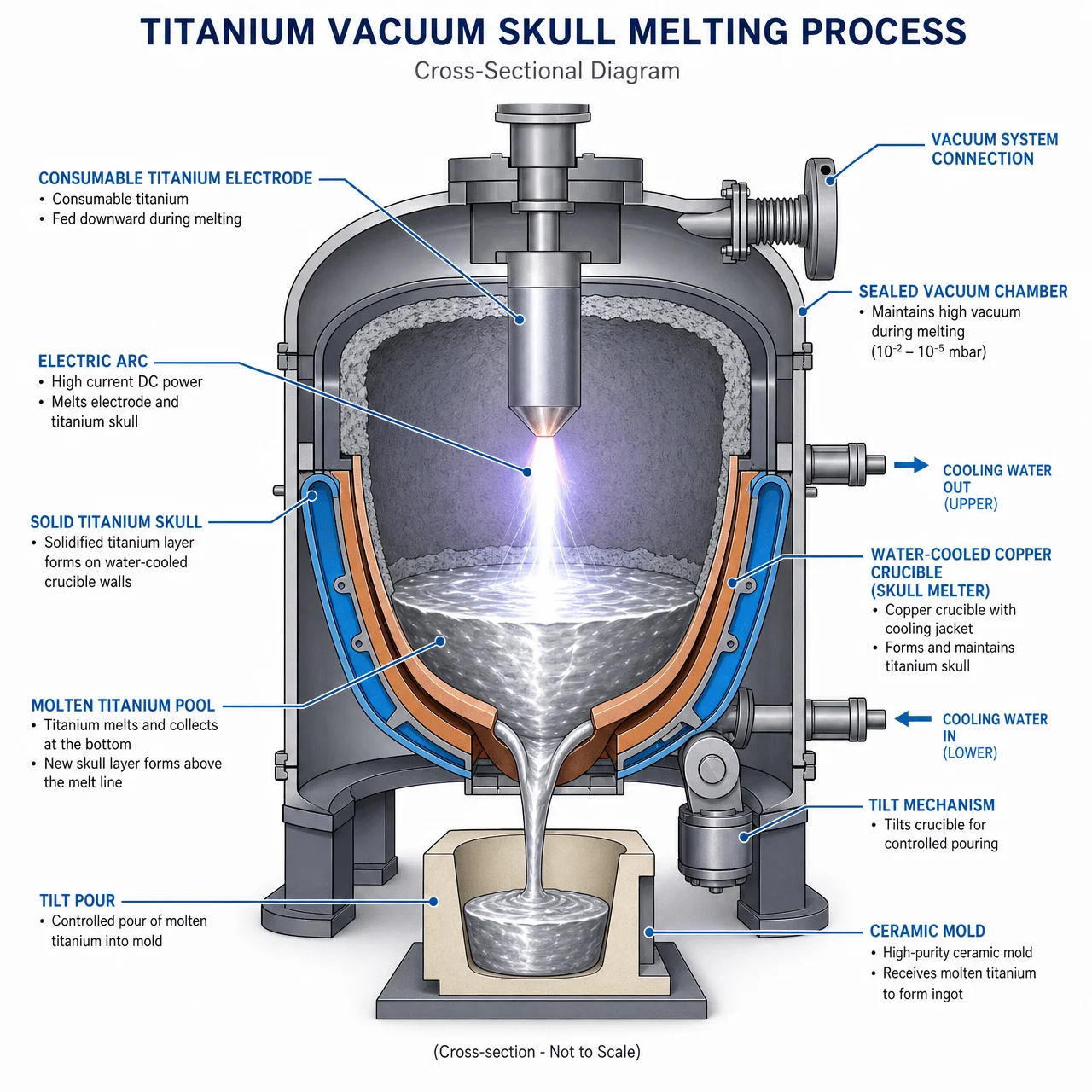
Questa è la fase che distingue maggiormente il titanio dagli altri metalli per fusione a cera persa. Si utilizza un crogiolo in rame raffreddato ad acqua (skull melter) anziché un crogiolo ceramico convenzionale, poiché il titanio fuso reagisce con le ceramiche ossidiche. Un arco elettrico si innesca tra l'elettrodo consumabile e una piccola quantità di materiale di avviamento nel crogiolo. Il titanio si fonde dalla punta dell'elettrodo, raccogliendosi nella vasca in rame raffreddata ad acqua.
Lo strato esterno del bagno di titanio si solidifica a contatto con le pareti in rame — formando lo “scull” — mentre l'interno rimane liquido. Questo scull di titanio solido impedisce fisicamente il contatto tra il bagno fuso e il rame. Le temperature nel bagno di fusione superano i 1700°C.
7. Colata per ribaltamento o colata centrifuga
Una volta raggiunto il volume di fusione richiesto, la camera si inclina (o si attiva un meccanismo centrifugo) per versare il titanio fuso nel guscio preriscaldato. L'intera colata avviene all'interno dell'ambiente sotto vuoto sigillato. Le varianti di colata centrifuga fanno ruotare il guscio a 200–500 RPM durante la colata per migliorare il riempimento delle sezioni sottili.
8. Raffreddamento controllato e rimozione del guscio
I getti si raffreddano sotto vuoto o in atmosfera inerte prima dell'apertura della camera. Il guscio ceramico viene rimosso mediante estrazione meccanica, decladding vibratorio o sabbiatura ad alta pressione con acqua.
9. Cutoff and Initial Inspection
Gates and risers are removed. Initial dimensional inspection and visual inspection follow. For aerospace applications, first-article inspection typically includes coordinate measuring machine (CMM) dimensional verification.
What Tolerances Can You Expect?
Titanium investment castings typically achieve:
- Linear dimensional tolleranza: ±0.005 in/in (±0.13 mm/mm) per ASTM B372 / industry practice
- Surface finish: Ra 1.6–3.2 µm (63–125 µin) as-cast — significantly better than sand casting
- Minimum spessore della parete: 1.5–2mm for most alloys
These tolerances assume proper tooling design and shell quality. Complex internal passages, cores, or thin sections require design-for-manufacturing review.
Titanium Sand Casting: When It Works and When It Doesn’t
Sand casting is the world’s most common metal casting process — but titanium makes it far more complicated than casting iron or steel.
The fundamental problem: conventional silica sand contains SiO₂ (silicon dioxide). At titanium casting temperatures, molten titanium aggressively reduces SiO₂, pulling oxygen into the melt and depositing silicon contamination. The result is a brittle, oxygen-enriched alpha-case layer on the casting surface that can extend several millimeters deep, requires aggressive chemical milling to remove, and represents a structural liability in load-bearing applications.
This is why the common statement “sand casting can be used for titanium” is technically true but practically misleading for most engineering applications.
Where Titanium Sand Casting Is Actually Used
Titanium sand casting does exist — but it uses non-reactive refractory aggregates, not conventional silica sand. Viable mold materials include:
- Graphite molds (most common for larger titanium parts)
- CaO-stabilized zirconia aggregate
- Calcia (CaO) or yttria (Y₂O₃) face-coat sand molds
And the entire process still requires a vacuum or inert-atmosphere environment for melting and pouring. Open-air titanium sand casting is not viable at production quality.
In practice, titanium “sand casting” (usually graphite mold casting) is used for:
- Large structural aerospace parts (wing carry-through structures, fuselage frames) where the geometry is too large for standard investment casting equipment
- Parts up to 500 kg where investment casting tooling costs are prohibitive
- Low-volume or prototype parts where shell tooling isn’t justified
Trade-offs vs. investment casting:
| Parametro | Fusione a cera persa sotto vuoto | Vacuum Sand/Graphite Casting |
|---|---|---|
| Surface finish (as-cast) | Ra 1.6–3.2 µm | Ra 6.3–12.5 µm (rougher) |
| Dimensional tolleranza | ±0.005 in/in | ±0.010–0.015 in/in |
| Max part size | ~25–50 kg (typical equipment) | 500+ kg feasible |
| Costo degli utensili | Moderate (wax/ceramic tooling) | Lower (graphite machining) |
| Alpha-case depth | 0.1–0.3 mm (ceramic shell) | 0.3–0.8 mm (graphite mold) |
| Applicazioni tipiche | Aerospace brackets, medical implants, industrial valves | Airframe structures, large pump casings |
The key takeaway: for any precision or structural titanium casting under ~50 kg, vacuum investment casting delivers better dimensional control and surface finish at comparable cost. Graphite mold casting becomes the practical choice when part size exceeds standard investment casting furnace capacity.
Vacuum Die Casting for Titanium: The High-Pressure Alternative
Vacuum die casting of titanium occupies a narrow but real niche, primarily studied and commercialized in the 1990s–2000s as a route to lower-cost titanium components. Research at ORNL and other institutions demonstrated that vacuum die casting can produce near-net-shape titanium parts with wall thicknesses down to 1mm at cycle times much faster than investment casting.
How it differs from conventional die casting:
- The die cavity is evacuated before injection
- Tooling must be compatible with titanium’s reactivity (specialized die coatings or materials)
- Shot speeds and pressures are modified to prevent turbulence that entraps gas
The catch: titanium’s high punto di fusione (1668°C) and reactivity with most tool steels makes die longevity a persistent challenge. Standard H13 tool steel dies used for aluminum die casting are not suitable — titanium solders to them and erodes them rapidly. This has limited widespread commercial adoption.
Where vacuum die casting for titanium currently sees use:
- High-volume consumer/automotive Ti components where investment casting tooling amortization is slow
- Thin-wall structural shapes that investment casting struggles to fill consistently
For most aerospace and medical procurement engineers, vacuum investment casting remains the default and the safe choice.
Post-Processing: The Part of Titanium Casting That Surprises Buyers
One of the most common budget surprises in titanium procurement: the casting itself is only part of the cost. Aerospace and medical applications require additional processing steps that add 30–70% to the part cost.
Pressatura isostatica a caldo (HIP)
Titanium investment castings contain micro-porosity from gas entrapment and solidification shrinkage. For structural applications, this porosity must be eliminated. HIP subjects the casting to simultaneous high temperature (~900–950°C) and high isostatic pressure (100–175 MPa / ~15,000–25,000 PSI) in an inert argon atmosphere. This collapses internal voids without changing external dimensions.
HIP is mandatory for flight-critical aerospace castings and for load-bearing medical implants. It is not optional if your part specification calls out AMS 2175 (castings standard) or AMS 2801 (heat treatment). Budget approximately 15–25% cost addition for HIP.
Alpha-Case Removal
Even with a good vacuum, the outermost surface of titanium castings develops a brittle, oxygen-enriched alpha-case layer. For investment castings with yttria-stabilized zirconia shells, this layer is typically 0.05–0.2 mm thick. For graphite mold castings, it can reach 0.5–1.0 mm.
Alpha case must be removed before the part is used in structural applications. Methods:
- Chemical milling (acid etching): Most common; HF/HNO₃ solutions dissolve the surface layer uniformly
- Mechanical removal: Electrochemical machining (ECM) or controlled abrasive blasting in some configurations
NADCAP-certified processing is standard for aerospace applications.
Trattamento termico
Ti-6Al-4V and other alpha-beta alloys typically receive a stress relief anneal or full solution treat + age cycle after casting to achieve target mechanical properties. Required parameters are alloy-specific and specified in AMS 2801 or the customer’s engineering specification.
NDT Requirements
Aerospace castings commonly require:
- X-ray or CT scanning (ASTM E1742 / MIL-STD-453)
- Fluorescent penetrant inspection (FPI per ASTM E1417)
- Chemical analysis (per-heat traceability to AMS or ASTM spec)
These add cost but are non-negotiable for flight hardware. Medical implants add biocompatibility certification requirements (ISO 10993, ASTM F136 for implant-grade Ti-6Al-4V BASSO CONTENUTO INTERSTIZIALE).
Selecting the Right Titanium Casting Method: A Decision Framework
The right casting method depends on four variables: part size, required tolleranza, production volume, and application criticality.
| Fattore decisionale | Fusione a cera persa sotto vuoto | Graphite/Sand Mold Casting | Fusione sotto vuoto in conchiglia |
|---|---|---|---|
| Part weight | <25–50 kg | Up to 500+ kg | <5 kg (typical) |
| Tolleranza requirement | Tight (±0.005 in/in) | Moderate (±0.010–0.015) | Tight (±0.003–0.005) |
| Surface finish priority | Alto | Low-moderate | Alto |
| Volume | Low to medium | Basso | Medium to high |
| Geometric complexity | High — thin walls, internal passages | Low-moderate | Moderate — thin walls |
| Aerospace/medical certifiable | Yes — industry standard | Yes — for large structures | Limited — less established |
| Relative tooling cost | Moderato | Basso | High (die cost) |
Practical selection rules:
- Part under 25 kg + complex geometry + aerospace/medical = fusione a cera persa sotto vuoto
- Part over 100 kg + simpler geometry + cost-sensitive = vacuum graphite mold casting
- High-volume + thin wall + consumer/automotive = vacuum die casting (if supplier is qualified)
- “Can we sand cast this titanium bracket?” from a conventional foundry = no — redirect to vacuum investment casting
Titanium Casting Grades: Which Alloy to Specify
Three titanium grades represent approximately 95% of castings in production:
CP Titanium Grado 2 (Commercially Pure)
- Density: 4.51 g/cm³; Resistenza a trazione: ~345 MPa as-cast
- Standards: ASTM B367, ASME SB367, ASTM F67 (for medical)
- Best for: Maximum resistenza alla corrosione applications — chemical process equipment, marine hardware, non-structural medical housings
- Don’t use for: Any load-bearing structural application
Ti-6Al-4V (Grado 5 / AMS 4991)
- Density: 4.43 g/cm³; Resistenza a trazione: 895–930 MPa (as-cast, post-HIP)
- Standards: AMS 4991 (casting), ASTM F136 (implant-grade BASSO CONTENUTO INTERSTIZIALE variant)
- Best for: Aerospace brackets, engine mounts, orthopedic implants, racing components
- Note: “Ti-6Al-4V” and “ASTM F136” are not interchangeable — medical implants require the BASSO CONTENUTO INTERSTIZIALE (Extra Low Interstitial) variant with tighter oxygen/nitrogen/hydrogen limits
Ti-6Al-2Sn-4Zr-2Mo (Grade 6 / AMS 4999)
- Density: 4.54 g/cm³; significantly higher creep resistance than Gr 5
- Standards: AMS 4999
- Best for: Jet engine stators, high-temperature actuators, components with sustained loads above 315°C (600°F)
- Cost: 2–3× Ti-6Al-4V; only justified when operating temperature demands it
Real Cost Ranges for Titanium Castings
Cost transparency is rare in titanium casting. Based on supplier data and industry benchmarks:
| Component Type | Lega | Rough Cost Range | Key Cost Driver |
|---|---|---|---|
| Simple valve body (50–200g) | CP Gr 2 | $800–$1,500/unit | Small volume, vacuum overhead |
| Aerospace bracket (0.5–2 kg) | Ti-6Al-4V | $1,800–$3,500/unit | HIP + X-ray + cert requirements |
| Medical hip stem (0.3–0.8 kg) | Ti-6Al-4V ELI | $4,000–$7,500/unit | ASTM F136 cert + electropolishing |
| Large structural frame (10–25 kg) | Ti-6Al-4V | $8,000–$25,000/unit | Furnace cycle cost, post-processing |
Raw material cost for Ti-6Al-4V is approximately $80–$120/kg for casting-grade sponge/electrode. But material is typically only 25–40% of total part cost — vacuum processing overhead, specialty ceramics, HIP, NDT, and certification compliance dominate.
The rule of thumb: titanium castings cost 5–10× equivalent stainless steel castings and 15–20× equivalent aluminum castings. This premium is justified when the application demands the strength-to-weight ratio, resistenza alla corrosione, or biocompatibility that titanium uniquely provides.
Qualifying a Titanium Casting Supplier: What to Ask
Most foundries cannot produce titanium castings. The equipment investment — vacuum arc melting furnaces, copper skull melters, yttria shell systems — runs $2–5M+, and the process expertise takes years to develop. Before sending an RFQ, verify:
Equipment:
- Does the foundry have its own vacuum arc remelting (VAR) or skull melting equipment? (Not outsourced)
- What is the maximum furnace capacity (kg per heat)?
- Is HIP done in-house or at a NADCAP-certified subcontractor?
Certificazioni:
- AS9100 Rev D (aerospace quality management) for aerospace parts
- NADCAP accreditation in casting (AC7102) and applicable special processes
- ISO 13485 for medical device applications
- Per-heat material traceability to AMS 4991 or ASTM F136
Process Controls:
- What ceramic shell system do they use? (Answer should reference yttria or calcia face coats — not generic silica)
- What vacuum level is achieved before pour? (Should be sub-10⁻³ mbar)
- What is their documented scrap rate for titanium? (Expect 10–20% for complex parts; significantly higher is a red flag)
Red flags: “We occasionally do titanium” / no dedicated vacuum furnace / generic material certs not tied to heat numbers.
Domande frequenti
Can titanium be sand cast?
Titanium can be cast in graphite or calcia/yttria-stabilized sand molds, but conventional silica sand reacts with molten titanium and is not suitable. Any titanium sand or graphite mold casting still requires a vacuum or inert-atmosphere environment for the melt and pour. For most precision applications under 50 kg, vacuum investment casting offers better results.
Why does titanium casting require a vacuum?
Molten titanium reacts aggressively with oxygen and nitrogen at its casting temperature (above 1668°C). These reactions form brittle interstitial phases and an alpha-case surface layer that compromises mechanical properties. A vacuum environment prevents atmospheric exposure during melting and pouring.
What is alpha case in titanium casting?
Alpha case is a brittle, oxygen-enriched surface layer that forms when molten titanium contacts oxygen or nitrogen. It is harder than the bulk material and has significantly reduced duttilità and fatigue life. For structural applications, alpha case must be removed by chemical milling (acid etching) before part acceptance.
What is HIP and why is it required for titanium castings?
Hot Isostatic Pressing (HIP) uses simultaneous heat (~900°C) and high inert gas pressure (~175 MPa) to collapse internal micro-porosity in the casting. For aerospace and load-bearing medical applications, the internal integrity HIP provides is a specification requirement, not a supplier option.
Is Ti-6Al-4V the best alloy for titanium castings?
For most applications, yes. Ti-6Al-4V (AMS 4991) offers the best combination of strength, castability, and available certification data. CP Gr 2 is preferred when maximum resistenza alla corrosione matters more than strength. Ti-6Al-2Sn-4Zr-2Mo (AMS 4999) is only justified for high-temperature applications above ~315°C sustained service temperature.
How long does titanium investment casting typically take from order to shipment?
Lead times for aerospace/medical titanium castings typically run 12–20 weeks for new parts (including tooling production, first-article inspection, and post-processing). Repeat production of qualified parts can be 8–12 weeks. This is significantly longer than aluminum or steel investment casting due to the complexity of post-processing and qualification requirements.
Sintesi
Titanium’s reactivity with oxygen is the defining fact of all titanium casting — it eliminates conventional sand casting, open-pour die casting, and any method that exposes molten metal to air. Vacuum investment casting using copper skull melters and yttria-stabilized ceramic shells is the industry-standard process because it handles complex geometries at near-net-shape precision while keeping the melt in a sealed vacuum environment.
Sand/graphite mold casting remains viable for large titanium structures that exceed standard investment casting furnace capacity, but requires the same vacuum environment and produces rougher surfaces and wider tolerances. Vacuum die casting handles niche high-volume thin-wall applications.
For buyers: the part cost is only the beginning. Budget for HIP, alpha-case removal, heat treatment, and NDT — these post-processing steps are mandatory for aerospace and medical parts and add 30–70% to casting cost. Verify your supplier’s equipment and certifications before sending drawings.