Titanium cutting boards look impressive and clean up in seconds, but independent BESS sharpness testing shows they dull knives roughly 30 times faster than end-grain walnut — a 444-point loss vs. 15 points. Wood’s bacteria story is also more nuanced than titanium marketing admits: a peer-reviewed 1994 study found wood absorbs and kills bacteria that plastic and metal surfaces leave alive. That said, titanium wins on zero maintenance and raw-protein hygiene for cooks who can’t be bothered with board oiling. The answer to “are titanium cutting boards worth it” depends almost entirely on whether knife longevity or cleaning convenience is your top priority. This article breaks down the data so you can decide.
Titanium vs Wood Cutting Board: Side-by-Side Comparison
Before diving into the details, here’s how both materials score across the dimensions that matter most to a home cook.
| Feature | Titanium | End-Grain Wood | Edge-Grain Wood |
|---|---|---|---|
| Knife friendliness | Poor — dulls fast | Excellent | Good |
| Hygiene (bacteria) | Excellent (non-porous) | Good (antimicrobial) | Moderate |
| Microplastic risk | None | None | None |
| Maintenance | Dishwasher safe, zero upkeep | Needs oiling every 1–2 months | Needs oiling every 1–2 months |
| Durability | Decades (no warping or cracks) | 10–20+ years with care | 5–15 years with care |
| Noise when chopping | Loud (metal-on-metal) | Quiet | Quiet |
| Slip resistance | Low (thin, flat) | High (heavy, grippy) | High |
| Price range | $40–$100+ | $60–$250 | $25–$100 |
| Weight | Light–moderate | Heavy | Moderate |
The table makes the trade-off clear: titanium wins on maintenance, loses on knife safety. Wood wins on the cutting experience but asks for regular care. Neither is objectively better — they serve different kitchens.
The Knife Damage Problem — By the Numbers
Titanium dulls knives significantly faster than any wood surface, and the margin is much larger than most people expect.
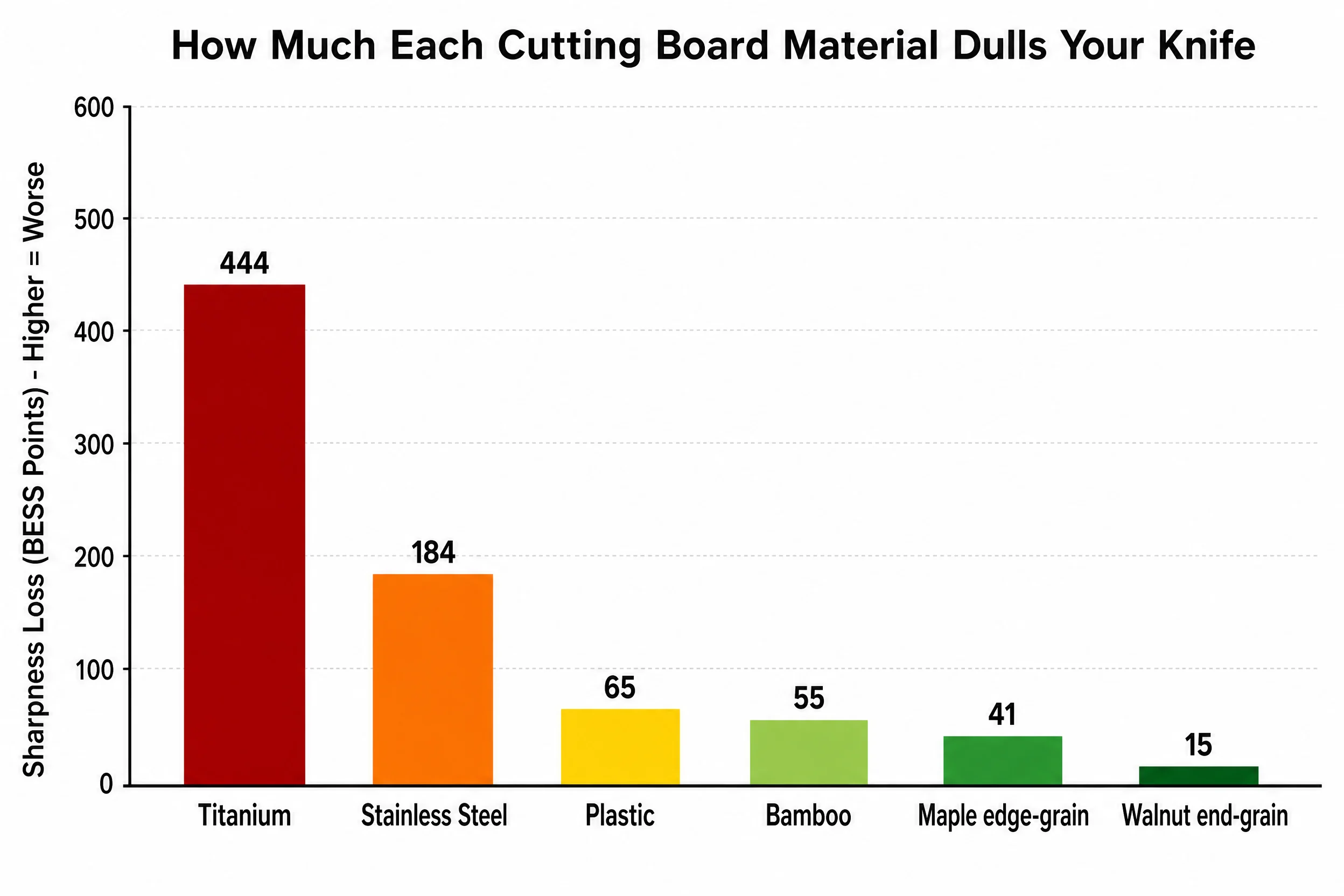
The most rigorous published comparison comes from Andrew Palermo at Prudent Reviews, who used a BESS-certified sharpness tester on ten different board materials. The BESS score measures the grams of pressure needed to cut a calibrated wire — lower is sharper. He ran three separate tests on titanium and averaged the results.
Here’s what he found:
| Material | Sharpness Loss (BESS points) |
|---|---|
| Titanium | 444 (worst result, tested 3×) |
| Stainless steel | 184 |
| Bamboo | 55 |
| Plastic (polypropylene) | 65 |
| Teak (edge grain) | 42 |
| Maple (edge grain) | 41 |
| Teak (end grain) | 27 |
| Walnut (end grain) | 15 (second best) |
| Rubber (Hasegawa) | 10 (best) |
Titanium’s 444-point average is nearly 30 times worse than walnut end-grain. To double-check, Palermo took two brand-new Miyabi knives of identical steel and hardness: one dulled on titanium (205→433 BESS), the other on an end-grain wood board (barely any change).
Why does this happen? Titanium has a Mohs hardness of 6.0 — harder than most wood at 1–3 Mohs, but this comparison is misleading. The issue isn’t Mohs hardness. It’s that titanium’s surface, even when scratched and textured, creates metal-on-metal friction with the steel knife edge. Every stroke drags both surfaces against each other. Wood fibers, by contrast, compress and part around the blade edge rather than abrading it — especially in end-grain construction where the blade slips between the fiber ends.
Practical implication: If you cook daily and use a titanium board, expect to sharpen your knives roughly twice as often. For a $200 Japanese knife, that’s a real long-term cost to factor in.
One caveat worth noting: a brand-affiliated site (CalmChop) published conflicting data showing only 8% sharpness loss on titanium vs. 5% on wood — but their methodology (CATRA tester, 500 cuts) wasn’t independently verified and the site sells titanium boards. The BESS-certified, three-run Prudent Reviews test is the more credible data point.
Hygiene and Bacteria: Wood Has a Better Story Than Titanium Marketing Admits
Titanium is non-porous and easy to sanitize — but wood isn’t the bacteria factory it’s often made out to be.
The most important study on this topic is a 1994 experiment by Dean Cliver and colleagues published in the Journal of Food Protection. They inoculated wood and plastic surfaces with E. coli, Listeria, and Salmonella typhimurium, then attempted to recover the bacteria at intervals. Their finding:
“If these fluids contained 10³–10⁴ CFU of bacteria likely to come from raw meat or poultry, the bacteria generally could not be recovered after entering the wood.”
Wood’s porous structure pulls surface moisture — and bacteria — deep into the grain through capillary action. Once inside, bacteria become trapped and die as the wood dries, rather than multiplying on the surface. Plastic and metal surfaces have no such mechanism; bacteria sit on top and can transfer to the next food item.
A 2023 study published in MDPI Coatings (Gutierrez et al.) reinforced this: unfinished wood outperformed both coated wood and non-wood materials on bacterial kill rate, because coatings actually interfere with the capillary action. The more “sealed” the wood surface, the less effectively it kills bacteria.
Does this mean wood is always safer? No. Wood that never dries — stored wet, not allowed to breathe — can harbor bacteria. Proper drying after washing matters. And wood isn’t dishwasher-safe; the high heat warps it.
Where titanium genuinely wins on hygiene:
- Raw meat, fish, and shellfish prep where you want to rinse with boiling water or bleach solution
- Households with immunocompromised members who need aggressive sanitizing
- Cooks who won’t remember to oil or dry their board properly
Where the hygiene argument is overstated:
- General vegetable and bread prep — properly maintained wood is well within safe limits
- The microplastics angle actually favors both wood and titanium equally: neither sheds plastic particles into food, unlike polypropylene and HDPE boards which release measurable microplastics with every cut (Yadav et al., Environmental Science & Technology, 2023)
The “Is It Real Titanium?” Problem
A significant percentage of cutting boards sold as “titanium” online are actually stainless steel — and you should know before you buy.
In a 2025 YouTube review, Andrew from Kitchen Knife Guy ordered a highly rated “titanium cutting board” from Temu. When it arrived, the texture, weight, and surface behavior all indicated stainless steel. The mislabeling is common because stainless steel is far cheaper to manufacture, and most consumers can’t tell the difference from a product photo.
Genuine titanium boards are lighter than stainless (titanium density: 4.51 g/cm³ vs. stainless steel at roughly 7.5–8.0 g/cm³ depending on alloy grade) and have a slightly warmer, more matte finish. If a “titanium” board feels unusually heavy for its size, it’s probably stainless.
Why this matters: Stainless steel has a Mohs hardness of roughly 5.5–6.5 depending on grade — similar to titanium — so the knife damage risk is comparable. But the marketing language around “titanium antibacterial properties” doesn’t apply to a stainless board. If you’re paying a premium for titanium’s specific characteristics, verify that’s what you’re getting.
A simple weight test: a genuine titanium board roughly 12×9 inches should weigh around 2–3 lbs. The same board in stainless steel would be closer to 4–5 lbs.
Maintenance, Weight, and Day-to-Day Reality
The daily experience of using these boards is more different than spec sheets suggest.
Wood boards — especially thick end-grain models from brands like John Boos or Teakhaus — are heavy enough to stay put while chopping. The weight is a feature. They absorb knife impact sound and give a satisfying, quiet thud. They need oiling with food-safe mineral oil every four to six weeks (more often when new), and they should never go in the dishwasher. Annual reconditioning with beeswax paste keeps surface cracks from forming. It takes maybe ten minutes every few weeks.
Titanium boards are typically thin — often 2–3mm — which makes them light but also slippery. Most ship with a thin rubber perimeter strip that helps, but testers consistently noted the boards shift during aggressive chopping. The thin profile also makes it harder to scrape chopped ingredients into a pile without them falling off the edge. The sound of a steel knife on titanium metal is notably louder and harsher than wood — relevant if you cook early morning or late at night.
On the upside: titanium goes in the dishwasher, handles boiling water rinses, doesn’t absorb garlic or turmeric odors, and won’t warp if you accidentally leave it in standing water. For a second board designated purely for raw proteins, this low-maintenance profile is genuinely useful.
Who Should Buy a Titanium Board — and Who Shouldn’t
This decision is cleaner than most cutting board articles make it.
Buy titanium if you:
- Use a separate board specifically for raw meat and poultry, and want something you can bleach and dishwasher without worry
- Own knives you sharpen yourself frequently and don’t mind slightly more frequent maintenance
- Have a modern kitchen where aesthetics matter and you want that minimal metal look
- Have allergies or sensitivities to wood treatments like mineral oil or beeswax
Stick with wood if you:
- Own Japanese high-carbon steel knives (typically 60–65 HRC) — the edges are thinner and more prone to rolling on hard surfaces
- Want an all-purpose daily driver that handles everything from bread to boning without a secondary board
- Prefer a quieter kitchen
- Cook for children or guests who would notice if knives start struggling on herbs and tomatoes
The hybrid approach most experienced cooks actually use: one large end-grain wood board as the primary cutting surface (Teakhaus, John Boos, or Jones Cutting Boards all performed well in independent testing), and a thin plastic or titanium board as a secondary for raw proteins. This gives you knife safety on your main board and easy sanitation for the messy jobs.
Frequently Asked Questions
Are titanium cutting boards worth it?
For most home cooks: no, not as a primary board. The knife damage is significant — BESS testing shows a 444-point average loss vs. 15 points for walnut end-grain. As a secondary board for raw meat prep, the easy sanitizing is genuinely useful.
Do titanium cutting boards dull knives?
Yes — faster than any other tested material. In BESS-certified tests (Prudent Reviews, 2025), titanium caused an average 444-point sharpness loss, nearly 30 times worse than walnut end-grain (15 points). The problem is metal-on-metal friction, which abrades knife edges differently than wood fibers.
Are titanium cutting boards more hygienic than wood?
Titanium’s non-porous surface is easier to sanitize aggressively, but well-maintained wood is not the hygiene hazard it’s often described as. Cliver et al. (1994) showed wood absorbs and kills common foodborne bacteria at concentrations typical of home kitchen contamination. Wood that dries properly between uses is safe for everyday cooking.
Can you put a titanium cutting board in the dishwasher?
Yes. Unlike wood, titanium won’t warp, crack, or absorb moisture from dishwasher cycles. This is one of titanium’s genuine advantages over wood boards.
Is bamboo better than titanium for knives?
Yes. Bamboo (technically a grass, not wood) sits at roughly 1–2 Mohs hardness and caused only 55 BESS points of sharpness loss in the Prudent Reviews test, vs. titanium’s 444. Bamboo does have its own issues — it’s harder on knives than maple or walnut, and some eco-claims around it are exaggerated — but it’s far less damaging than titanium.
Are some “titanium” cutting boards actually stainless steel?
Yes. Multiple reviewers (including Kitchen Knife Guy’s 2025 video) have received stainless steel boards marketed as titanium, particularly from discount suppliers and Temu. Genuine titanium is about half the density of stainless steel (4.51 vs. ~8 g/cm³), so a suspiciously heavy board is a red flag.
The Verdict
Titanium cutting boards are well-made, visually appealing, and genuinely low-maintenance — but the knife damage data is hard to argue with. A 30× worse sharpness loss compared to walnut end-grain isn’t a minor inconvenience; it’s a fundamental trade-off that matters every time you pick up a knife.
Wood wins as a daily driver. End-grain hardwood boards from reputable makers have been tested rigorously and consistently outperform every other material on knife preservation. Their bacteria story, properly understood through the science, is also stronger than marketing for alternatives would suggest.
Titanium earns a place as a secondary board — dishwasher-friendly, odor-proof, and easy to bleach after raw protein prep. If you’re buying it for that specific job, it’s worth the price. If you’re hoping it replaces a quality wood board, the data says otherwise.