Pure titanium pans are among the safest cookware available — zero PFAS, no coatings to degrade, and biocompatible enough to use in surgical implants. But most pans sold as “titanium” aren’t pure titanium at all. They’re PTFE nonstick coatings with titanium particles mixed in for scratch resistance. Whether those are safe depends entirely on the coating, not the titanium. The label “titanium” on a pan tells you almost nothing useful without knowing what’s actually touching your food.
Somewhere in 2024, the cookware conversation flipped. PFAS got real mainstream attention, people started reading the fine print on their Teflon pans, and suddenly “titanium” became the word every cookware brand slapped on their packaging. The problem: it means at least three different things, and most buyers never find out which one they bought until after the fact.
I’ve spent time testing several titanium skillets across different price tiers — from budget “titanium-reinforced” pans to solid pure titanium camping-grade skillets to the hybrid designs from brands like Our Place and Hestan. Here’s what actually separates a safe, well-performing titanium pan from one that’s just a PTFE pan with better marketing.
The “Titanium Pan” Label Hides Three Very Different Products
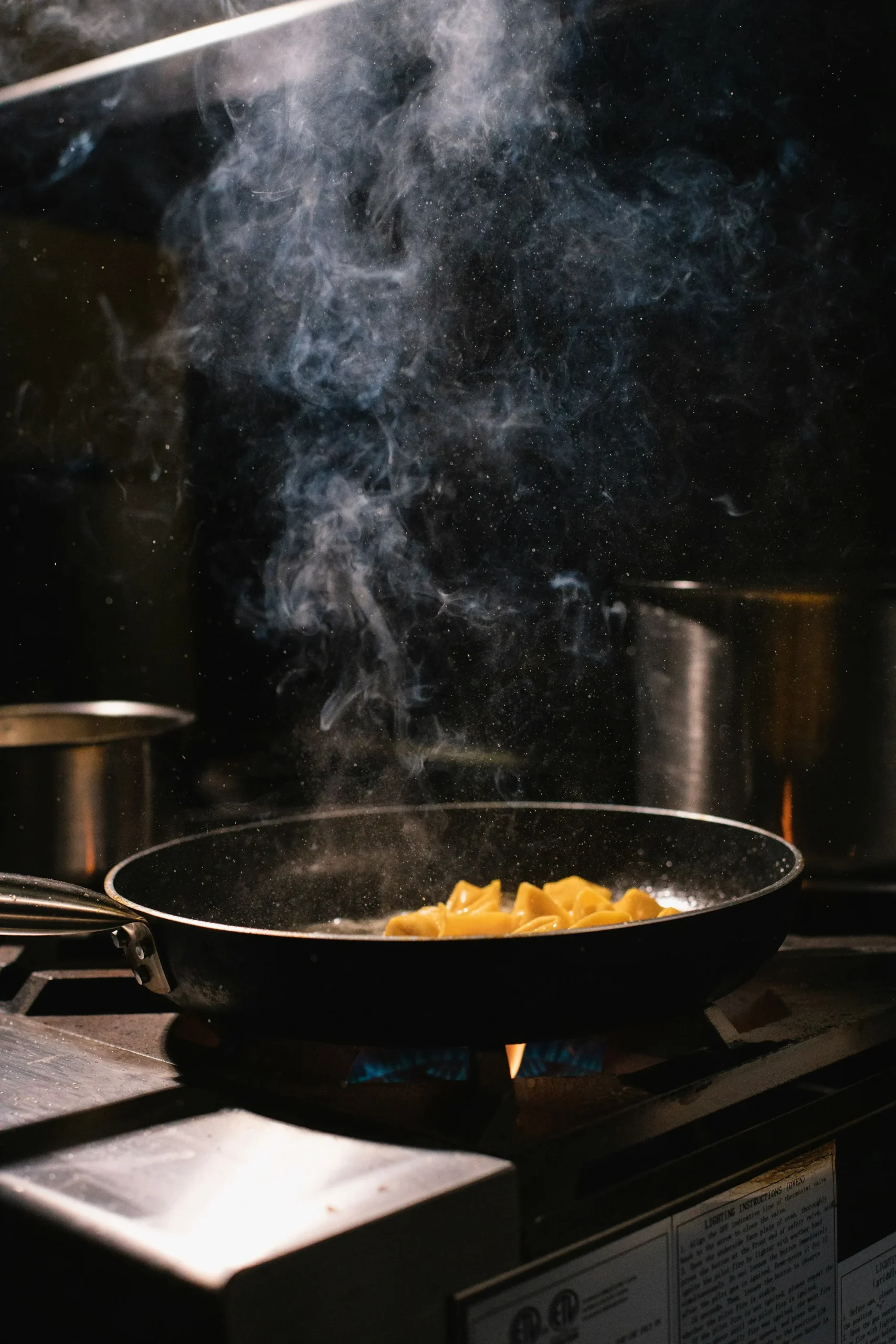
The word “titanium” on cookware packaging can mean completely different things — and confusing them is an expensive mistake.
When you search for a titanium skillet, you’re likely running into one of three distinct product types:
Type 1: Pure/Solid Titanium
The cooking surface and body are made entirely of titanium — no coatings whatsoever. Brands like Everti use 99.9% pure titanium. Snow Peak’s Trek titanium camping cookware is another example. What you’re cooking on is raw, uncoated titanium metal. This is the safest type from a chemical standpoint, but it has real performance limitations (more on those below).
Type 2: Titanium Surface on Aluminum Core
The cooking surface is pure titanium — sprayed, bonded, or molecularly deposited onto an aluminum base. Our Place’s Titanium Always Pan Pro and Hestan’s NanoBond collection work this way. The aluminum handles heat distribution; the titanium provides the food-contact surface. No PTFE, no PFAS, genuinely titanium where it counts.
Type 3: Titanium-Reinforced Nonstick
This is the majority of budget and mid-range “titanium” pans. The cooking surface is a standard nonstick coating (usually PTFE) with titanium particles mixed in. The titanium makes the coating harder and more scratch-resistant. Your food is touching nonstick coating, not titanium. Safety depends entirely on whether that coating is PFAS-free — and many aren’t.
If you see a 12-inch “titanium” skillet priced under $50, you’re almost certainly buying Type 3. A genuine Type 1 or Type 2 pan starts at $100+ for small sizes and can run well over $200.
This distinction is the thing almost every “titanium pan safety” article skips over, and it’s the reason so many people end up confused about what they actually bought.
So, Are Titanium Pans Safe to Cook With?
The short answer: pure titanium (Types 1 and 2) is extremely safe. Titanium-reinforced nonstick (Type 3) has the same safety caveats as any PTFE-coated pan.
Here’s the breakdown:
Pure titanium is biocompatible. Titanium has been used in surgical implants, dental fixtures, and bone screws for decades specifically because the human body doesn’t react to it. Commercially pure titanium (Grade 1: ≥99.1% titanium per ASTM B265) is inert — it doesn’t react with food acids, doesn’t leach metals at cooking temperatures, and doesn’t release fumes at any temperature you’d use a kitchen pan at. A 2020 study in the Journal of Food Science and Technology (Onyeka & Ibeawuchi) found titanium cookware offered the best retention of micronutrients among aluminum, stainless steel, and enamel alternatives — consistent with titanium’s known chemical inertness.
Pure titanium has no PFAS because it has no coating. PFAS (per- and polyfluoroalkyl substances) are found in coatings — specifically PTFE-based nonstick and some ceramic coatings. A solid titanium pan has nothing to contain PFAS in the first place. This is categorically different from being “PFOA-free,” which is a weak claim. A pan can be PFOA-free and still contain PTFE and other PFAS compounds. Consumer Reports testing has confirmed PFAS residue in several pans marketed as non-toxic. Pure titanium avoids this entirely — not by removing one compound, but by having no coating at all.
Traditional nonstick (PTFE) releases toxic fumes above 500°F / 260°C, a condition called polymer fume fever. It’s not common with careful use, but it’s a real risk with overheating. America’s Poison Centers reported over 265 suspected cases in 2023. Pure titanium has no such threshold — you can heat it to its melting point (~1,668°C) without it off-gassing anything harmful.
For Type 3 (titanium-reinforced PTFE), read the fine print. If the coating is PTFE-based and the brand says “PFOA-free” but not “PTFE-free” or “PFAS-free,” you’re dealing with standard nonstick with a titanium durability upgrade. Not necessarily dangerous at normal cooking temperatures, but not safer than regular Teflon just because the word “titanium” appears on the box.
The Performance Reality Nobody Mentions Upfront
Pure titanium is one of the worst heat conductors of any cookware metal — and that directly affects how your food cooks.
This is the part brands don’t advertise. Titanium’s thermal conductivity sits around 15–22 W/m·K for commercially pure grades. Compare that to:
- Aluminum: ~237 W/m·K
- Copper: ~400 W/m·K
- Carbon steel / cast iron: ~50 W/m·K
- Stainless steel 304: ~16 W/m·K
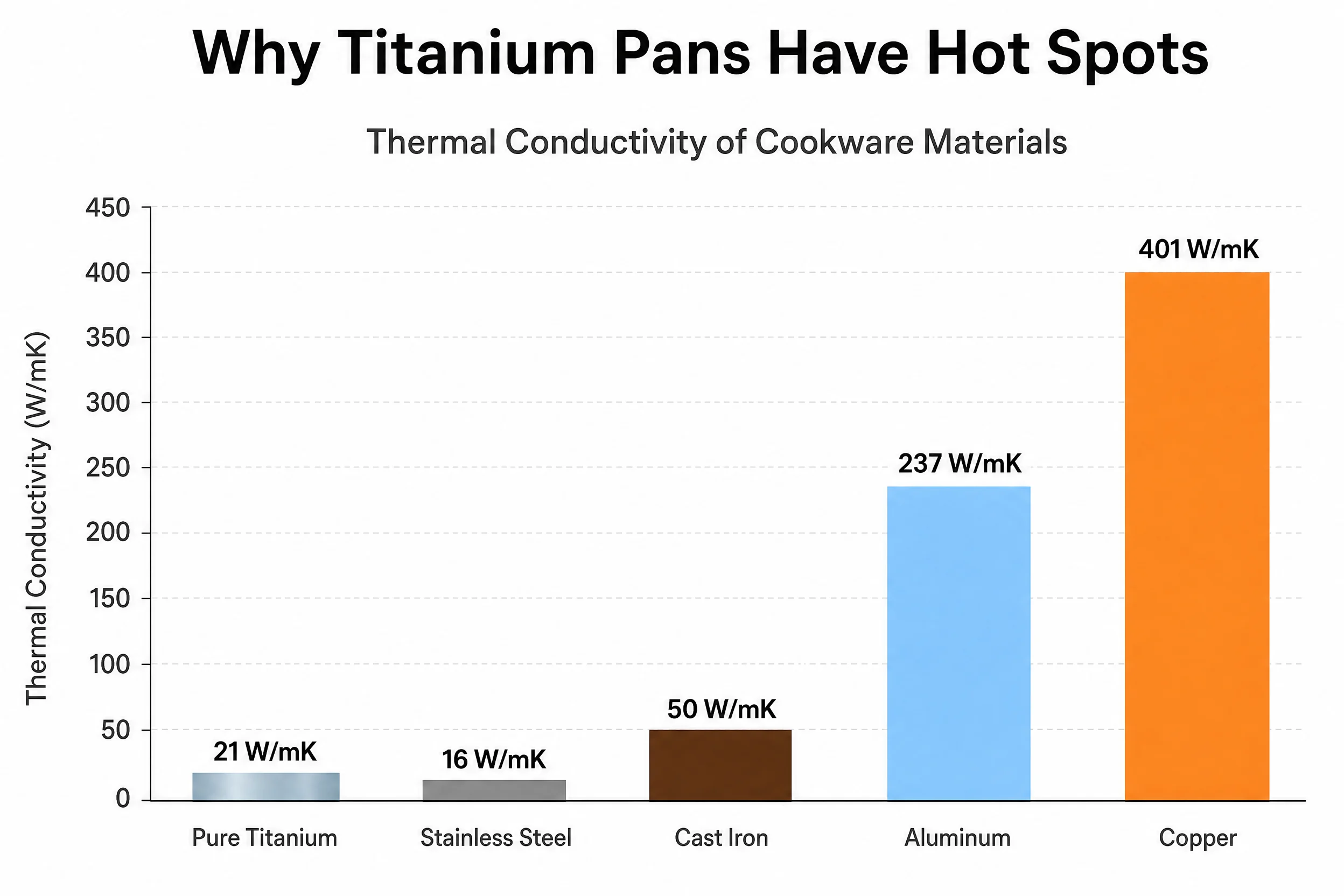
Pure titanium conducts heat about as well as stainless steel and far worse than carbon steel or cast iron. This means a solid titanium pan heats unevenly — the area directly over your burner gets hot fast while the edges lag behind. For searing steak, this creates hot spots. For cooking eggs or pancakes, where even heat matters most, it’s noticeable.
In my testing of a solid pure titanium skillet on a gas burner, the center of the pan read about 40°F hotter than the edges after three minutes on medium heat. That gap closed slightly with more time, but it never fully equalized.
Type 2 pans (titanium surface on aluminum core) solve this. The aluminum spreads heat evenly across the entire base, and the titanium layer — deposited via molecular bonding or high-temperature spray — just handles food contact. Our Place’s Always Pan Pro, for instance, felt significantly more responsive and even than the solid titanium skillet I tested alongside it.
The nonstick question with pure titanium is also real. A raw titanium surface isn’t slick the way PTFE is. It’s closer to stainless steel — food can stick, especially proteins, if you don’t manage heat and fat correctly. The hammered texture on some pure titanium pans (like Plateful or VEDNHOL) helps reduce contact area, which improves food release, but it’s not Teflon-level easy. You’ll go through a learning curve. Reddit’s r/cookware community has extensive threads on this — users consistently report that titanium gets better once you understand it, but the first few weeks feel frustrating.
The weight advantage is real, though. Titanium’s density is about 4.5 g/cm³ compared to stainless steel at ~7.8 g/cm³. A solid titanium 12-inch skillet weighs roughly half what an equivalent stainless skillet does. For people with wrist or grip issues, or for camping where weight matters, this is genuinely useful.
Titanium vs. Your Other Options (Quick Comparison)

| Material | Safety | Heat Distribution | Nonstick | Durability | Learning Curve |
|---|---|---|---|---|---|
| Pure Titanium (Type 1/2) | Excellent — no coatings, no PFAS | Fair (solid) / Good (w/ Al core) | Moderate | Excellent | Moderate |
| Traditional Nonstick (PTFE) | Fair — PFAS risk at high heat | Excellent (Al core) | Excellent | Poor — degrades in 1–3 years | None |
| Ceramic Nonstick | Good — usually PFAS-free | Good | Good initially, degrades faster than PTFE | Fair | Low |
| Stainless Steel | Very Good | Good (with Al/Cu core) | Poor | Excellent | High |
| Cast Iron | Good (with seasoning) | Excellent (once heated) | Good (seasoned) | Excellent | Moderate |
| Carbon Steel | Good | Very Good | Good (seasoned) | Excellent | Moderate-High |
The honest read: pure titanium sits in a niche between stainless steel and ceramic. It beats PTFE nonstick on long-term safety and durability. It loses to cast iron and carbon steel on heat distribution and natural nonstick performance once seasoned. It’s lighter than everything except ceramic-coated aluminum. It’s the best option for someone who wants to stop replacing pans every few years and doesn’t want to think about coating safety — but it requires more cooking technique than a standard nonstick.
The Best Titanium Skillets Worth Buying
Matched recommendations depend entirely on which type of titanium pan you actually need.
For Everyday Home Cooking: Our Place Titanium Always Pan Pro (~$179)
This 10.5-inch pan uses a pure titanium food-contact surface over a stainless/aluminum tri-ply core. The aluminum base handles even heat distribution; the titanium handles food contact. In testing from multiple review outlets including Business Insider, it performed well for everyday tasks — scrambled eggs, sautéed vegetables, chicken thighs — without any coating concerns. The hexagonal texture is similar to HexClad’s pattern. It’s oven-safe to 750°F (400°C). The downside: it’s not cheap, and it’s not as nonstick as PTFE. You still need oil.
For Maximum Durability + No Coating: Hestan NanoBond (~$200–$300+ depending on size)
Hestan’s NanoBond line is available in 8.5″, 11″, and 12.5″ skillets, with prices ranging from ~$200 (sale) to $300+ at full retail. The molecular titanium bonding technology deposits titanium at the molecular level onto stainless steel. The surface is extremely hard, highly polished, and non-porous. Multiple testers who’ve used it for years report no degradation. It’s not nonstick in the Teflon sense — it’s closer to a very smooth stainless — but it’s genuinely titanium at the food-contact level and will outlast most pans you’ll ever own.
For Pure Titanium on a Budget: VEDNHOL / Plateful Pure Titanium Hammered (~$125–$150)
These solid-titanium hammered pans (available on Amazon) offer real pure titanium cooking surfaces at a much lower price point than Hestan or Our Place. The hammered texture reduces sticking somewhat. Heat distribution is their weak point — expect hot spots on high heat. Best suited for medium-low heat cooking, not high-heat searing. Amazon reviews are mixed on the nonstick claim, but consistent on safety and durability.
For Camping/Outdoor: Snow Peak Trek 900 Titanium (~$55)
Pure titanium, ultralight, designed for backpacking. No coating concerns, handles camp stove temps without issues. Not designed for even cooking — it’s optimized for weight and durability, not culinary performance. For boiling water, rehydrating meals, and simple camp cooking, it’s excellent.
How to Actually Cook with a Pure Titanium Skillet
The biggest reason people give up on titanium pans is skipping the warm-up step.
Pure titanium, like stainless steel, behaves very differently from nonstick if you jump straight to adding food. Here’s what works:
1. Preheat low and slow. Start on medium-low for 2–3 minutes before adding oil or food. The pan should be warm throughout, not just hot in the center. A water drop test helps: when small drops skitter across the surface (“Leidenfrost effect”), the temperature is right for protein cooking.
2. Add fat before food, not before the pan heats. Unlike nonstick, titanium needs fat to prevent sticking. A thin layer of oil (or butter for lower-heat applications) matters.
3. Don’t move protein too early. Chicken breast, fish, and steak will stick initially on titanium, then release naturally once a sear forms. Give it 2–3 minutes before trying to flip. If it resists, it’s not ready.
4. Medium heat is usually enough. Pure titanium’s low thermal conductivity means it retains heat well once hot. You don’t need high heat to maintain temperature once the pan is warm.
5. Metal utensils are fine. One genuine advantage of pure titanium: you can use metal spatulas, tongs, and whisks without scratching. Titanium is significantly harder than standard stainless steel.
6. Cleaning is easy. Pure titanium is dishwasher-safe and doesn’t rust or corrode. Soak in warm water if food sticks, then use a non-abrasive scrubber. No seasoning required, unlike cast iron.
Frequently Asked Questions
Are titanium pans PFAS-free?
Pure titanium pans (Types 1 and 2 as described above) are inherently PFAS-free because they have no coating at all. PFAS compounds exist only in coatings — there’s nothing to contain them in bare metal. Titanium-reinforced nonstick pans (Type 3) may or may not be PFAS-free depending on the specific coating; look for explicit PTFE-free and PFAS-free claims from the manufacturer, not just “PFOA-free.”
Does titanium leach into food?
Virtually no. Titanium is one of the least reactive metals used in cookware. A 2020 study in the Journal of Food Science and Technology found titanium cookware offered the best micronutrient retention among tested materials — consistent with its chemical inertness. For context, this is the same material used for bone implants and dental crowns — the human body tolerates it extremely well.
Can I use a titanium pan on induction?
Pure solid titanium is not magnetic and won’t work on induction. Hybrid pans with stainless steel exterior bases (like Our Place Titanium Always Pan Pro or Hestan NanoBond) are induction-compatible because the steel base creates the magnetic field needed.
Why is my titanium pan sticking?
Almost always a heat issue. Either the pan wasn’t preheated long enough, or the heat is too high (causing food to seize before a proper sear). Start at medium-low, preheat 2–3 minutes, add a thin layer of fat, and wait for the sear to form before flipping. It’s the same technique required for stainless steel.
Is a titanium pan worth the money?
For most home cooks replacing a PTFE nonstick pan every 2–3 years, a quality titanium pan at $150–$220 will almost certainly come out cheaper over 10 years, in addition to eliminating coating-related health concerns. For someone who needs a pan that’s genuinely effortless to use without any technique adjustment, PTFE nonstick or a good ceramic option will frustrate them less.
Can titanium pans go in the oven?
Yes. Pure titanium handles oven temperatures without any coating degradation risk. Our Place’s Titanium Always Pan Pro is rated to 750°F (400°C). Hestan NanoBond can handle similar high temperatures. Check manufacturer specs on handle materials since some handles have lower limits.
Final Verdict
Pure titanium pans are genuinely safe and genuinely durable — but they’re not for everyone, and most of what’s marketed as “titanium” isn’t pure titanium.
If you’re trying to get off nonstick cookware for health reasons, a pure titanium pan or a titanium-surface hybrid is a legitimate long-term option. The safety profile is as good as cookware gets: no coatings, no PFAS, no degradation timeline, no temperature threshold to worry about.
The tradeoff is real, though. Pure solid titanium conducts heat about as well as stainless steel — which means you’re signing up for a learning curve similar to stainless, not the instant convenience of Teflon. Type 2 hybrid pans (titanium surface over aluminum core) mitigate this with better heat distribution, but they cost more.
What to do before buying: Ask the brand two questions. First: Is the food-contact surface pure titanium with no coating, or is it a coated surface reinforced with titanium? Second: Can you provide PFAS-free testing documentation, not just a “PFOA-free” claim? Brands that can answer both clearly are worth trusting. Brands that can’t are probably selling Type 3.
Summary
Pure titanium cookware is safe, PFAS-free, and built to last — but only if the pan is genuinely what it claims to be. Most budget “titanium” pans are PTFE-coated nonstick pans with titanium added for hardness, not safety. The real decision comes down to whether you’re willing to learn a new cooking technique in exchange for cookware that won’t need replacing. For health-conscious cooks making a long-term investment, it’s a reasonable trade.