Titanium offers an exceptional strength-to-weight ratio and outstanding corrosion resistance — but its wear resistance is surprisingly poor. Untreated Ti-6Al-4V has a Vickers hardness of only 349 HV and a specific wear rate exceeding 10⁻³ mm³/Nm in dry sliding conditions, placing it firmly in the severe wear regime. Without surface engineering, titanium galls, seizes, and scores under sliding contact with itself and other metals. This guide covers the metallurgical reasons behind titanium’s wear behavior, the ASTM standards used to test it (G99, G133, B117, G98), real pin-on-disk wear rate data, and a practical comparison of eight surface treatment methods — from TiN PVD coatings at 2,400 HV to plasma nitriding at 1,000+ HV — so you can select the right titanium grade and surface solution for your specific application.
Titanium Wear Resistance at a Glance
Here are the numbers that matter most when evaluating titanium for a wear-critical application.
| Property | CP Grade 1 | CP Grade 2 | CP Grade 4 | Ti-6Al-4V (Grade 5) | 304 Stainless Steel | D2 Tool Steel |
|---|---|---|---|---|---|---|
| Density (g/cm³) | 4.51 | 4.51 | 4.51 | 4.43 | 8.00 | 7.70 |
| Vickers Hardness (HV) | 122 | 145 | 280 | 349 | ~130 | 650–800 |
| Knoop Hardness (HK) | — | — | — | 363 | — | — |
| Rockwell C (HRC) | — | — | 23 | 36 | — | 58–62 |
| Tensile Strength (MPa) | 240 | 345 | 550 | 950 | 515 | — |
| Young’s Modulus (GPa) | 105 | 105 | 110 | 114 | 193 | 210 |
| Thermal Conductivity (W/m·K) | 16.0 | 16.4 | 20.6 | 6.7 | 16.2 | 20.0 |
Sources: MatWeb ASM International (MTU010, MTU020, MTU040, MTP641)
Three numbers in that table deserve immediate attention:
- 349 HV for Grade 5 titanium — that is roughly half the hardness of hardened tool steel (D2 at 650–800 HV) and nearly 3× harder than annealed 304 stainless steel (~130 HV). Hardness directly correlates with abrasion resistance in most sliding wear scenarios.
- 6.7 W/m·K thermal conductivity for Ti-6Al-4V — this is less than half of 304 stainless steel (16.2 W/m·K). During sliding contact, heat generated at the interface cannot dissipate into the bulk material, causing localized temperature spikes that accelerate oxidation, soften the surface, and promote adhesive wear.
- 114 GPa Young’s Modulus — roughly half the stiffness of steel (193–210 GPa). Under equivalent contact loads, titanium surfaces deform more elastically, increasing the real contact area and the friction coefficient.
The takeaway: Grade 5 titanium has outstanding strength-to-weight performance, but it ranks low on every metric that governs wear resistance. If your application involves sliding contact, impact, abrasion, or fretting — the base alloy alone will not be sufficient.
The Titanium Paradox: Why High Strength ≠ Wear Resistance
Titanium is simultaneously one of the strongest and one of the least wear-resistant structural metals available. Three metallurgical factors compound each other during sliding contact to create this paradox.
Low Thermal Conductivity Traps Heat at the Contact Zone
Ti-6Al-4V’s thermal conductivity is 6.7 W/m·K. Compare that to 16.2 W/m·K for 304 stainless steel or 50 W/m·K for plain carbon steel. When two surfaces slide against each other, friction generates heat at the asperity contact points. In steel, this heat spreads into the bulk material and dissipates. In titanium, it concentrates at the surface.
The result is predictable: localized temperature spikes at the contact zone that exceed 400–600°C during dry sliding, even at moderate speeds. This temperature is sufficient to:
- Break down the native TiO₂ passive layer (which forms at room temperature)
- Promote oxygen diffusion into the surface, creating a brittle alpha-case
- Cause material transfer between contacting surfaces (cold welding)
In one set of pin-on-disk experiments reviewed by Taylor & Francis (2024), dry sliding of Ti-6Al-4V against alumina generated surface temperatures high enough to transition from oxidative mild wear to severe adhesive wear within the first 200 meters of sliding distance.
Low Elastic Modulus Increases Real Contact Area
When a hard ball or pin presses into a titanium surface, the surface deforms more than it would under the same load on steel — titanium’s elastic modulus is roughly 114 GPa versus 193 GPa for 304 SS. This means the “real” contact area (the actual asperity-to-asperity contact, not the apparent geometric area) is larger in titanium.
A larger real contact area means more adhesive bonds form between the surfaces. When these bonds shear during sliding, material transfers from the softer surface to the harder one, creating the characteristic galling and scoring patterns that titanium is notorious for. MatWeb’s datasheet for Ti-6Al-4V states explicitly: “Ti-6Al-4V’s poor surface wear properties and tends to seize when in sliding contact.”
The Native TiO₂ Layer: Too Thin for Mechanical Protection
Every titanium surface in ambient air is covered by a passive oxide layer (TiO₂) approximately 1.5–10 nm thick (ScienceDirect, 2025; IOP Science). This layer is the reason titanium has excellent corrosion resistance — it creates a self-healing barrier that prevents oxygen from reaching the bulk metal.
But in the context of mechanical wear, this layer is effectively invisible. At 1.5–10 nm, it is three to four orders of magnitude thinner than the surface asperities that carry load during sliding contact. Under any meaningful normal load (above ~5 MPa), the oxide layer is stripped away faster than it can reform, exposing bare titanium metal to direct adhesive contact.
The only scenario where the TiO₂ layer meaningfully protects against wear is at elevated temperatures (above ~600°C), where the oxide grows thicker (above 1 μm) and transitions from anatase to rutile phase — the harder, more wear-resistant crystal form. This is the basis for “thermal oxidation” surface treatment, discussed later in this guide.
The bottom line: Titanium’s wear resistance is compromised by a trifecta — heat stays trapped, surfaces deform under load, and the oxide layer is too thin to help. None of these factors appear in a standard property table, which is why engineers who rely solely on strength-to-weight comparisons are often surprised by poor field performance in sliding applications.
Hardness vs. Wear Resistance: What the Numbers Really Tell You
Higher hardness generally means better wear resistance — the Archard wear equation relates wear rate inversely to hardness. But titanium violates this model in important ways.
Why Hardness Alone Is Not Enough for Titanium
Ti-6Al-4V at 349 HV is not extremely soft. It is significantly harder than annealed 304 stainless steel (~130 HV), and it is much harder than aluminum alloys (60–100 HV). Yet in dry sliding conditions, Ti-6Al-4V exhibits higher specific wear rates than 304 stainless steel, and sometimes even higher than softer aluminum alloys.
The explanation lies in the wear mechanism, not just the wear rate. Hardness governs resistance to abrasive wear — the mechanism where hard particles or surface asperities plow through a softer surface. For abrasive wear, titanium behaves approximately as the Archard equation predicts.
But titanium’s dominant wear mechanism in unlubricated sliding is adhesive wear, not abrasive wear. In adhesive wear:
- Surface asperities on the two contacting faces cold-weld together under normal load
- As sliding continues, these micro-welds shear, tearing material from one or both surfaces
- The torn material either transfers to the other surface or forms loose debris
- The cycle repeats, progressively roughening both surfaces
Hardness has only a secondary effect on adhesive wear because the driving force is the metallic bond strength between the two surfaces, not the resistance to indentation. This is why Ti-6Al-4V (349 HV) can exhibit worse adhesive wear than 304 stainless steel (~130 HV) — the stainless steel work-hardens at the surface during sliding, while titanium does not.
Galling: Titanium’s Specific Failure Mode
Galling is a severe form of adhesive wear that is particularly problematic with titanium. ASTM G98 defines the standard galling resistance test: a hardened button rotates against a stationary block under increasing normal force until material transfer becomes visible.
For self-mated Ti-6Al-4V (unlubricated), galling typically initiates at contact pressures as low as 20–50 MPa. For comparison:
| Material Pair | Galling Threshold (MPa) |
|---|---|
| Ti-6Al-4V / Ti-6Al-4V | 20–50 |
| 316L SS / 316L SS | 20–30 |
| Hardened 440C SS / 440C SS | 200+ |
| Stellite 6 / Stellite 6 | 300+ |
Sources: Budinski (1988) “Guide to Friction, Wear, and Erosion Testing”; ScienceDirect galling resistance studies
Titanium’s galling threshold is in the same range as austenitic stainless steel — both materials are notorious for galling in fastener applications. In practical terms, this means that any titanium-on-titanium or titanium-on-steel sliding joint (bolts, pins, bearing surfaces) requires surface treatment or dissimilar material pairing to avoid seizure.
The Wear Regime Map
Tribologists classify titanium wear into three regimes based on sliding conditions:
| Regime | Conditions | Behavior |
|---|---|---|
| Mild oxidative wear | Low load, low speed, or elevated temperature | TiO₂ layer acts as protective tribofilm; wear rate < 10⁻⁶ mm³/Nm |
| Severe adhesive wear | Moderate-high load, dry sliding, room temperature | Metal-to-metal contact, material transfer, galling; wear rate > 10⁻³ mm³/Nm |
| Catastrophic seizure | Very high load or speed without lubrication | Complete surface failure, bonding of components |
The engineering challenge is that most real-world applications fall squarely in the severe adhesive wear regime — the one regime where titanium performs worst. Surface treatments (discussed in a later section) work by either pushing the system into the mild oxidative regime (thermal oxidation) or by creating a hard barrier layer that prevents metal-to-metal contact (TiN, nitriding, DLC).
How Titanium Wear Is Tested: ASTM Standards Explained
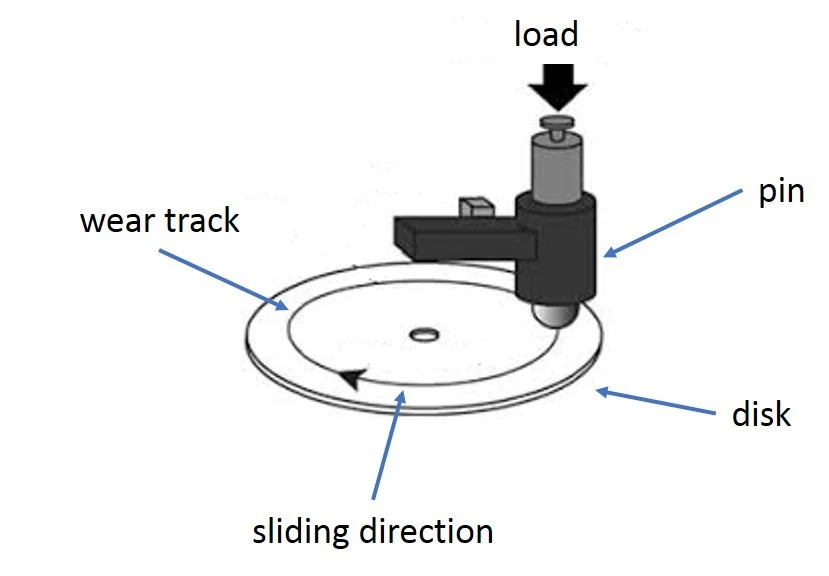
Four ASTM standards are most relevant for evaluating titanium’s durability behavior, each measuring a different aspect of wear performance.
ASTM G99-17: Pin-on-Disk Wear Test
This is the foundational tribology test for measuring friction and wear rate under controlled laboratory conditions. A stationary pin (or ball) presses against a rotating disk under a defined normal load while the frictional force and wear volume are recorded.
Standard test parameters for titanium:
| Parameter | Typical Range |
|---|---|
| Normal load | 5–50 N |
| Sliding velocity | 0.1–1.0 m/s |
| Sliding distance | 1,000–5,000 m |
| Temperature | Room temperature (~23°C) |
| Environment | Ambient air (12–78% RH) |
| Counterface | Alumina ball or hardened steel pin |
What it produces:
- Specific wear rate (k): k = V / (Fₙ × d), where V = volume loss (mm³), Fₙ = normal load (N), d = sliding distance (m). Units: mm³/N·m.
- Coefficient of friction (μ): ratio of frictional force to normal force.
How to read the results: A specific wear rate below 10⁻⁶ mm³/N·m indicates mild wear (acceptable for most applications). A value above 10⁻³ mm³/N·m indicates severe wear (component failure likely within thousands of operating hours).
ASTM G133: Reciprocating Ball-on-Flat Sliding Wear
This standard uses a back-and-forth (reciprocating) motion rather than continuous rotation, simulating applications where components oscillate or slide linearly — such as valve stems, piston rings, or linear bearings.
The test geometry produces different wear scar shapes than pin-on-disk, and the reversal of sliding direction at each stroke endpoint creates additional adhesive wear conditions. For titanium, ASTM G133 results often show higher wear rates than equivalent pin-on-disk tests, because the directional reversal disrupts any protective tribofilm that might form.
Expanite (a surface treatment company) published ASTM G133 test results for untreated Ti-6Al-4V showing a specific wear rate of 0.001 mm³/N·m — confirming that untreated Grade 5 titanium sits at the boundary between mild and severe wear even in reciprocating tests.
ASTM B117: Salt Spray (Fog) Corrosion Test
Although not a wear test per se, ASTM B117 is critical for evaluating the corrosion-wear interaction. Many applications — marine hardware, offshore equipment, medical implants exposed to body fluids — subject titanium to simultaneous mechanical wear and corrosive attack.
Test conditions:
- 5% NaCl solution at 35 ± 2°C
- Continuous fog exposure
- Duration: 24 hours to 5,000+ hours
Titanium performs exceptionally well in salt spray testing — it can exceed 5,000 hours with no visible corrosion, far surpassing most steels and many stainless steels. However, when surface wear removes the passive TiO₂ layer, the underlying fresh titanium can experience accelerated corrosion in chloride environments. This wear-corrosion synergy is a significant design consideration for offshore and marine applications.
ASTM G98: Galling Resistance Test
As discussed in the hardness section, this test measures the critical contact pressure at which galling (severe adhesive material transfer) initiates. It is essential for any application involving bolted joints, pivoting components, or oscillating contacts — all common in aerospace and medical implant assemblies.
Test method: A hardened button (62 HRC) rotates 360° against a stationary specimen under a controlled normal force. The contact surfaces are examined after each test cycle for evidence of material transfer. The critical galling stress is the highest load at which no galling occurs.
Titanium Wear Rate Data: What Pin-on-Disk Tests Reveal
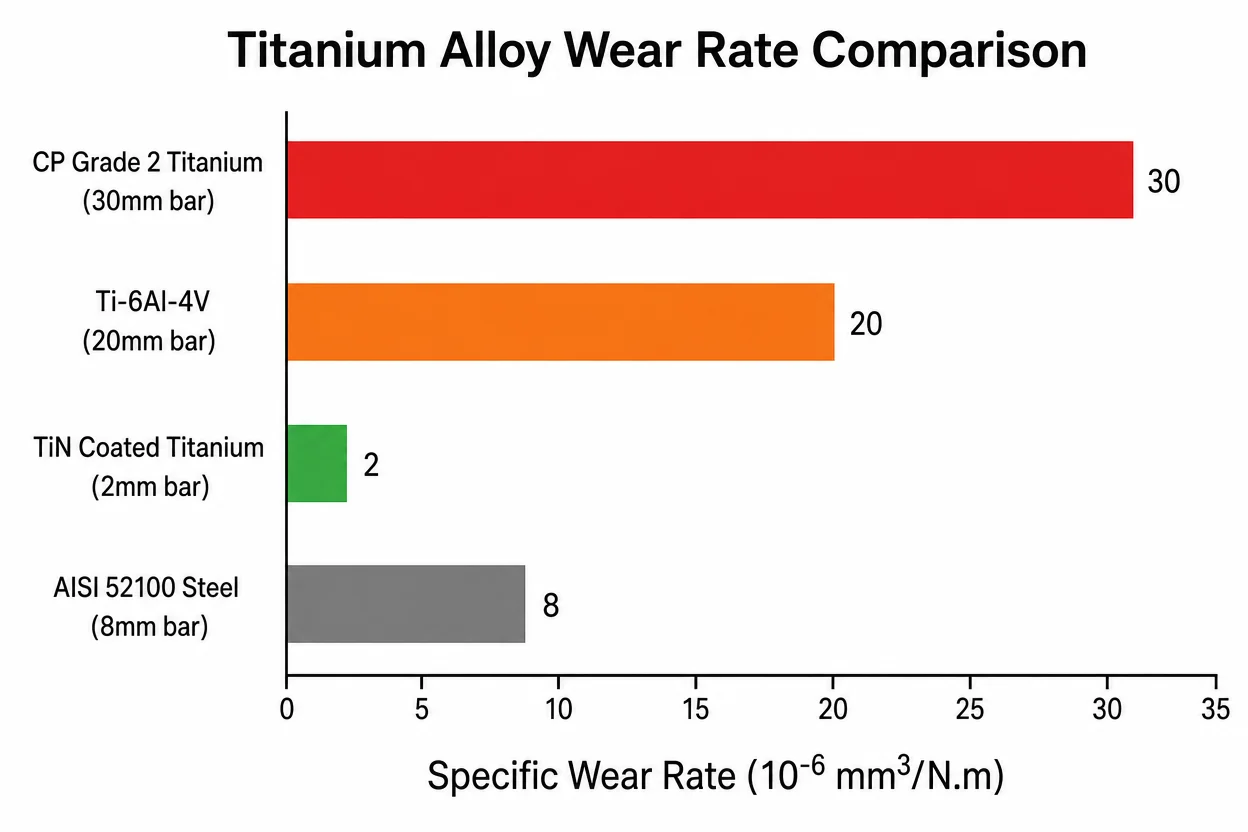
Published pin-on-disk wear rates for Ti-6Al-4V under various conditions, drawn from peer-reviewed studies.
Untreated Ti-6Al-4V
| Test Condition | Specific Wear Rate (mm³/N·m) | Source |
|---|---|---|
| Dry sliding, alumina counterface, 10N, 0.5 m/s | > 10⁻³ | Taylor & Francis (2024) review |
| Dry sliding, steel counterface, 10N, 0.3 m/s | ~10⁻³ to 10⁻⁴ | Expanite ASTM G133 data |
| Dry sliding, UHMWPE counterface, 2,250N | 2.26 × 10⁻⁷ (polymer wear, not Ti wear) | ScienceDirect (2025) |
Interpretation: At > 10⁻³ mm³/N·m, untreated Ti-6Al-4V in dry sliding against hard counterfaces is firmly in the severe wear regime. At this rate, a component with 0.1 mm³ of sacrificial material would lose that volume within approximately 100 m of sliding under 10N load — far too fast for most engineering applications.
Surface-Treated Ti-6Al-4V
| Treatment | Specific Wear Rate (mm³/N·m) | Improvement Factor | Source |
|---|---|---|---|
| Plasma nitrided | ~10⁻⁶ | ~1,000× | Titanium Association WCTP |
| Laser nitrided | < 10⁻⁷ | > 10,000× | ResearchGate (fretting study) |
| ExpaniteHard-Ti30 (nitrogen diffusion) | 2.7 × 10⁻⁶ | 370× | Expanite ASTM G133 |
| TiN PVD coated | ~10⁻⁶ | ~1,000× | Multiple studies |
| Thermal oxidation (700°C) | ~10⁻⁶ to 10⁻⁵ | 100–1,000× | MDPI Coatings (2024) |
The critical insight: Every effective surface treatment reduces titanium’s wear rate by at least two orders of magnitude — from > 10⁻³ (severe) to ~10⁻⁶ (mild). The difference between untreated and plasma-nitrided Ti-6Al-4V is not incremental — it is the difference between a component that fails in weeks and one that lasts decades.
Comparative Wear Rates: Titanium vs. Other Alloys
| Material | Specific Wear Rate (mm³/N·m) | Notes |
|---|---|---|
| Ti-6Al-4V (untreated) | > 10⁻³ | Severe wear |
| Ti-6Al-4V (plasma nitrided) | ~10⁻⁶ | Mild wear |
| Inconel 718 (cast) | ~10⁻³ | Also severe in dry sliding |
| Inconel 718 (L-PBF) | 2.7 × 10⁻⁴ | Improved with additive microstructure |
| Hardened D2 tool steel | 10⁻⁵ to 10⁻⁶ | Baseline for wear-resistant applications |
| Hardened 440C stainless | ~10⁻⁵ | Good galling resistance |
Sources: ResearchGate, SAGE Journals (2025), MatWeb
Titanium vs. Steel vs. Inconel: Wear Performance Compared
The right choice between titanium, stainless steel, and nickel superalloys depends on which failure mode is most likely in your application.
Head-to-Head Property Comparison
| Property | Ti-6Al-4V | 304 SS | 316L SS | Inconel 718 | D2 Tool Steel |
|---|---|---|---|---|---|
| Density (g/cm³) | 4.43 | 8.00 | 7.99 | 8.19 | 7.70 |
| Vickers Hardness (HV) | 349 | ~130 | ~130 | 360–450 (aged) | 650–800 |
| Specific Strength (MPa·cm³/g) | 214 | 64 | 69 | 107 | — |
| Thermal Conductivity (W/m·K) | 6.7 | 16.2 | 13.4 | 11.4 | 20.0 |
| Dry Sliding Wear Rate | > 10⁻³ | ~10⁻⁴ | ~10⁻⁴ | ~10⁻³ | 10⁻⁵ to 10⁻⁶ |
| Galling Resistance (self-mated) | Poor (20–50 MPa) | Poor (20–30 MPa) | Poor (20–30 MPa) | Moderate | Good (200+ MPa) |
| Corrosion Resistance | Excellent | Good | Excellent | Good | Poor |
| Salt Spray (ASTM B117) | > 5,000 hrs | 200–500 hrs | 1,000+ hrs | 500+ hrs | < 50 hrs |
| Relative Cost (per kg) | $15–30 | $2–5 | $3–7 | $25–60 | $5–10 |
Sources: MatWeb ASM, published ASTM B117 data, industry pricing (2025)
When to Choose Titanium Despite Its Wear Weakness
Despite poor wear resistance, titanium is the correct choice when:
- Weight is the primary constraint — aerospace airframes, racing components, portable medical devices. Ti-6Al-4V’s specific strength (214 MPa·cm³/g) is 3× that of 304 SS (64 MPa·cm³/g). Even with surface treatment costs, the weight savings can justify the premium.
- Corrosion is the dominant failure mode — marine hardware, chemical processing equipment, body-contacting implants. Titanium’s passive oxide layer provides > 5,000 hours in salt spray — far beyond what any steel can achieve.
- Fatigue life is critical — Ti-6Al-4V has an unnotched fatigue strength of 510 MPa at 10⁷ cycles (MatWeb), compared to ~240 MPa for 304 SS. For cyclically loaded components where corrosion-fatigue is a concern, titanium wins decisively.
When Steel or Inconel Is the Better Choice
- Pure sliding wear with no corrosion — hardened D2 or M2 tool steel at 650–800 HV will outperform untreated titanium by 100–1,000× in abrasive and adhesive wear.
- High-temperature wear above 500°C — Inconel 718 retains strength at temperatures where titanium alloys begin to lose mechanical properties.
- Budget is the primary constraint — stainless steel at $2–7/kg is 3–10× cheaper per unit mass than titanium at $15–30/kg, and the surface treatment costs to make titanium wear-resistant add further to the total.
The decision framework is not “which material is best” — it is “which failure mode is most likely in my application, and which material best addresses that mode.”
8 Surface Treatments to Transform Titanium Wear Resistance
Every effective surface treatment for titanium creates a hard, chemically distinct barrier layer that prevents direct metallic contact. The eight methods below range from commercially mature (TiN PVD, plasma nitriding) to emerging (large-span heterostructured coatings).
Master Comparison Table
| Treatment | Surface Hardness | Wear Rate After Treatment | Case Depth | Max Service Temp | Relative Cost | Best For |
|---|---|---|---|---|---|---|
| TiN PVD | 2,000–2,400 HV | ~10⁻⁶ mm³/N·m | 2–4 μm | 550°C | $$ | Cutting tools, fasteners, general wear |
| TiAlN PVD | 2,800–3,300 HV | ~10⁻⁶ mm³/N·m | 2–4 μm | 800°C | $$ | High-temperature tooling, engine components |
| AlTiN PVD | 4,000–4,500 HV | ~10⁻⁷ mm³/N·m | 2–4 μm | 800°C+ | $$$ | Extreme abrasive environments |
| TiCN PVD | 3,000 HV | ~10⁻⁶ mm³/N·m | 2–4 μm | 400°C | $$ | General-purpose hard coating |
| Plasma Nitriding | 600–1,200 HV | ~10⁻⁶ mm³/N·m | 20–110 μm | 600°C | $$ | Thick case, heavy loads, biomedical |
| DLC (Diamond-Like Carbon) | 1,500–8,000 HV | ~10⁻⁶ to 10⁻⁷ mm³/N·m | 1–5 μm | 350°C (a-C:H) | $$$ | Low friction, medical implants |
| Thermal Oxidation | 500–1,135 HV | ~10⁻⁶ mm³/N·m | 1–5 μm | 600°C | $ | Corrosion + mild wear, cost-sensitive |
| MAO/PEO | 600–1,200+ HV | 50–90% wear reduction | 10–100 μm | 800°C+ | $$ | Corrosion + wear, bioactive surfaces |
Sources: Wikipedia (TiN), Hannibal Carbide (TiAlN, AlTiN, TiCN), Encyclopedia.pub (plasma nitriding), Oerlikon Balzers (DLC), MDPI Coatings (thermal oxidation), Keronite (MAO/PEO)
TiN (Titanium Nitride) PVD Coating
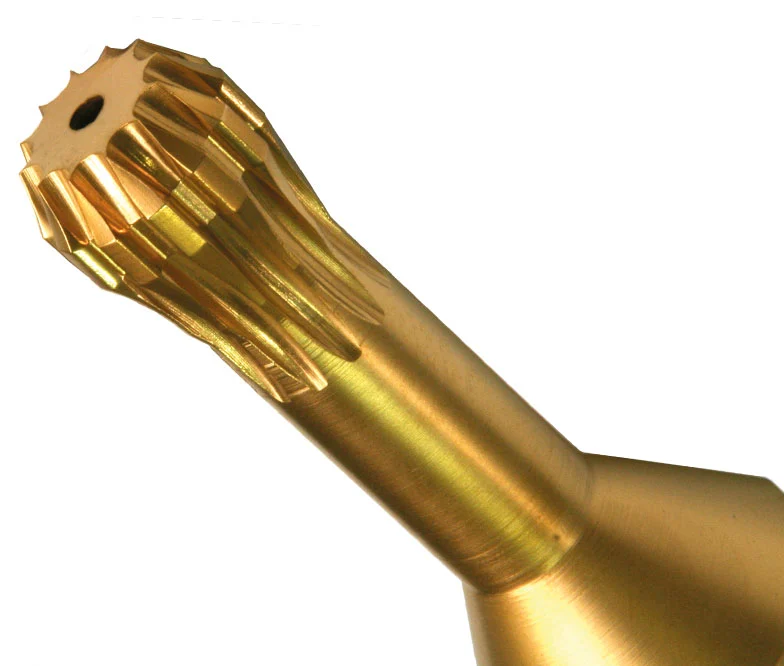
TiN is the most widely used PVD coating for titanium — the familiar gold-colored surface on cutting tools, drill bits, and medical instruments. It creates a hard (2,000–2,400 HV), low-friction ceramic layer via physical vapor deposition at temperatures of 200–500°C.
Strengths: High adhesion to titanium substrates, excellent abrasive wear resistance, well-understood and widely available, minimal dimensional change (2–4 μm thickness).
Limitations: Oxidation temperature of 550°C limits high-temperature applications. The thin coating can be worn through under very high loads, exposing the soft substrate beneath. Friction coefficient of 0.65 is moderate — not as low as DLC.
Typical applications: Titanium cutting tools, orthopedic instrument surfaces, bolt coatings, valve seats.
TiAlN and AlTiN PVD Coatings
TiAlN (2,800–3,300 HV) and AlTiN (4,000–4,500 HV) are advanced nitride coatings designed for higher temperature applications. AlTiN forms a self-healing aluminum oxide (Al₂O₃) layer on the surface during high-temperature operation, which continuously regenerates as the surface wears — a significant advantage for components exposed to sustained heat.
Key difference from TiN: AlTiN’s oxidation temperature is 800°C versus TiN’s 550°C, making it suitable for engine components, hot forming tools, and aerospace applications where surface temperatures routinely exceed 600°C.
Plasma Nitriding
Plasma nitriding introduces nitrogen into the titanium surface at 700–900°C in a nitrogen/ammonia atmosphere, creating a multi-layer structure:
- TiN compound layer (outermost): 1,800–2,100 HV, very thin (~1–5 μm)
- Ti₂N layer: ~1,000 HV, thicker than the TiN layer
- Diffusion zone (alpha-case): 750–900 HV, 60–110 μm deep
The total hardened case depth of 60–110 μm is a major advantage over PVD coatings (2–4 μm). Under high-contact-pressure applications — bearing surfaces, gear teeth, heavy-duty fasteners — the deep case prevents the “eggshell effect” where a thin hard coating collapses under a soft substrate.
Published data: Plasma-nitrided Ti-6Al-4V achieved surface hardness exceeding 750 HV (Vickers microhardness, HV0.05) after 800°C treatment for 24 hours, with core hardness remaining at 300–320 HV (IOP Science). In ASTM G99 pin-on-disk testing, plasma-nitrided specimens showed wear rates of ~10⁻⁶ mm³/N·m — a 1,000× improvement over untreated material.
Fatigue consideration: Nitriding introduces compressive residual stresses that can improve fatigue life, unlike some coating processes that introduce tensile stresses. Shot peening after nitriding can further restore any fatigue properties lost during thermal processing.
Diamond-Like Carbon (DLC)
DLC coatings offer the lowest friction coefficient of any titanium surface treatment — as low as 0.05–0.15, compared to 0.5–0.7 for untreated titanium. This self-lubricating property makes DLC uniquely valuable for applications where external lubrication is impractical (vacuum environments, inside sealed medical devices, food processing equipment).
Two main forms:
- a-C:H (hydrogenated amorphous carbon): 15–30 GPa hardness (1,500–3,000 HV), applied via PACVD at 200–300°C. Good for moderate loads.
- ta-C (tetrahedral amorphous carbon): 50–80 GPa hardness (5,000–8,000 HV), applied via filtered cathodic arc. Best for extreme wear resistance but higher internal stress limits thickness.
Medical implant advantage: DLC is biocompatible and reduces UHMWPE (ultra-high-molecular-weight polyethylene) counterface wear by up to 14× in hip joint simulator testing — making it the leading surface treatment for articulating titanium implant surfaces.
Thermal Oxidation
Thermal oxidation is the most cost-effective surface treatment for titanium. Parts are simply heated in air at 600–750°C for several hours, growing a thick, hard TiO₂ (rutile phase) layer on the surface.
Results by temperature:
- 600°C: 500–700 HV surface, moderate wear improvement
- 700°C: 800–1,000 HV surface, 92.6% wear reduction (MDPI Coatings, 2024)
- 750°C: 1,060–1,135 HV surface, 5× hardness increase over baseline (ScienceDirect, 2021)
Trade-off: The oxide layer is brittle and can crack under high-impact loads. Thermal oxidation works best for applications with steady sliding contact and moderate loads — not for impact or high-cycle fatigue.
Micro-Arc Oxidation (MAO) / Plasma Electrolytic Oxidation (PEO)
MAO/PEO creates thick (10–100 μm), ceramic-grade TiO₂ coatings by applying high voltage in an electrolyte bath, causing micro-discharges that grow a hard, dense oxide layer. The resulting surface hardness (600–1,200+ HV) is higher than conventional anodizing, and the thick case depth provides good load-bearing support.
Unique advantage: MAO surfaces can be impregnated with PTFE, graphite, or other solid lubricants in the coating pores, creating a composite surface with both high hardness and low friction (800–1,500 HV effective hardness). This makes MAO one of the few treatments that addresses both abrasive and adhesive wear simultaneously.
Industry Applications: Wear Solutions in Aerospace, Medical, and Automotive
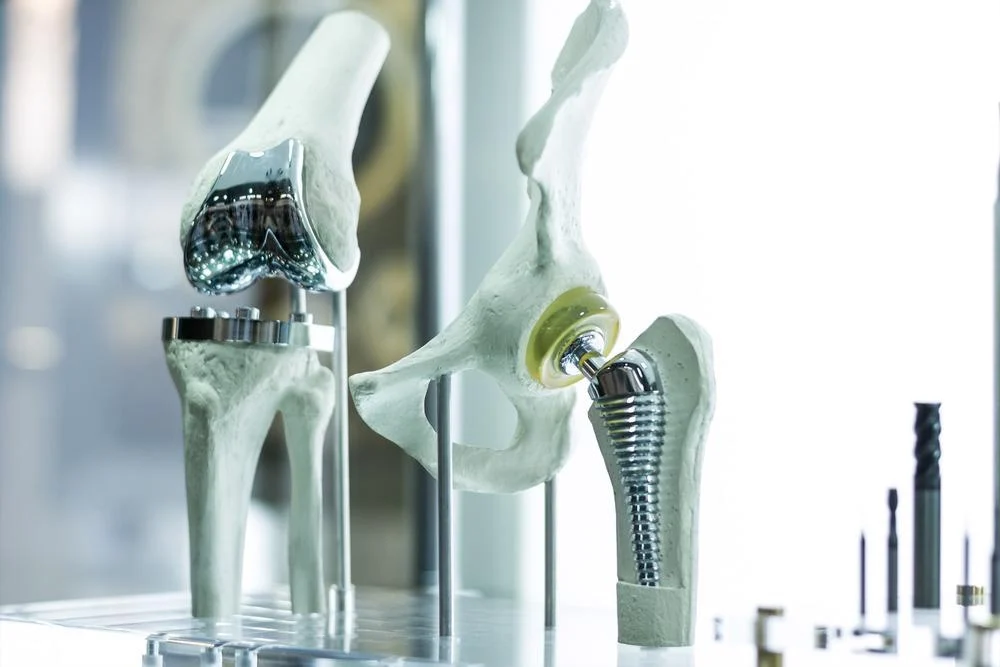
The “right” surface treatment depends heavily on the operating environment. Here is how three major industries approach titanium wear challenges — and the standards that govern their material decisions.
Aerospace
Primary wear challenges: Fretting wear at fastener joints, erosion in compressor blade leading edges, sliding wear in landing gear bushings, and fretting fatigue in structural joints.
Typical approach:
- Ti-6Al-4V structural components receive shot peening (compressive residual stress) to improve fretting fatigue life
- Fasteners and bearing surfaces receive TiN or TiAlN PVD coatings for wear protection
- Compressor blade tips may receive chromium nitride (CrN) or platinum-aluminide coatings for erosion resistance
Key standards: AMS 4928 (titanium rod/bar), AMS 4967 (titanium forging stock), ASTM F136 (Ti-6Al-4V ELI for aerospace/medical), NASM 1312-8 (fatigue testing)
Design insight: In aerospace, wear is rarely the primary design driver — weight savings and fatigue life usually dominate. Surface treatments are applied surgically to specific wear zones (bolt holes, pivot points, sliding interfaces) rather than coating entire structures.
Medical Implants
Primary wear challenges: Articulating surfaces in joint replacements (hip, knee), bone screw and plate fretting, and dental implant osseointegration surface requirements.
Typical approach:
- Ti-6Al-4V ELI (Grade 23, extra-low interstitial) per ASTM F136 for implant bodies
- UHMWPE or ceramic counterfaces articulating against titanium — not titanium against titanium
- DLC or TiN coatings on articulating titanium surfaces to reduce UHMWPE wear debris
- MAO/PEO coatings on non-articulating surfaces to promote bone integration (bioactive surface roughness)
Key standards: ASTM F136 (material), ASTM F732 (wear testing of polymeric components), ISO 5832-3 (titanium alloy for implants), ISO 6474 (ceramic counterfaces)
Critical design rule: Titanium is never used as a self-mated articulating surface in joint replacements — the wear debris (particles < 10 μm) triggers an inflammatory immune response that leads to osteolysis (bone loss) and implant loosening. The counterface must be a different material (UHMWPE, ceramic, or CoCrMo alloy).
Automotive and Motorsport
Primary wear challenges: Valve train contact (cam-follower, valve-guide), exhaust valve seat wear, suspension component fretting, and turbocharger shaft bearing wear.
Typical approach:
- Titanium intake and exhaust valves — weight reduction of 30–40% per valve enables higher RPM, reduced valve spring tension, and improved throttle response. Surface nitriding or PVD coating is applied to the valve stem and tip.
- Corvette Z06 example: titanium exhaust components saved up to 17 kg (35 lbs) versus the factory stainless steel system — significant in a vehicle where every gram matters.
- Racing suspension springs: titanium springs at 1.36 kg versus 4.12 kg for equivalent steel springs — 67% weight reduction.
Key consideration: Automotive titanium applications accept higher component costs because the weight savings translate directly into performance (lap times, fuel efficiency). In mass-market automotive, titanium is limited to high-performance variants; stainless steel or aluminum dominates cost-sensitive applications.
Practical Selection Framework
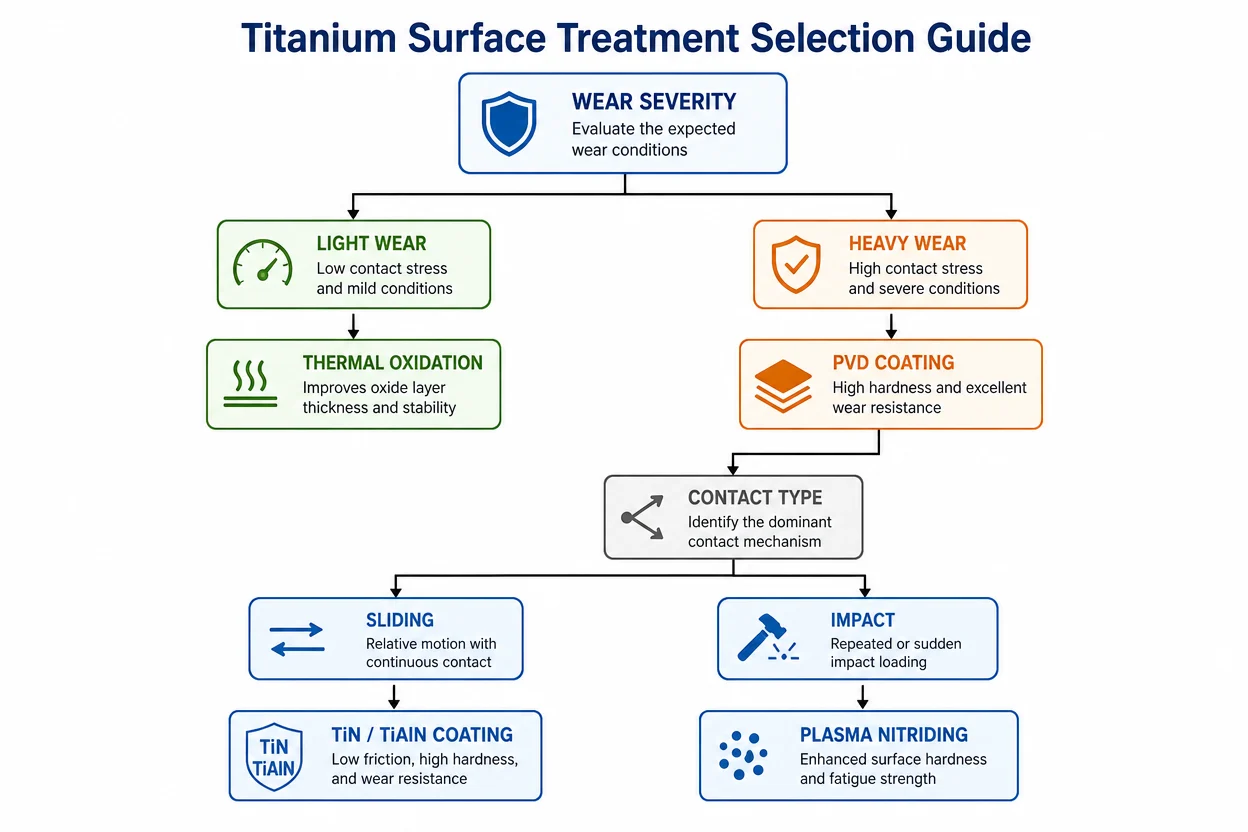
Use this decision matrix to narrow down the right titanium grade and surface treatment for your application. Start with your primary failure mode, then narrow by operating conditions.
| Primary Failure Mode | Recommended Grade | Recommended Surface Treatment | Key Standard |
|---|---|---|---|
| Abrasive wear (particle contact) | Ti-6Al-4V | TiN or AlTiN PVD | ASTM G99 |
| Adhesive wear (sliding contact) | Ti-6Al-4V | Plasma nitriding or DLC | ASTM G98, G99 |
| Fretting (oscillating contact) | Ti-6Al-4V ELI | Shot peening + TiN | ASTM F136 |
| Corrosion-wear (marine/chemical) | CP Grade 2 or Ti-6Al-4V | MAO/PEO or thermal oxidation | ASTM B117 |
| Impact + wear | Ti-6Al-4V STA | Plasma nitriding (deep case) | ASTM G99 |
| High-temp wear (>600°C) | Ti-6Al-4V or Ti-5553 | AlTiN PVD or CrN | AMS standards |
| Low-friction requirement | Ti-6Al-4V | DLC (ta-C) | ASTM F732 (medical) |
| Biomedical articulating | Ti-6Al-4V ELI | DLC or TiN (counterface: UHMWPE/ceramic) | ASTM F136, F732 |
A final note on testing: Never rely solely on published wear rate data from literature. Test conditions (load, speed, counterface, humidity, temperature) vary widely between studies, and wear rates can differ by an order of magnitude based on these parameters. Always conduct application-specific wear testing per ASTM G99 or G133 using your actual operating conditions — or request test data from your material supplier under conditions that match your application.
Frequently Asked Questions
Does titanium have good wear resistance?
No — commercially pure titanium and even Ti-6Al-4V (Grade 5) have poor wear resistance in dry sliding conditions. Ti-6Al-4V at 349 HV exhibits specific wear rates above 10⁻³ mm³/N·m in pin-on-disk testing, placing it firmly in the severe wear regime. Titanium’s wear resistance can be improved dramatically (100–10,000×) through surface treatments such as plasma nitriding, TiN PVD coating, or DLC coating.
Why is titanium not wear resistant if it is so strong?
Titanium’s high specific strength (strength divided by density) is unrelated to its wear resistance. Wear resistance depends primarily on surface hardness, thermal conductivity, and the tendency for adhesive bonding — all areas where titanium performs poorly. Ti-6Al-4V has a thermal conductivity of only 6.7 W/m·K (less than half of stainless steel), which traps heat at sliding contact surfaces, accelerates adhesive wear, and promotes galling.
What is the hardness of titanium in HV?
Commercially pure Grade 1 titanium has a Vickers hardness of approximately 122 HV. Grade 2 is ~145 HV, Grade 4 is 280 HV, and Ti-6Al-4V (Grade 5) is 349 HV in the annealed condition. For comparison, hardened tool steel ranges from 650–800 HV, and TiN PVD coatings reach 2,000–2,400 HV.
How is titanium wear tested?
Titanium wear is tested using ASTM G99 (pin-on-disk), ASTM G133 (reciprocating ball-on-flat), or ASTM G76 (solid particle erosion). The standard output is specific wear rate (mm³/N·m) and coefficient of friction. ASTM G98 tests galling resistance (critical contact pressure before material transfer), and ASTM B117 evaluates corrosion behavior in salt spray environments. Application-specific testing under actual operating conditions is always recommended over relying on published literature values.
What is the best surface treatment for titanium wear resistance?
The best treatment depends on your application: TiN PVD (2,000–2,400 HV) is the most widely used for general-purpose wear protection. Plasma nitriding provides the deepest hardened case (60–110 μm) for heavy-load applications. DLC coating offers the lowest friction coefficient (0.05–0.15) for unlubricated sliding. Thermal oxidation is the most cost-effective option at 800–1,135 HV. For extreme hardness, AlTiN PVD reaches 4,000–4,500 HV.
Is titanium harder than stainless steel?
Ti-6Al-4V (349 HV) is harder than annealed 304 stainless steel (~130 HV) and 316L (~130 HV), but it is significantly softer than hardened martensitic stainless steels like 440C (58–62 HRC, ~650–800 HV). Despite Ti-6Al-4V’s higher hardness versus austenitic stainless steels, it exhibits worse adhesive wear resistance because it does not work-harden during sliding, whereas stainless steel does.
How much does titanium surface treatment cost?
Cost varies significantly by method: thermal oxidation (low-cost, simple furnace operation) is the cheapest. Plasma nitriding and TiN PVD are mid-range. DLC coating and AlTiN PVD are premium. For a typical batch of small titanium components (fasteners, medical device parts), expect surface treatment to add 10-40% to raw material cost, depending on the method and batch size. The investment is justified when the untreated titanium would otherwise fail prematurely in service.
Can titanium be used for bearing surfaces?
Not without surface treatment. Untreated Ti-6Al-4V galls at contact pressures as low as 20–50 MPa (ASTM G98 data), making it unsuitable for unlubricated bearing applications. Plasma-nitrided or DLC-coated titanium can serve as effective bearing surfaces, and in medical implants, titanium is always paired with a dissimilar counterface (UHMWPE, ceramic, or CoCrMo) to prevent adhesive wear and osteolysis from titanium wear debris.
Conclusion
Titanium’s reputation as a “superior” material is well earned for strength-to-weight ratio and corrosion resistance — but it does not extend to wear resistance. Untreated Ti-6Al-4V at 349 HV with a thermal conductivity of 6.7 W/m·K and a native oxide layer only 1.5–10 nm thick is fundamentally limited in any sliding, fretting, or abrasive application.
The engineering data is clear: untreated titanium exhibits specific wear rates above 10⁻³ mm³/N·m in pin-on-disk testing, placing it in the severe wear regime alongside cast Inconel 718 and far behind hardened tool steel. The galling threshold of 20–50 MPa for self-mated Ti-6Al-4V means that any unlubricated sliding contact requires either surface treatment or dissimilar material pairing.
But the data also shows that the problem is solvable. Plasma nitriding, TiN PVD, DLC coating, and thermal oxidation each reduce wear rates by two to four orders of magnitude — from component failure in weeks to service life measured in decades. The key is matching the surface treatment to the specific operating conditions: TiN for general-purpose abrasive protection, plasma nitriding for deep-case heavy loads, DLC for low-friction unlubricated applications, and thermal oxidation for cost-effective mild wear and corrosion combinations.
The most important takeaway for engineers is this: do not select titanium based on property tables alone. The properties that govern wear resistance — thermal conductivity, elastic modulus, adhesive bond tendency — do not appear in standard material datasheets. Test your specific application conditions per ASTM G99 or G133, and always validate surface treatment performance under your actual operating parameters.