Introduction: The Billion-Dollar Battle Against Saltwater
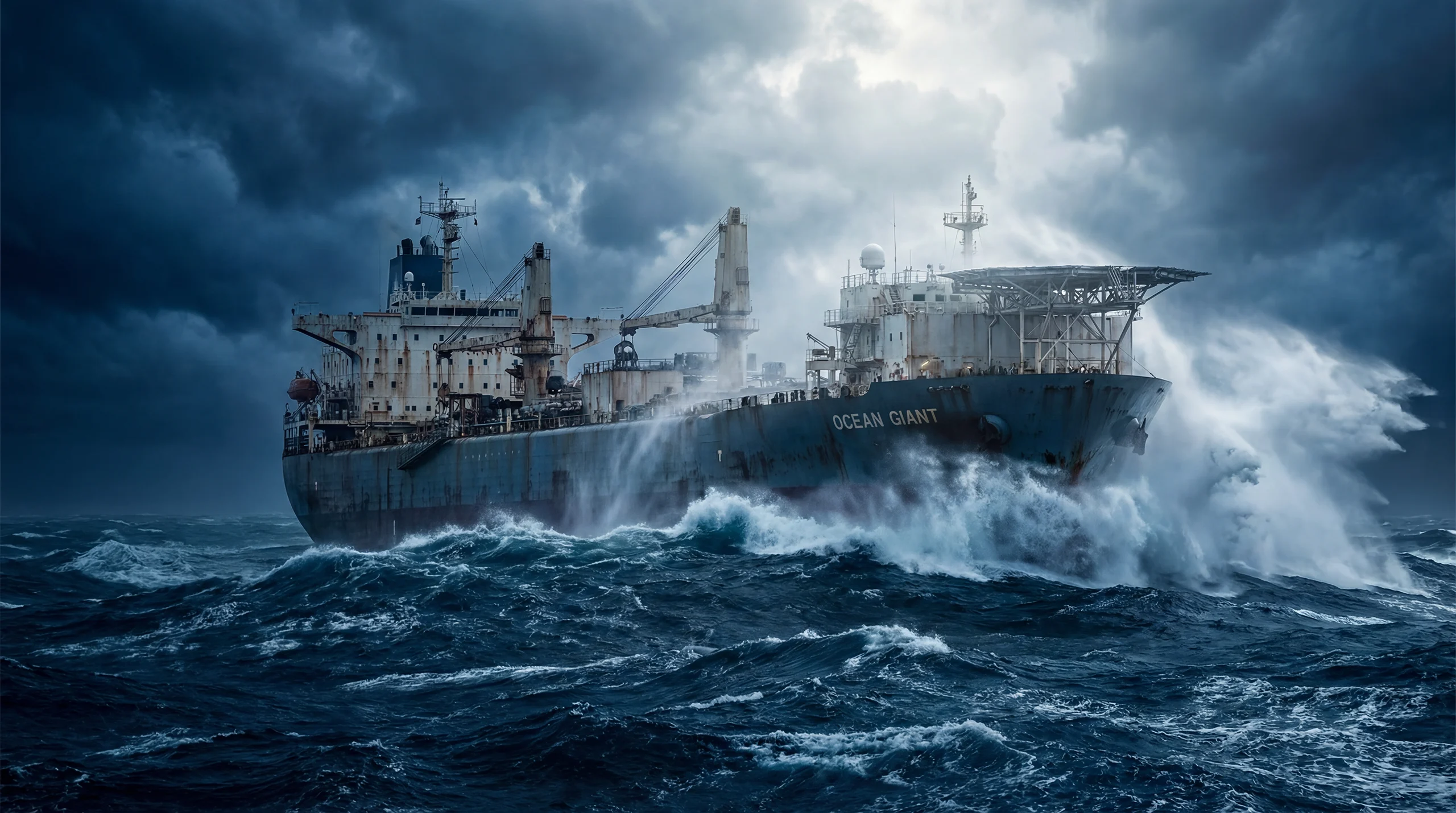
The ocean is unforgiving. For marine engineers, naval architects, and offshore project managers, the battle against saltwater corrosion is constant, costly, and exhausting.
In the harsh marine environment, traditional materials face an uphill struggle. Carbon steel corrodes rapidly without heavy protection. Aluminum pits. Even 316 stainless steel, often considered the “standard” for mild environments, falls victim to crevice corrosion and pitting when exposed to stagnant seawater or elevated temperatures.
The cost of this failure is not just in material replacement—it lies in downtime, maintenance labor, and catastrophic equipment failure.
Enter Marine Grade Titanium.
Often called the “Ocean Metal,” titanium is not merely an alternative; it is a paradigm shift in ocean engineering. Whether for heat exchangers in desalination plants, propeller shafts on high-speed vessels, or deep-sea submersibles, titanium offers a unique combination of virtual immunity to corrosion in ambient seawater and high specific strength.
But is the higher upfront cost justified? In this technical guide, we analyze the properties of titanium and explain why, for long-term marine applications, it is the most economically efficient choice on the market.
The Science: Why Titanium is “Virtually Immune” to the Ocean
To understand why titanium outperforms other saltwater resistant metals, we must look at its surface chemistry.
1. The Self-Healing Oxide Film (The “Shield”)
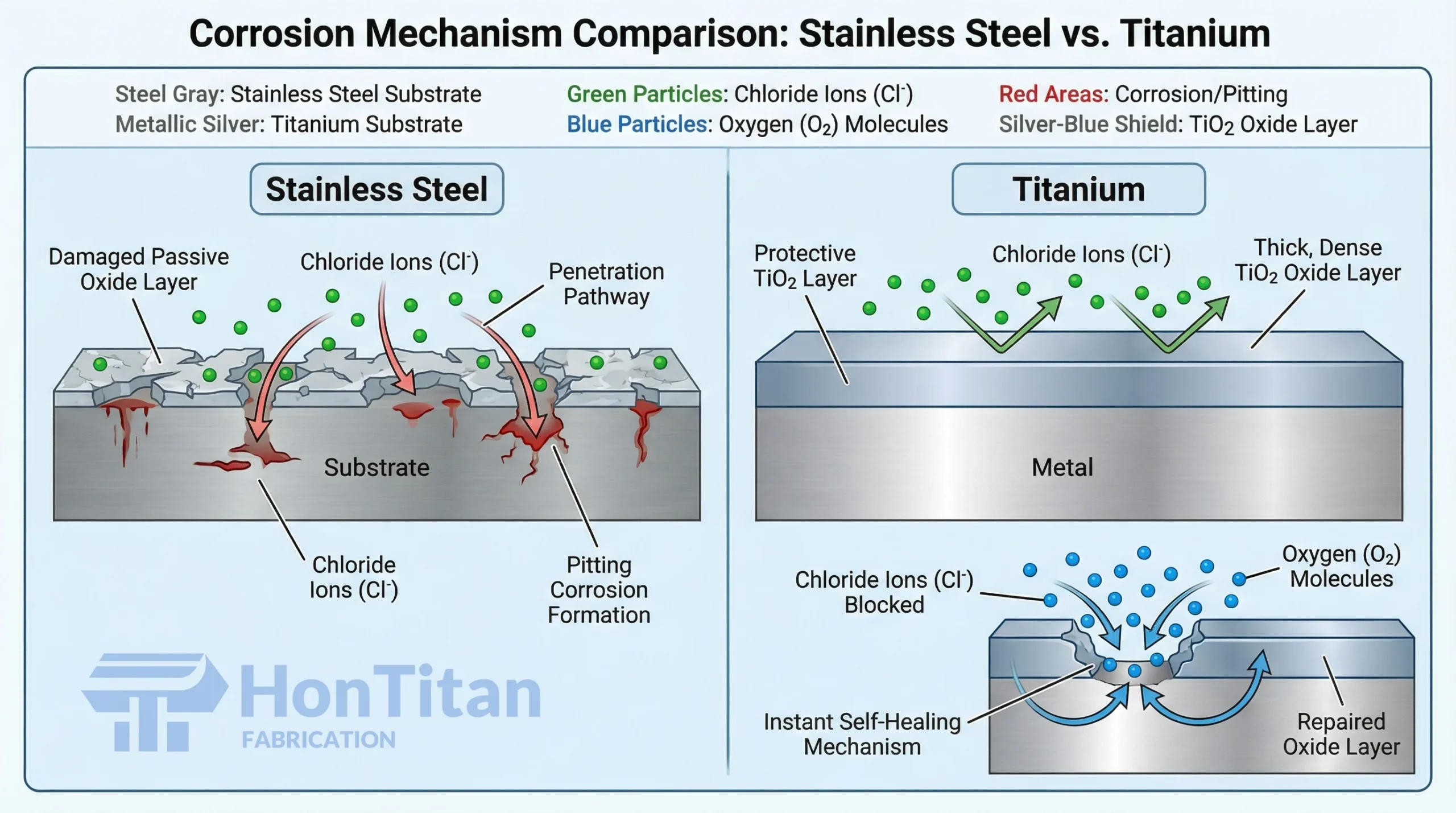
The secret lies in its affinity for oxygen. The moment titanium is exposed to air or water, it forms a thin (approx. 10nm), dense, and highly stable passive oxide film (primarily Titanium Dioxide, TiO2).
Unlike the passive layer on stainless steel, which can break down in low-oxygen environments, titanium’s oxide film exhibits three critical properties:
- Instantaneous Formation: It forms in nanoseconds upon exposure to oxygen.
- Self-Healing: If the surface is scratched or damaged by debris, the film instantly reforms as long as there is a trace of oxygen or water present (even in ppm levels).
- Impermeable Barrier: It physically prevents corrosive chloride ions from reaching the underlying metal.
Technical Note: This stability allows for a “Zero Corrosion Allowance” in design calculations (ASME VIII Div 1), meaning the wall thickness is determined solely by mechanical pressure requirements, not corrosion anticipation.
2. Chemical Stability & PREN Context
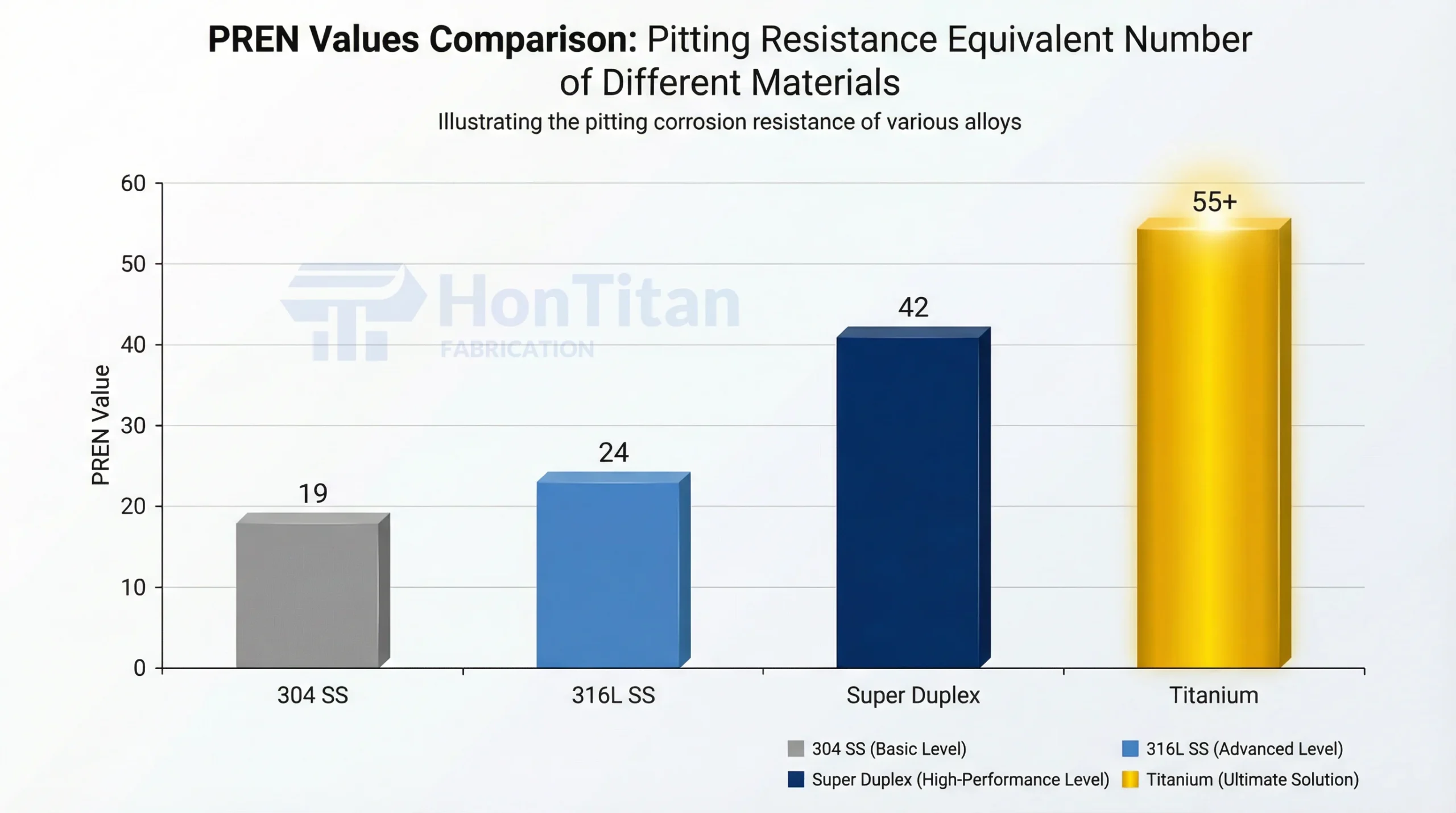
Seawater is rich in chlorides, the enemy of most metals. Stainless Steel is particularly susceptible to pitting in these environments, and its resistance is often measured by the Pitting Resistance Equivalent Number (PREN = %Cr + 3.3%Mo + 16%N).
While PREN is a formula designed specifically for stainless steels, titanium operates on a different level:
- Stainless Steel: Susceptible to pitting breakdown at specific potentials.
- Titanium: If we were to assign an equivalent performance metric based on critical pitting temperature (CPT) tests, it would score > 50. It remains fully passive in ambient seawater and is resistant to pitting up to significantly higher voltages than stainless steel.
3. Resistance to Microbial Induced Corrosion (MIC)
Titanium is resistant to the corrosive by-products (sulfides, acids) of marine bacteria and algae. While biofouling (marine growth) can still occur on the surface, it will not corrode the metal underneath, allowing for aggressive cleaning methods without damaging the equipment.
Titanium vs. The Alternatives: A Technical Comparison
While many metals claim to be “marine grade,” the data tells a different story. When comparing Titanium vs. Stainless Steel 316L and Copper-Nickel (Cu-Ni), the differences in performance are stark.
The Comparison Data Matrix
| Feature | Titanium (Grade 2) | Stainless Steel (316L) | Copper-Nickel (90/10) |
|---|---|---|---|
| Seawater Corrosion Rate | Negligible (<0.002 mm/yr) | Low (Subject to Pitting) | Moderate (0.02 – 0.1 mm/yr) |
| Critical Flow Velocity | > 30 m/s (Limited by Cavitation) | High (> 15 m/s)* | Limited (~ 3.5 m/s) |
| Density (g/cm³) | 4.51 (Lightweight) | 8.00 | 8.90 |
| Yield Strength (MPa) | 275 – 450+ | ~ 170 – 310 | ~ 100 – 150 |
| Equivalent PREN | > 50 (Performance Equiv) | ~ 24 | N/A |
*Note: While 316L handles high velocity well, it is critically limited by low velocity (<1 m/s) where pitting occurs due to oxygen depletion.
Titanium vs. Stainless Steel 316L: The “Pitting” Problem
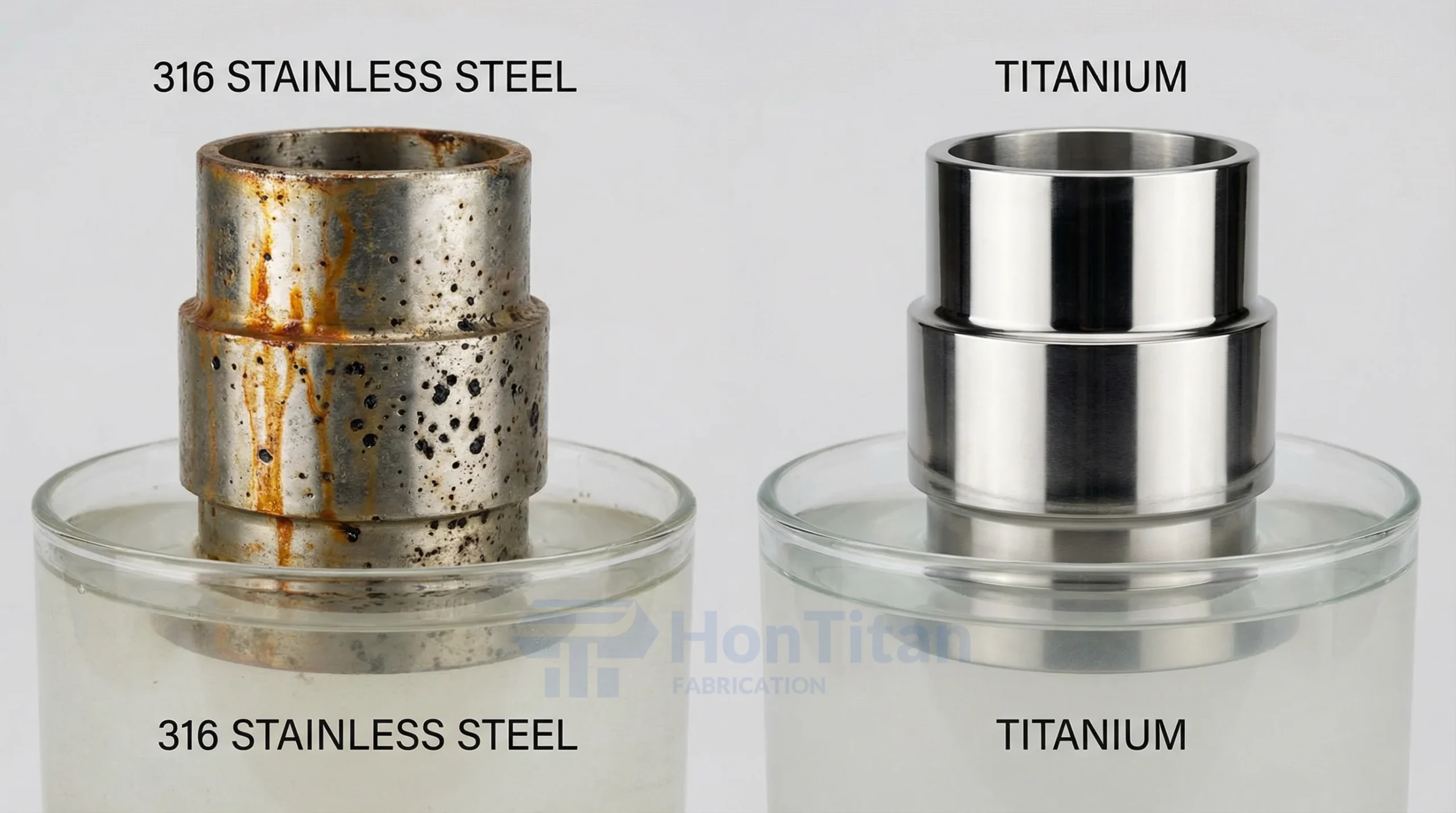
Stainless Steel 316L is standard for general use, but it has a fatal flaw: Crevice Corrosion.
- The Mechanism: In stagnant water (like under gaskets, bolt heads, or marine deposits), the oxygen supply is depleted. Without oxygen, stainless steel cannot repair its passive layer, leading to rapid localized pitting.
- The Titanium Advantage: Titanium does not rely on high oxygen levels to maintain passivity. It is essentially immune to crevice corrosion in seawater at temperatures up to 80°C (175°F) for Grade 2. For applications above this temperature or at very low pH, modified grades like Grade 7 (Ti-Pd) or Grade 12 (Ti-Ni-Mo) provide extended protection.
Titanium vs. Copper-Nickel: The Erosion Factor
Copper-Nickel alloys are traditionally used for piping due to anti-fouling properties, but they are soft and vulnerable to Erosion-Corrosion.
- The Limit: If water flows too fast (typically >3.5 m/s) or carries sand/silt, it physically scrubs away the copper’s protective layer through impingement attack.
- The Titanium Advantage: Titanium solves this limitation with an extremely hard and adherent oxide film. It can withstand velocities exceeding 30 m/s without erosion-corrosion. In practice, the flow limit for titanium systems is usually dictated by cavitation (pressure drops) rather than corrosion concerns, allowing engineers to design high-speed, compact pumping systems.
Empirical Evidence: A Case Study in Longevity
To move beyond theory, we look at historical performance in the North Sea oil fields.
Case Study: North Sea Fire Water Systems
In the 1980s and 90s, many offshore platforms utilized Copper-Nickel or Carbon Steel for fire water ring mains. However, high-velocity tests and stagnant waiting periods caused severe pitting and erosion-corrosion, leading to leaks and safety hazards.
As operators began retrofitting with Titanium Grade 2, the results were transformative. A study by the Norwegian Petroleum Directorate noted that titanium systems installed in these environments showed zero corrosion-related failures after 20+ years of service. Despite the higher material cost, the elimination of coating maintenance and pipe replacement resulted in significant CAPEX/OPEX savings over the asset’s life.
The Economics: High Initial Cost vs. Zero Maintenance
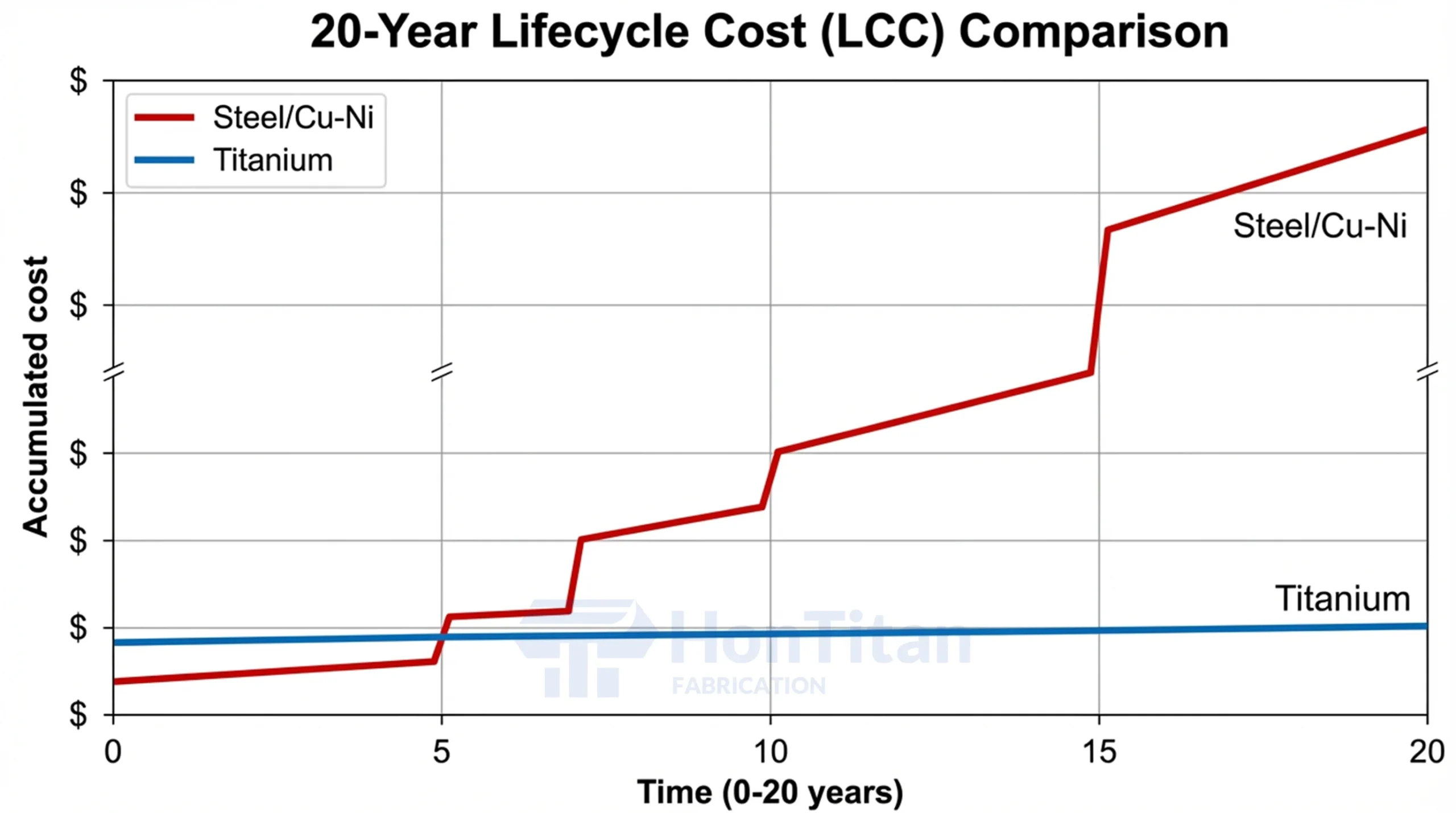
The most common objection to titanium is price. “It’s too expensive.” While the upfront cost per kilogram is higher than steel or copper, this is a misleading metric for marine projects. To understand the true value, we must look at the Life Cycle Cost (LCC) and the Thin Wall Concept.
The “Thin Wall” Advantage
Because titanium does not require a “Corrosion Allowance,” engineers can specify significantly thinner materials:
- Material Savings: A carbon steel pipe might need to be 3mm thick to survive 10 years, whereas a titanium pipe doing the same job can be 0.7mm thick (per ASME B31.3 allowables). This dramatic reduction in material weight offsets the higher price per kilogram.
- Heat Transfer: Thinner walls compensate for titanium’s lower thermal conductivity compared to copper. This often results in an equal or better overall heat transfer coefficient, especially since titanium does not suffer from the fouling and scaling layers that plague other metals.
The Verdict: For long-term assets like offshore platforms (>20 years), ship hulls, and coastal power plants, titanium is often the lowest cost option when LCC is calculated according to NORSOK M-001 standard guidance.
Engineering & Design: Grade Selection Guide
Not all titanium is created equal. For marine engineers, choosing between the various grades is critical.
Grade 2 (Commercially Pure Titanium) – The “Workhorse”
Grade 2 (ASTM B338 / ASME SB-338) is the industry standard for general corrosion resistance.
- Characteristics: Moderate yield strength (~275 MPa) but excellent formability.
- Best For: Heat exchangers, piping systems, and ballast tanks.
- Why choose it: The most cost-effective solution where corrosion resistance is the priority over structural load.
Grade 5 (Ti-6Al-4V) – The “Muscle”
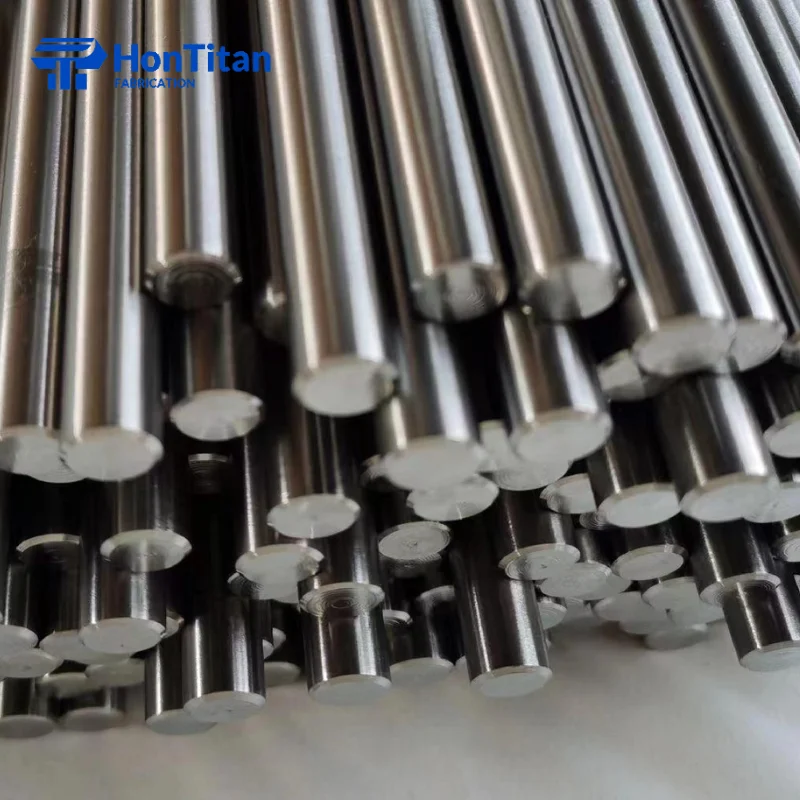
Grade 5 (ASTM B348) is a high-strength alloy containing Aluminum and Vanadium.
- Characteristics: High yield strength (~830 MPa), rivaling high-strength steels. Harder to form/weld than Grade 2.
- Best For: Propeller shafts, fasteners, pump casings, and subsea springs.
- Why choose it: Replaces 17-4 PH stainless steel where weight reduction and fatigue strength in seawater are paramount.
Extended Engineering FAQ
Q1: What about Biofouling? Titanium is biologically inert, meaning marine life will attach to it.
Solution: Titanium is immune to chlorination. Operators can use continuous chlorination or electro-chlorination systems to prevent fouling without risking pipe damage. Its surface hardness also permits mechanical pigging.
Q2: Will it cause Galvanic Corrosion? Since Titanium is cathodic (Noble), connecting it directly to steel or aluminum will accelerate their corrosion.
Solution:
Isolation: Install insulating flange kits (dielectric sleeves/washers).
Coatings: Coat the cathode (Titanium) near the joint to reduce the effective surface area, thereby minimizing the galvanic current density.
Q3: Should I worry about Hydrogen Embrittlement? Titanium can absorb hydrogen if cathodic protection potentials are too negative, leading to brittleness.
Solution: Per DNV-RP-B401 standards, engineers should maintain CP potentials no more negative than -0.80 V (vs Ag/AgCl). This prevents hydriding while still protecting coupled steel structures.
Q4: Is Titanium magnetic? No, titanium is paramagnetic (non-magnetic).
Benefit: Ideal for Mine Countermeasure Vessels (MCMV) and sensitive oceanographic instrumentation housings where magnetic signatures must be minimized.
- References & Industry Standards
- For further technical verification, please refer to:
- ASTM B338: Standard Specification for Seamless and Welded Titanium Tubes for Condensers and Heat Exchangers.
- NORSOK M-001: Materials Selection (Defines Titanium usage in North Sea).
- DNV-RP-B401: Cathodic Protection Design (Guidance on Titanium/Steel coupling).
- Ready to future-proof your marine project? Don’t let material failure be the weak link in your design. Contact our team today to discuss expert advice on material selection, from ASTM B338 tubes to custom Grade 5 forged shafts.