Hello, I’m Wayne.
I am a materials engineering specialist with a strong focus on titanium manufacturing, CNC machining, and advanced metal processing technologies. Over the past decade, I have worked closely with factories, engineers, and global B2B buyers, studying how titanium behaves in real production environments—how it cuts, forms, welds, and performs under demanding conditions.
My experience includes researching and writing about a wide range of titanium products, from custom-machined components to titanium electrodes, titanium fasteners, and industrial-grade titanium materials used across aerospace, medical devices, chemicals, and consumer goods. I strive to present technical information in a clear, practical way—helping engineers, procurement teams, and industry professionals understand the strengths, applications, and performance characteristics of titanium products.
Through every article I publish, my goal is to deliver accurate insights, engineering-based explanations, and real manufacturing knowledge that readers can apply to their projects. Whether you’re exploring titanium grades, comparing machining methods, or sourcing precision titanium parts, my work is here to guide you with clarity and technical depth.
For continued updates, industry analysis, and professional knowledge on titanium materials and advanced machining, feel free to follow my articles here on this website.
Thank you for reading — Wayne.

Titanium’s low thermal conductivity (6.7 W/m·K — roughly 1/8 of steel) traps cutting heat at the tool tip instead of dissipating it into the workpiece. That concentrated heat, combined with titanium’s HCP crystal structure, causes work hardening when feed rate drops too low or the drill dwells. The fix is counterintuitive: keep speeds conservative (50–230 […]
Pure titanium pans are among the safest cookware available — zero PFAS, no coatings to degrade, and biocompatible enough to use in surgical implants. But most pans sold as “titanium” aren’t pure titanium at all. They’re PTFE nonstick coatings with titanium particles mixed in for scratch resistance. Whether those are safe depends entirely on the […]
Titanium cutting boards look impressive and clean up in seconds, but independent BESS sharpness testing shows they dull knives roughly 30 times faster than end-grain walnut — a 444-point loss vs. 15 points. Wood’s bacteria story is also more nuanced than titanium marketing admits: a peer-reviewed 1994 study found wood absorbs and kills bacteria that […]
Titanium water bottles are 40-45% lighter than stainless steel, completely taste-neutral, and highly biocompatible with negligible ion leaching — but they cost 2-4 times more. After testing 5 titanium bottles over 6 months, I found they’re worth the investment for hikers, daily commuters, and health-conscious buyers who prioritize weight and purity over price. Quick Answer […]
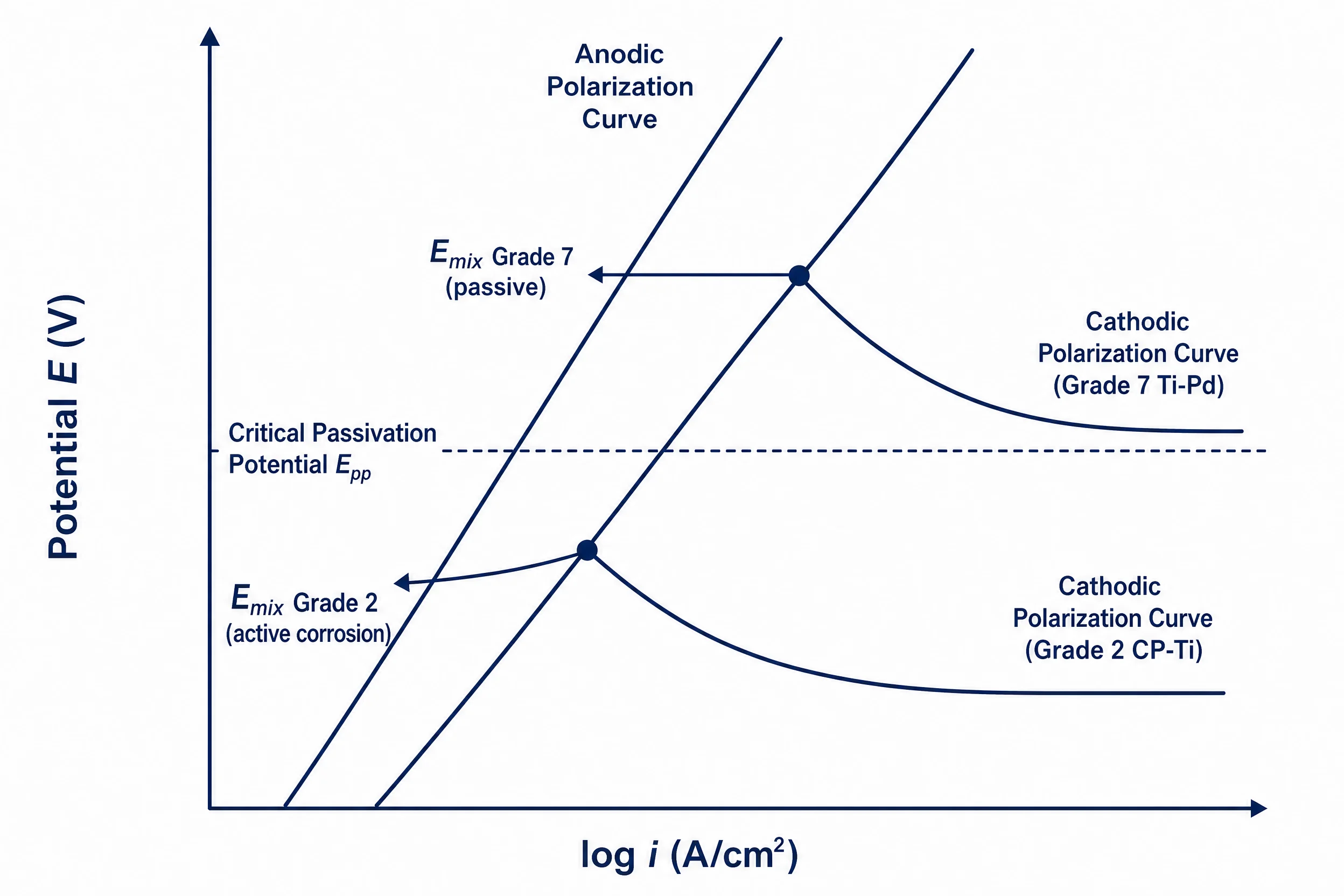
Grade 7 titanium (UNS R52400) is commercially pure titanium alloyed with 0.12–0.25% palladium. That trace Pd addition dramatically improves corrosion resistance in reducing acids — delivering 40× to over 1,000× better performance than Grade 2 in hydrochloric and sulfuric acid environments. Grade 11 shares the same Pd content but builds on a lower-interstitial Grade 1 […]
Grade 5 (Ti-6Al-4V) and Grade 23 (Ti-6Al-4V ELI) share the same base composition of 6% aluminum and 4% vanadium. The critical difference lies in interstitial element control — Grade 23 limits oxygen to 0.13% max versus Grade 5’s 0.20% max, along with tighter caps on nitrogen and hydrogen. This chemistry change produces meaningfully different mechanical […]
Titanium is the most widely used metal in medical implants today, holding 90.99% of the global dental implant market as of 2025. Its dominance isn’t marketing hype — it stems from a rare combination of properties: a self-healing oxide surface, the ability to physically bond with living bone, and near-total absence of allergic reactions. But […]
Titanium does not rust because it instantly forms a microscopic titanium dioxide (TiO₂) layer when exposed to air — a self-healing shield that stops corrosion before it starts. This passive oxide film is only 3–6 nanometers thick initially, yet it makes titanium nearly immune to seawater, salt spray, and most acids. Here’s exactly how this […]
Titanium is strong but not hard. In Rockwell C terms, Grade 5 titanium (Ti-6Al-4V) sits at HRC 30–34 in the annealed condition and HRC 35–39 after solution-treated-and-aged (STA). That is softer than most stainless steels and much softer than hardened tool steels. The trade-off is a strength-to-weight ratio roughly twice that of steel and natural corrosion resistance titanium […]
Titanium thermal conductivity is approximately 21.9 W/m·K at room temperature — roughly 1/18th that of copper (401 W/m·K) and 1/11th that of aluminum (237 W/m·K). In pure thermal conductivity terms, titanium is a poor heat conductor. But that single number tells an incomplete story. Titanium’s combination of low thermal conductivity, high melting point (1,668°C), exceptional corrosion […]
Quick Summary: Titanium surface finishing encompasses mechanical polishing, chemical polishing, electropolishing, anodizing, passivation, and advanced coatings—each serving distinct performance and aesthetic goals. This guide covers complete grit progressions, Ra value specifications by industry, alloy-specific procedures, and a decision framework for selecting the right finishing method based on application, budget, and compliance requirements. Drawing on 15 years […]
Titanium sheets offer tensile strengths ranging from 240 MPa (Grade 1 CP) to 895 MPa (Grade 5 Ti-6Al-4V) per ASTM B265 minimums, with yield strengths from 170 MPa to 828 MPa depending on grade and heat treatment. At roughly half the density of steel (4.43 vs 7.85 g/cm³), titanium sheets deliver the highest strength-to-weight ratio […]
WhatsApp us