Titanium’s low thermal conductivity (6.7 W/m·K) and tendency to weld to cutting edges make insert selection critical. Fine-grained uncoated carbide (ISO S group, hard-end substrate) is the baseline for finishing titanium, while PVD-coated grades with TiAlN or AlCrN excel in roughing and interrupted cuts. This guide breaks down the metallurgical reasons behind tool wear, compares coating chemistries head-to-head, lists workable cutting parameters for Ti-6Al-4V and cp-Ti, and identifies the exact conditions where paying for a coated insert is — and isn’t — worth it.
Why Titanium Destroys Cutting Tools (The Mechanism That Matters)
Titanium is not hard in the traditional sense — Ti-6Al-4V sits around 36 HRC, softer than hardened steel. The problem is thermodynamic.
Titanium conducts heat at roughly 6.7 W/m·K. Stainless steel is around 16 W/m·K. Carbon steel is near 45 W/m·K. Nearly all the heat generated at the cutting edge stays in the tool rather than flowing into the chip or workpiece. At high cutting speeds, rake face temperatures on a carbide insert machining titanium can reach 900–1,100°C — hot enough to trigger diffusion wear, where cobalt binder migrates from the carbide substrate into the workpiece.
Three failure modes dominate:
- Diffusion wear — at temperatures above ~700°C, cobalt diffuses from the WC-Co substrate into titanium. The carbide loses its binder and the cutting edge crumbles.
- Adhesion / built-up edge (BUE) — titanium’s chemical affinity for most tool materials causes micro-welding at the rake face. When the welded material tears away, it takes carbide particles with it.
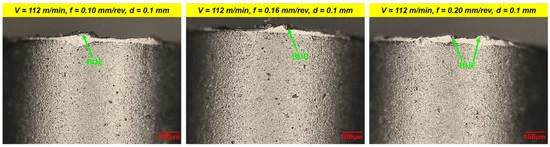
- Notch wear — the work-hardened layer just below the machined surface concentrates abrasive stress at the depth-of-cut line.
The implication for tool selection: anything that reduces cutting-zone temperature — lower cutting speeds, high-pressure coolant, sharp geometries — extends tool life more than the insert grade itself. Grade and coating matter, but they don’t override physics.
Carbide Substrate: Which Grade for Titanium
Carbide for titanium is almost exclusively WC-Co with fine or submicron grain size (grain size 0.5–1.0 µm). Coarse-grained grades sacrifice edge sharpness; ceramic and cermet grades fail in the thermally aggressive titanium environment.
ISO 513 workpiece material group for titanium: S
Under ISO 513, titanium alloys fall into group S — heat-resistant superalloys and titanium — alongside Inconel, Waspaloy, and similar materials. This is distinct from K group (cast iron) and M group (stainless steel). When a datasheet says “for ISO S materials,” that’s your confirmation it’s designed for titanium.
The hardness/toughness subclassification of the carbide tool material itself uses a number suffix (10 = harder/more wear-resistant, 30 = tougher/more shock-resistant). For titanium, the practical grade selection by substrate type:
| Carbide Grade Type | WC grain size | Co content | Best use on titanium |
|---|---|---|---|
| Fine-grain hard (S10 range) | 0.5–0.8 µm | 3–6% | Finishing, tight tolerances |
| Fine-grain medium (S20 range) | 0.8–1.2 µm | 6–8% | Semi-finishing, light interrupted |
| Fine-grain tough (S30 range) | 1.0–1.5 µm | 10–12% | Roughing, heavy interrupted |
| General-purpose M-class | 0.5–1.0 µm | 6–10% | Mixed cuts, less critical jobs |
For most Ti-6Al-4V turning, a medium-hardness fine-grain grade (S20-range) is the starting point. Harder grades give a finer edge for finishing but lack toughness for interrupted milling. Tougher grades handle roughing where vibration and chip load variation are high.
In practice, brands designate these grades commercially: Sandvik H13A (uncoated, traditional titanium choice), Sandvik GC1105/GC1210 (PVD-coated), Kennametal KC725M (general-purpose), Seco CH2540 (uncoated submicron). The brand grade is the commercial product; always cross-check the datasheet for the ISO S applicability rating.
Coated vs Uncoated: The Actual Trade-off
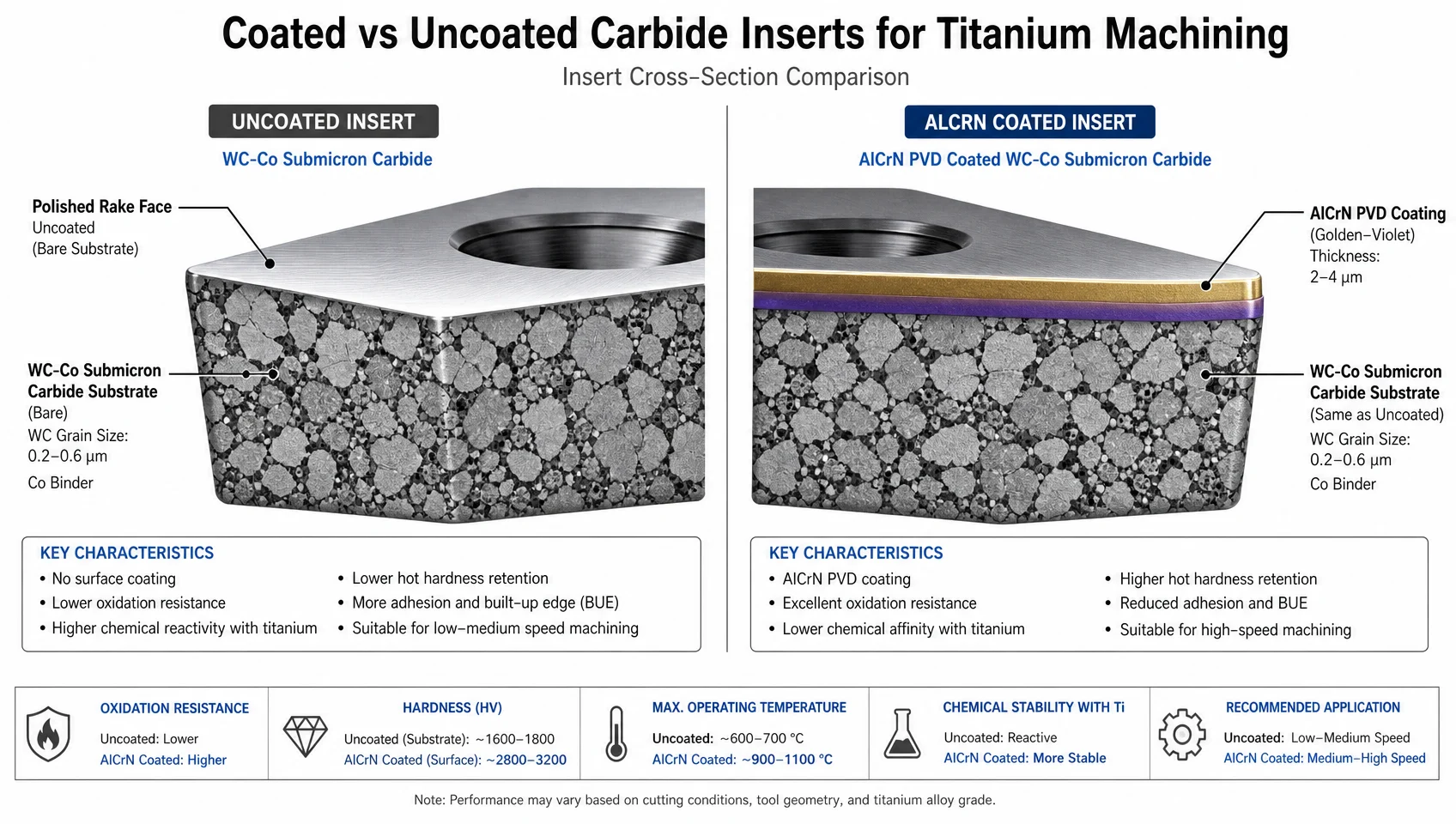
This is where most articles get it wrong by defaulting to “always use coated.” The coating chemistry and how it interacts with titanium’s chemical affinity changes the answer depending on the operation.
When uncoated carbide wins
In finishing cuts on titanium — low depth of cut (≤0.5 mm), low feed (≤0.1 mm/rev), tight surface finish requirements — uncoated submicron fine-grain carbide (ISO S group, hard end) outperforms coated in many shop tests. Sandvik H13A is the classic example: an uncoated WC-Co grade that has been the default titanium finishing choice for decades.
The reason: common PVD coatings contain titanium (TiAlN, TiCN, TiN). When a TiAlN-coated insert contacts a titanium workpiece, the chemical affinity between the coating and the chip material increases adhesion risk. The coating can actually accelerate BUE formation at low-temperature, low-speed finishing conditions. Uncoated carbide with a polished rake face (honed edge, Ra ≤ 0.2 µm) slides more cleanly.
Conditions where uncoated is preferred:
- Vc < 40 m/min (cutting temperature stays below coating benefit threshold)
- Depth of cut ≤ 0.5 mm
- Surface finish requirement Ra ≤ 0.8 µm
- cp-Ti (Grade 1–4) rather than Ti-6Al-4V (cp-Ti is more adhesive)
When coated carbide wins
In roughing and semi-finishing — higher cutting speeds (Vc 50–80 m/min), higher chip loads, longer engagements — PVD-coated grades dominate because the coating provides:
- Thermal barrier (reduces substrate temperature by ~150–200°C)
- Reduced diffusion wear at high temperature
- Harder surface (TiAlN ~3,300 HV vs WC-Co substrate ~1,600 HV) resisting abrasion
Conditions where coated is preferred:
- Vc > 50 m/min
- Roughing (ap > 1.5 mm)
- Milling with interrupted cuts
- Ti-6Al-4V and higher-strength titanium alloys
Coating Chemistry Comparison
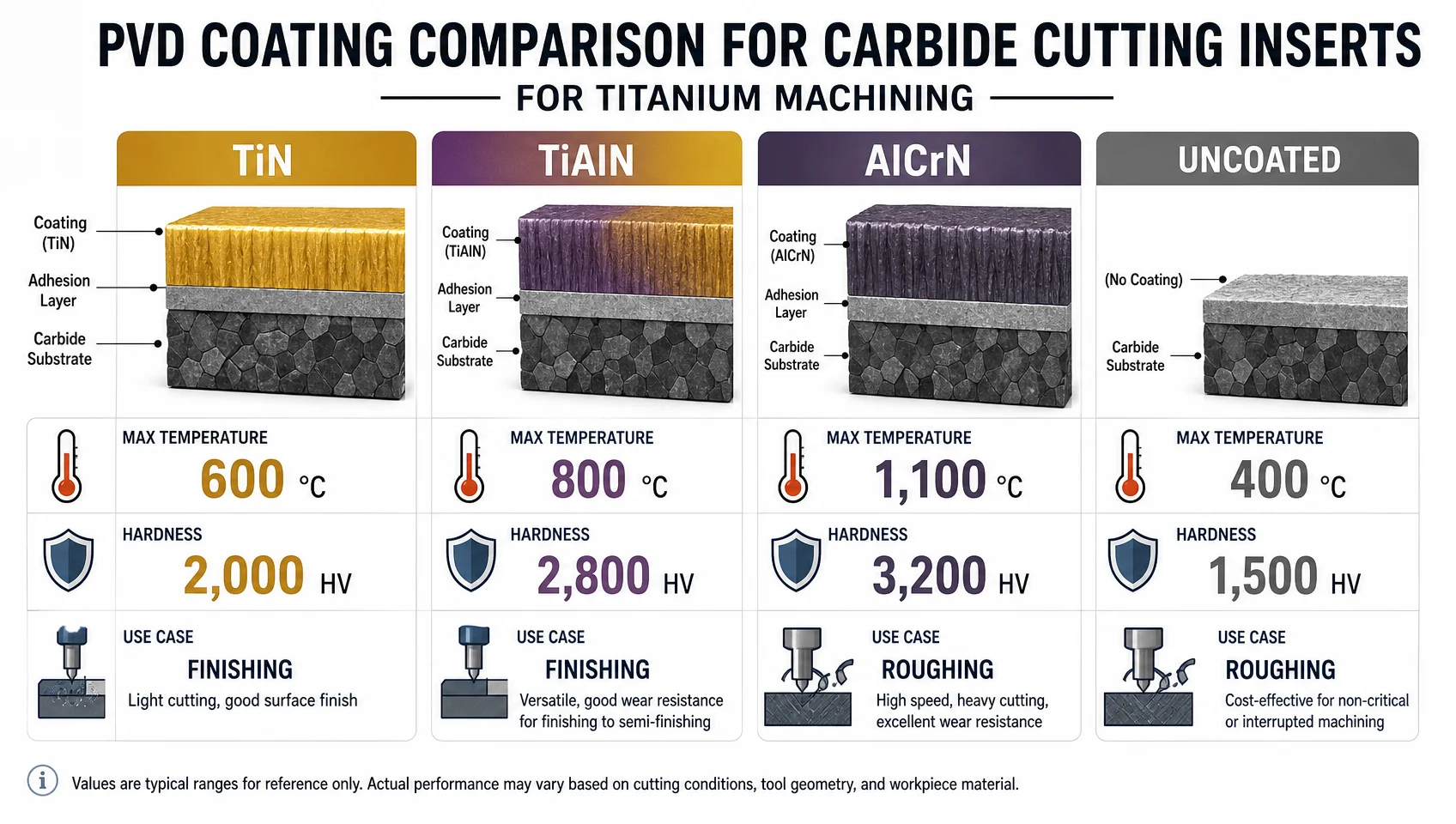
Not all PVD coatings behave the same on titanium. Here’s the matrix that most guides skip:
| Coating | Max temp (°C) | Hardness (HV) | Titanium affinity risk | Best application |
|---|---|---|---|---|
| TiN | 600 | 2,300 | High (Ti-Ti bond) | Not recommended for Ti |
| TiCN | 400 | 3,000 | Moderate | Low-temp, non-ferrous — marginal for Ti |
| TiAlN | 800 | 3,300 | Moderate-High | Roughing at medium speed |
| AlCrN | 1,100 | 3,200 | Low | High-speed roughing, best thermal stability |
| AlTiN | 900 | 3,500 | Moderate | High-hardness alloys, aerospace Ti |
| Uncoated | N/A (substrate ~900) | 1,600 | Low (bare WC-Co) | Finishing, cp-Ti |
The practical takeaway: For titanium specifically, AlCrN is the coating with the lowest chemical affinity to titanium because it contains no titanium in its chemistry. At high cutting speeds (Vc > 60 m/min) where thermal protection matters, AlCrN-coated grades consistently show longer tool life than TiAlN in published machining trials. TiAlN remains more common in shops because it’s cheaper and performs well across many materials — but for dedicated titanium tooling, AlCrN is worth the price premium.
TiN should be avoided on titanium entirely. The titanium-to-titanium chemical bond between coating and chip material accelerates both BUE and coating delamination.
Cutting Parameters for Ti-6Al-4V and cp-Ti
The single biggest source of premature tool failure is running titanium like stainless steel. The parameters are different.
Turning parameters:
| Parameter | cp-Ti (Grade 2) | Ti-6Al-4V (Grade 5) | Ti-6Al-2Sn-4Zr-2Mo |
|---|---|---|---|
| Cutting speed Vc (m/min) | 100–185 | 40–70 | 30–60 |
| Feed f (mm/rev) | 0.1–0.25 | 0.1–0.2 | 0.08–0.15 |
| Depth of cut ap (mm) | 0.5–3.0 | 0.5–2.5 | 0.5–2.0 |
| Coolant pressure (bar) | 40–70 | 80–150 | 80–150 |
Milling parameters (Ti-6Al-4V):
| Operation | Vc (m/min) | fz (mm/tooth) | ae/D ratio |
|---|---|---|---|
| Roughing (end mill) | 40–60 | 0.04–0.08 | 0.05–0.15 |
| Semi-finish (end mill) | 50–80 | 0.03–0.06 | 0.03–0.10 |
| Finish (end mill) | 60–100 | 0.01–0.03 | 0.02–0.05 |
Critical parameter rule: Keep the cutting speed conservative and increase feed rate rather than speed. Doubling feed has a far smaller impact on tool temperature than doubling speed. In titanium, speed kills tools; feed generates chips that carry heat away.
High-pressure coolant (HPC) is not optional for Ti-6Al-4V. Standard flood coolant at 5–10 bar cannot penetrate the chip-tool interface on titanium. At 80+ bar, HPC fractures the chip, clears the cutting zone, and reduces insert temperature by 200–300°C. The investment in HPC pays back in insert life within a single production run.
Insert Geometry: What the Grade Sheet Won’t Tell You
Rake angle: Positive rake (8–12°) reduces cutting forces and heat generation — critical for titanium. Negative rake is standard in steel turning but inappropriate for titanium because it increases cutting forces and temperature.
Edge preparation: Sharp edges (honed ≤ 0.02 mm) reduce the tendency for BUE. Some manufacturers offer polished rake faces specifically for titanium and aluminum — this is worth specifying.
Chip breaker: Avoid aggressive chip breakers (designed for steel) on titanium. The chip in titanium is segmented by nature (adiabatic shear banding) and doesn’t need a complex breaker. Open, free-cutting geometries work better; complex breakers tend to create chip packing and re-cutting.
Nose radius: Smaller nose radius (0.4–0.8 mm) reduces radial cutting force and vibration tendency. Larger nose radii improve surface finish but increase radial force, which can trigger chatter on slender titanium components.
Practical Insert Selection: A Decision Framework
Use this flowchart when selecting an insert for a new titanium job:
Step 1 — Identify the alloy:
- cp-Ti (Grade 1–4): more adhesive, lower strength → uncoated fine-grain medium-hard grade or AlCrN-coated medium grade
- Ti-6Al-4V: standard aerospace alloy (ISO S group) → AlCrN-coated medium grade for roughing, uncoated fine-grain hard grade for finishing
- Ti-6Al-2Sn-4Zr-2Mo or Ti-5553: higher-strength → coated tough grade, lower Vc, higher coolant pressure
Step 2 — Identify the operation:
- Finishing (Vc < 45 m/min, ap < 0.5 mm): uncoated submicron fine-grain hard grade (ISO S, hardness end)
- Semi-finishing: TiAlN or AlCrN coated medium grade
- Roughing: AlCrN coated tough grade, high-pressure coolant mandatory
Step 3 — Verify geometry:
- Positive rake ≥ 8°
- Sharp edge (honed ≤ 0.02 mm preferred)
- Nose radius 0.4–0.8 mm
Step 4 — Set conservative parameters first:
- Start at the low end of the Vc range
- Confirm chip formation before increasing speed
- Monitor for BUE (blue/discolored chips = temperature too high)
FAQ
Why does uncoated carbide sometimes outperform coated on titanium?
At low cutting speeds (below ~45 m/min) and finishing conditions, the temperature at the cutting interface is too low for many PVD coatings to provide their full benefit. More importantly, TiAlN and TiN coatings contain titanium — they have higher chemical affinity to titanium workpieces, which increases adhesion and BUE formation. Uncoated submicron carbide with a polished rake face has lower chemical affinity and slides more cleanly in these conditions.
What is the best coating for machining titanium alloys?
For dedicated titanium tooling at medium-to-high cutting speeds (Vc > 50 m/min), AlCrN (aluminum chromium nitride) offers the best balance of thermal stability and low chemical affinity to titanium. It contains no titanium in its chemistry, reducing adhesion risk. TiAlN is a solid second choice and more widely available. Avoid TiN entirely.
Do I need high-pressure coolant to machine titanium?
For Ti-6Al-4V and higher-strength titanium alloys, high-pressure coolant (80–150 bar) is strongly recommended for any sustained cutting. Standard flood coolant cannot penetrate the chip-tool interface at titanium’s cutting conditions. Without HPC, tool life degrades rapidly and surface finish suffers. For cp-Ti at low speeds, standard flood at 40–70 bar can work for light finishing cuts.
What cutting speed should I use for Ti-6Al-4V?
The practical range for turning Ti-6Al-4V with carbide inserts is 40–70 m/min. Start at 45 m/min and increase only if insert wear is light after 5–10 minutes of cutting. Exceeding 80 m/min with standard carbide shortens tool life dramatically due to diffusion wear above ~700°C.
Can I use the same inserts for titanium and stainless steel?
Technically possible with M-class general-purpose grades (M10–M20), but not optimal for either material. Titanium-dedicated grades (fine-grain K-class, AlCrN coated, positive rake) will significantly outperform general-purpose inserts on titanium, especially for production volumes where tool cost per part matters.
Summary
Titanium’s low thermal conductivity is the root cause of almost every tool failure in titanium machining — not hardness. Uncoated fine-grained carbide (K10–K15) is the right choice for finishing and cp-Ti; AlCrN-coated K20–K30 handles roughing and Ti-6Al-4V at production speeds. Avoid TiN and TiCN coatings on titanium due to their chemical affinity. Keep cutting speeds conservative (40–70 m/min for Ti-6Al-4V), prioritize high-pressure coolant over speed increases, and use positive rake geometry with sharp edges. These four variables — alloy, operation, coating chemistry, and coolant pressure — determine 90% of insert performance on titanium. Grade selection matters, but it’s the fourth variable, not the first.