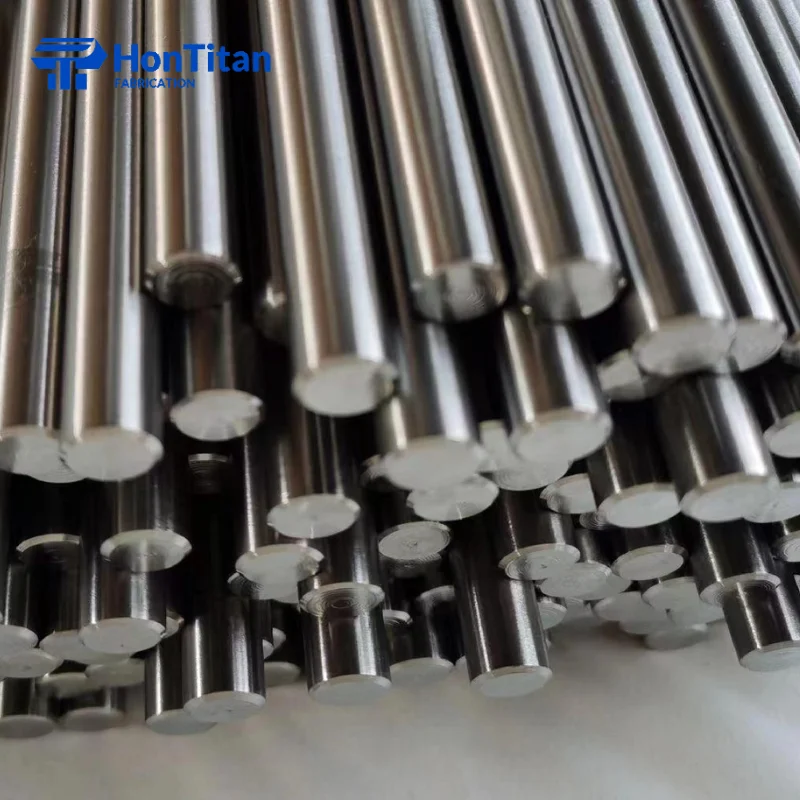
Titanium condenser tubes — specified to ASTM B338, typically Grade 2 — have become the preferred choice for power plant steam surface condensers in coastal, seawater-cooled, and industrial environments. Their near-zero corrosion rate in aggressive cooling water (< 0.0025 mm/year in seawater), combined with thin-wall design that compensates for lower thermal conductivity (~17 W/m·K for Grade 2), delivers a service life of 20–40+ years versus 10–15 years for copper alloys. U.S. nuclear plants that retubed with ASTM B338 Grade 2 in the 1970s–80s have reported failure rates approximately 1/100th of the copper alloys they replaced. For a 600 MW plant with seawater or brackish cooling water, the lifecycle cost math strongly favors titanium despite a 3–5× higher initial tube cost.
Why Power Plant Condensers Are a Corrosion Battleground
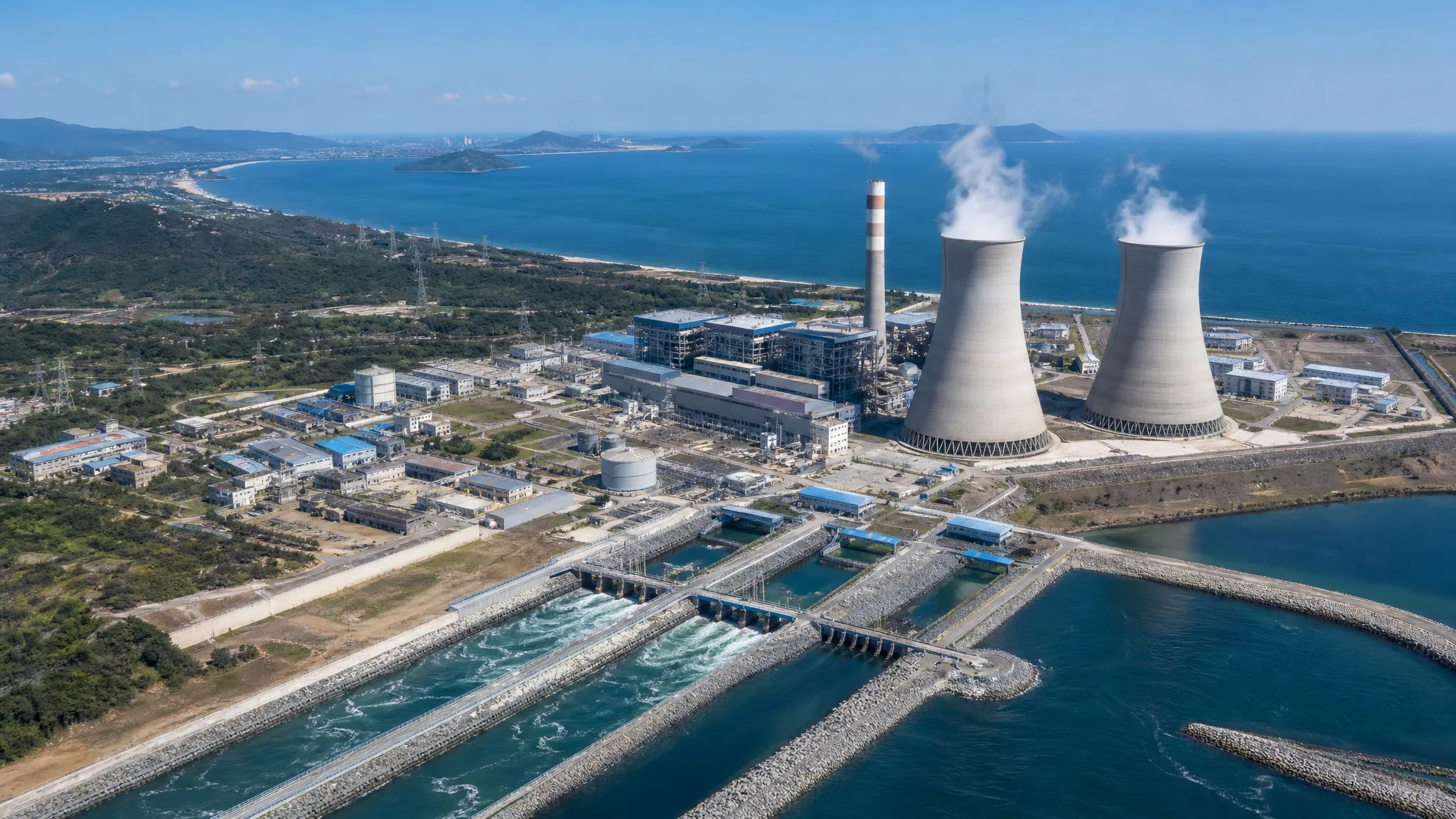
Every thermal power plant — coal, gas, nuclear, or geothermal — depends on the steam surface condenser. Steam from the turbine exhaust condenses back to water across thousands of thin-walled tubes, rejecting heat to whatever cooling water the plant has access to: seawater, brackish river water, brackish lake water, recirculating cooling tower blowdown.
That cooling water is corrosive. It carries dissolved chlorides, suspended solids, biological organisms, and, in coastal plants, the full electrochemical aggression of seawater. The condenser tube bundle is in continuous contact with this water, under vacuum on the steam side, and under modest pressure on the cooling water side.
The most common cause of forced outages in thermal power plants is condenser tube failure. A single leaking tube allows cooling water to contaminate the steam-water cycle, spiking conductivity in the boiler feedwater and threatening boiler tube corrosion, turbine blade deposition, and chemistry excursions that force a rapid shutdown. In large plants, an unplanned outage from condenser tube leaks can cost $500,000 to $2,000,000 per day in lost generation revenue and repair costs.
The tube material is the answer to this problem — and increasingly, that answer is titanium.
What Makes Titanium Different: The Corrosion Chemistry
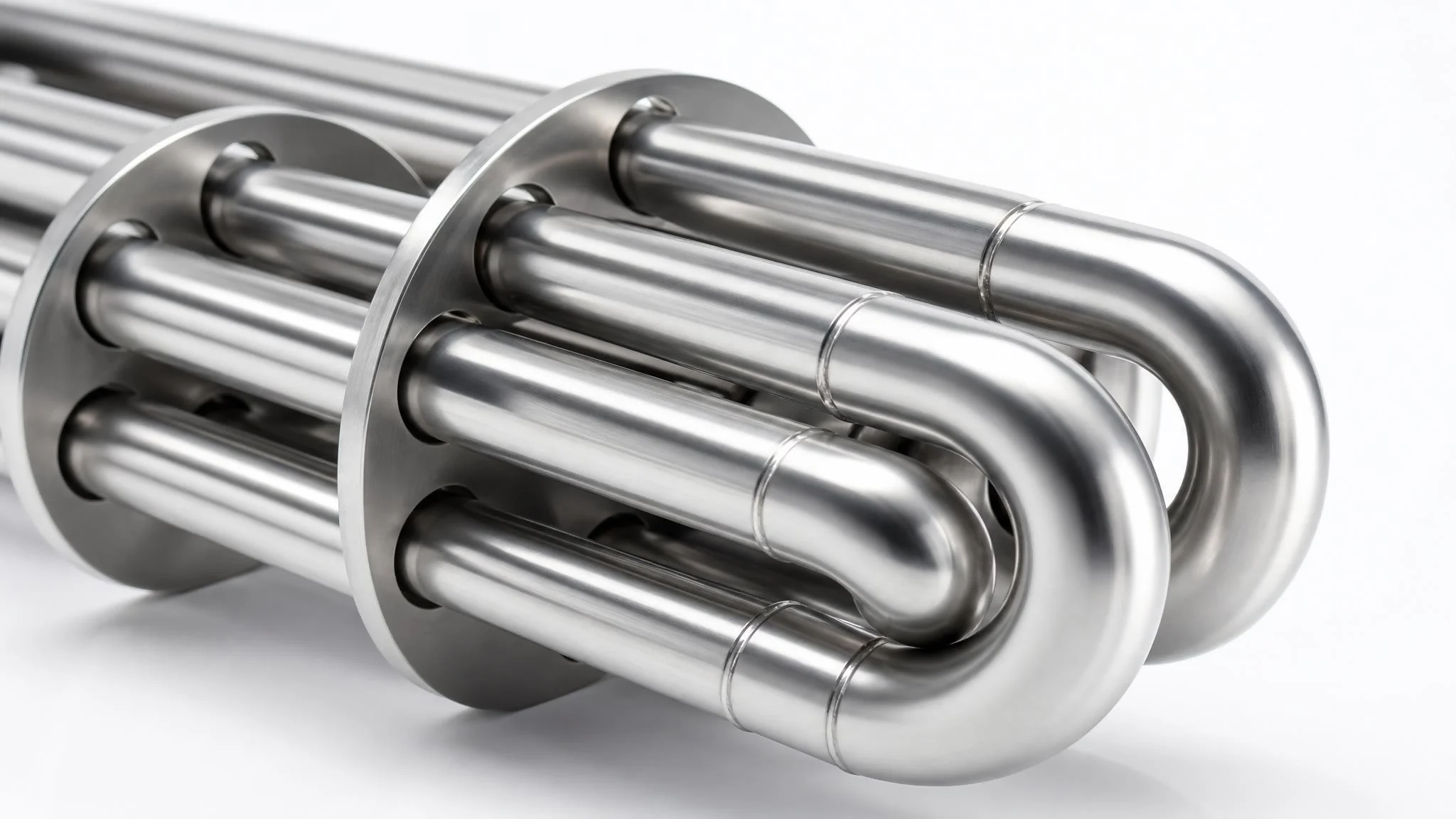
Titanium’s resistance to corrosion is not a passive property — it is an active one. When titanium is exposed to even trace quantities of oxygen or moisture, it instantly forms a self-healing titanium dioxide (TiO₂) oxide layer, typically 2–6 nm thick. This oxide layer is thermodynamically stable across an extraordinarily wide range of pH (roughly 2 to 12) and is essentially immune to chloride-induced pitting — the failure mode that destroys copper alloys and even 316L stainless steel in seawater.
In practice, titanium Grade 2 shows a corrosion rate below 0.0025 mm/year in seawater, a figure that is effectively immeasurable by conventional weight-loss testing. For context, copper-nickel (90/10 Cu-Ni) — long considered the gold standard for marine condenser applications — corrodes at rates of 0.02–0.05 mm/year under similar conditions, and is vulnerable to impingement attack, dealloying, and stress corrosion cracking under certain cooling water chemistries.
This is not theoretical. Multiple U.S. nuclear power plants retubed their condensers with ASTM B338 Grade 2 titanium during the 1970s and 1980s, replacing copper-nickel alloy tubes that had been suffering from ammoniacal SCC and deposit-driven corrosion. Those titanium installations have now logged over 40 years of continuous service, with failure rates documented at approximately 1/100th of the copper alloys they replaced. The Ringhals nuclear power plant in Sweden, which installed Grade 2 titanium condenser tubes in the 1980s, operated more than 20 years without a single tube pitting failure — with estimated savings of approximately $3 million in avoided maintenance and downtime costs.
The Thermal Conductivity Objection — and Why It Doesn’t Hold
The standard objection to titanium condenser tubes is thermal performance. Titanium Grade 2 has a thermal conductivity of approximately 17 W/(m·K), compared to about 45 W/(m·K) for 90/10 Cu-Ni and roughly 100–120 W/(m·K) for admiralty brass.
At face value, this looks like a significant penalty. In practice, it is not — for two reasons:
1. Wall thickness dominates thermal resistance at thin gauges.
The thermal resistance of a tube wall is:
R_wall = wall thickness / thermal conductivity
A conventional copper alloy condenser tube might have a wall thickness of 1.0–1.2 mm. A titanium Grade 2 tube for the same condenser service is typically specified at 0.7–0.9 mm wall thickness (ASTM B338 power plant standard), with some designs going as thin as 0.5 mm. Plugging numbers in:
- Admiralty brass, 1.0 mm wall: R = 1.0 / 120 = 0.0083 m²·K/W
- 90/10 Cu-Ni, 1.0 mm wall: R = 1.0 / 45 = 0.0222 m²·K/W
- Ti Grade 2, 0.7 mm wall: R = 0.7 / 17 = 0.0412 m²·K/W
- Ti Grade 2, 0.5 mm wall: R = 0.5 / 17 = 0.0294 m²·K/W
At standard power plant wall thicknesses, titanium’s wall resistance is higher than copper-nickel — this is the honest engineering reality. However, the overall heat transfer coefficient (U-value) in a condenser is governed not just by tube wall resistance but by the combined resistance chain: steam-side condensate film + tube wall + cooling-water-side convection film + fouling layer. The tube wall resistance is only one term, and in well-designed condensers with adequate cooling water velocity, the water-side and steam-side film resistances dominate. For thin-wall designs (0.5 mm), the gap versus copper alloy narrows significantly.
2. Cleanliness is a thermal multiplier.
Copper alloys, despite superior conductivity, build up biological and mineral fouling films over their service life. Biofouling, carbonate scale, and iron sulfide deposits add fouling resistance that degrades heat transfer by 20–40% over time. Titanium’s smooth, inert TiO₂ surface resists biological attachment and does not form the copper oxide/hydroxide patinas that provide nucleation sites for scale.
Well-designed titanium condensers operating in seawater have demonstrated overall heat transfer coefficients (U-values) within 5–15% of new copper alloy condensers, and that gap closes over time as copper alloys accumulate fouling while titanium’s TiO₂ surface stays clean. The practical outcome in long-running plants: titanium condensers maintain consistent thermal performance for decades, while copper alloy condensers degrade progressively until cleaned or replaced.
ASTM B338: The Standard That Governs Power Plant Titanium Tubes
Titanium condenser and heat exchanger tubes for power generation are procured to ASTM B338, the Standard Specification for Seamless and Welded Titanium and Titanium Alloy Tubes for Condensers and Heat Exchangers. This is the specification that defines dimensions, mechanical properties, chemical composition, and test requirements.
Key grades under B338 for power plant applications:
| Grade | Composition | Tensile Strength | Key Advantage | Typical Use |
|---|---|---|---|---|
| Grade 2 | Commercially pure Ti | 345 MPa min | Best overall corrosion resistance, lowest cost within Ti range | Seawater, brackish water condensers — standard choice, covers ~80% of power plant duties |
| Grade 7 | Ti-0.15Pd | 345 MPa min | Palladium addition enhances crevice corrosion resistance | High-chloride, stagnant water, deep crevice geometry, or cyclic wetting/drying |
| Grade 12 | Ti-0.3Mo-0.8Ni | 483 MPa min | Mo-Ni addition for high-velocity erosive environments | Sandy cooling water, high flow velocities, erosion-corrosion risk |
| Grade 9 | Ti-3Al-2.5V | 620 MPa min | Higher strength, thinner walls possible | High-pressure feedwater heaters where wall thickness reduction is critical |
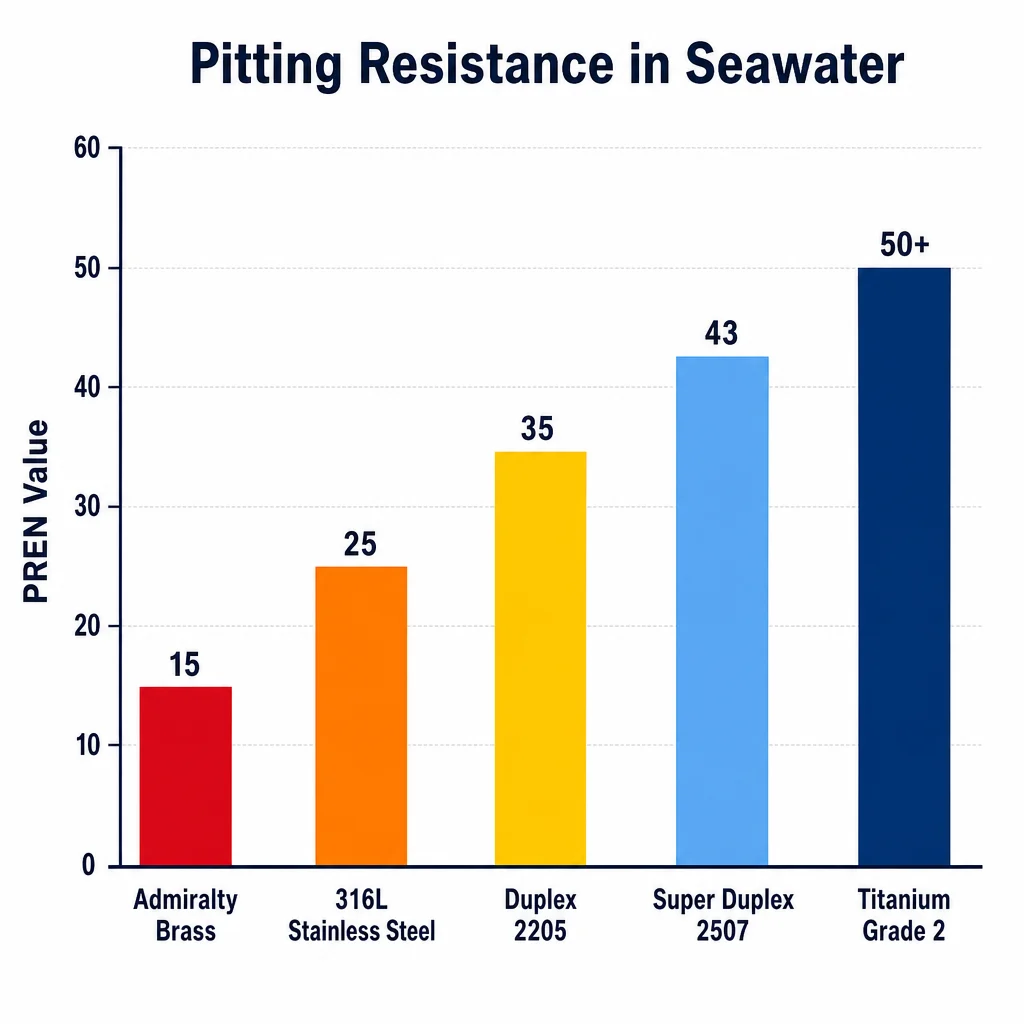
PREN (Pitting Resistance Equivalent Number) comparison — why titanium dominates chloride environments:
| Material | PREN | Seawater Suitability |
|---|---|---|
| Admiralty brass | ~15 | Poor — dezincification risk |
| 316L Stainless Steel | ~25 | Poor — pitting in seawater |
| Duplex 2205 | ~35 | Marginal |
| Super duplex 2507 | ~42–45 | Good |
| Titanium Grade 2 | > 50 | Excellent — effectively immune |
This is why copper alloys, which served adequately in lower-salinity river water, fail systematically when plants are sited on coastlines or switch to recirculated industrial water with elevated chloride concentration.
For most steam surface condenser applications with seawater or brackish cooling water, Grade 2 is the correct and most economical choice. Grade 12 is justified when the operating geometry creates deep crevices (thick tubesheets, tight tube-to-baffle clearances) or where cooling water temperatures exceed 70°C.
Standard dimensions for power plant condenser tubes under ASTM B338:
- Outside diameter: typically 19.05 mm (¾”) or 25.4 mm (1″), with 22.2 mm (⅞”) also common
- Wall thickness: 0.7–0.9 mm standard for power plant condenser service; 0.889–1.24 mm for higher-pressure feedwater heaters
- Lengths: up to 15,000 mm depending on condenser shell design
- Surface condition: bright annealed or pickled for optimal cleanliness and inspection
Tubes shall be supplied in the annealed condition. Each tube must pass hydrostatic testing (or eddy current testing as an alternative), dimensional verification, and tensile testing per B338 Table 5.
Grade Selection: A Practical Decision Framework
Selecting the right ASTM B338 grade is not complex if you anchor the decision on cooling water chemistry, operating temperature, and tube geometry.
Use Grade 2 when:
- Cooling water is seawater or brackish water at temperatures below 60°C
- Standard tube-to-tubesheet geometry (no extreme crevice depths)
- Operating pressure is low-pressure condenser service
- Budget is a consideration — Grade 2 covers approximately 80% of power plant condenser duties at the lowest cost within the titanium family
Use Grade 7 when:
- Deep crevice geometry (thick tubesheets > 50 mm, tightly packed baffles)
- Cooling water is stagnant or subject to wetting/drying cycles
- Elevated chloride concentration with limited aeration (reducing conditions)
- Note: Grade 7 carries a cost premium over Grade 2 for the palladium content
Use Grade 12 when:
- High cooling water velocity carrying suspended solids (sandy rivers, intake screens bypassed)
- Erosion-corrosion is the documented failure mode rather than pitting
- Geothermal brines or cooling water with high dissolved solids above 70°C
Use Grade 9 when:
- High-pressure feedwater heater service where wall thickness reduction saves weight and cost at pressure
In the majority of coastal power plant condenser retubing projects, Grade 2 at 0.7–0.9 mm wall is the specification that wins on both performance and delivered cost. Grade 7 is the upgrade path when crevice geometry makes Grade 2 marginal.
The Real ROI Calculation: Outages, Not Tube Price
Procurement teams often compare titanium condenser tubes to copper alloys on a price-per-meter basis and conclude titanium is prohibitively expensive at 3–5× the material cost. This framing misses the actual cost driver.
Consider a 600 MW coal-fired plant with a seawater-cooled condenser containing 15,000 tubes:
Scenario A: 90/10 Cu-Ni tubes at 1.0 mm wall
- Tube cost: ~$40–60/m × 15,000 tubes × 9 m = ~$5.4–8.1M per retubing
- Service life in seawater: 12–15 years (assuming no premature failures)
- Forced outages from tube leaks over 30 years: 3–6 events × 5 days × $1.5M/day = $22.5–45M in outage costs
- Retubing events over 30 years: 2 retubing cycles, additional $10–16M
Scenario B: ASTM B338 Grade 2 titanium at 0.7–0.9 mm wall
- Tube cost: ~$150–200/m × 15,000 tubes × 9 m = ~$20–27M initial investment
- Service life in seawater: 20–40+ years (effectively a once-in-plant-lifetime installation)
- Forced outages from tube leaks over 30 years: near zero (titanium does not pit in seawater)
- Retubing events over 30 years: 0
- Most retubing projects recover the titanium premium investment within 3–5 years from avoided forced outages and eliminated retubing cycles
30-year total cost of ownership: titanium is typically 40–60% less expensive than copper alloys in seawater applications, once forced outage risk is capitalized at even a conservative probability.
HonTitan supplies ASTM B338 Grade 2 and Grade 12 titanium condenser tubes direct to power plant retubing projects, with hydrostatic testing and full material certifications. The economics above reflect real project data, not optimistic assumptions.
Cooling Water Chemistry Limits: Where Titanium Excels and Where It Has Limits
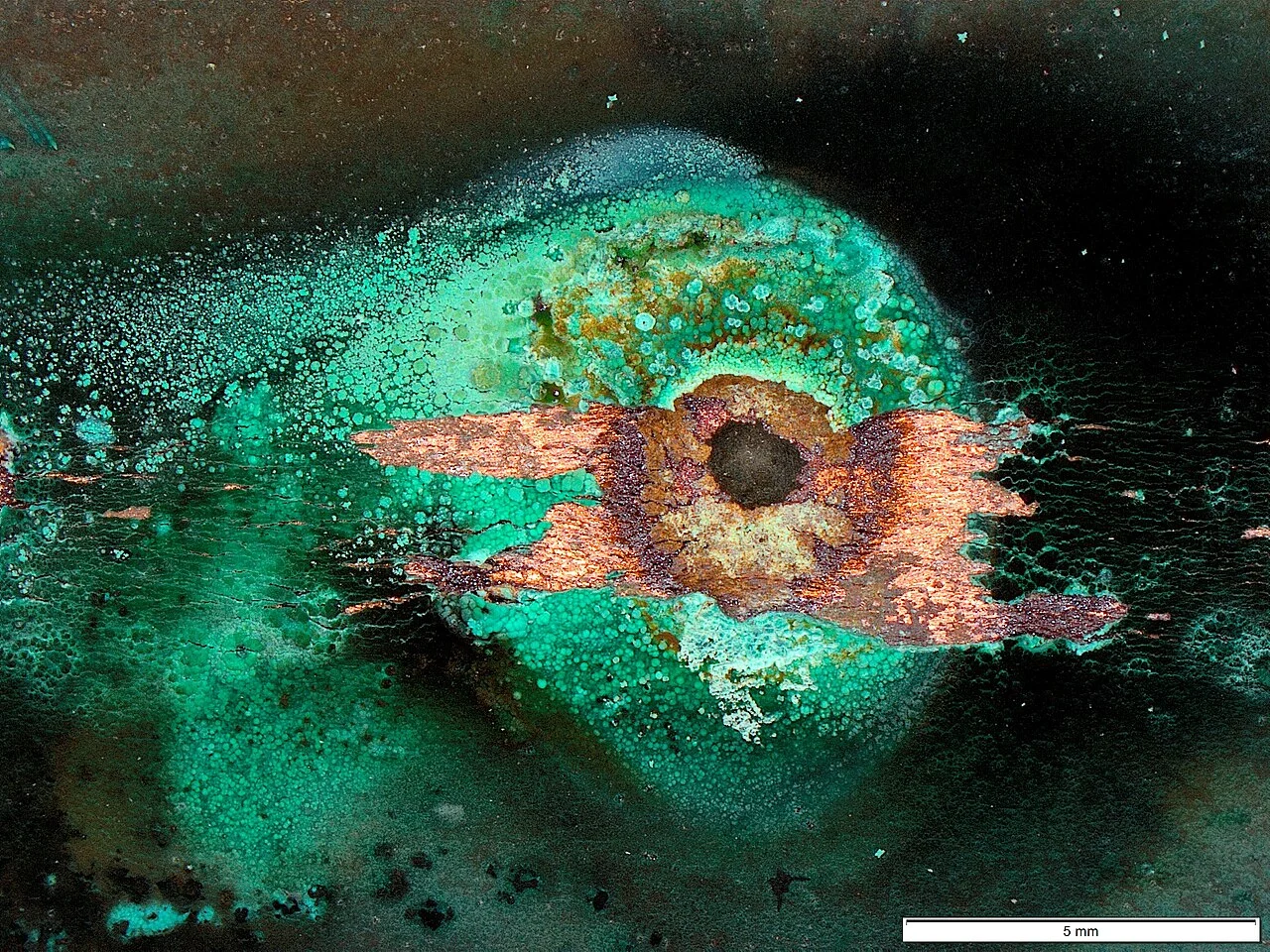
Titanium Grade 2 is not infinitely corrosion-resistant. Understanding its operating limits prevents misapplication.
Titanium performs exceptionally in:
- Seawater (all concentrations)
- Brackish water (chloride 500–35,000 ppm)
- Oxidizing acids (dilute nitric acid, chromic acid)
- Alkaline solutions (pH up to 14 in many environments)
- Biofouling environments — the TiO₂ surface discourages bacterial adhesion
Titanium has limitations in:
- Reducing acids: Hydrochloric acid, sulfuric acid, and phosphoric acid at high concentrations and temperatures can dissolve the TiO₂ film. This is rarely encountered in standard cooling water circuits.
- Fluoride ions: Even trace concentrations of fluoride (> ~50 ppm) can attack titanium at elevated temperature by forming soluble TiF₄. Industrial plants with fluoride-bearing cooling water (some chemical complexes) should consult a corrosion engineer before specifying Grade 2.
- High-velocity erosion with abrasives: Titanium resists corrosion and handles cooling water velocities of 12–30 m/s without corrosion-erosion — far exceeding the 2–3 m/s limit of copper alloys. However, if the cooling water carries significant suspended abrasive solids (sand, grit), even titanium can experience erosion at tube inlets above approximately 3–4 m/s solid loading. Inlet ferrules (titanium or PEEK) are standard practice to protect the first 50–100 mm of tube where inlet turbulence concentrates.
- Galvanic coupling: Titanium is noble. Contact between titanium tubes and copper alloy tubesheets creates a galvanic couple that accelerates tubesheet corrosion. Carbon steel or titanium-clad tubesheets are required when retubing with titanium.
The cooling water limits for Grade 2 in typical power plant condensers are well within normal operating envelopes. The fluoride and galvanic coupling points require engineering attention during specification — they are not showstoppers, but they do require planning.
Installation: What Changes When You Retube with Titanium
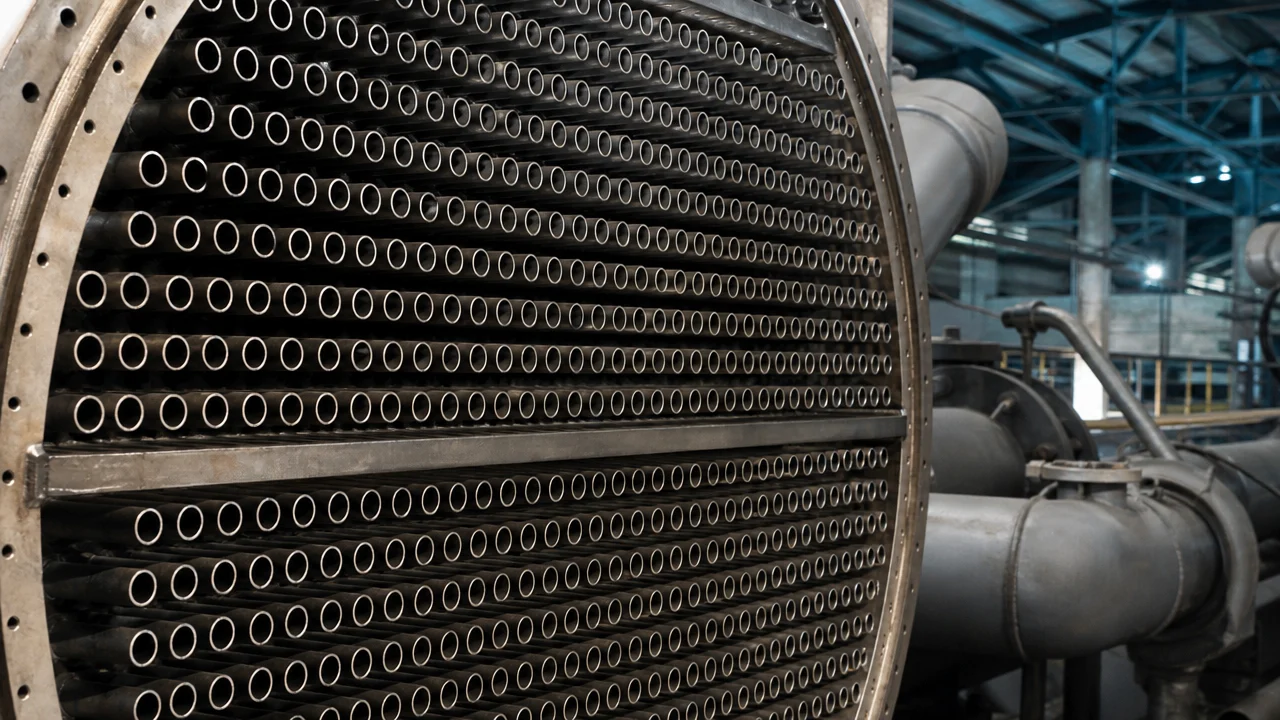
Retubing a condenser with titanium after decades of copper alloy service requires engineering attention in several areas:
Tube-to-tubesheet joining: Standard roller expansion works for titanium Grade 2. Hydraulic expansion is preferred for thin-wall tubes (≤ 0.5 mm) to minimize risk of over-thinning. Strength-welding the titanium tube-to-tubesheet joint provides the highest joint integrity and is standard practice in nuclear plant condensers.
Tubesheet material: As noted above, copper or naval brass tubesheets are galvanically incompatible with titanium. A carbon steel tubesheet with titanium tube seating, or a titanium-clad tubesheet, must be used. This is typically a one-time cost absorbed in the first retubing project.
Support baffles: Titanium tubes have a modulus of elasticity (~110 GPa) that is about 60% of copper alloy (~130 GPa) and 55% of carbon steel (~200 GPa). This lower stiffness means support baffle spacing must be designed or verified to prevent flow-induced vibration (FIV) — particularly important in condensers with high steam-side velocities.
Cleanliness during installation: Titanium absorbs hydrogen at elevated temperatures (>250°C). During welding and heat treatment, inert gas shielding is essential to prevent hydrogen embrittlement. For standard condenser tube installations (expansion only, no welding), this is not a concern. For welded joints, argon purging of the tube interior during joint welding is required.
With proper attention to these four areas, titanium retubing is a straightforward plant project that many EPC contractors and plant maintenance teams have executed successfully for decades.
FAQ: Titanium Condenser Tubes in Power Plants
What ASTM standard governs titanium condenser tubes?
ASTM B338 — Standard Specification for Seamless and Welded Titanium and Titanium Alloy Tubes for Condensers and Heat Exchangers. It covers chemical composition, mechanical properties, dimensional tolerances, and test requirements for all commercially used titanium grades.
Which titanium grade is best for seawater-cooled condenser service?
Grade 2 (commercially pure titanium) is the standard selection for seawater and brackish water condensers. It provides the optimal balance of corrosion resistance, weldability, ductility, and cost. Grade 12 (Ti-0.3Mo-0.8Ni) is specified when crevice corrosion is a concern due to deep crevice geometry or elevated cooling water temperature above 70°C.
Does titanium’s lower thermal conductivity hurt heat exchanger efficiency?
In practice, the impact is manageable and often outweighed by fouling performance. Titanium Grade 2’s conductivity (~17 W/m·K) is lower than copper alloys, and wall thermal resistance is higher at standard power plant wall thicknesses. However, the overall heat transfer coefficient in a condenser depends on the combined steam-film, tube-wall, water-film, and fouling resistances. Titanium’s inert TiO₂ surface resists biofouling and mineral scale throughout its service life — while copper alloys accumulate fouling that progressively degrades heat transfer. Long-term, titanium condensers maintain consistent performance while copper alloy condensers degrade.
How long do titanium condenser tubes last in power plants?
U.S. nuclear plants that retubed with ASTM B338 Grade 2 in the 1970s–80s have documented over 40 years of service with failure rates approximately 1/100th of the copper alloys replaced. The Ringhals nuclear plant in Sweden operated Grade 2 titanium tubes for over 20 years without a single tube pitting failure. Industry data consistently shows 20–40+ year service life for titanium in seawater-cooled condensers.
What is the typical cost difference between titanium and copper alloy condenser tubes?
Titanium Grade 2 condenser tubes typically cost 3–5× more per meter than 90/10 Cu-Ni on a purchased material basis. However, 30-year total cost of ownership analysis, including retubing cycles and avoided forced outage costs, typically shows titanium at 40–60% lower lifecycle cost in seawater-cooled plants.
Can existing copper alloy condensers be retubed with titanium?
Yes, but with important engineering steps: the tubesheet must be compatible (carbon steel or titanium-clad — copper alloy tubesheets are galvanically incompatible), tube-to-baffle clearances should be verified for vibration margin, and tube-to-tubesheet joint method (expansion vs. welding) must be specified. Retubing projects of this type are routine for experienced contractors.
One Leaking Tube, Unlimited Uptime: The Bottom Line on Titanium
In the calculus of power plant condenser material selection, titanium Grade 2 to ASTM B338 has moved from a premium option to the default specification for any plant where seawater, brackish water, or corrosive industrial cooling water is the heat rejection medium.
The objections that once held titanium back — higher cost, lower conductivity, unfamiliar installation practices — have been answered by 50 years of plant operating data, thin-wall manufacturing capability, and a straightforward lifecycle economics model. The question is no longer whether titanium is worth considering. The question is how many more condenser tube leaks your plant will absorb before making the change.