PVD (Physical Vapor Deposition) coating on titanium applies a hard, thin ceramic or metallic film — typically 1–5 µm thick — inside a vacuum chamber at 200–500°C. Common coating options include TiN (gold, ~2,000–2,300 HV), TiAlN (violet, ~2,800–3,300 HV, stable to 800°C), and CrN (silver-gray, ~2,000–2,300 HV, corrosion-resistant). DLC (Diamond-Like Carbon) offers lower friction but requires a chromium interlayer for reliable adhesion on titanium and degrades faster at elevated temperatures. The right choice depends on operating temperature, friction load, required aesthetics, and budget.
What Is PVD Coating on Titanium?
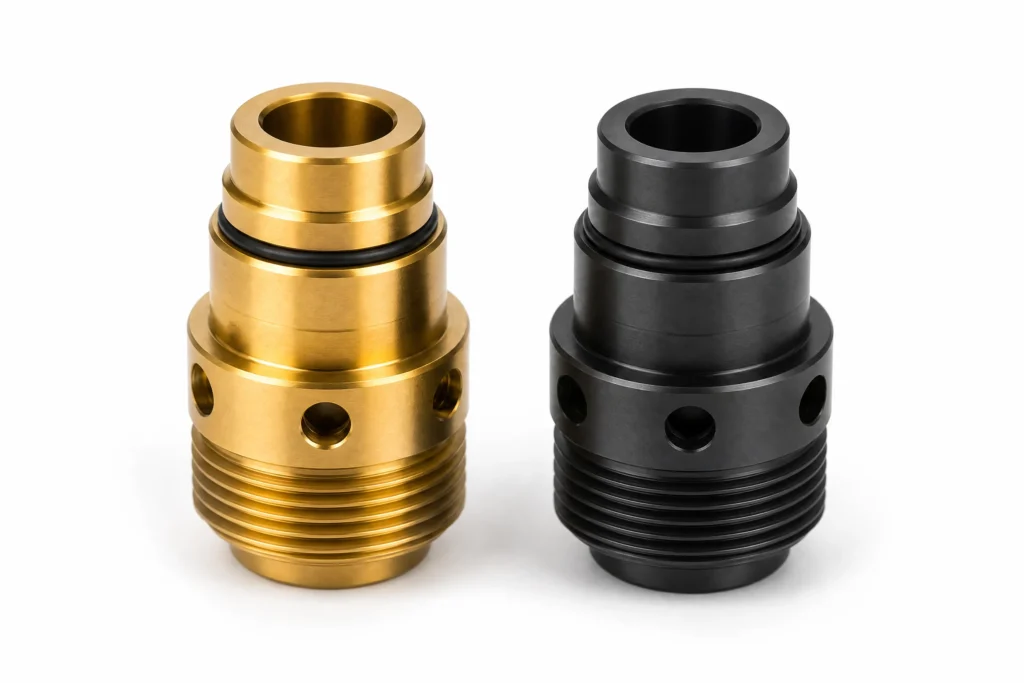
PVD coating on titanium deposits a hard, wear-resistant thin film onto a titanium substrate using a vacuum-based physical process — no wet chemistry, no acid baths.
Physical Vapor Deposition works by converting a solid source material (the target) into vapor inside a vacuum chamber, then condensing that vapor onto the part. The result is a dense, crystalline film typically 1–5 µm thick. On titanium — already a lightweight, corrosion-resistant material — PVD adds a second layer of performance: higher surface hardness, reduced friction, and, in many applications, a distinctive color.
What makes titanium a particularly good PVD candidate? A few things:
- Natural oxide stability. Titanium forms a stable TiO₂ passivation layer. Ion bombardment during PVD sputter cleaning strips this layer just before deposition, exposing a chemically active surface that bonds well with the incoming film.
- Low coefficient of thermal expansion (CTE) mismatch. Titanium alloys like Ti-6Al-4V share similar CTE values with common PVD nitride coatings, which reduces residual stress at the interface and improves adhesion.
- Heat tolerance up to the deposition range. Standard PVD deposition runs at 200–500°C. Ti-6Al-4V’s beta transus temperature is approximately 995°C, so the part remains dimensionally stable throughout the process.
One constraint worth flagging: Ti-6Al-4V’s thermal conductivity is roughly 6.7 W/m·K — far lower than steel’s ~50 W/m·K, and also lower than commercially pure titanium (Grades 1–4), which runs 16–22 W/m·K. In practice this means heat generated during cathodic arc deposition dissipates more slowly from a Ti-6Al-4V aerospace substrate, and chamber fixtures need to account for localized temperature buildup.
I’ve reviewed process records from coating runs on Ti-6Al-4V implant components, and the substrate temperature consistently came in at the lower end of the 200–300°C range specifically because of this heat management concern — not because of any adhesion requirement.
The PVD Process on Titanium: Step by Step
Getting PVD right on titanium is mostly about what happens before the chamber door closes.
1. Surface Preparation and Cleaning
This is where most PVD failures on titanium originate. The surface must be:
- Degreased — ultrasonic cleaning with aqueous alkaline detergent removes machining oils and handling contamination
- Rinsed — multiple deionized water rinse stages prevent drag-in of detergent residues
- Dried — vacuum drying or heated air; no residual moisture can survive the chamber pumpdown
For titanium specifically, residual titanium oxide from aggressive chemical brightening can act as a weak boundary layer. Parts that have been electropolished or acid-pickled need particularly thorough rinsing.
2. Chamber Loading and Pumpdown
Parts are racked on rotating fixtures for uniform coating coverage. The chamber is pumped down to a base pressure typically in the range of ~10⁻³ to 10⁻⁴ Pa for industrial arc/sputtering systems (ultra-high vacuum evaporation systems run lower, around 10⁻⁵ Pa). Achieving proper base pressure before striking the plasma is not negotiable — residual oxygen and water vapor contaminate the film and degrade adhesion.
3. Sputter Etching (In-Situ Ion Cleaning)
Before deposition starts, the loaded parts are bombarded with argon ions at a negative bias voltage (typically −500 to −1000 V). This physically sputters the outermost oxide and contamination layers off the titanium surface, leaving a chemically clean, reactive surface ready to bond with the incoming coating atoms.
This step is titanium PVD’s equivalent of a final weld prep — skip it and the coating’s adhesion drops dramatically.
4. Deposition
Depending on the coating type, the source material (titanium target, chromium target, aluminum-titanium alloy target) is vaporized by either:
- Cathodic arc evaporation — high ion energy, broad color range, slightly rougher surface texture
- Magnetron sputtering — lower ion energy, smoother surface, better for tight-tolerance parts where surface Ra must be preserved
Reactive gases (nitrogen for nitrides, acetylene or methane for DLC, oxygen for oxides) are introduced at controlled flow rates. Coating thickness builds at roughly 0.5–2 µm per hour depending on power settings and target-to-substrate distance.
5. Cooling and Post-Inspection
Parts cool inside the chamber under vacuum to prevent oxidation of the hot film surface. Once below roughly 150°C, the chamber is vented and parts are unloaded. Standard inspection checks:
- Color uniformity (visual, or spectrophotometer for tight color specs)
- Hardness (nanoindentation or micro-Vickers on a witness coupon)
- Adhesion (scratch test per ASTM C1624 or Rockwell indentation per VDI 3198)
- Thickness (ball cratering or X-ray fluorescence)
PVD Coating Types for Titanium: Which Grade Should You Specify?
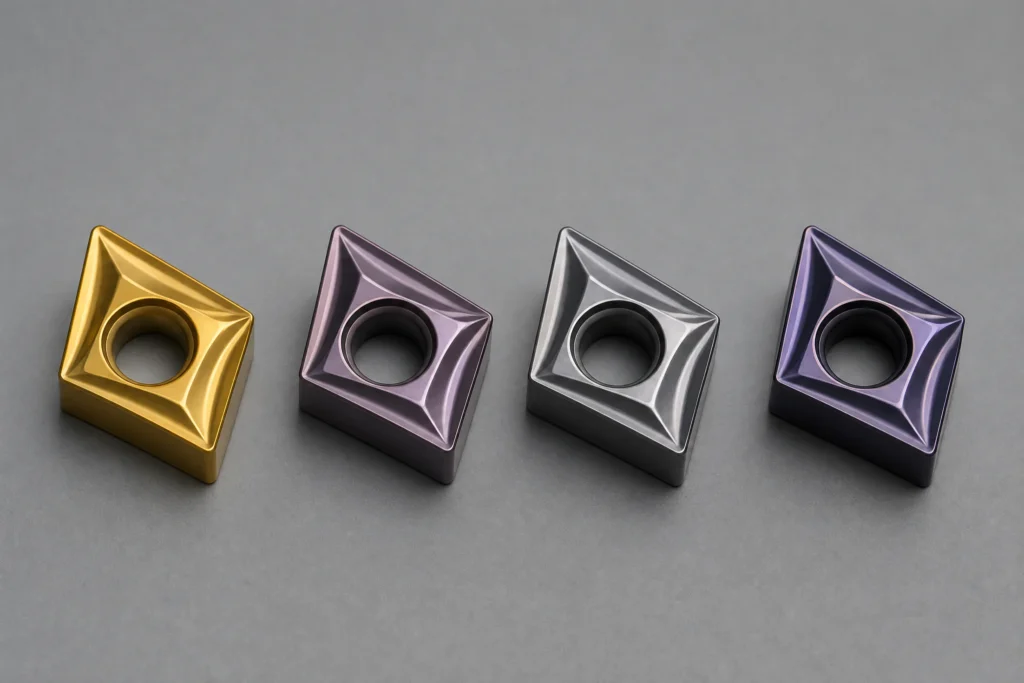
Choosing the wrong PVD coating type on a titanium substrate is a common mistake — each grade has a distinct operating envelope.
| Coating | Abbreviation | Hardness (HV) | Max Service Temp | Color | Best For |
|---|---|---|---|---|---|
| Titanium Nitride | TiN | ~2,000–2,300 HV | ~500°C | Gold | Medical implants, watch cases, general tooling |
| Titanium Aluminum Nitride | TiAlN | ~2,800–3,300 HV | ~800°C | Violet/dark gold | High-speed cutting, aerospace, dry machining |
| Chromium Nitride | CrN | ~2,000–2,300 HV | ~700°C | Silver-gray | Corrosive environments, hydraulics, forming |
| Aluminum Titanium Nitride | AlTiN | ~3,300 HV | ~900°C | Dark violet | Extreme heat applications, inserts, dies |
TiN remains the most widely deployed coating on titanium medical and dental components. Its gold color is instantly recognizable on surgical instruments and orthopedic drill bits, and its biocompatibility (per ISO 10993) is extensively documented. The tradeoff: at ~2,000–2,300 HV it is the softest of the common nitride PVD options.
TiAlN is the industrial workhorse when hardness and heat resistance matter more than color. The aluminum oxide layer that forms at the surface during high-temperature operation actually improves oxidation resistance — a phenomenon called “self-passivation.” In aerospace component finishing and dry CNC machining, TiAlN routinely extends tool life by 3–5× compared to uncoated titanium or TiN-coated alternatives.
CrN trades some hardness for exceptional corrosion resistance. Where a titanium part operates in saltwater, chemical processing environments, or repeated sterilization cycles, CrN holds up better than TiN or TiAlN under sustained chemical attack.
AlTiN (aluminum-rich variant, as opposed to TiAlN which is titanium-rich) is specified for the most thermally demanding cutting and forming applications. With a service temperature approaching 900°C, it is overkill for most titanium part applications — but right at home on the tooling used to machine those same parts.
A note on coating thickness: Most PVD coatings on precision titanium components target 2–4 µm. Thicker isn’t always better — beyond about 5 µm, residual stresses in the film increase and adhesion can degrade. Tight-tolerance bore or thread features may require dimensional compensation before coating if roundness or thread fit is critical.
Titanium PVD vs DLC Coating: Head-to-Head Comparison
If PVD nitrides are the reliable workhorse on titanium, DLC is the high-performance specialist — with specific adhesion constraints that every engineer needs to understand before specifying it.
| Property | PVD Nitride (TiN/TiAlN) | DLC (a-C:H or ta-C) |
|---|---|---|
| Hardness | 2,000–3,300 HV | 1,000–3,000 HV (a-C:H); up to 8,000+ HV (ta-C) |
| Coefficient of friction | 0.3–0.6 (dry) | 0.05–0.2 (dry) |
| Max service temperature | 500–900°C | ~300–350°C (practical max for most grades) |
| Thickness range | 1–5 µm | 1–4 µm |
| Adhesion to titanium | Good (direct deposition) | Requires Cr or Ti interlayer |
| Color options | Gold, violet, silver, dark violet | Dark gray to black only |
| Biocompatibility | Excellent (TiN: ISO 10993 documented) | Excellent (DLC is chemically inert) |
| Cost (job shop, small batch) | $50–$300 per part (aerospace grade) | $80–$500 per part |
| Process maturity | High — 40+ years industrial use | Moderate — growing fast |
Hardness: Closer Than You Think
The hardness gap between PVD nitrides and DLC depends heavily on which DLC variant you’re comparing. Hydrogenated amorphous DLC (a-C:H) typically measures 1,000–3,000 HV — often softer than TiAlN. Tetrahedral amorphous carbon (ta-C), the hydrogen-free variant deposited by filtered cathodic arc, can exceed 8,000 HV on the Vickers scale. Most commercial DLC coatings for industrial and watch applications are a-C:H variants, sitting in the 1,500–3,000 HV range. The point: don’t assume “DLC = harder than PVD” as a blanket rule — it depends entirely on which DLC subtype you’re being quoted.
Friction: Where DLC Wins Definitively
DLC’s coefficient of friction (CoF) in dry sliding conditions is genuinely low — 0.05 to 0.2 versus 0.3 to 0.6 for most PVD nitrides. This matters enormously for sliding contacts: pistons, engine valves, bearings, endoscopic instruments that must slide inside cannulas. On titanium aerospace fasteners and pins subject to fretting wear, DLC’s lubricity advantage is real and measurable.
However, DLC’s friction performance degrades in humid air — the CoF can rise to 0.3 or higher in environments with >50% relative humidity, partly closing the gap with PVD nitrides.
Temperature: PVD Nitrides’ Clear Advantage
PVD nitrides handle sustained heat far better than DLC. TiAlN on a titanium cutting tool remains functional at 800°C. DLC begins to graphitize in air at temperatures as low as 200°C, with practical performance degradation starting around 300–350°C for most commercial grades. Above 350°C, DLC’s hardness and friction advantages erode rapidly. In any application involving significant thermal cycling or continuous high-temperature operation, DLC is eliminated from consideration and a PVD nitride — typically TiAlN or AlTiN — takes over.
The Critical Issue: DLC Adhesion on Titanium
This is the part most vendor datasheets skip over. DLC films carry high compressive residual stresses — on the order of 1–10 GPa. The mismatch between DLC’s stress state and titanium’s elastic modulus (~114 GPa for Ti-6Al-4V) creates a significant driving force for delamination. In one 2024 MDPI study on Ti-6Al-4V substrates, DLC coatings without interlayers showed the greatest adhesion problems of all coatings tested.
The solution is a metallic interlayer — typically chromium (Cr) or titanium (Ti) — deposited before the DLC film. The interlayer acts as a compliant buffer zone that accommodates the stress mismatch. Chromium ion etching before DLC deposition further improves adhesion by creating a chromium-saturated interface zone.
The practical implication: any DLC coating process on titanium that doesn’t include an interlayer step should be treated as a reliability risk, especially in cyclic loading or impact applications.
Where Each Coating Wins: Application-by-Application
Neither PVD nitride nor DLC is universally superior — the right answer depends on what the titanium part actually experiences in service.
Aerospace Structural and Engine Components
Recommended: TiAlN or AlTiN PVD
Turbine blade roots, compressor disks, and titanium fasteners in hot sections of jet engines encounter both abrasive wear and thermal cycling. TiAlN holds its hardness through temperature excursions that would graphitize DLC. NADCAP-certified PVD coating is a standard part of the surface finishing specification for many OEM aerospace titanium components.
Medical Implants and Surgical Instruments
Recommended: TiN PVD (implants) or DLC (instruments)
For osseointegrating implants, TiN’s extensively documented biocompatibility (ISO 10993) and clinical track record make it the conservative, well-validated choice. For surgical instruments — where friction against tissue or against mating instrument surfaces matters more than temperature resistance — DLC’s ultra-low CoF is genuinely useful. Arthroscopic shavers, endoscope channels, and laparoscopic forceps benefit from DLC’s self-lubricating surface.
Watch Cases and Luxury Accessories
Recommended: PVD (decorative); DLC (all-black technical look)
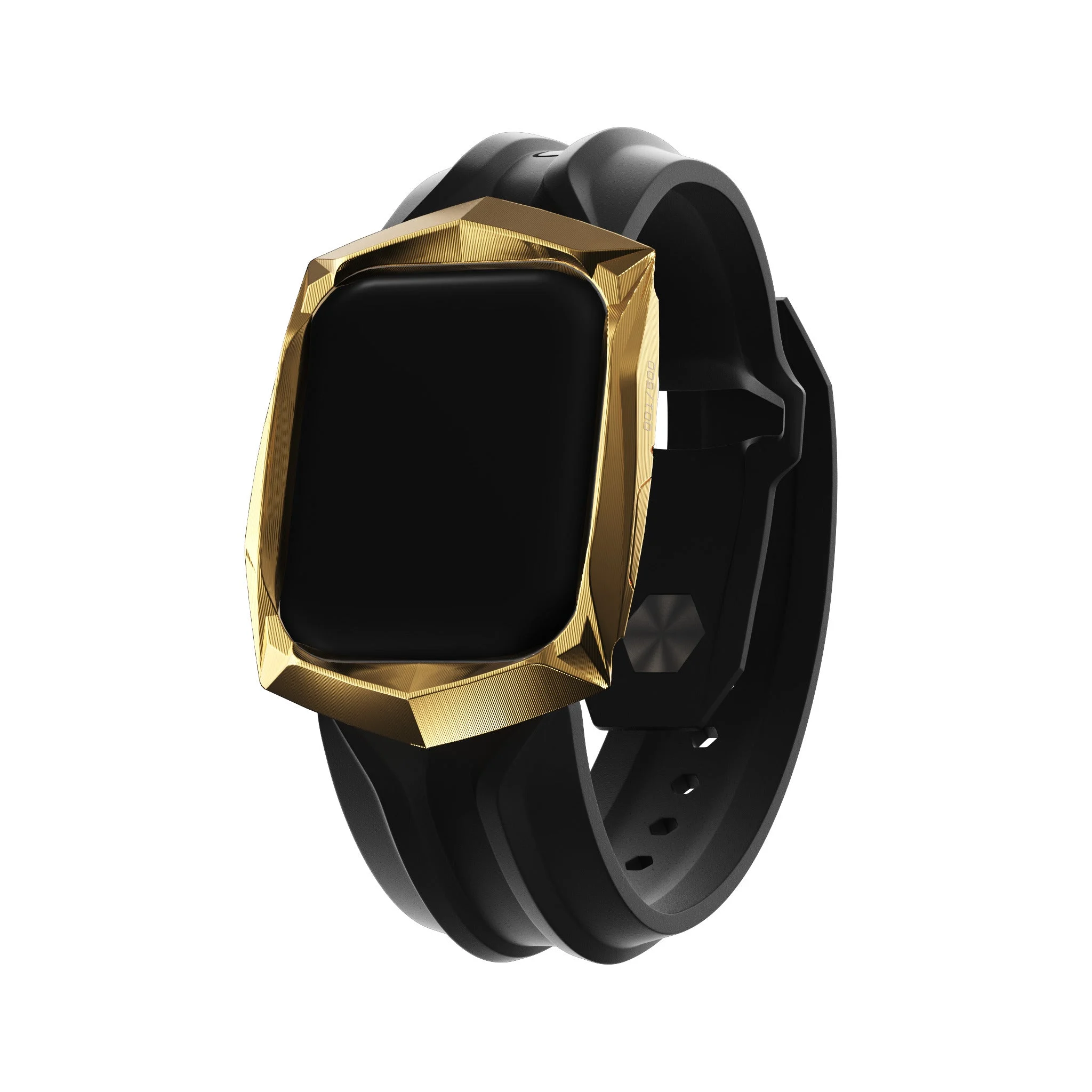
This is where the two coatings split cleanly on aesthetics. PVD on titanium watch cases gives you gold, rose gold, blue, bronze, and black finishes — the full palette that brands like Longines and Apple use on Apple Watch titanium editions. DLC produces a flat, dark gray-black finish with a slight matte appearance. If you need any color other than black, PVD is the only option.
On scratch resistance: high-quality PVD titanium watch coatings (TiN or TiAlN grades) outperform standard gold plating by a wide margin but will eventually show wear at sharp contact points (case edges, crown). DLC black coatings are marginally more scratch-resistant due to higher hardness, but the visual impact of scratches on a matte black surface is actually less obvious than on a polished gold PVD finish.
Cutting Tools and Forming Dies
Recommended: TiAlN PVD or DLC depending on temperature
For dry high-speed machining, TiAlN is the established choice. For cold-forming operations — stamping titanium sheet, precision cold extrusion, or injection molding of abrasive-filled polymers — DLC’s low friction dramatically reduces ejection force and prevents galling on titanium punch and die faces.
Titanium PVD for Decorative vs. Functional Use
The same physical process delivers two very different value propositions depending on what you’re coating.
Decorative PVD on Titanium
In consumer goods — watches, eyeglass frames, jewelry, architectural hardware — the PVD coating’s job is primarily aesthetic, with wear resistance as a bonus. Decorative titanium PVD:
- Runs at lower bias voltages to preserve surface gloss
- Often uses magnetron sputtering (smoother finish) over cathodic arc
- Targets 1–2 µm thickness to minimize color shift
- Common colors: gold (TiN), black (ZrN or CrN with black tuning), rose gold (TiN + copper alloy target blend), blue (TiO₂ or TiN with oxidation modulation)
The key quality differentiator in decorative PVD is film density and macroparticle count. A high-density TiN film with few macroparticles (the microdroplets inherent to cathodic arc processes) produces a glossier, more durable surface. VaporTech’s improved cathodic arc process, for example, achieved a >20% increase in surface gloss by reducing macroparticle formation.
Functional PVD on Titanium
Industrial and medical applications prioritize hardness, adhesion, and process stability over aesthetics. Functional coatings typically:
- Run at higher bias voltages (−50 to −200 V) for higher ion energy and denser film microstructure
- Target 3–5 µm thickness for maximum wear life
- Use adhesion testing per VDI 3198 as a release criterion
- May incorporate multilayer architectures (e.g., a CrN adhesion layer under a TiAlN wear layer) for demanding applications
The two use cases sometimes overlap — a medical implant needs both biocompatibility and a gold color (TiN satisfies both), while a luxury watch dial coating needs to survive 5+ years of daily wear (hardness matters there too).
How Much Does Titanium PVD Coating Cost?
Cost ranges vary significantly based on part geometry, batch size, coating type, and whether aerospace documentation is required.
For outsourced job shop work:
- Standard TiN on small parts (watch cases, surgical instruments): $5–$30 per piece in production quantities
- TiAlN on precision aerospace components (with NADCAP documentation): $50–$500 per piece
- DLC on precision components with interlayer: $80–$500 per piece, depending on interlayer process and part complexity
- Stripping and re-coating: typically 30–50% of the original coating cost
In-house PVD systems change the economics entirely. For companies running high volumes, the per-part cost can drop to cents per piece once capital equipment is amortized, but chamber time, target material, and process engineering overhead are real ongoing costs.
DLC tends to cost more than standard TiN per part because of the additional interlayer deposition step and longer cycle times in many PACVD (plasma-assisted CVD) processes. However, if DLC’s lower friction means reduced lubrication or longer component service life, the total cost of ownership can still favor DLC in the right application.
A practical note: Always ask your coating vendor whether their quoted price includes pre-cleaning. Many job shops quote coating only and charge separately for the cleaning process — which for titanium should be ultrasonic multi-stage cleaning, not a quick wipe-down.
Choosing the Right Coating: A Decision Framework
Three questions narrow the field quickly.
1. What’s the operating temperature?
- Above 400°C sustained → DLC is out. Use TiAlN or AlTiN.
- Below 300°C, no significant thermal cycling → DLC is viable.
2. Is low friction the primary requirement?
- Sliding contacts, bearings, endoscopic instruments → DLC (with interlayer)
- Wear resistance under moderate friction → TiN or TiAlN
3. Does it need a specific color or appearance?
- Any color other than dark gray/black → PVD nitride
- Matte black only → DLC or black PVD (ZrN-based or CrN)
A hybrid approach — a CrN adhesion layer beneath a DLC topcoat — is worth considering for titanium components that need both ultra-low friction and reliable adhesion. Some coating vendors offer this as a single-cycle multi-layer process.
Frequently Asked Questions
Can titanium be PVD coated directly?
Yes. Titanium is a well-established PVD substrate. The key preparation step is argon ion sputter cleaning inside the chamber immediately before deposition, which removes the native TiO₂ passivation layer and ensures strong film-to-substrate bonding.
What is the hardness of titanium PVD coating?
It depends on the coating type. TiN measures approximately 2,000–2,300 HV; TiAlN reaches ~2,800–3,300 HV; ta-C DLC can exceed 8,000 HV. Most production PVD nitride coatings on titanium parts fall in the 2,000–3,300 HV range.
How thick is PVD coating on titanium?
Typical thickness is 1–5 µm. Decorative applications target 1–2 µm to preserve surface finish; functional wear coatings are usually 3–5 µm. Going beyond 5 µm increases residual stress and can compromise adhesion.
Is titanium PVD coating biocompatible?
TiN is biocompatible per ISO 10993 and has decades of clinical use on implants and surgical instruments. DLC is also chemically inert and biocompatible, used in cardiovascular and orthopedic devices. Both are significantly better than nickel-containing electroplating for medical applications.
What temperature does PVD coating use on titanium?
Deposition temperatures typically range from 200°C to 500°C depending on the coating system. Cathodic arc processes can achieve full TiN deposition at temperatures low enough to coat thermally sensitive substrates. For titanium aerospace components, the usual target range is 250–450°C.
Why does DLC sometimes fail on titanium?
DLC has high intrinsic compressive stress. Without a metallic interlayer (Cr or Ti), this stress mismatch between the DLC film and the titanium substrate drives delamination, especially under cyclic loading. Properly designed DLC processes always include an interlayer deposition step.
How long does titanium PVD coating last?
Functional PVD coatings on tooling can last the lifetime of the component in the right application. Decorative PVD on watches and consumer goods typically maintains appearance for 3–7 years of daily use before showing wear at high-contact edges. Longevity depends far more on coating hardness, surface finish, and daily use conditions than on clock time.
Is PVD or DLC better for a titanium watch?
For color choice and proven track record, PVD. For the hardest possible matte-black finish, DLC. In practice, the difference in scratch resistance between a high-quality TiAlN PVD and a DLC coating is marginal at the wear rates typical in watch use. The bigger decision is usually aesthetic.
Summary
PVD coating on titanium is mature, well-understood, and versatile. The process works reliably across TiN, TiAlN, CrN, and AlTiN grades, with deposition temperatures (200–500°C) well within titanium’s thermal tolerance. For most functional applications, TiAlN is the first-choice PVD coating on titanium — it offers the best combination of hardness (~2,800–3,300 HV), temperature stability (800°C), and process reliability.
DLC offers lower friction and (in its ta-C form) higher peak hardness, but requires a metallic interlayer on titanium to achieve reliable adhesion and begins degrading around 300–350°C. DLC is the better choice when sliding friction is the dominant wear mode and operating temperatures stay well below 300°C. For everything else — heat, color flexibility, cost, and process maturity — PVD nitride wins on titanium.
The worst outcome is applying the wrong coating for the application. A DLC without an interlayer on a cycling aerospace component, or a TiN-coated tool pushed into a high-temperature dry-machining operation, will fail faster than an uncoated part. Start with the operating conditions, not the coating name.