China produces ~70% of the world’s titanium sponge — roughly 260,000 metric tons in 2025 — but that dominance does not translate to the aerospace market, where Western manufacturers can only source from a handful of certified suppliers in Japan, Kazakhstan, and Saudi Arabia. Japan ranks second at 53,000 t despite mining zero domestic ore. Russia, once Western aviation’s largest supplier, has seen output fall 24% in one year and now operates largely outside Western supply chains. This guide breaks down the 2026 rankings by country, explains what the numbers actually mean for procurement, and maps who can sell to Boeing, Airbus, and the US defense industrial base.
What “Titanium Production” Actually Measures — Three Different Rankings
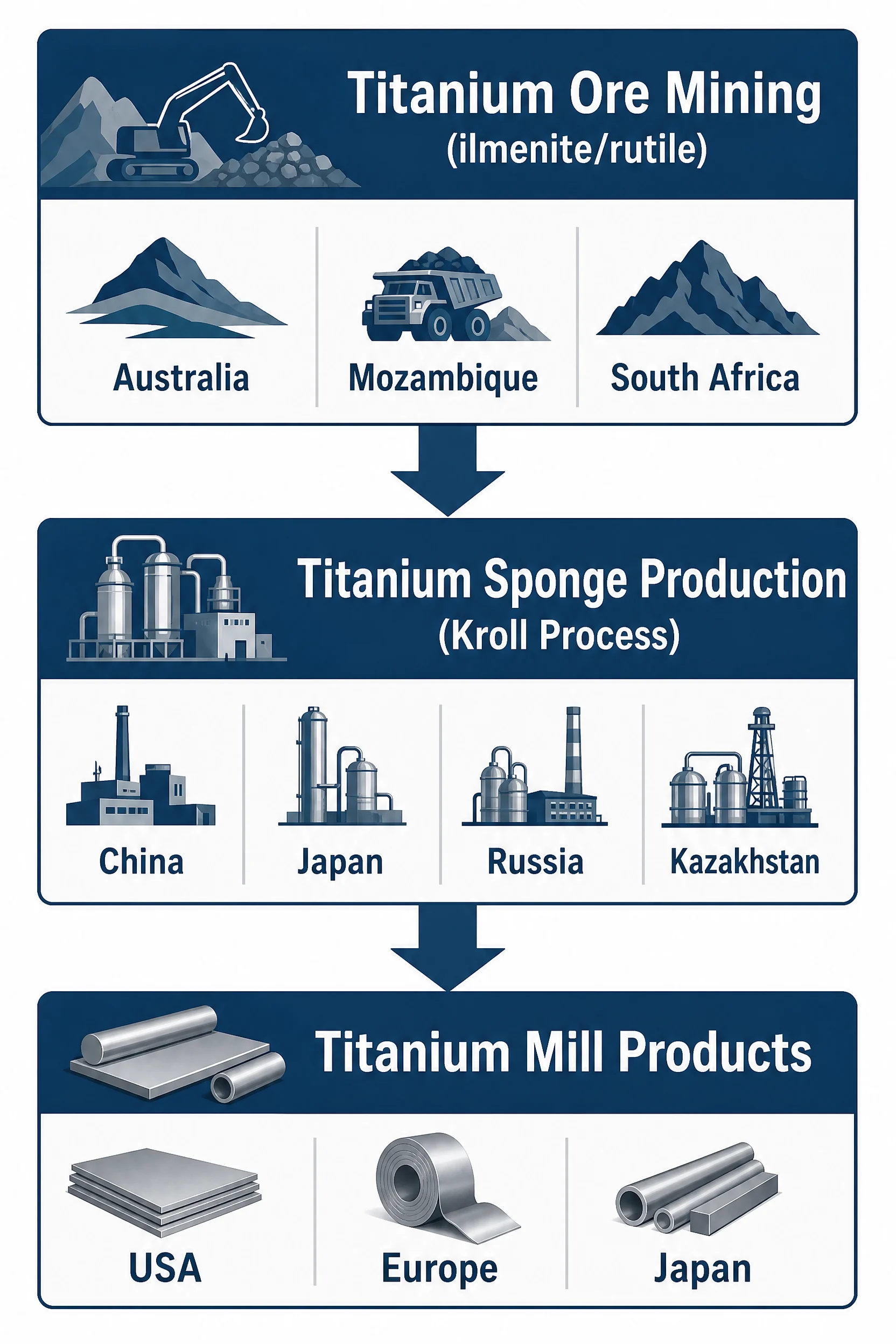
Before comparing countries, it’s worth clarifying what “titanium production” means — because the answer depends entirely on which step of the supply chain you’re measuring. Most ranking articles on this topic don’t specify, which is why you’ll find wildly different numbers for the same country depending on the source.
There are three distinct metrics:
1. Titanium mineral mining (ore) — This measures raw ilmenite and rutile ore extracted from the ground. Australia and Mozambique dominate here. This is where titanium feedstock originates.
2. Titanium sponge production — This is the conversion of ore (via the Kroll process) into porous metallic titanium “sponge,” the primary traded form of titanium metal. China dominates this step. This is the metric used in USGS production rankings and the one that matters most for the aerospace and industrial supply chain.
3. Titanium mill products — Ingot, bar, plate, sheet, and wire manufactured from sponge. The US, Europe, Japan, and China all have significant capacity here, but much of it depends on imported sponge.
| Metric | Top Countries | Who Ranks Where |
|---|---|---|
| Titanium ore mining (ilmenite + rutile) | Australia, Mozambique, South Africa, China, Canada | Australia often ranks #1 in ore |
| Titanium sponge production | China, Japan, Russia, Kazakhstan, Saudi Arabia | China is ~70% of global output |
| Titanium mill products | China, US (via imports), Japan, EU (via imports) | Ranking depends on sponge access |
The confusion in most SERP articles comes from mixing these three tiers. WorldAtlas’s often-cited ranking (Russia #2, Japan #3) uses 2013 sponge figures. A 2016 article from the same era shows Australia as a major “titanium producer” — which is accurate for ore mining but entirely wrong for sponge. The rest of this article focuses exclusively on titanium sponge, since that is the production metric that drives aerospace supply chains, pricing, and trade policy.
2026 Global Titanium Sponge Production Rankings
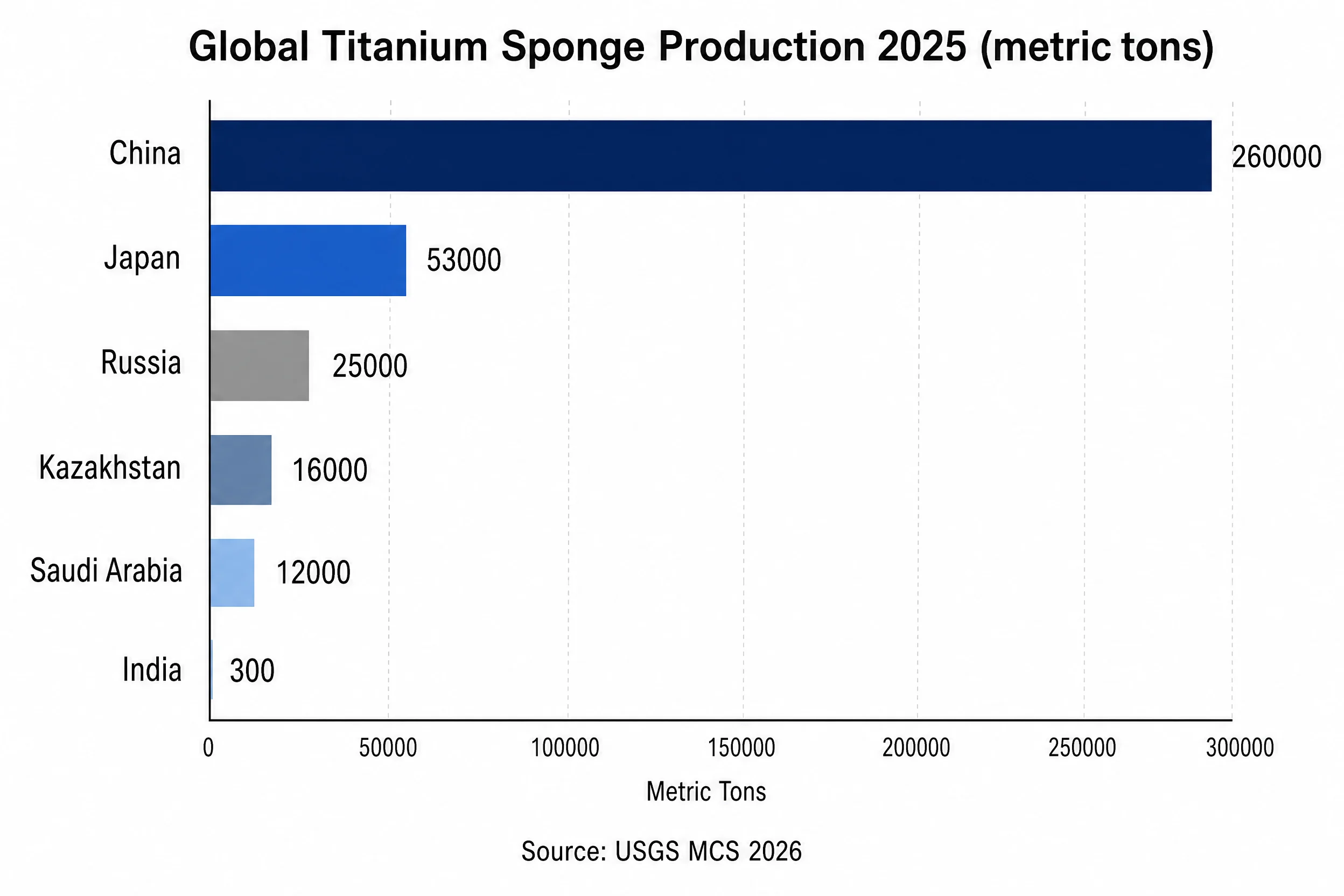
The table below is based on USGS Mineral Commodity Summaries 2026 (published February 2026), the most authoritative public dataset for titanium sponge production by country. The 2025 production column represents USGS estimates; 2024 figures are reported actuals.
| Rank | Country | 2024 Production (t) | 2025 Production (t, est.) | Capacity (t/yr) | Capacity Utilization | YoY Trend |
|---|---|---|---|---|---|---|
| 1 | China | 256,000 | 260,000 | 320,000 | 81% | ↑ +1.6% |
| 2 | Japan | 57,000 | 53,000 | 65,200 | 81% | ↓ −7% |
| 3 | Russia | 33,000 | 25,000 | 46,500 | 54% | ↓ −24% |
| 4 | Kazakhstan | 19,000 | 16,000 | 26,000 | 62% | ↓ −16% |
| 5 | Saudi Arabia | 14,000 | 12,000 | 15,600 | 77% | ↓ −14% |
| 6 | India | 300 | 300 | 500 | 60% | → flat |
| — | Ukraine | 0 | 0 | ~10,000 (idle) | 0% | war-related shutdown |
| — | United States | <500 (electronics grade only) | 0 | 24,000 (idled) | ~0% | last aerospace plant closed 2024 |
| — | World Total | ~380,000 | ~370,000 | ~470,000 | ~79% | ↓ −3% |
Source: USGS Mineral Commodity Summaries 2026. Russia figures are USGS estimates; EU Political Report (Sep 2025) cites ~17,000 t based on measured export data, suggesting actual output may be lower than the USGS estimate.
Three things stand out in this table:
China’s capacity far exceeds its output. At 320,000 t/yr of installed capacity against 260,000 t/yr of production, China is running with ~60,000 t/yr of idle capacity. This structural overcapacity has pushed Chinese domestic sponge prices to ~$5.70/kg — roughly half the price of aerospace-qualified material from Japan or Kazakhstan.
Russia fell 24% in a single year. The drop from 33,000 t (2024) to 25,000 t (2025) is the biggest year-over-year swing among established producers. This story has not been covered by any major trade publication. The USGS data is public; it simply hasn’t been translated into readable editorial content. More on Russia’s situation below.
The US has essentially no domestic sponge production. The last meaningful US aerospace-grade sponge plant (in Henderson, Nevada, 12,600 t/yr) was idled in 2020. A small facility in Utah produces ~500 t/yr of electronics-grade material. For all practical purposes, the US is 100% import-dependent on titanium sponge.
Country Profiles: The Full Picture Behind the Numbers
China — 70% of Volume, Zero Access to Western Aerospace
China’s dominance in titanium sponge is not in dispute. At 260,000 t produced in 2025 against a global total of ~370,000 t, China controls roughly 70% of world output. That share has tripled since 2018, when China accounted for ~39% of global sponge production (up from ~37% in 2015–2016).
The center of gravity is Baoji, Shaanxi province — a city of roughly 3.8 million people that accounts for ~65% of China’s titanium processing and an estimated 33% of total global titanium output. Baoji’s municipal government published a 2025 action plan targeting 100,000 t/yr from the city alone. There are more than 1,000 titanium enterprises concentrated in the area.
China’s cost advantage is structural. Titanium sponge production via the Kroll process is energy-intensive; China runs much of it on coal-heavy electricity at rates significantly below European or Japanese industrial tariffs. Labor costs are 70–80% lower than comparable Western facilities. The result: Chinese domestic sponge is trading at approximately $5.70/kg, compared to $11–14/kg for aerospace-qualified material from Japan or Kazakhstan.
But here is what most ranking articles miss: Chinese titanium sponge cannot be used in Western commercial or defense aerospace. The reasons are regulatory and logistical, not purely technical. Boeing and Airbus require their sponge suppliers to hold DFARS (Defense Federal Acquisition Regulation Supplement) compliance and AS9100 aerospace quality certification. VSMPO-AVISMA in Russia held those certifications; Osaka Titanium and Toho in Japan hold them; UKTMP in Kazakhstan holds them. No Chinese producer currently holds Western aerospace qualification.
The result: China produces 260,000 t/yr of sponge and can supply industrial applications — chemical processing equipment, consumer products, architectural components, military procurement for Chinese programs — but the premium aerospace market remains off-limits. Less than 5% of Baoji’s titanium output is aerospace or medical grade by Western certification standards.
A second factor worth noting: China introduced dual-use export controls in 2024 (MOFCOM regulations) requiring licenses for titanium alloys exceeding 900 MPa tensile strength and tubes exceeding 75mm OD. The practical impact on Western procurement is still being assessed, but it signals a more assertive Chinese stance on titanium as a strategic material.
China’s capacity overhang — 60,000 t/yr of installed but idle capacity — is also creating an overcapacity crisis domestically. Smaller Baoji producers are shuttering as prices fall below production costs for lower-quality grades. Chinese state media have acknowledged the problem. This dynamic is relevant for anyone tracking long-term price trends: if Chinese producers consolidate and idle more capacity, global sponge prices could firm from their current lows.
Japan — The Critical Middleman the US Cannot Replace
Japan’s position in titanium is genuinely paradoxical: the country has zero domestic titanium ore deposits yet ranks as the world’s second-largest sponge producer and the single most important source for US aerospace titanium.
Japan imported all of its titanium feedstock — primarily ilmenite concentrate from Australia and Mozambique — processed it via two producers (Osaka Titanium Technologies and Toho Titanium), and in 2025 exported product accounting for 73% of all US titanium sponge imports.
The two Japanese producers have distinct profiles:
- Osaka Titanium Technologies (OTC): World’s second-largest titanium sponge producer. Current capacity ~40,000 t/yr at its Amagasaki facility, with a ¥39 billion (~$250M) expansion targeting +10,000 t/yr (announced September 2024, revised upward March 2026).
- Toho Titanium: Domestic sponge capacity ~25,200 t/yr (Wakamatsu and Chigasaki plants). Also operates AMIC Toho Titanium Metal in Saudi Arabia (15,600 t/yr, a JV with Saudi Aramco subsidiary).
Japan’s 2025 production dropped to 53,000 t from 57,000 t in 2024, a ~7% decline. The cause: inventory corrections from downstream Japanese customers and lower-than-expected Boeing build rates. The Boeing 737 MAX and 787 Dreamliner production slowdowns in 2023–2024 reduced titanium drawdown across the entire aerospace supply chain.
The strategic fragility of Japan’s position is worth naming directly. Japan imports its ore — if Australian or Mozambican supply were disrupted, or if freight routes in the Pacific were interrupted, Japan’s entire production base could stall within weeks. The US defense industrial base has effectively outsourced its titanium sponge dependency to a country that has itself outsourced its raw material supply to the other side of the globe. The USGS BIS Section 232 report identified this as a strategic concern as far back as 2018.
Russia — A 24% Production Decline Nobody’s Reporting

Russia’s decline in the USGS 2026 data deserves more attention than it has received. Production fell from 33,000 t in 2024 to an estimated 25,000 t in 2025 — a 24% drop in a single year. Some analysts put the true figure even lower: EU Political Report (September 2025) cited ~17,000 t based on measured export data, suggesting VSMPO-AVISMA’s actual output may be substantially below the USGS estimate.
For context: Russia peaked at approximately 44,000 t/yr of sponge production pre-2022. That figure has now been cut roughly in half. Capacity sits at 46,500 t/yr, meaning actual utilization is somewhere between 37% and 54% — the lowest of any major sponge producer.
The cause is not technical or resource-related. VSMPO-AVISMA (owned ~25% by Rostec, the Russian state defense conglomerate) lost its largest Western customers after February 2022:
- Boeing suspended all Russian titanium purchases in March 2022. Before the war, Boeing sourced an estimated 30–35% of its titanium from VSMPO.
- Airbus had sourced roughly 50–60% of its titanium from VSMPO pre-war. It has since reduced that to approximately 20%, with further reduction ongoing.
- Both Boeing and Airbus have confirmed they are targeting near-zero Russian titanium by 2026–2027.
What makes Russia’s situation unusual is that titanium was deliberately excluded from Western sanctions. Neither the US, EU, nor UK has formally sanctioned VSMPO-AVISMA, despite Rostec’s presence on multiple sanctions lists. The rationale: sanctioning VSMPO in 2022 would have risked grounding Western civil aviation within months. That exemption has held through 2025, but pressure for formal sanctions was intensifying through Q4 2025, described by analysts as “increasingly hard to justify” as supply chains have diversified.
Much of VSMPO’s residual output now serves domestic Russian military programs (the PLA equivalent equivalent: Russian 4th-generation fighters use significantly more titanium than their predecessors). Some exports are reportedly routed through China, creating traceability concerns for Western buyers who want to ensure supply chain compliance.
Kazakhstan — The Quiet Winner Since 2022
Kazakhstan’s UKTMP (Ust-Kamenogorsk Titanium and Magnesium Plant) is one of the less-covered stories in critical minerals supply chains, but it may be the most consequential for Western aerospace buyers over the next five years.
UKTMP produced 19,000 t in 2024 (per Argus Media citing direct UKTMP confirmation, slightly above the USGS figure of 16,000 t for 2025 estimates) and holds a 26,000 t/yr capacity. When Russian supply fell out of Western aerospace supply chains post-2022, Kazakhstan was the most straightforward substitute: geographically adjacent, already AS9100-certified, and not subject to any sanctions.
By 2025, Kazakhstan accounted for 13% of US titanium sponge imports alongside Saudi Arabia. UKTMP’s management has stated an ambition to capture 18–20% of global aerospace-segment sponge supply.
The company has committed to a $520 million investment program through 2033, including a new sponge facility. In 2025, UKTMP sold approximately 12,000 t of titanium products generating ~$179M in revenue.
One underappreciated geopolitical factor: Kazakhstan has maintained a careful balancing act between Russia and the West. UKTMP continued exports to Western customers despite geographic proximity to Russia and historical supply chain links through Russian territory. This required deliberate routing through alternative logistics corridors (Trans-Caspian, via Azerbaijan and Turkey), adding cost but preserving market access.
Saudi Arabia — The Emerging #5 Most Analysts Miss
Saudi Arabia now ranks fifth in global titanium sponge production at 12,000 t (2025e, USGS), and yet it appears in almost none of the country-ranking articles in the SERP. That gap is worth filling, because Saudi Arabia is also one of only three or four sources of Western aerospace-qualified sponge globally, and it has become a top-three supplier to the US market.
The facility is AMIC Toho Titanium Metal — a joint venture between Toho Titanium (Japan) and the Advanced Metals Industries Cluster (AMIC), a Saudi company backed by Aramco subsidiaries. Capacity is 15,600 t/yr. Production ramped from 11,000 t in 2023 to 14,000 t in 2024, with 2025 estimates at 12,000 t (slight dip, likely reflecting the same Boeing production rate headwinds affecting Japan).
The strategic significance: Saudi Arabia holds aerospace certification, sits outside Russia and China’s geopolitical orbit, and is aligned with US industrial policy goals. The AMIC Toho JV structure means Toho’s quality management systems and aerospace qualification processes apply directly to the Saudi facility — the sponge is essentially Japanese-qualified titanium produced at lower cost in the Gulf.
In 2025, Saudi Arabia accounted for 13% of US titanium sponge imports — the same share as Kazakhstan, making it part of the new triumvirate (Japan 73%, Kazakhstan 13%, Saudi Arabia 13%) that now supplies the US.
India — Massive Reserves, Minimal Output (But Watch the Trajectory)
India is a case study in the gap between resources and production capability. The country holds approximately 11% of the world’s ilmenite reserves — significant by any measure — yet produces only 300 t/yr of titanium sponge, less than 0.1% of global output. India’s rutile and ilmenite deposits in Odisha, Tamil Nadu, and Kerala are well-documented and largely underdeveloped for domestic titanium conversion.
The capacity mismatch is beginning to close. Aeroalloy Technologies (part of PTC Industries, a listed Indian company) has commissioned what it describes as the world’s largest titanium sponge plant at 6,000 t/yr. If that capacity utilizes successfully, India could grow from 300 t to several thousand tons within two to three years.
India’s sponge production is not currently aerospace-certified for Western OEM supply chains. It would be a domestic market supplier first, potentially displacing some Chinese imports for Indian aerospace programs (HAL, ISRO, defense programs). An eventual path to Western certification exists but would require years of qualification work.
The Aerospace Certification Map — Who Can Boeing Actually Buy From?
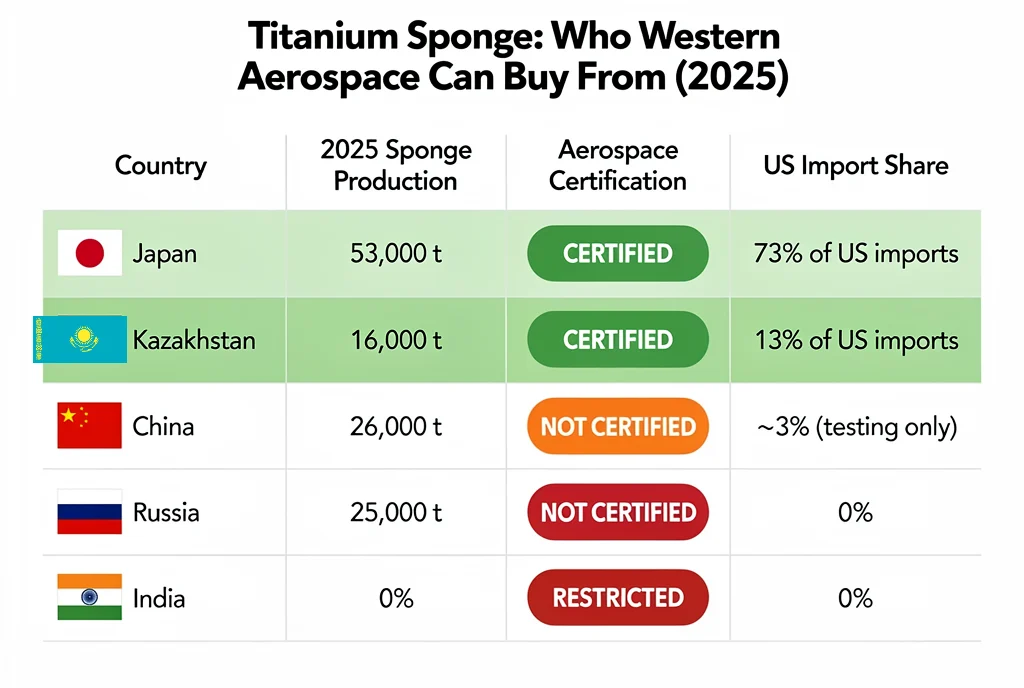
Production volume and procurement utility are two different things. The table above shows that China produces 260,000 t/yr of titanium sponge. But a Boeing or Airbus procurement team cannot buy Chinese titanium sponge for its 787 Dreamliner or A350 fuselage frames. Understanding why requires a quick look at how aerospace titanium qualification actually works.
Western commercial aircraft and defense contractors require titanium sponge suppliers to hold:
- AS9100 — the aerospace quality management standard (IAQG)
- DFARS compliance (Defense Federal Acquisition Regulation Supplement) — for US defense programs, requiring domestically produced or specifically approved allied-nation sources
- Boeing or Airbus approved supplier status — each OEM runs its own approved materials list (AML) with additional testing and auditing requirements on top of AS9100
Chinese sponge producers have not completed these qualification processes for Western commercial aerospace programs. Some Chinese companies supply Chinese military programs under Chinese military standards (GJB), which is a separate system. This is not a political restriction specifically — it is a certification bottleneck that would take years and significant investment to clear, and the commercial incentive for Chinese producers to pursue it is weak given their dominant position in the lower-cost industrial market.
The table below maps each major producing country against its actual aerospace access:
| Country | 2025 Sponge Production | Aerospace Certified? | US Import Share (Jan–Jul 2025) | Status |
|---|---|---|---|---|
| China | 260,000 t | No (not DFARS/AS9100 for Western OEMs) | ~3% (qualification testing only) | Industrial grade only |
| Japan | 53,000 t | Yes (Osaka Ti, Toho — full Boeing/Airbus AML) | 73% | Primary Western aerospace source |
| Russia | 25,000 t | Formerly yes; now de facto no | ~0% | Sanctioned commercial relationships |
| Kazakhstan | 16,000 t | Yes (UKTMP — AS9100, Boeing/Airbus approved) | 13% | Strategic Western alternative |
| Saudi Arabia | 12,000 t | Yes (AMIC Toho — Toho quality system) | 13% | Certified, growing capacity |
| India | 300 t | No (not yet qualified for Western aerospace) | 0% | Emerging; domestic market only |
The practical implication: out of ~370,000 t of global sponge production in 2025, roughly 81,000 t (Japan + Kazakhstan + Saudi Arabia) is consistently accessible for Western commercial aerospace and US defense procurement. That is approximately 22% of total global output.
Russia’s roughly 25,000 t/yr sits in a gray zone — technically not sanctioned, but Boeing and most major Western Tier 1 suppliers have wound down purchases, and auditing Russian facilities under current conditions is impractical. Realistically, Western aerospace procurement managers should not include Russia in their current sourcing calculations.
The implication for supply chain risk is stark. The US consumed approximately 44,000 t of sponge in 2025. Its domestic production is functionally zero. Its aerospace-certified import base is 81,000 t globally — with 73% of that coming from Japan, a country that itself sources 100% of its titanium ore from offshore.
This is the context behind the USGS BIS Section 232 report conclusion that titanium sponge represents a “potential single point of failure” in the US defense industrial base, a finding first published in 2019 that has not been resolved.
How the Russia-Ukraine War Rewired Titanium Trade Flows
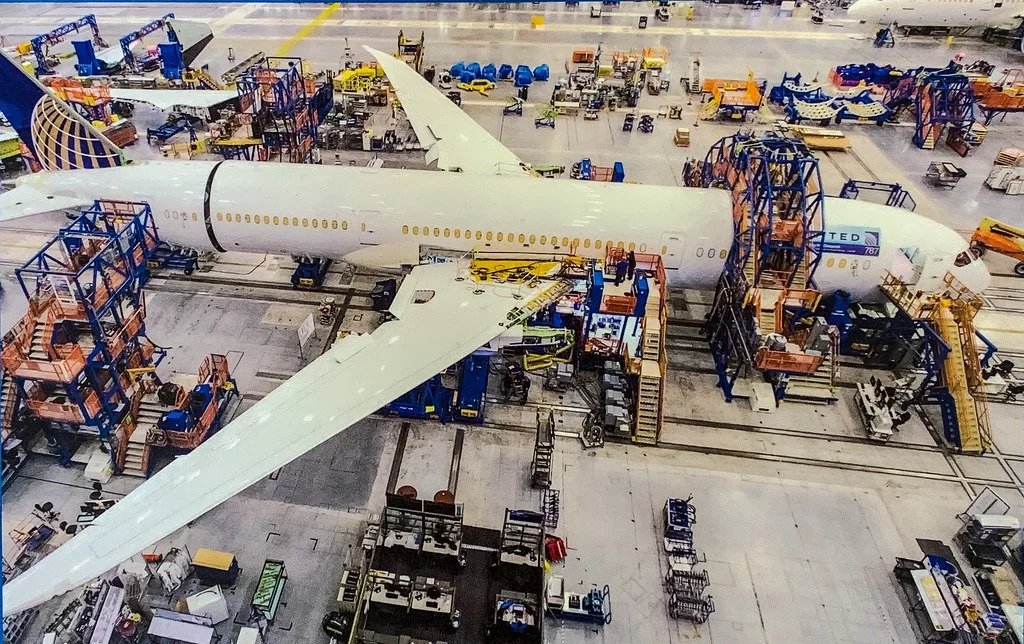
Before February 2022, the Western aerospace industry had concentrated a disproportionate share of its titanium supply in VSMPO-AVISMA. By most estimates, Boeing sourced 30–35% of its titanium from Russia; Airbus sourced closer to 50–60%. Both companies had long-term supply agreements with VSMPO, viewing it as an efficient, high-quality, and cost-competitive source.
The invasion changed that calculus overnight — not because of sanctions (titanium was specifically excluded), but because of reputational risk, ESG pressures, and the practical reality that auditing a Russian supplier became impossible under wartime conditions.
How US import flows shifted between 2021 and 2025:
| Year | Japan | Kazakhstan | Saudi Arabia | Russia | Other | Total Imports (t) |
|---|---|---|---|---|---|---|
| 2021 | ~85% | ~8% | ~5% | ~2% | <1% | 16,000 |
| 2022 | ~75% | ~12% | ~8% | ~0% | 5% | 30,900 |
| 2023 | ~82% | ~9% | ~7% | 0% | 2% | 40,400 |
| 2024 (Jan–Sep) | ~67% | ~7% | ~23% | 0% | 3% | ~40,000 |
| 2025 | 73% | 13% | 13% | 0% | 1% | 44,000 |
Sources: USGS MCS 2025 and MCS 2026. 2021–2023 figures are USGS reported; 2024 Jan–Sep from Argus Media; 2025 import source percentages reflect January–July 2025 per USGS MCS 2026.
Several dynamics are visible in this data:
Japan absorbed the initial shock. In 2022–2023, as Boeing and Airbus rapidly diversified away from Russia, Japan was the natural landing zone — it already held the certifications and the production capacity. US imports surged from 16,000 t in 2021 to 40,400 t in 2023, a 152% increase in two years. Japan captured the majority of that new demand.
Saudi Arabia’s rapid emergence. The jump in Saudi Arabia’s share — from ~5% in 2021 to 13% in 2025, passing through a notable spike to 23% in early 2024 — reflects AMIC Toho’s ramp to near-full capacity. The Saudi facility was already aerospace-certified (using Toho Japan’s quality systems), so it could absorb demand without a multi-year qualification delay.
Kazakhstan’s steady growth. UKTMP’s consistent 13% share reflects a deliberate strategy to displace Russian supply directly — same geography, same Kroll-process technology, different political alignment.
Ukraine’s parallel disruption — the ore supply angle.
Ukraine was not a major titanium sponge producer, but it was a meaningful raw material supplier. The Zaporizhzhia Titanium and Magnesium Combine (ZTMK) — located in Zaporizhzhia city — produced approximately 10,000 t of sponge annually pre-war, and Ukraine was a significant ilmenite ore exporter (553,000 t in 2021, generating $161.9M in export revenue). By 2022, ilmenite ore exports had fallen 42% to 322,000 t, and by 2023–2024 the ZTMK sponge facility was fully offline.
The double disruption — both Russian sponge supply and Ukrainian ore supply falling simultaneously — created acute pressure on Western supply chains in 2022–2023. The industry has substantially adapted by 2025, but the adjustment was neither smooth nor cheap.
Titanium Sponge Prices in 2026 — What Grade and Source Country Cost
Titanium sponge is not exchange-traded on the LME or any commodity exchange. Prices are negotiated via private OTC contracts and tracked by specialist services including Argus Media, Asian Metal, and ICIS. This means published price data represents reported ranges rather than a single benchmark.
The price landscape in 2025–2026 is defined by a large and persistent gap between Chinese domestic prices and aerospace-qualified material from Western-certified sources:
| Grade / Origin | Price Range (2025–2026) | Notes |
|---|---|---|
| China domestic (99.6% grade) | ~$5.70–6.40/kg | Highly competitive; industrial grade; not aerospace-qualified for Western OEMs |
| Kazakhstan / Saudi Arabia sponge | ~$8.50–10.50/kg | Aerospace-qualified; includes logistics premium |
| Japan aerospace-grade sponge | ~$11–14/kg | Premium for proven quality and supply security |
| US landed duty-paid (blended average) | ~$12–13/kg | USGS MCS 2025/2026 reported US import value |
| US landed with China tariff (if applicable) | ~$14–15/kg+ | 15% universal tariff + 25% China-specific Section 301 tariff |
Note: Prices are approximate and fluctuate. USGS import values are annual averages of declared customs values and include freight.
A few pricing dynamics worth flagging for procurement teams:
The China price is real, but the landed cost is not what it appears. Chinese sponge at $5.70/kg faces a 15% universal US import tariff plus a 25% China-specific Section 301 tariff, bringing the landed cost to approximately $9.70/kg before freight and processing. That still undercuts aerospace-qualified Japanese or Kazakh material in absolute terms, but the 25% tariff has created uncertainty around US procurement of Chinese sponge for industrial applications.
Prices rose through 2025 and softened into mid-2026. After the supply chain tightening of 2022–2023 pushed aerospace-grade prices briefly above $20/kg in some spot market transactions, prices moderated through 2024–2025 as Japan and Kazakhstan expanded supply. By July 2026, Chinese domestic sponge had fallen to approximately ¥46.50/kg (~$6.40/kg), down ~8% year-over-year.
The aerospace premium reflects certification, not cost. Japan and Kazakhstan do not charge $11–14/kg because their production is dramatically more expensive than China’s. The premium reflects the qualification investment, the audit infrastructure, and the supply security value — a Boeing supplier cannot afford to have their titanium source lose certification mid-program. That security premium is structural and unlikely to compress significantly even if Chinese sponge prices fall further.
The overall titanium sponge market was estimated at approximately $2.7–2.8 billion in 2025 (multiple commercial research firms; note that figures vary significantly by scope definition). Growth projections range from 3–8% CAGR through 2032, depending on aerospace build rate recovery and defense spending trajectories.
What’s Next — Capacity Expansions and Supply Chain Shifts Through 2030
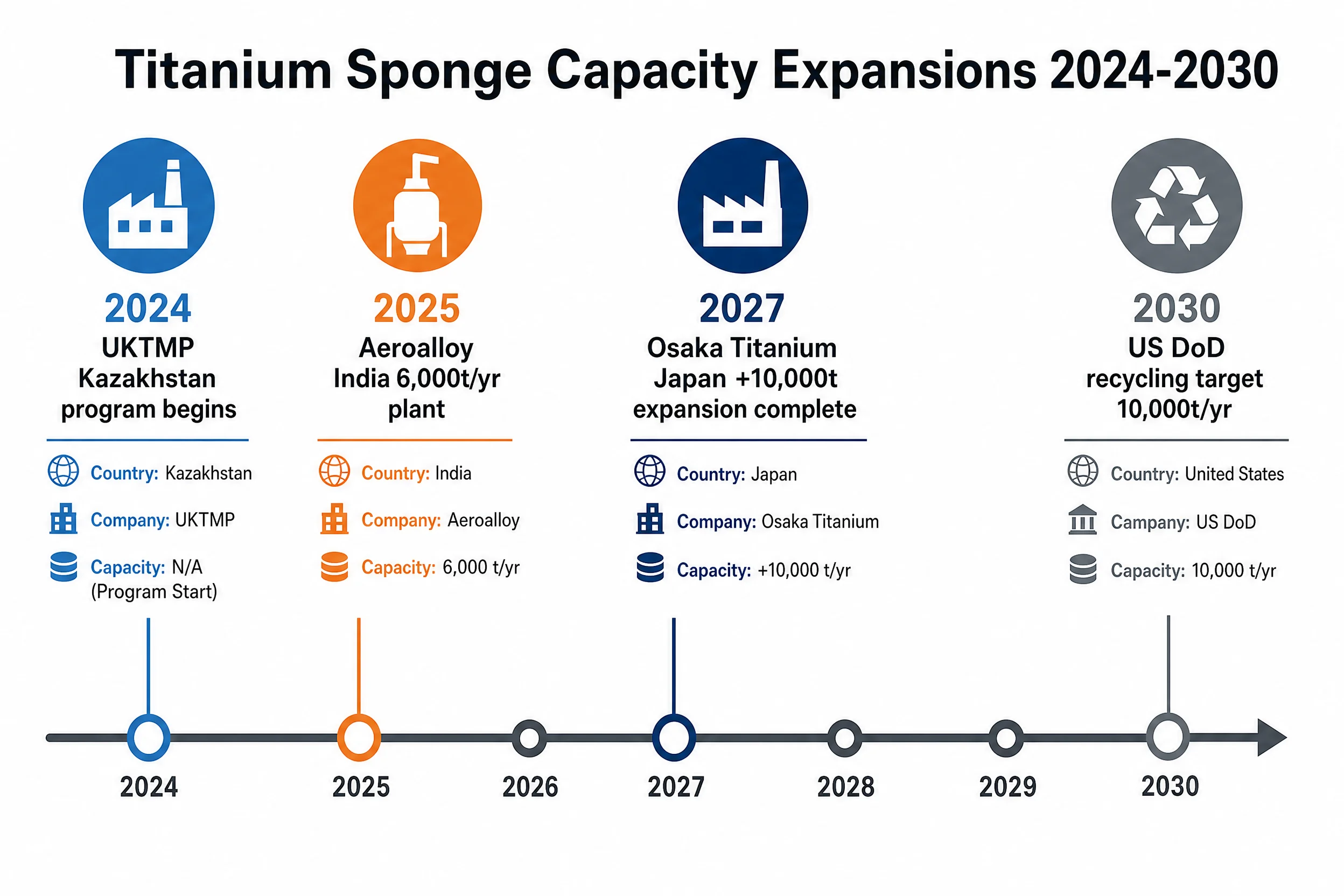
The current ranking is unlikely to look the same by 2030. Several confirmed capacity investments and policy shifts will materially alter the supply landscape over the next three to five years.
Osaka Titanium (Japan): +10,000 t/yr expansion underway
Osaka Titanium’s ¥39 billion (~$250M) expansion at its Amagasaki facility will bring capacity from ~40,000 t/yr to ~50,000 t/yr. The investment was originally announced at ¥33 billion in September 2024 and revised to ¥39 billion in March 2026 due to rising construction costs. The expansion was directly motivated by the post-Russia demand surge and Boeing’s stated commitment to diversify away from Russian suppliers. Timeline: targeted completion by 2027. This will consolidate Japan’s lead as the primary aerospace-qualified sponge source for Western programs.
Kazakhstan (UKTMP): $520M investment program through 2033
UKTMP’s expansion is the most significant capacity addition outside of China currently underway. The $520M program includes a new sponge production facility, upgraded magnesium recovery infrastructure, and logistics improvements to reduce dependence on Russian transit corridors. Management has stated a goal of supplying 18–20% of the global aerospace titanium sponge segment.
Saudi Arabia (AMIC Toho): Near full capacity, stable
AMIC Toho is already at approximately 77% of its 15,600 t/yr nameplate capacity. Growth potential is limited without additional capital investment. Toho has not publicly announced expansion plans for the Saudi facility, though the JV structure makes it dependent on Toho Japan’s strategic direction.
India (Aeroalloy Technologies): 6,000 t/yr sponge plant
Aeroalloy’s plant, part of PTC Industries, represents the most ambitious new-entrant sponge project outside established players. At 6,000 t/yr, it would make India a top-5 sponge producer if fully operational — a significant jump from 300 t/yr currently. The facility will initially target domestic Indian aerospace and defense programs (HAL’s LCA Tejas, ISRO launch vehicles, Indian Navy programs), not Western export markets. Timeline for full ramp is uncertain.
United States: Recycling-based production, DoD-funded
The US has essentially conceded that greenfield Kroll-process sponge production is not competitive domestically. Instead, policy has pivoted to scrap recycling technology. A Virginia-based company is scaling a plasma-based titanium powder production process from 2 t/yr to a targeted 125 t/yr using DoD funding, with long-term ambitions of 10,000 t/yr by 2030. Even at 10,000 t/yr, this would cover roughly 23% of US annual sponge consumption — a meaningful improvement from zero, but not supply independence.
China: Overcapacity management, export controls, dual-use restrictions
China’s trajectory through 2030 is less about adding capacity (it already has more than it can profitably run) and more about market segmentation. The 2024 dual-use export controls on high-strength alloys and tubing signal an intent to use titanium as a strategic lever. If similar controls were extended to sponge itself, the impact on Western aerospace supply chains — already dependent on a narrow set of certified sources — could be severe.
This is not the current direction; Chinese sponge is not restricted for export as of mid-2026. But the directional signal is worth noting for anyone doing five-year supply chain risk assessments.
Frequently Asked Questions
Which country produces the most titanium sponge in 2026?
China produces the most titanium sponge by far — approximately 260,000 metric tons in 2025 (USGS MCS 2026), representing roughly 70% of global output. Japan ranks second at 53,000 t, followed by Russia at 25,000 t, Kazakhstan at 16,000 t, and Saudi Arabia at 12,000 t.
Where does the US get most of its titanium from?
In 2025, the US imported approximately 44,000 metric tons of titanium sponge: 73% from Japan, 13% from Kazakhstan, and 13% from Saudi Arabia (USGS MCS 2026, January–July 2025 data). The US has no meaningful domestic sponge production — the last aerospace-grade plant was idled in 2020, and a small Utah facility produces ~500 t/yr of electronics-grade material only.
Is Russian titanium still available for Western manufacturers?
Russia’s VSMPO-AVISMA has not been formally sanctioned by the US, EU, or UK (titanium was deliberately excluded from sanctions to protect civil aviation supply chains). However, Boeing stopped purchasing Russian titanium in March 2022 and Airbus has reduced its Russian share from ~60% to approximately 20%, with further reduction ongoing. For most Western commercial aerospace and defense procurement purposes, Russian titanium should not be included in current supplier planning. Russia’s output has also declined sharply — an estimated 24% drop in a single year (33,000 t in 2024 to 25,000 t in 2025).
Why can’t Western aerospace manufacturers use Chinese titanium sponge?
It is not a sanctions issue — Chinese titanium sponge is legal to import. The barrier is certification: Western commercial aircraft manufacturers (Boeing, Airbus) and US defense contractors require suppliers to hold AS9100 aerospace quality certification, DFARS compliance for US defense programs, and approval on the OEM’s own Approved Materials List. No Chinese sponge producer currently holds these certifications for Western aerospace programs. The qualification process typically takes three to five years and significant investment; few Chinese producers have pursued it because their dominant position in the industrial market is commercially sufficient. Less than 5% of China’s Baoji titanium output is aerospace or medical grade by Western standards.
What is the difference between titanium ore production and sponge production?
These are two different stages of the supply chain. Titanium ore production (ilmenite and rutile mining) extracts raw mineral from the ground — Australia, Mozambique, and South Africa are major ore producers. Titanium sponge production is the conversion of ore into metallic titanium via the Kroll process — China, Japan, Russia, and Kazakhstan dominate this step. Country rankings differ dramatically between these two metrics, which is why sources that don’t specify which metric they are using produce confusingly inconsistent rankings.
How much does titanium sponge cost in 2026?
Prices vary significantly by grade and source country. Chinese domestic sponge (industrial grade) is approximately $5.70–6.40/kg. Aerospace-qualified sponge from Japan or Kazakhstan is $11–14/kg. US landed duty-paid average is approximately $12–13/kg (blended, per USGS). Chinese sponge imported to the US also faces a 15% universal tariff plus 25% China-specific tariff, raising the effective landed cost significantly. Titanium is not exchange-traded; all prices are OTC and approximate.
Which countries are expanding titanium production capacity?
Three major expansions are confirmed: (1) Osaka Titanium (Japan) is adding ~10,000 t/yr capacity through a ¥30 billion investment, targeted by 2027. (2) UKTMP (Kazakhstan) has committed a $520M investment program through 2033 to expand both sponge and related metals capacity. (3) Aeroalloy Technologies (India) has commissioned a 6,000 t/yr sponge facility, initially targeting domestic Indian aerospace programs. The US is pursuing recycling-based production through DoD-funded programs but at modest scale.
Summary
The global titanium sponge supply map has been redrawn since 2022. China now controls roughly 70% of global sponge production — but that share remains locked out of Western aerospace by certification barriers that are structural and unlikely to change soon. Russia, once the backbone of Western aviation’s titanium supply chain, has seen its output fall 24% in a single year and its role in Western supply chains shrink to near zero in commercial terms.
What remains is a relatively narrow set of certified aerospace sponge suppliers: Japan (the critical primary source), Kazakhstan (the strategic alternative), and Saudi Arabia (the emerging third-party certified source). Together, they supply roughly 81,000 t/yr of accessible, certification-compliant sponge against a global demand that exceeds 370,000 t/yr — a gap that reflects how much of global titanium production exists in a tier that Western aerospace simply cannot access without years of qualification work.
The supply chain looks more resilient than it did in early 2022, but the underlying concentration risk — in Japan specifically, and in the narrow base of certified producers generally — has not been structurally resolved. The Osaka Titanium expansion and Kazakhstan’s investment program are meaningful steps. US domestic production via recycling is promising but small. India’s trajectory is worth watching over a five-year horizon.
For procurement teams: the tier-one data point to track is not China’s total output. It is the combined production and capacity utilization of Japan, Kazakhstan, and Saudi Arabia — the three sources you can actually buy aerospace-qualified sponge from today.