Titanium forging uses controlled heat and pressure to shape titanium alloys into high-strength, near-net-shape components for aerospace, medical, and industrial applications. The two primary methods — open die and closed die forging — differ in tooling complexity, geometric capability, and economic breakeven. Temperature control is non-negotiable: Ti-6Al-4V, the most widely forged alloy, has a beta transus near 995°C, and most final forging stages target 875–950°C to preserve the dual alpha-beta microstructure that delivers optimal fatigue life and toughness. Exceeding that window degrades grain structure; dropping below it risks cracking and incomplete deformation. This guide covers all three forging methods, per-alloy temperature parameters, die selection logic, and the alpha case risk that no generic article bothers to mention.
What Is Titanium Forging?
Titanium forging is a solid-state deformation process: a heated titanium billet is pressed, hammered, or squeezed between dies to produce a near-net-shape component with a refined, directional grain structure. Unlike casting, which melts the metal and pours it into a mold, forging never crosses the liquidus — it works the metal while it remains solid, typically in the 800–050°C range depending on alloy and target microstructure.
Why forge instead of machine from bar stock? Grain flow. When titanium is forged, the grain structure follows the contour of the part — connecting rod fillets, blade root geometries, implant stems. That aligned grain flow raises fatigue strength and fracture toughness compared to a part machined from isotropic bar. For an aircraft structural bracket or a spinal implant, that difference is not academic.
The tradeoff is process complexity. Titanium’s narrow hot-working window, high reactivity above 650°C, and flow stress that changes sharply across the beta transus mean that a forging shop needs precise temperature control, the right lubrication system, and — for isothermal work — dies made from exotic nickel superalloys.
The Three Main Titanium Forging Methods
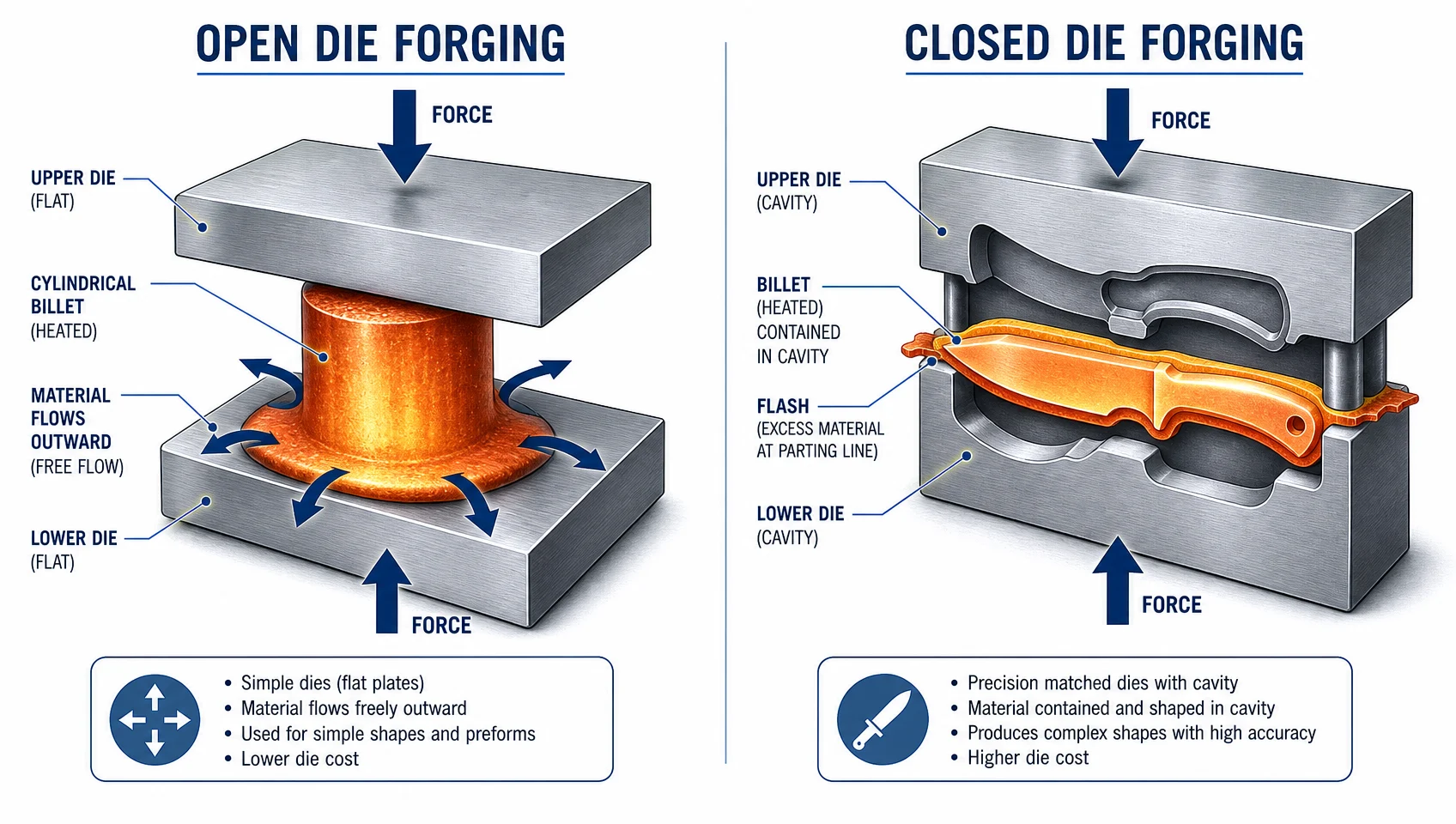
Before comparing open die and closed die head-to-head, it helps to understand all three methods used in production titanium forging:
Open Die Forging
The billet is deformed between flat or simple-contoured dies that do not fully enclose the workpiece. Excess material flows freely outward. The operator repositions and restrikes the billet multiple times to build up the target shape. This method handles very large parts — from 100 kg structural blocks to 40,000 kg landing gear forgings.
Closed Die Forging (Impression Die Forging)
A shaped cavity is machined into the die set. The billet is placed in the cavity and compressed until it fills the impression, with excess material escaping through a flash land. The flash is trimmed post-forging. Closed die forging achieves near-net shapes with tighter dimensional tolerances, reducing downstream machining.
Isothermal Forging (Hot Die Forging)
Both the billet and the die set are held at the same elevated temperature throughout the stroke — typically 850–950°C for titanium alloys. Eliminating the thermal gradient between workpiece and die allows very slow strain rates and very large reductions without cracking. The cost premium is significant (superalloy dies, vacuum or inert-atmosphere press chambers), but isothermal forging is the method of choice for complex titanium disks, blisks, and integrally bladed rotors where geometry, microstructure uniformity, and material utilization all matter simultaneously.
| Method | Tooling Cost | Geometric Complexity | Typical Part Size | Best For |
|---|---|---|---|---|
| Open Die | Low | Low–Medium | 10 kg–40,000+ kg | Large structural parts, prototype volumes, billet conversion |
| Closed Die | Medium–High | Medium–High | 0.1 kg–500 kg | Production runs, near-net shape, tight tolerances |
| Isothermal | Very High | High | 0.5 kg–200 kg | Complex disks, blisks, thin-web aerospace parts |
Open Die vs Closed Die Titanium Forging: A Practical Comparison
The choice between open die and closed die is rarely about technical capability alone — it’s a function of volume, geometry, tolerance, and total cost of ownership including downstream machining.
| Factor | Open Die | Closed Die |
|---|---|---|
| Die cost | Low (flat or simple dies) | High (precision machined impressions) |
| Part complexity | Simple–moderate (cylinders, rings, blocks, shafts) | Moderate–complex (airfoil sections, flanged parts, net-shape profiles) |
| Dimensional tolerance | ±1–3 mm typical; requires follow-on machining | ±0.3–0.8 mm typical; reduced machining stock |
| Minimum economic volume | 1–50 pieces | Typically 50–5,000+ pieces (amortize tooling cost) |
| Maximum part weight | 40,000+ kg | ~500 kg for titanium (press capacity dependent) |
| Material utilization | Lower — more machining stock needed | Higher — near-net shape, less waste |
| Lead time for first article | Short (no die design/manufacture) | Longer (4–6 weeks for die fabrication) |
| Flash trimming needed | No | Yes (closed die produces flash) |
| Grain flow control | Good for large, simple shapes | Excellent for complex geometries |
| Typical applications | Landing gear forgings, billet breakdown, heavy structural blocks, rings | Turbine blades, structural brackets, implants, connecting rods |
The practical rule: If you are making fewer than 50 pieces of a complex part, the die cost for closed die forging almost never pays off. Open die is the right call for prototypes, spares, and large-volume structural shapes. Closed die becomes compelling above volumes where material savings and machining time reductions outweigh the tooling investment — typically when a near-net closed die forging saves 30–0% of machining hours versus an open die preform.
In my experience reviewing quotations from titanium forging shops, the break-even volume is rarely stated upfront. Ask your supplier to show you the per-piece cost curve across volumes of 10, 50, 200, and 1,000 pieces — the crossover point reveals which process genuinely makes sense for your program.
Titanium Forging Temperature Parameters: The Numbers That Matter
This is where most articles fail. Saying “titanium is forged at 800–950°C” is like saying “steel is heat treated at 400–1200°C” — technically inclusive, practically useless. The relevant parameters are alloy-specific, phase-regime-specific, and they interact with strain rate.
The Beta Transus: The Line Everything Else Is Defined Against
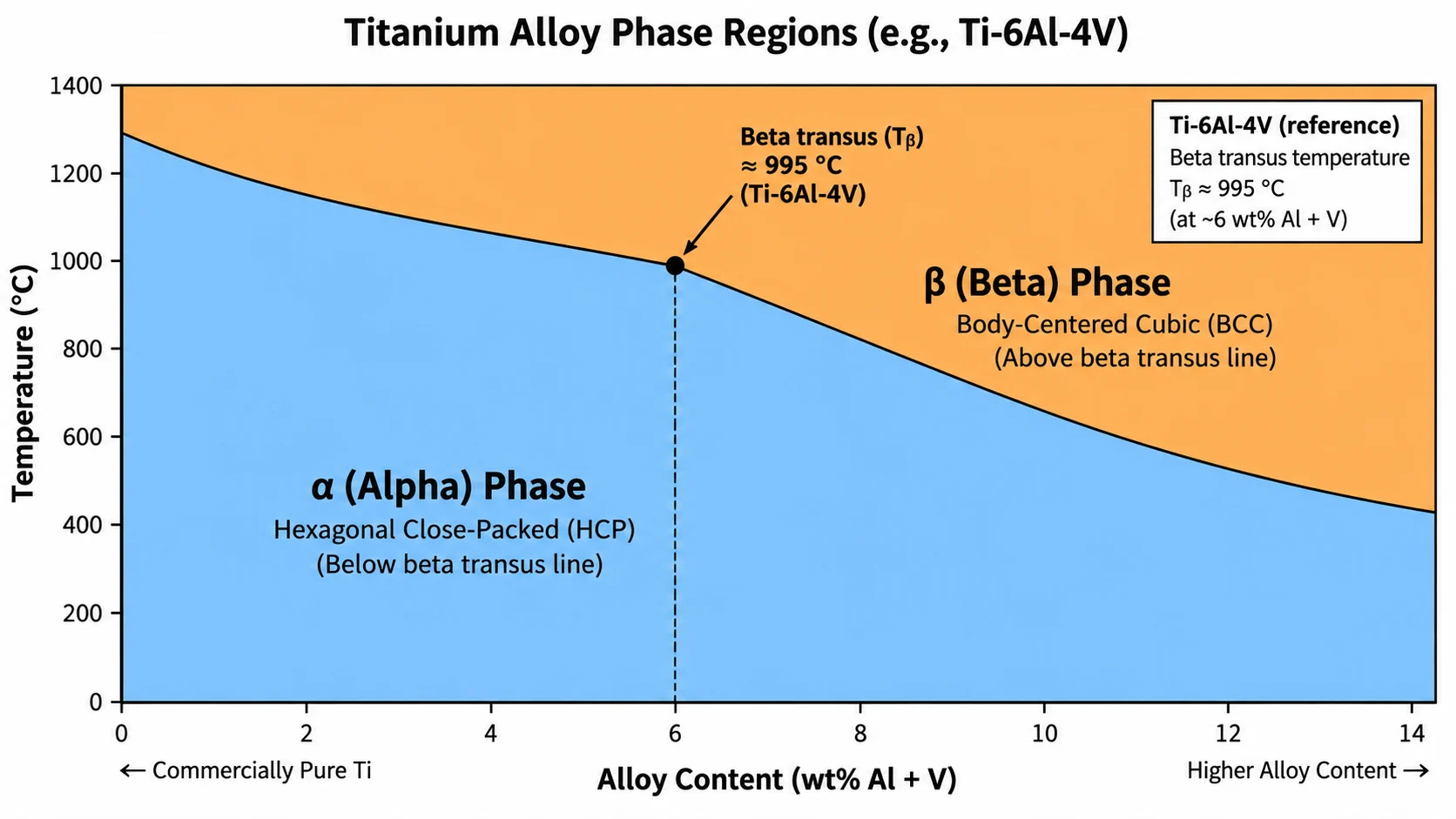
Every titanium alloy has a beta transus temperature — the point above which the microstructure is fully body-centered cubic beta phase, and below which a two-phase alpha+beta structure exists. For Ti-6Al-4V, that temperature is approximately 995°C (though it shifts ±15°C with exact chemistry, so every heat should be tested).
Forging below the beta transus (alpha-beta forging) preserves and refines the dual-phase microstructure. The result is equiaxed or bimodal alpha grains with good ductility and fatigue resistance. Forging above the beta transus (beta forging) produces a lamellar Widmanstätten structure — higher creep resistance and fracture toughness, but typically lower fatigue strength and ductility. Neither is universally superior; the choice is application-driven.
Per-Alloy Forging Temperature Reference
| Alloy | Beta Transus (approx.) | Alpha-Beta Forging Window | Beta Forging Range | Notes |
|---|---|---|---|---|
| Ti-6Al-4V (Grade 5) | ~995°C | 875–950°C | 1000–1060°C | Most widely forged; final passes typically ~50°C below transus |
| Ti-6Al-4V ELI (Grade 23) | ~990°C | 875–945°C | 995–1050°C | Lower interstitials; tighter O2 control needed |
| CP Titanium (Grade 2) | ~890°C | 750–875°C | 895–950°C | Lower flow stress; easier to forge; often used in chemical/marine |
| Ti-17 (Ti-5Al-2Sn-2Zr-4Mo-4Cr) | ~880–900°C | 830–875°C | 890–940°C | Near-beta; high strength; often beta-forged for fan disks |
| Ti-6242 (Ti-6Al-2Sn-4Zr-2Mo) | ~995°C | 900–960°C | 1000–1050°C | Creep-resistant; used for high-temp engine disks |
Sources: titanium.org World Conference Proceedings 2007; Springer MetTransA 2021; BenchChem Ti-17 Technical Protocol
Why the Final Forging Pass Temperature Is the Critical One
Research from the 2007 titanium.org World Conference confirms that final alpha-beta forging stages for Ti-6Al-4V are “generally carried out at approximately 50°C below the beta transus” — meaning ~940–950°C — to balance formability with microstructure control. Earlier breakdown passes can run higher (closer to transus or even above it for billet conversion), but the final impression forging that defines the part’s microstructure happens in the lower alpha-beta window.
Practical implication: if a supplier says they forge Ti-6Al-4V at “950°C,” ask whether that is the preheat temperature, the final forging temperature, or the die entry temperature. All three are different in a conventional (non-isothermal) process where the workpiece cools continuously during forming.
Strain Rate: The Parameter Most Articles Ignore
Temperature alone does not define a safe forging window. Strain rate matters because titanium generates significant adiabatic heating during rapid deformation — a billet preheated to 940°C can rise above the beta transus mid-stroke at high ram speeds, turning an alpha-beta operation into an unintended beta forging with no process control. Research on Ti-6Al-4V hot forging places the safe strain rate ceiling at ≤10 s⁻¹ for standard alpha-beta forging; isothermal processes deliberately run far slower (0.001–0.01 s⁻¹) to allow microstructure recovery.
How Temperature Regime Shapes Microstructure — and Why It Matters
Temperature regime determines the final microstructure, which determines mechanical properties. This connection is direct and quantifiable:
Alpha-Beta Forging (below beta transus):
- Produces equiaxed primary alpha grains in a transformed beta matrix
- High fatigue strength, good ductility, moderate toughness
- Target for rotating airfoils, structural brackets, implants
Beta Forging (above beta transus):
- Produces lamellar or colony alpha in beta matrix (Widmanstätten structure)
- Higher fracture toughness and creep resistance, lower fatigue strength
- Target for fan disks, heavy-section structural parts, some landing gear components
The Alpha Case Problem
Titanium absorbs oxygen rapidly above approximately 600–650°C in air or oxidizing atmospheres. This forms an oxygen-enriched surface layer — alpha case — that is hard, brittle, and prone to cracking. Alpha case reduces fatigue life and must be removed by machining or chemical milling. For aerospace parts, undetected alpha case is a rejection criterion.
What this means in practice: heating and forging operations at elevated temperature must use protective atmospheres, proper lubricant coverage, or strict time-at-temperature controls to minimize alpha case formation. Any supplier forging titanium without addressing atmospheric control should be asked specifically how they manage this risk.
Choosing the Right Process: A Decision Framework
Run through these questions in order:
1. Part weight and size
- Over 500 kg, or a shape exceeding closed die press capacity →Open die is your only option
- Under 500 kg and geometry is feasible →continue
2. Geometric complexity
- Simple shapes (cylinders, discs, rings, blocks) →Open die works well, lower cost
- Airfoil profiles, complex flanges, integral features →Closed die or isothermal
3. Annual volume
- Under 50 pieces/year →Open die almost always cheaper (avoid die amortization)
- 50–00 pieces/year →Evaluate closed die cost model per part
- Over 500 pieces/year →Closed die or isothermal justified; material savings and machining reduction compound
4. Tolerance and machining budget
- Loose tolerance (±2 mm) acceptable → Open die
- ±0.5 mm or better needed →Closed die or isothermal
5. Microstructure uniformity requirement
- Uniform microstructure across cross-section critical (e.g., rotating disk, critical structural) →Isothermal forging or tightly controlled closed die with preform
- Moderate uniformity acceptable →Open or closed die conventional process
Aerospace and Medical Applications: Where Process Choice Gets Critical
Aerospace
Jet engine disks and blisks — the most demanding titanium forgings — are almost exclusively produced by isothermal or closely controlled closed die forging. AMS 4928 (Ti-6Al-4V bar and billet) and AMS 6930 (Ti-6Al-4V forgings) set the baseline material requirements; NADCAP accreditation covers the heat treatment and processing controls. Landing gear components — among the largest titanium forgings produced — rely on open die for initial breakdown followed by closed die for final near-net shape. The weight saving versus steel (titanium is roughly 45% lighter at comparable strength) justifies the process cost at scale.
Medical
Orthopedic implants — femoral stems, spinal cages, acetabular cups — are typically closed die forged from Ti-6Al-4V ELI (Grade 23) with tightly controlled purity limits. ELI grade has lower oxygen and iron maxima than standard Grade 5, which directly improves fatigue performance in a cyclic loading environment (the human body). Alpha case contamination is a hard rejection criterion; most implant forging specs require complete removal to a defined depth.
Frequently Asked Questions
What temperature is titanium typically forged at?
It depends on the alloy and target microstructure. Ti-6Al-4V — the most common forging alloy — is typically forged in the alpha-beta field between 875–950°C, with the final pass approximately 50°C below its beta transus (~995°C). Grade 2 commercially pure titanium forges at lower temperatures, typically 750–875°C.
What is beta transus and why does it matter for forging?
Beta transus is the temperature above which a titanium alloy becomes fully body-centered cubic (beta phase). Forging below it preserves the dual alpha-beta microstructure associated with high fatigue strength. Forging above it produces a lamellar beta structure with better creep and toughness but lower fatigue resistance. The distinction is application-critical — engine disks and implants have opposite requirements.
When should I choose open die over closed die titanium forging?
Open die is the right choice for large parts (over 500 kg), prototype volumes (under 50 pieces), or simple geometries where the die cost for closed die cannot be amortized. Closed die becomes cost-effective at higher volumes where material savings and reduced machining offset tooling investment.
Can titanium be cold forged?
Only commercially pure titanium (Grade 1 and Grade 2) can be cold forged in limited applications with significant force and with careful lubrication. Alloyed titanium (Ti-6Al-4V and above) requires hot forging; the flow stress at room temperature is too high and ductility too limited for practical cold work.
What is isothermal forging and when is it used for titanium?
Isothermal forging maintains both the billet and the die at the same elevated temperature throughout the stroke, eliminating thermal gradients that cause cracking and uneven microstructure. It is used for complex, thin-section parts like blisks and engine disks where microstructure uniformity and near-net shape are both required. The process is expensive (nickel superalloy dies, controlled atmosphere) and reserved for high-value aerospace components.
What is alpha case and why is it a problem?
Alpha case is an oxygen-enriched, brittle surface layer that forms when titanium is exposed to air or oxidizing atmospheres above approximately 650°C. It is hard and fatigue-prone; for aerospace parts it is a rejection criterion. Forging shops manage it through protective atmospheres, lubricant coverage, and strict time-at-temperature limits, then remove it by machining or chemical milling.
What AMS standards apply to titanium forgings?
AMS 4928 covers Ti-6Al-4V bar, billet, and rod used as forging stock; AMS 6930 covers Ti-6Al-4V forgings and forged shapes. For medical grade Ti-6Al-4V ELI, ASTM F136 applies. Suppliers to aerospace programs typically require NADCAP accreditation covering both the forging process and associated heat treatment operations.
How does forging compare to casting for titanium?
Forging produces a denser, defect-free component with superior fatigue strength and directional grain flow. Casting allows more complex geometries but carries higher porosity risk and typically lower mechanical properties. For structural and rotating components in aerospace or implants in medical, forging is the standard. Casting is used where geometry complexity outweighs strength requirements.
Summary
Open die forging handles large, simple geometries and low volumes with minimal tooling cost. Closed die forging delivers near-net shapes, tighter tolerances, and better material utilization once volumes justify the die investment. Isothermal forging adds microstructure uniformity for the most demanding aerospace applications at a significant cost premium.
Temperature is not a single number — it is a per-alloy, per-regime set of parameters tied directly to the microstructure and mechanical properties the final part requires. Ti-6Al-4V at 940°C and Ti-6Al-4V at 1010°C produce structurally different parts. A qualified titanium forging supplier understands this distinction and controls it with documented process records, not just a pyrometer reading on the furnace door.
Alpha case formation, strain rate management, and AMS specification compliance are the differentiating markers of a serious titanium forging operation — ask your supplier about all three before committing to a source.