Titanium is unusual among structural metals because it exists in two distinct crystal forms depending on temperature and alloying. Below roughly 882°C, pure titanium adopts a hexagonal close-packed (HCP) structure known as the alpha phase. Above that temperature, it transforms to a body-centered cubic (BCC) arrangement called the beta phase. Alloying elements shift the balance between these two phases at room temperature, giving engineers the ability to design alloys ranging from highly weldable single-phase alpha grades to heat-treatable, high-strength alpha-beta alloys like Ti-6Al-4V, to ultra-formable near-beta alloys used in medical implants. Understanding the crystal structure behind each phase is the starting point for every alloy selection, heat treatment, and process decision in titanium manufacturing.
What Is the Alpha Phase in Titanium?
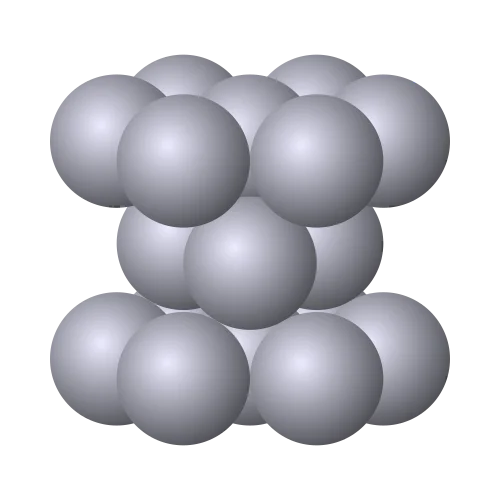
The alpha phase is titanium’s room-temperature form and is characterized by a hexagonal close-packed (HCP) crystal structure with a c/a axial ratio of 1.587. In this arrangement, atoms stack in alternating layers offset by 60°, forming a tightly packed lattice.
The HCP structure has fewer independent slip systems than BCC metals. Deformation in alpha-titanium occurs on pyramidal, prismatic, and basal planes in the close-packed directions — giving roughly 12 active slip systems, compared to the 48 available in BCC structures. That restriction makes alpha-phase titanium stronger but less ductile than beta.
Alpha titanium is stable from room temperature to approximately 882°C (1620°F) in commercially pure titanium. Above this threshold, the lattice reorganizes into the beta BCC structure.
Key characteristics of alpha-phase alloys:
- Excellent weldability — single-phase structure produces no martensite on weld cooling
- Good strength-to-weight ratio at low and cryogenic temperatures
- Lower ductility and formability compared to beta alloys
- Cannot be significantly strengthened by heat treatment (no phase transformation below the beta transus)
- Elevated-temperature capability to ~550–600°C for near-alpha grades
Commercial examples: Ti-5Al-2.5Sn (cryogenic storage vessels, liquid hydrogen tanks), CP titanium Grades 1–4 (chemical plant, medical implants).
What Is the Beta Phase?
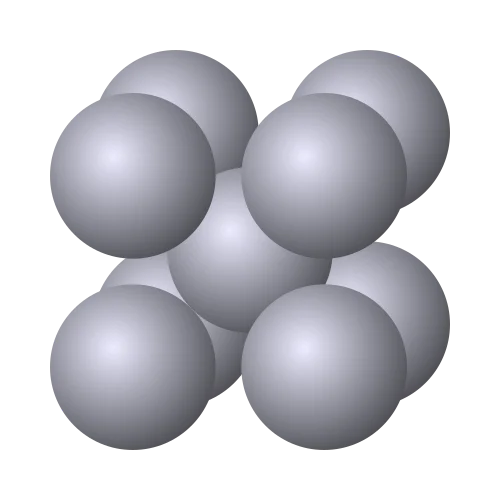
The beta phase is titanium’s high-temperature form and has a body-centered cubic (BCC) crystal structure — one atom at the cube center, atoms at each corner, a less densely packed arrangement than HCP.
BCC structures support more slip systems, which translates to greater ductility and formability. The tradeoff: beta-phase titanium has a ductile-to-brittle transition temperature that often sits near room temperature, which limits the use of fully beta alloys in structural applications without careful composition control.
In pure titanium, the beta phase is stable from 882°C to the melting point at approximately 1670°C. At room temperature, beta can only be retained by adding sufficient beta-stabilizing alloying elements — primarily vanadium, molybdenum, chromium, iron, and niobium — which suppress the beta→alpha transformation.
Key characteristics of beta-phase alloys:
- High formability and ductility in the solution-treated condition
- Low elastic modulus (~55–80 GPa for some grades) — closer to bone than alpha-beta alloys, valuable for orthopedic implants
- Capacity for significant age hardening through precipitation of fine alpha particles from the metastable beta matrix
- Heavier than alpha alloys due to the density of beta-stabilizing additions
Alpha vs Beta: Crystal Structure and Properties Compared
The two phases differ at the atomic level, and those differences scale directly to measurable mechanical properties.
| Property | Alpha (HCP) | Beta (BCC) | Alpha-Beta |
|---|---|---|---|
| Crystal structure | Hexagonal close-packed | Body-centered cubic | Mixed HCP + BCC |
| Stable range (pure Ti) | RT → ~882°C | ~882°C → 1670°C | Both present at RT |
| Active slip systems | ~12 | ~48 | Intermediate |
| Strength | Higher | Lower (pre-aging) | High (heat-treatable) |
| Ductility | Lower | Higher | Intermediate |
| Weldability | Excellent | Poor to moderate | Moderate |
| Heat-treatability | No | Yes (aging) | Yes (best range) |
| Typical applications | Weldable structures, cryogenic | Medical implants, springs | Aerospace, biomedical |
The core takeaway: alpha is the stronger, less ductile phase; beta is more deformable but weaker before aging. Alpha-beta alloys exploit both phases simultaneously — and heat treatment lets engineers tune the ratio.
How Alloying Elements Control Phase Stability

Titanium’s phase behavior makes it uniquely tunable through alloying. Every commercial additive falls into one of three categories relative to its effect on the beta transus — the temperature above which the alloy is 100% beta.
| Category | Elements | Effect | Commercial Role |
|---|---|---|---|
| Alpha stabilizers | Al, O, N, C, Ga | Raise beta transus | Al strengthens alpha without density penalty; O/N/C embrittle at high concentrations |
| Beta stabilizers (isomorphous) | Mo, V, W, Ta, Nb | Lower beta transus | V and Mo are most common; W adds density and is rarely used |
| Beta stabilizers (eutectoid) | Cu, Fe, Mn, Ni, Co, Cr, H | Lower beta transus + form eutectoid | Cr used for burn-resistant alloys; Fe for leaner beta alloys |
| Neutral | Zr, Sn, Si | Minimal effect on transus | Solid-solution strengtheners |
Aluminum is the single most important commercial addition. It stabilizes alpha, reduces density, and strengthens the alpha phase — which is why virtually all alpha-beta alloys include it. When the aluminum equivalent (Al + Sn/3 + Zr/6 + 10×O) exceeds about 9 wt%, the ordered Ti₃Al compound precipitates and embrittles the alloy.
Molybdenum and vanadium have the strongest practical beta-stabilizing effect. The molybdenum equivalent (Mo-eq = Mo + V/1.5 + Cr/0.6 + …) is the standard measure for comparing beta-stabilizing potency across alloys.
The beta transus temperature for Ti-6Al-4V sits at approximately 995°C (±15°C depending on exact oxygen and iron levels). All heat treatment is defined relative to this temperature.
The Three Alloy Families and Their Applications
Alpha and Near-Alpha Alloys
Single-phase or predominantly alpha. These alloys cannot be strengthened by quench-and-age heat treatment. Instead, they rely on solid-solution strengthening and grain refinement. Their advantages are excellent weldability, good cryogenic toughness, and creep resistance to moderate temperatures (~550°C for near-alpha grades).
Near-alpha grades contain ~1–2% beta stabilizers purely to improve hot workability without fundamentally altering the alpha-dominant structure.
Examples: Ti-5Al-2.5Sn (cryogenic vessels), Ti-6Al-2Sn-4Zr-2Mo (high-temperature aeroengine components such as compressor discs and blades operating below 590°C).
Alpha-Beta Alloys
The commercially dominant family. Both alpha and beta phases coexist at room temperature, and the alloy can be significantly strengthened by heat treatment. Solution treating followed by quenching and aging allows fine alpha particles to precipitate from metastable beta, substantially raising strength without a proportional loss of ductility.
Ti-6Al-4V (ASTM Grade 5 / AMS 4928) is the definitive example. It accounts for roughly 45% of all titanium produced globally — more than any other single alloy. Typical properties in the annealed condition: UTS ~950 MPa, yield ~880 MPa; after solution treat and age (AMS 4965): UTS ~1100 MPa. It covers aerospace airframe skins, engine fan blades, surgical implants, and high-performance automotive components.
Beta and Near-Beta Alloys
High concentrations of beta stabilizers (Mo-eq typically >10–15%) retain beta in a metastable condition after quenching. These alloys offer superior formability in the soft condition and can be aged to very high strengths (UTS >1300 MPa in some grades).
The low elastic modulus of beta alloys — as low as ~55 GPa for Ti-15Mo — is deliberately exploited in orthopedic implants to reduce stress shielding. Medical beta alloys specifically avoid vanadium and aluminum, using instead niobium, zirconium, tantalum, and molybdenum, which have substantially lower cytotoxicity.
Example: Ti-13V-11Cr-3Al (aerospace spring and fastener applications), Ti-15Mo (medical), Ti-35V-15Cr (burn-resistant aeroengine application).
Microstructure Morphologies: Equiaxed, Lamellar, and Bimodal
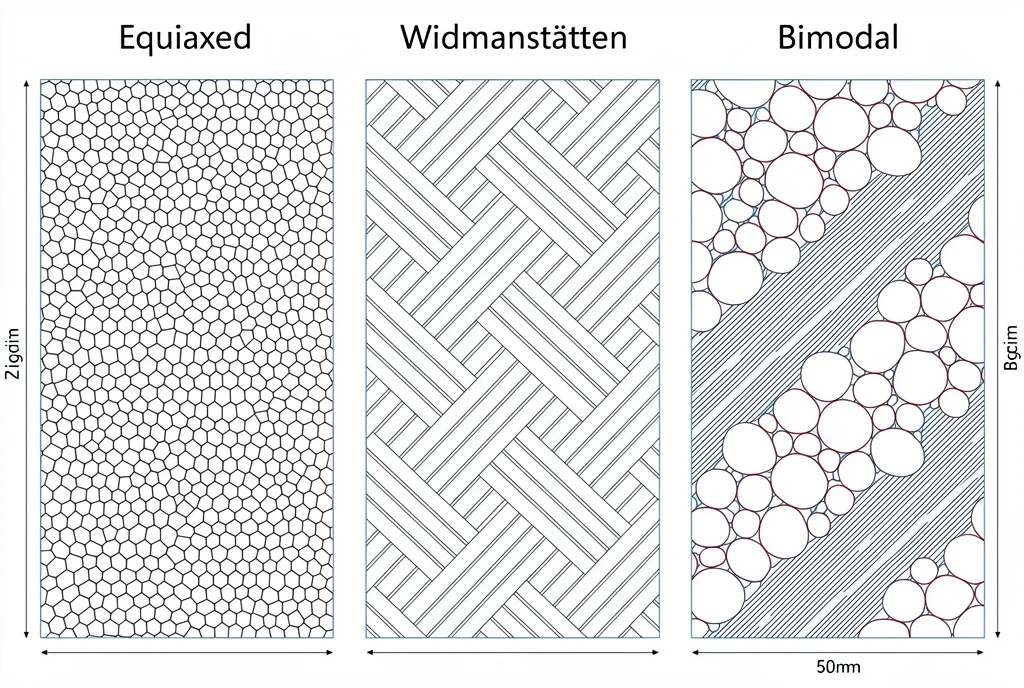
Phase composition tells you what is present; microstructure morphology tells you how those phases are arranged — and the arrangement has a major effect on fatigue life and fracture toughness.
Equiaxed microstructure: Fine, roughly equal-dimensional alpha grains with beta at grain boundaries. Produced by working below the beta transus (sub-transus processing) and recrystallizing. Equiaxed structures generally give the best fatigue strength and ductility. Rotating components and fatigue-critical aerospace parts typically target equiaxed or bimodal structures.
Lamellar (Widmanstätten) microstructure: Plate-like alpha lamellae arranged in colonies within prior beta grains. Forms when the alloy is cooled from above the beta transus (super-transus processing). Lamellar structures offer higher fracture toughness and creep resistance at the cost of fatigue strength. Colony size is the dominant microstructural variable — finer colonies improve fatigue; coarser colonies improve fracture toughness.
Bimodal (duplex) microstructure: A combination of equiaxed primary alpha grains embedded in a matrix of lamellar or acicular alpha plus beta. This is the most common target for high-performance parts: it balances ductility, strength, and fatigue life. Most aerospace turbine fan discs and compressor blades are bimodal.
Cooling rate from the beta transus governs which morphology forms:
- Furnace cool → coarse lamellar
- Air cool → fine acicular (basket-weave) alpha
- Water quench → alpha-prime (α’) martensite
How Heat Treatment Controls Microstructure
Heat treatment is the primary engineering lever for alpha-beta alloys, and every step is defined by its relationship to the beta transus.
Solution treatment heats the alloy either into the upper alpha-beta field (sub-transus, e.g., 950°C for Ti-6Al-4V) or into the full-beta field (super-transus, e.g., 1050°C). Sub-transus treatment preserves some primary alpha and leads to a bimodal final structure; super-transus treatment dissolves all alpha and produces a fully lamellar or martensitic structure after cooling.
Quenching from beta suppresses the diffusion-controlled beta→alpha transformation and forms alpha-prime (α’) martensite — an HCP structure. Unlike steel martensite, α’ in titanium is not dramatically harder than the parent beta, but the highly supersaturated, defect-rich structure is the precursor to fine-scale decomposition during aging.
Aging at 480–650°C causes fine alpha particles to precipitate from retained or transformed beta. For Ti-6Al-4V, a sub-transus solution treat at 950°C + water quench + aging at 538°C for 4 hours is a standard heat treatment cycle targeting UTS above 1100 MPa.
Annealing at 700–850°C (well below the beta transus) followed by air or furnace cooling gives a stable, stress-relieved structure with good ductility — the standard delivery condition for mill products.
What Phase Structure Means for Machining and Manufacturing
Crystal structure connects directly to process decisions:
Alpha and near-alpha alloys work-harden rapidly because the HCP structure’s limited slip systems cause deformation to concentrate at the surface layer. This makes them harder to machine than beta alloys, but their lack of phase transformation on weld cooling makes them straightforward to weld.
Alpha-beta alloys (Ti-6Al-4V) are notoriously difficult to machine. Low thermal conductivity (~7 W/m·K, roughly one-sixth of steel) concentrates heat at the tool tip. The tendency to work-harden creates built-up edge. Standard practice is cemented carbide tooling, high-pressure coolant, and cutting speeds well below those used for steel or aluminum.
Beta alloys in the solution-treated condition are relatively soft and machinable, but they adhere aggressively to cutting tools (galling). Aged beta alloys are very hard and share the same thermal conductivity problem as other titanium grades.
Microstructure effect on surface finish: Equiaxed microstructures generally produce better surface integrity than coarse lamellar structures at equivalent cutting conditions, because uniform grain size reduces instantaneous cutting force variation and built-up edge frequency.
For welding: alpha and near-alpha grades are the most reliable. All titanium requires stringent shielding-gas coverage above ~300°C (titanium oxidizes rapidly and becomes brittle). Beta alloys require special post-weld heat treatment; many are classified as poor weld candidates in structural applications.
Frequently Asked Questions
What is the crystal structure of alpha-phase titanium?
Alpha-phase titanium has a hexagonal close-packed (HCP) crystal structure with a c/a ratio of 1.587. It is the stable form of pure titanium from room temperature to approximately 882°C.
What is the crystal structure of beta-phase titanium?
Beta-phase titanium has a body-centered cubic (BCC) crystal structure. In pure titanium it is stable above 882°C; with sufficient beta-stabilizing additions (vanadium, molybdenum, etc.) it can be retained at room temperature.
What is the beta transus temperature?
The beta transus is the temperature above which the alloy is entirely beta phase. For pure titanium it is approximately 882°C. For Ti-6Al-4V it is approximately 995°C (±15°C). The exact value depends on alloy composition and is typically measured for each lot of material.
Why is Ti-6Al-4V called an alpha-beta alloy?
It contains 6 wt% aluminum (an alpha stabilizer) and 4 wt% vanadium (a beta stabilizer), so it retains both HCP alpha and BCC beta phases at room temperature. This two-phase structure enables significant strengthening through heat treatment — something single-phase alpha alloys cannot achieve.
What is the difference between equiaxed and lamellar titanium microstructure?
Equiaxed microstructures have roughly equal-dimensional alpha grains formed by sub-transus processing; they give better fatigue strength. Lamellar (Widmanstätten) microstructures have plate-like alpha colonies formed by super-transus processing; they give better fracture toughness and creep resistance.
Which alloying elements stabilize the alpha phase?
Aluminum (most important commercially), oxygen, nitrogen, carbon, and gallium all stabilize alpha by raising the beta transus temperature. Oxygen, nitrogen, and carbon must be tightly controlled because they embrittle the alloy at elevated concentrations.
Summary
Titanium’s dual crystal structure — HCP alpha below 882°C, BCC beta above it — is the foundation of everything commercially distinctive about the material. Alloying shifts the balance: alpha stabilizers (primarily aluminum) expand the alpha field; beta stabilizers (vanadium, molybdenum, and others) preserve beta at room temperature. The result is three commercially useful alloy families. Alpha alloys are weldable and cryogenically tough but not heat-treatable. Beta alloys are highly formable and can be aged to very high strengths. Alpha-beta alloys, led by Ti-6Al-4V, dominate production because they sit at the intersection of strength, toughness, and processability.
Heat treatment and thermomechanical processing then control microstructure morphology — equiaxed, lamellar, or bimodal — which fine-tunes the final property balance. For engineers specifying or processing titanium, the phase diagram is not abstract metallurgy. It is the decision tree behind every heat treat cycle, every weld procedure, and every machining strategy.