Titanium thermal conductivity is approximately 21.9 W/m·K at room temperature — roughly 1/18th that of copper (401 W/m·K) and 1/11th that of aluminum (237 W/m·K). In pure thermal conductivity terms, titanium is a poor heat conductor. But that single number tells an incomplete story. Titanium’s combination of low thermal conductivity, high melting point (1,668°C), exceptional corrosion resistance, and half-the-weight-of-steel density makes it the correct material choice in applications where copper and aluminum fail entirely. This article covers the exact thermal conductivity values for common titanium grades, compares titanium head-to-head with copper, aluminum, and stainless steel, explains why the numbers vary so much across sources, and identifies the engineering applications where titanium’s low conductivity is not a weakness — it is the feature.
What Is Thermal Conductivity?
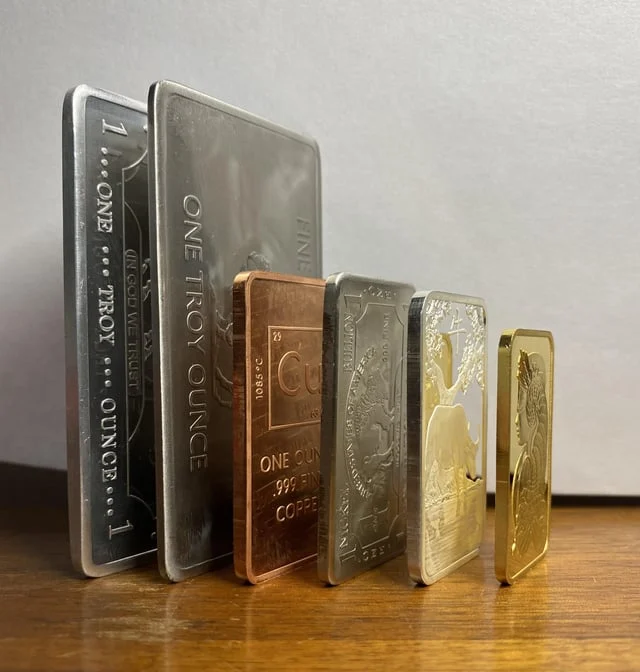
Thermal conductivity (symbol: k or λ) measures how efficiently a material transfers heat. It is expressed in watts per meter-kelvin (W/m·K). A material with high thermal conductivity — like copper at 401 W/m·K — moves heat quickly from hot regions to cold ones. A material with low thermal conductivity — like titanium at 21.9 W/m·K — resists heat flow, acting more like an insulator.
The number itself describes a specific physical phenomenon: the rate of heat energy that passes through one meter of material thickness for every one-degree temperature difference across that meter. A copper bar 1 meter long with a 1°C difference between its ends will conduct 401 watts of heat per square meter of cross-section. A titanium bar under identical conditions conducts only 21.9 watts.
In metals, heat is carried primarily by free electrons — the same mobile electrons that conduct electricity. This relationship between thermal and electrical conductivity in metals is described by the Wiedemann-Franz law, which states that the ratio of thermal to electrical conductivity is approximately constant across metals at a given temperature. Titanium has relatively high electrical resistivity (about 42 µΩ·cm versus copper’s 1.7 µΩ·cm), which directly corresponds to its low thermal conductivity.
Titanium Thermal Conductivity Values by Grade
Not all titanium conducts heat at the same rate. The thermal conductivity varies significantly depending on alloy composition, and this is one of the main reasons you will find contradictory numbers across different sources.
Pure Titanium (CP Grades 1–4)
Commercially pure titanium ranges from approximately 16.3 to 22.5 W/m·K at room temperature, depending on measurement method, purity, and source.
- Grade 1 (Ti-0.2Pd): ~16.3 W/m·K (AZoM reference data)
- Grade 2 (Ti-0.3Mo-0.8Ni): 16.3–21.9 W/m·K (AZoM lists 16.3; Engineering Toolbox and measured values suggest ~21.9)
- Grade 3: ~16.3 W/m·K
- Grade 4: ~16.3 W/m·K
Thermtest lab measurements using the Transient Plane Source (TPS) slab method yielded 25.91 W/m·K for a CP titanium slab at 25°C — higher than most reference tables. This discrepancy arises because tabulated values often represent minimum guaranteed values for commercial material (which contains trace impurities), while lab measurements may use higher-purity samples.
The practical takeaway: if you see 16.3 W/m·K for CP titanium, it is a conservative reference value. Actual measured conductivity of high-purity CP titanium is closer to 22 W/m·K. Both numbers are correct — they reflect different measurement contexts.
Titanium Alloys
| Alloy | Grade | Thermal Conductivity (W/m·K) | Source |
|---|---|---|---|
| CP Ti (Grade 2) | — | 16.3–21.9 | AZoM / Engineering Toolbox |
| Ti-6Al-4V | Grade 5 | 6.7 | ASM/MatWeb |
| Ti-6Al-2Sn-4Zr-2Mo | — | ~7.4 | ASM International |
| Ti-5Al-5V-5Mo-3Cr | Ti-5553 | ~7.5 | ASM International |
| Ti-15V-3Cr-3Sn-3Al | — | ~9.1 | ASM International |
The trend is clear: adding alloying elements reduces thermal conductivity further. Ti-6Al-4V — the most widely used titanium alloy in aerospace — conducts at just 6.7 W/m·K, roughly one-third the conductivity of pure titanium and about 1/60th that of copper.
The reason is straightforward from a materials science perspective. Alloying atoms sit within the crystal lattice at positions that scatter both electrons and phonons (lattice vibrations that carry heat). Each foreign atom creates a distortion in the electron flow and phonon path, reducing the material’s ability to transmit thermal energy. The more alloying elements and the greater their concentration, the lower the thermal conductivity.
Titanium Thermal Conductivity vs Copper: The Head-to-Head Comparison
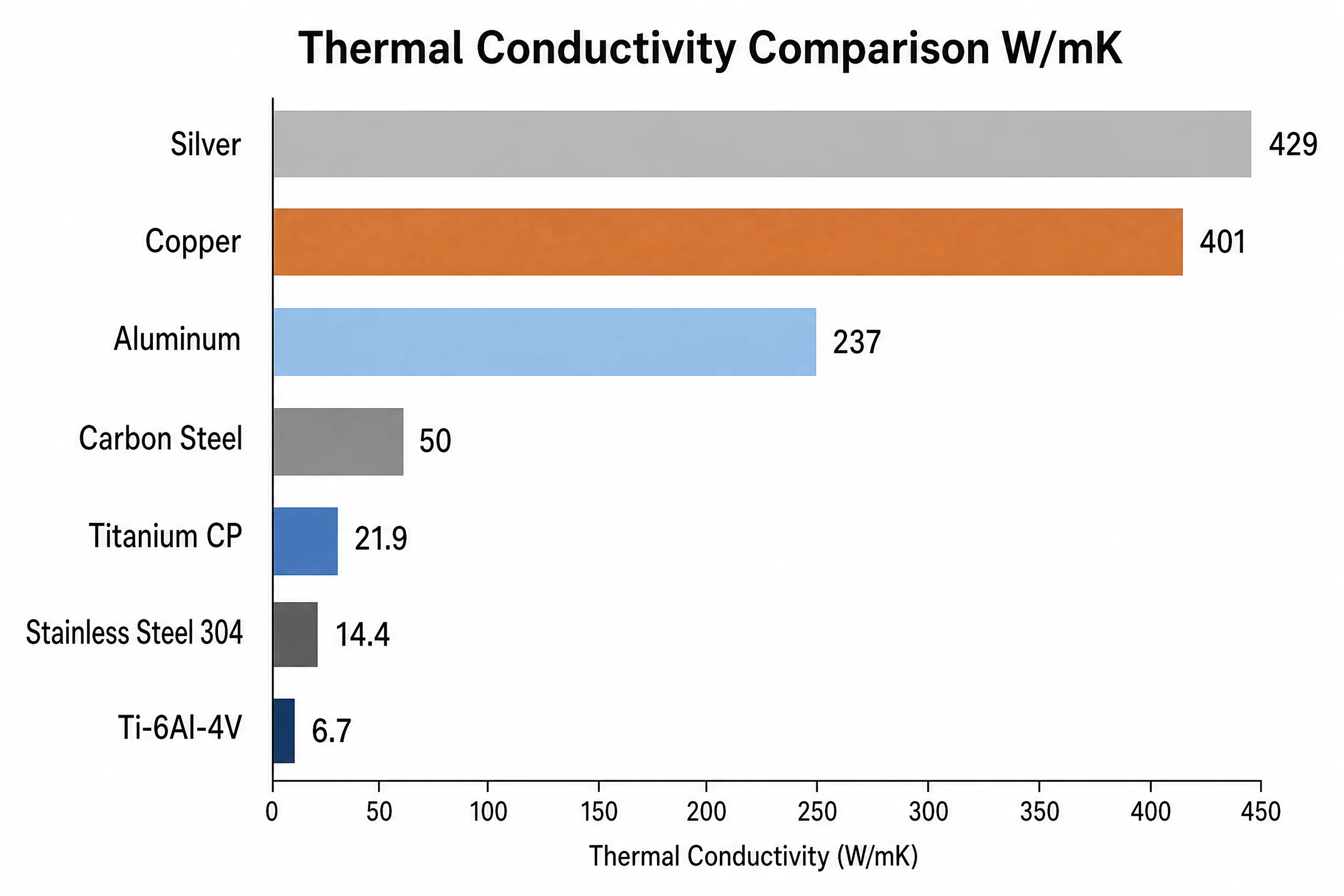
This is the comparison that matters most for engineers evaluating materials for heat transfer applications.
| Property | Titanium (CP) | Titanium (Ti-6Al-4V) | Copper (Pure) |
|---|---|---|---|
| Thermal conductivity (W/m·K) | 21.9 | 6.7 | 401 |
| Electrical resistivity (µΩ·cm) | 42 | ~170 | 1.7 |
| Density (g/cm³) | 4.51 | 4.43 | 8.96 |
| Melting point (°C) | 1,668 | 1,604–1,660 | 1,085 |
| Specific heat (J/g·K) | 0.523 | 0.526 | 0.385 |
| Thermal diffusivity (mm²/s) | 9.3 | 2.9 | 111 |
| Corrosion resistance in seawater | Excellent | Excellent | Poor |
| Cost (relative, approximate) | 5–10× | 8–15× | 1× |
Copper conducts approximately 18 times more heat than pure titanium and 60 times more than Ti-6Al-4V. There is no ambiguity here — copper is dramatically superior as a thermal conductor.
But thermal conductivity is only one property in a material selection decision. When we factor in density, the picture shifts. Copper weighs 8.96 g/cm³; titanium weighs 4.51 g/cm³ — roughly half. On a per-kilogram basis, titanium’s thermal conductivity (21.9 / 4.51 = 4.86 W/m·K per g/cm³) is closer to copper’s (401 / 8.96 = 44.8 W/m·K per g/cm³) than the raw numbers suggest, though copper still leads by about 9× on a weight-normalized basis.
More importantly, titanium does not corrode in seawater. Copper alloys erode rapidly in chloride environments. In a marine heat exchanger, a copper tube that loses 0.5 mm of wall thickness per year to corrosion will eventually fail, regardless of how well it conducts heat. A titanium tube with zero corrosion rate maintains its thin wall and design performance for 20+ years.
Temperature Effects on the Comparison
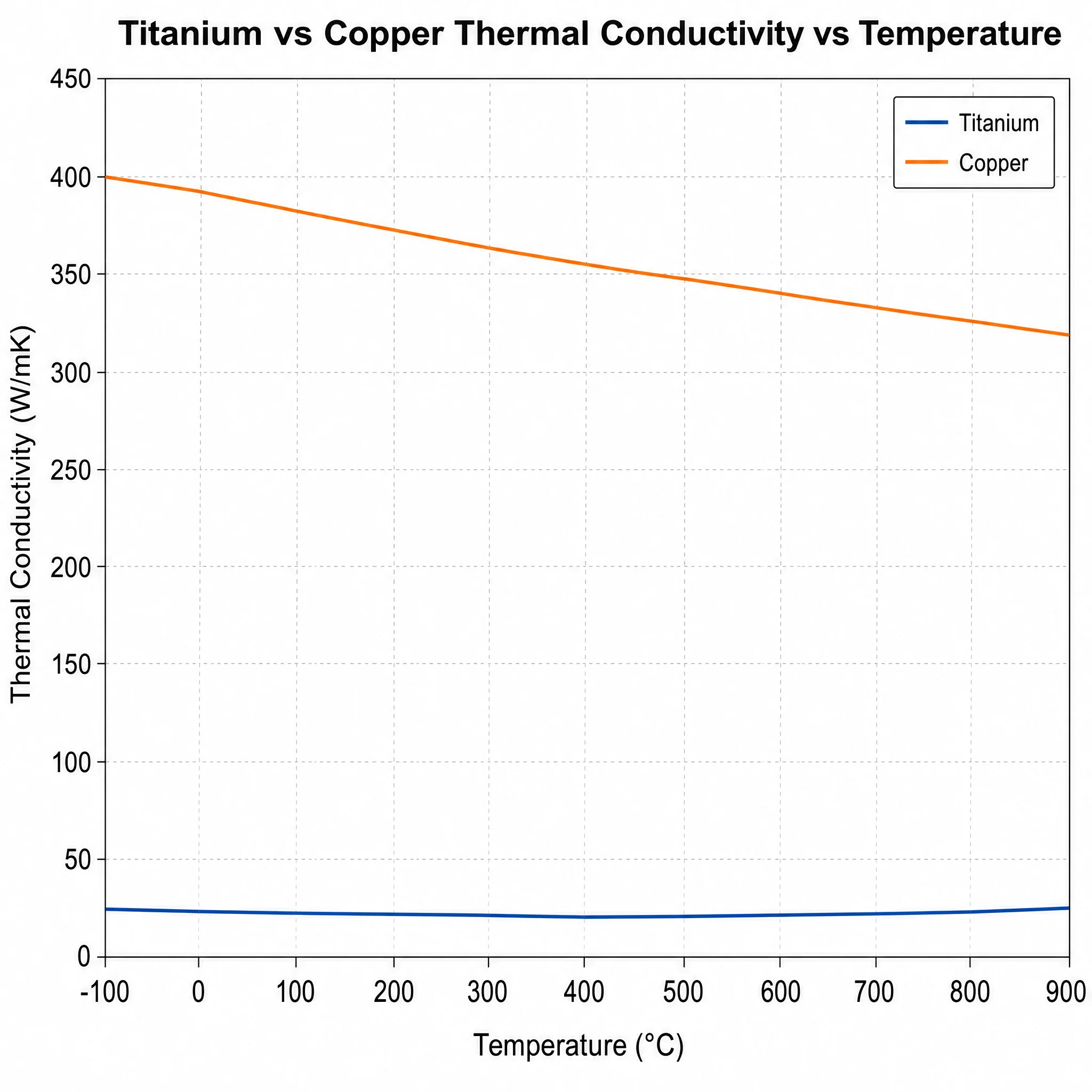
Titanium’s thermal conductivity does not stay constant. From Engineering Toolbox data across a temperature range:
| Temperature (°C) | Titanium k (W/m·K) | Copper k (W/m·K) | Ratio (Cu/Ti) |
|---|---|---|---|
| -73 | 24.5 | ~420 | 17:1 |
| 0 | 22.4 | ~401 | 18:1 |
| 127 | 20.4 | ~388 | 19:1 |
| 327 | 19.4 | ~373 | 19:1 |
| 527 | 19.7 | ~357 | 18:1 |
| 727 | 20.7 | ~339 | 16:1 |
| 927 | 22.0 | ~317 | 14:1 |
Titanium’s thermal conductivity decreases slightly from -73°C to about 327°C (reaching a minimum of ~19.4 W/m·K), then increases modestly at higher temperatures. This U-shaped behavior is characteristic of metals with hexagonal close-packed crystal structures. Copper’s thermal conductivity decreases more steadily with temperature.
The convergence at high temperatures is notable: at 927°C, the ratio narrows to 14:1, meaning titanium’s relative disadvantage diminishes as temperature rises.
Titanium Thermal Conductivity vs Aluminum
| Property | Titanium (CP) | Aluminum (Pure) | Ratio (Al/Ti) |
|---|---|---|---|
| Thermal conductivity (W/m·K) | 21.9 | 237 | 10.8:1 |
| Density (g/cm³) | 4.51 | 2.70 | 0.6:1 |
| Melting point (°C) | 1,668 | 660 | 0.4:1 |
| Max service temp (°C) | ~600 | ~200 | — |
| Corrosion resistance | Excellent | Good (pitting in chloride) | — |
Aluminum conducts approximately 11 times more heat than titanium and weighs 40% less. In a straight thermal performance contest, aluminum wins decisively. This is why aluminum dominates in consumer electronics heat sinks, automotive radiators, and cookware applications where weight, cost, and thermal performance must be balanced.
But aluminum melts at 660°C and loses structural strength above 200°C. In aerospace engine components, exhaust systems, and high-temperature industrial equipment, aluminum is not an option. High-temperature titanium alloys (such as Ti-6242S) maintain useful strength up to approximately 540°C, and titanium’s melting point of 1,668°C gives it a safety margin that aluminum cannot match.
In a Reddit r/flashlight community discussion, a user compared titanium and aluminum flashlight hosts under identical LED driver conditions. The aluminum host maintained LED junction temperatures 15–25°C lower than the titanium host under the same power output — a measurable consequence of aluminum’s superior thermal conductivity. Titanium flashlights step down to lower output sooner to protect the LED from overheating. The community consensus: “Titanium sure is beautiful, but it’s awful with heat dissipation.”
That honest user experience captures the tradeoff precisely: titanium looks premium and resists corrosion, but it cannot move heat the way aluminum does.
Why Does Titanium Have Such Low Thermal Conductivity?
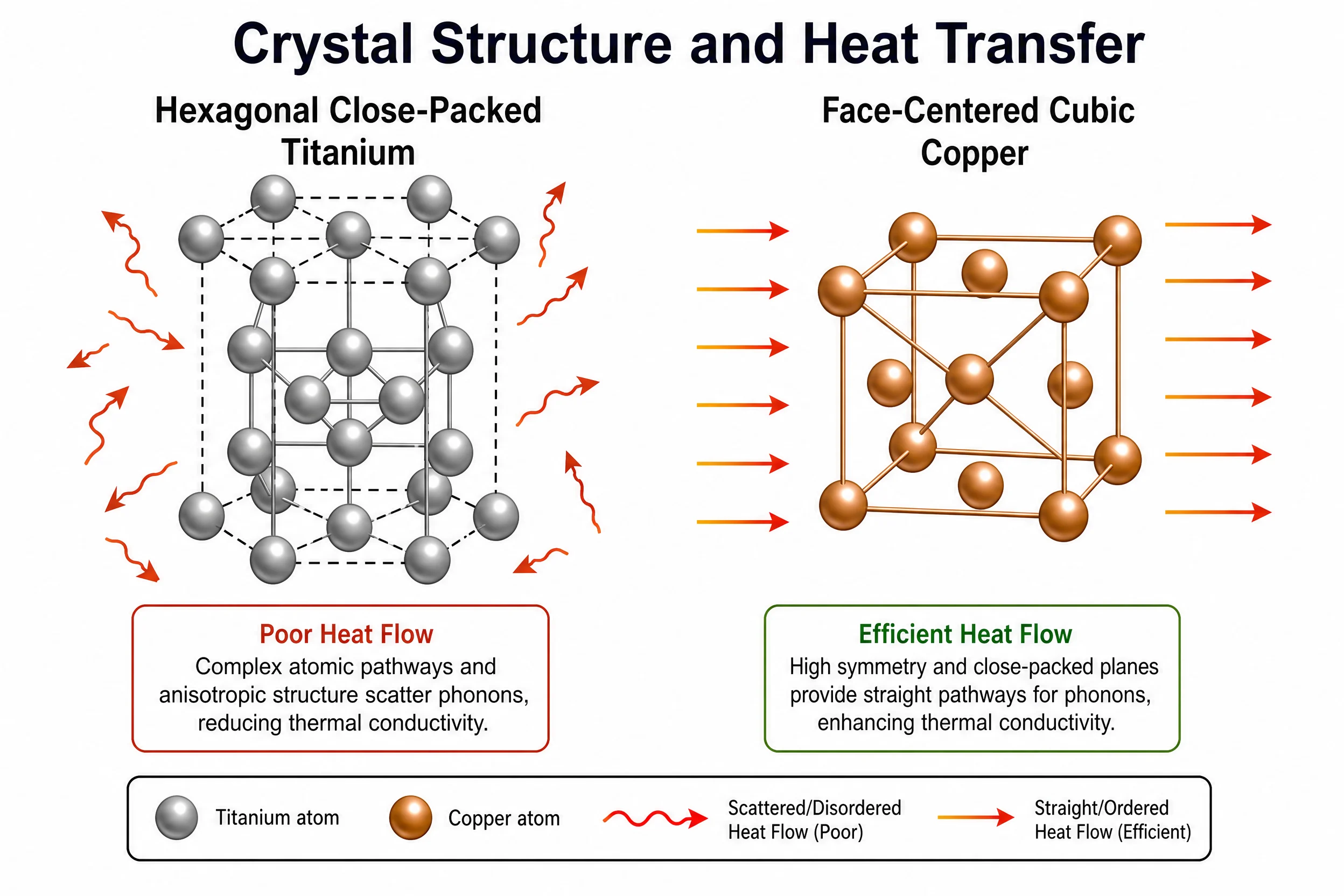
The answer lies in titanium’s electronic and crystal structure.
Crystal structure: At room temperature, pure titanium has a hexagonal close-packed (HCP) alpha-phase structure. This is less symmetric than the face-centered cubic (FCC) structure found in copper and aluminum. The lower symmetry of HCP creates directional dependence in how efficiently phonons (lattice vibrations) can travel through the crystal.
Electron scattering: The Wiedemann-Franz law connects thermal conductivity to electrical conductivity: metals with high electrical conductivity also have high thermal conductivity. Copper’s electrical resistivity is just 1.7 µΩ·cm; titanium’s is 42 µΩ·cm — 25 times higher. This means titanium’s free electrons scatter far more strongly against the crystal lattice, reducing both their electrical and thermal conductivities in lockstep.
Impurity effects: Even in nominally “pure” titanium, trace amounts of oxygen, nitrogen, carbon, and iron act as scattering centers that further reduce thermal conductivity. The difference between the 16.3 W/m·K reference value (which accounts for typical commercial purity) and the 22 W/m·K measured value (which may use higher-purity material) reflects this impurity sensitivity.
Alloying amplifies the effect: When you add aluminum and vanadium to make Ti-6Al-4V, you introduce millions of foreign atoms per cubic centimeter, each disrupting the electron and phonon flow. This is why Grade 5 titanium conducts at only 6.7 W/m·K — roughly one-third of pure titanium’s value.
Research from Caltech has revealed an additional mechanism in certain titanium-containing crystalline compounds: titanium atoms can quantum-mechanically tunnel between two positions in the crystal lattice, creating what researchers describe as “glass-like” thermal conductivity. The lead researcher explained it as “shining a light through a frosted glass, with the titanium atoms as the frost; incoming waves deflect off the titanium, and only a portion make their way through the material.”
When Titanium’s Low Thermal Conductivity Is Actually an Advantage
This is the section that separates engineering reality from textbook assumptions. Low thermal conductivity is not always a problem — sometimes it is the entire design rationale.
Seawater Heat Exchangers
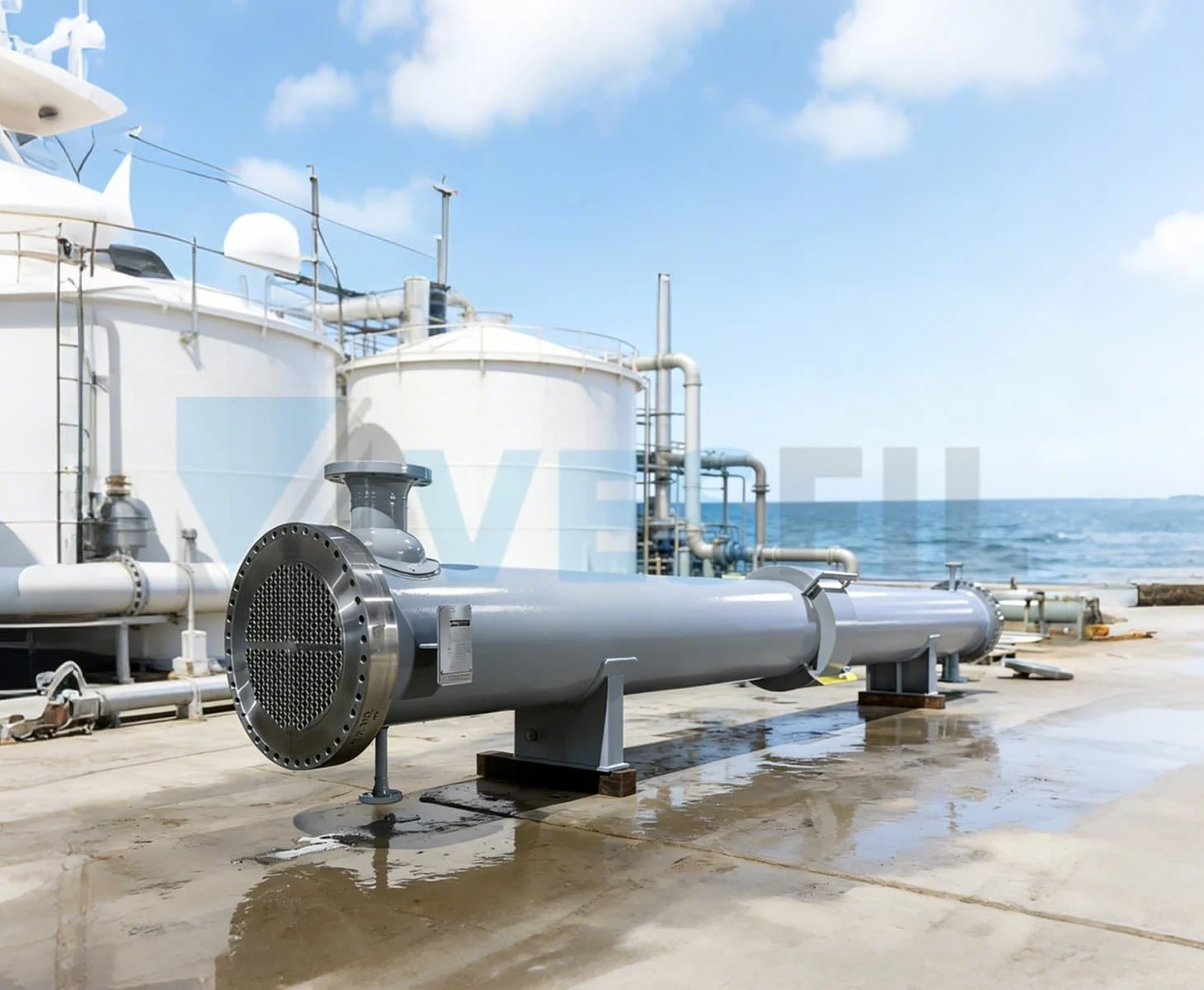
Titanium heat exchangers are standard in offshore oil platforms, desalination plants, and naval vessels. Yes, copper conducts 18× more heat. But admiralty brass tubes in warm seawater can begin failing within 5–10 years due to erosion-corrosion, microbiologically influenced corrosion (MIC), and pitting. Research published in ScienceDirect confirms that titanium alloy heat exchanger tubes demonstrate superior fouling resistance compared to copper, iron, or stainless steel in seawater applications.
Titanium’s smooth, self-passivating oxide surface resists biological adhesion and chemical attack. The net heat transfer performance over a multi-decade service life — factoring in wall thickness maintenance, cleaning frequency, and replacement costs — favors titanium despite its lower instantaneous thermal conductivity.
The design compensation is straightforward: use thinner titanium walls (possible because titanium is stronger) and slightly larger surface area. A well-designed titanium heat exchanger achieves comparable overall heat transfer rates to a copper-alloy unit at lower lifecycle cost.
Aerospace Engine Components
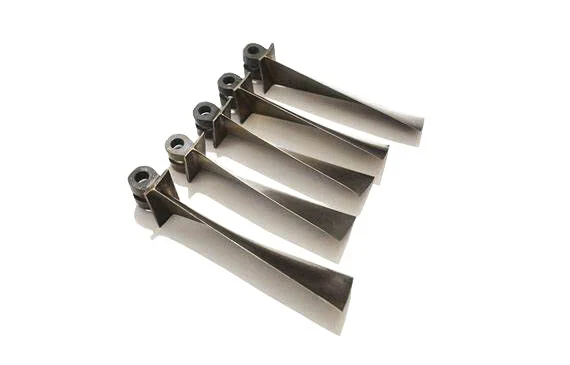
In jet engines and turbine sections, titanium’s low thermal conductivity acts as a natural thermal barrier. Heat generated in the combustion chamber does not propagate quickly through titanium structural components to adjacent systems. This protects surrounding electronics, seals, and fuel lines from thermal damage without requiring additional insulating layers.
Xometry notes: “This allows it to be used across a broad temperature range without degrading mechanical properties, which is valuable in high-heat applications such as jet engines, landing gear, automotive exhaust systems.”
Thermal Barriers in Electronics
In the flashlight and portable electronics communities (as documented across Reddit r/flashlight and BudgetLightForum), titanium’s low conductivity is both a challenge and a feature. In multi-cell flashlight designs, a titanium battery tube between two high-power cells acts as a thermal break, preventing heat from one cell from accelerating degradation in the adjacent cell. Designers sometimes choose titanium specifically for this insulating property.
Structural Components Requiring Thermal Isolation
In buildings and industrial equipment, titanium components between hot and cold zones can serve as structural thermal breaks — transmitting mechanical loads while limiting heat flow. This eliminates the need for separate insulation layers in tight spaces.
Titanium Thermal Conductivity in Cooking
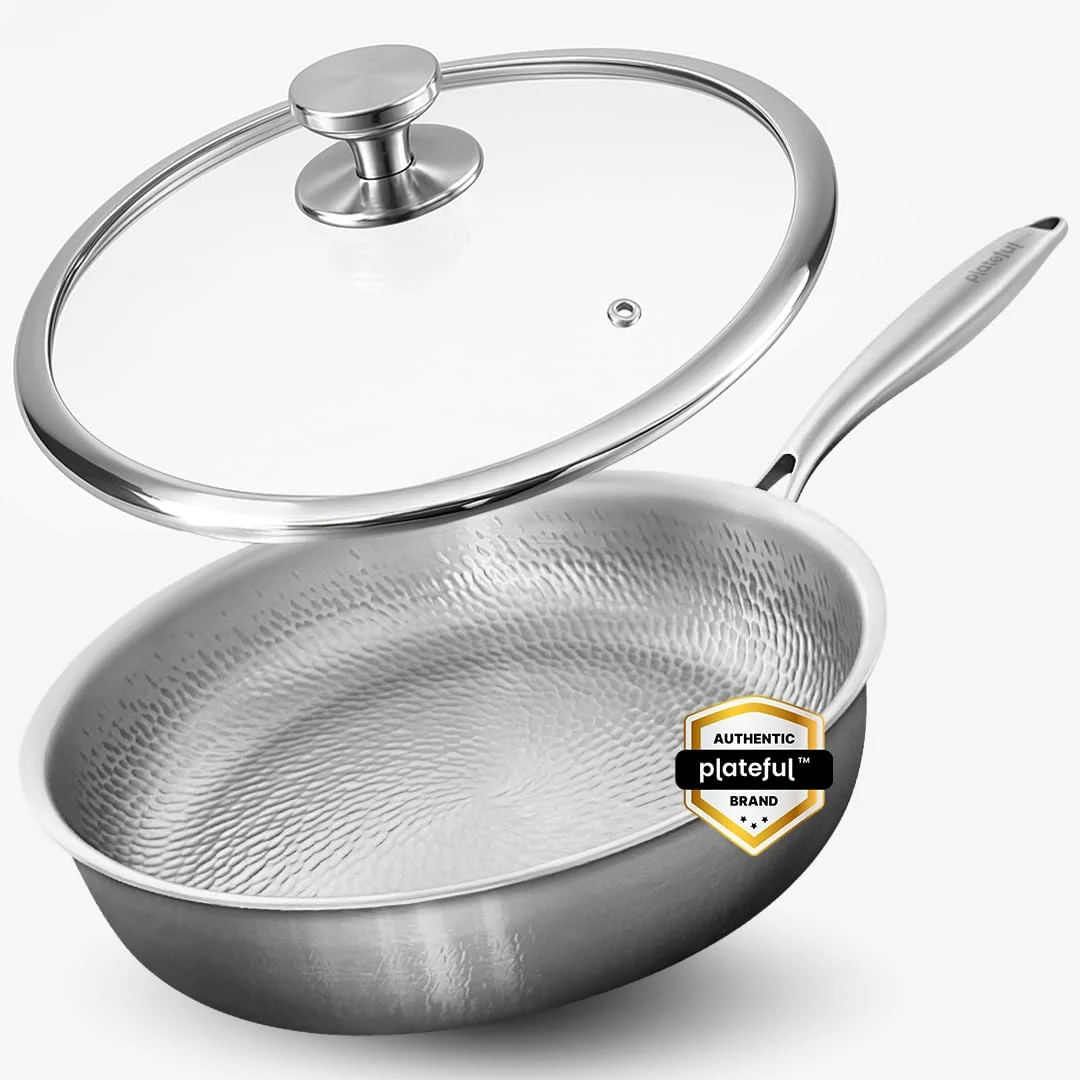
The Gallianz comparison article and community discussions on cookware forums both address this topic, and it deserves specific attention because it is one of the most common consumer-facing applications.
A titanium frying pan does not heat evenly. That is a direct consequence of 21.9 W/m·K thermal conductivity versus copper cookware at 401 W/m·K. When you place a titanium pan on a burner, the area directly above the flame heats rapidly while the edges remain significantly cooler. This creates hot spots that can scorch food in one spot while leaving it undercooked in another.
Professional cookware brands solve this with multi-ply construction: a thin titanium exterior for durability and corrosion resistance bonded to an aluminum or copper core for heat distribution. The titanium layer contributes perhaps 0.3–0.5 mm of the total wall thickness, with the aluminum or copper core providing the thermal performance.
Pure titanium cookware (no clad core) performs similarly to carbon steel with poor heat distribution — acceptable for high-heat searing where the entire surface is intentionally superheated, but problematic for delicate sauces or low-temperature cooking that requires uniform temperature across the cooking surface.
Thermal Conductivity Across Common Engineering Metals
This table puts titanium in context among the metals that engineers most frequently compare:
| Metal | k (W/m·K) | Density (g/cm³) | Melting Point (°C) | k per unit density | Primary advantage over titanium |
|---|---|---|---|---|---|
| Silver (pure) | 429 | 10.49 | 961 | 40.9 | Higher k; but heavier and expensive |
| Copper (pure) | 401 | 8.96 | 1,085 | 44.8 | Dramatically higher k |
| Gold (pure) | 318 | 19.32 | 1,064 | 16.5 | Corrosion immunity (but very heavy) |
| Aluminum (pure) | 237 | 2.70 | 660 | 87.8 | Higher k and lighter |
| Magnesium | 157 | 1.74 | 650 | 90.2 | Lightest structural metal |
| Carbon steel | 45–55 | 7.85 | ~1,425 | 6.3 | Lower cost |
| Titanium (CP) | 21.9 | 4.51 | 1,668 | 4.9 | — (baseline) |
| Stainless steel 304 | 14.4 | 7.90 | 1,400–1,455 | 1.8 | Slightly lower k |
| Ti-6Al-4V (Grade 5) | 6.7 | 4.43 | 1,660 | 1.5 | Lower k than Ti; stronger |
On a per-unit-density basis, aluminum’s thermal performance (87.8 W/m·K per g/cm³) dwarfs titanium’s (4.9 W/m·K per g/cm³) by about 18×. There is no scenario where titanium wins on thermal performance alone. Its advantages — corrosion immunity, high-temperature strength, biocompatibility, low magnetic permeability — are the reasons it gets specified despite the thermal penalty.
Frequently Asked Questions
Is titanium a good heat conductor?
No. Titanium is a poor thermal conductor compared to common engineering metals. At 21.9 W/m·K, it conducts roughly 1/18th the heat of copper (401 W/m·K) and 1/11th the heat of aluminum (237 W/m·K). However, titanium’s combination of high strength, low density, and corrosion resistance means engineers specify it for applications where thermal conductivity is secondary to these other properties — particularly in aerospace, marine, and chemical processing environments.
What is the thermal conductivity of titanium in W/mK?
Pure (CP) titanium has a thermal conductivity of approximately 21.9 W/m·K at room temperature, though reference tables sometimes list values from 16.3 to 25.9 W/m·K depending on purity, measurement method, and source. The most commonly cited ASM/MatWeb value for CP titanium is 16.3 W/m·K, while independently measured values tend toward 22–26 W/m·K. Ti-6Al-4V (Grade 5), the most common titanium alloy, has a thermal conductivity of 6.7 W/m·K.
Why is titanium’s thermal conductivity so much lower than copper’s?
Titanium has a hexagonal close-packed crystal structure that is less symmetric than copper’s face-centered cubic structure, reducing phonon transport efficiency. More importantly, titanium’s electrical resistivity (42 µΩ·cm) is 25 times higher than copper’s (1.7 µΩ·cm). Since metals conduct heat primarily through free electrons, this high electron scattering directly translates to low thermal conductivity. The Wiedemann-Franz law mathematically links these two properties, and titanium’s position on the Wiedemann-Franz plot falls squarely where its thermal conductivity is predicted by its electrical resistivity.
Does titanium conduct heat better than stainless steel?
Pure titanium (21.9 W/m·K) conducts somewhat better than stainless steel 304 (14.4 W/m·K) — about 50% more heat flow. However, Ti-6Al-4V (6.7 W/m·K) conducts less than half as much as stainless steel. The answer depends on which titanium grade you are comparing. For most engineering applications where CP titanium is used for its corrosion resistance, its thermal conductivity advantage over stainless steel is modest but real.
How does temperature affect titanium’s thermal conductivity?
Titanium’s thermal conductivity follows a U-shaped curve with temperature. Starting at about 22 W/m·K at room temperature, it decreases to a minimum of roughly 19.4 W/m·K around 327°C, then increases back to about 22 W/m·K at 927°C. The initial decrease results from increased electron-phonon scattering. The subsequent increase at high temperatures is characteristic of HCP metals and reflects changes in the phonon contribution to thermal transport.
What is the thermal conductivity of Ti-6Al-4V?
Ti-6Al-4V (ASTM Grade 5), the most widely used titanium alloy, has a thermal conductivity of approximately 6.7 W/m·K at room temperature. This value is consistent across ASM/MatWeb, Frontiers in Mechanical Engineering literature reviews, and Xometry reference data. Additive-manufactured (L-PBF) Ti-6Al-4V may have slightly lower values (4.0–6.2 W/m·K) depending on build orientation and post-processing.
Is titanium used in heat exchangers despite low thermal conductivity?
Yes. Titanium is the material of choice for heat exchangers in seawater cooling, desalination, offshore oil and gas, and chemical processing. The reason is not thermal conductivity — it is corrosion resistance. Copper alloy tubes in warm seawater environments can begin failing within 5–10 years due to erosion-corrosion and microbiological attack, while titanium tubes maintain negligible corrosion rates for decades. Designers compensate for lower thermal conductivity with thinner walls (titanium is stronger, allowing thinner sections) and increased surface area.
Can you cook with pure titanium cookware?
Yes, but with caveats. Pure titanium cookware has poor heat distribution due to its low thermal conductivity (21.9 W/m·K versus 401 W/m·K for copper). This creates hot spots over the heat source and cooler edges. Most quality titanium cookware uses multi-ply construction with an aluminum or copper core sandwiched between titanium layers, combining titanium’s durability and non-reactivity with the thermal performance of the core metal. Pure titanium cookware is popular in ultralight backpacking where weight is the overriding concern.